

What do you think?

The Slightly Irregular Fire Engine: Or, the Hithering Thithering Djinn
When Mathilda discovers a mysterious Chinese house in her backyard, she enters a new world of imagination and adventure.
32 pages, Hardcover
First published January 1, 1971
About the author
Donald Barthelme
162 books792 followers
Unspeakable Practices, Unnatural Acts
(1968) apparently collects sometimes surrealistic stories of modern life of American writer Donald Barthelme.
A student at the University of Pennsylvania bore Donald Barthelme. Two years later, in 1933, the family moved to Texas, where father of Barthelme served as a professor of architecture at the University of Houston, where Barthelme later majored in journalism.
In 1951, this still student composed his first articles for the Houston Post. The Army drafted Barthelme, who arrived in Korea on 27 July 1953, the very day, when parties signed the ceasefire, ending the war. He served briefly as the editor of a newspaper of Army before returning to the United States and his job at the Houston Post. Once back, he continued his studies of philosophy at the University of Houston. He continued to take classes until 1957 but never received a degree. He spent much of his free time in “black” jazz clubs of Houston and listened to musical innovators, such as Lionel Hampton and Peck Kelly; this experience influenced him later.
Barthelme, a rebellious son, struggled in his relationship with his demanding father. In later years, they tremendously argued about the kinds of literature that interested Barthelme. His avant-garde father in art and aesthetics in many ways approved not the postmodern and deconstruction schools. The Dead Father and The King , the novels, delineate attitude of Barthelme toward his father as King Arthur and Lancelot, the characters, picture him. From the Roman Catholicism of his especially devout mother, Barthelme independently moved away, but this separation as the distance with his father troubled Barthelme. He ably agreed to strictures of his seemingly much closer mother.
Barthelme went to teach for brief periods at Boston University and at University at Buffalo, and he at the college of the City of New York served as distinguished visiting professor from 1974-1975. He married four times. Helen Barthelme, his second wife, later entitled a biography Donald Barthelme: The Genesis of a Cool Sound , published in 2001. With Birgit Barthelme, his third wife and a Dane, he fathered Anne Barthelme, his first child, a daughter. He married Marion Barthelme near the end and fathered Kate Barthelme, his second daughter. Marion and Donald wed until his death from throat cancer. People respect fiction of Frederick Barthelme and Steven Barthelme, brothers of Donald Barthelme and also teachers at The University of Southern Mississippi.
A student at the University of Pennsylvania bore Donald Barthelme. Two years later, in 1933, the family moved to Texas, where father of Barthelme served as a professor of architecture at the University of Houston, where Barthelme later majored in journalism.
In 1951, this still student composed his first articles for the Houston Post. The Army drafted Barthelme, who arrived in Korea on 27 July 1953, the very day, when parties signed the ceasefire, ending the war. He served briefly as the editor of a newspaper of Army before returning to the United States and his job at the Houston Post. Once back, he continued his studies of philosophy at the University of Houston. He continued to take classes until 1957 but never received a degree. He spent much of his free time in “black” jazz clubs of Houston and listened to musical innovators, such as Lionel Hampton and Peck Kelly; this experience influenced him later.
Barthelme, a rebellious son, struggled in his relationship with his demanding father. In later years, they tremendously argued about the kinds of literature that interested Barthelme. His avant-garde father in art and aesthetics in many ways approved not the postmodern and deconstruction schools. The Dead Father and The King , the novels, delineate attitude of Barthelme toward his father as King Arthur and Lancelot, the characters, picture him. From the Roman Catholicism of his especially devout mother, Barthelme independently moved away, but this separation as the distance with his father troubled Barthelme. He ably agreed to strictures of his seemingly much closer mother.
Barthelme went to teach for brief periods at Boston University and at University at Buffalo, and he at the college of the City of New York served as distinguished visiting professor from 1974-1975. He married four times. Helen Barthelme, his second wife, later entitled a biography Donald Barthelme: The Genesis of a Cool Sound , published in 2001. With Birgit Barthelme, his third wife and a Dane, he fathered Anne Barthelme, his first child, a daughter. He married Marion Barthelme near the end and fathered Kate Barthelme, his second daughter. Marion and Donald wed until his death from throat cancer. People respect fiction of Frederick Barthelme and Steven Barthelme, brothers of Donald Barthelme and also teachers at The University of Southern Mississippi.
Ratings & Reviews
Friends & Following
Create a free account to discover what your friends think of this book!
Community Reviews
Displaying 1 - 27 of 27 reviews

July 27, 2017
A Donald Barthelme children's book might be the greatest thing under 1,000 words and between two hard covers. I only wish I owned this when my daughter was young - I would have read it to her over and over until she asked me to stop because the book smelled funny.
Because my personal copy does smell funny. A stale old cheese smell, something left on the counter better refrigerated. But I love it, and inhale deeply with each turned page, the scent altering slightly as the story progresses. A Barthelme children's book should smell as funny as the words. And pictures. Donald found a slew of 19th century wood engravings (each interesting and somewhat laughable in their own right) and then combined them to tell a magical story of desire through the eyes of the young hoop-loving Matlida. A djinn may/may not grant you your wishes. Choose wisely.
Wait, is this book supposed to be scratch-and-sniff?
Because my personal copy does smell funny. A stale old cheese smell, something left on the counter better refrigerated. But I love it, and inhale deeply with each turned page, the scent altering slightly as the story progresses. A Barthelme children's book should smell as funny as the words. And pictures. Donald found a slew of 19th century wood engravings (each interesting and somewhat laughable in their own right) and then combined them to tell a magical story of desire through the eyes of the young hoop-loving Matlida. A djinn may/may not grant you your wishes. Choose wisely.
Wait, is this book supposed to be scratch-and-sniff?
January 2, 2019
Undeniably brilliant. Should appeal to fans of Alice in Wonderland, as it has much the same disjointed dreamlike effect, and much the same set of themes having to do with adventure, greed, courtesy, ego, fear, and joy. But the themes are subtle... it presents as silly clever fun.
Do you have a Mathilda in your life? Does Roald Dahl's Matilda have anything in common with this child? Why does the elephant whisper and the djinn trumpet? What else does this book Provoke you to Think about?
Do you have a Mathilda in your life? Does Roald Dahl's Matilda have anything in common with this child? Why does the elephant whisper and the djinn trumpet? What else does this book Provoke you to Think about?

June 17, 2018
чудова абсурдна історія, майже Аліса, майже сон, гімн нестримній уяві, на яку здатні лише діти й генії.

August 22, 2010
Barthelme gears his minimalist mimicry into 'The Slightly Irregular Fire Engine,' a great children's picture book, which was justly rewarded with a National Book Award nearly 2 score years ago (1972).
It can be read in 10 minutes, so I won't say much as far as the plot goes without giving it away. But there are many lessons to be learned in this collaged story, such as finding happiness when what you want isn't happening quite exactly as you'd like.
TSIFE contains the types of collage works that many tirelessly attempt to recreate and fail miserably in doing so. Barthelme gives us just enough -- nothing more -- for the story to be told (or viewed) efficaciously.
Two slightly irregular thumbs up for this children's classic.
It can be read in 10 minutes, so I won't say much as far as the plot goes without giving it away. But there are many lessons to be learned in this collaged story, such as finding happiness when what you want isn't happening quite exactly as you'd like.
TSIFE contains the types of collage works that many tirelessly attempt to recreate and fail miserably in doing so. Barthelme gives us just enough -- nothing more -- for the story to be told (or viewed) efficaciously.
Two slightly irregular thumbs up for this children's classic.

January 6, 2020
Donald Barthelme wrote a children’s book back in the 70s, and luckily for completionists like me, it’s still available to purchase at a fair price online. I’d only recommend it to hardcore fans, but as someone who’s obsessed with the man’s work, it’s a very fun little oddity to add to the collection.

December 22, 2022
Open Library.

February 16, 2011
I couldn't even interest my 2-year-old son in TRYING to read this. After reading it once through myself, (with much protest from my son) I decided this isn't really a children's book. It's quite bizarre. I think it's meant to be some kind of hoity-toity, artistic, hullaballoo meant to impress adults with it's creativity. (but i don't appreciate it)

Want to Read
April 14, 2010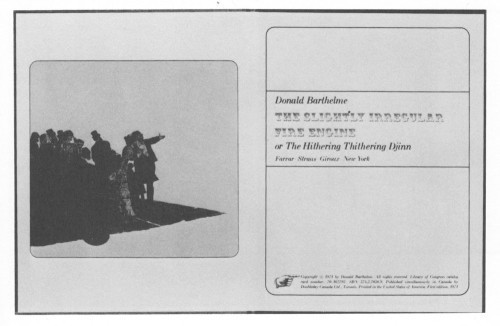
“Would you like to have an escapade?” the djinn asked. “We can arrange that. Escapades come in two styles – fancy and more fancy.”

September 3, 2008
I paid a lot of money for this book because it used to be out of print. Donald Barthelme wrote a a book for children?!? And it won an award?
I had to get a copy.
It was OK.
I had to get a copy.
It was OK.
July 8, 2024
Не книжка, а именины сердца!
Смотрите сами какой замес: девочка мечтает о красной пожарной машине и в один прекрасный день ей таки обламывается жирный судьбоносный куш: она обнаруживает во дворе китайский цирк. Какого бычьего цепня он там оказался? Вчера вроде не было, а сегодня - получите, распишитесь. Чёрт знает что творится. Но не в этом суть, как говорится (и вроде даже поётся). Суть в том, что девочка туда идёт. Цирк оказывается напичкан не больше, но и не меньше, чем всем, включая котопродавцов, циркачей, пиратов, занятых вязанием и много кем ещё. Джинн, конечно же, в столь уважаемом заведении тоже есть. Вот этот последний мне особенно приглянулся: спокойный, как статуя с острова Пасхи, рассудительный, да ещё и не жадный - готов был поддаться искреннему порыву и впарить Матильде презент. Правда, сначала хотел озолотить тем, что самому не жалко, руководствуясь принципом «на тебе, Б-же, что нам негоже»: «Хочешь бочонок маринованных огурчиков, увенчанный суровым гражданином с кислой миной? Или статую Начальника Полиции - в героическом стиле, сплошь мраморную? <…> Или воздушнокукурузную машину производительностью 50 000 зерен? Или анатомическую схему?» Но девочке такой финт не зашёл. Не, - говорит, - хочу тачку, и всё тут.
В итоге, ламповый житель сдался и одарил юную гостью пожарной машиной. Всамделишной! Только зелёной, а не красной. Немножко не то пожарное авто, но в целом, приемлемо, - заключила Матильда, благосклонно приняла дар и стала разрешать своим родителям время от времени на этой машине выезжать покататься. Вот так-то!
А ещё, в книжке картинки есть. Зачётнейшие! С такими, например, надписями: «Гидрат хлорала - нежный тихий бальзам утешенья для нервических духом». Весьма изысканно, аристократично и утончённо, как по мне)
Короче, я осталась более чем довольна. Годная детско-взрослая книжка, наполненная высокой философией - редкий зверь, а если еще и сдобренная сарказмом - так вообще краснокнижный.
Спасибо автору за то, что он такую прэлесть написал и мне за то, что я её прочитала.
Смотрите сами какой замес: девочка мечтает о красной пожарной машине и в один прекрасный день ей таки обламывается жирный судьбоносный куш: она обнаруживает во дворе китайский цирк. Какого бычьего цепня он там оказался? Вчера вроде не было, а сегодня - получите, распишитесь. Чёрт знает что творится. Но не в этом суть, как говорится (и вроде даже поётся). Суть в том, что девочка туда идёт. Цирк оказывается напичкан не больше, но и не меньше, чем всем, включая котопродавцов, циркачей, пиратов, занятых вязанием и много кем ещё. Джинн, конечно же, в столь уважаемом заведении тоже есть. Вот этот последний мне особенно приглянулся: спокойный, как статуя с острова Пасхи, рассудительный, да ещё и не жадный - готов был поддаться искреннему порыву и впарить Матильде презент. Правда, сначала хотел озолотить тем, что самому не жалко, руководствуясь принципом «на тебе, Б-же, что нам негоже»: «Хочешь бочонок маринованных огурчиков, увенчанный суровым гражданином с кислой миной? Или статую Начальника Полиции - в героическом стиле, сплошь мраморную? <…> Или воздушнокукурузную машину производительностью 50 000 зерен? Или анатомическую схему?» Но девочке такой финт не зашёл. Не, - говорит, - хочу тачку, и всё тут.
В итоге, ламповый житель сдался и одарил юную гостью пожарной машиной. Всамделишной! Только зелёной, а не красной. Немножко не то пожарное авто, но в целом, приемлемо, - заключила Матильда, благосклонно приняла дар и стала разрешать своим родителям время от времени на этой машине выезжать покататься. Вот так-то!
А ещё, в книжке картинки есть. Зачётнейшие! С такими, например, надписями: «Гидрат хлорала - нежный тихий бальзам утешенья для нервических духом». Весьма изысканно, аристократично и утончённо, как по мне)
Короче, я осталась более чем довольна. Годная детско-взрослая книжка, наполненная высокой философией - редкий зверь, а если еще и сдобренная сарказмом - так вообще краснокнижный.
Спасибо автору за то, что он такую прэлесть написал и мне за то, что я её прочитала.

July 25, 2023
That was beautiful! Such a stream of imagination, I love the stories like these.
“Would you like to have an escapade?” the djinn asked. “We can arrange that. Escapades come in two styles – fancy and more fancy.”
“Would you like to have an escapade?” the djinn asked. “We can arrange that. Escapades come in two styles – fancy and more fancy.”

December 16, 2018
Odd, but cute.
My favorite bit was the knitting pirate, but then again I'm a knitter who's always loved pirate stories, so consider the source.
My favorite bit was the knitting pirate, but then again I'm a knitter who's always loved pirate stories, so consider the source.

February 10, 2022
This was one of those books that left you asking, "What did I just read?"
It was thought-provoking and reminiscent of "Alice in Wonderland."
I just want to research this book now!
It was thought-provoking and reminiscent of "Alice in Wonderland."
I just want to research this book now!

September 20, 2022
slightly less immediately alienating to actual children than sam's bar, but i can imagine some of them getting a certain sort of pleasure from its deleteriousness

March 6, 2023
So odd and slightly racist. The use of old photos was interesting, though.

August 27, 2026
“flawless flourishy footlooseness”
would love to read this to my future kids one day
would love to read this to my future kids one day

June 24, 2026
It seemed to me that the author made up a story to go with the pictures that he cut out from catalogs or magazines, or whatever. The story doesn't make a lot of sense, unless one reads it as a dream, or as an Alice-in-Wonderland type fantasy. The pictures are old-fashioned black-and-white pictures pasted against color backgrounds.

March 30, 2013
This is one of those really odd books that I didn't really like so much as I liked finding something so obscure and strange in the library collection. A young girl goes out into her back yard to discover a mysterious Chinese house. The "illustrations" are 19th-century wood engravings. I really liked the elephant! I should add that this "children's" book (winner of the National Book Award!) will really appeal more to adults than actual kids.

September 3, 2008
I have known artists who work in the realm of word and image collage, but this is the most successful storyline I've seen. It's a beautiful, compelling, dadaist story with a letterpress aesthetic. Not to be missed!

September 3, 2008
An adult children's book, accompanied with great Victorian Dover-clip-art-esque illustrations. Bizarre tongue-in-cheek fun.

April 2, 2010
Didn't get it. Totally bizarro.
October 20, 2010
Any book that makes me laugh out loud on more than 50% of its total page count rates five stars from me!

November 21, 2010
Nice to have this back in print again.

July 2, 2013
This was the most bizarre children's book I've ever read. Normally I don't rate all the kids' books I read on here, but I wanted to save this one so I would remember it.

December 30, 2014
"years are bearing us to heaven"

February 8, 2016
This is a fantastic children's book! Full of wonderful characters and wordplay. Barthelme is brilliant!

May 24, 2013
Irregular, indeed.
Displaying 1 - 27 of 27 reviews