

What do you think?
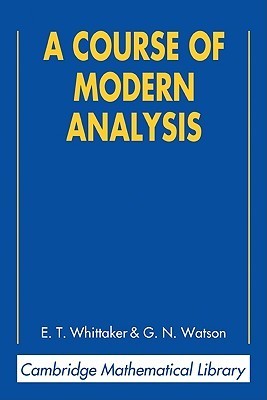
Cambridge Mathematical Library
A Course of Modern Analysis
This classic text has entered and held the field as the standard book on the applications of analysis to the transcendental functions. The authors explain the methods of modern analysis in the first part of the book and then proceed to a detailed discussion of the transcendental function, unhampered by the necessity of continually proving new theorems for special applications. In this way the authors have succeeded in being rigorous without imposing on the reader the mass of detail that so often tends to make a rigorous demonstration tedious. Researchers and students will find this book as valuable as ever.
Paperback
First published January 1, 1927
Ratings & Reviews
Friends & Following
Create a free account to discover what your friends think of this book!
Community Reviews
Displaying 1 - 3 of 3 reviews

November 25, 2019
A must-have classic in the theory of classical analysis. Treatment of topics is highly beneficial for number theorists, analysts, and algebraists. It is one of the excellent references to own. The topics treated about the special functions are rare to find in other books and are very useful for students in analytic number theory.

January 6, 2026
My mathematical history is fraught with confusion and missteps. I took classes up to Calculus II, where we had to memorize the Integration Rules for Trig Functions and some other ideas. I barely remember the material, but I did okay in the first semester of Calculus.
A Course of Modern Analysis: Third Edition is a Dover reprint of a 1902 classic. There are also some chapters added to the text from 1920. E. T. Whittaker and G. M. Watson collaborated on the book. It is a masterpiece of clarity. The book follows the tried-and-true idea of beginning with simple concepts and building to more challenging topics.
There are some points where the book shows its age, but these are minor nitpicks. For example, when the authors wrote "shew," they meant "show." Minor spelling errors are acceptable when a book is over 100 years old. I don't think the book has answers for the exercises, either. I may need to look more closely.
I enjoyed the book. Thanks for reading my review, and see you next time.
A Course of Modern Analysis: Third Edition is a Dover reprint of a 1902 classic. There are also some chapters added to the text from 1920. E. T. Whittaker and G. M. Watson collaborated on the book. It is a masterpiece of clarity. The book follows the tried-and-true idea of beginning with simple concepts and building to more challenging topics.
There are some points where the book shows its age, but these are minor nitpicks. For example, when the authors wrote "shew," they meant "show." Minor spelling errors are acceptable when a book is over 100 years old. I don't think the book has answers for the exercises, either. I may need to look more closely.
I enjoyed the book. Thanks for reading my review, and see you next time.

Want to Read
November 3, 2019For an up-to-date version of the treatment of special functions, see the "Bateman Manuscript Project".
Displaying 1 - 3 of 3 reviews