A remote island with a rich and ancient literature. A land of hot springs and volcanoes. A country with an extraordinary history, a challenging geography and a vibrant contemporary culture. A land of ice. In Ring of Seasons , Terry Lacy--an American who has lived in Iceland for twenty-four years-- brings both the perspective of the outsider and the familiar eye of the long-term resident to this delightful exploration of all facets of Iceland, past and present. She conveys her story with a skillful interlacing of history, religion, politics, and culture to paint a vivid picture of the way Icelanders live today as members of a wealthy society still very dependent upon nature--from a reliance on her icy waters to support an international fishing industry to a watchful cohabitation with the volcanoes that both destroy villages and create new islands. This is a book for all who have been charmed by reading the Norse sagas, for all those intrigued by the country that can claim the oldest living democracy. It is an excellent introduction for anyone planning to visit Iceland and a delightful read for all those who do their exploration from the comfort of an armchair. Terry G. Lacy is an American currently residing in Reykjavik, Iceland.
Because of the high expense of travel, it makes sense to prepare ourselves with as much knowledge and information as possible, prior to submitting ourselves to another culture. This is the reason for my reading of Terry Lacy’s informative work: Ring of Seasons.
Iceland is a very hard and challenging place to live, with relatively frequent volcanic eruptions. Iceland sits atop the Mid-Atlantic Ridge, where the tectonic plates of Europe and North America rub together. Essentially, Iceland is a land atop active volcanoes and lava flows. In 1875 a major volcanic eruption in the Dyngjufjoll Mountains sent pumice up that blanketed a large area of the northeast, causing much hardship. Mt. Hekla, thought by some to be literally the “gate to Hell”, has erupted many times. The Oraefajokull eruption of 1362 covered over a third of the country with volcanic ejecta. In 1783, a 25-kilometer long fissure opened in southern Iceland (the Lakagfgir eruption) and poured forth the largest flood of lava known in historical times anywhere on earth. The sun turned blood red in the blue haze, which spread over Europe. Livestock, fish, and farms were destroyed. Most recently, in 2010, the eruption of Eyjafjallajokull caused enormous disruption to air travel across Europe, due to ash and ejecta. In 2011, Grimsvotn volcano erupted and also thwarted air travel.
There is prolonged darkness in Iceland for much of the year, where the sun is up for only about 4 hours, and rises only a short distance above the horizon. The country has few natural resources and much of the history is one of suffering, hardship, isolation, and exploitation as a colony of Denmark and Norway.
After reading about the extreme history of hardship, this book leaves one questioning why other countries never sought to alleviate the severe need in Iceland. Instead, foreigners came only to exploit resources for themselves, as opposed to enlightening and easing the suffering of locals. Remarkably, the British and Germans routinely violated Iceland’s fishing radius, repetitively stealing vital natural resources from an impoverished country, incapable of defending itself. This problem persisted until 1985 and resulted in a series of confrontations known as the Cod Wars. The history of Iceland recounts a sparsely scattered people, battling the elements, very much isolated from the rest of the world, and struggling just to survive.
The most surprising thing that I learned about Icelanders from Lacy’s book was that so many of them (64% according to Lacy) believe in the supernatural and superstitious things. Lacy lists spiritual healing, ghosts, hidden people, elves, dwarfs, giants, sea monsters, sea serpents, mermen, good/evil whales, changelings, trolls, and fetches among the examples of lingering paganism that is still influential in the culture. A strong belief in Ghosts has persisted into the present, with 41% of Icelanders reporting having had contact with the dead. More shockingly, 88% of Icelanders believe it is possible to see those who have died and 55% believe in hauntings.
The religious heritage of Iceland comes from the Old Norse religion, which honored the mythical beings Thor & Odinn. In fact, one Thordur (many Icelandic names contain the word Thor) Halldorsson was interviewed on Icelandic State television in 1992 as the “last Icelandic sorcerer”. During the interview he said that sorcery was based upon living with nature and that his power extends from nature, through which he uses spells, trance states, animal/plant materials, runes, symbols, herbs, potions, chanted text, etc. Such sorcerers are reputed to employ curses and perform black magic by reciting the Lord’s Prayer backwards. It’s no surprise that authors like Tolkien were so much inspired by Iceland and its literature.
Lacy’s book made me understand that the depiction of characters in Halldor Laxness’ book “Independent People” are really quite accurate. The early Icelanders were themselves very much like creatures of the earth. The houses were built of sod, wet, cold, and often with leaking roofs. Grass grew from the sod roofs and walls. Heating fuel was peat, which smoked a great deal within the houses. The floors were packed earth. Mattresses were filled with moss or dried seaweed. The early people almost never bathed and bedding was washed no more than once or twice a year. Lice were common. Caloric intake was extremely limited and work so exhaustive that there was insufficient energy left for body growth, so the people were shorter. There were no doctors in Iceland before 1760 and a common remedy for backache was a poultice of warm cow manure. Lacy’s descriptions of the early Icelanders quickly brings to mind Tolkien’s Hobbits. In stark contrast, modern Icelanders have one of the best public health systems in the world and one of the lowest death rates.
Somewhere around the year 1016, while under Norwegian influence, it was decreed that Iceland should become Christian. Everyone was to be baptized Christian, but worship of the old pagan Gods was allowed in private, including the practice of exposing infants to the elements until dead, if done right after birth, which was allowed under the old law. Apparently, the meager resources were such that many times another mouth to feed was not a desirable thing for Icelanders. Lacy reports that later, in the 1400’s, Icelanders sometimes gave or sold their children to English sailors.
Catholicism built churches, monasteries, convents, and hired priests. The tithe was introduced essentially as a tax. The law decreed that the tithe must be paid. The Catholic Church held land, paid no taxes, held the crucial power of excommunication, and became very powerful. The Catholicism of the time became a blend of former beliefs and Christian beliefs, so the practice of sorcery was not altered drastically, as there was no formal Inquisition in Iceland. However, with the coming of Protestantism in 1550, there came the conviction that all sorcery stemmed from the devil and the rooting out of sorcery began. Between 1625 and 1685, 21 men were burned at the stake. The reformation also brought the abolition of the saints and holy relics of the Catholic church, and there was an eventual return of the old folk beliefs. A survey in 1974-75 revealed that two-thirds of the respondents had had an occult experience of some kind, the most common being “dreaming true”. Over a third said they had correctly dreamed the future. Icelanders are said to often exhibit an open interest in the occult.
The belief in the Hidden People still persists today, as beings that live beneath the lava mounds and rocks. One belief was that the sign of the cross made around a baby would keep the Hidden People from exchanging it for one of their own. Even today, Icelanders will not tell the name of a baby until it is christened, believing that keeping the name secret protects the baby from harm. According to Lacy, 5% of Icelanders contend they have seen the hidden people and 55% are either sure they exist or believe they exist. Sixty eight percent believe there are patches of ground where something bad will happen to those who disturb the hidden people there. There are records of seeing a rock open, revealing the Hidden People. Christian symbols are said to drive them off. In 1624, a woman insisted she had been made pregnant by a man of the Hidden People. In the summer of 1971, a street was diverted in the town of Kopavogur, simply to avoid a patch of ground said to be where the Hidden People must not be disturbed. According to Lacy, in the Reykjavik Municipal Planning Office, one can obtain a map showing where elves and Hidden People live in the Reykjavik area. Some equate the Hidden People to elves that look like human beings, but live in the hills and cliffs.
Today, 78% profess a belief in God, but only 1% attend church regularly. Lutheranism is now the State religion, but is supported by taxpayers. Lacy says the people believe less in a personal God than in a kind of Universal Spirit or life force. The philosophical tendency generally favors empiricism and situational ethics. Icelanders are known to have a fatalistic philosophy, accepting what happens with outward equanimity. Lacy describes modern Icelanders as having a bearing of outward calmness, a relaxed sense of time, holding emotions in, exhibiting little change in facial expression or voice tones, of a quite bearing, hard workers, individualists, somewhat introverted, generally impressed with poetry, and slaves to the latest fashions. Nevertheless, Lacy acknowledges that depression is common, there is much emphasis on materialism, there are frequent accidents due to driving under the influence, and much promiscuity. It is relatively normal in Iceland for births to occur out of wedlock. Lacy describes the people as harboring a need to prove their equality with the rest of the world with a “we have it too” syndrome and a “we already know it” approach. Most modern Icelanders have lived, studied or traveled abroad. There is a high sense of nationalism and, although stylish in dress, Icelanders strive to look alike. Both parents generally work and children are not well supervised. The rate of children with accidents requiring medical attention is the highest in Europe and the children tend to mature early.
Icelanders are more closely related to western Norwegians than any other group, being about 86% Norwegian and 14% Irish. Iceland became Independent from Denmark in 1944. The U.S. has maintained a base in Iceland since 1941, which has buoyed the Icelandic economy. The 1996 population of Iceland was 270,000.
Instead of Santa Claus, Iceland has 13 mischievous and ugly imps that come down from the mountains one each day until Christmas Eve and return one each day from Christmas day through Jan. 6. The imps have names like Likcer, Skyr Gobbler, and Door Sniffer. On the days these imps come down from the mountains it has become custom for the children to set out a shoe and hope for something nice from the Christmas elves. Such customs have always been difficult for me to understand, even in the form of our own Santa Claus. Why must the joy of giving from one human to another be diluted and cloaked behind some superstitious intermediary? Why not give openly? And, pray tell, why give demonic-like representations the credit for the giving, thus diminishing the otherwise direct transfer of a love gift? Why create in the mind of the child a perception that a gift has come from some strange being, to which they are thus beholden in gratitude? It makes no sense!
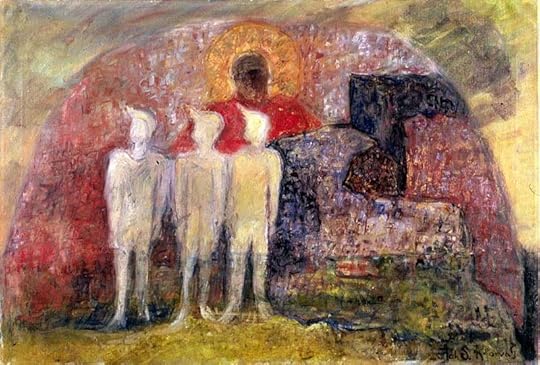
No doubt, Lacy’s book has certainly established Iceland as a legitimate mission field. The image below is by Icelandic artist Johannes Sveinsson Kjarval.
A great look into the culture and history of Iceland. It's a little outdated, being published over 10 years ago, but the information in it is solid and still relevant. I loved the chapters offering a glimpse into the family's life, mostly centering on holidays and major events. The folklore chapters were really interesting as well!
Recommended reading in preparation for our trip to Iceland in August. It's written by an American living in Iceland. She tells about history, geography, and contemporary culture. Just what I wanted.
Read this in preparation for upcoming trip to Iceland. It was an easy and enjoyable read about the history, culture and people of Iceland. She made it look inviting to visit.
I love Iceland and I really liked this book. Some of the history was a little dry, but the cultural chapters were fabulous. I am dying to get over there.
OK as a basic history of the country, but nothing stands out from the ordinary -- and after having read several histories now, it's striking how the country is often written about as a homogeneous place, rather than having any regional differences, and how the region I live in, the Westfjords, is barely mentioned at all.
This is a strange book. It covers over a thousand years of Icelandic history, mythology, natural history, and culture in only 252 pages. Because so much is crammed into so few pages, events are viewed at a very high level. Things that could merit multiple chapters, if not an entire book, are covered in a single paragraph. Most of the chapters can be textbook dry, but they're mingled with stories from folklore and mythology, and with "Family" chapters in which the author relates her visits with a fictional (according to a disclaimer at the front of the book) family. Reading these chapters is like reading an article in Highlights magazine, with stories about how Gummi and his family enjoy their lamb and potatoes and then happily recite their favorite poems. I think these chapters are the main reason I categorized the book as "strange" in my opening sentence.
Anyway, there's a lot of information here, and looking back, I realize that I learned an awful lot about Iceland in these 252 pages. So while the lack of depth was sometimes frustrating, I do appreciate the scope. I probably got about three or four books worth of information in this one slim book, so I'm certainly glad I read it. But I could have done without the chapters about Gummi and his family. (Sorry Gummi!)
A wonderful history of Iceland which presents political and cultural information about the country. Since it's written by an American who has lived in Iceland since the 1970s (and happens to be my friend), it has a nice "outsider's" perspective.