How does a young City lawyer end up as the People's Lawyer of the fourth-smallest country in the world, 18,000 kilometres from home?
We've all thought about getting off the treadmill, turning life on its head and doing something worthwhile. Philip Ells dreamed of turquoise seas, sandy beaches and palm trees, and he found these in the tiny Pacific island state of Tuvalu. But neither his Voluntary Service Overseas briefing pack nor his legal training could prepare him for what happened there.
He learned to deal with rapes, murders, incest, the unforgivable crime of pig theft and to look a shark in the eye. But he never dared ask the octogenarian Tuvaluan chief why he sat immobilised by a massive rock permanently resting on his groin.Well, you wouldn't, would you?
This is the story of a UK lawyer colliding with a Pacific island culture. The fallout is moving, dramatic, bewildering and often hilarious.
For a book that, according to Worldcat, cannot be found in a single library in the U.S., this isn’t half bad. It’s another memoir from an expat on a Pacific Island; I read it shortly after the much more popular Sex Lives of Cannibals and liked it a bit better. Troost is a better storyteller than Ells, but Ells has more interesting stories to tell. This is unsurprising, since Ells’s job allows him to see firsthand how people and their society function – as the People’s Lawyer of Tuvalu, he is both public defender and civil law consultant for the entire country (which works because Tuvalu has only about 10,000 people, and also, family law apparently doesn’t exist).
The marketing for this book is way off, suggesting that it is an Eat Pray Love, inspiration for career change kind of memoir. Not only is that off-base given that the author was only in his 20s (this is more youthful adventure than midlife crisis), but I doubt many people would want this career change. Ells is isolated on a tiny island with poor housing, bad food, regular gastrointestinal distress and other illnesses (when it gets serious he has to be medevac’d to Fiji because the local facilities are inadequate), bug and rodent infestations, and no modern conveniences. Oh, and he works hard, which makes sense when there’s an extremely limited social circle and no dating pool to speak of. Sure, swimming in the lagoon is a perk, but this book is unlikely to inspire much travel to Tuvalu.
I’ll get the negatives out of the way first: Ells is not the world’s greatest storyteller, and the book occasionally bogs down in boring descriptions of, for instance, expat social events. Especially in the first half of the book, there are numerous gross-out moments (and it isn’t just the setting; there’s a gratuitous turd story from Ells’s life pre-Tuvalu). Also, the writing uses British slang to the point that I – an American who’s spent several months in England – couldn’t always decipher his meaning. Finally, the author’s habitually flippant tone and his callous behavior toward his seasick assistant make him seem like a jerk for much of the book.
But I warmed back up to him when he showed genuine horror toward domestic violence and sexual assault, as well as an understanding of the societal pressures faced by victims. (He sees little of either type of crime in Tuvalu, where domestic violence is not taken seriously, but deals with a number of horrific crimes while on several weeks’ loan to Kiribati.) And it is definitely an interesting look into a tiny and remote country. Much of the island’s life appears to take place on and around the airport runway, and of course everyone knows everyone else – during a trial for pig stealing, Ells’s assistant can’t stop laughing during his client’s testimony, but then the magistrate lives down the road from the parties and so is unlikely to be fooled anyway. People come to the author with everything from defamation by their neighbors to constitutional crises, giving us a more complete picture of island life than most foreigners are likely to ever see. There is also some humor, though it’s not quite laugh-out-loud funny.
In sum . . . for the only book known to Goodreads to be set primarily in Tuvalu, this is an adequate read. In the end I rather liked reading it, so I'm rounding up to 3 stars, but my copy is headed for the donation bin.
Amusing and vivid? Definitely. A book? Not really.
More travel blog than book. A London lawyer volunteers in Tuvalu for 2 years. He details the cases he handled whilst sharing some cultural experiences in the process.
Much of the story-telling is unnecessarily highly detailed. There was no journey. No self discovery. Just I’m here. Trying to fit in. And noting the differences. Towards the end, you could see the author was trying to make a difference by promoting womens’ rights and you could tell he was a nice guy. But it would have been nice to hang on to something more than what was shared. To dig deeper.
Nevertheless, I could picture the islands of Tuvalu, the common attire, some of the ways and attitudes “don’t worry, be happy”, and the important issues of the time.
I read this as part of my around-the-world-reading challenge. Options were few. But it was fine. 2.5 stars rounded down.
75📘🇹🇻TUVALU 🇹🇻I don’t seek out books written by expat men, writing about their experiences on island nations in the Pacific, as a rule, though choices for this tiny independent nation were very limited. Tuvalu, formerly the Ellice Islands, is made up of nine dispersed and sparsely populated islands, which still manage a rather sophisticated, multi-tiered legal system. Unfortunately, Ells brought all his boring, neurotic, whingeing “lawyerness” with him, and failed to tell interesting stories of his two years as the “People’s Liar”. Bogged down in boring legal details, whilst not particularly patronising, Ells certainly could have been a better observer of the locals. Honestly, the epilogue was the most interesting part of the book.
Philip Ells was a lawyer in London and he was burnt out. He decided to escape his high pressure job by volunteering with Voluntary Service Overseas. He was sent to Tuvalu to be the People's Lawyer. That job is basically serving as a defense attorney for anyone who needs one. There aren't native lawyers available for people. The prosecuting attorney was also an ex-pat.
This job came with some problems that he hadn't expected. In Tuvalu there just isn't much crime. It is also customary to go to the police and write out a full confession immediately if you commit a crime. Everyone pleads guilty. That makes life for your defense attorney much harder. His main job was to try to get the sentences as short as possible for his clients by whatever means necessary. This led to most of the island residents calling him "The People's Liar." He filled out the rest of his time by writing threatening letters to government officials of behalf of citizens. That can get awkward when you then meet the officials socially or over tennis.
He also inherited Laita, a secretary/translator/paralegal with his office. She feels that the less he knows the better. He can cause fewer problems that way.
This book is written about his two years of service in the 1990s. That means that the community in Tuvalu, had very limited access to the outside world. There was no internet and mail may not come if there were extra passengers on the plane.
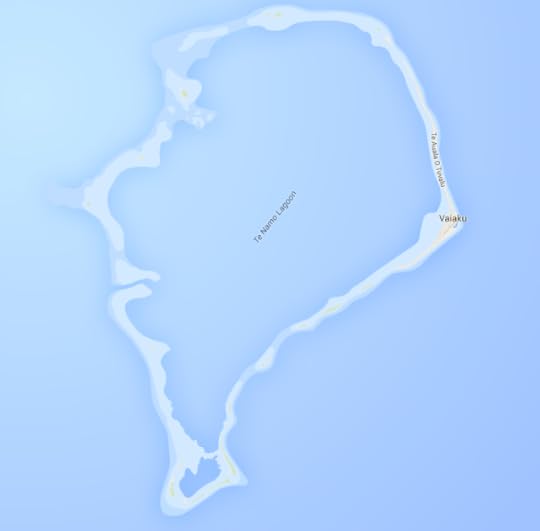
From Google Maps
This is the main island of Funafuti. The town is on the eastern side.
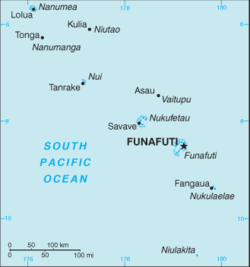
From Wikipedia
This is the whole island nation. The islands are spread far apart and there was a boat that tried to make a circuit of them about once a month. Sometimes it brings back fruits and vegetables. Most of the time it doesn't which leads to ex pat fantasies of the joys of a potato.
The ex pats and the natives of Tuvalu never truly understand each other. The author writes about this with self-deprecating wit. He comes to appreciate the quietness of the island especially after being loaned out to Kiribati and working for seven weeks on many horrific crimes in that country in addition to a Constitutional crisis.
He may have even been able to do some good such as helping teach a three day seminar on the legal rights of women in an area where domestic violence is not taken seriously by the police.
Where the Hell is Tuvalu? describes the two and a bit years Ells spent working as the People's Lawyer, or the People's Liar as came to be known, in the world's 4th smallest independent nation during the mid 1990's. Focusing on his job and ex-pat life among the Tuvaluans, Ells self-deprecating humour makes this an interesting read and stands almost alone as the only travel book written on this country.
Disillusioned with the corporate world at the grand old age of 23, Ells decides to enroll with Voluntary Service Overseas (VSO), an international development charity, and picks up a posting to Tuvalu, situated smack bang in the middle of the Pacific Ocean.
With a total land area of 26 square kilometres and a population of close to 10,000, this is a nation that few will have heard of, which also applied to the author who spent three months pondering whether to take the assignment. Previously comprising the Ellice part of the Gilbert and Ellice Islands colony (Kiribati making up the Gilbert component), the country only became fully independent in 1978. It's admission to the United Nations in 2000, means that it is the 6th newest UN-member (bizarrely beating Switzerland which only became a member in 2002!).
Where the Hell is Tuvalu? mostly concentrates on Ells' interactions with other palagis (pronounced pah-langis), the law cases he works and his daily life as an ex-pat on this tiny island. Naturally, most of his dealings with the Tuvaluan people is through the work he undertakes in his job as the People's Lawyer. It is in this role that he defends his clients mostly against charges of pig theft, traffic offences and drunken fighting. However, on "loan" to Kiribati his cases become much more gruesome, including rape and child abuse which signals a more somber tone to this part of the book.
Given his visit to, and Tuvalu's close historical connection to Kiribaiti, the book naturally lends itself to comparison with J. Maarten Troost's book, The Sex Lives of Cannibals. While Where the Hell is Tuvalu? contains a greater number of funny events that take place, Troost's superior writing ability makes his book the pick of the two by some distance. That said, there is still plenty that appeals within Ells' offering.
Suffering constantly from giardiasis, we probably learn way too much about his bodily functions than is absolutely necessary with this knowledge usually imparted by way of humourous events that occur to Ells. Ells' considerable efforts to also become immersed in the Tuvaluan way of life ensures that we also get glimpses of some of their customs, which he observes in an entirely by non-judgemental fashion. There's also illustrations of some of the steadfast friendships he makes during his time on Tuvalu, both with other ex-pats and locals.
All up, Where the Hell is Tuvalu? is a good read, told in humourous fashion and one which provides a bit of knowledge on what life on Tuvalu is like. Given the dearth of books available on this tiny Polynesian nation, this is definitely recommended for anyone wanting to find out more about Tuvalu. So long as you're able to find it.
This is the only book about Tuvalu that I was able to find. And it was really interesting to read.
The location of Tuvalu is really remote and the life there must be much different, so I was curious about this small island nation.
At the same time, I thought that describing the life in this country from a perspective of a law man is boring. And it was boring from the beginning. The first chapter describing the life before Tuvalu and it was the worst part of the book. There were more boring law-related passages throughout the book, but these parts were perfectly balanced by different life stories and adventures on the island.
But surprisingly since the book was written by a lawyer, it contains a great description on how Tuvaluan society works, how the people see the world and what is right and what is wrong in their own perspective. Only because the author is a lawyer, I could read not only about a climate and food in Tuvalu, but how people react to theft, rape or murder. This is a very unusual experience.
I am very far from law-related science, so sometimes it was boring to read and I skipped through some paragraphs, but overall the book is great and really unique.
Are you a lawyer thinking of a career change? Why not volunteer to be the People's Lawyer in Tuvalu? Your experience, sadly, will be completely unlike Philip Ells because we are in a technological age, now, and when PE went to Tuvalu (1993 & 1994), he was heavily reliant on irregular boats bringing post for news of the outside world.
This was a fun read, of a world long gone (and soon to be physically gone too if the sea levels keep on rising), and of the tensions between volunteers as outsiders, business people as outsiders and a traditional community (and tensions within that traditional community concerning women's rights, violence and change).
PE provides insightful comment and manages to stick to the volunteer mandate of observing and not judging. What is he doing, now, I wonder (I can probably google him...)
I loved this book. I enjoyed seeing the country and the culture through the eyes of a volunteer (who could, after all, have stayed at home). The adventure happened 30 years ago, and I expect many things have changed in the meantime. But it made me wish that I was that age again, starting out in my career and without significant responsibilities so that I could do the kind of thing that Ells did – and that I could write about it as wittily and self-deprecatingly as he did.
Allow me to address this book in one sentence. You became the lawman by signing up for a UK version of the Peace Corps when you were 23. That hardly gives you insight into telling others how to quit the rat race nor does it make a good story. You went somewhere exotic that few have traveled to. Congratulations. Now stop patting yourself on the back and get back to work.
(I should have known better considering I had to special order a used copy from the UK that this book was no bueno.)
This book was a great insight into life in a completely different part of the world, Kiribati as well as Tuvalu, and one not influenced by the outside world very much.
Philip Ells writing style didn't work for me and didn't see the wit mentioned on the cover or on Amazon reviews but it also didn't have me yawning.
This was a random choice based on round the world in 80 books and Pointless so it could have been worse.
The author volunteered his skills to the population of the tiny island of Tuvalu. He has a pleasant narrative style, but he rambles too much, like that really interesting, nice chap you spent a pleasant couple of hours listening to at the pub, but don't want to spend any more time with.
This is the memoir of an English lawyer in his 20s who volunteers to work for two years on Tuvalu, which-let’s face it-you would probably only read if, like me, you were trying to do a Read Around the World reading challenge, as the available pickings for Tuvalu are slim indeed.
Ells tells the story of his life on this remote Pacific Island group as the People’s Lawyer of Tuvalu, although he was at times called the People’s Liar. Ells was the only lawyer on an island which he describes as fairly carefree with little crime other than the odd pig theft. It is also a place where people readily confess to their crimes and always plead guilty, making a defence lawyer’s life quite tricky. Ells spent his time trying to find creative ways to plead for lower sentences and goading government officials into some type of action, also quite awkward on a small island when those government officials may be playing tennis with you the next day.
This was not a brilliantly told story, and had way too much detailed information about Ell’s bowel movements, trouble with giardia and other gastrointestinal concerns. There was some kind of humour to it, but not the belly-laugh, hilariou type. The main positive about this book was the snippet of life on Tuvalu it provided. There was some contrast with Kiribati where he spent a few weeks working, and found the domestic violence, rape and incest there very confronting. Overall this was a 2.5 star read which I will round up to a 3.
In veel opzichten een interessante inkijk in het leven van mensen op geïsoleerde eilanden in de Grote Oceaan, hun tradities, hun familierelaties... en dat is niet altijd mooi, wel integendeel zelfs. Vooral de positie van en de houding tegenover de vrouw is weinig benijdenswaardig. Jammer dat het relaas van de schrijver soms afdrijft in minder interessante gedetailleerde beschrijvingen van allerlei bijkomstigheden die de verhaallijn doorbreken. Je vraagt je wel af hoe de toekomst van die eilanden eruit ziet, vooral dan in het licht van de klimaatopwarming en de stijging van de zeespiegel. En het zou ook interessant zijn te weten hoe de levensomstandigheden van die mensen nu zijn, twintig jaar na publicatie van dit werk.
Well written and surprisingly entertaining and informative read recounting the experiences of a young British lawyer doing 2 years voluntary service in Tuvalu in the 90's. It highlights the struggle between customary village justice and the forces of post colonial law. Well worth a read as it gives great insights into Tuvaluan life on a remote Pacific island before mobile phones and the internet and describes well the often majestic setting.
Tuvalu è la quarta nazione più piccola del mondo, dopo il Vaticano, Monaco e Nauru. Sapevo dunque che sarebbe stato difficile trovare un libro da questo paese, e infatti così è stato. Neanche la lettura di Ann Morgan mi ha aiutato, perché il libro che ha letto lei non l’ho trovato da nessuna parte. Così questa volta ho un po’ barato e ho letto un libro di un autore inglese che ha vissuto due anni, anzi ventisette mesi, a Tuvalu.
Ma dove diavolo è Tuvalu? È un arcipelago sperduto in mezzo all’Oceano Pacifico, a mille chilometri di distanza dall’isola più vicina, e vi si arriva solo volando dalle Figi. Per arrivarci dall’Italia, come ho avuto modo di verificare, bisognerebbe prendere almeno quattro aerei e ci vorrebbero non meno di 38 ore. Insomma, ci vorrebbe molta, moltissima forza di volontà.
Più o meno lo stesso è accaduto a Philip Ells, che dalla natia Londra se n’è andato in questo arcipelago sperduto a 18.000 km di distanza. Con una brillante carriera di avvocato davanti a sé, ha capito che quella non era la sua strada e ha mollato il lavoro per conseguire un master in diritti umani. In seguito è stato mandato come volontario a Tuvalu, dove appunto ha esercitato come avvocato (The People's Lawyer era il titolo della prima edizione del libro) per ventisette mesi. Questo libro è il resoconto della sua esperienza, ed è interessante perché ci immerge in un mondo lontanissimo da noi non solo per chilometri ma anche per usi e costumi, per giunta quasi vent’anni fa, quando ancora non c’era internet e per avere un contatto con il mondo bisognava aspettare l’aereo che arrivava due volte a settimana con la posta, ma solo se non c’erano troppi bagagli a bordo, perché allora il turno saltava. Non è un libro eccezionale, ma è carino e interessante.
Le cose interessanti su Tuvalu le ho scoperte poi anche girando un po’ su internet, per esempio ho imparato che le isole, nel loro punto di massima altezza sono a 4,5 metri sul livello del mare, il che significa che un innalzamento del livello degli oceani sicuramente le sommergerà. Come le più famose Maldive, sono destinate a sparire, e nell’epilogo Ells ci dice che in seguito alcune persone sono emigrate in altre nazioni dell’Oceania cercando asilo come rifugiati ambientali.
Consiglio alcune letture a chi volesse approfondire l’argomento Tuvalu: