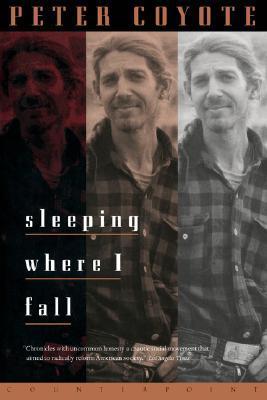
Ordained practitioner of Zen Buddhism, activist, and actor, Peter Coyote began his work in street theater and political organizing in San Francisco. In addition to acting in 120 films, Coyote has won an Emmy for narrating the award-winning documentary Pacific Century, and he has cowritten, directed, and performed in the play Olive Pits, which won The Mime Troupe an Obie Award. He lives in Mill Valley, California."
Peter Coyote is an actor now, but back in the day, he was a member of the San Francisco diggers community. His dad Morris was from rough, East-side, Jewish NYC, later a plutocrat financier. According to this narrative, in 1970, while visiting Peter, Morris said:“Capitalism is dying, boy. It’s dying of its own internal contradictions. You think the revolution’s gonna take 5 years? It’s gonna take fifty! So keep your head down and hang in for the long haul, because I’ll tell you something. The sons of bitches running things don’t give a shit about their children or grandchildren, and they certainly don’t give a shit about you! They’ve paid their dues, and they want to get out with theirs! They’re going to sell off everything’s that not nailed down to the highest bidder. Don’t get crushed when it topples down. Take care of yourself and your family. If you can make a difference, do it, but there are huge forces at work here, and they have to play themselves out according to their own design, not yours. Watch yourself.” In December 2008, sounds like prophesy to me.
If you want to know what the Counter Culture was really all about, read this memoir. Yes, drugs were ingested, people had premarital sex. That's not what the Revolution was about. Not all of us Counter Culturistas took drugs, but we did buy into the peace, love, and understanding mantra and worldview. We also did not trust anyone who might be a part of the Establishment, unlike today, where Americans fall all over themselves to be raked over by plutocrats, day traders, bankers, and financial "experts." Coyote reminds us that there once was a possibility for a better way to live in harmony with nature and with each other. And as Elvis Costello once said, "What's so funny 'bout peace, love, and understanding?" If you treasure the search for a balance of individualism and community, this book is a must read.
PBS made a documentary about the Summer of Love, the gist being that when teenagers and college students began flooding into San Francisco in 1967 to smoke dope and stare at lava lamps, the real hippies got fed up and relocated to the countryside. Peter Coyote was one of the interview subjects in that documentary, talking about the ease with which sincere utopian ideals deteriorate into hedonism.
I knew Coyote from the movie E.T., in which he played the government scientist. He’s also narrated many Ken Burns documentaries. He’s got a good voice.
In the ‘60s, he was at the center of the counter-cultural movement, first as an actor with the original San Francisco mime troupe, then as a leader in the Digger Free Family movement, which was a loose collective of various communes strewn throughout California, and beyond. He recounts motorcycle trips with the Hells Angels, the debacle of Altamont, life at the communes, drug trips, sexual frenzies, meeting half the Beatles, the skinning and eating of roadkill, the repairing of engines, the manual labor of organic farming, asking a tree for forgiveness before cutting it down, getting sad that a bear was killed, and the petty internecine squabbling of idealistic young men and women who were committed to cultural revolution, but unable to clearly articulate their own emotions, let alone goals. It’s fascinating, inspiring, and a tad naive, as Peter Coyote readily admits.
From the intro: “This book attempts to describe what the pursuit of absolute freedom felt like, what it taught me, and what it cost. It is neither an apologia for nor a romance of the sixties. Coming to understand the necessity and value of limits should not be construed as either a defense of the status quo or as the contrite repentance of someone who has flapped his wings a few times and decided that flight was impossible.”
It’s difficult to summarize what the Digger movement was all about, because it’s vague. You’d have to read the book. Their goals were to create an alternative to the prevailing norms of capitalism, monogamy, and private property. In practice, it meant crowding 20 poor hippies and their kids onto a ramshackle farm where most would work but some would leech, and they’d all do drugs and sleep with each other and then have hours-long group meetings to “process” their feelings.
It reminds me a bit of the South Park episode where the boys track down the underpants gnomes, and ask why are you stealing underpants? The gnomes explain their business plan:
What’s Phase 2, the boys ask? There’s a moment of confused silence. “I don’t know, but Phase 3 is profit.”
What Coyote and the Diggers have done is to identify problems with capitalism, traditional marriage, and mainstream culture. What they have failed to do offer clear solutions to these problems. What to do? Do you try and change the system from within, or do you exile yourself to the margins? Late in the memoir, Coyote reflects that perhaps they should have made more inroads with mainstream Americans, forged alliances with actual politicians, and formulated some concrete goals.
In addition to that South Park bit, the memoir made me think about Dante’s Inferno. I’ve never read Dante’s Inferno. But I’ve read about Dante’s Inferno. It describes hell in copious detail. There’s an entire history of literature and artwork that depicts flames, devils, and eternal torments (see Peter Bruegel). But depictions of heaven are scant. As David Byrne put it, heaven is a place where nothing happens. Why, as humans, can we so readily envision the torments of hell, but struggle to envision the bliss of heaven? Why do our imaginations fail us when we try and imagine the absence of pain, of suffering, of weakness?
In other words, why do we have such a difficult time proposing workable solutions to the failures of economics and human relationships?
I admire Coyote immensely as a human being, for his honesty, his integrity, and his independence of thought. Their social experiments were a total failure, on the the one hand, and a complete success, on the other.
“Every culture has its priests and devils, its intoxications and follies, and the counterculture we created was neither more nor less ethical, diverse, or contradictory than the majority culture. You can’t grow tomatoes without shit, they say, and while we may have had much of the latter, we also had plentiful tomatoes. The ideas and moral positions that emerged during this period—the civil rights movement, the peace movement, the ecology movement, feminism, holistic medicine, organic farming, numerous alternative physical and spiritual therapies and disciplines, and perhaps most important, bioregional or watershed political organization—were abetted by agents like the people remembered here: flawed and imperfect people certainly, but genuinely dedicated to creating more enlightened options for themselves and others.”
As long as I’m referencing South Park and Dante’s Inferno, I’d also like to give a shout out to the song “Common People” by Pulp. While reading this I was struck by how many members of the counter-cultural elite were from wealthy, privileged backgrounds, the sons and daughters of East Coast bankers and industry titans with summer homes on Martha’s Vineyard and cattle ranches in Texas.
Now I’ve matured enough to the point where I realize that privilege does not automatically confer happiness; the world is lousy with miserable rich people. But I would point out that someone who grew up in modest circumstances wouldn’t imagine that the answer to their problems lay in creating a society with no ownership, with no possessions other than your immediate personal items. Where you can’t kick people out of your house for starting a fight because to assert authority based on rights of ownership would be a bourgeoisie tactic, and your friends would think you’re lame. The rich have a way of romanticizing poverty.
So in “Common People” there’s that line about how when you’re lying in bed at night, watching roaches climb the wall, if you called your dad he could stop it all. I kept that in the back of my mind, that these kids had a safety net, many of them anyway.
Here’s one last quote I enjoyed, where Peter Coyote ties the fever of the sixties directly to his own troubled childhood and abusive father:
“As I matured, I discovered that my childhood experiences were not all that different from those of many others, and far milder and less damaging than many. I offer no excuses for my personal faults and shortcomings, nor do I blame my parents, who did their best with what they had inherited from their own parents. . . Fairness,however, demands that I point out that millions of young people did not accidentally or spontaneously express a decade of rage and disappointment like gas after a bad meal. My generation’s disillusion over social injustice and its fervent desire to make the world a more compassionate place must have had some antecedents. It does not seem foolish to search for that evidence inside the nation’s homes, where the young were bent, stretched, folded, stapled, and stressed by the social and political costs of the Cold War and the seductive, ridiculously inflated promises of Midas-like wealth. One way or another, such forces took their toll, and my household was no exception.”
"Sleeping Where I Fall" is a blunt, honest work about people who lived the ideals of the 60s. The Diggers and the Free Family weren't into empty rhetoric. They lived what they said, and Peter Coyote provides all the details. For anyone dreaming of commune life, be warned: Communal living is hard, especially if drugs are involved.
If you are interested in San Francisco or West Coast history, you will enjoy this book. The downside is that sometimes Coyote repeats himself, and his editor doesn't stop him. Many of the stories follow a similar pattern:
1. We got in a fight. 2. We had a long conversation. 3. We took drugs together, slept together, or both. 4. We hugged it out, and everything was okay. Except with the Hell's Angels. Those guys are jerks.
Once you get through that pattern and skim over a few of the fights, you'll have a good time.
really great auto bio of fellow that was in the thick of it in 1960's and 70's "revolutionary" movements in usa. so, diggers, san francisco mime, olema in califa and other communes in colorado (drop city) and new mexico communes, be-in's and teach-in's with ginsberg (and ginsburg too) then hollywood and indie films, then mainstream documentaries and indie documentaries. very well written, documented, and fair look back at hippies and what was accomplished and how that is manifested in late 20th century (i think this was written in 1998) . so think about music, literature, sex, womens' rights, environmentalism, individualism and communalism now in 2012. is it different because of coyote and his tribes? without a doubt. is it better because of them? perhaps,....or well, yes definitely, and perhaps some of our "progress" has been inevitable.? is it good, perfect, fair, loving, peaceful, healthy, fun? maybe not so much, or at least it seems a continuous struggle and many copped out as many did before, and many do now. significant book that goes very nicely with some new fiction like bisson's Any Day Now: A Novel , groff's Arcadia and kunzru's Gods Without Men
Peter Coyote’s Sleeping Where I Fall was the first autobiography / non fiction I ever read. After being fascinated with the era, I convinced my mother to purchase not only history and fact books, but also fictions and non-fictions from the time period. What I found appealing about Coyote’s words was their bluntness. While many autobiography’s and non fiction novels feature people using words that seem to connote apology or regret, Coyote’s did not. Instead he was blunt with his words and feelings on the occurrences of his life, never offering regret or apology, but owning his life just as he owns his words. His attitude brought to life to me, the attitude of his generation. Through his work I felt more connected with an era I found so intriguing as well as more able to communicate my own words with such honesty. If one person can make me feel part of or closer to an entire era, then they must be doing something right.
For those of us who think of Peter Coyote as the voice-over narrator of every documentary we watch on PBS, this memoir may come as a bit of a shock. Or not, depending on how wild your own youth happens to have been (few of us will have been anywhere near as wild as the author). In any case, I found it fascinating to read about his early life and adventures, and if you have any curiosity about San Francisco in the 1960s and what happened after that, you may appreciate this book, too.
I would have given the book 5 stars (and probably should have), but for one issue that continually threw me off. In the early part of the book, events are grounded in dates, but it's not long before we are in a timeless zone, where we have no idea what year it is, and this continues until the end of the book, when we are suddenly dropped back into a world of events with dates, or at least, years, attached to them. This is made more challenging by the fact that chapters will deal with the same time period from different perspectives: A chapter about the activities of groups of people the author belongs to (and/or leads in some unofficial way) will be followed by one in which we learn about the author's drug use and sexual and/or romantic entanglements during what may have been the same period. In one sense, this makes the narratives more readable: We follow the trajectory of the big story, then we get the underbelly of that story. But it left me uncertain where I was in either story, so that I would have appreciated something as simple as putting the year at the start of every chapter. Maybe the author left them out because they years didn't matter to them at the time? Maybe his drug use left them all a blur? He doesn't say.
However, what he does say is often compelling, and if I'm frustrated by what he doesn't say, too bad. The book gives us a look into experiences that I would otherwise have little chance of learning about, and I'm glad I read it. It's been on my radar for years, because I saw Peter Coyote being interviewed at the Mechanics Institute years ago and figured his memoir would have to be interesting. Recently I went to a talk about The Diggers at the Book Club of California and that prompted me to get the book from the library. I expect to be processing my thoughts about this book for a while, and I think that's a sign the book was worth reading. P.S. A few days later, another thought occurred to me: I liked the first part of the book because it was about service (the Diggers were trying to take care of all the runaways pouring into the Haight, and also trying to create a new kind of society while they were at it), and the last part was about service (Gary Snyder persuades Gov. Jerry Brown to appoint the author to the California Arts Commission), and the middle that kind of dragged was about how lost the author got when he began to take heroin. Just what I'm thinking right now, but I'm curious to know if anyone else who read it feels the same way.
I'd just like to say IRT some of the (rare) negative reviews who mention the author's air of superiority -
Coyote mostly presents his world view *as it happened*.
So you have to stick with the book to get to the point where he realizes, 'we had all these grand notions about remaking the world, but here I am a broke junkie with hepatitis and two kids by two moms - maybe I'm not such a genius after all.'
Reader, if you "drop out" of the book (heh) based on your preferences or judgments before then, it's your loss. Your view of history might wind up being a tad bit narrow.
Personally, I had very little knowledge of (and absolutely nothing in common with) this era or these people, and I'm so delighted I read this book. Learned a ton.
You would think this would've been an interesting book and a chance to gain insight on the idealistic Bay Area hippie scene of the 60's.
But it was surprisingly painful to read. On TV and in the movies Coyote seems like a likable, open-minded kind of guy. But in this memoir Coyote seems to want to justify a lot of some really bad and irresponsible behavior with a lot of really loony pseudo-intellectual ideological B.S. Though he tries over eagerly to impress with the supposed creativity and intellect of he and his friends, I got the very annoying impression that Coyote and his artist friends were just scammers who truly thought they were much smarter than everyone else.
The author explicates at great lengths his post-war Mid 20th century journeys - beginning with an escape from the hegemony of his dysfunctional parental home, through other dysfunctional hegemonies of hippie life in the Haight, the Hell's Angels and communal living experiences. The descriptions of living in the Haight, the lifestyles depicted, go a long way to explaining the zeitgeist that resulted in Manson's Helter Skelter. Favourite quotes #1: "This was our home and you were our guests. You abused it. You stabbed our dogs. You burned our fences. There was nothing we could do to stop you, but I'm calling it for what it was. You guys behaved like trash, and I never expected it from the Hell's Angels" (author quote, p 212). #2: "...our fixation with total freedom condemned us to marginality. While we believed that we were creating "alternatives" that the majority culture could take advantage of at a later date, we were actually scoring a line in the sand between our way of life and everyone else's" (p 300)...
I've always like Peter Coyote as an actor; he has a beautiful voice which is easily recognizable in many documentaries, and I recognize and admire his talent and apparent intelligence. I was surprised to read of his radical youth, amazed at his many adventures and impressed by his intelligent approach to his craft (acting), as well as his politics. Unfortunately, in spite of being a well written account of his life, he comes off sounding pretentious, pompous, and self-congratulatory. I'm not sure if that's just the way the words seem on the written page, and perhaps it would be better to listen to him narrating his memoirs (such a recording must exist somewhere).
I began to find the man rather tiresome and would have appreciated learning more about the times of his youth, and a bit less about him. For example, there are several references to Janis Joplin who he refers to as pal and sometimes lover. This is rich territory, but he doesn't develop it beyond stating the facts - (to paraphrase) "we hung out, she let us stay in her apartment, she was in a show we attended..." It's all so dry; a lost opportunity. I realize that he might not want to be one of those "kiss and tell" type chroniclers, but it would have been interesting to get more of a take on what it was like to witness that period in history, as opposed to schooling the reader repeatedly in the intricacies of mime theater.
I agree with all the comments I just now took time to read here, both positives and negatives. Speaking for myself, I read this book for two reasons:
(1) Personal associations: I know Peter Coyote's sister, I like watching him on the screen, and I didn't even know or remember he had written this book until I recently read that he has a new book coming out. If I was going to read that book, also a memoir, I figured I should read his first book.
(2) Personal history: I was coming of age in the 1960s-70s but felt no, may I repeat no, connection to the counterculture and its causes, and have always felt that was a vacuum in my past that I couldn't explain/understand.
I'm glad I read the book. The "needs" behind both reasons for reading it were met. I sticky-flagged many pages in the last couple of chapters and the Afterword, and then on top of the book I sticky-posted "What a workout!" He got my emotions going all over the place in reaction to his writing and to his life (into the 1980s, with the Afterword written in 1997). Anyone who is curious about the 1960s-70s will be well served by reading this book. If you get sick of it, less curious, then start skimming but stick with it. You will be rewarded by getting the whole picture of this man's (lengthy? delayed?) coming of age. It tells a true tale.
I finished this marvelous memoir of the radical 1960s this morning and I am feeling moved and touched and happy. The author is best known now as an actor in such movies as "E.T." and "Northfork," but, before that, he was a member of the anarchistic San Francisco group, The Diggers, and later the instigator of a number of Utopian communes. Coyote was there and, better than that, he has the great storyteller's ability to put you there, also. His stories are important stories and his lessons important lessons. I underlined whole sections of the book and could have done on every page. It’s meaty stuff and I must say, Coyote and his pals are heroes and their actions made the world a better place even if, some days, it does not seem so now. Here is one key paragraph, one that I took most to heart: “If you accept without question premises of profit and private property and if you pursue those ends, even in the best of faith, then eventually the cultural mall we call America will stand before you, the product of cumulative actions. No one will know precisely how it was built or for what purpose, and like goldfish in a bowl, we will no longer be able to imagine living outside the aquarium.”
For those of us who lived through the same era, the book is a walk down memory lane to some extent. Mr. Coyote has a way with words; I completely enjoyed his writing.
I loved this memoir of the 60's. A practically day-by-day account of Peter’s travels, incidents, confrontations, parties, learnings, dramas. And an insight into the major cultural anti-capitalist progression many people were steering towards during this wild era of US history. The goal was, in Peter’s words “towards regionally organized, self-sufficient communities”.
On Face: “One of the defining attributes of the sixties was the collective impulse to reveal yourself candidly and publicly, confessing your inner visions as your daily life. It was as if the participants at a costume ball suddenly found the event too silly and simultaneously dropped their masks. Farm boys from Nebraska were writing poems, preppy girls from Grosse Point were throwing the Tarot and studying herbs. Kids with no idea of who they wanted to become could idle on the teeming streets among people who would not judge them for their confusion. Personal style counted more than a pedigree.”
On Freedom: “Billy Murcott had intuited that people had internalized cultural premises about the sanctity of private property and capital so completely as to have become addicted to wealth and status; the enchantment ran so deep and the identity with job was so absolute as to have eradicated inner wildness and personal expression not condoned by society. … To be free, as Billy understood it, was the antidote to such addictions. For most people the word free means simply "without limits." Harnessed to the term enterprise, however, it has become a global force, intimating limitless wealth; as such it is the dominant engine of U.S. culture. …Personal freedom … has lots of limits: it limits aspirations (to adult adjustment, for instance), creates continual cultural and economic upheavals, forces relentless adjustment on an overstressed population, ignores biological and social principles of interdependence and reciprocity, violates the integrity of the family and community, exhausts biological niches, and has strip-mined common courtesy and civility from public life. Freedom within the relentless pressures of a market-driven society appeared impossible precisely because of its stultifying effects on the imagination in all realms but the material. From our point of view, freedom involved first liberating the imagination from economic assumptions of profit and private property that demanded existence at the expense of personal truthfulness and honor, then living according to personal authenticity and fidelity to inner directives and impulses. If enough people began to behave in this way, we believed, the culture would invariably change to accommodate them and become more compassionate and more human in the process. … Our hope was that if we were imaginative enough in creating social paradigms as free men and women, the example would be infectious enough and might produce self-directed (as opposed to coerced or manipulated) social change.”
On Leadership: "Followers" … were more than willing to pitch in and bring these compelling visions to glorious fruition. The flaw in this system was that if the leader did not consistently supply visionary energy and inducement, the followers dropped everything for the predilections of the moment, and the brave new world faltered and then stopped dead. I had so appropriated the collective vision that I deprived others of the opportunity of developing their own; I had unwittingly assumed the full responsibility for actualizing Olema's potential. If that potential failed to materialize, Olema was little more than a grubby, overcrowded dirt farm with a large, licentious, dysfunctional family alternately groping for sanity and destroying itself in small increments. Since I refused to see myself and my efforts so minimalized, I was forced to keep everyone else on track with "the big picture."
…We had behaved with both arrogance and naïveté, assuming that we were leading the way to a future of our own design. We had assumed the task of creating a culture from whole cloth, certain that our example would shine brilliantly enough and that more traditional people would join us. … There were aspects of our life that did not compel me: the chaos, the impossibility of refined group expression, the moral self-righteousness, and the personal failings and indulgences that undermined some of our best efforts. I viewed such problems as part of the process, but to outsiders, our problems represented what we were, and they found us offensive.”
It is fascinating to read about their free lifestyle and thoughts about how it could eventually make for positive change. Peter has many interesting insights: “In retrospect, the Diggers might be criticized as a decade-long performance art piece. We were, I believe, first and foremost artists, and while we were addressing real fundamentals, we allowed our commitment to "authenticity" to blunt our sensitivity to the needs and aspirations of many who were not interested in being artists, or special, or anything other than out from under the heel of an oppressive system. The failure to curb personal indulgence was a major collective error.”
Sleeping Where I Fall is an autobiographical book from Peter Coyote. You might know him as a Hollywood actor, a man with a stern face, playing congressmen, detectives and conservative dads or other such people in authority. What you probably don't know is that before he was 40, when he decided he would try his hand at an acting career on the big screen, he was a "live off the land" hippie, a fervent believer in alternative cultures that eschew capital and personal property and value human connection and respect of the land and of the spirit, a man who chose his last name as most representing of himself. The guy on the cover is Peter Coyote, too. This book is an amazing recounting of those times, one of the works that I believe need to be read, whether you like them or not.
Personally, I found it amazing. It's not the writing style or how it played with emotions, but the information buried within that makes it a valuable experience reading it. In fact, if I was to critique anything about it, it is that is so packed with anecdotes and mind blowing ideas and descriptions of people, groups, ideologies and places, but does little to bring the reader to the emotions of the writer. It is too intellectual, trying so hard to be accurate and objective as to make the reader numb. Everything else, though, is top notch.
I don't think I would do the book service to summarize it in this review, but it goes so many different and interesting places: hippie communes, motorcycle gangs, famous artists, drugs, politics, road trips, changing the world, personal stories, psychology, acting, music, environment, native American culture, Wall Street, Easy Rider and so on. I do feel that the man who wrote this book is a great human being, but I have the nagging feeling that he misrepresents some of what he describes. Perhaps it is the somewhat neutral tone, the elevated language to render heart wrenching moments or just the fact that I find it so hard to believe a man could go through all that in just under two decades. I don't want to read Emmett Grogan's book Ringolevio on the same period, but you might want to, in order to cross reference and get a more accurate picture.
I recommend this book to just about everyone. It is one of those things that open your eyes a little to what was lost and what could be different and what you never thought about.
As additional resources, you might want to look at The Digger Archives online, where the site is terribly out of date, but the information there is (as is the Digger way) free. Frankly, I am disappointed to see that neither Sleeping Where I Fall or Ringolevio are offered free on that site.
Bad sign, for the first time, as I'm reading a book, in the back of my head I'm already thinking how will I review it on goodreads. I have to stop doing that.
Now the book: It is a 4 not because of the style, which is sometimes annoyingly lyrical, but thankfully by and large direct and down to earth. No, it is a 4 because of the topic, and because of the introspection.
They say that if you enjoy sausages, you should never see how they are done. Same with hippies, and peace and love. There are so many contradictions, universal love vs blinding ego-centrism, creativity and self-destruction, etc. I like that Coyote at least is aware of, and spells out most of them, a few of them remarkably enough that would make great quotes. Alas, it was a library book, didn't dare to underline, a real hippie would have found some justification, like saying it wasn't vandalizing, but adding value for later readers.
The ability to justify any crime, or most often to ignore the real life scenarios (ie, airplanes, airports, electric grid for billions, open heart surgery, can't emerge from self-organized communes, but require complex society and organizations) is astonishing.
like any memoir, I'm flabbergasted hos he could remember so may episodes with such detail. I barely remember some names from my high school classmates, he seems to remember every room he had been in, every lover he had been with (hard to say which was more numerous).
It does prompt the question, have I been living wrong, the values and lifestyle which so starkly contrasts with what's portrayed here. Is a good book, Id say, which manages to make you take seriously and objectively those questions.
Unrealistic dreamers, like cops, or lawyers, are necessary members of our society, even if each of those groups can be also maladies due to their very nature. Once you become a realistic dreamer, no one considers you a dreamer anymore.
After hearing his narration of my favorite Kerouac documentary and various Ken Burns’ films, and also attending Coyote’s book signing for this 2014 rerelease, I was curious to read his story. Very, very detailed information about everything which sometimes made it feel a bit drawn out. After reading about communal living in the ‘60s and ‘70s, it further cemented the reality of it versus my adolescent dreaming that it would be an ideal way to live back then (I would have never survived in that environment). It was an interesting experiment, but a very trying experiment, and Coyote was right there with the free love, free living idealism of the time. I can’t say that I walked away from the book loving all of his friends. His updated afterword was interesting in that he admits to those who were disappointed or upset about their depiction or how he remembered events, but memory is sometimes mixed with equal amounts of romance about an event as it is with the truth. Looking forward to reading his follow up, The Rainman’s Third Cure as it seems more condensed and more in line with his current Buddhist practice. That is, curious to see how he views this time from an even more mature perspective.
Sleeping Where I Fall: A Chronicle by Peter Coyote (Counterpoint Books 1998) (979.4). What a great memoir from a less-remembered Sixties legend, countercultural division. This volume draws the reader's focus to the groups from the more exteme and revolutionary portion of the countercultural spectrum: The Diggers, The San Francisco Mime Troupe, The Free Family, the communards, and the Hell's Angels, to name a few. To greatly oversimnplify things, what do these groups have in common? That their members were usually hardcore believers. They walked the walk instead of talking the talk. Peter Coyote became an actor and director of some renown after he grew up (just kidding – don't ever change, Peter). I admire his writing style. He narrates guilelessly and honestly, and it seems as though he was present at most of the seminal events of the Sixties. I'm glad I ran across this work. My rating: 7/10, finished 2/7/19. I purchased a PB copy from Amazon 12/7/18 in good condition for $3.00. PPPPPPPPPPPPPPPPPPPPPPPPPPPPPPPPPPPPPPPPPPPPPPP
This is an important book. For those of us who grew up in the late 50's and 60's, the experiences that Peter writes about here resonate with many of us. He talks about the hope that we felt and the sense that we were able to cast aside the strait jackets that society and our Western culture had gifted us with and that condemned us to follow a pre-ordained path that would eliminate any chance to effect change in our lives or the world. It was a revolutionary time. Peter is brutally honest about the problems and downsides to our somewhat naive view of ourselves and the world. Drugs underpinned and were central to rapidly changing our understanding of ourselves. But there were drugs that were positive and those that were negative, drugs that opened our minds to heretofore unknown possibilities and drugs that anesthetized us to the contradictions of living in a culture addicted to money. Peter's honesty is incredibly refreshing.
This is a must read for anyone trying to understand the potency of the 1960's and what that cultural ferment was really about.
Kind of a rough ride thru familiar territory but it didn't illuminate anything new for me. Nor did it lift Peter's persona in my mind, at least not til the end. There were far too many minute details about people, places & events. How could he remember these, I wondered, unless he kept journals? I'm glad he made it out alive considering what he did to his body, repeatedly, yet never got the message, even after sacred rituals and guided 'trips'. The message being: time to stop being so self centered and take responsibility for yourself and your family. He does clean up his act at the end & redeem himself with work on the Calif Arts Council. His second bio, The Rainman's Third Cure was more down to earth it seemed, and I understood why he was so broken inside and unable to have long term relationships. Still, I think his purpose in writing both books is to assuage his inner demons and guilt. To make right with the world and clean up the mess he left behind.
(1 1/2). A fairly quintessential trip through the 60’s. Coyote details, and I do mean details, one of the more unbelievable lifestyles on the planet during this era. A major proponent of the “free” way of living, an awful lot of this is so removed from “normal” thinking that it is really hard to believe this is how many folks existed. But they did, and their ability to survive, even thrive at times is really crazy. Coyote obviously had smarts and skill to survive all of this, and actually even had some fun along the way. His ability to remember names, incidents and places is unbelievable, to the extent that this book is not that interesting or readable part of the time because of the effort needed to get through all the detail. OK stuff.
Overall, I'm glad I took the effort to read this. At times Coyote is full of himself, but in the end we get to learn:
1) The advantages of what happens when a community accepts people which are different (i.e. Olema), and the disadvantages when the reactionary forces win out (i.e the far northern reaches of California, where the locals were introduced to poverty when the benefits of logging were extinguished).
2) The excesses of the hippies did in fact come back to bite those who couldn't handle it.
3) That being said, community wins out over money.
Coyote must've come off to some as a jerk back in the 1960's, but his commentating on Ken Burns' masterpieces more than makes up for that. Read this if you can.
Loved it. I was looking for a first-hand account of communal living and the counterculture in the 60s, and this book was that and much more, with a lucid perspective on both the flaws of mainstream society and the hardships in creating a new culture.
Some other readers have pointed out how the author may come off as pompous and pretentious. That is undeniable, however, that didn't stop me from enjoying the account. What Coyote and his associates were trying to do was undeniably revolutionary, and they had tremendous insight already 60 years ago about issues that are as present as ever.
Such a diverse account, and engaging narration. It was a real journey to go through it. Recommended to people who are interested in seeing the world from a very original perspective.
An interesting glimpse into the counterculture of a radical SF Mime Troupe performer and what life was like living as a communard and gypsy in the 60's and 70's. What annoyed me at times was the vocabulary. I know big words too, but that doesn't mean I need to inundate my text with lengthy, obtuse verbiage (see what I did there), when simple words suffice to get the message across. I don't like pontificating and although he's often self-effacing, this still came across as blathering ego. There are not that many lessons I can take away after finishing it, so it feels like a waste of time. Still, interesting to peek into a lifestyle I'd have no interest in joining.
Say the name Peter Coyote and you might remember him from his movies; Southern Comfort, ET, Jagged Edge, The Legend of Billie Jean, Outrageous Fortune etc.... But long before he became a legitimate actor, he was part of the San Francisco hippie scene and Sleeping Where I Fall is literally that, the stories of his days as part of a mime troupe that traveled the West coast and dropped acid. This is not the cool hippie pictures of tie dye and peace symbols. In fact it gets pretty ugly. But it paints a visual picture of what free really meant.
Sleeping Where I Fall gives a raw, honest look into 60’s counterculture. Peter Coyote’s memoir does an excellent job describing every last detail of communal living and life on the road. Some parts of the book, however, are almost too detailed to the point where it feels like Coyote is only name dropping as a pathetic attempt for his own cultural validation. This memoire is definitely an interesting read that gives plenty of insight to the underbelly of American life during one of the most tumultuous decades in history.