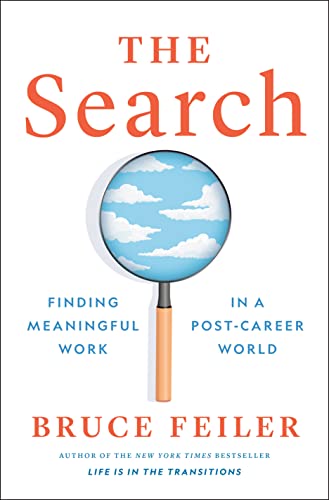
Find work you love. On your own terms. From the New York Times bestselling author of Life Is in the Transitions comes a bold new road map for finding meaning and purpose in what you do, based on insights drawn from hundreds of life stories of Americans of all backgrounds.
America is at a once-in-a-generation turning point around unprecedented numbers are quitting their jobs, rethinking their routines, breaking away from stifling expectations. The most suffocating iron cage of all is the idea that each of us must follow a linear career—lock into a dream early, always climb higher, never stop until you reach the top. Few ideas have squandered more human potential.
Employing his signature, immersive approach, Bruce Feiler is known for taking complex challenges and converting them into actionable steps that can help each of us live with more fulfillment and joy. From thousands of hours of interviews, Feiler has distilled a powerful new vision of The people who are happiest don’t chase someone else’s dreams; they chase their own. Freed from outdated scripts, they identify what brings them meaning and write their own story of success.
The Search introduces an all-new toolkit for achieving that goal, 21 Questions to Find Work You Love. Practical and empowering, these questions will help you unearth the story of work you’ve been trying to tell your whole life—then go achieve it. You’ll
· The upsides and downsides of work you learned from your parents; · Why your childhood role model offers the best clue to what you should do now; · Who is your waymaker; · When to leave a job and when to stay; · What is your purpose right now; …and much more.
From a master storyteller who’s helped millions transform their lives for better, The Search arrives as the world reimagines the basic assumptions of work and offers a timely, urgent playbook for each of us to get the happiness we seek, the meaning we crave, and the success we deserve.
BRUCE FEILER is one of America’s most popular voices on contemporary life. He is the author of six consecutive New York Times bestsellers; the presenter of two prime-time series on PBS; and the inspiration for the drama COUNCIL OF DADS on NBC. Bruce’s two TED Talks have been viewed more than two million times. Employing a firsthand approach to his work, Bruce is known for living the experiences he writes about. His work combines timeless wisdom with timely knowledge turned into practical, positive messages that allow people to live with more meaning, passion, and joy. His new book, LIFE IS IN THE TRANSITIONS: Mastering Change at Any Age, describes his journey across America, collecting hundreds of life stories, exploring how we can navigate the growing number of life transitions with greater purpose and skill.
For more than a decade, Bruce has explored the intersection of families, relationships, health, and happiness. His book THE SECRETS OF HAPPY FAMILIES collects best practices from some of the country’s most creative minds. The book was featured on World News, GMA, and TODAY and excerpted in the Wall Street Journal, the New York Times, and Parade. THE COUNCIL OF DADS describes how, faced with one of life’s greatest challenges, he asked six friends to support his young daughters. The book was profiled in PEOPLE, USA Today, and Time and was the subject of a CNN documentary hosted by Dr. Sanjay Gupta.
Since 2001, Bruce has been one of the country’s preeminent thinkers about the role of spirituality in contemporary life. WALKING THE BIBLE describes his 10,000-mile journey retracing the Five Books of Moses through the desert. (“An instant classic,” Washington Post). The book spent a year and a half on the New York Times bestseller list and has been translated into fifteen languages.
ABRAHAM recounts his search for the shared ancestor of the monotheistic religions. (“Exquisitely written,” Boston Globe). WHERE GOD WAS BORN describes his trek visiting biblical sites throughout Israel, Iraq, and Iran. (“Bruce Feiler is a real-life Indiana Jones,” Atlanta Journal-Constitution). AMERICA’S PROPHET is the groundbreaking story of the influence of Moses on American history. THE FIRST LOVE STORY is a journey across four continents exploring how Adam and Eve shaped our deepest feelings about relationships. (“A miraculous thing—the literary equivalent of breathing new life into a figure of clay,” New York Times Book Review; “Feiler’s best work yet,” Publishers Weekly).
A native of Savannah, Georgia, Bruce lives in Brooklyn with wife, Linda Rottenberg, and their identical twin daughters.
This book is definitely for someone, but I'm not entirely sure who. The "thesis" can be broken down into three points:
1) Disruptive events in life cause our work lives to change and cause us to rethink what we want out of work.
2) There are many nonlinear pathways to success and the average person switches industries/jobs many times in their life.
3) What "success" means to someone is subjective and requires some soul searching to figure out.
If your response to these points is "yeah, no kidding," then save your time and money and look elsewhere.
The rest of the book is anecdotes and "statistical data" extrapolated from a diverse, (lots of representation from different backgrounds including race, gender, class, etc) but ultimately heavily skewed data set of people. Almost the entirety of individuals that Feiler interviews are folks who have ended up becoming quite successful -- they are CEOs, media stars, leaders of government, non-profit founders, and so on. Thus, the "data" becomes statistically unreliable in two ways -- the first being a survivorship bias (we do not hear from the people whose dreams/ambitions failed and were never able to recover) and the second being that this slice of the population also seems to skew heavily in the mindset of being highly motivated and driven, what one could consider "outliers."
So, if you are someone who is highly motivated and driven, is this book helpful? Maybe, but I would argue it probably is just reinforcing a lot of the behavior that such a person would already possess. If this is you, congratulations! I am envious of the way your brain works.
So, if you are someone like me who is starting in their career and not quite sure what they want out of life and their cognition leans toward being less driven/motivated, is this book helpful? It's hard to say. I think it does a good job at positing helpful questions to ask one's self about what they want out of life/work, but the rest is ultimately a lot of white noise and chapter length profiles of successful people. In concept I love the idea -- interviewing people across the country about their lives and work and how they intertwine -- but unfortunately it never goes much deeper than a surface level scan of the people interviewed and how they manage to fit back into Feiler's fairly obvious thesis.
I recently listened to an episode of Dan Harris’ podcast, Ten Percent Happier, on which Bruce Feiler was a guest. He was promoting this new book, and the conversation was fantastic. Bruce is an engaging story-teller with a bend towards the motivational, and I recommend that episode to anyone considering their career and making a change.
The podcast episode does a good job of explaining the major tenants of the book, but unfortunately for the book, the podcast is a more succinct and digestible form for this information (at least for me). The book felt weighed down by a plethora of anecdotal evidence, and it was at times hard to follow and inconsistent. Feiler has clearly done an incredible volume of interviews, but on the page, he struggles to connect the dots of his thinking. For example, Feiler will present someone’s “work story” and quickly conclude that story with a self-help-flavored sentence like, “We are the only ones who can forge our own stories, who can write the narrative of our future.” Don’t get me wrong - I’m a sucker for some good self-help, but a lot of these conclusions felt unearned. It bears repeating that the sheer amount of anecdotes in this book give it a meandering quality that undermines Feiler’s genuinely life-changing and resonant advice.
Another problem I had with the book, and perhaps this could count as grandstanding, but Feiler glazes over what feel like some pretty intense trappings of late-stage capitalism. There are multiple opportunities in the book to underline the racial, surveillance, and carceral forces that create many contemporary working conditions. It’s not something to celebrate that people have to supplement full-time work with additional jobs. I agree that it’s nice that we can explore our passions on the side, but no one should have to work full time during the day and then drive for Lyft in the evening to pay off an absurd amount of student debt that they incurred in order to get the degree necessary for their employment in the first place.
Moreover, I agree that it’s a net-positive that we can create a sample platter of careers to build our own idiosyncratic future, but capital-W-Work should not be the place that guarantees health insurance or the ability to remain in this country. Feiler is not responsible for fixing the gig economy with his book, but he gets eerily close to endorsing it. For all the mentions of “minority workers” (yikes) in every chapter, The Search majorly lacks a larger critique of how modern work is used to subjugate - and yes, enslave - unthinkable quantities of people. The book also offers no critical ways of assessing if your work place is taking advantage of you and how you and your fellow workers may resist that exploitation. Again, I concede that Feiler’s book cannot do all this work at once, but he misses multiple opportunities to do anything meaningful with these gnarly realities, and instead, he concludes the book with a serious meditation on the most unserious, cringe-inducing concept of “The American Dream,” which is slog to read about even when it’s being critiqued.
All in all, The Search is a book that provides powerful wisdom at the expense of being an anecdote merry-go-round. If you are considering reading this, I strongly suggest you first listen to the Ten Percent Happier episode, because Feiler is a great speaker, and I think audio is a more successful medium for these insights.
Ehh. This was staring me down from the new shelf at the library and I couldn't resist since I have no clue what I want to do next for work.....going through the Who/What/When/Where/Why framework for past/present/future you is probably helpful framing for thinking about career, but this could have been a blog post.
100s of career stories in here that boiled down to a) dig deep to figure out what's important to you b) go after it, ignoring sunk costs and c) It'll all work out. Not necessarily bad advice, but too much fluff for me.
These days, more and more people are taking control of their working lives. And that often means walking away from their jobs without having the next one ready to go. An unprecedented million people have been leaving their jobs in the US alone – and that’s every week!
The quit rate – the monthly total of people leaving their jobs – has been steadily climbing. Now, almost one-third quit their jobs every year, and one-third redesign their jobs to pursue other interests or have more family time.
Times are changing. People don’t just want a job – they want a job with meaning. You, too, can take advantage of this new work environment – and, hey, even get the happiness you so richly deserve. But how, exactly?
Well, that’s where this book comes in. First, you need to revisit what you believe about work. Second, you need to look back and chase your own dream. And third, you need to take control and develop your unique work story.
-
Three little lies about work
So the first thing we need to do is dispel some illusions you have about work. Let’s call them what they are: lies.
Lie #1. I have a career.
For millennia, work hasn’t been viewed favorably. Even in the Garden of Eden, work was simply a punishment for disobeying God. In many languages, the root of the word for work carries negative connotations. In French and Spanish, for example, travail and trabajo, respectively, are rooted in the Latin for torture. But by the beginning of the sixteenth century, many people had gained more control over their lives. Numeracy and literacy improved, agriculture gave way to industry, and a new word emerged: career.
In the early 1900s, Frank Parsons – who’d never held down one job for particularly long – opened an office to assist others in making “good career choices.” His approach gained popularity, leading to the widespread adoption of a visual representation of a person’s career: the résumé. Soon, employers started requesting résumés from prospective employees.
This linear approach to work has been detrimental: deviating from your career path or spending too much or too little time in one job can be detrimental to your résumé.
Today’s world of work is anything but linear. New technologies have emerged, causing shifts in work and required skills. It’s become important not simply to concentrate on periods of stability, but also on periods of instability – when things go wrong, when you realize it’s time for a change. To fully grasp this concept, the author Bruce Feiler has coined the term workquake.
Lie #2. I have a path.
So what does workquake mean? Feiler defines it as “a moment of disruption, inflection, or reevaluation that redirects our work in a meaningful way.” There are many causes of workquakes,including, for example, taking a new job, going back to school, losing employment, the birth of a child – or, as witnessed in the last few years, even a pandemic.
Although workquakes can be scary and destabilizing, they also present opportunities for growth, renewal, and self-reflection. They allow us to re-story our lives. These disruptions are becoming more frequent and diverse, with long-reaching consequences. Feiler says that on average, individuals experience a workquake every two years and 10 months, and that women encounter them 22 percent more often than men.
Effectively, this means none of us has a path anymore. It often means saying goodbye to advice like Follow your dreams or Pursue what brings you joy with determination. Feiler’s research showed that only 38 percent of people were doing something that they dreamed of as a child or teenager, and only 12 percent were following their passion.
So perhaps you need a plan to follow? Well, also no. While some people have a clear plan – they know they want to become a doctor, for example – most people’s plans veer off course at some point due to unexpected encounters, events, or circumstances. Feiler refers to these as butterflies, drawing on the concept of the butterfly effect. In his interviews, he found that everyone who’d experienced an unexpected shift in their work could identify their butterfly – whether that was a person, an experience, or a thing. Feiler’s advice is thus to “follow your butterfly.”
Lie #3. I have a job.
Virtually nobody has just one job these days, they have multiple jobs. Indeed, Feiler’s research revealed that the average person has three-and-a-half jobs. Many people use the word job broadly, encompassing not only paid work but also anything that involves responsibility, such as serving on nonprofit boards or taking care of their children. Even if we exclude unpaid work, Feiler found that 63 percent had more than one job. And then, of course, we also work on our relationships, parenting, social media, and our bodies. Every role is a job. Feiler refers to this new way of defining work as Work360. Within it, he says, there are five jobs everyone has.
Let’s start with your main job. What exactly is that? Is it your primary source of income, the activity that occupies most of your time, or maybe your primary source of meaning? Perhaps it’s not even possible to say. Fewer than half of Americans now have what could be called a main job – actually, only 39 percent do.
Next, you might have a side job – often referred to as a side hustle – that provides more money, meaning, future options, or a combination of those. It might act as a vehicle for becoming self-employed while you support yourself through your main job. Feiler found that around 75 percent of people have at least one side job.
The third type of job is the hope job. This is something you do in your spare time – perhaps you write novels or sell homemade cookies – hoping that at some stage it will develop into something bigger. Incredibly, 89 percent of people have a hope job, ranging from writing a memoir, creating comic books, or making jewelry, to performing burlesque or starting a new business. Whatever it is, we’re prepared to sacrifice our free time if such a job makes us happy.
The fourth job type is the care job, involving caring for someone else – child, parent, or neighbor, for example. Such jobs rarely make money, but they provide us with meaning.
Lastly, there are what Feiler refers to as ghost jobs. These are often deeply personal and unsettling, resembling a job in their impact. Astoundingly, 93 percent of Feiler’s participants experienced inner battles that felt like jobs. Ghost jobs can involve workplace discrimination, such as racism or sexism, struggles with self-confidence, or financial worries. Everyone encounters such ghosts from time to time, and it is crucial that we acknowledge their existence rather than allowing people to suffer in silence.
So now we’ve covered three lies about work. But are there any truths? Well … there is one.
-
There’s only one truth about work
Work is changing – that much you know by now. We’re facing increased instability and uncertainty – but at the same time, we also have more freedom, options, and opportunity. But who can help us navigate this new world of work?
So here it is. It shouldn’t come as any surprise. The one truth about work: You, and only you, can help yourself and provide the direction you need. And that’s what we’ll cover here.
Stop to think for a moment about what work and success mean to you.
Work is a delicate balance of time, effort, and money on one side, and meaning, purpose, and happiness on the other. Success, on the other hand, can be defined as how that balance aligns with your life in general. So does your work fulfill how you see yourself? Does it reflect your values and align with the values of your family, community, and country?
These days, you don’t need to conform to society’s definition of success. Instead, you need to take charge of your own success story and define exactly what success means to you. How exactly? Well here are three steps that can help you define it, collectively forming what Feiler calls a meaning audit.
The first step of your audit is to evaluate your past. Reflect on your initial thoughts about work. Were there dream jobs you didn’t pursue? Did you abandon versions of yourself along the way? Think about what you’ve been told about work, money, and success. Bring to the surface any long-buried themes in your life. Many people discover their true vocation through some personal emotional exploration.
Now, on to the second step: examine your present. Ask yourself what your priorities are. What matters to you right now? How does that differ from two, five, or ten years ago? What is your primary focus? Is it you, the people you love, or your community?
In a world where we can be who we want to be, do, live, and believe what we want, and are free to love as we want, we can find ourselves overwhelmed – paralyzed by the abundance of choices. No wonder, then, that when it comes to writing our own stories, we often experience writer’s block!
This is where the ABCs of Meaning come into play. A for Agency is what you do, make, or create – your autonomy, freedom, and mastery. B for Belonging encompasses your relationships with family, friends, colleagues, and loved ones. And C for Cause is your mission or purpose. These aspects are your I, we, and thee parts of your story. Consider how much time you spend on these. Have they changed over time? What is important to you now?
The final step is to create your future. Using the insights from steps one and two, begin to construct your future. Of course, the process isn’t easy, and you might not be in control of everything that comes, but if you want to find meaning in your work, don’t fall into the trap of just updating your résumé, applying for jobs, and doing interviews. Those steps come later, if at all. If you’re not sure where your story is heading, you can start by asking yourself six fundamental questions – which we’ll explore in the next section.
-
Who, what, when, where, why, and how?
For each of these questions, you need to ask yourself about your past, present, and future in a similar way to the meaning audit you just carried out. So let’s go.
Who? Who do you want to be? Begin by contemplating your past. What were the work-related values imparted by your parents? Were there any negative aspects they instilled in you? Then, think about who is the dominant who in your life right now. Is it your boss, spouse, parent, child, lover, or someone else? Perhaps you’ve encountered a transitional person who’s entered your life at just the right moment and guided you. Finally, think about the kind of person you want to be. Try completing the sentence “I want to be the kind of person who …” Learning to be your own who can be very fulfilling.
What? Consider this as the plot of your story. What exactly is it that you want to do? Try completing the sentence “I want to do work that …” To assist you, again reflect on your past, present, and future. Think about your role models from childhood. What aspects of their character did you admire? Was it their integrity, charisma, or something else? Next, think about your current work. What are the best and worst things about it right now? What emotions arise when you’re working? Finally, in light of your answers, revisit that question of what it is you want to do.
When? When is often something we neglect. Begin by asking yourself when your work story started. When did the energy first take hold? Perhaps it was as a child, or as an adult, or perhaps you’re still waiting. Whenever it was, it likely marked a break in time initiating a new chapter. Now think about the present. Is it the best time to take new steps? Should you plan first or follow your intuition? Continue as you are, or take the plunge now? Finally, here’s the next sentence to complete based on your observations so far, “I’m at a moment in my life when …” Remember, this isn’t a forever answer – things will change in the future, too.
Where? Here’s your sentence for your where: “I want to be in a place that …” To help you answer, reflect first on where you most desired to be as a child. Was it home, the garden, in a forest, or somewhere else? What drew you to that place? Next, think about where you want to be right now. And finally, return to the statement about where you want to be in the future. This might need you to think about moving from a place where you feel uncomfortable to a place where you can authentically be yourself.
Why? Now it’s time to reflect on your purpose. As always, begin by reflecting on the past. What recurring patterns of pain are there in your life? What childhood obsessions do you still have? Are there problems you’ve been trying to solve forever? Feiler found that answers to these questions mostly concentrated on five themes: injustice, helplessness, escape, identity, and money. Next, think about the kind of stories that resonate with you. These stories often shape the narrative of the stories you want to tell. Finally, complete this sentence to explore your why: “My purpose right now is …” What do you want it to be?
How? How is the most practical of the questions; it’s how you are going to make everything happen – or, as Feiler puts it, transitioning from “once upon a time” to “happily ever after.” First, consider the best work-related advice you ever received. Was someone able to help you? Who was that someone, and what wisdom did they share? Next, think about change. The most pressing question here is, How can you give yourself permission to change? However you go about it, it’s essential to grant yourself that permission. And now here’s your concluding statement: “The best advice I have for myself is …” The answer to this lies within you, waiting to be discovered.
Write out all of your completed statements to see the draft of the next chapter in your work story. Build on it from there.
-
Let’s finish this book with a set of four rules for your future success.
Rule 1: Dig for success. Follow your own script, which you’ll find by digging deep into your memories and discovering those buried dreams.
Rule 2: Success is collective, not individual. No one succeeds alone – so forget the idea of self-reliance and find your community.
Rule 3: Find your success in meaning. Forget what anyone else thinks success means. What meaning do you ascribe to success?
And finally, Rule 4: Your success is your story. It’s what you want it to be – not a destination, but rather a narration with no fixed ending. Your story is a work in progress – and you own it.
3/5 The tips were a bit general and obvious, albeit a few good ones here and there. My pet peeve are books that start each chapter with long stories about random people’s lives. The book overall lacked cohesion, but was still sort of readable…?
Interesting breakdown and especially a criticism of the traditional notions of career growth and success.
It encourages people to prioritize work that helps others rather than accumulate wealth and material success.
There were many (almost too many) stories of people who made career changes once they had that sort of "aha" moment and felt that they understood their purpose.
If you haven't had that moment yet, he offers some ideas to get you started in thinking about it, mostly involving turning your work history into a "story."
I haven't gotten there yet myself but I suppose it's worth a try.
I’m in the midst of a “work quake,” as I am in the process of selling my half of my business and in a government job that pays well but is not fulfilling. I’ve long felt something was off in my career path and I appreciate the questions the author posed, and the many stories of those who have disrupted their lives to find greater alignment with their purpose.
I think this has a good message and overall enjoyed it so i would recommend it to someone, however i think he would have done better to focus on a few stories rather than so many. He would make reference to someone he had written one paragraph about 50 pages ago so it got a little confusing. I like the overall message of finding meaningful work without focusing so much on what it looks like to others (i.e. a linear career path)!
Gifted this book. Some sound framework for grappling with core desires/ambitions, but a lot felt obvious. Advice here could have been condensed to one chapter. Wayyy too many stories.
Too many stories, too many pages … There are some great ideas and suggestions here but I think it would be more truly useful to job and career seekers if it had some worksheets to go with it.
I bought this book because I thought it would help me as I go through a career inflection point. Who doesn’t want to understand how to find meaningful work?
Unfortunately, what I got was an author who was obsessed with gender identity and race. It was difficult to get any meaningful takeaways because it was all hidden under a focus on race, gender, or sexual identity. Why does any of that matter when the topic is about finding meaningful work?
This is the problem with many books written after 2020. This book had potential but in Bruce Feiler’s attempt to be overly inclusive, he alienates a large portion of his audience. Just focus on the book’s message next time.
I heard about this book, while listening to the author on a podcast. The questions posed were so interesting and I felt the same while reading the book, unfortunately the numerous stories about ppl was so overwhelming and (imo) there were just too many. It was so distracting from the questions and really made me disinterested.
First, you need to revisit what you believe about work.
Second, you need to look back and chase your own dream.
And third, you need to take control and develop your unique work story.
Write your unique work story.
The author claims there are 3 little lies about work:
Lie #1. I have a career. It’s detrimental to think of work as linear.
Lie #2. I have a path. Feiler defines it as “a moment of disruption, inflection, or reevaluation that redirects our work in a meaningful way.” There are many causes of workquakes,including, for example, taking a new job, going back to school, losing employment, the birth of a child – or, as witnessed in the last few years, even a pandemic.
Lie #3. I have a job. Virtually nobody has just one job these days, they have multiple jobs.
Best part of this book are the reflection questions:
Who? Who do you want to be? Begin by contemplating your past. What were the work-related values imparted by your parents? Were there any negative aspects they instilled in you? Then, think about who is the dominant who in your life right now. Is it your boss, spouse, parent, child, lover, or someone else? Perhaps you’ve encountered a transitional person who’s entered your life at just the right moment and guided you. Finally, think about the kind of person you want to be. Try completing the sentence “I want to be the kind of person who …” Learning to be your own who can be very fulfilling.
What? Consider this as the plot of your story. What exactly is it that you want to do? Try completing the sentence “I want to do work that …” To assist you, again reflect on your past, present, and future. Think about your role models from childhood. What aspects of their character did you admire? Was it their integrity, charisma, or something else? Next, think about your current work. What are the best and worst things about it right now? What emotions arise when you’re working? Finally, in light of your answers, revisit that question of what it is you want to do.
When? When is often something we neglect. Begin by asking yourself when your work story started. When did the energy first take hold? Perhaps it was as a child, or as an adult, or perhaps you’re still waiting. Whenever it was, it likely marked a break in time initiating a new chapter. Now think about the present. Is it the best time to take new steps? Should you plan first or follow your intuition? Continue as you are, or take the plunge now? Finally, here’s the next sentence to complete based on your observations so far, “I’m at a moment in my life when …” Remember, this isn’t a forever answer – things will change in the future, too.
Where? Here’s your sentence for your where: “I want to be in a place that …” To help you answer, reflect first on where you most desired to be as a child. Was it home, the garden, in a forest, or somewhere else? What drew you to that place? Next, think about where you want to be right now. And finally, return to the statement about where you want to be in the future. This might need you to think about moving from a place where you feel uncomfortable to a place where you can authentically be yourself.
Why? Now it’s time to reflect on your purpose. As always, begin by reflecting on the past. What recurring patterns of pain are there in your life? What childhood obsessions do you still have? Are there problems you’ve been trying to solve forever? Feiler found that answers to these questions mostly concentrated on five themes: injustice, helplessness, escape, identity, and money. Next, think about the kind of stories that resonate with you. These stories often shape the narrative of the stories you want to tell. Finally, complete this sentence to explore your why: “My purpose right now is …” What do you want it to be?
How? How is the most practical of the questions; it’s how you are going to make everything happen – or, as Feiler puts it, transitioning from “once upon a time” to “happily ever after.” First, consider the best work-related advice you ever received. Was someone able to help you? Who was that someone, and what wisdom did they share? Next, think about change. The most pressing question here is, How can you give yourself permission to change? However you go about it, it’s essential to grant yourself that permission. And now here’s your concluding statement: “The best advice I have for myself is …” The answer to this lies within you, waiting to be discovered.
Write out all of your completed statements to see the draft of the next chapter in your work story. Build on it from there.
This entire review has been hidden because of spoilers.
a quick read/listen about finding satisfaction with your career that was recommended to me by a friend. it was good, but i feel like this was published too late to be truly impactful and relevant.
this book seems to be geared towards two types of people: people earlier in their careers, and people who need a little extra push to make a big change in their careers. neither of which are me at the moment, so i don’t think it quite landed the way it could’ve. so take that into account with my review.
there are a number of good, impactful nuggets in here: about making choices about your career that align with your values and work for the kind of life you want to have; understanding that in today’s world, a job and career looks very different from the traditional linear path our parents grew up with; and that with more untraditional job options means a plethora of paths and choices that simply feel overwhelming at times. it just.. all fell flat to me somehow because nothing about what he’s saying is new - a lot of ideas have been floating around in the general discourse for at least a decade already - nor is it leading to any additional insights. it all seems to distill down to: know thyself and thy motivations well so you can more easily figure out what sort of next job and career you want.
i feel like Feiler’s intent with this book is to motivate the reader to be brave in making risky career decisions. most of the stories he highlights are of people who make these changes: how they decided to make such a large change, and the outcome of that (spoiler: all are the happier for having taken the risk). and i do think it would be motivational to a more primed audience - but it just fell a bit flat for me, especially off the tails of a v good career-centric book like 7 Habit.
overall, it’s a solid, easy read that is very temporal - idk if it will stand the test of time. it was uplifting and inspiring hearing some of the stories. but - just not for me.
Easy and enjoyable to read, practical, well presented and well researched, hopeful, inspirational without being overly preachy (with the exception of the last page or so) The content is timely both in offering a snapshot of contemporaty (post 2020) societal views of work and bc I am going thru my own "workquake". The author blends stories from interviewees, data findings, history, and open ended reflection questions in this book, offering us an invitation to examine the individual and collective stories we tell about work in America. I plan to use his 6 Kipling Questions as a map for navigating my current situation and it was comforting hearing stories of others workquakes, but this isn't just a self help book for those reexamining their relarionship with work; I think its interesting reading even if you are completelty satisfied with your work life. I especially appreciated learning the history of how we got some of current common narratives about work and meaning (Did you know the term American Dream wasn't even invented until the 1930s?!). Also major kudos to the author both for the diversity of stories represented and for calling out the lack of diversity in classic self help/ career exploration literature.
This book came at a relevant time in my life, when I've recently had what Feiler calls a "workquake." I've changed jobs a few times, and now industries, and sometimes feel that my career is already a failure (at 27) because of it.
However, Feiler changed my perspective about my own career through the stories of others. I read stories of people who changed jobs, industries, positions in their career; some who did a complete 180, leaving the corporate world and giving up huge salaries, and all their possessions in one case; and others who never really knew what they were doing but stumbled upon meaningful work that had always been a part of their underlying narrative. The common theme in all of these stories was that people were not concerned with climbing a corporate ladder - or any ladder at all - or always making an upwards move in their career. Many took a step back to prioritize other things in their lives.
Feiler provides us with a framework for thinking about our career, through the basic questions of "who, what, where, why, when, and how." From there, he dives into past, present, and future ideas of ourselves. Some of the stories in this section felt as if he was trying to make them fit within his theory. But the questions are helpful to ask oneself.
For me the book was so-so. Had some good points and I love the idea of interviewing so many people about their work stories, but overall it wasn't quite what I was expecting. Not sure what I expected, to be fair.
I did like the concepts of: -main job -side job -care job -hope job (pg. 25)
and of workquakes (interruptions, voluntary or not) that change our job situation and they apparently happen about once every 2 years and 10 months (pg. 59).
I also liked the idea of going back to how you spent your free time as a kid or who your role models were as a kid. I think that can be helpful especially to student unsure about what to major in or even what to do after college.
-Most people mention how work makes them feel when you ask what's the first word you think of when I say "work" (pg 34).
I also enjoyed some of the job/work history. Humans didn't always go to work. That's obvious if you stop to think about it, but easily forgotten.
ABCs (pgs 146-147) Agency (our me story). What we do, make, create, our sense of freedom Belonging (our we story). Friends, loves ones, colleagues. Family=belonging for many of us. Cause (thee story). A calling, mission, a purpose. Our sense of giving back. How do we prioritize these? (CBA)
I'm worried people will think I'm exaggerating when I say this, but I'll take the chance: The Search by Bruce Feiler catapulted me into my life scripture.
I'm so grateful to the author for writing the most timely book out there for those of us who are stuck in a workquake.
I took tons of notes and am proud to say I have left the publishing industry after 13 years to live my life scripture: working with and for the incarcerated.
The Kipling questions pushed me to dig deep, so definitely take advantage of those.
Finally, as a millennial, it was a breath of fresh air to feel so validated by this man's words. Generations before me tend to place all the blame on millennials and Gen Z when it comes to jobs, careers, passions, etc. We're told we're not working hard enough, we're too soft, that degree SHOULD be making us money, etc. etc. It felt so nice to be told what I already know: the American Dream is not the same dream our parents or grandparents had, and it's okay to redefine it for us.
I wish I had had this book when I was first starting out -- back then, the path was high school, college, career, and then up that career ladder. And one career, not a patchwork of jobs, side hustles, and gigs to make a living. Mr. Feiler's thesis is that work today isn't that linear and that what we want and think will make us happy changes over time.
Mr. Feiler's research shows that we actually have the impetus to reinvent ourselves every two and half years, what he calls “workquakes.” If we notice and act, these can give us a reason to explore where we are and what we want and, if warranted, rethink our priorities. It's an interesting though exercise, and one I'll be trying -- soon than two and a half years!
The main message: stop chasing someone else's dreams, discover your own -- and be prepared for it to change over time.
Many thanks to NetGalley and the publisher for a review copy of this book.
I loved five of Feiler's earlier adventuresome books but when he disclosed he had cancer of the left femur bone, I thought “Oh, oh, no more books.” So I was happy to note (p13) that after a cancer remission and a leg rebuild there came more books. Here, Feiler punctures holes in the American work ethic: Ben Franklin as a model is hackneyed; Horatio Alger, odious. The work world is no longer linear. There are many new fields for work Yes, meaningful jobs may mean less monetary pay. There's no such thing as a generic success story. Traditional norms no longer hold. He notes that as a writer he himself is very agentic (now that's a derivation of the word agency as a verb new to me). But that's the whole theme of this book – having the gumption to get out of a rut and be a hero of your own story. I would add for further reading: The Courage to Lead by Brian Stanfield (publisher: iUniverse)
Overall I think the book was well written from a language and story telling aspect, which in a way is the point of this book, that it’s you that needs to tell your own story. If you’ve read Walden by Thoreau, you get the basic premise of this book, don’t be a conformist, be like me and do your own thing, but specifically regarding what you want to do with your life. While there’s nothing really new or earth shattering here, it goes over his theories of what people should do to figure things out for themselves. I agree with the need to figure out for oneself, which is why the author can’t tell you how to do it. What helps with the theory and ideas is the storytelling that’s added to illustrate examples.
An excellent book with engaging stories about understanding work less as a means to an end and more as an expression of meaning and purpose, as well as an exploration of the nuances in changing concepts of work and employment. I appreciated Feiler's broad and thorough research with a variety of individuals engaged in a variety of work transitions, as well as his own personal reflections and transformation through both this book project and the trajectory of his own life. The guidance provided in developing a structure by which to assess the work one does, and consider the manner and timing in which one might change this, proved helpful in the midst of a current job transition as well as to ongoing musings about the future arc of my professional life.
It took me a few chapters to really get into this, but once I did, WOW. I’m going through a life/work transition right now, trying to figure out what’s next for me as I lose my vision due to a degenerative retinal condition. In fact, my Kindle told me that I’d reached my limit of copying text (I’m creating a file of all his advice), something that’s never happened to me before — and I read a lot!! Felier’s method of interviewing everyday people and retelling their stories is engaging, thoughtful and helpful. I REALLY loved his other book on Lifequakes and highly recommend it.
Like Stud Terkel's Working he interviewed hundreds of people and tells backstories of how people ended up in jobs...but then focuses on an inflection point where they veer off to a new career. I think most of the steps/questions he defines are natural thought processes and there is a lot of overlap. People don't necessarily go through every question. Lots of interesting statistics about how important people and purpose are in jobs, but the overwhelming statistic not mentioned was how many of his illustrative examples created their own businesses...something that just isn't practical for most people.
A hopeful discussion on how to reframe the so-called "American Dream" so that it has value and accessibility to more people, more depth than "climbing the corporate ladder" and more meaning than "getting paid." Bruce Feller offers critical advice for anyone looking for more that the *appearances* of success. Individuals who feel as if they've been left out of the Great American Success story will embrace the interviews that the author conducted with a broad selection of people who knew that they needed not just a job, but a calling.
Lots of thought provoking questions for an introspective assessment of personal work journey which i found useful for my own journey and as a mentor. Also lots of stories from the interviews that led to this book…interesting if somewhat distracting if you want to use this book as more of a journaling guide. i was hoping all the questions would be listed in an appendix. Research was fascinating and highlighted generational differences in views of career and work which were useful for anyone in a mulit-generational workplace.