

What do you think?

The Disinterment
The Disinterment by H. P. Lovecraft and Duane W. Rimel
12 pages, Kindle Edition
First published January 1, 1935
About the author
H.P. Lovecraft
7,053 books19.8k followersHoward Phillips Lovecraft, of Providence, Rhode Island, was an American author of horror, fantasy and science fiction.
Lovecraft's major inspiration and invention was cosmic horror: life is incomprehensible to human minds and the universe is fundamentally alien. Those who genuinely reason, like his protagonists, gamble with sanity. Lovecraft has developed a cult following for his Cthulhu Mythos, a series of loosely interconnected fictions featuring a pantheon of human-nullifying entities, as well as the Necronomicon, a fictional grimoire of magical rites and forbidden lore. His works were deeply pessimistic and cynical, challenging the values of the Enlightenment, Romanticism and Christianity. Lovecraft's protagonists usually achieve the mirror-opposite of traditional gnosis and mysticism by momentarily glimpsing the horror of ultimate reality.
Although Lovecraft's readership was limited during his life, his reputation has grown over the decades. He is now commonly regarded as one of the most influential horror writers of the 20th Century, exerting widespread and indirect influence, and frequently compared to Edgar Allan Poe.
See also Howard Phillips Lovecraft.
— Wikipedia
Lovecraft's major inspiration and invention was cosmic horror: life is incomprehensible to human minds and the universe is fundamentally alien. Those who genuinely reason, like his protagonists, gamble with sanity. Lovecraft has developed a cult following for his Cthulhu Mythos, a series of loosely interconnected fictions featuring a pantheon of human-nullifying entities, as well as the Necronomicon, a fictional grimoire of magical rites and forbidden lore. His works were deeply pessimistic and cynical, challenging the values of the Enlightenment, Romanticism and Christianity. Lovecraft's protagonists usually achieve the mirror-opposite of traditional gnosis and mysticism by momentarily glimpsing the horror of ultimate reality.
Although Lovecraft's readership was limited during his life, his reputation has grown over the decades. He is now commonly regarded as one of the most influential horror writers of the 20th Century, exerting widespread and indirect influence, and frequently compared to Edgar Allan Poe.
See also Howard Phillips Lovecraft.
— Wikipedia
Ratings & Reviews
Friends & Following
Create a free account to discover what your friends think of this book!
Community Reviews
Displaying 1 - 30 of 36 reviews

June 2, 2016
A collaboration with Duane W. Rimel (Rimel disputed this and one can see why this might be true, but nobody knows for sure).
I liked The Disinterment. The narrator wakes up in a bed and you get a feeling that the very act of waking up is not something normal. The story then jumps back a bit to show what happened before. We find out that he shares the house with his friend who is a surgeon.
A year ago the narrator contracted leprosy while nursing his brother in the Philippines. I didn't like his friend Andrews at all because he noticed the symptoms but didn't tell him right away. That tiny little detail should have been a dead giveaway regarding their friendship.
The symptoms are still not visible, but the time is very important here and he agrees to his friend's plan to do something about it. What I find a bit confusing here is the reason the narrator accepts the plan. He doesn't want to be discovered and deported, that I understand. But the rest of it is not very well thought out. Even if they succeed, he wouldn't be able to benefit from it.
So, Andrews offers to go to the West Indies and find a cure. Four months later he comes back and they proceed with their plan. Then his friend's behaviour changes. He stops treating the narrator as a friend. He starts treating him as a specimen in a lab. In time, it gets worse.
The narrator gets sick of this and decides to leave. And there the true horror of his situation is revealed.
All this might sound as a spoiler, but it isn't. Most of the more important things are left out.
I liked The Disinterment. The narrator wakes up in a bed and you get a feeling that the very act of waking up is not something normal. The story then jumps back a bit to show what happened before. We find out that he shares the house with his friend who is a surgeon.
A year ago the narrator contracted leprosy while nursing his brother in the Philippines. I didn't like his friend Andrews at all because he noticed the symptoms but didn't tell him right away. That tiny little detail should have been a dead giveaway regarding their friendship.
The symptoms are still not visible, but the time is very important here and he agrees to his friend's plan to do something about it. What I find a bit confusing here is the reason the narrator accepts the plan. He doesn't want to be discovered and deported, that I understand. But the rest of it is not very well thought out. Even if they succeed, he wouldn't be able to benefit from it.
So, Andrews offers to go to the West Indies and find a cure. Four months later he comes back and they proceed with their plan. Then his friend's behaviour changes. He stops treating the narrator as a friend. He starts treating him as a specimen in a lab. In time, it gets worse.
The narrator gets sick of this and decides to leave. And there the true horror of his situation is revealed.
All this might sound as a spoiler, but it isn't. Most of the more important things are left out.

May 20, 2020
Ahora sólo puedo desear aquello que una vez fue mío; aquello que todo hombre tiene derecho a poseer hasta su muerte; aquello que puede contemplar, en un momento de pánico, en aquel antiguo cementerio cuando abrí la tapa del ataúd; mi propio cuerpo, marchito, podrido y sin cabeza.
Una narración muy aterradora. El mejor personaje es Andrews, que esta muy bien desarrollado y logra generar un gran miedo al lector. Es uno de los mejores cuentos de Lovecraft que he leído, esta peleando cabeza con cabeza con: "el extraño", el final te sorprende, ya que no lo pude decifrar hasta que lei las últimas estrofas.
Una narración muy aterradora. El mejor personaje es Andrews, que esta muy bien desarrollado y logra generar un gran miedo al lector. Es uno de los mejores cuentos de Lovecraft que he leído, esta peleando cabeza con cabeza con: "el extraño", el final te sorprende, ya que no lo pude decifrar hasta que lei las últimas estrofas.


September 19, 2018
Simply wonderful, whatever HPL's involvement. I read this thinking it was going to turn out like Kafka's 'Metamorphosis' but the author throws a real monkey wrench into the works.

September 13, 2017
Our unnamed narrator travels to the far Philippines to nurse a brother dying of leprosy. Unfortunately he catches the disease, that was, at the time, a death sentence, a huge social stigma, and cause for deportation and loss of basic legal rights of personhood. That is to say that real history can be more horrifying than fiction. After the narrator returns home, his long-time companion and physician Marshall Andrews offers to help... but he may have some other motives after all.
The story would have been interesting if it did not have so many plot holes and if the narrator actions would make more sense...
The story would have been interesting if it did not have so many plot holes and if the narrator actions would make more sense...

September 13, 2016
The Modern Promethus strikes again.

December 11, 2019
Wordsworth Editions
London 2010.
Language is tasty in this novella, it is yummy in its atmospheric scenes and a well shown psichological characterization of the protagonist.
Por cierto the protagonist is the narrator, thus we have... What do we have my virtual pupils?
Yes, that is right. We have an autodiegetic narrator.
Now pay me, this is not a state school....
The content has parallels with Shelley s "Frankenstein" and thus also with one of the craziest and best films of all time; https://www.imdb.com/title/tt0021884/, https://www.imdb.com/title/tt0026138/..., https://www.imdb.com/title/tt0031951/..., https://www.imdb.com/title/tt0034786/..., https://www.imdb.com/title/tt0035899/..., https://www.imdb.com/title/tt0036931/... and https://www.imdb.com/title/tt0040068/. The last film was the only film after "Dracula" that Bela Lugosi acted... Who do you think... Dracula of course!
Read this novella! READ IT!
And watch the movies that I have thrown. WATCH THEM!
Because you never know when your soul must go...https://www.youtube.com/watch?v=EnxF3...
¡Hasta luego!
London 2010.
Language is tasty in this novella, it is yummy in its atmospheric scenes and a well shown psichological characterization of the protagonist.
Por cierto the protagonist is the narrator, thus we have... What do we have my virtual pupils?
Yes, that is right. We have an autodiegetic narrator.
Now pay me, this is not a state school....
The content has parallels with Shelley s "Frankenstein" and thus also with one of the craziest and best films of all time; https://www.imdb.com/title/tt0021884/, https://www.imdb.com/title/tt0026138/..., https://www.imdb.com/title/tt0031951/..., https://www.imdb.com/title/tt0034786/..., https://www.imdb.com/title/tt0035899/..., https://www.imdb.com/title/tt0036931/... and https://www.imdb.com/title/tt0040068/. The last film was the only film after "Dracula" that Bela Lugosi acted... Who do you think... Dracula of course!
Read this novella! READ IT!
And watch the movies that I have thrown. WATCH THEM!
Because you never know when your soul must go...https://www.youtube.com/watch?v=EnxF3...
¡Hasta luego!

May 23, 2022
Lovecraft #100 out of 104: The Disinterment (1935, with Duane W. Rimel)
“Intuitively I knew my own tombstone; for the grass had scarcely begun to grow between the pieces of sod. With feverish haste I began clawing at the mound, and scraping the wet earth from the hole left by the removal of the grass and roots.”
“The Disinterment” makes good use of language and imagery, creating suspense and an unsettling mood. Unfortunately, there are logical problems in the plot that diminished the fun for me. The story is arguably the 100th oldest extant story worked on by American weird fiction author Howard Philips Lovecraft (1890-1937), this time in collaboration with Duane W. Rimel (1915-1996). I am reading all of his fictional works in chronological order to see his development as a writer.
According to Joshi & Schultz (2001) in their An H.P. Lovecraft Encyclopedia, Rimel probably did the majority of the writing and the younger author claimed that “HPL performed only slight revisions” (p. 69). This is up for debate, however. Joshi & Schultz (2001) point out that if Lovecraft only made slight changes, “Rimel never came so close to imitating HPL’s style and the idiom” (p. 69). Resemblances to Lovecraft’s early work are apparent, especially themes from “The Outsider” (1921). As I wrote above, the prose is strong in “The Disinterment.” There are several plot holes that bother me. The unnamed narrator’s motivation to fake his own death does not make any sense. His “friend” Marshall Andrews is the only one who could have possibly benefited from it. What’s more, how come our protagonist never realized that Andrews had a dark side. They had been friends for years. What’s more, surely the narrator would have figured out that his head had been surgically implanted onto the body of a primate earlier. For example, when he put on shoes he would have noticed how short, hairy, and ape-like his feet were. A rewrite by the author could have fixed these problems and we could have wound up with a much better weird tale.
Title: “The Disinterment”
Author: Duane W. Rimel with H.P. Lovecraft
Dates: September 1935 (written), January 1937 (first published)
Genre: Fiction - Short story, science fiction, horror
Word count: 4,600 words
Date(s) read: 5/23/22
Reading journal entry #162 in 2022
Sources:
Link to the story: https://hplovecraft.com/writings/fict...
First publication citation: Weird Tales vol. 29, no. 1 (January 1937): 95–102.
Joshi, S. T., & Schultz, D. E. (2001). An H.P. Lovecraft Encyclopedia. Greenwood Press.
Link to the image:
https://www.deviantart.com/mrzarono/a...
Written on 5/23/22.
“Intuitively I knew my own tombstone; for the grass had scarcely begun to grow between the pieces of sod. With feverish haste I began clawing at the mound, and scraping the wet earth from the hole left by the removal of the grass and roots.”
[Dark Mother of a Thousand Young (2017) by MrZarono]
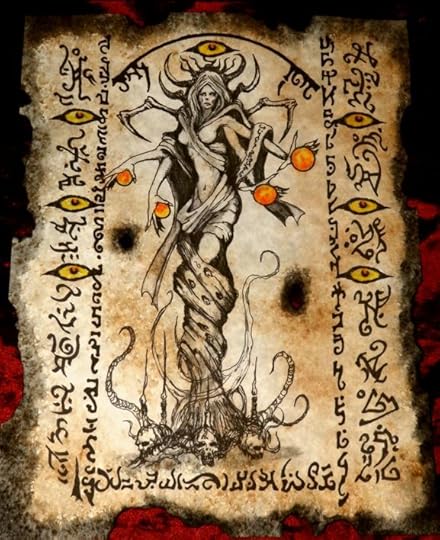
“The Disinterment” makes good use of language and imagery, creating suspense and an unsettling mood. Unfortunately, there are logical problems in the plot that diminished the fun for me. The story is arguably the 100th oldest extant story worked on by American weird fiction author Howard Philips Lovecraft (1890-1937), this time in collaboration with Duane W. Rimel (1915-1996). I am reading all of his fictional works in chronological order to see his development as a writer.
According to Joshi & Schultz (2001) in their An H.P. Lovecraft Encyclopedia, Rimel probably did the majority of the writing and the younger author claimed that “HPL performed only slight revisions” (p. 69). This is up for debate, however. Joshi & Schultz (2001) point out that if Lovecraft only made slight changes, “Rimel never came so close to imitating HPL’s style and the idiom” (p. 69). Resemblances to Lovecraft’s early work are apparent, especially themes from “The Outsider” (1921). As I wrote above, the prose is strong in “The Disinterment.” There are several plot holes that bother me. The unnamed narrator’s motivation to fake his own death does not make any sense. His “friend” Marshall Andrews is the only one who could have possibly benefited from it. What’s more, how come our protagonist never realized that Andrews had a dark side. They had been friends for years. What’s more, surely the narrator would have figured out that his head had been surgically implanted onto the body of a primate earlier. For example, when he put on shoes he would have noticed how short, hairy, and ape-like his feet were. A rewrite by the author could have fixed these problems and we could have wound up with a much better weird tale.
Title: “The Disinterment”
Author: Duane W. Rimel with H.P. Lovecraft
Dates: September 1935 (written), January 1937 (first published)
Genre: Fiction - Short story, science fiction, horror
Word count: 4,600 words
Date(s) read: 5/23/22
Reading journal entry #162 in 2022
Sources:
Link to the story: https://hplovecraft.com/writings/fict...
First publication citation: Weird Tales vol. 29, no. 1 (January 1937): 95–102.
Joshi, S. T., & Schultz, D. E. (2001). An H.P. Lovecraft Encyclopedia. Greenwood Press.
Link to the image:
https://www.deviantart.com/mrzarono/a...
Written on 5/23/22.

January 3, 2016
Although with an obvious twist of affairs the story unfolds itself as an ensemble of conventional horror with a precise and constant beat. Nevertheless, one should recognize Lovecraft's dexterity in summoning a detailed landscape in this particular story. Even if the ending and the direction are quite obvious from the first paragraphs onwards, it holds a very picturesque gothic presence which is pleasant. The details are ample and well illustrated, rendering a very clear and articulate picture of the unfolding drama from the victim’s point of view. This belongs to a good, yet short, mid-afternoon winter read.

May 19, 2017
My solid Howie is back, after the racist crap that was Medusa's Coil. Here in the The Disinterment, our narrator contracts leprosy during his travels, and seeks the help of his doctor friend, who also has a reputation for wild experimentation. There's also some vague rumors of strange medicine from Haiti. You would think the narrator would take this as a dire warning, leprosy or no leprosy. The florid language, the slow anticipation, the build up to the horrific end - all of these elements which I love so much in Lovecraft's fiction are present in this little story. Nicely done.

April 27, 2017
Es el primer cuento que leo de Lovecraft , y debo decir que estoy gratamente sorprendida. Cuando se escucha mucho de un autor, se termina leyendo con demasiadas expectativas pero este no es el caso.
Definitivamente el autor sabe cómo crear una atmósfera de misterio en torno a sus personajes, y como involucrar al lector con los pequeños datos que va dando, tentándonos a descubrir el misterio.
En conclusión, esta pequeña narración me ha gustado bastante y voy a seguir buscando más cuentos de este autor.
Definitivamente el autor sabe cómo crear una atmósfera de misterio en torno a sus personajes, y como involucrar al lector con los pequeños datos que va dando, tentándonos a descubrir el misterio.
En conclusión, esta pequeña narración me ha gustado bastante y voy a seguir buscando más cuentos de este autor.

March 1, 2018
Decently drawn out psychological tension, but (a) the ending was telegraphed; (b) it's hard to believe that the narrator didn't "peek", given the length of time described. Still, the writing was better than usual for Lovecraft.


June 2, 2012
Lovecraft reworks The Reanimator, from the victim's point-of-view. Interesting, but the twist is horribly obvious early on.

June 7, 2019
Оповідач заразився проказою, лікуючи свого брата на Філіппінських островах. Його друг Ендрюс пропонує йому пожити у себе, щоб ніхто не дізнався про хворобу і це не зіпсувало йому репутацію. Ендрюс є вправним хірургом, але йому потрібна поміч. Він пливе на Карибські острови, де дізнається про один цікавий метод. Він пропонує оповідачу наступний вихід: доведеться інсценувати його смерть, щоб ніхто не дізнався про хворобу, а потім він його вилікує. отримавши згоду, Ендрюс вводить його в короткочасну кому, проводить "похорони", викопує і робить операцію. Після операції оповідач довго не може опанувати своє тіло. Він живий і, схоже, здоровий, але ледь рухається. Ще він помічає, що Ендрюс тепер дивиться на нього не як на друга, а як на піддослідного. Нарешті йому вдається натренувати своє тіло так, що йому вдається звільнитися і вбити підозрілого лікаря. На цвинтарі він помічає свою могилу, але в ній дійсно лежить його тіло - однак без голови, яка зараз пришита до чужого тіла.

January 25, 2018
A man supposedly suffering from leprosy is assisted by his friend who is a surgeon. After visiting Haiti his friend suggests the use of a strange drug which causes temporary death - mimicking rigor mortis - and a mock burial and funeral. Upon awakening he realises that his friend has evil intent, and has been scheming to manipulate his fear of illness to turn him into one of his strange and evil experiments.
Bed bound and devoid of sensation below the neck he waits whilst sensation and muscle use slowly returns. Eventually realising that a vile and unnatural experiment has been practised on him, his body switched whilst his own rots headless in the grave.
Chilling and an interesting take on the Frankenstein legend.
Bed bound and devoid of sensation below the neck he waits whilst sensation and muscle use slowly returns. Eventually realising that a vile and unnatural experiment has been practised on him, his body switched whilst his own rots headless in the grave.
Chilling and an interesting take on the Frankenstein legend.

June 9, 2019
Another one of Lovecraft's Frankenstein ripoffs, which always seem to be my least favorite of his stories. But this one was actually pretty good, due in part to the perspective it takes. Not the arrogant knowledge-seeker as usual, but rather the subject of said character's vile experiments. That viewpoint drives a more engaging drama and more efficiently and satisfyingly controls the flow of information. It's also quick and to the point, unlike Herbert West Reanimator.

January 3, 2024
Might be somewhat of a classic horror story by this point, but it must have been a pretty freakish idea back then. The narration is from the point of view of a ex-soldier who was unfortunately afflicted with leprosy. He unwittingly agreed to a scientist friend's suggestion on how to prevent discovery by others before his affliction became visible. Somewhat predictably, his friend turned out to have ulterior motives.

February 2, 2022
The end was good, but the buildup was lacking. I feel like it could have gone much quicker in the lead up to the end. It was almost boring at points, but the end, the internal thoughts of the narrator were pretty spot on and believable to how I think someone in his position would feel which I liked.
November 17, 2022
Здесь довольно неплохо и лепра и зомби (не совсем) и трансплантация. И есть некоторый неожиданный поворот
Я честно говоря ожидал в конце окажется, что повествователя переселили в тело негра. Но видно для Лавкрафта это уже было бы слишком.
Я честно говоря ожидал в конце окажется, что повествователя переселили в тело негра. Но видно для Лавкрафта это уже было бы слишком.

December 6, 2017
A collab I hadn't heard of before but was glad to read. The MC becomes ill with leprosy and his "pal" offers to look after him but he soon finds out that his "buddy" has his own plans for him.

February 7, 2021
Fugu tetrodotoxin interment.

February 12, 2021
Short and creepy, just as like it. There isn't much potential in the story, but it delivers what is expected from it (thanks to the ending).

May 18, 2023
54.00
Хирург Эндрюс, прокаженный друг и чужое тело
Хирург Эндрюс, прокаженный друг и чужое тело
This entire review has been hidden because of spoilers.

November 20, 2023
Plastic surgery before it was cool
This entire review has been hidden because of spoilers.
August 2, 2024
najlepsze opowiadanie Lovecrafta 👍

August 29, 2024
Not bad!

December 9, 2024
نسخة فرانكشتاين من اللافكرافيتة ...

February 11, 2025
This was intriguing 🤨
Andrew is basically a mad scientist who views his friend, the narrator as nothing more than a test subject
Andrew is basically a mad scientist who views his friend, the narrator as nothing more than a test subject
February 19, 2025
6/10 - Short Story
Displaying 1 - 30 of 36 reviews