Jump to ratings and reviews
Rate this book

Toronto Trilogy #1

Murther & Walking Spirits

Rate this book
"I was never so amazed in my life as when the Sniffer drew his concealed weapon from its case and struck me to the ground, stone dead."

So begins the story of Connor "Gil" Gilmartin when he catches his wife in flagrante with the Sniffer, his former colleague and now his murderer. Unfortunately, death is only the first indignity Gil is about to suffer.

For he lingers on as a ghost, and from this bleak vantage - made even less endurable by the fact that he must spend the afterlife sitting beside his killer at a film festival - he is forced to view the exploits and failures of his ancestors, from the forerunners who sailed up the Hudson to Canada during the American Revolution to his university-professor parents.

322 pages, Paperback

First published January 1, 1991

52 people are currently reading
1312 people want to read

About the author

Robertson Davies

111 books921 followers
William Robertson Davies, CC, FRSC, FRSL (died in Orangeville, Ontario) was a Canadian novelist, playwright, critic, journalist, and professor. He was one of Canada's best-known and most popular authors, and one of its most distinguished "men of letters", a term Davies is sometimes said to have detested. Davies was the founding Master of Massey College, a graduate college at the University of Toronto.

Novels:

The Salterton Trilogy
Tempest-tost (1951)
Leaven of Malice (1954)
A Mixture of Frailties (1958)
The Deptford Trilogy
Fifth Business (1970)
The Manticore (1972)
World of Wonders (1975)
The Cornish Trilogy
The Rebel Angels (1981)
What's Bred in the Bone (1985)
The Lyre of Orpheus (1988)
The Toronto Trilogy (Davies' final, incomplete, trilogy)
Murther and Walking Spirits (1991)
The Cunning Man (1994)

http://en.wikipedia.org/wiki/Robertso...

Ratings & Reviews

What do you think?
Rate this book

Friends & Following

Create a free account to discover what your friends think of this book!

Community Reviews

5 stars
529 (24%)
4 stars
845 (39%)
3 stars
605 (28%)
2 stars
133 (6%)
1 star
36 (1%)
Displaying 1 - 30 of 137 reviews
Profile Image for W.D. Clarke.
Author 3 books352 followers
March 3, 2022
3.5* rounded down (in relative not absolute terms, to but reflect its position in my personal Davies pantheon)

A polyphonic novel is a bit of a risky gambit. In Milan Kundera's terms, it involves (as I wrote elsewhere)
the addition to the novel's discourse of other ways of knowing—philosophy, history, meditative essay, dream, etc.—that will create “a new art of novelistic counterpoint” (quot'ns from The Art of the Novel) in which each (economically deployed) supplemental discourse resonates with the main narrative to the extent that the reader has a kind of polyphonic experience, listens to the concordant melodies of several well-trained voices, voices capable of superposing themselves in a single, unified thematic direction, into “one music.”
In addition to this, Kundera advocates paring the narrative component itself down to the bare minimum, so as to attack the unique existential question which belongs to this novel and to no other novel (for that is, a K sees it, the novel's sole raison d'etre) as swiftly and as efficiently as possible, to achieve the maximum poetic desnity. "Such density," I go on (and on, a bit)
is further achieved through polyphonic composition, “the simultaneous presentation of two or more voices (melodic lines) that are perfectly bound together but still keep their relative independence”. But polyphony does not mean mere digression or the telling of stories-within-stories, something that the novel has dealt with since the seventeenth century. Rather, true polyphony can only result when there is no sense that the additional voice is a mere departure from the main narrative line, a departure that will somehow serve or be subsumed into the primary voice. For “one of the fundamental principles of the great polyphonic composers was the equality of voices: no one voice should dominate, none should serve as mere accompaniment (75). Each , in fact, should so successfully blend into the other that, while they appear to be quite independent of the others, when taken together the audience should experience “the invisibility of the whole”(76).

Such an emphasis on thematic rather than narrative unity can be perceived most clearly by the reader in negative terms: if the reader mentally “erases” or removes even one of the voices from a Kundera novel—be it a diary entry, philosophical meditation or first person narration—it immediately becomes apparent that the brilliance of the novel’s thematic obsession—the number of thematic “lumens” it produces (so to speak, and to shift the metaphorical register from aural to visual) is thereby greatly diminished. If Immortality had been written without, for example, the story of Goethe and Bettina, or if The Unbearable Lightness of Being lacked the author’s meditation on how the philosophical legacy of Descartes cast a shadow over Teresa’s relationship with her dog Karenin, how much less powerful those two novels would be!
Now in practice, some of Kundera's other books approach the ideal experience described above less closely than others: especially with the short stories, I feel, there is a sense that though polyphony was aimed for, cacophony threatened in the wings, or crept onstage while the conductor's back was turned.

Such is the case with Murther and the Walking Spirits, alas, though it is not all bad news, not by a long shot. What Davies does so well here is completely inhabit the disparate lives which people this novel, all of whom are ancestors of the protagonist who is murdered right at the vary outset, and who spends the rest of the book attending a classic films retrospective series at TIFF, the annual Toronto International Film Festival—as a ghost, mind you, and seeing an entirely different set of films than the ones presented before the, erm, live audience (though they bear the same titles).

That these films bear partial/thematic resemblance to their originals (e.g. The Spirit of 76, Bergman's Scenes From a Marriage) in some fashion goes but a short way toward making them properly polyphonic in the book. What really yokes them together, and at times somewhat forcibly in my opinion, is that they all peep in on the psychic interiors of the murder victim's paternal great-great grandparents, great-grandparents, and so on, right up to his own father, from pre-revolutionary Haarlem and 18th century Wales through a pioneer town in 19th century Ontario before heading to Salterton (Kingston, Ontario, home of my alma mater!) and then finally back to Wales, Davies does quite a remarkable job at inventing and fully inhabiting their lives and worlds.

His ghost does this after the manner (and, in the quot'n below, words) of the ghost's colleague and teacher, something of an expert in trans-cultural or syncretistic metaphysics:
"The Queen of Pastimes, the sport of the intellect, the high romance of speculative thought; infinite in scope, relying on the treacherous subtlety and learning of the player; and yet, in its daring and refusal to heed mundane considerations, capable of splendid flights into the darkness that surrounds our visible world. Metaphysics, the mother of psychology and the laughing father of psychoanalysis. A wondrous game, Mr. Going, in which the players cannot decide what the relative values of the pieces are, or how big a board they are playing on. A wondrous, wondrous diversion for a really adventurous mind."
His ghost spends relatively little time actually reflecting upon metaphysics or the above lives, however, and so the lone unifying feature to the polyphony—the regretful, loitering, but somewhat questing ghost—doesn't process the data quite enough himself to drive to the heart of the kind of existential question that Kundera is talking about above. That he projects it on to us, rather, as if he were the light shining through the film and we readers the screen, does provide its own unique pleasures (for one departs from the lives of ancestor's family to land like a time-traveler smack in the midst of another in much the same manner that one is forced to abruptly leave off reading one amazing novel's start in Cavino's If On a Winter's Night a Traveller only to be dazzled by another), but for this reader they felt like partial pleasures when viewing the novel as an attempted whole.
And yes, what of the murder itself? Well, imagine a great introductory chapter which raises that very question, then a lacuna of 230pp, then you are back to the murder for an answer, of sorts—an attempt to tie up the whole transplendent effusion together in a mere 30 pages was doomed to fail, perhaps, but it was actually kinda glorious to witness the lad try. He was nearing the end of it all himself, and he hadn't yet tired of trying something new, or of trying to wrestle with that great mystery, existence, and our species' dogged persistence at it, in spite of everything.

You know, writing this I feel tempted to award it that extra half-star for effort, but no. It was a was good enough innings, a very fine achievement even, of its kind. And so like a homecoming to be back in his universe (of erudition, of Rabelaisian tolerance and even love for the earthen, for all of life) once again. My regret: only one more novel to go, as the Toronto Trilogy was never completed.
Profile Image for julieta.
1,332 reviews42.5k followers
November 30, 2008
I´ll start by saying that I love R Davies. His Salterton and Deptford Trilogies are wonderful. But this book is just strange. The story seems promising, a man is killed by his wife´s lover, and becomes the narrator as a ghost who can´t seem to go away. He has the Davies humor which I so much love, when he starts to talk about the lover (Sniffer, who he does not take seriously at all), or his wife who seems like another person after the murder.
But then he forgets about that and goes on to tell the story of his family, is it his family? It´s never one thing or the other, the whole thing seems so subjective, there is something about how the characters never really develop, that makes it seem like telling the story is much more important than the story itself.
There are very few dialogues, one of the RD traits that I most love, he seems to want to cover so many generations, in a way that he never really gets into any of them. The first and last part are really good (about the murder and the wife), but most of the book is this never ending story which I just wanted to finish. I only came to the end because I have loved so many of his books, I just could not give up on him!
Profile Image for David.
744 reviews4 followers
June 30, 2023
I first became acquainted with Robertson Davies' remarkable fiction way, way back in college. He died almost 30 years ago yet remains one of Canada's finest authors. With a penchant for trilogies, this novel is the first volume from his unfinished fourth set: The Toronto Trilogy. Part of me wishes there was a twelfth book still waiting to be read; part of me has to admit that this is nowhere close to his best effort. The linguistic elegance and narrative creativity are still present, but the story itself didn't transport me. Not much, anyway.

The bulk of the book involves our narrator - the disembodied spirit of a recently murdered theater and film critic - watching his family's multi-generational history play out before him cinematically. Let's just say that some sections are more compelling that others. I strongly suspect that there is a fair amount of autobiography woven throughout. However, hundreds of pages devoted to a fictional character's extensive family background can be tiresome. There are brief contemporary sections which book-end the central story and these were more interesting.

If you choose to give Robertson Davies a try, I would steer you toward the Cornish Trilogy and away from this one.

Profile Image for Katerina.
900 reviews795 followers
August 31, 2021
DNF at 30%

I’m so, so sorry.
Может, параллельный монтаж работает в кино, но тут все герои и судьбы схлестнулись, как линии высоковольтных проводов в большом городе: хаос, смятение, не понятно, кто куда ведёт и нельзя ли этот провод отключить вообще. Мне показалось, что можно.
Увы и ах.
Profile Image for Rafa Sánchez.
462 reviews108 followers
April 30, 2019
Soy un fan declarado de Robertson Davies. Llevaba varios años sin leer algo de él, desde que terminé su última trilogía completa (Salterton) que me pareció ligeramente inferior a las dos primeras (Deptford y Cornish), aunque en conjunto las nueve novelas me parecen una obra colosal, creo que serían las únicas novelas que recomiendo a cualquier persona, antes de conocer sus gustos literarios, porque son 9 novelas amenas, profundas, interesantes, divertidas y perfectas en ritmo y estilo narrativo.

La décima novela de Davies "Asesinato y ánimas en pena" es otro ejercicio más de sabiduría humanística (es el rasgo de personalidad del autor que más me conmueve). Tenemos mucha fortuna de que personas de tanta cultura se rebajen a escribir novelas para que nos abran las mentes a campos de conocimiento ignotos, nos siembra la inquietud de intuir que hay toda una cultura esperando a que le hinquemos el diente. Y toda esta misión ciclópea de desasnar a nuestra atribuladas personas la lleva a cabo con un distanciamiento humorístico, sin ninguna afectación ni moralina, con una media sonrisa que te seduce intelectualmentne. Gracias, Robertson.
Profile Image for Kristen.
674 reviews47 followers
November 9, 2025
2021: With this, I've read all of Davies's fiction, but certainly not for the last time. Murther and Walking Spirits is an interesting twist on Davies's penchant for coming of age stories. Rather than tell the story of one person's life, Murther tells the story of protagonist Conner Gilmartin through a series of historical vignettes featuring his ancestors and the events that brought them to Canada. As such, it's also a biography of Canada as a nation, caught somewhere between Commonwealth loyalties and American influence. That's just one variation of the theme of the golden mean, which winds through the book: "These matters require what I think of as the Shakespearean cast of thought. That is to say, a fine credulity about everything, kept in check by a lively skepticism about everything."

2025: It was not the last time. I actually re-read this fairly quickly as part of my Davies re-read project. Enjoyed it again immensely and was struck anew how good all of his books are.
Profile Image for Vassiliki Dass.
299 reviews34 followers
September 18, 2017
4.5* et 5* pour le dernier chapitre ainsi que pour son amour et son grand estime pour la Grèce antique et la religion orthodoxe. Un plaisir à lire
573 reviews9 followers
August 25, 2013
Another fun read. An interesting premise and as always brilliant insights into ourselves in the process. i.e. in the musings of the dead main character who gets a chance to view the lives of his ancestors in a very private and personal way: "Yet -- was I really such an unreflecting, uncomprehending jackass when I was alive that I supposed the sufferings and inadequacies of humanity came for the first time in my own experience? No; not wholly. But I had never applied what I knew as general truths to the people without whom I should never have experienced life; I had taken them for granted. As McWearie use to say, one's family is made up of supporting players in one's personal drama. One never supposes that they starred in some possibly gaudy and certainly deeply felt show of their own." It's interesting how the humanness of our parents/grandparents/aunts/uncles, and yes, even our children is missed by ourselves as we navigate in our own stories. It's a good warning to not become a trivializer by separating our thinking from our feeling because "To the human creature nothing that gets strongly to him is trivial. It is all on the heroic scale, so far as he can grasp it...They just have to live (in italics) it, and endure it so far as they can bear."

I always come away from Robertson Davies wondering exactly where he stands on faith. At times he is very disparaging, yet there are things that ring true to me in my own faith. I'm sure in his non-fiction writings he's likely an agnostic, but yet through my own tinted glasses I feel reaffirmed. A case in point with the protagonist's reflection upon how generations progressively move (in what seems to me over time to be a pendular fashion)away from faith (only to have subsequent generations come back to it): "Doubtless it is the devil's work to nibble away at a man's belief in such a fashion, but it must be admitted that the Devil is a fine craftsman, and so many of his arguments are unanswerable. Probably Heraclitus would have had something to say about that. Everything, in time, begets it's opposite."

Profile Image for Rachel.
570 reviews5 followers
October 1, 2014
(Actual rating = 2.75 stars)

Murther and Walking Spirits chronicles the death and early afterlife of Conor Gilmartin, an arts editor for a Toronto newspaper. After his wife's lover kills him, Conor takes a journey through his father's family's past.

If I had read the negative reviews of this book before picking it up, I might have decided not to read it. I share the sentiments of many of the reviewers who didn't like this book. It starts off strong, but Conor's journey through his family's history feels like a diversion, and I really didn't care about what happened to his great-great-grandparents. The only moments that I enjoyed were in the present, when Conor is trying to find a way to haunt his killer.
Profile Image for Tim Weakley.
693 reviews27 followers
June 14, 2009
This…is a very odd book. I bought it and shelved it at first because, as a Canadian, I thought I should read something by one of the “Great Canadian Author’s”. I chose Davies because I had had very little exposure to him. The book begins with the main character being murdered in the opening line, and progresses from there. I really wasn’t sure if I was going to enjoy it or not but as we progress through the stories or our protagonists ancestors if began to pick up speed for me. While we watch Connor obtain perspective ( he espouses the idea “we live and learn, but we die and learn too” ) on everything that had gone before him I confess to becoming caught up in the idea of wasted opportunities. I became tied into the thought that it is impossible to see the people that we know as our parents and grandparents as anything other than just that. The concept that they were once young and had plans and dreams, made mistakes and choices that they might not have otherwise made, is a difficult one to grasp in anything other than a superficial way. The ending of the book was a little week, but I can forgive that for where it took me. I’ll read more of this author and I can see why he gets the play he has over the decades.
Profile Image for Paul Clayton.
Author 13 books76 followers
November 18, 2014
‘Gil’Gilmartin is killed by his wife’s lover. Afterwards, Instead of watching his whole life passing before him as the cliché says, he instead finds himself hovering about his killer (a film critic) at a film festival and watching not his own life, but the lives of all his forebears in a series of films. After I started the book, I had doubts that I would enjoy such a novelistic device. However, I recalled how much enjoyment I got from reading one of Davies’ books thirty some years ago while on a trip to Canada. I would say that there are, based on this book and the last Davies’ book I read, two things that you will learn from his novels. First off, I don’t know what Davies background is, but he is a fountain of knowledge. Historic and cultural facts are interwoven with the finesse of an artist and the confidence of an academic that has long studied his subjects. AND, you will learn something of life, if you’re open to that. I recommend this book and I will read another of Mr. Davies’ fine novels soon.

Murther and Walking Spirits
Profile Image for Dominique.
209 reviews14 followers
February 18, 2016
This was a completely different book than I thought it was. It's kind of like 2 books; a story within a story, a venn diagram sort of book. Actually, it was a book within a novella. It was fine or whatever. Not as good as The Deptford Trilogy: Fifth Business/The Manticore/World of Wonders, but still fine.

(I skipped a bunch of pages at the end because I just wanted it to be the end. Not in a bad way, but in a "This is all great, but I don't have time for this right now" way.) Skip it, unless you want to read all of his stuff for completion's sake.
Profile Image for Julie Akeman.
1,104 reviews21 followers
November 27, 2016
I'm glad I wasn't drinking wine or I would have spewed it out too just like that ass Going. This was really a fantastic read and it's the first I read of this particular author. History, humor, Irony and sardonic wit, I really love the forays into philosophysing over life, death and one's ancestoral background. A good piece that made me sigh in satisfaction when I finished it. It's still rolling around in my head even though I am deep into another book, but that is just how my brain works. This is a good thing, that a book stays with you even when you are on to the next one. It's a worthy read. loved it!!
Profile Image for David.
489 reviews8 followers
June 30, 2017
Rant: please put R Davies' books on ebook, reading physical books is a chore for me.

The main character is murdered in the book's first sentence, when he walks in on his wife and her lover. In his ghostly form he follows the killer as he attends a film festival, but instead of viewing those movies he sees his ancestors' lives going back hundreds of years. It concludes by returning to the present.

Really enjoyed the stories and characters of his ancestors, their successes and failures, and how they arrived in the New World. The denouement seems incomplete but there is a sequel I'll want to tackle, if it ever comes to Kindle.
Profile Image for Isabelle.
247 reviews67 followers
October 6, 2007
Very unique premise since the narrator is dead and comes to the reader in the form of a spirit, telling his tale an revisiting his life immediately after he is murdered (at the opening of the book). Of course, he has a lot to atone for, and hi tale will shed light on guilt, despair, the unconscious. The book is also very metaphysical, not a stretch since the hero/narrator is a ghost in transit.
Profile Image for Stephen Gallup.
Author 1 book72 followers
January 28, 2020
The first-person narrator of this story—theatre and film critic Connor Gilmartin, who is generally considered "a first-rate journalist" and "an able fellow"—is murdered in the very first sentence of the book.

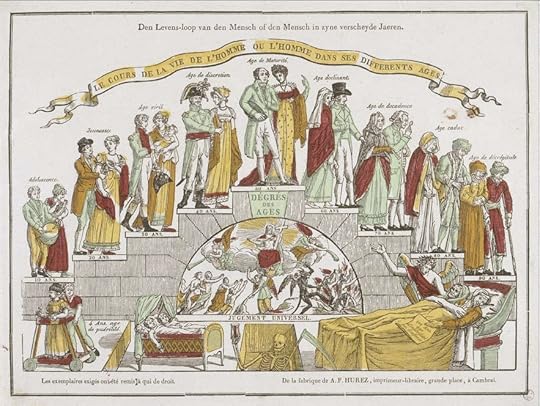
That event decisively truncates his earthly existence, removing him from what would be the fourth step of the antique painting shown below (which is pointedly discussed at both ends of the book), and robbing him and the world of anything he might have done in the time he reasonably assumed to have had left. Degrés des Ages

He feels annoyed by this turn of events, noting that "I appear to be stranded in a state of nothingness ... Feelings I certainly have. Emotions, perhaps I should say." He seems mildly disappointed in his wife Esme, who promptly begins repairing the crime scene as matter-of-factly as if someone had spilled a glass of milk. But he is quite irked with the guy who offed him, Allard Going, aka "the Sniffer," an ambitious lesser talent, "a posturing ninny," in fact, whom he'd discovered in bed with her.

That much is established in the opening pages. But what, if anything, remains for poor Connor? He continues to lurk around, and I thought for a while the story might resemble that old Patrick Swayze movie, particularly in passages like this:

"I have not tested my powers, for I am still a green hand at this business of death, and I have no clear idea of what my powers may be. Can I haunt Going? I have never given any consideration to the matter of haunting before, and what I recollect from ghost stories does not especially appeal to me. To be a crude spectre, appearing in doorways or discovered squatting by the fireside when people enter rooms, is out of the question for such a spirit as I. My intended prey lives in an apartment, and has no fireside; I shall certainly not make a fool of myself squatting by his thermostat."

Instead, when the oblivious Going assumes Conner's job by attending a classic film festival, Conner tags along, and to his surprise Conner finds himself watching movies especially made for him. They are enactments of the lives of his ancestors over the last couple hundred years, people who, mostly, had just been names to him.

There's Anna Gage, for example, widow of a British officer in the Revolutionary War, who flees to Canada with her three children. Another branch of the family tree begins with a Wesleyan evangelist who adopts a boy in a remote corner of Wales, names him Wesley, and teaches him to be a weaver. Most of the book is taken up with dramatizing the successive generations of these two families, which eventually converge in Canada.

I spent much of my time with this book feeling mystified as to its purpose. It was certainly well-written and insightful. For example, observing his own father in youth, Connor says, "If he had inherited all his father's wealth he would undoubtedly have continued to be a professor of Eng-Lang-and-Lit because that was what he knew, what he liked best, and what afforded him refuge from aspects of life he did not want to face." So I believed the author had a purpose in painstakingly tying all these lives together with Connor's. I just couldn't imagine what that purpose might be. (It helped that this treatment reminded me somewhat of one of my favorite novels, Ursula, Under .)

Gradually, I perceived that the wisdom and foolishness and kindness and indifference and prosperity and dissolution that marks each preceding generation is no different from anything Connor has experienced. His discovery (which isn't all that earth-shaking): He'd assumed his forebears to be mere "supporting players" in his own drama. He'd never considered that they might have "starred in some possibly gaudy and certainly deeply felt show of their own."

In other words, I guess, his personal fate is not exactly tragic, because it is simply another permutation of the usual. Did I get that right?

Davies got me right, perhaps, because he described my interaction with his book in saying of one of its characters, "He thought he was reading, but he was musing—not thinking, not deciding anything, not seeing anything afresh but just bobbing up and down in the dark tarn of his feelings." That's the mode it tended to put me in. I did not thoroughly enjoy it, but I wouldn't mind giving another of his titles a try.
Profile Image for Karla Huebner.
Author 7 books94 followers
Read
December 26, 2018
While this is by no means my favorite of Davies's novels, I nonetheless felt I should give it a reread. I love the premise-the protagonist has just been somewhat comically murdered by his wife's lover (a fellow journalist of whom he has a rather low opinion), and in the afterworld he becomes acquainted with the lives of various ancestors while still taking an interest in his wife and his killer. Davies didn't really manage to pull this one off with the brilliance of his other books (even his early and less philosophical novels), but if nothing else I need to think through just why this book doesn't quite succeed. I think that, in part, while the ancestors are interesting, the device of dead Gil seeing their lives in movie form while the Sniffer is at a film festival isn't that well carried out, and I'm trying to think through just why since again, I rather like the device itself. But the ancestors' lives bear little relation to Gil's murder by the Sniffer, and despite the historical interest of their stories, we don't really get sufficiently involved in all of their personalities and sufferings. Perhaps a bit less of the ancestors (or a less distanced visit with them) and a bit more with Gil's own life and view-from-afterlife. There's a whole lot to like here, only I would have suggested revisions had I been Davies's first reader. (Is he, from the afterlife, observing me type these comments? If so, does he wish me well in my related endeavors? Love you much, dear departed Author. Here's to three decades together, and we hope three decades more to come.)
69 reviews1 follower
May 23, 2021
I really like Anthony Burgess, and because he believed that Robertson Davies wrote one of the 99 best books in the world, I picked up this book when I stumbled across it. I now know why Burgess is impressed--in fact I kept seeing glimpses of Burgess in Murther. Though slow at times, Murther kept my interest. The plot mechanism was quite unique, and it dovetails into why genealogy fascinates me much. A family is a book. Each generation is a chapter that creates the setting for the generation to come.

Now I have to read #2 in the Toronto Trilogy. Too bad Davies died before he could write #3. At least he has another two trilogies that I look forward to reading.
Profile Image for Greta.
1,003 reviews5 followers
March 9, 2023
Davies is a great writer and tells an interesting story, but this particular book is the first of three and doesn't bring closure to the total story. I'll look forward to reading more of his writing in the next books.
66 reviews
September 16, 2024
Robertson Davies. After a string of unpleasant reads (excepting the Brautigan) whom did I turn? The Master Robertson Davies. So knowledgeable, perceptive, wise, warm, and hilarious, I’ve immensely enjoyed every one of his novels. (Unfortunately, I’ve only one novel of his left to read.)
Profile Image for Linda.
23 reviews2 followers
March 20, 2013
The narrator of the novel is murdered on the first page and is bound in some way to his murderer. Together they attend a film festival, where the murderer (a film critic) watches classic films along with the rest of the audience. The narrator, however, is trapped and forced to watch a different set of films. Gradually it becomes clear that these are films showing his history and that of his family - the story of his great great grandmother escaping New York after the War of Independence for example.

Nothing is hidden - the narrator can overhear their thoughts, see the unfolding actions in context. It is beautifully written, with strong characters and a really strong sense of place (the description of the poverty stricken village in Wales is particularly striking).

It is also an uncomfortable read in the sense that gradually you as the reader begin to wonder what you would have to watch if you were in this position.

I would recommend the novel - it is quirky, amusing and very well written; although it appears to be episodic everything is connected. The different characters are clearly defined, with some that are almost unforgettable and the sense of place is flawless.
Profile Image for Alexandra.
34 reviews1 follower
November 5, 2012
It is getting more interesting as I am starting to catch on to what is going on. Basically this guy is murdered by his wife's mister. Now the murdered guy is at a movie festival at his murderer's side, watching movies that relate to himself, or "attend to his posthumous needs". I am not sure if this movie festival is actually an exploration into the consciousness of murderer and murdered as a way for them both to deal with the event that just happened. I am starting to not want to put the book down!

update: I finished the book. Overall, it was difficult to follow, but had some wisdom and wit that was worthy of reading.
Profile Image for Kate.
837 reviews14 followers
August 10, 2016
Discovering the work of Robertson Davies is one of the highlights of my reading life. This one was a particular delight: how could you not love a book whose first-person narrator is killed in the book's first paragraph? The conceit of Connor Gilmartin watching his family history unspool as a private film festival is brilliant, and Gil is a wry and erudite narrator. I loved the book's final twists and its large cast of characters, who are all true individuals. A tragedy for dedicated readers that Davies did not live to finish this trilogy; there are such intriguing possibilities for so many of the characters in this book.
1,778 reviews8 followers
December 11, 2016
Inventive and original, entertaining and interesting. I'm not sure how this book would be categorized in terms of genre, but I would simply describe it as thoroughly enjoyable and a great pleasure to read.
Profile Image for Lory Hess.
Author 3 books29 followers
Read
December 22, 2021
"We live and learn, yes. But we die and learn, too, it appears."

Reread of what I think is Davies's weakest novel, with an interesting but awkwardly worked out premise. The idea of a recently deceased man viewing a private "film festival" of his ancestors' lives is ingenious, but hard to put into practice: describing films is the deadliest thing imaginable, and aside from a few glimpses Davies wisely doesn't try, mostly reverting to the narrative techniques that he is accustomed to using. In effect his first-person narrator becomes a third-person narrator of the scenes he is beholding, and the switching back and forth can be jarring.

I also don't feel like we get enough of Gil, the dead man - he comes to know himself through this vision of his forebears, or so he says, but who is he? Again, we get some glimpses, but then we're swept away into someone else's life, and the result just doesn't entirely satisfy.

Along the way there were some wonderful nuggets of wisdom, even if the whole didn't quite gel for me.

"Was I really such an unreflecting, uncomprehending jackass when I was alive that I supposed the sufferings and inadequacies of humanity came for the first time in my own experience? No; not wholly. But I had never applied what I knew as general truths to the people without whom I should never have experienced life; I had taken them for granted. As McWearie used to say, one's family is made up of supporting players in one's personal drama. One never supposes that they starred in some possibly gaudy and certainly deeply felt show of their own."

In the end, the message is one of compassion and love, for the players with whom we share our little drama, but also for ourselves. And that's always worth an attempt at communication.
1,082 reviews14 followers
December 11, 2019
Anything by Robertson Davies is going to be a little strange but having your narrator killed in the first sentence and then have him narrate his own history as a ghost (if that is what he is) is very strange indeed.
Connor (Gil) Gilmartin is killed in an unexpected dispute with his wife's lover. However that is only a device to get Gil dead so that he can attend what appears to be the first Toronto International Film Festival and there view a series of personal films showing events in his personal family history.
What Davies is actually telling in great humorous detail is a history of Ontario from the point of view of the British settlers. It is not intended to be complete but gives one family's development from incomers to thorough Canadians. It is a very egocentric tale because these characters were concerned about themselves, especially since they seem all to have been running away from something; the first being a Dutch New York widow of a dead British officer fleeing the American rebellion.
As Gil learns about his ancestors he is also still aware of what is happening in the present and is able to think about ways that he can get revenge on the "Sniffer" for having killed him. Strange that he doesn't really have great animus against Esme, his wife, except in her choice of partner.
As with any Davies book all you can do is let it run over you and try to keep your laughter from blocking the narration. I'm sure there are lengthy lectures on the ins and outs of the book in "can lit" classes but it's so much better to be able just to enjoy it and I have learned the noun for the verb despise; it is despisal.
Profile Image for Manuel García Borrego.
33 reviews
April 29, 2020
Davies mata por aburrimiento. Parece, de hecho, bastante consciente de que para mantener al lector en el páramo que ocupa la mayor parte del libro tiene que proponer un arranque fuerte que lo compense, y por eso se carga al protagonista nada más empezar. Con ese caramelo se retrotrae al siglo XVIII para contar la historia completa de la familia, un recurso que funciona mientras el lector es capaz de ser paciente y mientras el propio Davies no se cansa de sí mismo, algo que ocurre en el tercio final. Cuando decide apartarse de esa narración lineal —¿demasiado estándar para un escritor que quiere ser de culto?— y comienza a experimentar de manera peregrina se diluye por completo la trama, apenas se adivina un hilo escondido detrás de parrafadas vacías, y la lectura se convierte en un proceso diagonal en el que pasar las páginas es más importante que leerlas. Por suerte en los últimos compases retoma la trama inicial, le aplica un buen envoltorio al capítulo histórico y lo remata decentemente.
Profile Image for Erik.
360 reviews17 followers
Read
June 16, 2020
You know how an author can lose my attention? Set up an interesting premise (the main character is murdered in the first paragraph and narrates the story of his wife and murderer's complicity in his murder) and then goes off on a tangent by telling me the main character's family tree. Starting with his great-great-great-grandfather. Every mundane detail of his existence. Then we move on to his great-great-grandfather. Every mundane detail. Then we move on to his great-grand...... well, you get the idea.

I understand that we are witnessing what is known in NDE circles as a "life review", but could it be the main character's life, please? I don't give a hoot about anyone's great-great-great-grandfather, and I look askance at anyone who does. Whether my ancestor was a horse thief or a duke, it makes no real difference to my life. I should be neither ashamed nor proud. I only wish that Davies felt the same. He left a fascinating premise on the table, squandering it to tell yet another dreary family history.

I could not finish this book.
Displaying 1 - 30 of 137 reviews

Can't find what you're looking for?

Get help and learn more about the design.