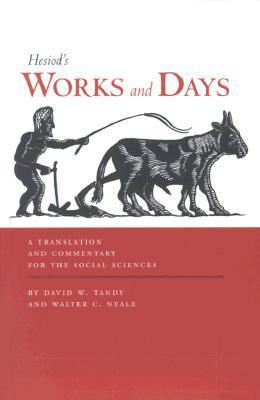
This new, annotated translation of Hesiod's Works and Days is a collaboration between David W. Tandy, a classicist, and Walter Neale, an economist and economic historian. Hesiod was an ancient Greek poet whose Works and Days discusses agricultural practices and society in general. Classicists and ancient historians have turned to Works and Days for its insights on Greek mythology and religion. The poem also sheds light on economic history and ancient agriculture, and is a good resource for social scientists interested in these areas. This translation emphasizes the activities and problems of a practicing agriculturist as well as the larger, changing political and economic institutions of the early archaic period.
The authors provide a clear, accurate translation along with notes aimed at a broad audience. The introductory essay discusses the changing economic, political and trading world of the eighth and seventh centuries B.C.E., while the notes present the range and possible meanings of important Greek terms and references in the poem and highlight areas of ambiguity in our understanding of Works and Days.
Hesiod (Greek: Ησίοδος) was an ancient Greek poet generally thought to have been active between 750 and 650 BC, around the same time as Homer. Several of Hesiod's works have survived in their entirety. Among these are Theogony, which tells the origins of the gods, their lineages, and the events that led to Zeus's rise to power, and Works and Days, a poem that describes the five Ages of Man, offers advice and wisdom, and includes myths such as Pandora's box. Hesiod is generally regarded by Western authors as 'the first written poet in the Western tradition to regard himself as an individual persona with an active role to play in his subject.' Ancient authors credited Hesiod and Homer with establishing Greek religious customs. Modern scholars refer to him as a major source on Greek mythology, farming techniques, early economic thought, Archaic Greek astronomy, cosmology, and ancient time-keeping.
"Perses! Hey, good morning, little bro! It's 3pm! Here, check it out, I got some advice here for you, in the form of a poem.
1.) Wise is the man who gets his ass up off the couch and gets a fucking job already PERSES. 2.) Plant at this time, plow at this time, early to bed, early to rise, makes a man healthy, wealthy, and stop borrowing entirely too much money from his older brother PERSES. 3.) Make sure to find a hot wife, but like, make sure she's not... defective, or anything. You don't want your neighbors laughing at you, like they would laugh at someone who just lays around all day spending their parents' inheritance leavings that they took their fucking older brother to court to screw him out of his fair share PERSES. 4.) Women are terrible. I hate them. Employ several dozen, and get married at 30. A smart man, before getting married, would probably secure a goddamn job PERSES. 5.) Don't ever get on a boat. Boats are the worst thing the world. They're almost as bad as women. God, I hate women.
All right, that's it, go live that now. What do you mean, twenty bucks? Twenty MORE bucks, Perses? Jesus. Fine, here."
One of the most peculiar books I have ever read. Basically, it is a long didactic poem with a plethora of practical tips Hesiod wrote for his brother, Perses. A hodgepodge of philosophy, mythology and everyday life, from motivational aphorisms to agricultural lifehacks.
I admire A. E. Stallings' efforts to make her translation of Works and Days accessible. The use of contemporary vocabulary and dactylic hexameter, bizarrely akin to the rhythm of rap, makes this book, written around 700 BC, an enjoyable read. The translator's hard work and dedication are remarkable. She investigated so many details, for instance, types of thistle or species of cranes. Truth be told, I often found her comments more interesting than the book itself. I also enjoyed the personal tone of the long (37% of the book!) introduction which reads like a captivating essay.
I did my best to let A. E. Stallings infect me with her passion for Hesiod — and her deep fascination with his oeuvre is perceptible — but I turned out to be rather immune. For example, his opinion on women made me cringe: Don’t let a woman mystify your mind With sweet talk and the sway of her behind – She’s just after your barn. He who believes A woman, is a man who trusts in thieves. At the same time, it turns out that a wife makes an indispensable part of the equipment: You'll need A woman and an ox to start a life. How gallant of Hesiod to list a woman first!
What does Works and Days tell us about Hesiod? I guess his intention was to sound wise, experienced and generous, sharing his precious knowledge with his brother who evidently does not deserve it. His patronizing tone was so irksome! Hesiod seems to be a boring know-it-all and I found his superiority obnoxious. It felt awkward when he kept boasting about winning a poetry competition. He seemingly cares for his brother but at the same time, he portrays — or rather caricatures — him as a halfwit.
What does Works and Days tell us about Perses, Hesiod's brother? The way Hesiod addresses his brother is not exactly affectionate: Fool Perses, what I say’s for your own good.
You great fool, Perses! Judging from Hesiod's instructive advice on urinating and defecating: Do not piss on the road Or off it, as you walk.
Don’t urinate in streams that flow downhill To the sea, or springs. To this, be much averse. And do not void yourself in them – that’s worse! ...and his friendly reminder not to show privates smirched with sex, Perses must have been a catastrophic failure. Or this is what Hesiod wants us to believe. Isn't it strange that such a stupid, primitive simpleton was supposed to read and understand his brother's fancy didactic poem written in dactylic hexameter?
El escrito se compone de géneros poéticos a través de la tradición oral griega recogidos e incorporados del mundo Persa.
Incluye calendarios, consejos, instrucciones y proverbios entre los que cabe destacar los relacionados con las cinco Edades del Hombre sobre la tierra.
Es una obra muy interesante si te gusta profundizar en la historia antigua y la visión que estos tenían.
There is something fundamentally universal in the ethical values given by Hesiod when he describes the relationship between man and woman. There has to be trust, dedication, a willingness to work and meet basic living needs, faith and prudence, and all these make the Hesiodian recipe for a successful relationship, for a happy family. And this is the moral core that still holds today, whether it is about a couple of men, a couple of women, a couple of man and woman, a cis couple, or a trans couple etc. This is the essence above and beyond any historical context.
Hesiod says "The man who trusts womankind trusts deceivers" but afterwards clarifies that: "a man wins nothing better than a good wife, and, again, nothing worse than a bad one".
Don't forget that this text was written 2,800 ago and Hesiod intends to help his brother, Perses, to find a good life partner not to belittle women in general.
As far as the "peeing regulations" are concerned and all the other rules about cleanliness:
"Do not stand upright facing the sun when you make water, but remember to do this when he has set and towards his rising. And do not make water as you go, whether on the road or off the road, and do not uncover yourself: the nights belong to the blessed gods. A scrupulous man who has a wise heart sits down or goes to the wall of an enclosed court. Do not expose yourself befouled by the fireside in your house, but avoid this".
Mind you, the sun was a deity in ancient Hellas and so was the hearth, devoted to goddess Hestia. Every culture has its own ritualistic procedures that are sometimes hard for the western people to understand, but even with today's standards, who in the right mind would relieve themselves out in the public or a place of worship?
Hesiod speaks of an ancient civilization that lived in harmony with the natural world: the race of iron. Nowadays, we are the "race of plastic" and we could all benefit from his didactic poem, provided that we keep the essence of his text and not stick to the letter.
Το Έργα και Ημέραι είναι ένα διδακτικό έπος που γράφτηκε από τον Ησίοδο πριν από 2.800 χρόνια κάπου προς τα τέλη του 8ου αιώνα π.Χ. (Ο 8ος αιώνας π.Χ. αρχίζει το 800 π.Χ. και τελειώνει το 701 π.Χ.).
Η μετάφραση που διάβασα και παραθέτω είναι από τον Σταύρο Γκιργκένη και τις εκδόσεις Ζήτρος.
Εκείνο τον αιώνα ξεκίνησαν στην Ελλάδα οι πρώτοι Ολυμπιακοί αγώνες, και οι πρόγονοί μας δημιούργησαν αποικίες στη Νότια Ιταλία - Σικελία (Τάραντας, Συρακούσες, Σύβαρις κτλ) καθώς την αποικία της Τραπεζούντας στον Εύξεινο Πόντο (Μαύρη Θάλασσα, Τουρκία), αρχίζει η συγγραφή των Ουπανισάδων (Ινδουιστικά ιερά κείμενα), στη Μεσοποταμία κυριαρχεί η Ασσυριακή Αυτοκρατορία και ο Ασσύριος μονάρχης Σαργών Β κατακτά το (Βόρειο) βασίλειο του Ισραήλ, το Βασίλειο του Κους ( Βασίλειο των Αιθιόπων) στο σημερινό βόρειο Σουδάν κατακτά την Αίγυπτο και ιδρύει την 25η δυναστεία Φαραώ, για την Κίνα αρχίζει η Περίοδος της Άνοιξης και του Φθινοπώρου (μια εποχή της οποίας η ιστορία καταγράφηκε στο ομώνυμο χρονικό από το οποίο έλαβε τελικά το όνομά της) και κυριαρχεί η δυναστεία των Ανατολικών Τζόου (Eastern Zhou) η οποία σταδιακά χάνει την εξουσία της επάνω στα επιμέρους φεουδαρχικά κρατίδια που συνιστούσαν το σύνολο της αυτοκρατορίας.
Πρόκειται για έναν αιώνα όπου διαφέρει πολύ από τη σημερινή εποχή. Η δομή των κοινωνιών ήταν πατριαρχική, υπήρχε ο θεσμός της δουλείας, η εργασία των ανθρώπων, είτε ασχολούνταν με τη γεωργία είτε με τη ναυτιλία, ήταν σαφώς χειρωνακτική καθώς δεν είχαν ακόμα εφευρεθεί τα σύγχρονα τεχνολογικά μέσα. Η ανατροφή των παιδιών ήταν μία από τις βασικές ενασχολήσεις των γυναικών, η μέριμνα για τους ηλικιωμένους αποτελούσε υποχρέωση των απογόνων τους. Υπήρχε η πίστη σε θεούς που όριζαν το πεπρωμένο των ανθρώπων στο πλαίσιο κάποιων αρχαιότερων θρησκευτικών παραδόσεων, βάσει των οποίων οι άνθρωποι προσδιόριζαν τόσο τις απαρχές όσο και τις δομές των κοινωνιών τους. Οι άνθρωποι εκείνης της εποχής δεν είχαν να αντιτάξουν απέναντι στις ασθένειες, τα γηρατειά και το θάνατο τα σημερινά ιατρικά μέσα που στην εποχή μας μπορούν να σώσουν ή να παρατείνουν ή να βελτιώσουν την ανθρώπινη ζωή.
Κι όμως, παρά τις όποιες διαφορές, τότε όπως και σήμερα υπήρχαν ιδέες για το τι είναι δίκαιο και τι άδικο, με ποιους τρόπους μπορούμε να εξασφαλίσουμε την επιτυχία και την ασφάλεια μέσα από την εργασία μας και τη συνεργασία μας με τους άλλους ανθρώπους. Υπήρχαν νόμοι, κανόνες και παραδόσεις που ρύθμιζαν τις σχέσεις μεταξύ των ανθρώπων και κάλυπταν όλες τις πτυχές του ανθρώπινου βίου, ακόμα και βασικοί κανόνες υγιεινής και καθαριότητας που μπορεί να είχαν πρακτικό ή θρησκευτικό - τελετουργικό χαρακτήρα.
Όλα αυτά τα συνοψίζει αριστοτεχνικά ο Ησίοδος στο συγκεκριμένο έργο και μας δίνει μια εικόνα της καθημερινής ζωής των ανθρώπων που πρέπει να μελετούν τα σημάδια της φύσης, να προσέχουν την εναλλαγή των εποχών, να υπακούν στους κανόνες της σωστής κοινωνικής συμπεριφοράς, να είναι προσεκτικοί στις συναναστροφές τους και εργατικοί προκειμένου να εξασφαλίσουν για τους εαυτούς τους μια καλή ποιότητα ζωής.
Αφορμή ή αιτία για να γράψει αυτό το έργο του ο Ησίοδος είναι η αντιδικία του με τον αδερφό του τον Πέρση πάνω σε κτηματικές διαφορές. Ο πατέρας τους μετά από σκληρή δουλειά και επικίνδυνα ταξίδια με πλοίο κατάφερε να φτιάξει μια περιουσία, την οποία προφανώς τους μοίρασε:
όπως, πολύ ανόητε Πέρση, ο πατέρας ο δικός μου και δικός σου έπλεε στα καράβια, γιατί ᾽χε ανάγκη για ένα βιος καλό. Αυτός μια μέρα έφτασε κι εδώ αφού διέσχισε θάλασσα πολλή, αφού την Κύμη την αιολική άφησε πίσω του σε μαύρο πλοίο μέσα, όχι την αφθονία προσπαθώντας να ξεφύγει, τον πλούτο και την ευτυχία, μα την κακή τη φτώχεια, που ο Δίας στους ανθρώπους δίνει. Και πλάι στον Ελικώνα, σε κώμη ελεεινή κατοίκησε, στην Άσκρα, κακή το χειμώνα, το θέρος ανυπόφορη, ποτέ καλή.
Στην ουσία με όσα γράφει ο Ησίοδος προτρέπει στον Πέρση αντί να διεκδικεί τον κλήρο του αδερφού του, να διδαχτεί από τις συμβουλές του τον τρόπο με τον οποίο θα διατηρήσει και θα αυξήσει αυτά που ήδη του ανήκουν.
Η δομή του κειμένου έχει ως εξής:
1) Αναφορά στις δύο Έριδες, την καλή και την κακή, εκείνη που παρακινεί τους ανθρώπους να ακολουθούν το παράδειγμα των προκομμένων ανθρώπων ώστε να προκόβουν και οι ίδιοι, κι εκείνη που οδηγεί σε πολέμους και διαμάχες σαν κι αυτές που προκαλεί και ο Πέρσης με τις αδιάκοπες διεκδικήσεις του.
2) Αναδρομή στο παρελθόν απαριθμώντας τα γένη των ανθρώπων που προηγήθηκαν και τις ιδιότητές τους, το χρυσό, το αργυρό (ασημένιο), το χάλκινο, το γένος των ημιθέων - ηρώων και στο παρόν όπου συγκαταλέγεται το πέμπτο γένος, το σημερινό, των σιδερένιων ανθρώπων και αφηγείται τον μύθο της Πανδώρας που έγινε η αρχή των δεινών των ανθρώπων.
3) Παραβολή για την εξουσία των βασιλέων στους οποίους καταφεύγει ο Πέρσης για να επιλύσει τις διαφορές του χωρίς να λαμβάνει υπόψη πως έτσι πάει σαν το αηδόνι στο στόμα του γερακιού, ο αδύναμος αφήνεται στην κρίση του ισχυρού αντί να διευθετήσει χωρίς την παρέμβασή τους τα θέματα που έχει με τον αδερφό του. Και για τους βασιλιάδες ωστόσο ισχύει η ίδια παραβολή καθώς κι αυτοί μπορεί να αφανιστούν από τους ισχυρότερούς τους ανθρώπους ή τους ισχυρότερους όλων, τους θεούς, αν τους εξοργίσουν.
4) Απαρίθμηση μια σειράς από κανόνες καλής συμπεριφοράς.
5) Αποκάλυψη των τρόπων και των μεθόδων προκειμένου ο Πέρσης να εξασφαλίσει όχι μόνο τη διατήρηση αλλά και την αύξηση της περιουσίας του, παραδίδοντάς του ένα εγχειρίδιο για το πότε και πώς πρέπει να γίνονται οι αγροτικές εργασίες μέσα στο έτος.
6) Επιστροφή και συμπλήρωση της λίστας με τους κανόνες καλής συμπεριφοράς που παρέθεσε προηγουμένως.
7) Έκθεση των ημερών του μήνα ανάλογα με τη δυσμενή ή ευνοϊκή φύση τους, κάτι που είναι σύμφωνο με τις δοξασίες της εποχής.
(Για τα παραπάνω βλέπε: Φλώρα Μανακίδου, Ιχνηλατώντας τα Έργα και Ημέραι του Ησιόδου, στον συγκεντρωτικό τόμο με τίτλο Μουσάων αρχώμεθα, Ο Ησίοδος και η αρχαϊκή επική ποίηση, εκδ. Πατάκη, Αθήνα 2006, σελ. 282)
Σχετικά με τον πολυθρύλητο μισογυνισμό του Ησιόδου, ομολογώ πως κάτι τέτοιο δεν είδα. Αν συγκρίνουμε τη σημερινή θέση της γυναίκας (στις σύγχρονες δυτικές ή εκδυτικισμένες κοινωνίες) με εκείνη των γυναικών του 720 π.Χ. για παράδειγμα, τότε θα βρούμε σαφώς θεμελιώδεις διαφορές. Πλέον δε νοείται διαχωρισμός για το τι μπορεί ή δεν μπορεί να κάνει κάποιο από τα φύλα και έχουν αλλάξει προς το καλύτερο πολλά πράγματα σχετικά με το τη δομή και τον ορισμό της οικογένειας, τις διαφυλικές σχέσεις, τον σεξουαλικό προσανατολισμό των ανθρώπων και εν γένει τον τρόπο που οι άνθρωποι αυτοπροσδιορίζονται σε σχέση με τον εαυτό τους και τους συνανθρώπους τους.
Γράφοντας το κείμενό του αυτό ο Ησίοδος πριν από 2.800 χρόνια οφείλει να λάβει ως δεδομένη την ανισότητα της εποχής του, όπως εγώ λαμβάνω ως αδιαμφισβήτητη και δεδομένη την ισότητα (ή την επιτακτική και αδιαπραγμάτευτη ανάγκη αυτής) της δικής μου εποχής. Πουθενά δεν εμπαίζει ή δεν χυδαιολογεί εις βάρος της γυναίκας και ακριβώς επειδή ένας άνδρας της εποχής του κινδυνεύει να καταστραφεί αν δεν έχει στο πλάι του μια καλή και άξια (σύμφωνα με το αξιολογικό σύστημα της εποχής του) σύντροφο, αποτρέπει τον Πέρση από το να συνάψει δεσμό με κάποια γυναίκα που αποβλέπει στην κατασπατάληση της οικογενειακής περιουσίας προς προσωπική της τέρψη και απόλαυση. Γι'΄αυτές τις γυναίκες αναφέρει:
Και μη σου εξαπατά το νου γυναίκα με στολισμένα πισινά σαν φλυαρεί χαριτωμένα την ώρα που την έπιασες να εξερευνά την αποθήκη σου. Όποιος γυναίκα εμπιστεύεται, απατεώνα εμπιστεύεται.
Γι' αυτό και παρακάτω, όταν του δίνει συμβουλές για να κάνει έναν επιτυχημένο γάμο (να βρει μια νέα που να μην έχει γνωρίσει άλλον άνδρα, να είναι κάποια από το κοντινό του περιβάλλον που να τη γνωρίζει, να είναι φρόνιμη και αφοσιωμένη στο ρόλο που ορίζει η εποχή της) ο ποιητής προχωρεί στο εγκώμιο των καλών γυναικών και την κατάκριση των κακών:
Απ᾽ τη γυναίκα την καλή τίποτε πιο καλό δεν αποκτά ο άντρας και τίποτε πάλι φοβερότερο απ᾽ την κακή, που το φαΐ παραμονεύει: αυτή το σύζυγό της, και δυνατός να είναι ακόμα, δίχως δαυλό τον καίει και πρόωρα γηρατειά τού δίνει.
Μέσα στον γάμο αυτό θα πρέπει να είναι πιστοί ο ένας στον άλλο καθώς προηγουμένως τον έχει συμβουλεύσει να μην συνευρεθεί με γυναίκα άλλου, μέσα σε ένα πλαίσιο κανόνων σωστής και ηθικής συμπεριφοράς που κάθε άνδρας οφείλει να ακολουθεί:
Όμοια κι εκείνος που κακό θα κάνει στον ικέτη ή τον ξένο του, κι εκείνος που στην κλίνη του αδερφού του ανεβαίνει, στο κρυφό κρεβάτι της συζύγου του, κάνοντας πράγματα ανάρμοστα, αυτός που απ᾽ αμυαλιά αδίκησε παιδιά ορφανά, κι όποιος το γέροντα γονιό του στο κακό των γηρατειών κατώφλι με λόγια σκληρά στεναχωρεί και βρίζει. Μ᾽ αυτόν στ᾽ αλήθεια οργίζεται ο Δίας ο ίδιος και στο τέλος του για τ᾽ άδικα τα έργα του όρισε σκληρή αμοιβή.
Συμπερασματικά υπάρχει κάτι ουσιωδώς πανανθρώπινο σε επίπεδο αξιών και ηθικών επιταγών στον τρόπο που περιγράφει τη σχέση ανάμεσα στον άνδρα και τη γυναίκα. Πρέπει να υπάρχει εμπιστοσύνη, αφοσίωση, διάθεση για εργασία που θα τους εξασφαλίσει την κάλυψη βασικών βιοτικών αναγκών, πίστη, φρόνηση και όλα αυτά είναι η Ησιόδεια συνταγή για μια επιτυχημένη σχέση, για μια ευτυχισμένη οικογένεια. Και αυτός είναι ο ηθικός πυρήνας που ισχύει ακόμα και σήμερα, είτε πρόκειται για ένα ζευγάρι ανδρών, είτε για ένα ζευγάρι γυναικών, είτε για ένα ζευγάρι γυναίκας με άνδρα, είτε για ένα cis ζευγάρι, είτε για ένα τρανς ζευγάρι κτλ.
Αυτή είναι η ουσία πάνω και πέρα από κάθε ιστορικό πλαίσιο.
Κλείνοντας θα ήθελα να συμπληρώσω κάτι σχετικά με την ομορφιά αυτού του κειμένου έτσι όπως περιγράφεται η εναλλαγή των εποχών.
Για τους χειμώνες που αργεί να ξημερώσει και λυσσομανά ο παγωμένος άνεμος κι εκεί πρωτίστως χρειάζεται η ζεστασιά ενός σπιτιού και η εξασφάλιση μια καλής συγκομιδής:
Μουγκρίζει το δάσος και η γη. Πολλές βελανιδιές ψηλόκορφες κι έλατα ογκώδη μες στα φαράγγια του βουνού τα ρίχνει κάτω στην πολύτροφη γη σαν πέφτει πάνω τους. Κι όλο το δάσος τότε το απέραντο βοά. Τρέμουν τ᾽ αγρίμια και βάζουν την ουρά απ᾽ τ᾽ αχαμνά τους κάτω.
Για τις ανοιξιάτικες βροχές:
τότε που ο κούκος μέσα απ᾽ τα φύλλα της βαλανιδιάς πρώτη φορά λαλεί, και τέρπει τους θνητούς πάνω στη δίχως όρια γη, μακάρι να βρέξει τότε ο Δίας την τρίτη μέρα, δίχως να σταματά, και δίχως το νερό να ξεπερνά τη χηλή απ᾽ το βόδι, ούτε να υπολείπεται.
Για τις κοπιαστικές και ζεστές ημέρες του καλοκαιριού:
μόλις το γαϊδουράγκαθο ανθίζει και το τζιτζίκι βουερό πάνω στο δέντρο καθισμένο οξύ τραγούδι χύνει συνεχώς απ᾽ τα φτερά του κάτω, την ώρα του θέρους τού κοπιαστικού
Για την εποχή του τρύγου και του οργώματος, του Φθινοπώρου:
Κι όταν ο Ωρίωνας κι ο Σείριος στο μέσον έρθουν τ᾽ ουρανού και τον Αρκτούρο δει η ροδοδάχτυλη αυγή, τότε να κόψεις και να πάρεις σπίτι, Πέρση, όλα τα σταφύλια. Δείξ᾽ τα στον ήλιο για μέρες δέκα και δέκα νύχτες, βάλ᾽ τα στον ίσκιο πέντε μέρες, και την έκτη άδειασε στους κάδους σου τα δώρα του πολύτερπνου Διόνυσου. Κι όταν οι Υάδες κι οι Πλειάδες κι ο δυνατός Ωρίων βασιλεύουν, τότε να θυμηθείς πως είναι η ώρα του οργώματος. Και η σπορά κάτω απ᾽ τη γη καλά βαλμένη ας είναι.
Αυτή η αρμονία ή πιο σωστά η εναρμόνιση του ανθρώπου με το φυσικό του περιβάλλον, η πανάρχαια γνώση των σημαδιών της κάθε εποχής, η ομορφιά και η γοητεία κάθε εποχής, ο ήλιος, οι αστερισμοί, ο άνεμος, του κελάηδημα των πουλιών, η βροχή, η μυρωδιά το φρεσκοργωμένου χώματος όλα είναι μέρος της ανθρώπινης υπόστασης, πηγή τροφής υλικής και πνευματικής. Αυτό είναι κάτι που δεν πρέπει να ξεχνάμε, γιατί επάνω σε αυτό στηρίζεται ακόμα και σήμερα η επιβίωση του ανθρώπινου γένους. Εμείς, που ακολουθούμε μετά από το σιδερένιο γένος και που αν ο Ησίοδος ζούσε σήμερα, ίσως να μας ονόμαζε το Πλαστικό Γένος.
The second work attributed to the early Greek writer Hesiod (8th-7th century BCE) is certainly of a different nature than his Theogony. There are similarities, such as the call to the Muses at the beginning, the odes to the supremacy of Zeus, and the verse form (the dactylic hexameter). One of the most striking differences is that the author (seemingly) reveals more of himself here: the book is addressed to his brother (possibly a fictitious character), with whom he is apparently at odds and whom he wants to lecture. And the second major difference is that the focus here is largely on human existence: while humanity in Theogony is viewed entirely through the eyes of the gods, the perspective in Works and Days shifts to the human sphere and human activities themselves.
Note, however, that the author continually emphasizes that humanity is integrated into the divine order, and especially that of Zeus. And Hesiod leaves no doubt: this divine order dictates that humanity must work, work, and work. The encouragements in this regard to the (apparently lazy and not so honest) brother are overwhelming. They demonstrate an ethic based on caution, diligence, honesty, and justice, all anchored in a strict work ethic. Could this be the first articulation of a social ethic based on the principle of justice and honest work? An ethic directly linked to and guarded by the supreme god Zeus. So, could this be an early precursor of the Axial Age, as defined by Karl Jasper? I'm not sure, but this part of Work and Days surely is impressive.
This work, of course, is primarily defined by its agricultural context. The author himself claims to be the son of a farmer, and he backs this up by giving his brother extensive, concrete guidelines for sowing and reaping. Incidentally, this section is strongly reminiscent of Virgil's much later Georgics. It includes the well-known advice to not marry under 30, and some rather contemptuous comments on women.
But Hesiod's exhortation doesn't just concern manual labor: he also encourages his brother (and us, his reader) to also think and judge by himself, thus also to be intellectually self-sufficient. And that strikes me as quite remarkable and unique advice, even though it's mentioned in just one verse. It's tempting to see this as the beginning (or illustration) of the coming "Greek genius," although I'm reluctant to use such hellenophile notions, with their derogatory undertone toward other cultures. But it's clear that such an exhortation can certainly not be found in the Mesopotamian, Egyptian, or Hebrew scriptures!
This element alone makes Works and Days worth reading (and considering it's almost 2,700 years old). But this little book contains many other things: a brief reprise of the cosmological story from Theogony (with a few variations), including the Prometheus story and now supplemented with the famous Pandora story. There's also the renowned passage describing degrading ages of heroes and humans, usually associated with metals: gold, silver, bronze, iron (which seems reminiscent to Nebuchadnezzar's dream in the Bible book Daniel 2). The book also contains the first fable from the Greek period, that of the hawk and the nightingale (representing the prince/ruler and the poet). And finally, an extensive series of wisdoms, very reminiscent of the popular Near Eastern wisdom genre.
Works and Days may be more diverse and erratic than Theogony, but I found it much more readable (though still rather chaotic in its composition) and interesting. Perhaps this is due to the work's more down-to-earth nature, with its concrete guidelines for human behavior, in contrast to the chaos that characterizes the pantheon of Theogony. Some experts see this as a deliberate shift, an intended message by the author: after the turbulent period at the beginning of the cosmos and the struggle between gods and demigods, it is now up to humans—once Zeus's rule was established—to flourish within the divine order, founded on law and justice. Perhaps this, too, can be seen as a foreshadowing of that adage attributed to the Greeks (Protagoras) "man as the measure of all things"?
read this because it was the only short book in my room and i was hiding in my room because there was a massive FLY terrorising me in the living room
twas v cool, I’ve wanted to read it for ages and I’m glad I finally did (even if it’s for a bad reason lol). Especially love the two, sister Strifes, that’s so cool.
AE Stallings’ introduction to her translation of Hesiod’s Works and Days is fantastic. It’s worth picking up this edition just for her enthusiastic commentary and notes.
Hesiod ist der früheste Autor der griechischen Antike… über den wir etwas Konkretes wissen. Und damit natürlich einer der ersten in dieser Catch-up edition.
Aber zuerst zu den Basics: Werke und Tage ist um 700 v. Chr. entstanden und damit das erste Lehrgedicht der Geschichte. Und um seine Klasse vorwegzunehmen, trotz dieser enormen Zeitspanne ist es vollständig erhalten.
Seit Hesiod steht die Debatte, ob ein Lehrgedicht zu den Sachepen zählt oder vollständig aus der Poesie auszuschließen ist. Denn einerseits geht es vordergründig darum, die unterschiedlichsten Themen zu erklären, andererseits ist da die Sprache… Hexameter, Epische Ornatus, Gleichnisse, Musenanrufe, Exkurse und Götterhymnen sind eigentlich nur im Epos zu finden… und im Lehrgedicht. Generell gesagt werden kann allerdings, dass ein Prosatext im epischen Stil verpackt wird, um ästhetische Freude hervorzurufen. Hesiod setzt dabei nebenbeigesagt Standards, die in späteren Zeiten nur schwer übertroffen werden konnten.
Vom Inhalt her geht es in den Grundzügen um die Landwirtschaft. Doch auch wenn es technische Passagen gibt und die Wichtigkeit von guter und rechtlicher Arbeit immer wieder hervorgestrichen wird, geht es Hesiod in erster Linie um die moralische Erziehung der gesamten Gesellschaft. Mit seinem „faulen“ Bruder Perses als Adressaten, geht der Dichter zuerst einmal dazu über vom Beginn der Welt und den 5 Menschengeschlechtern zu erzählen. Jedoch verkam jedes folgende Geschlecht immer mehr, bis Prometheus und Pandora schließlich das Übel über die Menschheit brachten. Dieses können wir als das letzte und somit elendste Geschlecht nur durch ehrliche Arbeit, gute Gesinnung und allgemeinen Respekt den Göttern gegenüber überwinden, wie Hesiod nicht müde wird uns zu erinnern.
Auch wenn Hesiod es hin und wieder mit der Moralisierung ein wenig übertreibt, wird er aus gutem Grund als Meister des Lehrgedichts gehandelt!!!
Eh. Second time reading this and it reinforced the fact that I don’t really care for it at all despite its historical and literary importance. The few stories at the beginning (Pandora’s Box and Zeus’ creation of the different types of humans) are interesting. But I could really care less about why certain days of the month are good for doing specific things. Again, I see it’s relevance, and it is at least somewhat interesting to see the Ancient Greek way of life through a poet’s eyes, but I feel that there are better ways to get this information.
"Il est le plus sage celui qui, expérimentant tout par lui-même, médite sur les actions qui seront les meilleures une fois accomplies. Il est aussi très-méritoire celui qui consent à être bien conseillé ; mais celui qui n’écoute ni lui-même ni les autres est un homme inutile"
Tremendo coñazo. Todo se resume en "no seas un puto vago y levanta la pala"
La frase de "Que no te haga perder la cabeza una mujer de trasero emperifollado que susurre requiebros mientras busca tu granero." es mi favorita. Poético.
I read both Paavo Castrén's Työt ja päivät and A. E. Stallings' Works and Days, and I should say Stallings' edition was far superior: Castrén's work was clean and legible, whereas Stallings provided a fantastically exhaustive introduction and showcased a superb use of diction, bringing especially the more epic moments to life. It seems to me that I am somewhat biased when it comes to Finnish in epic-styled poetry: it can be done really well (like Oksala has done with Virgil), but even slight changes of tone can break the spell. (Nimimerkillä "Tyhmä Perses"...)
I am slightly embarrassed to give Hesiod only three stars and justify it all with my enjoyment of the work. He is the fountainhead of Western literature, for goodness' sake! He gave us the myths of Prometheus and Pandora, and the 5 Ages of Man, and started things off with a wonderfully Joycean flair, mixing the epic with the low, genuflecting before the gods and hitting the younger brother with a well-aimed stick; showcasing his learning and boasting about his achievements; and lamenting the fate of man and the corruption of the race. He even was a forerunner to economics, pointing out the ups and downs of investment, opportunism, division of labour and steady accrual. And besides that, neither Castrén nor Stallings made a bad job at all: the latter especially was a joy to read with her relaxed commentary and multifarious verbiage (the rhyming couplets I could've foregone myself, though—they made the rhythm rather awkward).
Well, I suppose it all comes down to expectations once again: I was rather naively prepared for something more stupendous. "Give me the ichor of Zeus or at least the very visage of Kronos!" I could hear myself whimper, pounding at my chest and coughing profusely as a result. But the sad matter of the fact is that the mythological elements are quickly depleted herein, serving as a nice rhetorical device to keep the foolish Perses on his toes. Very soon after that we get charming auguries and omens, an almanac for farmers and whatnot, delivered with rather silly conviction (clearly there were no such things as breach of promise or the liabilities of advertisement back in the day). That is not the kind of information I was expecting in such abundance, and it's not exactly the kind of information that I can build my mental picture of the Greek of Eld with due to its painstaking detail. (Of course I can go with generalisation like "it was more or less the same as in Virgil's Georgics", but that feels like a major cop-out...)
Yet, fortunately, I can admire this work from afar, and I can partake in the enjoyment of deciphering the poet behind the text. Before I read Stallings, I did not really see any need to question Hesiod's authenticity, but I did find the use of the name "Perses" most... convenient, given that it means "wastrel" or "destroyer". Yet in the English edition, it was pointed out that Perses is actually a Titan and a father to Hecate, a popular deity in Asia Minor, where the father of Hesiod and Perses the wastrel hailed from. That would indeed make Perses a more likely name—and probably adds some erudite irony into the work.
As for the structure, think about it: You want to lecture your nitwit of a sibling. You eschew brotherly violence for reasons only known to you(, your sibling and the possibly venal top brass in your location,) and you clearly want to edify him. What you do is recount the mythological history of treachery and divine displeasure throughout ages and, at the same time, substantiate claims that Need and Toil are both a punishment and a reward, nothing to be grumbled at due to their god-given nature. Then you give the doomed dolt the best advice you can conjure up, teach them the art of phenology, instill the sense of duty in them, give them the tools for optimisation in life and also offer them the option of seafaring to boot. Yes, you probably want to cast a little expletive down his way every now and then, but it's all for the greater good.
For all this, I'm even willing to blink at Hesiod's curmudgeonly misanthropy—he may be a bit of a crank, but he puts a lot of effort into giving good advice to a brother of his, even though he himself acknowledges that blood is not always thicker than water.
Works and Days, has a more personal character. It is addressed to his brother Perses, who by guile and bribery has already secured for himself an excessive share of their inheritance and is seeking to gain another advantage in a similar manner. Trying to dissuade him from such practices, Hesiod recounts in the first part of the poem two myths illustrating the necessity for honest, hard work in man’s wretched life. One continues the story of Pandora, who out of curiosity opens a jar, loosing multifarious evils on humanity; the other traces man’s decline since the Golden Age. Against the brutality and injustice of his contemporaries, Hesiod affirms his unshakable belief in the power of justice. For him, Justice is a deity and, indeed, Zeus’s favourite daughter, and the happiness of individuals as well as of communities depends on their treatment of her.
The part of Hesiod’s message that exalts justice and deprecates hubris is addressed to the leaders of his community, who seem inclined to abet Perses. Hesiod also speaks to Perses directly, urging him to abandon his schemes and thenceforth to gain his livelihood through strenuous and persistent work: “Before success the immortal gods have placed the sweat of our brows.” Hard work is for Hesiod the only way to prosperity and distinction. The concept of life that Hesiod here develops is in conscious opposition to the more glorious ideals of the heroic epic of Homer.
In the second half of the poem, Hesiod describes with much practical detail the kind of work appropriate to each part of the calendar and explains how to set about it. The description of the rural year is enlivened by a vivid feeling for the rhythm of human life and the forces of nature, from the overpowering winter storm, which drives man back into his home, to the parching heat of summer, during which he must have respite from his labours.
Ante todo es necesario saber que el mito de Prometeo, bajo la pluma de este poeta, es la primera vez que aparece en la historia. De modo que, a pesar de que gran parte de la mitología tiene como referente a Homero, el educador de Grecia toda (República, 606e), la fuerza originaria y evocadora del personaje titánico se debe al autor que abogaba por el modo de vivir campesino, que ya no se fijaba en los nobles aristócratas sino en los hombres de arduo trabajo. Y no escribe al respecto una sino dos veces, en distintas obras, su particular perspectiva sobre el mismo.
En primer lugar, en la Teogonía, donde aborda el destino...
"Nichts verschiebe auf morgen und übermorgen, denn nur, wer tüchtig anpackt und nicht alles verschiebt, füllt seine Scheuer."
Sehr beruhigend zu wissen, dass die Menschen im alten Griechenland wohl auch Probleme mit Prokrastination hatten. Nur wird es bei ihnen wohl um unmittelbar lebensnotwendigere Dinge gegangen sein, als das Schreiben von E-Mails.
Ähnlich wie die Theogonie empfand ich auch die Werke und Tage als interessante Lektüre, zeichnet sich doch hier schon eine Alltagsethik ab, die wohl zur späteren Tugendethik geführt hat. Auch hier war das Nachwort des Übersetzers Otto Schönberger informationsreich und bietete kontexuelle Einbettung sowie eine Lektüreliste. Habe es gerne gelesen, auch wenn doch dem richtigen Urinieren eine überraschend hohe Anzahl von Versen gewidmet war.
I mean, cannot say I 'enjoyed it', because Hesiod is like an old annoying man giving unsolicited advice about semen to his brother, but its the first book I read for university and it really helped me understad a lot about Greece back then.
The vagaries of history are often quite interesting. That it has given us two home economics books separated by over two thousand years is even more delightful. Hesiod's "Works and Days" of the 700s BCE is quite simply one of the first complete and personal works of Western civilization. While "The Goodman of Paris" from 1393 is of unknown authorship, it is even more beautifully personal. Both books are guides to the proper maintenance of the homestead.
Hesiod's writes from the perspective of the landed peasant emerging from the Grecian Dark Ages and aims directly to the heart of the struggle for survival in a changing world. The object of his pontification is his never-do-well brother who has managed to mismanage his land inheritance from his father's estate. Hesiod's home is also his agricultural estate and his only domestic means of survival. He is a frugal, gods-fearing, and pragmatic farmer with little regard or need for the sins of the city. But Hesiod is not a naive bumpkin - in times of need his has left his small village for the greater world in search of monies through the toil at oars of commerce and warfare.
The Goodman of Paris on the other hand is a man of substance, an haute bourgeoisie in the capital of Medieval France balanced between High Gothic and the Black Death and social instability. His focus is directing his new and young wife in how to manage her domestic duties efficiently and effectively. Unlike Hesiod, his approach is not confrontational but loving. There is an overlying tenderness that is refreshing in our era of nuclear-exploding families and much wisdom to be considered for our own domestic tranquility.
For anyone who wants to enter the world of the past both these works are as close as one can get. You will be enveloped in the thoughts and feelings of the men of these eras and discover how little in some ways the nature of man has changed despite the technologies surrounding us.
It's really interesting and super easy to read given its only 33 pages, a short essay, and a glossary.
Despite being a poet, Hesiod is credited as the first known economist. Like philosophical texts, the context helps prior to reading but can also be dry. As well as mentions to Greek Philosophy, Hesiod establishes himself as the first to write a biography in western history.
It's interesting how Hesiod talks about work and it being a curse and a blessing and making reference to Justice, which might link to Plato later in The Republic and references made there to The Poets. Even more so, the appreciation that hard work is what is needed to attain wealth, fortune, and a good life originates here.
It's interesting that the translation adapts well and makes the majority of the verse interesting when discussing the gods, the ages of man, his brother, and the need for the judges overseeing his case needing to be honest. Even in ancient Greece, there were corrupt systems of justice being openly criticised in a way which can translate to the modern ages legal issues.
Hesiod does make misogynistic and misanthropic references, which seem to stem from Greek mythology. The translator argues that Hesiod is more misanthrope than misogynist, but both seem apparent in the verse at times.
Hesiod does have some great lines that stand out on justice, work, and humanity. Hesiod also has my new favourite use of an animal based fable being turned on its head to remind the judges and his brother that the animals eat each other but humans have law and should not take all lessons from the animal kingdom. The fact this was done 80 years prior to Aesop and basically criticises even using animal allegory to draw moral understanding is profound.
This is such a strange little work of poetry. While I love Stallings and admire her translation as always. Hesiod's content just didn't really inspire. It's interesting, but it just felt a bit strange to have what amounts to life advice be presented in this long poem that shifts its focus every so often.
While most of the focus seems to be on the importance of work there are all kinds topics addressed as well. That women are useful, but not particularly good so be careful; talk is a lot less useful than action; take care about where you urinate; and that boats aren't Hesiod's favorite, but if you have to use them here are some tips. It's just a strange combination of topics that just felt a bit odd to have a poem about.
To add another interesting layer to this rather pragmatic poem is the mixing of the Greek pantheon into the discussion. After all for Hesiod this appears to be just part of the pragmatic advice that he is giving. Advice to not make the gods angry and to take know what days are best suited to start various tasks. It's an interesting aspect to this work, which will also sound a bit odd to most modern readers.
Hesiod just didn't really win me over. While some of his advice is decent, the tone of the poem and the advice that isn't so decent just make for a poem that I struggled with. I didn't necessarily dislike the poem, which admittedly the small length probably helped. I just also didn't really love it either. It was simply okay.
”Muses from Pieria, who glorify by songs, come to me, tell of Zeus your father in your singing. Because of him mortal men are unmentioned and mentioned, spoken and unspoken of, according to great Zeus’ will.”
Hesiod’s Works and Days is a didactic poem about morality, agriculture and worship. He offers a wide array of advice, everything from how to treat your neighbours, when to plow your fields, when to sail to when and where to pee at night. He also retells the myths of Pandora and the Five Ages of Man.
Finally, after years of wanting to read it, I finally got around to picking up Works and Days. This was a rather fun poem to read, but I know that if it had been a bit longer, it would’ve gotten perhaps a little dull. There’s only so much talk of oxes and plowing fields I can take. As it is now, the poem remained engaging from beginning to end, going from topic to topic in quick succession.
As a huge mythology nerd, I loved the retellings of Pandora’s story as well as the Five Ages of Man (Golden, Silver, Bronze, Heroic and Iron), and I found the references to how to worship the gods properly, how to keep them happy and how to ensure their favor very interesting. Hesiod also doesn’t just mention gods of the big twelve, but also smaller mythological figures, such as Philomela who was transformed into a swallow. I am quite well-versed in ancient myth and lore but I still had to check out the translator’s (M. L. West) notes at the back to make sure I understood all the little references. You will get so much more out of the book if you take your time to unpack everything, so I highly recommend reading a copy with a thorough notes section. My favorite thing I learned from the notes was that the greeks referred to snails as ”carryhouses” cause their carry their homes on their back.
Hesiod hated women and brothers with a fiery passion, and both dislikes are apparent in this poem. He keeps addressing his ”foolish” brother Perses (though some scholars think Perses was a literary device rather than his actual brother) and roasting him, calling him all sorts of things and explaining how he should live his life. I cackled when, among all the serious advice about agriculture and the like and roasting brothers and women, Hesiod took the time to mention that he once won a poetry competition and was taught by the muses themselves. An ancient not-so-humble brag. Women, whenever they pop up, are almost always described as dangerous, devious and so on. Pandora, the first ever woman, was given a "bitch's mind and a knavish nature". As Hesiod put it: "– he who believes a woman, believes cheaters." Of marriage, he said, which I found interesting, was that girls should marry four years after first getting their period – it is often assumed Greek women married at the age of 12 or something like that, and while that did happen occasionally, it was not the norm. Another interesting tidbit about women was that, at the very end, when discussing which days of the month are bad and which ones are blessed, Hesiod says ”sometimes a day is a stepmother, sometimes a mother” – it seems stepmoms were, even in 8th to 7th century BC, seen as evil, mean, dangerous women.
Hesiod would be, I think, in today’s world one of those annoying male influencers who preaches the benefits of waking up at 4 AM, never taking holidays and grinding from birth to death. In this poem, he advices people to always be hardworking and to never postpone tasks they could get done today, and though he has some great points (such as the necessity of working hard in spring and summer so you have food for winter), he does sound like quite the buzzkill. I liked this quote about how people who don’t do the work struggle with hunger come winter: "Hope is no good provider for a needy man sitting in the parlour without substance to depend on. Point out to your laboures while it is still midsummer: 'It will not always be summer. Build your huts.'" It was fun reading about what Hesiod had to say about nature’s signs in regards to agriculture: the appearance of a certain bird, for example, can mean the changing of the seasons is near or that it might rain soon. Those kinds of moments made me really appreciate just how dependent most people were on nature. The emphasis on Demeter’s worship also highlights this. Hesiod also gives advice on what types of wood to use when making household items or agricultural tools. Lots of fun stuff, especially if you are interested in day-to-day life in the past.
As in all good didactic poems, there’s also plenty about morality and what makes a person good. I don’t agree with Hesiod on many things, but I did appreciate his emphasis on treating your neighbours well, helping others and being good to your community. Hesiod emphasised that being honest, fair and hardworking is not just for your own personal benefit but it also protects the entire community you live in: the gods may, after all, punish the whole village if one person decides to commit crimes. It’s intriguing to see how integral community was. Some of the moral advice was, unsurprisingly, really annoying and patriarchal, but, oh well, what can you expect from a poem that’s thousands of years old and was written by a guy who is, even in antiquity’s standards, a big misogynist?
By the end, Hesiod proceeds to give advice on some really random stuff. For some god forsaken reason he gives a lot of advice on peeing. You shouldn’t ever pee facing the sun, from sunset to sunrise, you shouldn’t pee on the road or off the road or unclothed because that could offend the gods. You also shouldn’t, under any occasion, pee in rivers that flow into the sea or in streams. Peeing improperly can bring you bad luck, as could washing with women’s washwater if you were a man or sitting on a tomb. Reading stuff like this was terribly amusing to me, but also, in all seriousness, offered an interesting glimpse into the importance of propriety, superstition, customs and following the rules.
Works and Days is a text you can easily read in one or two sittings. So if you are interested in ancient culture and literature but feel like this book's topics are not all that interesting, I would suggest you pick it up anyway. It’s not a massive commitment like, say, The Iliad, but it's a classic due to Hesiod's significance as a poet.
El poema es breve: una suerte de tratado moral en el que se enaltece al trabajo como virtud necesaria para una sociedad sana. Aparecen además los mitos de las cinco razas de hombres creadas por Zeus, el jarro de Pandora, del que escapan males inevitables (incluida la Esperanza, que curiosamente es vista como una especie de virtud dañina), y los engaños de Prometeo, quien roba el fuego a los dioses y desencadena con ello una serie de desgracias para la humanidad. Sin embargo, al menos en la edición de la UNAM (Bibliotheca Scriptorvm Graecorvm et Romanorvm) el aparato crítico es inmenso con respecto a la brevedad del contenido original (en griego y en español), tanto en la introducción como en las notas finales, con lo que deja la sensación de un robusto y engañoso emparedado, cuyos panes sumamente gruesos custodian una nanométrica rebanada de jamón...