Jump to ratings and reviews
Rate this book

Visions of the Daughters of Albion

Rate this book
This landmark edition of William Blake's Visions of the Daughters of Albion provides the first full-size reproduction of the Huntington Library's copy of the work, printed and colored by Blake and his wife, Catherine, in 1793. Generally seen as a continuation of The Book of Thel , this relatively early work of Blake's offers a criticism of the sexual morals of his time, presenting its author's views on the evils of organized religion, on slavery, and on oppressed womanhood. Drawings related to Visions that Blake sketched in his Notebook, now held in the British Library, have been digitally enhanced in the reproductions in this edition and are visible for the first time. Blake expert Robert Essick explains not just the text but also Blake's invention of the method he used to etch his poetry and designs. A plate-by-plate analysis of the images and text sets the enigmas of Blake's poetry in the clarifying contexts of his life and thought and of contemporary literature and politics. Robert N. Essick is Professor of English at the University of California, Riverside. Among his many books are William Blake, Printmaker, selected by Choice as an Outstanding Academic Book of 1980-81, and William Blake at the Huntington , a Book-of-the-Month Club alternate selection. Essick specializes in British romantic literature and art, particularly William Blake.

100 pages, Hardcover

First published January 1, 1793

Loading...
Loading...

About the author

William Blake

1,330 books3,296 followers
William Blake was an English poet, painter, and printmaker. Largely unrecognised during his lifetime, Blake's work is today considered seminal and significant in the history of both poetry and the visual arts.

Blake's prophetic poetry has been said to form "what is in proportion to its merits the least read body of poetry in the language". His visual artistry has led one modern critic to proclaim him "far and away the greatest artist Britain has ever produced." Although he only once travelled any further than a day's walk outside London over the course of his life, his creative vision engendered a diverse and symbolically rich corpus, which embraced 'imagination' as "the body of God", or "Human existence itself".

Once considered mad for his idiosyncratic views, Blake is highly regarded today for his expressiveness and creativity, and the philosophical and mystical currents that underlie his work. His work has been characterized as part of the Romantic movement, or even "Pre-Romantic", for its largely having appeared in the 18th century. Reverent of the Bible but hostile to the established Church, Blake was influenced by the ideals and ambitions of the French and American revolutions, as well as by such thinkers as Emanuel Swedenborg.

Despite these known influences, the originality and singularity of Blake's work make it difficult to classify. One 19th century scholar characterised Blake as a "glorious luminary", "a man not forestalled by predecessors, nor to be classed with contemporaries, nor to be replaced by known or readily surmisable successors."

Ratings & Reviews

What do you think?
Rate this book

Friends & Following

Create a free account to discover what your friends think of this book!

Community Reviews

5 stars
153 (38%)
4 stars
138 (34%)
3 stars
75 (18%)
2 stars
29 (7%)
1 star
5 (1%)
Displaying 1 - 30 of 30 reviews
Profile Image for Paul.
2,981 reviews20 followers
June 12, 2021
Another volume of Blake’s own mythos, this is a rather harrowing long poem about the loss of innocence and the hypocrisy surrounding it. Very symbolic and quite upsetting.

Visions of the Daughters of Albion: The Argument

I loved Theotormon
And I was not ashamed
I trembled in my virgin fears
And I hid in Leutha’s Vale!

I plucked Leutha’s flower,
And I rose up from the vale,
But the terrible thunders tore
My virgin mantle in twain…’


My next book: Mr. Tickle
Profile Image for sajad.
106 reviews1 follower
November 19, 2024
With what sense does the parson claim the labour of the farmer?
What are his nets and gins and traps, and how does he surround him
With cold floods of abstraction, and with forests of solitude,
To build him castles and high spires, where kings and priests may dwell,
Till she who burns with youth, and knows no fixed lot, is bound
In spells of law to one she loaths: and must she drag the chain
Of life, in weary lust! must chilling murderous thoughts obscure
The clear heaven of her eternal spring? to bear the wintry rage
Of a harsh terror, driv'n to madness, bound to hold a rod
Over her shrinking shoulders all the day, and all the night
To turn the wheel of false desire: and longings that wake her womb
To the abhorred birth of cherubs in the human form
That live a pestilence and die a meteor and are no more-
Till the child dwell with one he hates, and do the deed he loaths
And the impure scourge force his seed into its unripe birth
Ere yet his eyelids can behold the arrows of the day.
Profile Image for Nancy Nguyen.
113 reviews257 followers
January 31, 2013
Can you tell I'm in a Romanticism class? Well, I think Blake is an INFJ. He has to be. He's got such revolutionary thoughts, and thoughts that have to do with social causes (no matter how heretic-like). Also, he's a genius. He's influenced so much post-mortum. This story can even be applied now with the question of rape culture and victim blaming and slut shaming. Blake was so ahead of his time. I wish I met him.
Profile Image for Andy Febrico Bintoro.
3,709 reviews32 followers
May 30, 2022
The book was full of symbols and mysticism. Its hard to understand. Here us the argument:
I loved Theotormon And I was not ashamed I trembled in my virgin fears And I hid in Leutha’s vale! I plucked Leutha’s flower, And I rose up from the vale; But the terrible thunders tore My virgin mantle in twain.
Profile Image for George Dibble.
230 reviews
December 16, 2025
4.5/5

Metaphysics, Idealism, Gnosticism, Women's Rights, and the only recently studied idea of our perception receptors differing from reality and image-making and even some Simulation Theories--Wililam Blake, all while not being Romantic, destroying the general, only answering to specifics; and what an ending!; my man.

Profile Image for M.W. Lee.
Author 4 books6 followers
July 11, 2019
This is one of my favorite long poems. I've read it many times. However, on this reading, I began to question my previous ideas about the main character, Oothoon. I've always found her to be incredibly strong in horrible circumstances. Yet, on this reading, I found her more than strong: I found her powerful. Someone who questions the status quo, the norms of the day. She doesn't just question, she defiantly speaks out loud her thoughts without backing down.

An excellent read! worth revisiting many times.

Reading 2019--Still feel the same, except this year, I realized I really don't understand as much as I think I do. I think I'd have to exam each line, especially, Oothoon's monologue. I feel that Blake's symbolism isn't being read by me as well as it should. Perhaps another reading sooner than later.
Profile Image for Martin Keith.
98 reviews5 followers
January 6, 2024
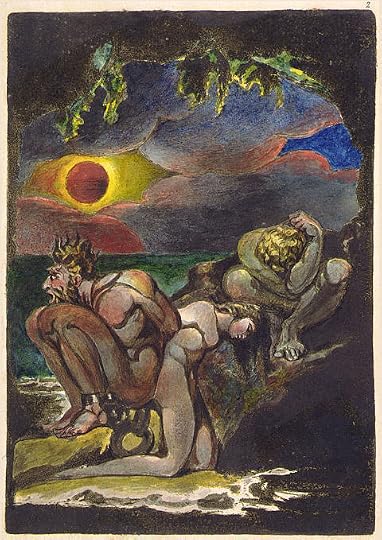
Why dost thou seek religion? Is it because acts are not lovely, that thou seekest solitude, where the horrible darkness is impressed with reflections of desire.
I'm familiar with Blake's short poems but this is the first 'prophetic book' of his that I've read. It's still very short overall, though, not a time commitment.

It's an early Blake volume but it summarises the ideas he's best known for. It's a short narrative of Oothoon, a woman who's the 'soft soul of America'. The poem describes her mistreatment by two men: self-righteous Theotormon and violent Bromion. Through the narrative, Blake's critical of the institutions that govern sexuality and try to pass off the bonds of commitment as 'love'. Whether or not you agree with him, the poem's lyricism and imagery are simple yet beautiful.
Profile Image for Keith.
1,107 reviews14 followers
July 18, 2026
Step four on Benjamin McEvoy's William Blake reading path is where the mythology turns explicitly political, and where Blake's radicalism becomes hardest to look away from. Visions of the Daughters of Albion was engraved in 1793, the same year as America: A Prophecy, and the two works are companion pieces. Where America addresses political revolution, Visions addresses sexual and moral revolution — and finds the same enemy in both: the forces of law, repression, and institutional power that Blake had already begun calling Urizen.

The poem is short, eight plates, but the argument is not. Oothoon, the central figure, plucks the "flower" of female sexuality but is soon raped by Bromion. Her lover, Theotormon, responds with silence and useless abstraction. This slender plot is a thread on which Blake hangs Oothoon's questionings of conventional morality. What follows is not a lament. It is an argument. Oothoon insists, through a long series of speeches that constitute the bulk of the poem, that she has not been diminished by what was done to her. The rape has not taken anything from her essential self. She is not soiled goods. She is not a harlot. She is not a broken vessel unfit for love. She says, plainly: she is pure.

This is the poem's central and most radical claim, and in 1793 it was a genuinely dangerous one. The prevailing social logic held that a woman who had been raped was ruined: unloveable, unmarriageable, suspect. Bromion, after assaulting Oothoon, immediately calls her a harlot, and Theotormon, her would-be lover, responds not with rage at Bromion but with paralysis — tormented by his own God-given taboos about "damaged goods." Between the rapist who brands his victim as his property and the beloved who cannot bring himself to look past the rape, Oothoon is trapped — bound, literally in Blake's illustrations, back to back with Bromion while Theotormon weeps on the shore. And still she speaks. Still she argues. The poem's power lives in that asymmetry: two men defined by possession and prohibition, one woman insisting on the inviolability of her own selfhood.

Blake was influenced here by Mary Wollstonecraft's A Vindication of the Rights of Woman, published just a year earlier in 1792. The two texts in dialogue are illuminating. Wollstonecraft argued for women's rational equality; Blake goes further, arguing for the liberation of desire itself. Wollstonecraft had called loveless, constrained marriage "legal prostitution." Blake's Oothoon agrees, and names the social mechanisms that enforce it: the "nets and gins and traps" of law, the "cold floods of abstraction," the castles and spires "where kings and priests may dwell," the woman who "burns with youth and knows no fixed lot" yet is "bound in spells of law to one she loaths." The critique is not merely of rape but of the entire moral architecture — religious, legal, social — that makes rape into a verdict on the victim rather than the perpetrator.

The symbolism operates on more than one level simultaneously, as it always does in Blake. Oothoon is called the "soft soul of America" — and Blake has the Daughters of Albion look to the West, to America, because he believed there was a promise in America that would one day end all forms of discrimination, a place where races would live in harmony and women would claim their own sexuality. But the promise is contradicted by the reality. America had thrown off its old English fetters but had not ceased forging new ones. Oothoon as America is a nation liberated in principle and enslaved in practice — politically free and morally captive, capable of envisioning freedom without yet achieving it. Bromion says to Oothoon: "Thy soft American plains are mine, and mine thy north and south: Stampt with my signet are the swarthy children of the sun: They are obedient, they resist not." The double meaning is transparent. The idea of people and land as property is examined together.

This is where the poem's feminism and its abolitionism meet. David Erdman, in Prophet Against Empire, read Visions as political oratory in the service of the anti-slavery lobby. Oothoon is the type of the slave; Bromion the merciless slave trader; Theotormon the wishy-washy conformist who cannot quite bring himself to express his opposition. The parallels are not incidental. Blake had recently engraved the illustrations for John Stedman's account of slavery and brutality in Suriname; he was, at the time of writing, steeped in the imagery and moral horror of the Atlantic trade. Oppression, for Blake, is oppression: the same false god who chains the woman chains the slave, and his name is Urizen.

The poem ends without resolution. Theotormon does not relent. Oothoon is not freed. She insists on her inner purity and, in a long concluding lament to the Daughters of Albion, on the varieties of energetic self-expression that cannot be delimited by materialist philosophies or legalistic codes. The Daughters hear her. They weep. But the structure of oppression remains intact. This is characteristic Blake — the visionary speaks; the world does not yet listen. The apocalypse is promised but deferred.

It is worth pausing on how the poem's two most towering early interpreters approached its feminist dimension — because both Frye and Bloom, for all their brilliance, read past it in revealing ways. Frye, in Fearful Symmetry, situates Visions within Blake's doomed Orc cycle, treating it primarily as a chapter in Blake's mythological system rather than as a work of women's liberation. His broader framework attributes to Blake the view that "nothing outside man is worthy of respect. Nature is miserably cruel, wasteful, purposeless, chaotic, and half dead" — a characterization later critics have argued imposes a transcendently anti-corporeal reading onto a poem that is, at its core, about an embodied woman who refuses to let what was done to her body define her soul. Bloom, writing in Blake's Apocalypse, does acknowledge that Oothoon achieves what he calls "Organized Innocence" — a genuine visionary state — but his sympathy gravitates toward Theotormon, writing that his response is "moving" because "all men have suffered his jealousy." The man who weeps on the shore while his beloved is chained to her rapist is, for Bloom, primarily a figure of pathos rather than of moral failure. Later feminist scholars have argued that both critics, in their shared focus on transcendent free love, end up depending on the very dualisms the poem is actively criticizing — reading Oothoon as a mouthpiece for metaphysics while the embodied political reality of the poem slips past them.

This is not a reason to dismiss either critic — both are essential to any serious reading of Blake. But it is a useful reminder that a poem can be more radical than the tradition that canonizes it. Oothoon's insistence that she has not been ruined, that a body can be violated without a self being destroyed, is a claim that the male critical establishment of the mid-twentieth century was not quite equipped to fully hear. It took feminist criticism of the 1970s and beyond to put the question of what the poem actually does for women back at the center of the conversation where Blake had placed it in 1793.

This is step four. The journey continues below.


Songs of Innocence and of Experience (1794)
The Book of Thel (1789)
The Marriage of Heaven and Hell (1790)
Visions of the Daughters of Albion (1793)
America: A Prophecy (1793)
Europe: A Prophecy (1794)
The Song of Los (1795)
The Book of Urizen (1794)
Milton: A Poem in Two Books (1804–1811)
Jerusalem: The Emanation of the Giant Albion (1804–1820)


[Image: Book Cover]

Citations:
Blake, W. (2013). Visions of the daughters of Albion. In The complete illuminated books of William Blake (eBook). e-artnow. https://sackett.net/blake-illuminated... (Original work published 1793).

Blake, W. (2012). Visions of the daughters of Albion. In Delphi complete works of William Blake (eBook). Delphi Classics. https://www.amazon.com/gp/product/B00... (Original work published 1793).

Bloom, H. (1963). Blake's apocalypse: A study in poetic argument. Doubleday.

Frye, N. (1947). Fearful symmetry: A study of William Blake. Princeton University Press.

Title: Visions of the Daughters of Albion
Author(s): William Blake (1757–1827)
Year: 1793
Genre: Fiction — Narrative Poem
Date(s) read: 5/7/26
Book 93 in 2026

William Blake's complete works:
Poetical Sketches (1783)
An Island in the Moon (1784)
All Religions Are One (1788)
There Is No Natural Religion (1788)
Tiriel (1789)
Songs of Innocence (1789)
The Book of Thel (1789)
The Marriage of Heaven and Hell (1790)
The French Revolution (1791)
Visions of the Daughters of Albion (1793)
America: A Prophecy (1793)
Europe: A Prophecy (1794)
The First Book of Urizen (1793)
For Children: The Gates of Paradise (1793)
Songs of Experience (1794)
The Book of Los (1795)
The Song of Los (1795)
The Book of Ahania (1795)
The Four Zoas (1796–1807)
Milton: A Poem (1804–1811)
Jerusalem: The Emanation of the Giant Albion (1804–1820)
Songs and Ballads from Blake's Notebook (1793) [Composed c. 1787–1818]
Satiric Verses and Epigrams from Blake's Notebook [Composed c. 1787–1818]
Uncollected Works
For the Sexes: The Gates of Paradise (1820)
On Homer's Poetry and On Virgil (1822)
The Ghost of Abel (1822)
Laocoön (1826)
Profile Image for Jacky Chan.
261 reviews8 followers
October 25, 2022
It's about the need to celebrate desire and the body without the damning doctrines of the Church, but quickly expands and balloons into a vision of freedom and revolution through the figure, body, and voice of the woman: 'the forms of sexual oppression [depicted in the poem] can also be found in other kinds of tyranny, whether racial, economic, or colonial [...] Oothoon's sexual energy, prophetic imagination, and visionary authority, and the allusions that link her to Jesus and Prometheus, place her in a revolutionary tradition that was normally reserved for men' (Peter Otto). Why don't we read and teach Blake more?
May 23, 2018
Konzor
Zagreb, 2001.
Izabrao i preveo: Luko Paljetak
Objavljeno 1793.
Kratak epsko-lirski spjev.
Izrazito živopisan jezik, bujnost i raškosnost su glavne odlike jezika. Snažne metafore, genijalne personifikacije, oštre metonimije, tekst je tkan na način da daleko više djeluje na um nego svi suvremeni elektrodrekovi.
Tematika je tjelesna, Blake zagovara slobodnu ljubav te se protivi uskogrudnom konzervativizmu Crkve. Kad bi Blake gledao suvremene libtarde zažalio bi za puritanskim načinom života...
Hasta luego!
45 reviews1 follower
April 13, 2026
They can’t all be zingers.
Blake’s poem “A Little Girl Lost” conveys many of the same ideas explored in “Visions of the Daughters of Albion”, except much more concisely and sharply. Here, it felt like Blake was just arguing with a vague backdrop of a plot and admittedly beautiful language to boot. So in essence, this felt like a fancy, unique rant. I just wasn’t impressed, interested or moved.
Maybe I’m just spoiled cause Blake’s other works are so good. Haha.
Profile Image for vita✨.
40 reviews5 followers
September 1, 2020
this is really... something else. i find most romantic poets unbearably wanky but this is so powerful and angry and passionate and heartbreaking... cant wait to write an essay on this when i wake up tomorrow
Profile Image for Salomé.
236 reviews42 followers
April 17, 2018
Some of my favorite lines:
“And is there not one law for both the lion and the ox?”
“Can that be Love, that drinks another as a sponge drink water?”
Profile Image for Caitlin.
55 reviews
March 15, 2023
Full to the brim of symbolism and mythological references. I really enjoyed this, but was helped that I was reading it alongside the English literature class to have more insight
Profile Image for Sara Brennan.
222 reviews
September 30, 2023
Read it and thought: well that was shite cause I have no clue what just happened. Then I read about it and felt bad for thinking it was shite.
Profile Image for Adam Shenouda.
23 reviews
September 9, 2025
one of his sadder books for sure :( a lot here about the role of women and gender as horror which could be cool to look into for masters
Profile Image for coricopatcat.
57 reviews1 follower
April 22, 2026
ooothooon my shayla <33 revolutionary spitit during the Terror reappraised it seems
Profile Image for Lucas Chance.
311 reviews7 followers
September 30, 2018
I had not heard of this volume as much, but it so heartbreaking. It deals with the rape of a spirit and she is bound to the back of her rapist. The rest of the poem is a series of lamentation from the spirit, the rapist, and the lover who watches his beloved's torment but does nothing. Heart-rending and an examination of how sex can be seen as impurity, but how that is projected onto rather than it being inherent to the act itself.
This entire review has been hidden because of spoilers.
Profile Image for Daniel Schechtel.
186 reviews32 followers
May 21, 2016
Damn it, great work! Not only metaphysically profound (specially when read in the light of mystic Böhme's work), but also politically and psychologically deep.

I cry, Love! Love! Love! happy happy Love! free as the mountain wind!
Can that be Love, that drinks another as a sponge drinks water?
That clouds with jealousy his nights, with weepings all the day:
To spin a web of age around him, grey and hoary! dark!
Till his eyes sicken at the fruit that hangs before his sight.
Such is self-love that envies all! a creeping skeleton
With lamplike eyes watching around the frozen marriage bed.
Profile Image for Matthew.
94 reviews22 followers
September 17, 2007
I don't understand the poem or the accompanying paintings, but I love how William Blake challenges me. And I feel that the beauty of this work is inescapable.
Profile Image for Rebecca.
278 reviews402 followers
July 31, 2008
Tis a condemnation of slavery 'n' female oppression.
Love his paintings. Exhibitions make me frantically kleptomaniacal.

*craves*
Profile Image for Adria.
6 reviews4 followers
July 22, 2016
Definitely will need a resource support book for better comprehend this book
Profile Image for Faby.
199 reviews15 followers
March 14, 2013
amazing revolutionary book
Displaying 1 - 30 of 30 reviews