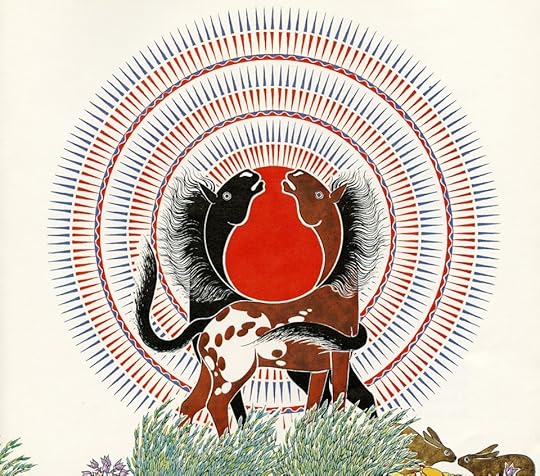
A Plains Indian girl is lost in the mountains during a storm. A wild stallion becomes her friend and she decides to ride free with the herd even after she is found.
In simple words and brilliant paintings that sweep and stampede across his pages, Paul Goble tells of a Native American girl's love of horses.
Her people saw that she understood the herd in a special way. The horses would follow her to drink at the river. And in the hot sun she would sleep contentedly beside them as they grazed among flowers near her village.
One day a thunderstorm drove the girl and the horses far from home, and the people were frightened. The girl was lost beneath strange, moonlit cliffs; yet, next morning, she was glad for a beautiful stallion who was the leader of the wild horses welcomed her to live with them.
Winner of the 1979 Caldecott Medal and many more recognitions, this is a classic story about love and friendship the families will cherish for generations to come.
Paul Goble was an award winning author and illustrator of children's books. He has won both the Caldecott Medal and The Library of Congress' Children's Book of the Year Award. He gave his entire collection of original illustrations to the South Dakota Art Museum in Brookings, South Dakota. Goble, a native of England, studied at the Central School of Art in London. He became a United States citizen in 1984. Goble's life-long fascination with Native Americans of the plains began during his childhood when he became intrigued with their spirituality and culture. His illustrations accurately depict Native American clothing, customs and surroundings in brilliant color and detail. Goble researched ancient stories and retold them for his young audiences in a manner sympathetic to Native American ways. Goble lived with his wife in Rapid City, SD.
For the most part, I have indeed enjoyed The Girl Who Loved Wild Horses and have truly loved author/illustrator Paul Goble's boldly expressive illustrations. However, while I certainly do understand why this book won the Caldecott Medal, and that many also seem to have fond childhood memories of it, that many simply adore The Girl Who Loved Wild Horses, the controversies of authenticity and charges of cultural appropriation that have been repeatedly levelled at Paul Goble have certainly made me approach this American picture book classic rather critically and with some major trepidation. And while I do certainly think that some of the criticisms against Paul Goble and his work in general might have been rather over the top so to speak and exceedingly harsh, Paul Goble has in my opinion also seemingly invited some if not much of this himself (with how he has approached the controversies, with his own reactions to the same, reactions that I have found rather extreme and at times massively childish and petty). And with this in mind, the following rather lengthy musings are not so much an analysis of the story and the accompanying illustrations in and of themselves (as I have already mentioned, I generally rather enjoyed them, hence a high two star rating), but more my personal attitudes towards the controversies surrounding The Girl Who Loved Wild Horses.
For me, personally, one of the main issues with The Girl Who Loved Wild Horses is the lack of specific information about its conception and development. Not only is the Native American tribe to which the girl is supposed to belong never specifically mentioned, there are also no author's note and no acknowledgement of Paul Goble's sources or possible sources. There is thus also no way of knowing whether The Girl Who Loved Wild Horses is a retelling of a Native American tale (or tales) or whether it just represents a story made up by Paul Goble (and please note that the story itself is not at all inappropriate in scope, but I can certainly understand why many Native Americans and even some folklorists regard this tale with more than a bit of suspicion). And really, not acknowledging the sources of "Native American" tales, especially if they are not written by Native Americans, is seen by more than a few Native Americans as problematic at best; some actually consider it massive and unforgivable cultural appropriation. Indeed, I know that personally I cannot totally and without a nagging sense of incompleteness enjoy traditional folk or fairy tale retellings that do not have an author's note showing sources, background and the like, but with Native American, Native Canadian retellings (in fact, with many if not most retellings of stories based on aboriginal cultures, taken from aboriginal traditions and lore), leaving this information out is not only a lack, is not only something that leaves out information culturally and often historically relevant and interesting, but is in many ways also rather a sign of disrespect (at least that is my opinion, and I know it is an opinion shared by many Native peoples).
And that many teachers often seem to use Paul Goble in social studies units or in units specifically on Native American culture is precisely one of the main reasons why some Native American scholars and activists have issues with him and his work, as they basically believe that Paul Goble has gotten very rich and very famous from his retellings (so to speak) of Native American tales, but that he has (at least according to them) never really reached out to Native American communities and tribes (but simply appropriated Native American culture and lore without acknowledgement and without humility).
Now Paul Goble might have indeed vetted his stories with certain tribal elders, as he has claimed (but that is just hear-say, and I know that it is not universally accepted or believed). But if I were a teacher, while I would most probably still use Paul Goble's retellings as folklore (but yes, only with older children), I would definitely discuss the controversies surrounding his stories, and I would also juxtapose Goble's stories with tales that have (in my opinion) better and more detailed author's notes. And I would most certainly never feature only Paul Goble's stories, but make his oeuvre part of a unit on Native folklore (and I would furthermore make sure that I included folklore stories retold and collected by Native American/Canadian authors, such as Joseph Bruchac, who in fact, almost always includes detailed and interesting supplemental information and appropriate cultural acknowledgements).
Yes, I do well realise that author's notes are actually a relatively recent phenomenon, and thus, I was curious as to whether Paul Goble does now include supplemental information in his Native American retellings. And indeed, he does seem to now add actual references, although he just lists them and does not specifically state of which of the listed entries he has made use. And no, I am not trying to sound dismissive here, but to me Paul Goble (even though many of his stories are lovely, with equally wonderful illustrations) still has not done a good enough job documenting his sources (and in the newer books, it seems almost as though he has and very grudgingly responded to the criticism that his earlier books lacked source materials by simply overloading us with a reference section, but one that is simply listed, in a to me rather user unfriendly manner, and perhaps even deliberately so). One is still not given information as to from exactly where, from which of the sources featured, Goble's tales have been gleaned, which in a good supplemental author's note, should and would be the case.
But for me, even more problematic (and yes, I know I am veering a bit off topic here, but I think this is necessary) is that for some of the more recent Iktomi retellings (the ones I found in my local library), Paul Goble has actually (in the front material) poked some rather nasty fun at his critics (mostly his Native American critics). In Iktomi And The Coyote, Paul Goble writes "Hi kids! I'M IKTOMI! That white guy, Paul Goble, is telling my stories again. Only Native Americans can tell Native American stories. So, let's not have anything to do with them. Huh?" And in Iktomi and the Ducks: A Plains Indian Story, Paul Goble goes as far as to write in the front material, "There goes that white guy, Paul Goble, telling another story about me ... My attorney will Sioux." Maybe Paul Goble thought and thinks that this was and is funny, but I found it quite offensive and I bet that many Native Americans would find it offensive as well (it certainly does nothing to give me a more positive attitude towards Goble, in fact, it makes him appear childish and whiningly petulant).
Furthermore, I was actually more than willing to give Paul Goble the benefit of a doubt with regard to the lack of an author's note in The Girl Who loved Wild Horses (for let's face it, only recently, have author's notes come to be common and expected) until I saw these "humorous" quotes in the two Iktomi books I got from the library. I can understand that Paul Goble might be a bit annoyed and even legitimately angered at some of the criticism (especially if he feels that his books are, in fact, respectful to Native Americans), but his way of showing his displeasure is not at all funny and smacks of the kind of attitudes towards Native Americans that have created this situation in the first place. And yes, I am actually glad to have gone to the library and searched for these books because it kind of has justified my rather critical attitude towards Paul Goble and his work. I would still use his work with children, but I would most definitely not only discuss the controversies, I would also be very critical and even publicly critical of him (especially with regard to the Iktomi books, that is just so unacceptable, it defies description, and is probably the main reason why I have now after careful thought and analysis decided on just and only a two star and not a three star rating for The Girl Who Loved Wild Horses).
Finally, and just to point out again, I actually do think that Paul Goble might have received a perhaps slightly undeserved rough ride with regard to his work as a whole. However, he should have been intelligent enough and intuitive/perceptive enough to have realised that his retellings might well feel like cultural approbation to some and perhaps even many Native Americans. And yes I also do not think that even if Paul Goble had added what I would call better and more detailed authors' notes to The Girl Who Loved Wild Horses and his other Native American inspired picture books (ones showing not only references but exactly which stories he had used and/or which stories he had been told), it would have silenced all of the criticism and controversy, but I think it might have silenced or perhaps mitigated at least some of it. And in my opinion (and sorry about being repetitive), but the supposedly humorous jabs in the front materials of the two Iktomi books I found at our public library, they do show not only massive disrespect and a patronising attitude towards Native Americans and actually children in general, but also point out that Paul Goble obviously has a rather inflated opinion of himself and only very grudgingly accepts any type of criticism.
Oh dear, I had a review and the program didn't save it, it appears.
I thought this a very strange story. The artwork was lovely, but it was a strange legend. I guess most legends are strange. It had a Catharine the Great feel to me to the story.
A girl loves horses and one day they stampede away with her and get lost for a year. She does not want to return to her village.
The kids were crazy about this one either. Neither of them got the story. They both gave this love stars. I'm sorry I lost the review I wrote.
This book was around during my own childhood and I never discovered it. My son's childhood missed it, too. Thank goodness I finally found it in time to give to my daughter, whose long black hair blows in the wind just like the hair of the girl who loved wild horses.
If you have a daughter or granddaughter (of any hair color!) who happens to love horses, this is the perfect book to add to your library in the Year of the Horse.
In a beautiful stylistic way Paul Goble has told a vivid story of a wise girl who wanted to be one with nature and to feel its inner meaning. A beautiful reading experience, superb, amazing Art!!!
"There was a girl in the village who loved horses. She would often get up at daybreak when the birds were singing about the rising sun. She led the horses to drink at the river. She spoke softly and they followed. People noticed that she understood horses in a special way. She knew which grass they liked best and where to find them shelter from the winter blizzards. If a horse was hurt she looked after it." "Today we are still glad to remember that we have relatives among the Horse People. And it gives us joy to see the wild horses running free. Our thoughts fly with them."
I have been reading many Native American folktales lately and I have recently stumbled upon this little gem called “The Girl Who Loved Wild Horses.” “The Girl Who Loved Wild Horses” is a Caldecott Medal award winning book by Paul Goble which is about how a young Native American girl’s love for horses has led her to the land of the wild horses and how she has to make the decision of her life to be happy forever. “The Girl Who Loved Wild Horses” is a true classic tale that every child will enjoy for many years!
I have read many Native American folktales in my time, but never have I read one so full of luscious illustrations and an amazing story! Paul Goble has done a beautiful job at retelling an ancient Native American folktale and what I loved about his writing was how he made the girl into such a kindhearted character and it was so interesting seeing her love for the horses as she would constantly feed them and talk to them. I also loved the way that Paul Goble made this story extremely dramatic, especially during the thunderstorm scene as Paul Goble made it seriously intense. When I was reading the thunderstorm scene, I was practically on the edge of my seat hoping that the girl and the horses would make it to safety! Paul Goble’s illustrations are the true highlights in this story as they are extremely beautiful and creative to look at. I loved the way that Paul Goble illustrated the girl as having a blue dress and there are beautiful white designs scattered all over the girl’s blue dress which makes the girl look truly regal. I also loved the images of the horses themselves as they truly defined the beauty that they show the girl as they are brown and are drawn in an elegant way. But my most favorite image in this book was the image of the thunderstorm as it truly does look threatening as the clouds are extremely black and it swirls around menacingly around the girl and the horses and that truly made the scene more intense.
Parents should know that there is a brief image of blood shown at the beginning of the page as a buffalo is pierced by an arrow. It is a very small image, but still, children who do not like the sight of blood might want to skip over this scene.
Overall, “The Girl Who Loved Wild Horses” is a brilliant and memorable book for children who love reading Native American folktales and also has an extreme love for horses! I would recommend this book to children ages six and up since the image of a buffalo being pierced might unsettle smaller children.
Is Paul Goble's The Girl Who Loved Wild Horses one of your favorite books? It won the Caldecott Medal thirty-five years ago, but let's take a look at it to see if we'd use it today, when one of the criteria for books about American Indians is whether or not it names a specific tribe.
Here's the first paragraph in the story:
"The people were always moving from place to place following the herds of buffalo. They had many horses to carry the tipis and all their belongings. They trained their fastest horses to hunt the buffalo."
With the word 'tipis' in that paragraph Goble suggests that these are Plains people. The buffalo are another clue that suggests the story is one belonging to the Plains tribes.
As the story begins, we learn of "a girl" (we are never given her name) who loved horses. People in the village see that she has a way with them. One day when she is out with the herd of horses, a huge storm erupts. She leaps onto one as the herd races in fear. When the horses stop that night, the girl looks around and realizes that they are lost. The next morning she wakes to the neighing of a handsome stallion who tells her he is the leader of the wild horses that roam the hills. He welcomes her to live with them. She and her herd are happy.
Meanwhile, her people spend the next year looking for her. One day, two hunters see the stallion and the girl, too. She's on a horse, leading a colt. They call and wave at her. She waved back, but the stallion drove her and the herd away from the hunters. Other men join them in an attempt to reach the girl, but the stallion keeps them away from the girl and the colt. But, the girl's horse stumbles, and she falls. The hunters take her back to the village. She was happy to see her parents but she is sad. She misses the colt and the wild horses. At night, the stallion calls to her. The girl is lonely and gets sick. Doctors ask what would make her happy again, and she says she wants to return to the wild horses.
The stallion and wild horses come to the village. The people give the horses blankets and saddles and they give the girl a beautiful dress and the best horse in the village. The girl gives her parents a colt, and she rides away, beside the stallion, reunited with the herd. Each year, she brings her parents another colt. But one year, she doesn't return at all.
Then, the hunters see the stallion again. Beside him is "a beautiful mare with a mane and tail floating with wispy clouds about her." They believe the girl is that mare, that she has become a wild horse, too. The story ends with:
"Today we are still glad to remember that we have relatives among the Horse People. And it gives us joy to see the wild horses running free. Our thoughts fly with them."
Nowhere in The Girl Who Loved Wild Horses do we have any sources for that story. As noted earlier, Goble's use of 'tipis' suggests a Plains tribe. What we know as the Great Plains is a vast area, stretching from north to south, about 1500 miles. In that area are a lot of tribes. They don't speak the same language and they don't tell the same stories.
The question is, who does this story about a girl who became a wild horse belong to? It'd be good to know. If it is a story Goble came up with, then it isn't a Native story, is it?
Though it won the Caldecott, and though a lot of people love Goble's art, I think it is (past) time to set aside The Girl Who Loved Wild Horses. What do you think?
In this book we clearly see the close relationship that so many Native Americans have with horses. Paul Goble has given us a fable filled with magical realism and striking illustrations. The girl gets lost in a storm with a herd of horses and meets a handsome spotted wild stallion. She runs free with the herd until her tribe rescues her. When back with her family, she finds that her destiny is with the stallion and his herd. Includes two native songs about horses -- one Navaho and one Sioux.
My horse's teeth are made of white shell. The long rainbow is in his mouth for a bridle, And with it I guide him.
As it has been years since I read this book, this will be an incomplete review.
I understand that my opinion is not the norm, but I did not like this book near as much as I thought I would. The illustrations are amazing and probably do deserve the award. Native American myths are usually interesting and entertaining for young children...but I felt that the way the myth was presented negated much of the entertainment value. I frankly found this boring. You never got a chance to relate with the main character and the illustrations, while beautiful, did not work with the words but beside them. It is a hard concept to explain but it does happen. I've seen books where the pictures made the words better, they made the words worse, I've seen where the two blend together, fight each other, or merely sit there side by side and do nothing for each other. That is what felt like was happening here. The fact that both were done by the same person makes this harder to believe because I've tended to find picture books that do that have a different writer than artist and their parts don't mesh.
The thing is, I really expected to like this book...and didn't. A great idea that just doesn't seem to work in execution.
———————————————————— AR POINTS: .5 READING LEVEL: 4.1 ————————————————————
The Girl Who Loved Wild Horses by Paul Goble (1978) 36 pages. Read online at Archive.org
A beautifully written and illustrated Native American story of a girl who loved and honored her wild horses. When a storm caused them to run away with her and become lost, the horses invited her to live with them.
When her people finally found her, she did return home, but was very unhappy. The stallion of the group of horses missed her and would stand high on an overlooking mountain beckoning her to return to them.
Her parents saw her sadness and allowed her to return to the wild horses. She would visit her parents every year and bring them a colt. But, one year she did not visit and was never seen again. But, they did notice a beautiful mare with a beautiful mane floating like a cloud, riding along side the stallion. It was believed the girl now rode with the Horse People, a belief of Native Americans that they have relatives that ride with the wild horses.
Paul Goble was not Native American. He is actually a British-American who specializes in writing and illustrating amazing Native American books for children. This book won the Caldecott Medal as the year’s best illustrated book for children.
This is a lovely folktale about a (big shocker here) girl who loved wild horses. There's also a couple of Native American songs about horses at the end.
The story was interesting, though somewhat predictable by folktale standards, but the illustrations are wonderful, with bold colors, strong geometric designs and a raw, natural feel to them.
This book was selected as one of the alternate books for the September 2014 - Horses discussion at the Picture-Book Club in the Children's Books Group here at Goodreads.
The Girl Who Loved Wild Horses has been one of my favorite books since I was a young girl. My mom use to read it to me until I was able to read it to myself. It is a Navajo story about how a plains girl became one with the horses. It begins with a young girl getting lost on the plains with her tribes horses she then meets the wild horses and they become one herd. The young girl lives amoung them until one day men from her tribe find her and bring her home. She is happy to see her family but she misses the horses she soon becomes very sick. She is then taken back to her horses by her family and she becomes better. Every year she returns to visit her family and brings them a colt. She later disappears but her people know that she became a beautiful mare. This story is a great Navajo Folk tale it explains how the girl became the horse. It is illustrated beautifully and the colors captivate the readers. It is a longer picture book and would probably be best for students from 4th grade and up. I love this book and this that it will be reads for a very long time.
One look at these lovely earth-tone illustrations reveals why Paul Goble’s slender book won the Caldecott Medal in 1979. Readers will be moved by Goble’s story of a girl who loved adventure and freedom, but never forgot her Navajo tribe. The tale is on one level, an old Navajo legend, but on another it’s the tale of Everywoman, caught between obligations to others and her own needs. Children and adults will love this book for very different reasons.
I was surprised by how much I actually liked the illustrations. I really appreciated the flow and movement to them with all the vivid colors that captured the Native Americans, their villages, and the flora and fauna in an authentic, yet passive way. The story was interesting, but I must admit the plot weakened for me when the girl gave her parents a colt as a gift. That just didn't make sense to me. Why didn't the horses just live with her and her family? The ending was a little odd, too. I guess I wasn't expecting such a strong folklore tale. Although it was different, and it didn't make it onto my favorite shelf, I am still oddly happy with this read.
This won the Caldecott for 1979. The Indian girl who knew the horses so well, got lost out in the wilderness with them in a storm and then lived a year with the horses prior to her tribe finding her. She did not do well returning home, and went back to live forever with the horses. She disappeared, but a new horse was seen partnered to the lead stallion, so it surely must be her.
I liked the many horse pictures, that had the feel of the paintings I've seen that native people have made of horses. So it is easy to get immersed in this book/story. Each page is maybe a bit heavy on the text, so it feels like a slightly older child book.
A good folklore/mythological tale like this is good to hear. Kids really identify with pets/animals, as they all talk to their pets more than adults do. So I'm sure kids will love this.
The thing that I’ve noticed about the illustrations is that they don’t look American, so it doesn’t capture the Native American feel. It looks more like Japanese artwork, the land of the rising sun, especially with that big orange ball on the cover. The design in the inside cover really didn’t look that way. The color scheme was from another country to me, and the modern rays of the sun in no way represented Native Americans.
I liked the girl’s dress, with the white shells on it. Her moccasins were so pretty with the light and dark blue design. The first two pages of the warriors on horseback in a stampede of buffalo was nice. I liked the warriors with their bows drawn hunting the animals.
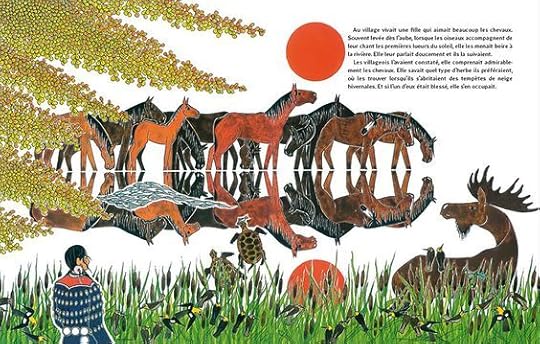
The third and fourth pages were the most unsuccessful water scene I’ve ever seen. There were a group of horses standing further up the page and they were chopped at the ankles and a white space separated them from what was supposed to be the mirror image of them in the water. There were turtles and a fish floating randomly in this white space. The water wasn’t even blue, it was just blank space on the page. Then there was tall grass and cattails in the foreground, with a moose just standing behind the blades so we couldn’t see his hooves and what he was standing on. I guess he was in the water. There was a mirror image of the sun hiding behind the grass, so that meant the water was somewhere behind the grass so I had no idea where the water began and the ground left off. The perspective was entirely wrong. The grass was on one plane and the water taking up a space that was impossible for it to do.
He brought that culture to life, that the girl knew which grass the horses like to eat and where to give them shelter in the snow. I liked the black cloud rolling in during the thunderstorm. It was dramatic, with the bolt of lightning and that big orange sun. They were colors that captured the eye. I really liked the pages of the girl wrapped in her blue, orange and black blanket atop one of the horses, and those tall black cliffs outlined in white with the full yellow moon and the stars. It was a striking scene.
When she met the leader of all horses, the artwork really didn’t convey that. There were random stones hanging in yet again blank white space, going up the page like they were supposed to represent a cliff but it didn’t show that. There was a waterfall at the top that ended up stopping randomly, breaking into white space and then the water picked up further on and cascaded down rocks. It made no sense. Also, the rainbow and the water didn’t go along with the other illustration because it looked like crayon and that’s not the medium the illustrations are in. There were random trails of greenery with flowers snaking out onto the pages on top of white space, a part of nothing. The ground should have been colored in so it didn’t look like magic flowers growing out of nothing.
The story made no sense to say the people looked everywhere for her but couldn’t find her, but then a year later 2 hunters went into the hills and saw her. Why did they wait an entire year to look in the hills? Wouldn’t they have looked for her in the beginning so there was a better chance of finding her? That was a huge hole in the story.
I liked the images of the tipis, even though they weren’t authentic. One had a bear on it and another a deer. It was cute that the wild stallion stood on top of the hill and neighed sadly because she the hunters took her home. But I wanted her to go home and be with her people again. It was dramatic that she turned ill because she was away from the horses. It was sweet of her to give her parents the colt from the wild herd, and every year after that she’d visit them and give them a colt. It was sad when one year she didn’t come and was never seen again. A quite dramatic, sad ending for a story I thought would be happy. When I realized she turned into a mare and was seen with the stallion, things turned weird. I thought how perverse it was that she turned into a horse and immediately my mind went to her mating with the stallion and how gross that was that a person would be in horse form mating with a horse. I couldn’t help it, cuz that’s what would be happening.
It was a nice note to end on that they consider themselves to have relatives among the horses, and they like to see wild horses run free. The story just wasn’t what I expected. What threw me was her going to live alone with the horses and then becoming a horse herself. I would have liked the story better had that not happened. The artwork was okay but needed to be better and use the colors authentic to the tribe he’s representing. And talking to my sister, she pointed out you never know what tribe he’s talking about, and that’s true. There’s not one mention of a tribe. I obviously know it’s a Plains tribe because of the dress and the landscape and buffalo. I assumed it was Sioux. You don’t get to know anything much about the tribe, just that they hunted buffalo and had horses. I need more background for the story and facts on their way of life to get to know them.
At the end he included a song about horses from the Sioux and Navajo, and it would've been nice to know which tribe this was based on.
This entire review has been hidden because of spoilers.
“The Girl Who Loved Wild Horses” tells the story of a young girl who loves her people, but loves the horses more. She understands the horses in a special way and spends time helping to look after them with her mother. One day in a storm, the girl jumps on a horse as it gallops way scared of the thunder. She ends up in an area she has never been before and lives happily with the horse while her people search for her without success. Eventually she is found and brought back to the village, but she is lonely and wants to return to the wild horses. Her parents agree that she should live with the wild horses, allowing her to return to them. The girl thanks them with the gift of a colt every year until one year when she is never seen again. Her people say this is because she had become one of the wild horses herself. This book would be a great addition to a classroom library. The connection between the girl and the horses show the importance of a connection with nature in the Native American culture and could be read as part of a unit on folktales or the history of the United States. I enjoyed this book because of the beautiful pen-and-ink and watercolor paintings that illustrate this book. These images brought the story alive and there style was reminiscent of Native American art. I think that any student with an interest in folktales, horses, Native American culture, or beautiful illustrations would love this book.
Told in a simple, yet beautiful narrative, this story highlights American Indian beliefs in humanity's connection to nature. A girl who has a special gift to talk to horses, finds that she is more at home with them than her own people, but she never forgets her parents or village and brings them a new colt every year. The legend eventually says that she bacame a horse and her people are happy to have a representative in the horse community. There are also two American Indian songs about horses in the back of the book.
The picutures are full color black ink and watercolor paintings and are in bright earth tones.
The story shows how a person can move on from their home without turning their back on their culture. There is also an interesting lesson about naturalist people (see Howard Gardner's 8th Intelligence) who feel more comfortable in nature than society.
These illustrations were beautifully done and really captures the Native American artwork; he used rich colors and intricate details on the clothing. The pictures really seemed to put the text to life. As a reader, I was able to feel the fear of the horses when the storm hit. I especially liked this book because I love horses and have always dreamed about seeing wild mustangs. What I found odd was that this young girl leaves her tribe to live with the wild horses. I wonder how she was able to survive by herself out in the wilderness, especially being so young. However, that's what makes old folktales so entertaining; everything doesn't have to make sense. If I was to use this book in my classroom, I would read it to go along with the Native American unit. I would also read other Native American folktales and have the students compare them.
This is a traditional Pueblo Indian folk tale. A young girl loves horses and takes on the care of the tribe’s stock. But during a violent storm her favorite horse is spooked by the lightning and runs away with the girl on her back; the horse runs so far that they do not know how to get back to the camp. However, they notice a herd of wild horses, led by a spotted stallion, and they join that herd for help and protection. Eventually the girl returns to her people, but she finds she misses the wild horses whom she has come to love, so she leaves her home to join the wild horses.
There is a message here about the relationship between people and the natural world, about protecting the resources of the earth, and being thankful for the gifts received from nature.
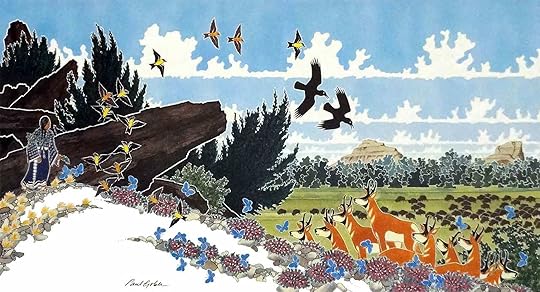
Goble’s illustrations are marvelously detailed and evocative of the American Southwest landscape.
A girl in an Indian village loved horses, and they loved her in return. She quickly did her chores so she could enjoy the horses. One day, she took the horses with her for a trip to the meadows beyond the village. A storm came upon them. The Indian girl was successful in calming the horses from the loud bangs of thunder, and the quick, nasty lightening.
After this experience, she was asked by the horses to live with them. Leaving her family, she lived happily among the beautiful wild horses. When her family found her, they saw how naturally she lived with the horses. They agreed to let her stay there with them. Each year she visited her village and brought a beautiful colt to them.
This is a lovely Caldecott medal award winning book.
This book gets three stars mostly because I just love the illustration, I think they are so vivid and colorful, I just want to stare at them all day. But I don't care for the story nearly as much as the pictures. I didn't really care for the ending and I thought that some parts of the story were a little weird and I wondered why the characters would act that way. All in all, this is a very pretty book that I think anyone could enjoy.
A Navajo tale of a young girl who might be considered a "horse whisperer." She loves to be among the horses of her tribe and discovers a heard of wild horses, whom she comes to lives with.
Paul Goble proves to be a very talented artist. His illustrations are crisp, sharp, colorful and richly detailed. This is quite deserving of the Caldecott Medal.
I love the way Paul Goble creates different landscapes in his illustrations, simply by changing the arrangement of his figures on a white background. The story itself freaked me out a little bit, but I have never been fond of horses. Little girls with that particular obsession will undoubtedly relate much better to the girl’s desire to run with the horses, and to become one.
Paul Goble, born September 27, 1933, is author and illustrator of over 40 children’s books about Native Americans. He was born and raised in Oxford, England and as a child when his mother made him a tipi and fringed leggings he developed a fascination with this culture. As an adult, he moved to Black Hills, South Dakota to learn all he could from the Native Americans. In 1959, he was ‘adopted’ by Chief Edgar Red Cloud and given the Indian name Wakinyan Chikala, “Little Thunder.”
It is known that in the Navajo Nation; northeastern Arizona, southeastern Utah, and northwestern New Mexico there are herds of wild horses. In this book, Paul Goble retells the legend of how this nation acquired horses, or became “horse people.” The book’s central character is a tribal girl that loves wild horses. She is drawn to these horses and spends most of her days riding among them, even sleeping in the meadows with them while they graze. When caught in a storm, she rides through canyons at night with a frightened herd and soon discovers she is lost. A spotted stallion calms her and she becomes a member of the “horse family.” While she is living among the horses on the plains, her tribal family wonders where she is and misses her dearly. One day she is seen riding the spotted stallion in a group of wild horses and she is rescued or rather ‘taken’ back home. Although glad to see her parents again, she is very sad to be away from the horses that she now feels so attached to. She tells her people that she will return to the horses and promises to give them a colt each year. As the story ends readers are introduced to a new beautiful black mare that is obviously the girl. Having loved the horses so much, she becomes one herself. Although it is never mentioned that this mare was once the Indian girl, one can gather that is what happens to her in the end.
Also in the end of the story are several Navajo songs about horses. In looking them up online I discovered authentic recordings of Navajo Horse Riding Songs. This hypnotic music seems to bridge the gap between humans and animals to touch the souls of both. Reflecting on his childhood in an interview with Wisdom Tales Press, Paul says, “I loved nature and would often walk to the lake at the end of our garden. I enjoyed the trees, flowers, birds, and insects. I spent much of my time in search of wild flowers for my pressed-flower collection, and watching birds. I drew and painted birds and butterflies from books in our home, and from things I saw in museums.”
The Girl Who Loved Wild Horses was awarded a Caldecott Medal in 1979. The Caldecott Medal was named in honor of nineteenth-century English illustrator Randolph Caldecott. It is awarded annually by the Association for Library Service to Children, a division of the American Library Association, to the artist of the most distinguished American picture book for children. Goble uses pen and watercolors to illustrate his books. Joe Medicine Crow, Crow Tribal Historian, and oldest living member of the Crow Tribe describes Goble’s work, “His art is tremendous because he is able to recreate the traditional forms with great accuracy and detail. The designs he draws are completely authentic and his colors are the same ones that were used by the old-timers before the reservation days. He is able to recreate the spirit of the old stories with his illustrations and his words.”
When I review children’s books, I like to get a child’s opinion. I read this award-winning picture book with Elizabeth Moseley, a young illustrator of her own stories. Elizabeth has just begun kindergarten and already has notebooks full of drawings that feature animals, people, flowers, trees, and even dinosaurs. While reading about the wild horses, we discovered all sorts of other animals hidden in the scenery … lizards, prairie dogs, rabbits, badgers, and elk. Elizabeth noticed the buffalo and recalled seeing buffalo out in a pasture along Hwy 221.There were flowers, birds, butterflies, lightening, and rainbows. Goble’s pictures engage adults and young readers in conversation surrounding the story, and for Elizabeth new vocabulary was also discovered. Children grow up knowing about horses, but maybe not hearing the words stallion, mare, or colt. I recommend this book for its cultural and artistic expression, but most of all for opening the door to your imagination. Spotted Stallions by Elizabeth Moseley and Paul Goble
I certainly would consider two and a half stars for The Girl Who Loved Wild Horses.
Paul Goble's telling of this story evokes all the nuanced majesty of a deeply affecting Native American legend. The Girl Who Loved Horses, as she is known, stands out among the people of her tribe for her intuitive affinity for horses. Only she can get them to do what they need to do, leading them to streams to drink and sheltering them from dangerous weather and other hazards of the land. The Girl loves the horses, and they, in turn, trust and love her.
When The Girl and her family's horses become hopelessly lost one night during a severe lightning storm, they meet up with a beautiful, wild stallion, and The Girl wordlessly agrees to give up her regular life to merge her horses with those of the stallion and all live together as one wild herd. Even a year later, when the girl is finally located by her family and brought back home, she finds that she no longer is happy living within the confines of human civilization. She must live among the wild horses, where her destiny can freely unfold and she can find the life that she was always meant to lead.
I liked the illustrations in this book, but The Girl Who Loved Wild Horses is actually one of the few Caldecott Medal winners for which I actually thought that the story exceeded its pictures. This is one of the best Caldecott books, in my view, and I would definitely recommend it.