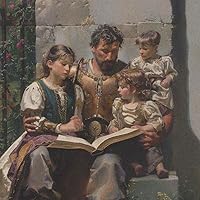
Wolfram von Eschenbach was a German knight and poet, regarded as one of the greatest epic poets of his time. As a Minnesinger, he also wrote lyric poetry.
Little is known of Wolfram's life. There are no historical documents which mention him, and his works are the sole source of evidence. In Parzival he talks of wir Beier ("we Bavarians") and the dialect of his works is East Franconian. This and a number of geographical references have resulted in the present-day Wolframs-Eschenbach, previously Obereschenbach, near Ansbach in Bavaria, being officially designated as his birthplace. However, the evidence is circumstantial and not without problems - there are at least four other places named Eschenbach in present-day Bavaria, and Wolframs-Eschenbach was not part of Bavaria in Wolfram's time.
The arms shown in the Manesse manuscript come from the imagination of a 14th-century artist, drawing on the figure of the Red Knight in Parzival, and have no heraldic connection with Wolfram.
Wolfram's work indicates a number of possible patrons (most reliably Hermann I of Thuringia), which suggests that he served at a number of courts during his life. In his Parzival he claims he is illiterate and recorded the work by dictation, though the claim is treated with scepticism by scholars.
Wolfram is best known today for his Parzival, sometimes regarded as the greatest of all German epics from that time. Based on Chrétien de Troyes' Perceval, le Conte du Graal, it is the first extant work in German to have as its subject the Holy Grail. In the poem, Wolfram's narrator expresses disdain for Chrétien's (unfinished) version of the tale, and states that his source was a poet from Provence called Kyot. Some scholars believe Wolfram might have meant Guiot de Provins (though none of the latter's surviving works relate to the themes of Parzival), however others believe Kyot was simply a literary device invented by Wolfram to explain his deviations from Chrétien's version.
Wolfram is the author of two other narrative works: the unfinished Willehalm and the fragmentary Titurel. These were both composed after Parzival, and Titurel mentions the death of Hermann I, which dates it firmly after 1217. Wolfram's nine surviving songs, five of which are dawn-songs, are regarded as masterpieces of Minnesang.
Parzival - 1 and 2 Wolfram von Eschenbach (1170 – 1220)
For this work, we need to mention two authors: Chretien de Troyes, between 1182 and 1190 in medieval French language, created a series of epic poetry on chivalry. The last and unfinished one of these was named ‘Perceval’, or ‘The Legend of the Graal’. These works would become known as the saga of King Arthur of Britany and his knights of the round table.
Wolfram von Eschenbach used the same story as an inspirational background and wrote ‘Parzival’ medieval German language, ‘Mittelhochdeutsch’ in the years between 1200 and 1210. This edition presents the original rimed poetic version on the left page and the translation in prose in ‘Neuhochdeutsch’ on the right. Von Eschenbach, in his work, raises the theme of noble chivalry to the highest level of imagination. For every knight, honor is the first and foremost aim to achieve. The honor of faultless loyalty to God, the king and the lady of his heart. The honor of being the best fighter in every battle situation, on horseback, in friendly or deadly duels. The honor of being true to a given promise without fault, forever. To be fearless of enemies and generous and forgiving to fallen opponents. The story follows the lives of Parzival and Gawan in parallel and sometimes crossing paths, through countless horseback battles in the search of the famous Graal, an ever vanishing quest for the perfect issue of love, religion and fulfillment of chivalry. The writing style of this poetry is similar for both authors. They were written in short lines, no more than six to eight words in each. Each line rimes with the front line, flat and simple. The charm of these lines comes without doubt from the humor and whit expressed by the poet. Even for a native German reader, it is difficult to make any sense out of ‘Mittelhochdeutsch’ if not for a scholar. Individual words can be the same as from old, and others can be recognized with a little imagination, that is about as far as it gets. The reader is, therefore, relying on the prose translation into ‘Neuhochdeutsch’. And as always with translations, the beauty of the work is mostly lost. The poem is counts of about 25000 lines. About 75 handwritten copies are in existence, proving the widespread success of this work during the authors lifetime and long after. We must remember that in those days, literature was not printed and sold in large numbers. It was the tradition in to read the poems aloud to a circle of aristocratic, clerical and other enthusiastic listeners. Each one of these readers could, therefore, produce an act of personal interpretation, like an actor on a stage. This popularity of Parzival in Germany continued to the 19th century when Richard Wagner composed his musical drama “Parsifal”. It was first presented on stage in 1882.
Recommending this work to readers of our times must be limited to enthusiasts of chivalry stories and medieval literature.
Ja, Schamgefühl belohnt mit Ruhm, Es ist zugleich die Seelenkrone. Schamgefühl ist mehr als Sitte: Tugend! - Ich hörte nie ein Lob auf Männer, die mutig waren, aber grob. - Sie hielt in ihrer Habd den Psalter - so entdeckte Parzival den schmalen Ring; den hatte sie trotz allen Leids nicht abgelegt, sie trug ihn immer noch aus Liebe. - Wo zeigte sich je größre Liebe, als sie Gott an uns erwies, den man für uns ans Kreuz geschlagen? Wenn Ihr ein wahrer Christ seid, Herr, so müßt Ihr diesen Tausch beklagen: Sein Leben, das so kostbar war, gab Er, im Tod, für unsre Schuld - denn die Menschheit war verloren, durch Schuld der Hölle ausgeliefert. Wenn Ihr nicht ein Heide seid, Herr, heiligt diesen Feiertag. - Wer erfolglos bleibt, der ist voller Habgier, voller Feindschaft; es tut dem Mann mit Kampfgeist wohl, hält der Ruhm des Freundes stand, so daß die Schande von ihm flieht. - An ihren Augen zeigt sich euch, ob sie sich nach dem Freunde sehnt.
The work itself would get five stars, but the present rating is for this particular rendering, the first English translation, and the only one I know of into verse. I find that it becomes wearying rather fast, but others may enjoy it.
It is a product of late-nineteenth-century scholarship, and much of what the translator has to say is dated, let alone the base text.
Breaking up the digital edition into two "volumes" follows the lead of the original edition. This requires two purchases. Other digital publishers have put them into a single file (they aren't abrodged. as this might suggest).
This one was actually better and somehow more enjoyable than the first. Probably because Parzival shared the space in the spotlight with Gawan, who was a much more interesting character than Parzival himself, who - let's be honest - was a total brat in the first part, nearly raping a woman and just killing someone for his armour (though authorised), and yes I know he "didn't know better" - for which one should probably blame his mother, and as he finally realised his errors he overall became quite depressive and whiny (also because he was in love). Now Gawan, on the other hand...I really enjoyed his 'books' in the overall story of Parzival. I mean, the fight in the magic castle was brilliant - fighting with a chess board and his love interest throwing chess figures. My ranking of the two books (first received two stars) is like that because both are really, really old and this was considered by me in rating them (without this, they would have received 1 and 2 stars).
This entire review has been hidden because of spoilers.
Definitely one of those stories where everything but the main character is the interesting thing, particularly Fereifs’ kid being Prester John and all the race dynamics and blended family dynamics in Parzival and Fereifs being half brothers. And then Parzival’s kid Lohengrin running off on his wife- and then how Eschenbach sung this for a woman. Though I could do without Gawain’s trying to get in Orelgeuse’s pants.