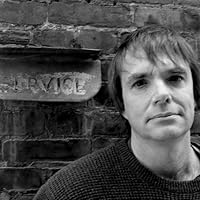
"Under Albany is the shadow movement of Ron Silliman's epic of everyday life, The Alphabet. Silliman provides a set of extended, vividly etched, mostly autobiographical, meditations on the background for each of the original 100 sentences of his 1981 poem Albany. This constructivist memoir provides an exquisitely rich exploration of the relation of context to reference, subtext to meaning, back story to presented experience, and composition to poetics. All of Silliman's work unravels and reforms in this exemplary and exhilarating act of attention, recollection, and reflection." --Charles Bernstein
Ron Silliman has written and edited 30 books to date, most recently articipating in the multi-volume collaborative autobiography, The Grand Piano. Between 1979 & 2004, Silliman wrote a single poem, entitled The Alphabet. In addition to Woundwood, a part of VOG, volumes published thus far from that project have included ABC, Demo to Ink, Jones, Lit, Manifest, N/O, Paradise, (R), Toner, What and Xing. The University of Alabama Press will publish the entire work as a single volume in 2008. Silliman has now begun writing a new poem entitled Universe.
Silliman was the 2006 Poet Laureate of the Blogosphere, a 2003 Literary Fellow of the National Endowment for the Arts and was a 2002 Fellow of the Pennsylvania Arts Council as well as a Pew Fellow in the Arts in 1998. He lives in Chester County, Pennsylvania, with his wife and two sons, and works as a market analyst in the computer industry.
For a LANGUAGE poet who is well known for his impersonal and formal poetry, Under Albany is surprisingly lyrical and rather almost straightforward as a memoir. Under Albany, as the title wld imply, goes under the architecture of Silliman’s 100 (new) sentence poem, Albany. I cannot recall where I read it, but Silliman said that Albany was an autobiographical poem. But in reading, much like Heijnian’s My Life, one cannot fill in the gaps through the disjunctive and paratactical sentences without the deeper knowledge provided here of Silliman’s life. I do think the poem shows itself as a critique of everyday life and the class struggles that pervade the space of the everyday. However, Silliman is attempting to create a memoir of his life that corresponds to the sentences of Albany. He does it in a way that follows the fragments and non-chronological movement of the sentences rather than just saying something like “oh well this sentence meant this to me.” Rather, in an interesting way Silliman interprets the sentences himself as if he was in a way separated from their production. That might be pushing too far on the form because Silliman is adamant about poetry being a form of labour, creative labour, but the impersonality of the new sentence seems to create a distance between the language and writer. But unlike Albany’s formal impersonal architecture, Under Albany is a plainly written memoir that shows the new sentence isn’t necessarily as disjunctive and non-narrative as can be thought. The new sentence can still follow an elaborate narrative structure, however it’s a new form of narrative. This is still a rudimentary thought I’ve been having concerning my poetics but I like to think LANGUAGE poetics (Coolidge, Silliman, Heijnian, Ashbery too!) alter the function of narrative in poetry by changing the relation between word and narrativity. The words still function in a way of generating narrative but they don’t necessarily follow narrative. Think Beckett’s The Unnameable and his closed space short prose pieces. The words do advance and create a narrative space, however the words are still in disjunction from the narrative. Albany, as shown by this book, follows a certain form of autobiographical narrative, but the word and sentence doesn’t necessarily strictly follow linear and concise narrative. The words don’t have to follow in succession to coalesce into a narrative that follows a beginning, middle, and end structure but rather remain in a somewhat indeterminate space and create new contexts through the participation of the reader in filling the gap between word and world. Maybe drivel - but I see Albany and My Life as generating this new function of narrativity and word.
Even after all of Silliman describing his life through 103 pages, he claims in the end that “It is not possible to ‘describe a life’” (103). That this comes after Silliman attempts to “describe his life” through the act of memoir suggests how even this memoir becomes an act of fiction by means of creating it in the word, by creating it as literature. Life & experience come through almost as a wordless void, the poet may attempt to put this into word and language but Silliman, I think, remains suspicious of this assuredness that we can accurately describe our lives in autobiographical manners. Notice how the memoir is free flowing and non-chronological, each sentence corresponding to different periods of Silliman’s life, from writing in fifth grade to meeting his now wife Krishna Evans. He even says “life is not a plot” (99). It wld seem almost nihilistic to say that life is rather very plotless, but Silliman is here pointing to the fact that life indeed isn’t what literature and poetry makes it out to be. Certain forms of literature wish to control this plotless mass of life by instilling order and “plot” to it. It wants to create a narrative out of life but Silliman’s new sentence and narrativity mimics the rhythms of life far closer; life is rather disjunctive than conjunctive isn’t it? Yet, Silliman shows how much it is both connected and disconnected. Every sentence seems detached and fragmented but through this act of memoir, Silliman shows how everything is inevitably connected and matters to the whole of his life. There is a way the new sentence produces both connection and disconnection. But wld saying that it is impossible to describe “a life” (note how it’s an indefinite article too, it’s not to describe life, it’s not a definite life, but rather “a” life, how does one construct “a life?”) then invalidate everything that has come prior? The suggestion of this impossibility illustrates the indeterminate chances in life. Silliman towards the end, working his way towards this final statement on autobiography, begins writing a lot about how everything cld have been so utterly different. He states: “This [his future with Krishna] is the exact opposite of telos, but rather a recognition that choice is central to freedom. With both its intended and unintended consequences” (101). Life doesn’t have a telos, it doesn’t have an end, but rather there are so many (phantom) threads of what cld have been and what will be unknowingly in the act of becoming. Silliman’s final statement doesn’t invalidate the memoir but rather shows how hard it is to accurately fill the gaps between word, world, and “a life.” Because every sentence and event cld have been arranged in an entirely different way, been told in completely different words. The question will always remain as to whether one can accurately render their life? Silliman denies this possibility. But he can only deny the possibility after writing this wonderful memoir.
The memoir is truly beautiful and lyrical (again a surprise coming from such an anti-lyrical poet). When he is describing his love with Krishna and how they wld end up together, it is genuinely very touching and sensitive. Especially in that he addresses a good portion of this section to their son, Colin. It’s a wonderful use of a secondary pronoun in memoir which reminds me a little of Theresa Hak Kyung Cha’s Dictee, where she too uses You to address her mother in autobiographical terms. It also provides a (albeit somewhat short) history into social movements within the Bay Area where Silliman was active for a good portion of his life. Silliman was active within the prison movement for a long time of his life and you see a lot of his social struggles as an activist going between his daily life and poetry writing. Interestingly enough there isn’t as much talk necessarily about his poetry as there is the activist parts and his daily life. It is nice when you get insights into his poetic thoughts and processes though and where he was coming from. Like when he discusses where Ketjak’s first sentence came from, the ole “Revolving door.” He isn’t afraid to hold back from his sex life either and discusses his various loves somewhat in (non-graphic) detail. Although imma be real wtf is he talking about “which gave our sex a sense of play (and occasionally even incestuousness)” (28). Ron Silliman WHAT ARE YOU TALKIN ABOUT. I think the fact that he wrote that in parentheses while talking about having sex with a married woman is just so strange. I ain’t even trying to be a prude why in parentheses is he saying this spontaneous sex with a married woman feels incestuous?? It feels like a weirdly out of place line that wld be more at home in a Bataille novel. I will say some of the talk about sex is just a little eh, he doesn’t write about any of it with sensitivity or an erotic touch so it just seems out of place. I get it’s a part of daily life and I’m not saying it should be censored but I think it cld’ve been rendered a little better.
Other than that I loved the book and think it is essential to understanding Silliman’s new sentence and it’s function in terms of narrative and autobiography. Because not only does it illuminate Albany, but I can see how much Heijnian’s My Life follows this exact same model. Plus it’s interesting as a historical document of class struggles within the Bay Area. (I do love finding out anything I can about the Bay Area and it’s rich history of social and class struggle 🤓🥸.)