Jump to ratings and reviews
Rate this book

Oda plutoniana y otros poemas

Rate this book
Plutonian Title poem combines scientific info on 24,000-year cycle of the Great Year compared with equal half-life of Plutonium waste, accounting Homeric formula for appeasing underground millionaire Pluto Lord of Death, jack in the gnostic box of Aeons, and Adamantine Truth of ordinary mind inspiration, unhexing nuclear ministry of fear. Following poems chronologies Wyoming grass blues, a punk-rock sonnet, personal grave musing, Manhattan landscape hypertension, lovelorn heart thumps, mantric rhymes, Neruda's tearful Lincoln ode retranslated to U.S. vernacular oratory, Nagasaki Bomb anniversary haikus, Zen Bluegrass raunch, free verse demystification of sacred fame, Reznikoffian filial epiphanies, hot pants Skeltonic doggerel, a Kerouackian New Year's eve ditty, professional homework, New Jersey quatrains, scarecrow haiku, improvised dice roll for high school kids, English rock-and-roll sophistications, an old love glimpse, little German movies, old queen conclusions, a tender renaissance song, ode to hero-flop, Peace protest prophecies, Lower East Side snapshots, national flashed in the Buddhafields, Sapphic stanzas in quantitative idiom, look out at the bedroom window, feverish birdbrain verses from Eastern Europe for chanting with electric bands, Beethovinean ear strophes drowned in rain, a glance at Cloud Castle, poems 1977-1980 end with International new wave hit lyric Capitol Air

108 pages, Paperback

First published January 1, 1981

4 people are currently reading
193 people want to read

About the author

Allen Ginsberg

490 books4,111 followers
Allen Ginsberg was a groundbreaking American poet and activist best known for his central role in the Beat Generation and for writing the landmark poem Howl. Born in 1926 in Newark, New Jersey, to Jewish parents, Ginsberg grew up in a household shaped by both intellectualism and psychological struggle. His father, Louis Ginsberg, was a published poet and a schoolteacher, while his mother, Naomi, suffered from severe mental illness, which deeply affected Ginsberg and later influenced his writing—most notably in his poem Kaddish.
As a young man, Ginsberg attended Columbia University, where he befriended other future Beat luminaries such as Jack Kerouac, William S. Burroughs, and Neal Cassady. These relationships formed the core of what became known as the Beat Generation—a loose-knit group of writers and artists who rejected mainstream American values in favor of personal liberation, spontaneity, spiritual exploration, and radical politics.
Ginsberg rose to national prominence in 1956 with the publication of Howl and Other Poems, released by City Lights Books in San Francisco. Howl, an emotionally charged and stylistically experimental poem, offered an unfiltered vision of America’s underbelly. It included candid references to homosexuality, drug use, and mental illness—subjects considered taboo at the time. The poem led to an obscenity trial, which ultimately concluded in Ginsberg’s favor, setting a precedent for freedom of speech in literature.
His work consistently challenged social norms and addressed themes of personal freedom, sexual identity, spirituality, and political dissent. Ginsberg was openly gay at a time when homosexuality was still criminalized in much of the United States, and he became a vocal advocate for LGBTQ+ rights throughout his life. His poetry often intertwined the personal with the political, blending confessional intimacy with a broader critique of American society.
Beyond his literary achievements, Ginsberg was also a dedicated activist. He protested against the Vietnam War, nuclear proliferation, and later, U.S. foreign policy in Latin America. He was present at many pivotal cultural and political moments of the 1960s and 1970s, including the 1968 Democratic National Convention and various countercultural gatherings. His spiritual journey led him to Buddhism, which deeply influenced his writing and worldview. He studied under Tibetan teacher Chögyam Trungpa and helped establish the Jack Kerouac School of Disembodied Poetics at Naropa University in Boulder, Colorado.
Ginsberg’s later years were marked by continued literary output and collaborations with musicians such as Bob Dylan and The Clash. His poetry collections, including Reality Sandwiches, Planet News, and The Fall of America, were widely read and respected. He received numerous honors for his work, including the National Book Award for Poetry in 1974.
He died of liver cancer in 1997 at the age of 70. Today, Allen Ginsberg is remembered not only as a pioneering poet, but also as a courageous voice for free expression, social justice, and spiritual inquiry. His influence on American literature and culture remains profound and enduring.

Ratings & Reviews

What do you think?
Rate this book

Friends & Following

Create a free account to discover what your friends think of this book!

Community Reviews

5 stars
60 (23%)
4 stars
100 (38%)
3 stars
78 (30%)
2 stars
19 (7%)
1 star
2 (<1%)
Displaying 1 - 23 of 23 reviews
Profile Image for Jon Nakapalau.
6,547 reviews1,034 followers
January 2, 2026
Not my one favorite poems; but still a glimpse into the concerns of Ginsberg (G) latter in his life - a circle drawing to closure; but within that circle a new and expanding realization of the transition from a creative process that will evolve. For G fans this book will be of particular interest; a glimpse of a poetic road taken.
Profile Image for Steven Godin.
2,791 reviews3,454 followers
August 25, 2022

'My oratory advances on your vaunted Mystery! This
breath dispels your braggart fears! I sing your
form at last
behind your concrete & iron walls inside your fortress
of rubber & translucent silicon shields in filtered
cabinets and baths of lathe oil,
My voice resounds through robot glove boxes & ignot
cans and echoes in electric vaults inert of atmo-
sphere,
I enter with spirit out loud into your fuel rod drums
underground on soundless thrones and beds of
lead
O density! This weightless anthem trumpets transcendent
through hidden chambers and breaks through
iron doors into the Infernal Room!
Over your dreadful vibration this measured harmony
floats audible, these jubilant tones are honey and
milk and wine-sweet water
Poured on the stone black floor, these syllables are
barley groats I scatter on the Reactor's core,
I call your name with hollow vowels, I psalm your Fate
close by, my breath near deathless ever at your
side
to Spell your destiny, I set this verse prophetic on your
mausoleum walls to seal you up Eternally with
Diamond Truth! O doomed Plutonium'
Profile Image for Ben.
916 reviews62 followers
April 10, 2013
Bob Dylan said in a 2007 interview with Jann Wenner of Rolling Stone, "[T]he 1950s and 1960s interest people now. A part of the reason, if not the whole reason, is the atom bomb. The atom bomb fueled the entire world that came after it. It showed that indiscriminate killing and indiscriminate homicide on a mass level was possible. . . . I'm sure that fueled all aspects of society. I know if gave rise to the music we were playing. If you look at all these early performers, they were atom-bomb-fueled. Jerry Lee, Carl Perkins, Buddy Holly, Gene Vincent, Eddie Cochran . . . They were fast and furious, their songs were all of the edge." Hiroshima and Nagasaki ended the bloody carnage of the Second World War (in many ways a continuation of the senseless brutality of the First World War) with a horrible boom. I'm not sure if it was the senselessness of the wars though or the development of the atomic bomb that created that atom-bomb-fueled culture with its sense of fury and urgency or something else (disappointment, economics, frustration about race and class), but I think Dylan's hypothesis is an interesting one. Ginsberg, born in 1926, was a young man when the atomic bomb was dropped. Born in 1941, Dylan was just a tot when the A-bomb fell, but he lived through the Cold War and the fears of nuclear jeopardy ("A Hard Rain's a-Gonna Fall" was just one of his songs that more directly dealt with this) that shook the world and put many a man's fears to the test.

It's was "A Hard Rain's A-Gonna Fall" that really first placed Bob Dylan on Allen Ginsberg's radar. Ginsberg explains in Scorsese's "No Direction Home": “I heard A Hard Rain’s A-Gonna Fall, I think, and wept because it seemed to me that the torch had been passed to another generation from earlier Beat illumination and self-empowerment.”

The Beat Generation was also part of this atom-bomb-fueled culture that Dylan speaks of -- Kerouac, Ginsberg, Corso. They were doing with literature, in a sense, what Elvis, Buddy Holly and Little Richard were doing with music. They, in many ways, especially in (though not limited to) style and tone changed the literature landscape in America. Ginsberg's "Howl and Other Poems" was not only stylistically different, but Ginsberg was different from the straight macho traditional image in literature (e.g., Hemingway), as Ferlinghetti points out. The Beat generation were a generation of mad ones -- as Kerouac writes, "the ones who are mad to live, mad to talk, mad to be saved, desirous of everything at the same time, the ones who never yawn or say a commonplace thing, but burn, burn, burn like fabulous yellow roman candles exploding like spiders across the stars.” They were a generation influenced by music, poetry and, yes, the fury and speed that came with the threat of atomic warfare. And Ginsberg's "Howl" was in verse what Kerouac's "On the Road" was in prose; two works that really epitomized the Beat Generation and put it on the cultural map. Of Ginsberg's "Howl," Michael McClure said: "a barrier had been broken . . . a human voice and body had been hurled against the harsh wall of America..."

"Howl" is very likely Ginsberg's best work, and certainly his best-known work. He wrote some other fine poems after (I particularly liked "Reality Sandwiches"), but none with the same power and intensity. He broke a mighty barrier with "Howl," as McClure says, and it is hard to repeat such a feat with the same effect. Whereas Ginsberg's "Howl" had a sense of this urgency to it, "Plutonian Ode and Other Poems," while very directly still atom-bomb-fueled -- "Plutonian Ode" and many of the other poems are explicit protests against the nuclear arms race -- don't have the same urgency or the same hopefulness that one can find in "Howl." This may largely be owed to the events of the 1960s (the assassinations of MLK and RFK, and earlier JFK), the backlash against the 1960s counterculture (particularly the shooting at Kent State in May of 1970) and the rise of conservatism by the late 1970s (not to mention Ginsberg's own personal concerns about mortality and aging).

The lack of urgency and of hope, the fact that much of Ginsberg's sexual explicitness had lost its initial shock or the value of its honesty, combined with comparatively lackluster verse make this a work of lesser merit when held up to some of Ginsberg's earlier works. Ginsberg's verse here seemed to have gone the same direction of rock and roll in the late 1970s -- away from hope and promise and towards a sort of quiet protest mixed with a regretful acceptance of the new realities of the world (I'm thinking of critic and feminist Ellen Willis' musings in "Beginning to See the Light").

All that said, "Plutonian Ode," which "combines scientific info on 24,000-year cycle of the Great Year compared with equal half life of Plutonian waste . . ." (the end notes are helpful and merit an immediate re-reading) may be the best work in the collection. I also enjoyed "Garden State" -- I find a certain joy and interest in reading about places (something about it also brought to mind William Carlos Williams' "Paterson," my favorite of his works) -- and "Some Love," which, to me, was the best of Ginsberg's rhymed verse. Much of the rest of the rhymed poems seemed a bit forced and sophomoric. The closing poem "Capitol Air" suffered from some of these faults; it was not a particularly memorable work or a great poem, but it is fun to read and it characterizes the beginning of the 1980s: "Half the voters didn't vote they knew it was too late/Newspaper headlines called it a big Mandate/Some people voted for Reagan eyes open wide/3 out of 4 didn't vote for him That's a Landslide." While the poem and the collection ends with a note of optimism, -- "Aware Aware wherever you are No Fear/Trust your heart Don't ride your Paranoia dear/Breathe together with an ordinary mind/Armed with Humor Feed & Help Enlighten Woe Mankind" -- which is nice, but judging from the general tone of the work it doesn't seem that Ginsberg truly feels very much hope any more, though it certainly seems that he wants to.

The work is still very much atom-bomb-fueled, but the fury and urgency have become subdued and uncertainty (not so much fear, per se) has seemed to eclipse hope.
637 reviews13 followers
Read
October 1, 2019
This has got to be the slowest I've ever read anything. And this was what, 100 pages? Anyway, love Ginsberg. Fave poems from this book: "Homework", "Reflections on Lake Louise", "Ode to Failure", and "Birdbrain!" Honorable mention to "Eroica" because I love seeing how people describe music.
Profile Image for Matt.
521 reviews18 followers
July 16, 2020
This is a somewhat inconsistent collection. But every time I’d start to get really bored with him, Ginsberg would surprise me with something perfectly phrased and intimate, or screaming a rage about the world as timely now as 40-odd years ago.
Profile Image for Tuhin Bhowal.
Author 7 books39 followers
March 25, 2019
"I don't like the government where I live
I don't like dictatorship of the Rich
I don't like bureaucrats telling me what to eat
I don't like Police dogs sniffing round my feet"
Profile Image for ❦.
90 reviews8 followers
February 2, 2026
America and Russia want to bomb themselves Okay
Profile Image for M.W.P.M..
1,679 reviews28 followers
January 23, 2022
Before reading Plutonian Ode and Other Poems, I assumed "Plutonian" referred to Pluto, that Ginsberg would be commenting on the Space Race, as in "Poem Rocket"...
[...]
Moon politicians earth weeping and warring in eternity
tho not one star disturbed by screaming madmen from Hollywood
oil tycoons from Romania making secret deals with flabby green Plutonians
[...]
- Poem Rocket (Collected Poems 1947-1997, pg. 171)
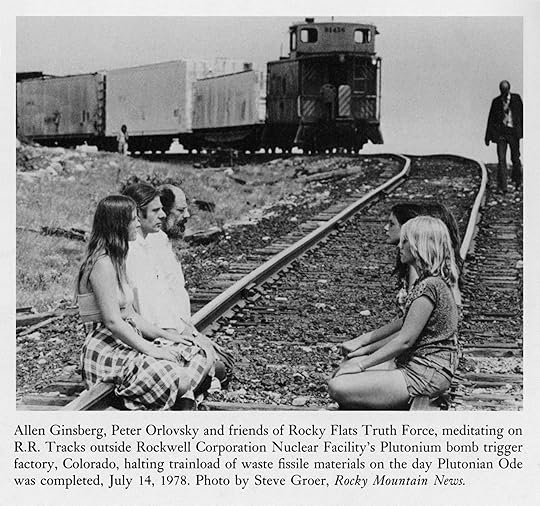

On the contrary, "Plutonian" refers to Plutonium. Nuclear power and the disposal of radioactive material was a growing concern in the 1970s, dramatized in such films as The China Syndrome . (It's still a concern, or at least it should be.) Ginsberg's political activism is well documented. Indeed, Ginsberg and his partner Peter Orlovsky participated in a number of protests to raise awareness of the dangers of nuclear power and radioactive material. A photograph from one such protest appears in the front of Plutonian Ode and Other Poems...

Allen Ginsberg, Peter Orlovsky, and friends of Rocky Flats Truth Force, meditating on R.R. Tracks outside Rockwell Corporation Nuclear Facility’s Plutonium bomb trigger factory...

[...]
Radioactive Nemesis were you there at the beginning black dumb tongueless unsmelling blast of Disillusion?
I manifest your Baptismal Word after four billion years
I guess your birthday in Earthling Night, I salute your dreadful presence last majestic as the Gods,
Sabaot, Jehova, Astapheus, Adonaeus, Elohim, Iao, Ialdabaoth, Aeon from Aeon born ignorant in an Abyss of Light,
Sophia's reflections glittering thoughtful galaxies, whirlpools of starspume silver-thin as hairs of Einstein!
Father Whitman I celebrate a matter that renders Self oblivion!
Grand Subject that annihilates inky hands & pages' prayers, old orators' inspired Immortalities,
I begin your chant, openmouthed exhaling into spacious sky over silent mills at Hanford, Savannah River, Rocky Flats, Pantex, Burlington, Albuquerque
I yell thru Washington, South Carolina, Colorado, Texas, Iowa, New Mexico,
where nuclear reactors creat a new Thing under the Sun, where Rockwell war-plants fabricate this death stuff trigger in nitrogen baths,
Hanger-Silas Mason assembles the terrified weapon secret by ten thousands, & where Manzano Mountain boasts to store
its dreadful decay through two hundred forty millenia while our Galaxy spirals around its nebulous core.
[...]
- Plutonian Ode, I (pg. 12-13)


"Plutonian Ode" reflects Ginsberg's fears and anxieties surrounding the radioactive threat. The fear and anxiety is comparable to that experienced by the post-WW2 generation's response to the bomb. These combined anxieties permeate the pages of Plutonian Ode and Other Poems, intensifying a fear of death that became prominent in Ginsberg's work circa Mind Breaths , but could just as easily be traced back to Kaddish and Other Poems and the death of Ginsberg's mother...
Strange now to think of you, gone without corsets & eyes, while I walk on the sunny pavement of Greenwich Village.
downtown Manhattan, clear winter noon, and I’ve been up all night, talking, talking, reading the Kaddish aloud, listening to Ray Charles blues shout blind on the phonograph
the rhythm the rhythm—and your memory in my head three years after—And read Adonais’ last triumphant stanzas aloud—wept, realizing how we suffer—
And how Death is that remedy all singers dream of, sing, remember, prophesy as in the Hebrew Anthem, or the Buddhist Book of Answers—and my own imagination of a withered leaf—at dawn—
Dreaming back thru life, Your time—and mine accelerating toward Apocalypse,
the final moment—the flower burning in the Day—and what comes after,
looking back on the mind itself that saw an American city
a flash away, and the great dream of Me or China, or you and a phantom Russia, or a crumpled bed that never existed—
like a poem in the dark—escaped back to Oblivion—
[...]
- Kaddish, for Naomi Ginsberg, 1894—1956


Annotations to Rabindranath Tagore's Sung Poetry

"In later days, remembering this I shall certainly go mad."


Reading Sung poems, I think of my poems to Neal
dead few years now, Jack underground
invisible - their faces rise in my mind.
Did I write truthfully of them? In later times
I saw them little, not much different they're dead.
They live in books and memory, strong as on earth.
[...]
- Returning to the Country for a Brief Visit (Mind Breaths)


But whereas the poems of these collections reflect a personal fear and anxiety surrounding death, aggravated by the deaths of family and friends, the poems of Plutonian Ode and Other Poems encapsulates all life that is threatened by the devastating consequences of war and bombs and radioactivity (all the same).
[...]
Yes the body stink of City bowels, rotting tubes six feet under
Could explode any minute sparked by Con Ed's breathing Puttering truck
I notice parked, as I passed by hurriedly Thinking Ancient Rome, Ur
Were they like this, the same shadowy surveyors & passers-by
scribing records of decaying pipes & Garbage piles on Marble, Cuneiform,
ordinary midnight citizen out on the street looking for Empire News,
rumor, gossip, workmen police in uniform, walking silent sunk in thought
under windows of sleepers coupled with Monster squids & Other-Planet eyeballs in their sheets
in the same night six thousand years old where Cities rise & fall & turn to dream?
- Manhattan May Day Midnight (pg. 34)


2,000,000 killed in Vietnam
13,000,000 refugees in Indochina 1972
200,000,000 years for the Galaxy to revolve on its core
24,000 the Babylonian Great Year
24,000 half life of plutonium
2,000 the most I ever got for a poetry reading
80,000 dolphins killed in the dragnet
4,000,000,000 years earth been born
- Nagasaki Days, VI Numbers in Red Notebook (pg. 43)


[...]
Einstein invented atom bombs
in Princeton, television antennae
spring over West Orange - lobotomies
performed in Greystone State Hospital.
[...]
- Garden State (pg. 62)


[...]
Too many radioactive
plutonium wastebarrels
Take the Rhine gold
Build a big tomb
[...]
- Ruhr-Gebiet (pg. 74)


[...]
The Warrior knows his own sad & tender heart, which is not the heart of most newspapers
Which is not the heart of most Television - This kind of sadness doesn't sell popcorn
This kind of sadness never goes to war, never spends $100 Billion on MX Missile systems, never fights shadows in Utah,
never hides inside a hollow mountain near Colorado Springs with North American Aerospace Defense Command
waiting orders that he press the Secret button to blow up the Great Cities of Earth
- Verses Written for Student Antidraft Registration Rally 1980 (pg. 80)


[...]
I never dissolved Plutonium or dismantled the nuclear Bomb before my skull lose hair
I have not yet stopped the Armies of entire Mankind in their march toward World War III
I never got to Heaven, Nirvana, X, Whatchamacallit, I never left Earth,
I never learned to die.
- Ode to Failure (pg. 91)


[...]
America and Russia want to bomb themselves Okay
Everybody dead on both sides Everybody pray
All except the Generals in caves where they can hide
And fuck each other in the ass waiting for the nest free ride
[...]
- Capitol Air (pg. 106)
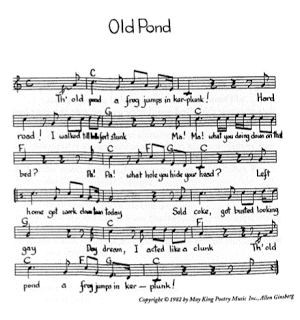

I was fascinated to learn that Allen Ginsberg and Philip Glass collaborated on a musical interpretation of "Plutonian Ode". I'm fascinated but I'm not surprised, considering a number of Ginsberg's poems, such as "Old Pond", had already been set to music included alongside the poems...

Old Pond

Ginsberg's collaborations with musicians dates back (as far as I know) to Bob Dylan...
"I first met Bob at a party at the Eighth Street Book Shop, and he invited me to go on tour with him. I ended up not going, but, boy, if I’d known then what I know now, I’d have gone like a flash. He’d probably have put me onstage with him"
(from Deliberate Prose)


Legend has it that Ginsberg encouraged Dylan to write outside of the song form, exposing him to such works as A Season in Hell and The Songs of Maldorer , resulting in Dylan's Tarantula . Filmmaker Todd Haynes dramatizes Ginsberg's influence on Dylan in I'm Not There by including a scene in which Ginsberg (played by David Cross) reads from Nietzsche's Thus Spoke Zarathustra ...
Behold, this is the hole of the tarantula. Do you want to see the tarantula itself? Here hangs its web; touch it, that it tremble! There it comes willingly: welcome, tarantula! Your triangle and symbol sits black on your back; and I also know what sits in your soul. Revenge sits in your soul: wherever you bite, black scabs grow; your poison makes the soul whirl with revenge.
- Friedrich Nietzsche, "On the Tarantula" (from Thus Spoke Zarathustra)


Dylan's influence on Ginsberg resulted in the incorporation of music into Ginsberg's poetry, along with collaborations with musicians including Philip Glass.
Profile Image for Dane Cobain.
Author 22 books322 followers
July 19, 2014
Plutonian Ode is one of Ginsberg’s more forgettable collections, but only in comparison to the stand-out work that he produced throughout the fifties – there are still some fantastic poems here, political pieces designed to make his readers think about the world around them.

These poems are no less relevant than they were when they were written, between the years of 1977 and 1980. If you’ve read and enjoyed some of Ginsberg’s other work then I highly recommend you buy not only this but the rest of Ginsberg’s pocket poets collection.
Profile Image for Fabian van Hal.
2 reviews8 followers
January 16, 2016
In één dag uitgelezen, met veel moeite. Die moeite zat hem in het ontdekken van de geniale metaforen van Ginsberg. Veel verwijzingen naar de Griekse en Romeinse cultuur maakt Ginsberg tot een schrijver die tussen Plato en Aristoteles in zou kunnen staan. Zulke verwijzingen zie je niet vaak meer.

Eén nadeel: Soms liggen de metaforen er íets te dik bovenop. Te veel van het goede. Desalniettemin geweldig.
Profile Image for Bob Lathrop.
23 reviews2 followers
May 24, 2013
A meditation on the politics, nuclear threat, tensions between US & Russia, American geopolitics, identifies precursors to the emergence of terrorism threats that we face today. A cynical, critical, as well as a clearly expressed observation of the world from a dissidents point of view.
Profile Image for Sarah.
100 reviews2 followers
October 5, 2017
Another language, perhaps more penetrating than whatever it is we use today. Ginsberg runs rampant in this work and I couldn’t be happier about it. For at least a little while these poems carved new pathways in my brain.
Profile Image for Evelina Dimova.
34 reviews5 followers
April 25, 2013
favourite peoms include "don't grow old", "to the punks of dawlish", "homework", birdbrain!", "eroica" and "capitol air".
Profile Image for M. Ashraf.
2,399 reviews132 followers
October 31, 2021
Plutonian Ode
And Other Poems
Allen Ginsberg

A good collection of poems but still not my favorite; bit political; too dry but good to read.


I don't like the government where I live
I don't like dictatorship of the Rich
I don't like bureaucrats telling me what to eat
I don't like Police dogs sniffing round my feet
Profile Image for Jane Dodge.
120 reviews9 followers
January 8, 2022
Truly amazing political commentary as always from Ginsberg. His later works always have a strange fascination with performing explicit sex acts on young boys which is never great. It has an air of pedophilia that is hard to read. Once or twice, I can understand why you might include it to show maturity or acceptance of sexual identity… but it’s so much in his later years that it’s just creepy.
Profile Image for Juan Idiazabal.
Author 14 books19 followers
June 26, 2020
Es Allen Ginsberg, que más puedo decir salvo que hay que leerlo para comprender la genialidad de su poesía y lo que uno se pierde al no hacerlo.
Profile Image for Carmen García.
4 reviews
March 11, 2017
"Don't grow old" es un poema precioso y escribo esto mayormente para acordarme en un futuro de que está en este libro
Profile Image for Eric Cartier.
296 reviews22 followers
February 3, 2016
I zipped through this in a day and dug most of it. After the title poem, the rest are chronologically arranged, and Ginsberg's later works are the better ones. In earlier poems, some of the phrasing and plodding rhyming seem off, and some sad sack "I'm-in-my-fifties-and-can't-get-off" poems aren't worth re-reading. My faves were "Punk Rock Your My Big Crybaby", "Grim Skeleton", "Love Returned", "To the Punks of Dawlish", "Love Forgiven", "Homework", "Ode to Failure", "Birdbrain!", and "Eroica". I'm always glad to dip into more of Ginsberg's American vernacular Whitmanesque poems, though.
Profile Image for Greg.
515 reviews2 followers
March 25, 2016
Pretty good collection of Ginsberg from the early 1970s. The Plutonian Ode is classic Ginsberg, and several other poems are very interesting/funny/clever/important. I didn't care as much for the kind of cornier ones he did (pretty much all of the ones with rhymes) which just didn't seem to be up to his usual cleverness level. Maybe that was on purpose; surely Ginsy knew they weren't particularly astounding rhymes (most are Top 40 song-simple). But that's just me. Overall, it's worth a read if you dig Ginsberg.
Profile Image for Dirk Mercelis.
154 reviews
April 25, 2021
Fantastisch gedicht over het chemisch element plutonium, zeer leesbaar vertaald door Simon Vinkenoog. Ginsberg was erudiet en intellectueel, en dat spat er van af. De verklarende nota's op de linkerbladzijden (naast het gedicht op de rechterbladzijden) zijn geen overbodige luxe. Desalniettemin is het een prachtige tekst, die zich laat savoureren als een complex meergangenmenu. Het digestief maakt er dan ook een volkomen einde aan. Het is een ode die vooral de gevaren en risico's van plutonium aan de kaak stelt en eindigt met een oproep tot vernietiging.
Profile Image for Esthër.
173 reviews38 followers
April 9, 2013
Resumo el mensaje del libro en estos dos versos de Ginsberg:

Arriba Arriba ciudadanos del mundo usad vuestros pulmones
Contestad a los tiranos lo único que temen es vuestras lenguas
Profile Image for Suma Cheru.
10 reviews91 followers
July 4, 2016
LOVE HIM to death!!!! Beautiful writing; is able to really detail the gravity of nuclear warfare with a touch of the frivolity and quirkiness of the beatniks.
Displaying 1 - 23 of 23 reviews

Can't find what you're looking for?

Get help and learn more about the design.