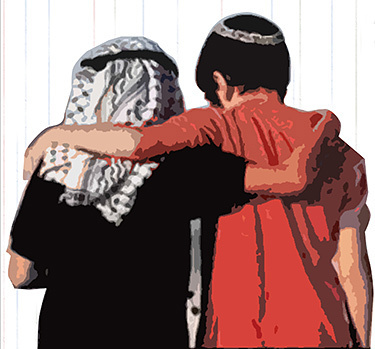
In 2000, a group of Israeli and Palestinian teachers gathered to address what to many people seemed an unbridgeable gulf between the two societies. Struck by how different the standard Israeli and Palestinian textbook histories of the same events were from one another, they began to explore how to “disarm” the teaching of the history of the Middle East in Israeli and Palestinian classrooms.
The result is a riveting “dual narrative” of Israeli and Palestinian history. Side by Side comprises the history of two peoples, in separate narratives set literally side-by-side, so that readers can track each against the other, noting both where they differ as well as where they correspond. The unique and fascinating presentation has been translated into English and is now available to American audiences for the first time.
An eye-opening—and inspiring—new approach to thinking about one of the world’s most deeply entrenched conflicts, Side by Side is a breakthrough book that will spark a new public discussion about the bridge to peace in the Middle East.
Thank you to Netgalley, all the authors/editors and The New Press. This was originally released in 2012 and Netgalley recently made this available again. I am providing an honest review.
This book is a labor of love and truth (s). This was written over a period of several years organized by the Peace Research Institute in the Middle East. The contributors are Israeli and Palestinian teachers and historians that wanted to present a dual narrative approach to the history of Israel/Palestine over the past century. The book is written for High School and University students to present a holistic approach. To me this is 5 star amazing.
I have so many holes in my knowledge of Israel/Palestine and I hoped that this book would help. Boy did it ever. Most of my understanding came from biased Western news reports and documentaries or from very opinionated friends of both regions. This book helped me immensely and I am left despairing, hopeless and immensely sad for all that has transpired in the past hundred years to the region and the immense suffering of two peoples. I am also left angry (but not surprised) at the games (strategies) of UK/France in the contribution of this ongoing human tragedy.I am not going to say anymore except that this was incredibly informative and provided me with much needed context in understanding the present conflicts.
My main difficulty with this book was the formatting of the ecopy. (in a nutshell beyond terrible).
The physical book would include the two histories on opposite pages.....the ebook had all of these strange page breaks and this was very jarring when involving such important recent history. The perspectives were not labeled and often I was disoriented and frustrated until I got my bearings again. Many of the diagrams and maps were also not translated into English. The quality of the information also varied and the earlier history was more robust and then seemed to get rushed and at times a bit sloppy.
I would highly recommend the physical book to read it as the project intended. Also having some knowledge of the geography of the Middle East will be extremely helpful to a reader.
Overall a good to very good reading experience (3.3 stars) and will sit on my 3.5 star bookshelf.
I am very torn about how many stars I should give this book. On one hand, I found the book to be very frustrating. On the other hand, I found the book extremely enlightening. In the end, I decided to give it five (5) stars to encourage people to read the book.
Side by side as selected in my continuing effort to understand that Palestinian narrative. The book was published as the culmination of an initiative undertaken by the Peace Research Institute in the Middle East (PRIME). Israeli and Palestinian educators came together to build a curriculum and narrative of the history of the region from Balfour Declaration to Oslo and the lack of final solution by 2000.
It has published both versions, the Israeli text on the left-hand page and the Palestinian text on the right. The first challenge is figuring out how to read the book. At first, I attempted to read the Israeli left page followed by the Palestinian right page. This proved to be unsuccessful because the two narratives focus and the pace were different. Thus the topic on one side might not match the subject matter on the other.
There are then two ways to approach the book. Read all one narrative and then read the other. This would be the equivalent of reading two books. The method I settled on was to first read the Palestinian text then the Israeli text chapter by chapter. Since I am already familiar with the Israeli perspective of history, I chose to start with the Palestinian perspective.
Having now read what is being taught to Palestinians in school, I am extremely pessimistic that there will be peace in the upcoming generations. I have read some of the Palestinian perspective, such as the Six Day War was an Israeli war of aggression and expansion; however, I was not prepared for what I read.
In the Palestinian narrative, there was nothing that was ever the fault of the Palestinians. The Palestinian history always assigned blame on the Jews, the British, Europe, the UN, or the US. This is accomplished by omitting key facts from the review of history. For example according to the Palestinian narrative, the British trained the Jews for combat in WW II which prepared them to win in the War of Independence. Of course, the fact that the Palestinians, led by Haj Amin Al-Husseini were allied with Nazi Germany had nothing to do with the fact that the British did not train Palestinians.
Not taking any responsibility for their situation reinforces the victim's story that Palestinians portray to the entire world. And thus far it has been successful; however, I believe as more people study history, they will come to realize that the Palestinians have contributed as much to their current situations as much if not more than any other fact.
I was equally amazed at the Israeli story; however, for much different reasons. When I first learned the "Story of the Foundation of Israel" in Hebrew school, I was told many amazing myths including that Israel invited all Arabs to live in Israel in peace, but they abandoned Israel at the behest of the Arab Legion so the surrounding countries could drive the Jews into the Sea and return twice as much land to the Palestinians. Of course, this narrative is based upon fact that many historians have documented. Efraim Karsh, founding Director of the Middle East and Mediterranean studies in Kings College in London has documented these facts in his book, "Palestine Betrayed." However, more recently a new school of Israeli historians including Benny Morris and Tom Segev has documented the fact that there were Arab villages where the residents were driven out of their homes.
In addition, the Israeli history did not shy away from outright mistakes that were made using the history as an example of what not to do. The Israeli discussion included a section on Kafr Qassem, a blemish on the history of Israel and the IDF where before the eve of the Sinai Campaign, the IDF moved up the curfew for the village of Kafr Qassem; however, many did not hear about it. While Palestinians were returning from the fields, the IDF forces shot innocent civilians. There was an in-depth discussion of the Israelis who were charged and convicted of the massacre and used the incident to highlight the fact it is illegal to follow an illegal order. Considering that this is a High School text and many of the Israeli teens will soon be in the IDF, I found the discussion to be not only refreshing but extremely pertinent to their future.
Unless both sides come to a realistic discussion of the history that occurred in this region over the past 150 years, I doubt there will be peace in the near future. From what I have seen from this effort, we are very far from both sides understanding each other. Although I applaud "Letters to My Palestinian Neighbor" by Yossi Klien Halevi, I think the dialogue has to start at a much younger age and should start with a realistic review of historical facts from ALL perspectives.
This was an excellent idea: teams of historians/instructors write parallel histories from an Israeli side and a Palestinian side. It makes for fascinating reading. This might be a fine textbook to base a course on the conflict. However, there are some deep disparities in quality that need to be corrected in future editions. The Israeli side is mostly fine; it’s not the old Zionist propaganda, shows evidence of historical nuance, is critical of some government activities, and notes cleavages within Israel’s populations. It will make apologists uncomfortable. The Palestinian narrative doesn’t do itself justice. The English is wobbly at best, and the last chapter needs a thorough redrafting. The authors side step tensions within Palestinian society especially the rise of Hamas. Suicide bombings are obscured as “resistance activities”. Were political operatives looking over their shoulders? Many claims are irresponsibly vague, and the sloppy references and untraceable endnotes do not help.
While the book was well put-together and easy to follow along, I couldn’t help but find myself surprised and disappointed with the different teaching styles of the two textbooks (Israeli and Palestinian). Though, I am admittedly biased, it became clear that the Palestinian textbook, rather than attempting to properly teach the information at hand, it attempts to absolve the Palestinians of any blame and any responsibility for missteps and failures. The Palestinian textbook teaches the reader how it should feel, rather than telling the reader the actual events that occurred. The Israeli textbook noticeably shows accountability for missteps and failures and leaves emotions out of the textbook. Very obvious, noteable differences in education.
Good starting point but wish the reading format was easier to read instead of having to go back and forth and sometimes didn’t really align well. I also found it would be helpful to have citations on the same page so certain information could be quickly looked up while reading.
I gave it 5 stars mostly because it’s a must read for anyone trying to understand the history of the Israel-Palestine conflict we see today. The caveat here is that this book is trying to portray the narratives that have been passed down on opposing sides through generations, and it is not trying to give a neutral take on the history. It’s most useful in understanding why peace and compromise are so difficult in today’s situation, not in objective fact gathering.
My professor actually used this as a textbook for a class I took and I really enjoyed that. I think this is how history should be taught. Every time you open the book, the Israeli/Jewish perspective of the historical event will be on the left, and the Palestinian on the right. Really goes to show how history being told different ways can have a big effect on modern day. Well done
I found this book very informative and rather liked the side-by-side format. My biggest complaint is that the Palestinian side did not appear to be edited as well as the Israeli side. This was quite profound in some instances and while it didn't detract from the validity of the information the disparity could influence the reader negatively. My other complaint is that the maps should have been translated into English. Most of them were useless unless you already knew a lot about the geography of the area. Overall, this was a great introduction to the conflict and I wish it hadn't stopped at the year 2000. If anyone out there reading this has any suggestions for reasonably impartial histories of the area please send them to me.
This book is an absolute must-read! I have been recommending it to all of my friends. It was written by a team of educators (Israeli and Palestinian) to tell the parallel histories and interpretation and impact of key events on lives in the region. In reading it, while there are differences in interpretation there are also glimmers of hope and common views that can begin bridging the divide in viewpoints to be able to have a robust conversation about current events. I learned a lot by reading this book and feel it gave me a good foundation of the history. The structure is unique -- on one side of the page is the Israeli history and on the other side is the Palestinian history. It took me awhile to figure out the best way to digest it so I ended up realizing what worked for me, was to read through one perspective first and then read through the other perspective. I highly recommend this book!
Thank you to Netgalley and The New Press for an ARC and I voluntarily left this review.
This book dares to do what should become a standard of the telling of history. It is an overview of the Israel-Palestine relationship from the early 1900s to the turn of the millennia…
…the difference is that on the left side of the page (odds), you have the Israeli account, and on the right (evens) you have the Palestinian account. Two versions - one by the victor and one by the victim - next to each other, allowing the learner to hold two very different perceptions of events in tandem. It’s hard to read, not gonna lie. It confronts all perceptions, wordings, portrayals of events, and fosters an empathy toward and understanding of the “other”. This is how history should be told - if there are two sides to every story, let them both be brought forward for fair evaluation.
Amazing effort by PRIME (Peace Research Institute in the Middle East). Hopefully someday this shared history will reach a resolution both sides can look back on in peace.
This book is a very interesting concept. It is an attempt at a dual narrative of the Israeli-Palestinian conflict. On the left side is the Israeli history, and on the right is that of the Palestinians. So instead of their being a single writing style, there are two. The Israeli tone feels a lot more detached, like they are looking objectively at the conflict; however, just because it seems more objective, it doesn't mean it is any more factual. The Palestinian narrative feels a lot more emotional and involved, which is to be expected since they are the ones still suffering from these historical events.
Regarding the history, both narratives deal with the same basic events. It is the perspective that changes. The Israeli perspective comes off as concerned with the “big picture,” for lack of a better term. They justify their actions by pointing to how they have been treated by the surrounding Arab states, and how often deals and arrangements with them have fallen through. The Palestinian narrative is much more concerned with the small picture. There are people suffering, and that is the problem. The troubled relationship between Israel and other Arab states in the past is not an excuse. Israel has to move on and face up to the fact that they are abusing Palestine, and that has to stop.
The main issue with this book is the simplicity of the historical narrative. It only covers the events and details that the authors think are important, and does not usually go far beyond the surface of the events. However, this could be a positive. Since the book's main goal is to enlighten both groups to the narrative of the other side, it does very well. Overall, a good and informative read.
The idea behind this book is a very important one- that the narratives surrounding the Israeli-Palestinian conflict are as important as the objective facts, whatever those even are, in discussing and potentially trying to solve it. I wouldn't recommend this for someone as a first read to get familiar with the conflict, but it's definitely a must-read for anyone seeking a deeper understanding of the conflict.
I read this for one of my book clubs. The premise of this book is interesting. On facing pages, you have the history of Israel and Palestine from each perspective. All of us found the Israeli story familiar, and the Palestinian story, virtually unknown. This book would make appropriate reading for advanced high school classes and college classes.
This is a great introductory book, so long as readers understand that it does not present the more sophisticated conversations on the subject. It read (to me) like grade-school propaganda where each side claims to be the only party that acts in good faith.
I've long felt that I know insufficient facts about the history of the Middle East in general and the Israel/Palestine issue in particular. Given the current fighting that resulted from the Hamas terror attacks it seemed as though now was a good time to work on improving my knowledge and this book was recommended to me as a good place to begin.
It is an interesting approach to a narrative, and not one I have seen before. It is essentially written as a history, from the Israeli and Palestinian points of view and, as the subtitle suggests, these accounts are presented side by side. In other words, the same period of history is covered on the left hand side by the Israeli perspective, with the Palestinian take on the facing pages. This presents the reader with a decision as to how best to consume such a work. This is addressed in the book itself because it is so unusual. It is obviously not possible, at least for this reader, to coherently read one left page then a right page because the narrative would become far too disjointed. One is left deciding whether to read one chapter at a time, alternating the two narratives, or reading the whole book of one narrative, then the same for the alternate view. I chose the former and I think it just about works.
However, there is obviously a lot of duplication of material in this approach, but it is useful to hear two sides of the same historical periods. As one would expect, these takes vary but perhaps not as violently as I had expected. There is a genuine attempt to tell a story without mudslinging or hyperbole about the other side. Again, as one would expect, there are going to be accusations of terrorism and unreasonable attitudes leveled at protagonists from one side to the other, and these are definitely there.
As a Brit it is clear that the seeds of this conflict, although sown centuries ago certainly came to fruition under British rule and the withdrawal of my countrymen (almost all men of course) from the Palestine region after ostensibly pushing a very Zionist agenda at times but unafraid to make arguments from the other side too, and renege on promises made which was how we typically ran much of the Empire of course. Divide and conquer works well when you are a colonizing power. However, as much as one my support the Zionist cause, there was always going to be an issue with setting up a country in Palestine and sure enough, the relationships that have evolved over the years, through a myriad different figures and agreements has born that out over the subsequent decades. This may now be as close to an intractable issue as there is, especially as Israel now seems to be engaged in a war to flatten the Gaza Strip in an effort, an understandable effort, to eliminate the threat of Hamas.
It is a shame that the book doesn't cover this conflict because it was obviously written well beforehand. Being a somewhat amateur studier of history, I don't think that fighting to wipe out an ideology, however much it may be a spawning ground of terrorism is ever likely to succeed. There are always more people who share these views and are likely to become radicalized as a result. In discussions on this I often refer to "The Troubles" in Northern Ireland which were only able to move forward when the two sides accepted that the only way to achieve peace was through the ballot box and through negotiation and compromise. That seems thin on the ground in the Middle East right now and, indeed, it is hard to agree to negotiate with an organization such as Hamas who are egregious terrorists and espouse a goal of eliminating the country of Israel entirely. This makes it different of course.
I think it is also hard for those of us who are gentile, or who don't live in Israel to really appreciate the threats of anti-semitism and the threats to the physical existence of the country we call home. I would like to have seen this more overtly covered in this narrative but still, this was indeed an interesting look at the history of this conflict from the period leading up to the formation of Israel and the various attempts to solve this problem since. I think the style of side by side narratives just about works and is probably the best way to tell both sides within a single book and I applaud the publishers for this attempt at so doing.
lots of mixed feelings on this. I came in wanting to read what I imagined was two history books, and I slowly realized this isn’t like that at all. you won’t find the level of detail you will get in a normal history book, nor will you find as many citations as you’d probably like.
this frustrated me a lot at first, until I came to realize that the value of this book isn’t so much in finding the objective truth as it is understanding two narratives. if you try to read this as “what do these people believe and how do they frame these beliefs” instead of “what is true about what each side says,” you’ll have a better time.
still, despite recognizing that, I can’t help but feel that this book is hurt by its historical laxity, so to speak. there’s only one historian for each side, which means neither perspective represents a consensus-based belief. and most seriously, there are major historical errors in this. I don’t know what the intended reaction is to seeing contradictions like this, but when I see two opposing claims about easily-demonstrable facts — for example, like whether the British mandate for Palestine helped or hurt Palestinian literacy — my impression is that one person is either lying or wrong, and I trust that person much less.
in this book, it’s the Palestinian side that contains those sorts of errors. perhaps I was blind to the Israeli errors, but I could really only find one sin of omission from him, that being no mention of the Naksa after the Six Day War.
in contrast, within the first 5 pages of the Palestinian narrative, I was confronted with outright fabrications. it begins with a claim that Napoleon had a plan to establish a Jewish state and rebuild their Temple in Jerusalem. while there’s a newspaper clipping mentioning this, there’s never been any other evidence of such a declaration ever being written or promulgated.
but that’s not the worst. shortly thereafter, it’s claimed that in 1907 there was a Campbell-Bannerman High Committee that released a report recommending fomenting division in the Arab world and to establish puppet regimes in the region. there’s even less evidence for this meeting, and it seems to be about as true as the Protocols. seeing such a blatant fabrication immediately poisoned the Palestinian narrative for me, and I felt like I couldn’t trust any claim that the author would go on to make.
there’s a similar error that’s also self-contradictory. the author claims at some points, despite mentioning the MacDonald White Paper of 1938, that the British did nothing to stem the tide of Jewish immigration to Palestine. knowing the White Paper is enough to falsify this claim, but you don’t even need to know that. the author mentions at other points the numbers of illegal immigrants to Palestine, the existence of which belies the claim that the British did nothing. if they didn’t stop Jews from immigrating, why would they have to do so illegally?
there’s other minor, easily disproven errors as well. the author calls the Biltmore Conference the “Baltimore Conference”; the author claims the Balfour declaration preceded British soldiers entering Palestine, even though they had entered Rafah in Jan 1917 and issued the declaration in Nov 1917; and says the Soviet Union had dissolved in 1989, when it was at the end of 1991, instead.
despite all of this, and despite me saying that you should verify every claim made in this book (by either side), I still think it’s worth reading. just know that you are trying to understand what people believe about what events happened, rather than understanding the events themselves. this book could be better, but it’s still an admirable initiative, and it’s a step towards progress.
This high school history textbook is a collaborative effort between twenty-four Israeli and Palestinian high school teachers organized by Dan Bar-On and Sami Adwan. It contains the histories and narratives of both the Israeli and Palestinian sides together in one book. Each chapter covers one decade from 1900-2000.
Instead of alternating chapters between the Israeli and Palestinian perspectives, it has the Israeli part on the left and the Palestinian part on the right, alternating page by page. One could go through reading one full chapter first and then going back and reading the other chapter, but I decided to go page by page, often having to reread the last paragraph on the previous page. It was a little bothersome, but I felt like that was the intention.
I think Side by Side would be a really good place to start for people unfamiliar with the Israeli-Palestinian conflict. Each side is presenting their version of events not totally free of bias, but having the other side’s perspective right there balances things out.
A clear example of that is in the glossary. Hajj Al-Amin Husseini (the Mufti of Jerusalem) has two entries: the Israeli one tells how he “incited the riots of 1920-1921” and “left for Nazi Germany and supported the war effort and propaganda of the fascist countries” (370) and the Palestinian side only says positive things about him, describing his “political wisdom and diplomatic skills” (365).
I appreciated how both sides included a lot of excerpts from poetry and journals that illustrate each side’s national feeling and narrative. I think if they made a companion book of the most commonly used excerpts from Israeli and Palestinian high school curriculums that would be interesting to read.
There are a lot of relevant pictures sprinkled throughout that help keep readers’ attention.
The fact that Side by Side is intended for high school students makes it very accessible, which I appreciate after struggling through A History of Israel. Because it’s both accessible and pretty balanced, it’s going to be my new go-to recommendation for books on the history of Israel/Palestine.
Flipping back through, I feel like a lot of the facts kind of washed themselves out of my brain, but what will stick with me is the general attitude each side displays here towards themselves and towards the other.
Both sides have a lot of pride in their nation.
Israel seems to see itself as an innovator. Tough but persecuted. It sees Palestine as perpetually angry and unable to be placated.
Palestine seems to see itself as a long-suffering victim that never quite gives up hope of regaining its land. It holds a lot of resentment towards Israel for taking its land and screwing it over in a myriad of different ways. It also seems to feel a lot of resentment towards the other Arab countries because it feels they have abandoned it. And it resents the West for colonizing it.
I’m sorry if that doesn’t jibe with your view of the situation, but that’s the impression I came away with of where each side is coming from emotionally and in terms of national/other narrative.
Anyway, I highly recommend this book to anyone interested in learning more about the Israel/Palestine conflict, especially those looking for a place to start that isn’t too difficult!
I think I would've loved this if it was an epub rip pdf readers akin to mouse osu users ok anyways.
also realizing I don't really know how I feel about me having the power to rate a textbook I'm def xxx to do that but anyways.
ok my illiterate review:
originally thought I knew enough so uhhh didn't really care about "learning about events objectively” (ego i'm sorry) but I came into this reading with a specific goal to understand the core realities that inform stances / fuel the discussions for both sides. wanted to leave with a more comprehensive framework and I think it worked :D
- core points weren't explicitly underlined for me as a reader, I was sifting through one liners about massacres paralleled with pages on political casualties in the other.
- I was trying to read through each account on the defensive, questioning why these events were glossed over, why highlight these movements, impartiality of tone compared to the emotional invitation of another.
-reading between the lines with trying to see the takeaways each offered and being conscious of not having my own rationality co-opted from me when engaging with both to an extent that would be feasible to create space / properly engage with both comprehensively- and that was hard ok that sentence didn't make sense but in my head it did
- I do wish that both sides committed to their narratives a bit more in where there was clearly a reaction the text wanted from the audience and it could’ve used more partial language “unfairly so, disproportionately skewed in favour of etc.” instead of having me think through each line hmmm that does seem a bit unfair oh wait actually hmmm
-somethihgn something account shows intent to push this narrative that is frustrating sometimes very much just tell me pleaase
-there were many moments positioned as an impartial telling of facts but the including this in the telling despite it not being in the other is reason enough to tell me you wanted to say something so just say it.
-not even-handed truth, something something underlying nationalism and biases were evident no need to hide it / just made my job harder when the writer attempted to craft that polished narrative and it becomes uniquely ineffective in doing what it was supposed to do: provide a detailed account of their side. what happened to reality what happened to love what happened to truth rip tok you would’ve loved this
- I also recognize that perhaps the splitting of 50/50 accounts gives equal weighting to both at times when it would probably be inhumane to do so something something should there be equal relevance to both narratives at all time?
I'm reminded of that quote about siding with neutrality and at what point does that itself become an act of oppression? I’ll stop and we are losing the plot to the white men talking about dying-kids-at-the-dinner-table-type-removed so I’ll stop but yes this took me longer to read than I'm willing to admit
Side by Side is a highly informative guide to the Israel-Palestine conflict that approaches the issue in a different way from most. Rather than trying to ascertain the most balanced and "true" narrative of the conflict, the book simply takes a textbook from each side and puts them right next to each other. This was a successful approach, and while I still have some questions, I feel like I understand each side's perspective much more after reading this book.
Unsurprisingly, it quickly becomes apparent just how tragic and compelling each side's narrative is. Both Israel and Palestine have suffered some truly terrible things, and I can understand why each of them are so poisoned against the other. I already knew about most of the major events, but the benefit of using local textbooks is learning about many smaller events not discussed in the West. From the early history of the Haganah to the conflict over water distribution in the Sea of Galilee, understanding more of these events means having greater sympathy for both sides. In this format, you can also see how the conflict warped and escalated over time. By 1948, peace already seemed virtually impossible, and by 1967 and the 70s that dream became increasingly unrealistic. The Oslo Accords offered the only real chance of a final agreement, but both sides contributed to the failure of the peace process in their own ways. The major lesson of this book is that there isn't one "right" narrative or version of history, but rather two equally accurate and wounded perspectives.
This book was published a good 20 years ago, which means its history leaves out many recent developments between Israel and Palestine. It's revealing, and foreboding, that one can almost draw a straight line between the Al-Aqsa Intifada of 2000 and the events of 2023-24: it makes logical sense how both sides got to where they are today, yet peace is further away than ever. My only other critique of the book is that the two sides' textbooks seem stylistically distinct and not exactly a structural mirror of each other. The Israeli textbook seems slightly better-written, and a little more reflective than the Palestinian one, but I can't tell if that's because of censorship, different dates or means of publication, or just different places within the political ideology of each side. It'd be useful for the book to explain this at some point, since it doesn't go into much detail about the historiographical process.
Nonetheless, this book is a good a resource as any for learning about the Israel-Palestine conflict from the 1890s to the turn of the 21st century. It does a remarkable job showing the ways in which each side has wronged and been wronged. And if everyone read this book, we would be substantially closer to peace. Consequently, I would recommend this book to anyone curious about history, current events, or the Middle East in general.
Wow - this book gets 5 stars from me because it's both unique and extraordinarily important (though not the easiest book to read). The book is structured in a particular way, in that the Israeli and Palestinian historical accounts are placed "side by side" on opposing pages throughout the book, so you cannot read straight through as you would a "normal" history text. Instead, the reader must decide how to progress, by reading a certain narrative up to a certain point, then backtracking to catch up through the lens of the other included narrative. This reading process is unlike anything else I've worked through, and that structure (and the way it makes you labor through the book) are actually part of the learning process, and deeply impacted me.
Also, I just learned a ton from working my way through this volume (and I considered myself relatively well-informed on the history of Israel-Palestine BEFORE I picked this up). While the narratives overlap in their broad scope and major events, it's stark to see how certain ordeals are emphasized in one side, and barely glossed over in the other (examples: the Holocaust is given multiple pages in the Israeli narrative, and mentioned only briefly in the Palestinian; or, the policies the British implemented in the land pre-1948 are recounted in meticulous detail on the Palestinian side, including the manifold ways they excluded Palestinians from education, land, or work; while these are given little attention in the Israeli narrative, and so on). Other events are given equal discussion, but interpreted quite differently (example: the intent of Arab nations in diverting the water sources for Israel leading up to the 1967 war, was it to fully divert water from Israel to provoke drought and possible starvation? Or was it to fairly distribute water across the region?).
It can get a little head-spinning, but I suppose that's the point. These narratives are overlapping, can be wildly divergent, but both have strong legitimacy for making sense of the situation in the land. It's a bit overwhelming to take it, and it's heartbreaking to read in light of the events of 2024.
It's not an easy read, but it's straight to the top of my list of recommendations for ANYONE trying to make sense of what's going on in the Middle East today. Anyone who thinks there's a simple reason, or a single cause, or even a single "good" or "bad" actor in all these is woefully naive, and reading "Side by Side" should be a requirement for them before forming any certain opinions on the subject.
This book works on two levels. On the surface it is a good introduction to the recent history of the region, which fundamentally needs to be understood if you want to understand the motivations of the Israelis and the Palestinians. On a deeper level however it also shows you how framing is literally everything. They recount the same history but if you only read one and not the other your understanding of the conflict would be completely different. As far as I can tell there's very little outright lying from either side, but there are clearly lies by omissions and the same events are spun in completely different ways. Reading this book I think will give the reader a healthy dose of scepticisim when approaching any kind of historical text.
I will also say though that despite the fact that I hate the Israeli government, Zionism, and the genocide taking place in Palestine, there is very clear difference in quality between the two texts. The Israeli perspective at points does somewhat diminish some of their crimes but it does at least criticise the Israeli government fairly frequently. The Palestinian perspective however is written more like a polemic then a genuine piece of history. It is 100% valuable, it goes into a lot of detail about how the Palestinians were subjugated by the British and then the Americans, a lot of more detail than the Israeli perspective goes into so it is 100% worth the read, but it could have tried to be a bit less emotionally charged. The thing is, an objective, unemotive retelling of the history of the region would 100% lead most toward the Palestinian side anyway so all this style of writing does is give zionists an excuse to discredit the Palestinians as has unfortuantely happened in this comment section.
A noble and worthy project to bridge the lived histories of both sides.
The one thing I feel compelled to highlight was the dubiousness of a section in the first chapter, relating to Henry Campbell-Bannerman. There is a reference to a 'Campbell-Bannerman report' from 1907, describing a plot to divide and conquer the Middle East. The list of apparent contents quickly struck me as too moustache-twirling in their bluntness to be credible. Indeed, there was no reference given, so I looked it up and it appears to be little more than a conspiracy theory.
What I discovered doesn't lend the theory much credit:
• Campbell-Bannerman was not a pro-imperial PM. In fact, he supported Irish Home Rule and gave self-rule to the Boer states, leading to the Union of South Africa. He bypassed the House of Lords in order to make sure the decree went through.
• There was an Imperial Conference in 1907, chaired by C-B, but it was to discuss moving away from colonisation and towards self-governance for the colonies. South Africa was one of them, along with Australia and Canada. India and Ireland were also discussed. I searched the minutes of the conference (available on the Internet Archive) and found no results for 'Ottoman', 'Palestine', 'Israel', 'vilayet', 'Syria', and only three references to 'Levant' — all of which were talking about the Germans expanding trade there.
I felt I should raise this because the point does go on to influence how the rest of the chapter is written.
This book is essential reading for anyone who wants to know about the history of pre-state Palestine, Israel, and the modern Palestinian national movement. Not because it's exhaustive, or even the final word on any of those narratives. But because by presenting them together, literally side by side, you can't avoid confronting the existence and limitations of each story - both of which are based heavily in facts and actual events, and both of which extract meaning and interpretations in such different ways. So much conflict comes from the erasure or ignorance of other narratives, of the other side's experience, and this book is a critical step in bridging that gap for Israelis and Palestinians. Both sides are right, and both sides are wrong; both sides are persecuted minorities, and both sides have dramatic power imbalances. There are some conflicts where oppressor and oppressed are clear and consistent; this is not one of them. We should not forget how both peoples see the world, and their shared ancestral homeland.
It was interesting read this along with other books written from the Palestinian perspective. The historical facts that are either overlooked or ignored is amazing. The complaint that 750,000 residents of Palestine either voluntarily left or were forced out of their homes in 1948. Is a fact. The fact that 750,000 Jews were forced from their homes is various Arab countries at the same time, countries they had lived for hundreds of years is ignored. The fact that over the last 100 years over 100 million people have been forcibly displace due to war. Of those only these Palestinians were not absorbed by other Arab countries where they share a common language, common religion, common culture. Why?
Also, what is downplayed is that while there have been periodic conferences, for the most part the only governmental organizational institutions have been the PLO with its President now serving his 20th year of a 4 year term or HAMAS which routinely murders fellow citizens for not being loyal.
There has been continuous self questioning on the Israel side. Over the years, the Diaspora Jews have provided substantial financial and political aid which has helped Israel to be a prosperous hi-tech country. During this same period the billions of dollars of aid going to the Palestinians has gone to building military tunnels, weapons, corruption, payment to families who had someone kill Jews. Again, everything is viewed as Israel's fault.
Lastly, the Palestinians have been offered their own country multiple times and each time without a counter offer have turned it down because it would have resulted in a country next to a Jewish one.
All I read here is Palestinians living in refugee camps which are really cities complaining about Israel as they watch Israel prosper and they are ignored by their fellow Arabs and ruled by dictators who have shown no real concern for making their lives better.
An interesting style to read both sides: the Palestinian and Israeli sides of the story of the conflict. While this book cannot be depended on solely to understand the history of the conflict in a non-biased way, this book does a great job in portraying the two sides in each of their perspective. This book was written by Palestinians and Israelis (each writing for their own side), and by doing that, it really helps to understand narratives each side holds. This book however, doesn't touch upon the current 21st century on the conflict, which I wished it did.
Enlightning to read and timely. After reading afraid it will always will be timely. Would be good if everyone read this book from both sides and bystandards in America. Most folks probably don't know anything. Like me before reading. Most of the Maps didn't do much for me. I just stared at them blankly. Also some readings felt unbalanced in terms of writing style and nuance between fact and opinion, but seems to me probably impossible to fully present everything objective when presenting the interpretations of nations. Was surprised to have enjoyed.
Like the name suggests, this book is written as two side-by-side histories – each section has the Israeli perspective on the left and the Palestinian perspective on the right. I appreciate this stylistic choice, as opposed to just chunking separate chapters, because I think it forces the reader to wrestle with these narratives alongside eachother. A good read for anyone hoping to learn more about the Israeli-Palestinian conflict.
The concept of having two narrative side-by-side is a great idea. However in practice, the layout made it very hard to read a page at a time. Would would have made it better would have been to put photos, graphics, and bullet points side by side so that it would have been easier to compare the two texts.