

What do you think?

The Atom of Delight
- GenresBiography
240 pages, Paperback
First published January 1, 1956
About the author
Neil M. Gunn
61 books53 followersNeil Gunn, one of Scotland's most prolific and distinguished novelists, wrote over a period that spanned the Recession, the political crises of the 1920's and 1930's, and the Second World War and its aftermath. Although nearly all his 20 novels are set in the Highlands of Scotland, he is not a regional author in the narrow sense of that description; his novels reflect a search for meaning in troubled times, both past and present, a search that leads him into the realms of philosophy, archaeology, folk tradition and metaphysical speculation.
Born in the coastal village of Dunbeath, Caithness, the son of a successful fishing boat skipper, Gunn was educated at the local village primary school and privately in Galloway. In 1911 he entered the Civil Service and spent some time in both London and Edinburgh before returning to the North as a customs and excise officer based (after a short spell in Caithness) in Inverness. Before voluntary retirement from Government service in 1937 to become a full-time writer, he had embarked on a literary career with considerable success.
His first novel, The Grey Coast (1926), a novel in the realist tradition and set in Caithness in the 1920's, occupied an important position in the literary movement known as the Scottish Renaissance. His second novel, Morning Tide (1931), an idyll of a Highland childhood, won a Book Society award and the praise of the well known literary and public figure, John Buchan. The turning point in Gunn's career, however, came in 1937, when he won the prestigious James Tait Black Memorial prize for his deeply thought-provoking Highland River, a quasi autobiographical novel written in the third person, in which the main protagonist's life is made analogous to a Highland river and the search for its source.
In 1941 Gunn's epic novel about the fishing boom of the late 18th and early 19th centuries, The Silver Darlings, was widely acclaimed as a modern classic and considered the finest balance between concrete action and metaphysical speculation achieved by any British writer in the 20th century. It was also the final novel of a trilogy of the history of the Northlands, the other novels being Sun Circle (1933) on the Viking invasions of the 9th century and Butcher's Broom (1934) on the Clearances. In 1944 Gunn wrote his anti-Utopian novel, The Green Isle of the Great Deep, a book that preceded George Orwell's novel on the same theme, Nineteen Eighty-Four, by five years. The novel, using an old man and a young boy from a rural background as characters in a struggle against the pressures of totalitarian state, evoked an enthusiastic response from the famous Swiss psychiatrist Carl Gustav Jung.
Some of Gunn's later books, whilst not ignoring the uglier aspects of the modern world, touch more on metaphysical speculation in a vein that is not without humour. The Well at the Worlds End (1951), in particular, lays emphasis on the more positive aspects of living and the value of that approach in finding meaning and purpose in life. Gunn's spiritual autobiography, The Atom of Delight (1956), which, although similar in many ways to Highland River, incorporates a vein of thought derived from Gunn's interest in Zen Buddhism. The autobiography was Gunn's last major work.
In 1948 Gunn's contribution to literature was recognised by Edinburgh University with an honorary doctorate to the author; in 1972 the Scottish Arts Council created the Neil Gunn Fellowship in his honour, a fellowship that was to include such famous writers as Henrich Boll, Saul Bellow, Ruth Prawar Jhabvala, Nadine Gordimer and Mario Vargas Llosa.
Born in the coastal village of Dunbeath, Caithness, the son of a successful fishing boat skipper, Gunn was educated at the local village primary school and privately in Galloway. In 1911 he entered the Civil Service and spent some time in both London and Edinburgh before returning to the North as a customs and excise officer based (after a short spell in Caithness) in Inverness. Before voluntary retirement from Government service in 1937 to become a full-time writer, he had embarked on a literary career with considerable success.
His first novel, The Grey Coast (1926), a novel in the realist tradition and set in Caithness in the 1920's, occupied an important position in the literary movement known as the Scottish Renaissance. His second novel, Morning Tide (1931), an idyll of a Highland childhood, won a Book Society award and the praise of the well known literary and public figure, John Buchan. The turning point in Gunn's career, however, came in 1937, when he won the prestigious James Tait Black Memorial prize for his deeply thought-provoking Highland River, a quasi autobiographical novel written in the third person, in which the main protagonist's life is made analogous to a Highland river and the search for its source.
In 1941 Gunn's epic novel about the fishing boom of the late 18th and early 19th centuries, The Silver Darlings, was widely acclaimed as a modern classic and considered the finest balance between concrete action and metaphysical speculation achieved by any British writer in the 20th century. It was also the final novel of a trilogy of the history of the Northlands, the other novels being Sun Circle (1933) on the Viking invasions of the 9th century and Butcher's Broom (1934) on the Clearances. In 1944 Gunn wrote his anti-Utopian novel, The Green Isle of the Great Deep, a book that preceded George Orwell's novel on the same theme, Nineteen Eighty-Four, by five years. The novel, using an old man and a young boy from a rural background as characters in a struggle against the pressures of totalitarian state, evoked an enthusiastic response from the famous Swiss psychiatrist Carl Gustav Jung.
Some of Gunn's later books, whilst not ignoring the uglier aspects of the modern world, touch more on metaphysical speculation in a vein that is not without humour. The Well at the Worlds End (1951), in particular, lays emphasis on the more positive aspects of living and the value of that approach in finding meaning and purpose in life. Gunn's spiritual autobiography, The Atom of Delight (1956), which, although similar in many ways to Highland River, incorporates a vein of thought derived from Gunn's interest in Zen Buddhism. The autobiography was Gunn's last major work.
In 1948 Gunn's contribution to literature was recognised by Edinburgh University with an honorary doctorate to the author; in 1972 the Scottish Arts Council created the Neil Gunn Fellowship in his honour, a fellowship that was to include such famous writers as Henrich Boll, Saul Bellow, Ruth Prawar Jhabvala, Nadine Gordimer and Mario Vargas Llosa.
Ratings & Reviews
Friends & Following
Create a free account to discover what your friends think of this book!
Community Reviews
Displaying 1 - 5 of 5 reviews

November 30, 2024
Die 1956 geschriebene Biografie ist das letzte Werk Neil Gunns. In ihr erzählt er von seiner Kindheit in den schottischen Highlands, von seiner Jugend die er bei seiner Schwester und deren Mann verbrachte und von seinen ersten Jahren im Staatsdienst. Die Biografie endet als er ungefähr 20 ist. Er erzählt viel über Dinge die ihm wichtig waren und die ihn interessierten, aber wenig über sich. Ein Teil von The atom of delight befassen sich mit Zen-Buddhismus, der ihm im Verlauf seines Lebens als Schriftsteller immer wichtiger wurde, was man auch in vielen seiner späteren Werke sehen kann. Erst in den Kapiteln, in denen er von seinem Leben in London erzählt tritt dieses Thema beiseite und man erfährt mehr über den jungen Neil Gunn.
Wie schon gesagt liess mich die Autobiografie mit gemischten Gefühlen zurück. Der Autor schien nie über sich selbst zu reden, sondern sprach immer nur von "the boy", "the young man" oder sagte "one had to...". Diese Distanz hat mir zu schaffen gemacht. Viele der Dinge die er aus seiner Kindheit erzählte, kannte ich schon aus seinen Büchern. Ich war mir nie sicher, ob seine Bücher autobiografisch sind oder ob er deren Inhalte in seine Biografie einfliessen liess. The atom of delight brachte mir den Menschen Neil Gunn nicht wirklich näher
Wie schon gesagt liess mich die Autobiografie mit gemischten Gefühlen zurück. Der Autor schien nie über sich selbst zu reden, sondern sprach immer nur von "the boy", "the young man" oder sagte "one had to...". Diese Distanz hat mir zu schaffen gemacht. Viele der Dinge die er aus seiner Kindheit erzählte, kannte ich schon aus seinen Büchern. Ich war mir nie sicher, ob seine Bücher autobiografisch sind oder ob er deren Inhalte in seine Biografie einfliessen liess. The atom of delight brachte mir den Menschen Neil Gunn nicht wirklich näher

June 6, 2017
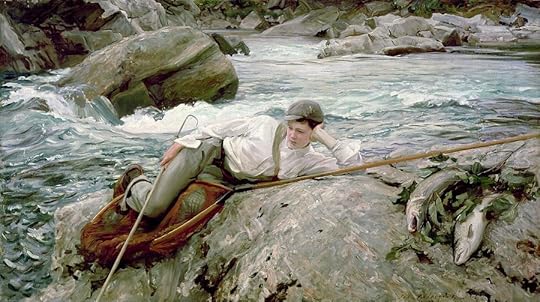
I was pleasantly surprised by the quality of Gunn's writing, I had not heard of him before and bought the book by chance. The account he gives of salmon fishing is an absolute delight
June 9, 2022
Absolutely delightful in parts, difficult in others but I suspect recollections of this book will stay with me and I will return to sections. Glad I had read some of his novels beforehand.

January 28, 2010
I've read two Gunn novels in recent months, and this 'autobiography' throws light backwards on them as they do forward to it. Since experience naked rather than experience mediated are the atom and the complex, the best thing I would suggest to others is to read the book. It irritated me at times to the point I considered it could have been reduced to a shorter essay. But the book's not long, and delightfully it cleared my own smoke to intimate the delight that Gunn thinks cosmically available. If a book 'gets through' like that, it's indeed superfluous to say much 'about' it in the limited contemporary value languages. Obviously (an interesting word, that), Gunn has not set out to describe 'the atom of delight' but a lucky reader may well go off seeking it.

February 3, 2010
Twice read and twice learned that pinning down life is not the point.
Displaying 1 - 5 of 5 reviews