For me, this is the best book of the Sword of Honour trilogy. The story-line and many of the characters continue on from the first book, Men at Arms , so it is set in the war years, with the poor Guy Crouchback as the protagonist, forever being denied his wish for some meaningful action and forever being reprimanded quite unjustly.
There were many points in the book which reminded me strongly of Joseph Heller’s Catch 22 . The latter was published in 1961, Officers and Gentlemen in 1955, and the last of Waugh’s trilogy, Unconditional Surrender, also in 1961. Both books contain a plethora of absurd situations. In Officers and Gentlemen , these absurdities arrive at a more rapid pace than they do in the other two parts of the trilogy.
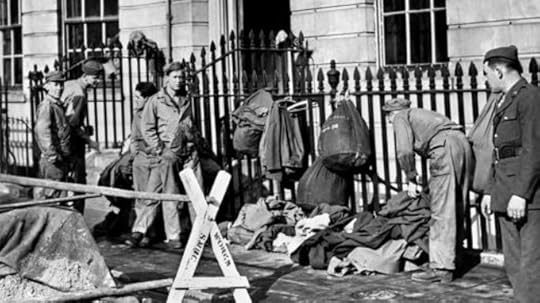
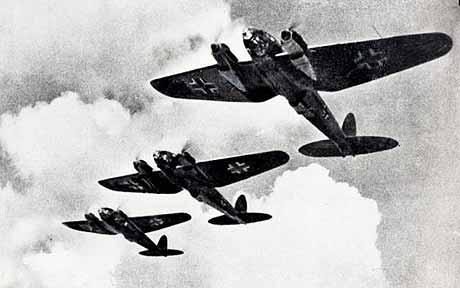
At the opening of the book, Guy is in London where the blitz is well and truly under way, and he watches Turtle’s Club burning: “On the pavement opposite Turtle’s a group of progressive novelists in firemen’s uniform were squirting a little jet of water into the morning-room.” When he enters the intact and crowded Bellamy’s club, he is at the billiard table and recognizes he has stepped on a man’s hand. He later finds that the hand was the Air Marshall’s; this individual dives under the table whenever there is an air-raid warning, because standing orders are for all men to take cover whenever a warning sounds. No one else takes any action but he feels that, as a senior officer, he should set the right example. Perhaps there is a little self-preservation at work as well?
Guy is instructed to report to a secret location for a debrief or reprimand as a result of the disastrous mission initiated contrary to orders off west Africa by Brigadier Ritchie-Hook, in which Guy had played an obedient and gallant role. The adjutant and the sergeant-major have a long discussion on how to inform Guy of the address of the meeting: it cannot be written down since it is on the Most Secret list. Eventually, they agree to send a colonel to take him in person to the address. “‘Jumbo’ Trotter, as his nickname suggested, was both ponderous and popular; he retired with the rank of full colonel in 1936. Within an hour of the declaration of war he was back in barracks and there he had sat ever since. No one had summoned him. No one cared to question his presence. His age and rank rendered him valueless for barrack duties. He dozed over the newspapers, lumbered round the billiard-table, beamed on his juniors’ scrimmages on Guest Nights, and regularly attended Church Parade. Now and then he expressed a wish to ‘have a go at the Jerries’. Mostly he slept.” The colonel never travels without his bedding and so it is decided to give him a car and driver. Just after they have left, the adjutant realises it would have been more straightforward to instruct Guy to go to them and be given the address by hand.
During his extended sojourn in London, Jumbo encounters a major who used to be his drill-sergeant and quietly observes, “‘Extraordinary system taking first-rate NCOs and making second-rate officers of them.’”
Guy is, as earlier requested by the dying Apthorpe, gathering together the latter’s arcane and eclectic belongings so as to take them to the designated, unsuspecting inheritor. This proves to be a massive load, much too large for their car. So Jumbo, assuming Guy is on a secret mission, organises an army truck. All of this with Britain fighting a war undermanned and under-equipped.
By and large, Waugh allows the absurdity of the situations he sets up as being able in themselves to carry the satire.
From time to time, though, he inserts some commentary: “that bizarre product of total war which later was to proliferate through five acres of valuable London property, engrossing the simple high staff officers of all the Services with experts, charlatans, plain lunatics and every unemployed member of the British Communist Party.” Several times in the trilogy Waugh refers to the various non-combatants, “progressive writers” or communists who are thrust into assorted paramedical or emergency roles where their major visible characteristic is their indifference.
The “product of total war” was the HOO, the Hazardous Offensive Operations which mistakenly sends Guy to a Scottish island, Mugg.
Waugh develops some lovely eccentric characters, one, Ivo Claire is gorgeously introduced in the local hotel: “At three o’clock he found it empty except for a Captain of the Blues who reclined upon a sofa, his head enveloped in a turban of lint, his feet shod in narrow velvet slippers embroidered in gold thread with his monogram. He was nursing a white pekinese; beside him stood a glass of white liqueur./ The sofa was upholstered in Turkey carpet. The table which held the glass and bottle was octagonal, inlaid with mother-of-pearl. The pictorial effect was of a young prince of the Near East in his grand divan in the early years of the century. Guy recognises Ivo as a former elegantly skilful show-jumper; however his war service is not as accomplished. Waugh plays around with his narrative perspective: “Soon, as in an old-fashioned, well-constructed comedy, other characters began to enter Left: first a medical officer… an enormous Grenadier Captain in the tradition of comedy hustled into the hall. ”
There is some havoc at this time when Captain Sir Angus Anstruther-Kerr is stretchered out after a climbing accident, and the other residents show little interest in his injuries as they rush to claim his now vacated room but find it already taken by Guy. The man who is to receive Apthorpe’s bequest is “Chatty Corner” who has been delegated to provide instruction in mountain-climbing, despite his having never been a mountaineer and knowing nothing of rocks or ice. The consequence is regular climbing casualties.
Trimmer, who appeared in Men at Arms is also here, but is now known as Alistair McTavish and wears the full kilt regalia. We eventually find that he was originally a hairdresser on cruises, where he met Guy’s former wife, Virginia, one of the clients he especially cosseted. By the end of the story, he will be a war hero, his achievements having been completely misinterpreted and then used for war-PR, with part of his appeal to the newspapers being that he came from humble beginnings which supposedly obstructed his advancement in the elitist forces. This story is created by Lord Copper of the Daily Beast , familiar to readers of Scoop .
Perhaps the finest writing in Officers and Gentlemen comes when his friend Tommy (who had, of course, been the man for whom Virginia left Guy, only to leave Tommy soon after for another beau) insists Guy accompanies him to a dinner invitation with Colonel Hector Campbell of Mugg, who is eccentric and partially deaf. Mugg and his ancestral residence are superbly described. They eat in a great hall, along with their “six dogs, ranging in size from a couple of deerhounds to an almost hairless pomeranian, as well as a piper who intervenes from time to time. “The laird looked at Guy, decided the distance between them was insurmountable and contentedly splashed about in his soup.” “Fish appeared. Colonel Campbell was silent while he ate, got into trouble with some bones, buried his head in his napkin, took out his teeth and at last got himself to rights./ ‘Mugg finds fish very difficult nowadays,’ said Mrs Campbell during this process.”
Mugg is hoping to get the army to blow up a troublesome piece of his land. Trimmer/McTavish is to be involved in the secret undertaking, but the submarine transporting them to the site gets lost.
Meanwhile, Guy is suspected of complicity in an anti-war campaign, and of collaborating with an Egyptian spy. More black marks. Then there is another disastrous action, this one in Italy, Cyprus and Croatia, ending up with Guy joining an escape in a boat and arriving unconscious.
Towards the end of the book, Evelyn Waugh sets up a moral conundrum, which is really not in the same register as the rest of the parodying satire. Ivo has not behaved well and the three characters who become involved have very different perspectives. Julia Stitch helps Ivo: “For Julia Stitch there was no problem. An old friend was in trouble. Rally round. Tommy had his constant guide in the precept: never cause trouble except for positive preponderant advantage. In the fields, if Ivor or anyone else were endangering a position, Tommy would have had no compunction in shooting him out of hand. This was another matter./ Perhaps in later years when Tommy met Ivor in Bellamy’s he might be a shade less cordial than of old. But to instigate a court-martial on a capital charge was inconceivable; in the narrowest view it would cause endless professional annoyance and delay; in the widest it would lend comfort to the enemy./ Guy lacked these simple rules of conduct. He had no old love for Ivor, no liking at all, for the man who had been his friend had proved to be an illusion. He had a sense, too, that all war consisted in causing trouble without much hope of advantage.”
So, in amongst the mockery of military incompetence, we encounter this quite searching examination of people’s differing ethical perspectives. Satire is, of course, not just for laughing; it is for tricking people into thinking about difficult matters. The event that had most impact on me was perhaps when Guy took the identity disc from a soldier’s corpse so that the man’s family might be informed of his death. He gave the disc to Julia Stitch but, as soon as he has left, she throws it in the bin. A simple decision, a simple action from an amoral agent which deprives a soldier’s relatives of the knowledge of his fate.
Officers and Gentlemen could reasonably be considered Evelyn Waugh’s most consistently impressive novel.