Among Blake's finest 21 watercolors interpreting the great biblical book and its theme of unmerited suffering. Also presented here are 11 additional watercolors, plus 28 black-and-white illustrations, including 21 extraordinary engravings based on the watercolors. All reproduced from a rare, limited facsimile edition published by The Pierpont Morgan Library. New introductory essay. 60 illustrations.
William Blake was an English poet, painter, and printmaker. Largely unrecognised during his lifetime, Blake's work is today considered seminal and significant in the history of both poetry and the visual arts.
Blake's prophetic poetry has been said to form "what is in proportion to its merits the least read body of poetry in the language". His visual artistry has led one modern critic to proclaim him "far and away the greatest artist Britain has ever produced." Although he only once travelled any further than a day's walk outside London over the course of his life, his creative vision engendered a diverse and symbolically rich corpus, which embraced 'imagination' as "the body of God", or "Human existence itself".
Once considered mad for his idiosyncratic views, Blake is highly regarded today for his expressiveness and creativity, and the philosophical and mystical currents that underlie his work. His work has been characterized as part of the Romantic movement, or even "Pre-Romantic", for its largely having appeared in the 18th century. Reverent of the Bible but hostile to the established Church, Blake was influenced by the ideals and ambitions of the French and American revolutions, as well as by such thinkers as Emanuel Swedenborg.
Despite these known influences, the originality and singularity of Blake's work make it difficult to classify. One 19th century scholar characterised Blake as a "glorious luminary", "a man not forestalled by predecessors, nor to be classed with contemporaries, nor to be replaced by known or readily surmisable successors."
It’s like finding the old book that was hidden inside an empty house under the broken roof, with the air high in moisture and the green color on the walls. The illustration looks like it’s drawn from the late Middle Ages; inspirational and enchanting. The suffering of Job wasn’t really about pain only, it’s dictated by faith. And God put His most loyal servant Job in calamity not to prove, nor to test solely by which we humans comprehend. Job understood the word of God, and it’s not shaped, it was more than an answer. Even in silence there lay the divine, the grace of great God in the heart of Job.
This is fabulous. Rarely have I seen such beauty and power in drawings. The illustrations were of the biblical book of Job. A book that deserves to be read in itself. There's simply one word to describe this work by William Blake and that's outstanding. 5 stars. Wish there were 50 that I could give.
O Livro de Jó narra a história de um homem virtuoso, bondoso e temente a deus que, após um teste de fé orquestrado por satanás e assentido por deus, é acometido por desgraças que o levam a sofrer intensamente. Jó, ao perder as suas posses e se ver repleto de bolhas pelo corpo, passa a questionar a justiça divina, sendo então reprimido em seu leito de morte por três amigos, um jovem estranho e o próprio deus, que aparece em formato de ventania.
A moral desse livro assustador é que nunca se deve questionar a perfeição moral de deus e que, mais cedo ou mais tarde (mais tarde do que cedo, eu diria), os virtuosos serão recompensados e os ímpios serão punidos — mesmo que em uma vida após a morte. O aspecto curioso é que essa moral é estabelecida somente quando deus humilha (no sentido latino, de ser levado ao "humus", ao solo) o próprio Jó, que então se torna humilde (naquele mesmo sentido).
Deixando a exegese e a minha possível simpatia ou antipatia bíblica de lado, temos que reconhecer que o ocidente foi formado a partir da moral bíblica. Sendo esse o caso, nada mais importante do que ler algumas passagens icônicas das escrituras para entender e questionar os pressupostos dessa moralidade. Fazer essa leitura guiada pelas ilustrações de William Blake torna tudo ainda mais interessante e, até certo ponto, acaba sendo uma experiência mística.
A estrelinha a menos se deu apenas porque essa edição está descuidada. A qualidade do papel é insatisfatoriamente baixa; o tamanho e a nitidez das ilustrações são menores do que o desejável; e, como se trata de um livro de ilustrações, acredito que essa edição mereceria ser de capa dura.
Parece que en estos tiempos que corren en España se le está dando el reconocimiento que merece a la figura de William Blake, tanto en su vertiente de poeta como en la de artista. Atalanta lleva ya un tiempo poniendo a disposición del lector español la obra de Blake con libros como Ocho ensayos sobre William Blakeo la titánica empresa de los dos volúmenes de los Libros Proféticos. Esta vez le ha tocado a La Felguera Editores dar el paso al frente en la reivindicación de William Blake y para ello han decidido presentar estas Ilustraciones al Libro de Job en una magnífica edición, como ellos siempre acostumbran. La fecha y el lugar de presentación del libro lo hicieron todo un acontecimiento: el domingo 28 de septiembre de 2014 nos dieron cita en el cementerio inglés de Madrid, lugar al que los seguidores de Blake acudimos con gran expectación. En tan intrigante paraje y con lecturas selectas de su poesía vio la luz esta especial edición de William Blake. Como es sabido, William Blake, a lo largo de su vida y de su obra, concibió todo un sistema de pensamiento, toda una revisión de los textos bíblicos que junto a influencias de corte esotérico de autores como Emanuel Swedenborg y Jakob Böhme, unidos a su carácter visionario alumbró un universo críptico y tremendamente expresivo que podemos descubrir a través de su poesía y su obra gráfica. El tema de Job es una de las constantes a lo largo de la producción de Blake. En su personal DzTeología de la Imaginacióndz–como así la define Javier Calvo en el prólogo- Job adquiere una particular importancia a lo largo de su obra. Por ello Blake introduce elementos adicionales a este capítulo del Antiguo Testamento. Así, las veintidós ilustraciones que componen este trabajo, acompañadas de citas tomadas de diversas fuentes, no solo bíblicas, vienen a plasmar la mirada de Blake sobre este santo de la paciencia al que dota de una singular interpretación.Este trabajo artístico fue un encargo del editor John Linnell promovido por el colectivo de artistas The Ancients, uno de los pocos apoyos que tuvo en vida este colosal autor, pero no logró ninguna repercusión, lo que agravó la mala salud de Blake y que haría que las Ilustraciones al Libro de Job fueran el último proyecto de William Blake. La belleza de las ilustraciones habla por si sola. La calidad es magnífica, con un Blake al máximo nivel de madurez artística. La edición nos ofrece una a una cada ilustración, acompañadas de la traducción de las crípticas citas de Blake, magníficamente traducidas por Raquel Duato. En definitiva, una magnífica obra del titán británico que se pone por primera vez al alcance del lector hispano. Felicitamos a La Felguera por tan magnífica edición y os invitamos a todos los interesados en Blake a que disfrutéis de este magnífico volumen. Esta reseña se publicó en la revista Mistérica Ars Secreta Nº1 http://www.misterica.net
from the preface: "Publisher's Note" "...by the time Blake produced the first complete set of watercolors illustrating the Book of Job (ca. 1818), the subject had been in his consciousness for over thirty years, and toward the end of this period he had, like Job, gone through considerable trial. After the failure of his exhibition of 1809, upon which he had pinned great hopes, the artist had sunk into a long period of almost total obscurity, neglect and indigency. It was only in 1818, when Blake made the acquaintance of the young artist John Linnell (1792-1882), that he found himself in more encouraging circumstances. Linnell introduced him to a circle of young artists named The Ancients, who paid him the attention he deserved. "The watercolor series illustrating the Book of Job was sold ... to Thomas Butts... It was Blake's hope that people to whom Butts showed his set would order copies from Blake, but no such commissions were forthcoming..... "...Blake's style held little appeal for the general public, which found it 'dry,' and the artist remained known only by a small circle of artists and connoisseurs until the early twentieth century." (pg. iii)
"Blake's treatment of the Book of Job should be regarded as an interpretation rather than a simple attempt at illustration. The artist depicts an internal struggle, hence the similarity between the figures of God and Job.... The symbolism by which Blake expresses his view is complex, and necessitates a full background in the artist's iconography." (pg. iv)
From S. Foster Damon's commentary for illustration XIV: When the morning Stars sang together, & all the Sons of God shouted for joy
"The mystical ecstasy is a state of knowledge as well as emotion, but the knowledge is usually so profound as to be incommunicable afterward. Blake, however, possessed two arts with which to capture and define the wisdom obtained from such experience. The vision of the universe, which appears in this illustration, is an aspect of Job's experience with the Whirlwind. "This universe is the fourfold soul of man: the flesh, the brain, the heart, and the imagination. Lowest is the world of flesh, wherein Job sits with his wife and friends; they are shut in by the thickest of the cloud-barriers. Above them to the left is the Greek god Apollo, who represents the intellect. The radiant sun god, drawn by the horses of instruction, endeavors perpetually to push back the clouds enclosing this world, thus enlarging it. Balancing him on the right is the moon goddess Diana, the heart. Her purity guides the dragons of passion in the night of Beulah (marriage). Highest of all is the realm of the imagination, enclosed by the thinnest of the cloud-barriers. It is separated from the others by a small space, which expands into other empty spaces, suggesting that there are worlds in the human soul as yet unknown." pg. 38
This is an awesome book, and on so many levels that it just blows me away: first, I mean if there's a book of the bible you want the illustrations to it is definitely the Book of Job. Lots of blisters, rodents, dying sheep and stomping on mantels to work with, and Blake works it. And in a surprisingly "DIY-fanzine" personal and compelling style of drawing with the handwritten bible text in Blake's schoolboy handwriting further enhancing the weird feeling that this may actually be an art school hipster's graduate work or Daniel Johnston's new thing.
But I refuse to drown in such layers of reference and just thoroughly enjoy this gem.
Really helpful commentary on Blake's illustrations - not too much detail, either, which is impressive with how much information this short book contains! Blake crafts a compelling narrative, creating something uniquely his own out of the framework of the book of Job by using his own symbolism and interpretive lens.
It's merely a collection of actual illustrations (not poetry) by William Blake depicting scenes from the book of Job, and all feel as if they come from the mind of Edvard Munch.
I'm continually surprised how beloved Blake is by contemporary Christians, despite his many heterodox opinions and interpretations; he certainly was very creative and original, but that's not always the best thing in a dogmatic religion like Christianity. Regardless, I thoroughly enjoyed this illuminating book of illustrations (pun intended), even in the parts I disagreed with.
The book is composed of an extremely helpful introduction to Blake's theology and his wider romantic philosophy, as well as a preview of his interpretation of Job. The rest of the book is composed of 21 detail-rich etchings, each on its own page, with a helpful description and exposition of the dense symbology from the editor S. Foster Damon. Special attention was paid to certain repeating motifs, such as the use of right vs left hands and feet to imply positive or negative connotations, as well as some seemingly contentious claims such as certain stacks of blocks supposedly being "crosses", which the editor alleged Blake treated negatively. I'm not well-versed in Blake's symbology, so he's probably right, I just thought it to be a visual stretch.
I think this book is a great experiment, because it begs you to "read" the images that Blake so painstakingly "wrote" and composed (in his own words, like a poem). Not only is the line work exquisite, but the spatial composition is astounding because of how dense yet comprehensible some of them are. The layout of those original pages from Blake are somewhat confusing, because you first are struck by the image, and want to closely examine that, but then you see the "title" below the image (a quote from the book of Job), and then you notice extra quotes scattered around the margins, and sometimes it's overwhelming to know where to start. This is why the commentary on the opposite page works so well, because sometimes the image is self-explanatory enough, sometimes not. In addition, the introduction also includes an extremely helpful chart of the different Cycles (1-3), States (Innocence, Experience, Revolution, Dark Night, and New Life), Eye (observer's perspective), Event (description), and Contrary (the positive or negative opposite of the illustration in question).
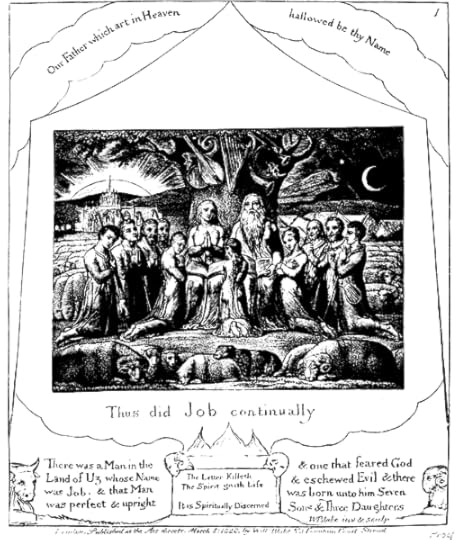
The illustrations start off with Job and his family sitting around a tree, reading from books and praying, waiting for the sun to go down. I thought the sun-setting was a great visual cue, and I was surprised by how almost-anti-moral Blake was, decrying the "Law" and reading rote prayers from a book; ironically, he quotes said book when, at the bottom of the first illustration, he quotes "The Letter Killeth. The Spirit giveth Life." Blake, as far as I can tell, seems to flirt with antinomianism. Blake makes the startling argument that Job is only good in his own eyes (merely refrains from evil, doesn't "Do" enough good), because the law he is following and the God he is worshiping are his own invention. Throughout the hardship that he faces, he ends up discovering the "true" God. I would agree in part that the trials he went through were for his own edification, not for God to see if he would remain faithful. God already knows all things, so any trials we face are for our growth, not God's pleasure or his learning (Lewis very helpfully pointed this out in A Grief Observed).
Blake's assertion that Job's initial God is a god of his own making is reflected in how similar to each other Job and God look. Blake sees satan not as a literal being who would show his own folly at the expense of a mortal, but rather as the Accuser within Job's own mind. Much of Blake's interpretation of the story is surprisingly psychological and metaphorical. I say surprising because, given that Blake is a Romantic, us contemporaries would assume that psychologizing is something done by modernists of a more scientific and rationalistic bent, rather than a romanitic. Essentially, this book gives more nuance to our view of those two groups.
Soon, calamity strikes, and though the illustration of Job's children dying is quite dramatic, the commentary explains that it's a metaphorical dying, i.e. they're "dead to Job". He has disowned them because they have not lived up to the letter of the law which he held in his books at the start. I find all of this an intriguing explanation, contrary to the one I heard back in the day; at the end of the story, Job is given back twice as much of everything he had, but it says that he had 10 more children, instead of 20 more children (which backs up the reference to the resurrection in the middle of the book), since the first 10 aren't gone, only dead, and he'll see them again.
Interestingly, when calamity strikes, Job's wife doesn't disown him in these illustrations, she doesn't blaspheme, but stays by him loyally and weeps for him. I found this quite interesting, because in the original story, literally everyone is against Job: his wife, his 3 friends, satan, etc.; only God and faith in the resurrection still sustains Job. I was surprised that the arguments between Job and his friends only take up a couple illustrations, since it comprises the vast bulk of the biblical story.
It is right after Job's friends show up that Job reaches utter despair and curses the day he was born. this is the starting place of the conversation between him and his friends (in the biblical story), and it's the starting place of the inward renewal of Job finding the "true" God in Blake's interpretation. Despite his wealth, Job couldn't stave off catastrophe; despite his lack of sin, he still found suffering. Did Job trust in his wealth? Did he do no positive good, only avoiding evil? Neither of these are directly answered in the original text, so I think Blake is reading into this what he wants to see, a vaguely anti-church Christianity which wants to revitalize what can get lost in stagnation and dogmatism. I might view it more as steadfastness in the face of a changing world, with Job being a stoic man who faces every possible hardship and still attempts to praise God. He especially avoids giving in to the karmic heresy that his friends force on him, and he points back to his savior in that most beautiful of speeches (I know that my redeemer lives). Blake, interestingly, finds a parallel between the chastising/disowning of Job's children with the accusation of Job by his friends (there is a classic image in the middle, #10, which shows all three pointing both hands at him (6 hands, the incomplete number).
It is at this point (#11, the exact middle) that Blake's gnosticism becomes explicit, where the cloven-hoofed (Old Testament) God points with one hand to the tablets of the law, and with the other toward Hell. The commentator makes it sound like Blake is an out and out gnostic, that this God is a God "entwined with the serpent of materialism" and "The true God is not the evil and temporary God of Justice, but Jesus, who forgives all sins and requires no penalty. The sinner is punished already in the very act of his sin; what profit, then to inflict mechanically some preordained chastisement?" Without this commentary, one could easily take a very Lutheran reading of the images, so that this illustration is the damning expectation of true perfection found in the Law, and Job's realization that it's not his works which save him, but only his faith in [Christ's] resurrection (as evidenced by his good works which flow from that faith) that can save him. It is below this traumatic, accusational image that Blake inscribes the classic "I know that my redeemer lives" verse, which recontextualizes it from a moment of hope to a moment of revelation and realization.
The shift is completed by the introduction of the fourth friend, the younger Elihu, who is the last to chastise Job; Blake depicts Job as listening and reflecting on the young man's words, giving off a distant look. I remember being annoyed by the youngster when I first read Job, but now that I revisit Elihu's words, I find the start to be extremely helpful (and relatable), and the ending is poignant because he starts asking questions akin to God's ("Do you know how God controls the clouds and makes the lightning flash?..."). Elihu's address starts off very memorably, and I think correctly:
So these three men stopped answering Job, because he was righteous in his own eyes. But Elihu son of Barakel the Buzite, of the family of Ram, became very angry with Job for justifying himself rather than God. He was also angry with the three friends, because they had found no way to refute Job, and yet had condemned him. Now Elihu had waited before speaking to Job because they were older than he. But when he saw that the three men had nothing more to say, his anger was aroused.
So Elihu son of Barakel the Buzite said:
“I am young in years, and you are old; that is why I was fearful, not daring to tell you what I know. I thought, ‘Age should speak; advanced years should teach wisdom.’ But it is the spirit in a person, the breath of the Almighty, that gives them understanding. It is not only the old who are wise, not only the aged who understand what is right.
I think this is a great model for us when we see others debate or argue or philosophize; people love to talk past each other, missing the simple truth (it's usually an "emperor has no clothes" situation). Perhaps we need more Elihu's today; we have enough finger pointing, we just need someone to point us back to God, to correct both the accusers and the accused. Following Elihu's correction, God comes rushing in the whirlwind, which terrifies the Friends but fills Job with hope. From now on, God is depicted by Blake as having his arms outstretched in a cruciform stance, pointing out that it's Christ and forgiveness that saves, not the Law.
Soon afterwards we get the classic image of Behemoth and Leviathan, and this starts off the corrections of the errors that Job began with. Satan is cast down, but not in a literal sense: "They fall into the flames of annihilation--not of everlasting torture, for such a hell Blake did not admit; Error recognized is Error destroyed." Unfortunately, this explanation is deeply unbiblical and is more of a reflection of Blake's philosophy than the Bible's theology (which really is a good summary of the entire book, honestly).
It is here that we also get more verses from the New Testament (largely John and Revelation), instead of Job references below the images. It's understandable that Blake liked John's writings, since they're the most mystical of the New Testament, and thus can engender the most speculation and misinterpretation. Job, in thankfulness for being pointed back to Christ, offers offerings on behalf of his friends and children. Job is reunited with his daughters, and Job sits with arms outstretched in a similar cruciform pattern like seen earlier, pointing them in turn back to Christ. The commentary explains that the three daughters stand for "Poetry, Painting, and Music", but there's little visual evidence of this in the illustrations. In the final image, all of Job's family is playing instruments or singing praise, and the sun once again is seen rising.
I was delighted at the illustrations, but I can't help but see Blake's interpretation as an overreaction to an overreaction, namely a Gospel-heavy approach to counteract the medieval over-emphasis of the Law. His insistence that one need not change one's actions (i.e. act more morally), but rather we need to eradicate the "accuser" within ourselves (our conscience?)... all of this sounds like contemporary liberal approaches to theology, where sin itself as a concept is undermined (because it makes people feel uncomfy, and comfort is the secret, unspoken god). But as all conservative theologians of the past few centuries have pointed out, without an honest recognition of sin, there is no need for a savior or for forgiveness (what is God forgiving? what are you being saved from?). Blake seems to strangely see the accusation of sin as the only real sin, i.e. the only true sin is calling out sin, and calling out the calling out of sin is paradoxically the only good work. Perhaps this is being too pessimistic or equating him too much with contemporary theological trends, but this looks and feels like yet another case of reading what one wants to see into scripture, instead of using scripture to interpret scripture, using scripture to reform one's worldview. Regardless, I'm glad I read this thought-provoking little book, and you should read it too.
There is something undeniably enticing about Blake's work, despite the overwhelming Christianity of it all. He does flatten and misuse parts of Job, turning it into a reductionist story of fall then redemption, misunderstanding then correction. But, then the imagery contradicts the simple reading - just stare at Plate 11. Is that a demon hanging over him, or God entwined with the serpant? Is it Satan dressed as God? Or is God Satanic? ...
Note: I only looked at the engravings (online), not the watercolours
Have pity upon me, have pity upon me, O ye my friends; for the hand of God hath touched me. Why do ye persecute me as God, and are not satisfied with my flesh? Oh that my words were now written! oh that they were printed in a book! That they were graven with an iron pen and lead in the rock for ever! For I know that my redeemer liveth, and that he shall stand at the latter day upon the earth: And though after my skin worms destroy this body, yet in my flesh shall I see God:
Blake’s Job is a series of engravings which collectively represent William Blake’s unique interpretation of the Book of Job. The collection was edited by Brown University’s S. Foster Damon, who also provided the introductory remarks and – importantly – step-by-step readings of each engraving. Throughout, Damon demystifies the complex and highly codified symbol systems that Blake utilized, and he notes the places in which Blake’s Job deviates from the Job of common orthodoxy. A highly valuable and practical guidebook for scholars and laypersons alike.
Una auténtica obra maestra en la que Blake muestra todo su potencial como artista visionario. Sus ilustraciones muestran una visión muy personal del Libro de Job, en la que se resume la visión sobre el sentimiento religioso del gran ilustrador y poeta inglés. Un compendio de su relectura gnóstica de la Biblia, donde la gnosis se adquiere a través de la imaginación artística. La edición de La Felguera es una delicia, con la que se pueden saborear en todo su esplendor la obra póstuma de Blake.
This was like reading the graphic novel version of the Book of Job. I think I would enjoy having the rest of the bible done in this manner. The illustrations are lovely!