Jump to ratings and reviews
Rate this book

Amsterdam Stories

Rate this book
No one has written more feelingly and more beautifully than Nescio about the madness and sadness, courage and vulnerability of youth: its big plans, and vague longings, not to mention the binges, crashes, and marathon walks and talks. No one, for that matter, has written with such pristine clarity about the radiating canals of Amsterdam and the cloud-swept landscape of the Netherlands. Who was Nescio? Nescio—Latin for “I don’t know”—was the pen name of J.H.F. Groenloh, the highly successful director of the Holland-Bombay Trading Company and a father of four—someone who knew more than enough about respectable maturity. Only in his spare time and under the cover of a pseudonym, as if commemorating a lost self, did he let himself go, producing over the course of his lifetime a handful of utterly original stories that contain some of the most luminous pages in modern literature. This is the first English translation of Nescio’s stories.

Contents:
The freeloader
When we were titans
The writing on the wall
Out along the IJ
Little poet
From an unfinished novel
The valley of obligations
The end
Insula dei

161 pages, Paperback

First published March 20, 2012

84 people are currently reading
3265 people want to read

About the author

Nescio

19 books54 followers
Jan Hendrik Frederik Grönloh was born in Amsterdam, the oldest of four children. After an idealistic youth, he joined the Holland–Bombay Trading Company in 1904, becoming director in 1926, suffering a nervous breakdown leading to a short hospitalization in 1927, and retiring at age fifty-five, on December 31, 1937; he married Aagje Tiket (b. 1883) in 1906 and had four daughters with her, born in 1907, 1908, 1909, and 1912. Meanwhile, as Nescio (Latin for “I don’t know”; he adopted a pseudonym so as not to jeopardize his business career, acknowledging his authorship publicly only in 1929), he wrote what is now considered perhaps the best prose in the Dutch language.

Ratings & Reviews

What do you think?
Rate this book

Friends & Following

Create a free account to discover what your friends think of this book!

Community Reviews

5 stars
297 (29%)
4 stars
374 (36%)
3 stars
251 (24%)
2 stars
72 (7%)
1 star
18 (1%)
Displaying 1 - 30 of 163 reviews
Profile Image for s.penkevich [hiatus-will return-miss you all].
1,573 reviews15.2k followers
January 18, 2023
I stood on the little bridge on the edge of nothingness, enveloped in infinity.

The unbridled aspirations of youth are like a fiery golden sunrise, headstrong and self-assured to light the world ablaze with midday brilliance and pushing aside the inevitability of the purple twilight that is to come. Amsterdam Stories, a slim yet surprisingly substantial collection from the life’s work of Nescio— the Latin pseudonym of Dutch businessman and director of the Holland-Bombay Trading Company Jan Hendrik Frederik Grönloh meaning ‘I Don’t Know’ —beautifully bottles the passions and endeavours of youth in pristine prose. Focusing on a cavalcade of young artists who passively watch the world turn while assured of their own importance and coming fame, Nescio’s stories read like a more matured and polished Beat novel coming alive in the streets of Amsterdam and the artistic expressions of his characters. The natural world reigns supreme with Nescio as his artists attempt to harness it for personal glory while inevitably succumbing to the passage of time that leaves them only dust and the world churning on.

Perhaps the enjoyment of Nescio hinges on one’s tolerance for youthful nostalgia performed through long walks and talks, drunken binges and the occasional art of otherwise unproductive young men in society. However, even those disenchanted with Beat Generation style antics are sure to find solace in the much more matured insight through the gorgeously polished prose of Nescio. For me, the nostalgia is like being seated around a warm fire on a vast summer’s night with friends now long gone; the stories made me feel the heart within my chest throb in all its abstract and emotional qualities and overflow my senses with nearly-forgotten stimuli as if I were suddenly transported to the basements and bars of my early twenties. Reading more like a memoir than short stories as the majority contain the same characters in a circle of friends, Nescio refrains from adding much concrete detail to character descriptions and the reader is sure to naturally fill the gaps in with their own adolescent friends; many of these stories read like experiencing your own past as Nescio bestows a universality to his characters that make you believe you somehow know them.
We would shock the world, unimpressive as we were, sitting calmly there with our legs pulled up and our eight hands clasping our eight knees
Nescio instills that youthful feeling of infinitude and importance, where the world is just a test, and obstacle, that can easily be overcome for one to find themselves reigning supreme. The hatred for the privileged that skate through life on their last names, the disgust towards bleeding out your life as a bound and tied slave to corporate servitude, all the aspects of maturity and adulthood that youth despises despite doing nothing to the contrary come alive in each story. Nescio returns you to the feeling that nothing is impossible, the wonderful feeling that you are unique, special and bound for greatness—a greatness that grows exponentially with each drink and smoke as you chatter away with your friends into the endless numbered nights.

'Oh, we took our revenge, we learned languages they had never even heard of and we read books they couldn't even begin to understand, we experienced feelings they never knew existed.'

Each story perfectly captures the emotions of young life. The Freeloader (‘he always knew how to have a damned good time spending money while other people earned it’, seemingly a acute observation of an author with a business bent on his artistic friends and lifestyle) features a friend we all know and initially loved for their carefree manner and ability to enjoy life to the fullest without suffering the yellow-dawn existential angst and regret that typically permeate each hangover and smoked-out morning breath. Young Titans, my personal favorite, exquisitely examines the group of artists on a lifelong timeline, from sunrise to sunset, first loves and dreams towards a lifetime of mediocrity and defeat, and rings true to the point of jabbing its emotional knife into the soul of every reader. The Little Poet in particular manages to assess love, particularly impossible love and the sleeplessness of love-pangs, in a world where God and the Devil toy with their creations for sport. These are stories of white-hot emotion and ambition, of burning the candle at both ends just to see it blaze, and dying in the afterglow.

I sit there aimlessly, God's will is aimless.
But to keep this awareness always is granted to no man.


Nescio’s prose is full of vibrant life and color. While his characters go relatively undescribed, except the beautiful women of Holland each with intoxicating ‘knowing eyes’ that even leads God Himself to wonder ‘if he had seen ten thousand girls or one girl ten thousand time’, the Dutch landscapes are described in lavish language. The natural world and it’s impenetrable mysteries and unharnessed beauty enlivens each page and inspires the characters as they trade in their lives in artistic servitude to capture nature through their paintings and poetry. It is no surprise then that in Insula Dei the most disconcerting aspect of the Nazi occupation to the focal character is the destruction of trees and nature, as mankind is acknowledged as disposable to ‘God’s plan’ and nature the everlasting truth. Nescio gives a sobering reminder that we are finite in an infinite universe, yet avoids melancholy and accepts this truth in a manner that feels all the more empowering and beautiful for it.
Two thousand years, that’s nothing, the earth has existed for thousands and thousands more years than that and will probably exist for thousands more. The water will probably flow thousands of years more, without him seeing it. And even if the world did end, that still didn’t really mean anything. There would be so much more time afterwards, time would never end. And all that time, he would be dead.
There is something so freeing in accepting one’s fate, in acknowledging that time eats all and outlasts all. Through Nescio, we watch the goals of youth shattered on the shores of adulthood, either crushed by the world, sunk into mediocrity working for a paycheck ‘hounded and oppressed by people and by necessity, just like everyone else,’ or disintegrating and disappearing forever as time takes it’s course. Despite the typically morose endings to the stories, Nescio manages to avoid burdening the reader with sadness but instead a sly smile at the irony of existence.

A new age would dawn, we could still do great things. I did my best to believe it, my very, very best.

These stories really struck a chord with me. They returned me to my youth in decrepit college apartments with former roommates as we passed long nights laughing, talking, smoking, and dreaming as we welcomed the stars with wine and guitars. Nescio rings true into the depths of the human soul and his message is just as valuable and digestible now as it was when first written. While this seems a meager offering of translated stories, a large chunk of the included works being unfinished drafts, the culmination of work still steals the heart and allows the reader to watch the progression of the author through the years. Amsterdam Stories leaves the reader wishing there was more, however, this is preferable to a collection having the reader overstimulated, overwhelmed and beyond ready for completion. Nescio captures the essence of youth in all its fiery glory and one is sure to feel empowered by his words.
4/5

A new batch of little Titans are still busy piling up little boulders so that they can topple [God] down off his heights and arrange the world the way they think it should be. He only laughs, and thinks: “That’s good, boys. You may be crazy but I still like you better than the proper, sensible gentlemen. I’m sorry you have to break your necks and I have to let the gentlemen thrive, but I’m only God.”
And so everything takes its little course, and woe to those who ask: Why?
Profile Image for BlackOxford.
1,095 reviews70.4k followers
February 19, 2021
Engagement & Alienation

To appreciate Nescio, I suggest it’s helpful to compare him with his English near-contemporary, Henry Green. Nescio might well be considered the Dutch Henry Green (or more precisely Jan Hendrik Frederik Grönloh is the Dutch Henry Vincent Yorke). Both were businessmen who were also authors of some remarkable prose beginning in the 1910’s and 1920’s. Although Green was far more prolific, Nescio like Green was a stylist interested in the perplexing details of everyday life. Both, perhaps because of their dichotomous lives, are primarily concerned with the idea of ‘duty,’ that is the implicit obligations or plichten that most of us respond to (or are trapped in, depending on mood).

Nescio and Green both use dialect extensively, which is unfortunately untranslatable in either direction. Green writes about the mores of the English country house, upper class snobbery and working class woes. Nescio is more narrowly focused on the bourgeois smugness of a much more compacted class structure in Holland. This he finds as tedious as the orderly and unvarying Dutch landscape:
“And the tide came in and the tide went out; the water rose and fell. Every night the limping harbormaster came and first he lit the green light on Noorderhoofd, the breakwater, then he came back down and then he had to go around the whole harbor and then you saw him by the tower again and then he opened the wooden gate and climbed the wooden steps and lit the light in that tower too. And then Japi said ‘Another day, boss.’”
Green tends toward description not evaluation. His characters aren’t trying to prove anything. They may be eccentric, but they are aren’t counter-cultural. Nescio’s, on the other hand, could be proto-hippies - a taste perhaps of what Amsterdam would become famous for a half-century later: “‘No,’ Japi said, ‘I am nothing and I do nothing. Actually I do much too much. I’m busy overcoming the body. The best thing is to just sit still; going places and thinking are only for stupid people. I don’t think either’... He had just one wish: to overcome the body, to no longer feel hunger or exhaustion, cold or rain.” His characters agonise over their apparent conformity to the ethic of work, responsibility and achievement. One way or another society wins, however.

Youth is consequently not a happy time in Nescio’s Amsterdam. Perhaps it never is anywhere. Society is oppressive, unlike in Green where it simply is. Dutch youth are portrayed as frustrated idealists who aren’t sure about their ideals. “We were on top of the world and the world was on top of us, weighing down heavily.” As office workers, they resent the wealth they see around them and the authority it exerts over them. For Green, young Birmingham factory workers are realists who recognise the world is changing, but largely without their help. They have no ambition to be other than they are except respected by authority and paid decently. Unlike the Dutch, they are comfortable with their social status.

The Dutch and the English seem ‘woke’ (to use the latest term for social awareness) in entirely different ways in the works of the two writers. The Dutch are remarkably modern; their conversations might be perceived as taking place today rather than a century ago. Although they are poor, they are cosmopolitain, travelling from one end of the Dutch-speaking world to the other and speaking other languages as if in defiance of their own culture. The English are parochial and provincial regardless of class. Except for some gentry, they do not travel, not even around their own country. They are entirely unaware of events outside their cultural world.

If I were fifty years younger, I might want to pursue this further. As things stand though, I think I’ll let the suggestion lie fallow. Perhaps some young aggressive scholar might pick it up.
Profile Image for Jola.
184 reviews448 followers
July 5, 2017
Let’s start our walk with crocuses, shall we?
’I think back to last year’s crocuses in the parks in Groningen, in the gardens of the villas on the way to Haren, and farther. Spring was late last year. The crocuses were in full bloom in mid-April. Yellow, purple, and white, the vanguard of spring.’

And how about weeping willows?
'She saw the weeping willow turn yellow, its branches hung down and they reached for the water, they hung in deathly silent yellow adoration over the pond and they saw their own yellow light in the water..'

You are probably surprised that I am starting my review of 'Amsterdam Stories' by Nescio (1882-1962) with flowers and trees. The nature and the city? Believe me, I was also startled by such a vivid presence of plants.


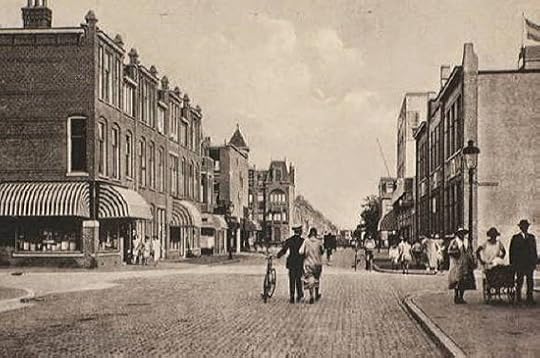
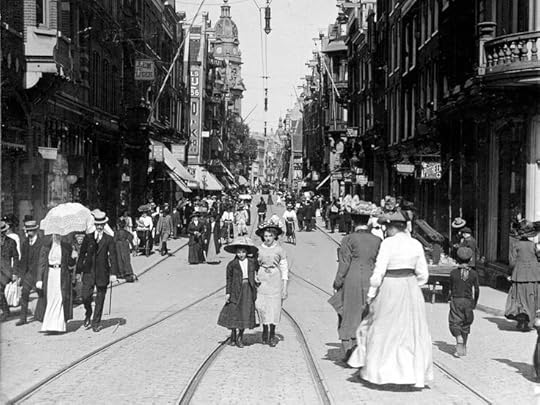
Amsterdam, Leidsestraat, 1910.

I’ve never been to Amsterdam, we haven’t met in person yet. I’ve always imagined the capital of Holland as a picturesque combination of buildings and canals. Similar to Venice but slightly more solid and palpable, as if Venice has been painted with watercolours and Amsterdam with oil colours. Nescio’s sublime descriptions of flowers and trees make the city even more irresistible, though he worries about the inadequacy of words compared to the breathtaking beauty of nature: 'The birch trunks were silvery white, but prettier than silver. Language is poor, fatally poor.'

Who was Nescio? His real name was Jan Hendrik Frederik Grönloh. I have never heard before about this Dutch writer who published only three books in his lifetime. 'Amsterdam Stories' (New York Review of Books, 2012) is a collection of his novellas and short stories, written between 1909 and 1942.

We will see in the future if I can recall many details of Nescio's plots but I will surely remember the melancholy and nostalgia which enveloped me all over like a soft, misty cloak. The author calls it 'the longing, without knowing what for'. This cloak has a silver lining though: it’s Nescio’s inimitable sense of humour which helps him to be at peace with the constantly changing world. Nescio’s philosophy reminded me of the Stoics. Like Marcus Aurelius or Epictetus, Nescio encourages us to feel satisfied with who we are and what we have and to observe the world carefully. Nescio's characters are similar to flâneurs but instead of walking they sit and contemplate. Watching the nature turns out to be especially reassuring and helpful.


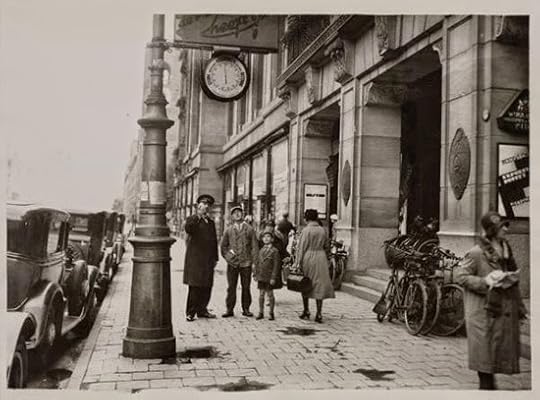
Amsterdam, 1900-1930.

Nescio’s sadness wasn’t a guest from nowhere. It had probably fermented in him for years. He was a typical idealist, a promising young writer, who buried his dreams to become a businessman. He kept writing anyway but used a Latin pen name – Nescio means 'I don’t know' - as he preferred not to risk his career.

The form of Nescio’s works, especially the last ones, is open, even fluid. If you like to feel the spine of the story under your fingertips, you might feel disappointed. These stories have been woven with loosely connected fragments, glimpses, observations. The directions, which his characters’ thoughts follow, often intersect and some images or phrases are repeated like a chorus, for example 'Insula Dei' or 'It’s thawing'. The narrator goes round in circles around some topics, at times comes back to those he’s already abandoned. The capricious and delicate structure of these short stories and novellas reminded me of a cobweb seen against the light.


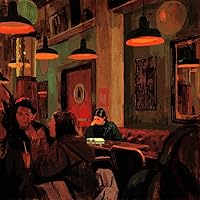
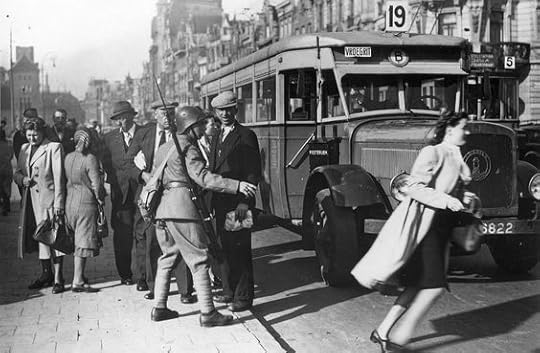
Amsterdam, May 11, 1940.

Get ready to meet a wide range of characters in Nescio's stories: from a teenage wannabe writer to the God of the Netherlands. The Amsterdammish freeloaders seem to be an especially intriguing species and you will meet quite a few: 'The freeloader you found lying in your bed with his dirty shoes on when you came home late; the freeloader who smoked your cigars and filled his pipe with your tobacco and burned your coal and peered into your cupboards and borrowed your money and wore out your shoes and took your coat when he had to go home in the rain.' The type might sound familiar!

Even episodic characters, who appear just for a few seconds, are remarkable, like the old man, wearing a pince-nez and a bowler hat, who says: There are only five things worth bothering about, and I list them here in order of importance: Amsterdam, early spring, the last ten or fourteen days of August, women, and the incomprehensibility of God. From most to least important.' Number one on this list, Amsterdam, is not just a mere setting of Nescio's novellas and stories. It seems to be like a protagonist itself: reflects characters' moods and provokes musings.

In the preface to 'Above the Valley' the author says: 'it would please me greatly to think that you too can’t get enough of Amsterdam.' Now I want more of Amsterdam, Mr Nescio. I want more.


Amsterdam, 1900-1930.
Profile Image for Katia N.
718 reviews1,134 followers
October 6, 2024
It is a slim book containing a handful of stories. The best of them are about being young: “We were heading out to conquer the world, except for Hoyer, he was the only one who didn’t believe that, all he knew that he was out for a walk on Zeeburgerdjik, past the slaughterhouse.” And at the same time they are about getting older without yet realising it. It is about finding out one day that your friends as you know them are not there anymore. They turned into Strangers, different people. Or maybe they still hide those ones you knew deep inside but it is not easy to get there anymore. And time has become the major scarcity.

Also, it has been a while since I’ve read someone able to reveal a glimpse of a transcendental, or rather to show someone caught in a struggle with it:

It’s so strange, having that melancholy sound behind you. It’s like the ocean wants something from me, that’s what it’s like. God is in there too. God is calling. It’s really not a walk in the park, he is everywhere, and everywhere he is calling Bavink. You get sick of your own name when it’s called so much. And then Bavink has to paint. Has to get God onto canvas, with paint. Then it’s Bavink who’s calling “God”. So there they are, calling each other. It’s just a game to God, he is everywhere and without end. He just calls. But Bavink has only one stupid head and one stupid right hand and can only work on one stupid painting at a time. And when he thinks he has God, all he has is paint and canvas. It turns out God is everywhere except where Bavink wants him to be. And then some guy comes along and writes that Bavink is privileged… Privileged, right. You know what I wish? I wish I wrote timetables. God leaves people like that alone, they’re not worth the trouble.


It has reminded me how Cortázar has rendered the impossible pain of creating faced by Charlie Parker in The Pursuer. But also it seems these stories anticipate Fosse’s Septology, not in terms of style but in this overwhelming feeling of metaphysical longing and depiction of the power, an intrinsic connection contained in male friendship.

Deep luminous metaphysics entangled with transient beauty of ordinary moments and melancholy of existence.
Profile Image for E. G..
1,181 reviews795 followers
September 17, 2018
Introduction, by Joseph O'Neill

--The Freeloader
--Young Titans
--The Writing on the Wall
--Out Along the IJ
--Little Poet
--From an Unfinished Novel
--The Valley of Obligations
--The End
--Insula Dei

Notes
Profile Image for 7jane.
829 reviews365 followers
February 18, 2021
4.5 stars.

This was like a refreshing misty rain or a cool wind after some previous readings. A collection of short stories from JHF Grönloh, under the pen-name of Nescio, written partly during his work as a director of Holland-Bombay Trading Company, arranged here in writing order. The notes at the end give further info on each story.

Nescio write very little (well of course: his main job took most of his time), and only short stories, though sometime he did want to write longer stuff. There’s much bittersweetness to these stories, yet it doesn’t feel too heavy. Each story, whether the people in them are just-starting young clerks, or much older gentlemen, charming idlers like Japi of the first of the stories, artists, or even young girls like in Little Poet (God and the Devil also make their appearance on that story).

To me, these stories gave me a feel of a good Dutch landscape painting, memories of my short visit to Amsterdam… they brought up Amsterdam and the countryside alive for me. The themes, how I felt them to be – the weather, the sun, the seasons, the landscapes, the ambitions and the reality of people’s lives, the walks they had (Nescio was a fan of walking a lot), the permanence of seasons and days’ changes, thoughts on God, *God’s* thoughts, food, cigars, reminiscing on the past, and on the future.
(My favorites were: The Freeloader, Out Along The Ij, and Insula Dei.)

These stories, while often holding their sadness, nostalgia, and life’s frustrations, also gave me the beauty of nature, the rightness of friendships, the thoughts on time passing. Very refreshing, funny, and hope-giving, that’s what they were for me.
Profile Image for Emmeline.
452 reviews
October 13, 2023
4.5 stars

It’s not so easy to move up in the world, even if you know deep down you’re still a little poet.

There are some really high standard reviews of this book here on Goodreads that I felt humbled reading. I’m not sure I can rise to their level, particularly as I read this slim collection over ten months, so perhaps I will just reflect a little on what it made me think of.

A lot of recent books have concerned female friendship, which is understandable considering how neglected a topic it was for many years. Nescio’s book is about, among other things, male friendship, and this got me thinking that male friendship is not something I see explored much anymore. The nineteenth century was full of depictions of male friendships, often young men sharing rooms and moving through the city together, eventually separating to marry and go their own ways. I so seldom read about male friendship now. I almost wonder if men have friendships. They do, of course, but so much of male friendship I see around me seems to be centred around doing things, whether going to the pub or rock climbing/cycling/playing music. Whereas depictions of female friendships often involve sitting around and talking, meeting for coffee, going for lunch. The expectation is that friendship does not need an activity to prop it up, it just needs a meeting place.

Nescio’s male friendships are like contemporary female friendships then, or like 19th century male friendships (and these stories were written in the early 20th century, so that makes sense). His young men are artists and writers, or aspiring artists and writers. Many of them also hold down office jobs, which make them feel simultaneously miserable and superior — miserable to be trapped indoors, unable to see the sky change and the sun set, yet superior to their bosses and colleagues:

Oh, we took our revenge, we learned languages they had never even heard of and we read books they couldn’t even begin to understand, we experienced feelings they never knew existed. On Sundays we walked for hours on paths where they never went, and at the office we thought about the canals and the meadows we had seen while they ordered us to do things that we didn’t see the point of…. But still, they had us in their power, they confiscated the greater part of our time, they kept us out of the sunshine and away from the meadows and the seaside.

Some of them produce little bits of writing or painting that have some success; others never had much artistic talent to begin with. As the years pass, many marry, conform, others slide through the cracks, go mad. In any case what they are grappling with is not so much art as the existence of God, the way to live in the sight of God and as such, to be immortal. This God isn’t religious, although he’s called God. He’s more of a representation of all of humanity’s yearnings and finer feelings.

…a little poet reaches up, powerful and powerless, from the raging river of his poethood toward God, who never does come out from behind the blue sky and show himself…. Then the little poet recaptured the wan romance of the whole situation. God didn’t mean anything by it. He was only playing around, only getting everything ready for a new production of "The Sorrows of Young Werther."

God is also an appreciator of human beauty:

And when she tilted her head forward —she wore her hair up now — the God of heaven and earth himself looked up for a moment… and he beheld the fine hairs that glinted in the sunlight, and he smiled. Then he looked gravely back down past his feet at his Rhine winding back and forth between his mountains, and he mused: “What’s going on here? How did I let the Germans found another empire? Those Prussians…”

And while poets are suffering, both with their own mortality and the fragile mortality of their dreams, time marches on. In the early story “Young Titans,” the narrator remarks that

It was a strange time. And when I think about it, I realize that that time must still be happening now, it will last as long as there are young men of nineteen or twenty running around. It’s only for us that the time is long since past.

Even so, youth and beauty aren’t entirely untouched by history. The last story is set in 1942, under Nazi rule, and the now older friend the narrator encounters (“an older man with a wretched walrus mustache that’s dirty yellow and gray with poverty, and a poor man’s red nose, but without a drop hanging off the end at least”) has been defeated not just by time and disillusion but by actual suffering.

Still, the book as a whole is concerned with a different kind of defeat, the defeat of the freedom and yearnings of youth (in freezing attics with only a piece of bread and tea to eat all day) by the comforts and dullings of middle age in the middle class. And what makes the book truly masterful is that this defeat is never a full defeat, there are still poets and artists inside us even when we know longer cut young, romantic figures, and these stories, after all, have come out, nostalgic, humorous missives from another time.

A bonus point for the translation, which is so understated, and yet when you examine it, so full of perfect words and sentences.
Profile Image for Tony.
1,037 reviews1,920 followers
March 10, 2015
Two I liked a lot.

The Freeloader is Japi. A mooch. The story rather quickly put me in mind of Bartleby. Which I mean as a high compliment. The difference, here, is that Japi, who sponges constantly, nevertheless makes fast friends. Bohemians mostly, but still. How could you not like Japi, who actually had an office job, and, unlike Bartleby, stopped going. He explained:

You don't know what an office job is like ... First you go to school till you're eighteen. Do you know how many sheep there are in Australia or how deep the Suez Canal is? My point exactly. But I knew all that. Do you know what polarization is? Me neither, but I used to. I had to learn the strangest things: 'Credited to the inventory account,' translate that into French. Have a go at that. You have no idea, Koekebakker. And it goes on for years. Then your old man sticks you in an office. And you realize that the reason you learned all those things was so that you could wet slips of paper with a little brush...

My point exactly.

One other thing I learned in this story, and I reprise here for your edification, is that that the term sucked face was already in use in 1910. At least in Amsterdam. What you choose to do with this tidbit is entirely up to you, but I thought it was important enough to air.

The other story I liked was: Little Poet.

This story, in particular, had an autobiographical feel. The protagonist is a poet who because of circumstances - wife and four kids, public obloquy - gets a real job that turns into a real moneymaker. He's still a poet at heart though, which means his head turns easily to the lovely girl across the tracks. He fairly bleeds his amorous soul onto the pages, enough so, that our author writes this:

Now before I go any farther I should probably mention that my manuscripts too are recopied by my wife, and that she does not see the poetry in this story. Coba's flirting is not so terrible, she thinks it's because the little poet was neglecting her. The lady on the tram deserved a slap in the face and the little poet too. It's strange, in other stories she reads she doesn't think things along these lines are that bad. I think it's because I'm the one who wrote this story. Of course she knows there's a difference between the author and Mr. Nescio himself, but to her that's splitting hairs. It's a difficult situation. My domestic bliss is somewhat troubled--but still I'll keep going.

(Class Discussion Topic: So, authors and budding authors, you have all these great anecdotes with accompanying self-scrutiny from your own rule-bending past screaming for story treatment. Clearly you have to do more than just call your protagonist 'Fred' to avoid detection. Assume that your spouse would actually read what you've written (as I said, for discussion purposes). How do you avoid divorce court?)

What else I loved about 'Little Poet' was that God and the Devil have roles. They were both scene-stealers. A nice literary touch. In one scene, Dora, on the cusp of becoming a woman, has fallen for her brother-in-law. She spends an afternoon looking at her naked form, wondering. And God does too:

he beheld the tan little bumps above the hollow that was a poem, and the fine hairs that glinted in the sunlight, and he smiled. Then he looked gravely back down past his feet at his Rhine winding back and forth between his mountains, and he mused: "What's going on here? How did I let the Germans found another empire? Those Prussians...."

In another passage, God is riding the train. First-class compartment though. When he isn't looking out at the passing landscape, he's reading a report which states:

"Man's fate is to feel regret when he fails to reach his goal and to feel regret when he succeeds.
"There is no consolation in virtue and no consolation is sin.
"Therefore, cheerfully renounce all expectations. Place your hope in eternity: there is no awakening from this dream."


My point exactly.

_____________________________

The other stories were either fragments, whose placement here was lost on me, or stories of artist wannabes that I didn't find important. Sorry.

_____________________________

'Nescio', by the way, was the pen name of J.H.F. Grönloh, a highly successful businessman who wrote anonymously on the side. 'Nescio' is Latin for "I don't know". Now, I have many Goodreads friends who are multi-lingual. I'm not. That would make me feel inadequate, except that, unlike yinz, I'm fairly conversant in Appalachian. Here, "I don't know" would be spoken as UHN-uh-uh". Like Xhosa, it takes some practice.
Profile Image for Steve.
441 reviews589 followers
Read
May 20, 2017
Actually, 4.5 stars...

What a welcome change of pace!

Nescio was the pseudonym of Jan Hendrik Frederik Grönloh (1882-1961), a pseudonym he felt was necessary to protect his career at an Amsterdam import-export house (at least until 1929), where he spent 33 years of his life and where he rose to be the director of the firm. But this was no life story like that of his contemporary Charles Ives, who was satisfied with his career as insurance executive and used most of his free time to write idiosyncratic music ahead of its time. It is fairly clear that Grönloh did not want his career, but by the age of 30 he had 4 young daughters and a wife to take care of. However, he also didn't really want to be a writer, either, for he published little, even after he retired at the age of 55. Like one of his best known characters, he wanted to be, not to do.

But the little he graced us with leaves me regretting that he didn't feel more strongly the calling to be a writer. For the short stories and sketches selected and translated by Damion Searles for this book, including all of the stories published in his first book (1918) which can be found in the original Dutch on the Project Gutenberg site, are charming, lively, melancholic and wry. With no sign of the drive to impress evinced by some of our contemporary authors, Nescio artfully tells his stories with a light touch. He is regarded as an admirable stylist in the Netherlands, which is why I read De uitvreter (the first story in this collection) in Dutch. I succeeded only in confirming once again that understanding what is written is a long way from grasping literary quality... There is no sign of linguistic fireworks, and it flows very nicely. More than that I can't say at this point.

So back to the translation, which also flows nicely and captures Nescio's wry humor and quiet sadness (which occasionally breaks out into loud despair - see below). What comes through clearly is an unmistakable voice, one you want to hear more of and regret when it stops its amused and sad narration.

About what, you ask.

The collection opens with "The Freeloader" ( uitvreter - loafer, sponger). This tells of the interactions of a group of young men, of which the primary characters are three: a self-tormented painter, the "freeloader" and the first person narrator, who is a writer of sorts. At first irritated by the freeloader's shameless sponging, the other two become fascinated by his free spirit and his manner of living totally in the moment. But the freeloader is ground down, though most of the grinding takes place outside of the view of the narrator. We are left speculating about the details.

In the next story Titaantjes (little titans, translated by Searls as "Young Titans", which, I think, misses some of the irony), the same group of young men appears again, without the freeloader. This time they are a typical bunch of 19-20 year olds, "us against them all", disparaging all they find before them and anxious to change the world, though exactly how and in what manner are not too clear to them. Grönloh aptly sketches this time of life and I, at least, at a safe distance from that period of my life, laughed aloud here. I suspect that those going through that time of life would not crack a smile.


Oh, we took our revenge, we learned languages they had never even heard of and we read books they couldn't even begin to understand, we experienced feelings they never knew existed.


So right! Do you remember? I can't help but contrast these healthy sentiments with the anomie of the young people in Tao Lin's Taipei , to mention but one example.

But life has a way of taking young people and changing them, changing them into something they never dreamed they would become; for the better, for the worse? Often, one really can't judge from the outside. The narrator tells the story 10 years after this time of inchoate hopes and dreams has passed, and sobering glimpses of the eventual outcomes of these people are allowed...

The narrator finds a kind of peace: "God's aim is aimlessness." In the next line: "But to keep this awareness always is granted to no man." His view is anti-modern - life is eternal, unchanging cycle; apparent changes are superficial, negligible. Individual lives go through huge changes; life itself never changes. Grönloh finds consolation there.

Not wanting this review to become all too long, I won't say anything about the remaining stories (not even the nearly perfect "Little Poet") and close, instead, with these remarks:

The strains caused by the disparity between his nature and the demands of his profession were intense enough to cause a nervous breakdown in 1927, resulting in a short hospitalization. But they also manifested themselves in the following brief text, "The Valley of Obligations" (1922):


I sit on the hill and look down into the valley of obligations. It is barren, there is no water, there are no flowers or trees in the valley. A lot of people are milling around, most of them drooping and misshapen and constantly looking down at the ground. Some of them look up every once in a while and then they scream. They all die sooner or later but I don't see their numbers decrease, the valley always looks the same. Do they deserve anything better?

I stand in the valley on a slag heap next to a small pile of scrap wood and a broken wash kettle. And I look up and see myself sitting up there and I howl like a dog in the night.


I've been there, but only as a young man, occasionally; Grönloh was 40 when he wrote this... Well, he had a long, long retirement and spent uncounted hours walking through his beloved Dutch countryside, just looking and being. At his death a journal of his hikes was found and has been published (in fact, nearly every scrap of his writing has been published, because the Dutch have taken him into their hearts), and I am intrigued, because when he described the countryside, the sky and the sea in these stories the intensity of his attention markedly increased. I'm afraid I might just have to hunt down nearly every scrap of his writing, too.
Profile Image for Ben Winch.
Author 4 books419 followers
April 23, 2022
I love this guy. He’s so humble, so understated, so unhistrionic, but what comes through (to me at least) is a palpable sadness. You might even say a cosmic sadness, in that he’s aware of his smallness and his characters’ smallness in relation to forces they only fool themselves they can fight. And it’s powerful, so powerful that despite his beautiful words and images I’m almost glad he published only these hundred-odd pages in his lifetime, because more would be heartbreaking. In his quiet way he’s almost another Akhmatova, sensitive and alert and destined to write but shaped by world events into a kind of writer he might never have imagined. There’s an irony in his giving up his bohemian life to be a bourgeois, then being reduced to ersatz coffee and counting his last cigars as the Second World War sets in just when he’d retired and thought he’d earned his luxuries. But he doesn’t hit you over the head with it. Nor does he wax too nostalgic for past times. Other reviewers have emphasized this: the romantic look over one shoulder at the past. But I read it more as tragedy. Even the ‘young titans’ planning their takeover of the future struggle to believe in their plans. The seeds of their failures are there from the start.

I liked these stories equally – I could start reading at any page and be enthralled – but I thought the machinations with the devil and the young husband and wife in ‘Young Poet’ were particularly strong:

Then the little poet looked up at the window across from him in the streetcar. The houses were all dark, and the ladies reading this know perfectly well that in such circumstances you see all the passengers in the streetcar reflected in the little window, outside.

The contemplative eyes of the little poet then looked straight into the contemplative eyes of Clara, the dazzling, which looked as though they knew something very special, but that was just an illusion. For a moment, the four contemplative eyes grew bigger and more dazzling, then the little poet lost his nerve, he was a well-behaved young man after all, even if there were such strange meanderings in his never-ending poem, and he looked at the brown fabric and black fur and at the vague shape of her legs under her suit and then wrenched his gaze toward a dairy outside.

… And so the little poet poetized away at his never-ending poem and even the silliest woman could poetize along with him. But they couldn’t be together. And maybe that was what made it so beautiful.


On to the little poet’s wife:

Coba is sitting at an outdoor table at the Beursbengel cafe... Her little girl is sitting across from her... In the corner sits the devil, twisting the ends of his moustache. I once heard a woman, a high-minded, principled woman, say: ‘A man like that, what does he take me for? Does he think I’ll fall in love with him just because he tugs at a wisp of hair? Bah!’ Don’t trust this woman too much. Now she’s lying awake at night clenching her wet pillow between her teeth.


At times, there seems little imagination in these stories. They’re like memoirs, with a single cast of characters that I presume are based on real people. ‘Little Poet’ is something else – the most fictional of the lot – but its world is so familiar from the others that its easy to see the autobiography in it. Given such material, it would have been easy for Nescio, self-proclaimed hater of ‘important gentlemen’ turned important gentleman, to turn on his younger self and proclaim a higher set of ideals from his new position of privilege. To me, he got the balance right. He’s mocking, but gently so. He offers no answers besides those his younger self might have offered, but in the beauty of his prose he affirms something more: humility, decency, abiding love of nature. And by refusing to put anything but his very best efforts into his work, he actually gives meaning to his self-denial, beyond the earning of an income to support his wife and children. Seen in this light, it’s a discipline. Don’t waste words, Nescio, time is ticking!

A small, unique classic. I won’t give it a perfect score because I can’t yet tell if we’ll be familiars. Or maybe I’m scared we are already? No, (un)fortunately I feel I’ve never grown up.
Profile Image for Ipsita.
63 reviews11 followers
October 18, 2017
Brilliant, captivating, scintillating with wry humour (beyond the usual cynicism, more like an enlightened comical view of a tragedy), and tranquil resignation regarding the purpose of man's existence.

Here are some of the remarkable quotes from this excellent piece of literature:

a) The Freeloader

For the earth everything was simple enough. It just turned on its axis and followed its course around the sun and had nothing to worry about. But the people on it fretted out their days with troubles and cares and endless worries, as though without these troubles, these cares, and these worries, the day wouldn’t turn into night.

“Do? Nothing. All you people are so pathetically sensible: everything needs a reason and a purpose. I’m going to Friesland, not to do anything, not for anything. No reason. Because I feel like it.”


b) Young Titans

Paint two horizontal stripes, one on top of the other, same width, one blue and one gold, and then put a round gold bit in the middle of the blue stripe. We’ll write in the catalog #666: The Thought, oil on canvas. And we’ll submit it under my name: Johannes Bavink, Second Jan Steenstraat, number soand-so, and we’ll price it at eight hundred guilders. Then you can just sit back and see everything they come up with. They’ll discover all sorts of things in there that you didn’t have the slightest idea of.


“You think I’m drunk?” I did indeed. “It doesn’t matter, Koekebakker, when I’m sober I don’t understand anything anyway.”


God’s throne is still unshaken. His world just takes its course. Now and then God smiles for a moment about the important gentlemen who think they’re really something. A new batch of little Titans are still busy piling up little boulders so that they can topple him down off his heights and arrange the world the way they think it should be.


I sit there aimlessly, God’s aim is aimlessness.
But to keep this awareness always is granted to no man.

c) The Writing on the Wall

Again the longest day was past. The days were getting shorter—it was still barely noticeable but we knew it was happening, this summer too would pass. Again the day came to an end, again the bright red above the horizon grew pale, the water in the distance kept its color, but barely, darkness crept up everywhere, out of the earth, now the canal in the distance had vanished in the night. We were gloomy about all the things that had passed, and about our lives, which would end while all these things continued to exist. We would see the days get longer a few more times, then we wouldn’t be young anymore. And after that, when the chestnut trees had blossomed red or white a few more times, we would die, in the prime of our lives or maybe as old men, which would be even worse. And the sky would be red again and the canal would still be there too, most likely, gold in the twilight, and they wouldn’t notice any difference.


d) Out Along the IJ

And then we thought of the spring to come, after this winter, and we felt immortal again and not the least bit sad, not anymore.


e) Little Poet

Bellum transit, amor manet.


“Man’s fate is to feel regret when he fails to reach his goal and to feel regret when he succeeds.
“There is no consolation in virtue and no consolation in sin.
“Therefore, cheerfully renounce all expectations. Place your hope in eternity: there is no awakening from this dream.”
These were truly strange times. It couldn’t end well. And now he’d gone and said that a new age had dawned. The age of Ironic Dilettantism was over, a new age of Trailblazing Optimism and Dynamic Vigor had begun.


To be a great poet, and then to fall: When the little poet thought about what he actually wanted most of all, it was that. To astound the world, just once, and to have just once an affair with a poetess. He thought this thought again and again, for years, he was so naïve.


Why did God ever make anyone a little poet?


God carries us up to the heights only to hurl us back down again. The path over the summit is short but the valleys are long. Anyone who has been to the mountaintop spends the rest of his days in misery.


But he understood himself all right, it was horribly clear to him, and that is why nothing happened. He looked at her and the poet in him worshipped her and raised her up to the throne alongside the God of heaven and earth and he didn’t dare touch her.
And at the same time, deep inside the little poet, the wild animal crouched, ready to pounce and devour all the things that taunted him, everything that stood around him and walked past him and didn’t notice him. First of all, her—the beautiful, the beloved, first—so that there would be no reason not to devour everything else. To lift her up as high as the stars in the winter night and do his worst with her and then let her fall down into the unfathomable deeps. To avenge upon her, in his pleasure, the whole world’s taunting indifference. And besides, what would a little poetess want more than to fall like that?


f) From an Unfinished Novel

They endlessly make art, dead literature and other dead works of art, and it doesn’t seem to kill them either.


October is especially beautiful this year, we live in a golden city, and not for any amount of money, not for a hundred thousand rijksdollar bills would I want to be respectable. I’d rather just stay who I am, a piece of humanity like this walking right at the edge of the embankment, beyond the trees, stopping and turning around every time, like someone a little confused. And it has stopped raining, it hasn’t rained for days and I’m no longer dreaming about wet feet, I’m wide awake. And definitely confused.


g) The Valley of Obligations

I sit on the hill and look down into the valley of obligations. It is barren, there is no water, there are no flowers or trees in the valley. A lot of people are milling around, most of them drooping and misshapen and constantly looking down at the ground. Some of them look up every once in a while and then they scream. They all die sooner or later but I don’t see their numbers decrease, the valley always looks the same. Do they deserve anything better?
I stretch and look up past my arms at the blue sky.
I stand in the valley on a slag heap next to a small pile of scrap wood and a broken wash kettle. And I look up and see myself sitting up there, and I howl like a dog in the night.


h) The End

You create a world of your own, you reject this and take a close look at that, you discover, you add more, and finally you see that it is good. And then the disintegration starts, slowly at first, you barely notice it and don’t realize what’s happening. What you’ve worked so hard to make your own— what you love—disappears or changes into something unrecognizable: landscapes and waterscapes, roads, bridges, buildings, villages and cities, people too. They don’t ask you first, they just do it.


So you’re wrong if you think “Oh, good!” and hurry to start reading. The terrible disintegration won’t matter to you, it won’t touch you at all.


Suddenly the man sitting across from me says: “There are only five things worth bothering about, and I list them here in order of importance: Amsterdam, early spring, the last ten or fourteen days of August, women, and the incomprehensibility of God. From most to least important.”


Everything went so differently from how we thought. That the world didn’t care much about us—we all understood that a long time ago. But we still thought, for a while longer, that it was up to us to make the silent course of things take their course.
The man across from me says that he and that silent course of things have nothing more to say to each other. “Laugh at it and hit back. Other than that, God only knows.” His high bony forehead has two very sharp planes. He says in his Amsterdammish: “The more barbarians the better, as far as I’m concerned.”


i) Insula Dei

They stand there stoic and resigned, we have learned how to be stoic.


“I’m not pathetic. I am an island.”


We already know how each other’s life has gone. We don’t need to talk about the war: we’ve looked each other in the eye a couple of times. We only need to sit quietly and the past rises up between us and spreads out all around us, we see the faces, we hear the voices, we see the endless meadows, we see the house fronts and the rivers and streams, the water splashes, if we listen closely we can hear the creeks too, “burble burble,” a cow is standing in the creek, we see the leaves on the trees. We sit out in front of the little cafés on the market squares and we wait on the ferry causeways, hands on our bicycles.


“God is often incomprehensible. His incomprehensibility is never far away. Just think about the snow that day when we ran into each other last week. And the neighborhood.”


I think about these eventful times. You want to do something, make a difference. But these aren’t the first eventful times I have lived through and if I’m granted even more years then with God’s help I will most likely get to my third war. The silent course of things takes its silent, implacable course, the little man who is a hero today will tomorrow, when peace comes, be scolded in his stupid little job or maybe won’t have a job at all and will turn back into the useless piece of clockwork he used to be. And if he has a little more to him, maybe he will read the first chapter of Ecclesiastes: “All things are full of labour; man cannot utter it.”
Eventful times. What remains from Italy’s eventful times in the thirteenth century except Dante’s Inferno?
Do. As if I haven’t had enough pointless doing. Oh they have nothing else, they only are when they do. I want to be, and for me to do is: not to be.


“There are so many things I did wrong,” he says. “Who hasn’t?” I ask.
He props his elbows on his knees, props his head on his hands again, and looks at me like that. Then he shakes his head: “No, not just some things. I did everything wrong. And treated people badly. And why? For nothing, for a figment of the imagination.”
“A figment of the imagination?” I say. “Is there anything else in life?”
Profile Image for MJ Nicholls.
2,289 reviews4,894 followers
August 26, 2014
Nine stories from an underappreciated Dutch scribe with a melancholic and tender sensibility. Early works ‘The Freeloader’ and ‘Young Titans’ were the most affecting for me, with later pieces ‘Little Poet’ and ‘Insula Dei’ a little too scattershot in approach to be wholly satisfying. The remaining stories are slight sketches or incomplete fragments. A fittingly gloomy but hopeful end to 2012.
Profile Image for J.
170 reviews1 follower
March 6, 2025


'Why did God ever make anyone a little poet?'

'October is especially beautiful this year, we live in a golden city, and not for any amount of money, not for a hundred thousand rijksdollar bills would I want to be respectable. I’d rather just stay who I am, a piece of humanity like this walking right at the edge of the embankment, beyond the trees, stopping and turning around every time, like someone a little confused. And it has stopped raining, it hasn’t rained for days and I’m no longer dreaming about wet feet, I’m wide awake. And definitely confused.'

'After twenty years I went back to Castricum and The Resting Hunter was still there but I couldn’t see it at first, it was so surrounded by everything. The main street looked like a bad haircut and then those ‘darling little apartments’ everywhere, dear God. Where can you still find a nice slender bridge? They need to be wide, for the traffic, much too wide for such short bridges. Abominations. And then ‘artistic’ too sometimes. I ask you. As long as they can drive fast. What do they know of God’s slenderness?'


*
Profile Image for Proustitute (on hiatus).
264 reviews
January 5, 2020
A truly wonderful collection by a gifted short story writer and life chronicler who is sadly unknown outside of his native Holland. Even this collection, superbly selected and translated by Damion Searls for NYRB Classics, is the first of Nescio's works to be available in English.

Nescio's gift is for focusing on the city as a living, breathing, and sometimes temperamental character in its own right. He also has a fine touch for characterization and interior conflict; many characters recur in the tales collected here, and the Künstlerroman themes are evident in nearly all of the stories. Nescio's focus on youth, on freedom, and on dreams is idyllic at times and then crushed by the harsh realities of maturation, external factors, and the world at large.

One of his strongest stories, "Little Poet," handles all of his usual themes with a highly nuanced awareness of war, infidelity, and the diminishing role of the artist in modern life. Nescio's increased attention to issues of gender and how these relate to his concerns from this story onward show an immense shift in his treatment, widening the scope, and leaving at least this reader hungry for more of his stories to be translated into English.

"The Freeloader" and "Young Titans"—which, along with "Little Poet," are the longest of Nescio's tales—are also remarkable, the first being stronger for its Melvillean misanthropy. Of the other tales collected here, only "The Writing on the Wall" and "Out Along the IJ" are weak; whether this is due to their rather short length (Nescio appears to need much longer canvases to unfold his narratives, except for two I'll mention below) or merely because they were sketches for other work, I can't say. What I can say is that his extremely short "The Valley of Obligations" is the closest to modernist prose poetry Nescio comes in a prescient way, and "The End" is apocalyptic in its Künstlerroman pessimism, its antebellum anxieties, and its aesthetic simplicity, both stories proving that Nescio worked brilliantly in shorter forms as well as longer novella-length tales.

Youth, dreams, life, love, loss, and the unrelenting realities of the world at large. All of this and the shifting, sometimes alien and sometimes intimate city of Amsterdam as a backdrop—Nescio's tales are timeless and all too ready for a new generation of readers.
Profile Image for JimZ.
1,306 reviews778 followers
January 5, 2020
I indeed liked The Freeloader, the first story in this collection of short stories and other pieces (half started stories). The story was interesting…the freeloader’s take/philosophy on life. It reminded me of Ecclesiastes…"Nothing is new under the sun.” We all go around from day to day engaging in our activities from sunup to sundown, from childhood to our old age…and what does it all mean. To me it means a lot, but the freeloader (name of Japi) reminded me of another take on it all: the meaningless of life. To wit:

“No,” Japi said. “I am nothing and I do nothing. Actually I do too much. I’m busy overcoming the body. The best thing is to just sit still; going places and thinking are only for stupid people. I don’t think either. It’s too bad I have to eat and sleep. I’d rather spend all day and all night just sitting.”
I don’t do the story justice. It was enjoyable to read and to be introduced to a supposed freeloader who was more than that.

But I was not too jazzed about the other stories in the collection, especially a 40+ page short story, Little Poet, that had way too many flowerly overly descriptive sentences and many paragraphs where I just wanted it to end. And I was wondering why this author was so revered in the Netherlands and then elsewhere (since it’s a New York Review of Books Classics Original). The introduction was written by Joseph O’Neill who I like a lot (he wrote a wonderful novel, Netherland, and a short story that was really good from the New Yorker…what an interesting word in the title that I had to look up: The Poltroon Husband [March 12, 2018). But I digress…sorry! Amsterdam Stories was worthwhile for the first story and then afterwards my interest and enthusiasm wanted.
Profile Image for Nicholas During.
187 reviews39 followers
April 17, 2012
I've been reading and talking about this book a fair amount over the past week so I'm not sure which opinions are mine and which are others. I'll just say that I really enjoyed this book, and I thought it was a very successful treatment of the angst of young smart men who suffer by working in mundane jobs when they thought they could change the world and make a name for themselves with their art and talent. Not me of course. What is interesting about it, and this I don't think is my idea, is the way that the reader can get into the young man's head and be critical of the elder, bourgeois men around him, but one emphasizes with the elder man who had to compromise and give up his youthful dreams. Nescio does this, but doesn't then reject his younger ideals--he still accepts that he was honest and mostly correct if a bit silly when young--his older men remember their youth with a wistful pride and it is kind of a sustenance for them in the practical and clerical lives afterwards, especially in 'Insula Dei' where they are under Nazi Occupation and in serious poverty. This understanding, and often humor, makes the book work in my mind.

It also is a very lyrical, poetic prose style, that I feel Damion Searls has done a very good job translating. Also props should go to Joseph O'Neill for his introduction, not the most creative and expansive intro, but very, very solid.

And finally there is no doubt that this is a great example of a regional fiction. I'm sure there is much to say on the theme "regional literature" (cue Tim Parks), but the descriptions of both Amsterdam and the rural surroundings are really superb and feel very heartful. Also, the typical Dutch types are both loved and skewered, and some Dutch traits come out, both in the characters but also in the tone. I don't think there anything wrong with that. And as last note this book does fit into the early 20th century literature in an important way. I won't go into comparisons, but if you're interested in the time and region, and like the Robert Walser and Kafka themes of young men on the verge of a revolutionary time in Euopre, you'll like this.
Profile Image for Philipp.
709 reviews228 followers
February 14, 2015
Read this on the train to Amsterdam, but it's not really about Amsterdam, more about growing older. The tone and atmosphere reminds me of Hard Rain Falling or Stoner, a melancholy caused by the inevitability of having to face what happened to your failed dreams when growing up.

Most stories focus on a group of friends from the Netherlands, they want to be artists and despise the bourgeoisie, but it's the Netherlands [1], it's small and focuses on the "respectable" people, the middle class. The group of friends grows older, no-one is really successful despite their high opinions of themselves, most of them have to work low-level office jobs to make ends meet (except for Jupi, the last larrikin).


Everything went so differently from how we thought. That the world didn't care much about us - we all understood that a long time ago. But we still thought, for a while longer, that it was up to us to make the silent course of things take their course.


Highly recommended.

[1] I find the Netherlands to be more confusing than Japan. What's up with these huge ground-floor living room windows where you can see everything from everyone? And how come no-one is ever in these living rooms? And these living rooms are so spotless you could operate in there? Is there a second "real" living room in the basement where people actually hang out? Why are the Flodders so great?
Profile Image for Cosimo.
443 reviews
March 28, 2015
Diversamente sensibile

Il vento fresco ci soffiava intorno. Il mare mormorava lamentoso, il mare, che si lamenta senza sapere perché. Il mare si arena triste sulla riva. I miei pensieri sono un mare, si arenano tristi sui loro confini”.

Nescio è un poeta che racconta la malinconia della luce e degli ideali che vengono sconfitti dalla realtà; sognava di diventare un grande poeta e poi cadere, di dipingere infiniti tramonti e dialogare con il rossore del sole, catturandolo in una cappelliera. La gioventù è uno stato d'animo naturale nelle sue pagine, intrise di spleen e abitate da viaggiatori, dove i bohémien condividono l'acquavite discorrendo di Dio, sullo sfondo di un paesaggio ombroso e crepuscolare. Siamo intenti a costruire una vita secondo il desiderio e la morale, in questi misteriosi frammenti, ma la nostalgia e il ricordo del passato, specchiandosi nell'oggi, ci colgono di sorpresa: tutto ciò che non si dimentica è poetica aspirazione e tempo ritrovato tra le mani di questo invisibile e splendido artista.

“No, non sono niente e non faccio niente. A dire la verità faccio anche troppo. Sono occupato a morire. La cosa migliore è starsene fermo: muoversi e pensare va bene per gli idioti. Io non penso nemmeno. E' già un peccato dover mangiare e dormire. Mi piacerebbe potermene stare semplicemente seduto da qualche parte giorno e notte”.
Profile Image for Argos.
1,269 reviews497 followers
March 26, 2022
Jan Hendrik Frederik Grönloh yazarın gerçek ismi, kullandığı ad latince “bilmiyorum” anlamına gelen Nescio. Hepi topu bu kitaptaki 4 uzun hikaye yazmış. 1900’lü yılların başlarında Amsterdam ve kırsallarında gençlik arkadaşlarıyla ilgili öyküler, bir tanesi (Küçük Şair) otobiyografik öğeler taşıyor.

Esasen ben bu öykülerde çok bir şey bulamadım, Hollanda’nın en sevilen 10 romancısından biri olmasını ve bu dört kısacık roman ile nasıl ünlendiğini de pek anlamış değilim. Hele bir de Robert Walser ile benzerliğinden bahsedilmesi acaba neyi kaçırıyorum sorusunu sordurdurdu kendime.

Kitaptan aldığım zevk, on yıldan bu yana yılda en az iki kez gittiğim Amsterdam’ın çok iyi bildiğim yer ve sokaklarının 20. yüzyıl başlarındaki halini okuduğum bölümlerle sınırlı.
Profile Image for Tuck.
2,264 reviews253 followers
June 4, 2012
classic shorts from holland pre-wwi, during wwii, and waiting for wwiii. surprisingly modern in tone and sensibilities, nescio mostly follows the lives of 5 artists struggling with their art, jobs, poverty, and having the time to really pay attention to their lives and landscapes they live in. lots of recurring descriptions of sunsets over the canals and rivers and sea, trees, cows in pastures, love and lack of, all the "straights" and how silly they are in their concerns for jobs, careers, families. highly recommended for hard core readers. you'll learn something from these short short novels and stories.
Profile Image for David.
384 reviews44 followers
February 6, 2017
I think this is just not for me.

I enjoyed "The Freeloader" and "Little Poet". Everything else was very, very dull and I was very happy to be done.
Profile Image for Luke.
1,641 reviews1,205 followers
October 9, 2021
4.5/5
And so then we were sitting across form each other again, he who'd been rationalized away and I who had done some rationalizing of my own until I'd collapsed under the absurdity of it all.
This is one book that I would have considered an absolute favorite had I read it nearly a decade ago when I first became interested in it. Instead, it took me nearly a decade to acquire a copy, and while I have more critical perspective of the time, place, and concerns of the writing before me, I still have to say that I am not at all surprised to hear how beloved this author and his stories are in his native land. The references to Melville's Bartleby and other singularly conscientious objectors to objectification and denaturization of both the land and the people are apt, but I also think of de Assis' Brás Cubas, whose posthumous musings are sometimes known under the title of Epitaph of a Small Winner. It is a deft, yet somber, light, yet tragic, free-wheeling, yet trodden-down voice that guides us through the tales of professional moochers, erratic painters, self-satisfied capitalists, bureaucratic revolutionists, and finally to the little poet, the little titans, the little group of friends who stood on the backs of women and colonialism and thought that they were going to change the world. As that last bit will alert you to, there are certain instances of concerted ignorance in the works regarding both the wider world that fed its wealth and half their country's population that prevent me from rating it any higher. However, outside of that, and even sometimes during it, it is lovely, lovely, lovely, and it would be unfair of me to not acknowledge that its due.

I have never officially read to a satisfying degree any works of Walter Benjamin. However, what bits and pieces I have garnered from hearsay and a particularly disappointing piece of academic nonfiction have led me to believe that that philosopher had some interest in thinking about the sensory experience of the industrialized world, how the humans attempt to build themselves into an ideal capitalist architecture and how the archetypes of nature and the spirit still manage to slip through the cracks and entice the seemingly city-bound denizens towards something less mechanized. Nescio's writing on the natural landscape of his country, even in translation, holds its own with the best of the genre, and his recounting in certain later sections of how key pieces of natural environmental glory were torn down, filled in, and erased reminded me of nothing so much as my own sorrow when, returning to the fields behind my house after a long sojourn, I found the dangerously decrepit, yet rustically superb, farmhouse had been torn down and stamped over with a couple of pristine streets excruciatingly filled with tightly wound townhouses.

There's also something to be said about how one's idealistic youth lived alongside similarly minded friends falls out over the decades until you have to have an appointment to meet with one and insist on meeting at a restaurant so you can buy them their first meal in weeks for another and have to continually remind yourself that this one walked off a bridge some years ago for yet another. The success of Nescio's alter-ego, his 'worksona,' if you will, subtly keeps him on the successful side of the divide too much for me to fully commiserate, but there was so much keen and largely (this is where the de Assis narration comes in) unafraid appreciation of the world and its land and its people written in such a wonderfully lilting prose that it wasn't hard to move on. I didn't even mind not insignificant number of references to God scattered throughout the stories, for for every one of them that was overwhelmingly appreciative, there were at least one or two that side-eyed the deity that would raise the smug conservative to the heights of luxury and leave the creative type to starve. So, the kind of mincing, fretful, swooning breed of writing that complains a great deal about the ways of the world and doesn't directly involve itself in anything that could possibly do something about it, but strain it through enough scintillating prose and mix in enough themes that are relatable to the middle class denizen with thwarted artistic aspirations and an appreciation for nature in all her colors, and you'll apparently have a winner with me.

This year has been the year of one of my lowest average ratings across the reading board, so when I come across something that manages to uplift me despite all its foibles, I take a firm hold of it and never let go. Nescio's total output was small enough for this collection to include a good portion of it, but there is a bundle of nonfiction nature writings mentioned in the endnotes that I would be rather keen on seeing (whenever it hits an Anglo translation, of course). For all its pointless mystifications regarding the personhood of women, this writing has a certain tempered joie de vivre that I have a regular need for even when there isn't a pandemic raging outside my door, and the work coming when it did has a hint of the extraordinary to it. In any case, once again, the NYRB Classics reminds me why I fell in love with them all those years ago, as well as why I continue to dip into them every once in a while when I have mustered up sufficient quantities of both hopes for the best and preparations for the worst. A short work composed of even shorter stories is definitely not the sort of piece I go for these days, and thus is not the most likely place where I Should expect to find a fluttering portion of my soul. Not an absolute favorite, but novel enough, feeling enough, and charming enough for me to see that the general time that the public spent waiting for an Anglo translation and the personal time I spent waiting till I was ready to read it was well worth it. My copy won't be leaving my domain as quickly due to constraints on book buybacks, but I hope that whoever eventually plucks it from the used bookstore stacks derives as much surprised pleasure from it as I did.
In the north the darkness was gulping down the light, the mountain was nearly swallowed up, the day's last escort fled to the northwest and I stood on the little bridge on the edge of nothingness, enveloped in infinity.
Profile Image for Caroline.
916 reviews316 followers
October 15, 2013
This is admirable writing, in particular the story 'The Young Titans.' Nescio writes with both understanding and irony about the twenty year olds with the sensibility of artists, but little discipline to actually create. He writes about their contempt for the 'important gentlemen' for whom they have to work to eat, while subtly acknowledging his characters grudging shame that those men are actually accomplishing a great deal.

Eventually some of his characters do produce some work, but generally it is unsatisfying to them. They cannot capture the ineffable, and cannot be satisfied with anything less. God and the Devil stroll through the stories occasionally, sometimes as characters Nescio may or many not believe in, sometimes as cultural artifacts the artists believe exist only in their heads. Much of the writing takes the perspective of a middle-aged man looking back on his and others youth from the vantage point of a decline into bourgeois externality and estrangement.

Nescio writes superbly about the Dutch countryside. He has observed closely and takes the reader into stunning moments, usually at sunset--transcendent moments. City life also is present in a very physical way in these stories.

This description makes the book sound depressing, but the writing is so fine that one reads slowly to savor the language. It turns out to be uplifting in a curious way, that one of those men did in fact turn out to write as well as he aspired to. And it should be noted that the translation by Joseph O'Neill must be excellent; obviously I don't know the original but this book is wonderful.

Profile Image for Stephen Durrant.
674 reviews171 followers
September 13, 2014
Nescio--a pen name meaning "I don't know"--is a Dutch writer from the early decades of the twentieth century. I had never heard of him before coming across this collection of his short stories, published in a NYRB edition, in, yes, it really is true, Amsterdam! It was a lucky find. Nescio, as I have subsequently learned, is sometimes compared to Kafka. The comparison is appropriate in some ways and not in others. Both describe small men facing a world of work and duty for which they are entirely unsuited. But whereas Kafka's characters often confront something grand, impenetrable, bizarre and/or frightening, Nescio's characters confront little more than boredom and gradual sufficiation of their small dreams. These stories are about "losers," one might say, who want to keep some hope alive that they really can't sustain. "The little poet," for example, only wants to write a famous poem and then "fall" as a result of some steamy affair. To write a poem and then fall, such a grand dream! Other characters sit in the countryside looking out across the flat land that is the Netherlands thinking about future achievements they just won't achieve, realizing that the river they see flowing in the distance will still be flowing after every single one of them is dead. Maybe too much reality here!
Profile Image for Rebecca.
129 reviews45 followers
December 3, 2015
"il mio cuore morto è un grosso peso da portare. "


storie di falliti che non provano neanche a riscattarsi. malinconia e tenerezza guidano tutte le storie.
Profile Image for Aliefka Bijlsma.
Author 4 books10 followers
October 20, 2012
These Amsterdam Stories by Nescio are absolutely wonderful. They give such great insight into "the Dutchness of being" - we think we are the center of the world, know everything, can do everything, we think we are special... but then we grow up and realize we actually aren't. We are quite mediocre, in fact, and then find ourselves stuck in this way thinking. This is very Dutch.
Necsio's Amsterdam Stories have been translated into English wonderfully. Well worth buying, and not only if you're interested in Dutch literature. His style is simple and compact, but powerful. My favourite Dutch author, for sure.
Profile Image for J..
462 reviews237 followers
January 21, 2015
Much as I like a riveting tale of creeping inertia, will-sapping ennui and desolation, the present volume is more than a little flat.

No doubt this is some modernist-precursor which vindicates itself retroactively or something. But it kind of reminds me of hanging out with unemployed english-major friends right after college. What's not to like about men arguing theoreticals in unheated flats, draining gin bottles and smoking cheap tobacco ? Hard to know where to begin, really.

In the storied annals of not-giving-a-fuck, Raskolnikov and Bartleby still rule. Skip this one.
4 reviews
February 19, 2025
Libro iniziato durante la turbolenta fase di adattamento nella mia nuovissima tappa olandese, mi ha mostrato la bellezza di Amsterdam e dintorni proprio mentre ero sui vari treni che segnavano alcune delle tante tappe del libro. Un’esperienza nuova e particolare che mi ha permesso di assaporare l’atmosfera di queste mondane storie olandesi nel modo più autentico possibile.
Particolarmente interessanti e sentiti i primi racconti dove giovani senza aspettative percorrono questo suolo dritto e gelido senza una chiara destinazione ma con energia ed una una sottesa nostalgia di fondo che di certo non guasta.
Stupende le descrizioni paesaggistiche, mia personale parte preferita del libro, insieme alle accurate descrizioni dei particolari che circondano i personaggi.
Peccato per gli ultimi racconti a mio avviso un po’ meno sentiti, meno coinvolgenti e superfluamente criptici.
Un ringraziamento speciale a @Elilli che mi ha prestato il libro per farmi sentire un po’ più a casa.
Profile Image for Nick Sweeney.
Author 16 books30 followers
October 27, 2017
Many of these stories, by the little known Nescio, are about youth looking critically at middle age, and, sometimes in the same stories, with middle age taking a more understanding look back. They centre on groups of friends in Amsterdam at the turn of the last century, and are a good pointer to how young people acted, spoke and thought at the time - like young people everywhere else, in general, but with the added touch of being in Amsterdam, with its sea not far away, held back by walls, with its damp atmosphere, its dunes, its towers. Some of the stories made me picture landscapes by Flemish painters.

There is a central strand running through most of the stories, focusing on how young men, in particular, react to the problems of their era: do they follow the plans of their elders and betters, and therefore go the whole bourgeois route of working - office workers seem to be held in the most contempt, which almost seems like a running joke - and becoming a slave to the system? Do they hang on to their dreams of writing poetry, painting great pictures, changing the world? Even the successful artists are kept in the sniping sights, however, and one laments his own success, with his take on his work that people will buy any old rubbish if they think it's art - a bit like the arguments and debates brought up in recent years by conceptual art.

All the stories are beautifully translated, so I have to assume that they were beautifully written in the first place. All have a melancholy turn to them, with occasional bursts of dry humour that made me laugh out loud on at least one occasion. A gentle read, in general - if you can't get to Amsterdam to read it, it's one for an afternoon of dull British spring weather.
Displaying 1 - 30 of 163 reviews

Join the discussion

Can't find what you're looking for?

Get help and learn more about the design.