Nueva edición, a mayor tamaño y con nuevo coloreado, de una de las series clave en la historia francobelga, a la espera del nuevo álbum, LA MAQUINACIÓN VORONOV.
Edgar Pierre Jacobs naît le 30 mars 1904 à Bruxelles. Il se passionne très tôt pour le dessin et la musique. Après avoir exercé quelques petits métiers, il travaille dans la publicité. Parallèlement, à partir de 1921, il devient figurant au Théâtre Royal de la monnaie à Bruxelles. Le 25 août 1922, le futur chanteur d'opéra signe son premier contrat d'artiste aux cotés de Mistinguett pour la Grande Revue du Casino de Paris. Le 29 août 1929, le baryton reçoit le premier grand prix de chant. Il sera engagé juste après, comme artiste lyrique, à l'opéra de Lille. En 1940, il doit abandonner la scène, à cause de la seconde guerre mondiale, chose qu'il regrettera toute sa vie. Le "baryton du neuvième art" allait dès lors s'illustrer dans des travaux graphiques alimentaires (publicité, catalogues, presse) qui le mèneraient à d'autres "planches", celles de la Bande Dessinée, dérisoires à ses yeux, qui pourtant lui assureraient une gloire de diva. En 1941, il entre au journal "Bravo". Après quelques illustrations pour divers contes, nouvelles et romans, il se voit confier, en 1942, la reprise de "Flash Gordon", cette saga américaine dessinée par Alex Raymond ne parvenant plus en Belgique. Il s'en acquitte avec bonheur mais la censure allemande interdit la série quelques semaines plus tard. En 1943, Jacobs élabore une nouvelle bande dessinée de science-fiction intitulée "Le Rayon U". Jusqu'en juillet 1946, il collabore à "Bravo". Entre-temps, il fait la connaissance d'Hergé. Ce dernier lui confie, à partir de 1944, la mise en couleur et les décors de ses albums. Il entreprend des corrections, des remises au format et les coloriages de "Tintin au Congo", de "Tintin en Amérique", du "Sceptre d'Ottokar" et du "Lotus Bleu". Il travaille également sur le "Trésor de Rackham le Rouge", les "Sept Boules de Cristal" et le "Temple du Soleil". Cette collaboration liera les deux hommes d'une profonde (et rivale) amitié qui culmine au lendemain de la guerre lorsque Jacobs n'hésite pas à jouer du gourdin pour défendre Hergé contre les épurateurs d'une autre espèce de "collaboration". En septembre 1946, Hergé invite son compère à participer au lancement du journal "Tintin". Le 26 septembre de cette année-là, dans un numéro 1 aujourd'hui recherché comme une pièce de trésor, paraît la première page du "Secret de l'Espadon". L'aventure de nos trois immortels héros : Blake (inspiré par son grand ami Jacques Laudy), Mortimer (inspiré par son autre grand ami Jacques Van Melkebeke) et Olrik (inspiré de Jacobs lui-même) commence. Ce dernier, colonel et gangster à monocle, est l'incombustible prince du mal que combattent deux chevaliers de l'ordre historique et scientifique : l'émérite capitaine d'aviation Francis Percy Blake, chef du "MI5", blond et flegmatique Gallois, et son "good old fellow", le professeur Philip Edgar Angus Mortimer, bouillant barbu rouquin (né aux Indes), spécialiste de physique nucléaire tout autant que de biologie moléculaire. En 1947, Jacobs abandonne sa collaboration avec Hergé et se consacre dès lors de manière quasi-exclusive à sa propre série où il fait vivre de multiples et périlleuses aventures à ses very British Héros. Après avoir gagné, grâce à l'Espadon (un sous-marin volant révolutionnaire), la troisième guerre mondiale menée par le diabolique colonel pour le compte des Jaunes (Hiroshima, en 1946, n'est pas encore un remords ...), Blake et Mortimer ne perceront "Le Mystère de la Grande Pyramide" (début de la parution le 24 mars 1950) qu'après un nouvel affrontement, en Egypte, avec Olrik,... qui s'en sortira, forcément, mais si déglingué qu'il deviendra l'esclave téléguidé d'un savant fou dans "La Marque Jaune" (début de la parution le 6 août 1953), semant la terreur dans Londres, où veillent heureusement Blake et Mortimer. Ces derniers ne laisseront échapper leur ennemi préféré que pour mi
An enjoyable conclusion to the Egyptian adventures of Blake and Mortimer.
Actually, Blake is more conspicuous by his absence in this story, rather like Holmes in The Hound of the Baskerville's, so most of the action is carried by Professor Mortimer, who does a pretty good job of it. When Captain Blake does appear, it is in a very Holmesian way, which I took as an homage to the Great Detective rather than a cliché, though I guess it could be seen either way depending upon your inclination.
The supernatural element is similarly debatable: was magic actually used, or were suggestion and hypnotism employed? It could easily be either, and the story does not suffer for the ambiguity - another mystery to ponder!
I'm reading these stories in the order they were published in English, so chronologically this story comes before the one I read first, The Yellow "M": The Adventures of Blake and Mortimer Volume 1. The stories are enjoyable in whatever order you read them, but it would make sense to read them within their internal chronology.
This one was good, being the second part of the adventure started in Blake and Mortimer - The Mystery of the Great Pyramid Part 1, but I found it a bit wordy. Something Hergé was very good at was showing, as opposed to telling. This is very important in an illustrated, or graphic, medium. Considering the nature of the Blake & Mortimer stories and the subject matter, some exposition is inevitable, but there was a lot of reading to be done here, some of which seemed unnecessary. Other than that, it would have been a four star read.
Part 2 is quite a bit easier to follow than Part 1, which consisted largely of a series of capture/escape/capture/escape scenes, which seemed to serve only to pad out the story and confuse things a bit. (Though now I feel like I have to go back and read Part 1 again, understanding where the story is headed.)
The pacing in Part 2, then, is much better, and in the end what we've got is a perfect pulp adventure story with everything you might expect from Egypt and tomb robbing and secret passages and some ancient Egyptian mysticism to cap it off.
As I suggested in my earlier review, fans of Tintin are a perfect audience for this series as the style is instantly recognizable. (Edgar P. Jacobs collaborated with Herge on several early/mid-period Tintin books.) The main difference would be the humor that effuses a Tintin story. (Not that this two-parter didn't have its light moments.) In fact, you could almost see this as Jacobs' own version of "The Seven Crystal Balls/Prisoners of the Sun."
I certainly recommend checking out this series if you have any fondness for the Tintin series (particularly the middle/later books). As for me, I'm sure I'll move on to further Adventures of Blake and Mortimer.
Une merveilleuse exploration des sous-sols de la grande pyramide, avec chambre secrète, mystères vivant par-delà des abîmes de temps, et conclusion aussi mystérieuse qu'intriguante. Et en plus, il n'y a pas vraiment de Deus Ex Machina !
»»» A compra: Uma incursão no mundo de Blake e Mortimer que me pareceu bem quando dei com os dois volumes à venda num alfarrabista.
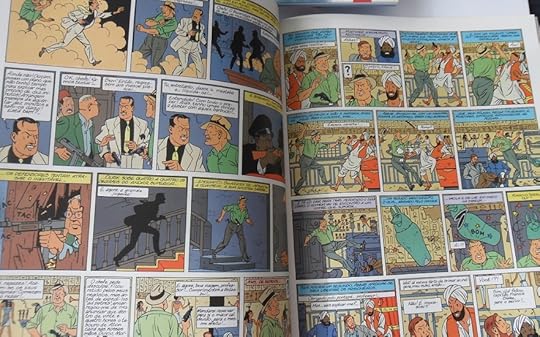
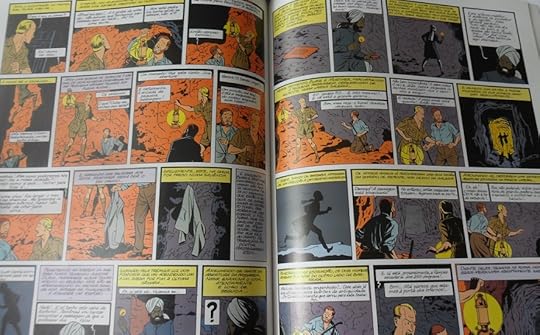
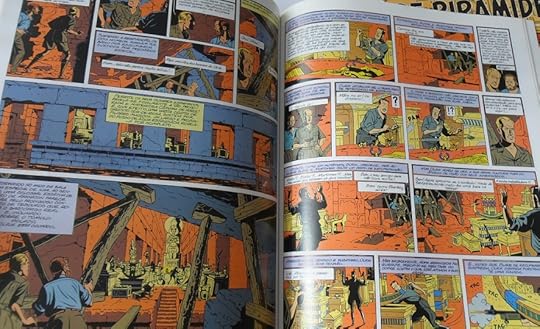
»»» A aventura: A demanda do Dr. Mortimer e do conservador do museu de antiguidades do Egipto prossegue apesar de todos os golpes sofridos, o maior sendo as notícias da morte do Capitão Blake. É nas entranhas da grande pirâmide que se começa a revelar o mistério da câmara de Hórus, mas quando Mortimer segue por túneis escuros, escondidos há séculos dos olhares menos curiosos, a descoberta do local exato da câmara e do que ela contém torna-se uma corrida contra o tempo, pois atrás dele está o antiquário vigarista e os seus homens. O esplendor das revelações da câmara e dos seus protetores, crocodilos esfomeados incluídos, trazem um culminar da aventura de cortar a respiração, onde a ajuda do Capitão Blake se revelará no momento certo.
»»» Sentimento final: Fabuloso. Fantástico a colocar-nos no centro da ação e na resolução dos mistérios da câmara de Hórus, com os cenários da mitologia egípcia a ganhar relevo. Tudo segue a um excelente ritmo, ao ponto de me ter distraído das irritantes falas gigantescas que chegam a ocupar metade de algumas das vinhetas.
»»» Nota final (capa e outras considerações): --- [Capa] – Igualmente fantástica, tal como o volume 1. --- [Desenho] – O traço mantém-se limpo, mas com o pormenor necessário a criar os ambientes da ação e nada demonstra isso melhor que o desenho da câmara de Hórus e dos seus perigos.
Synopsis: Professor Mortimer is on holiday in Egypt and pursuing amateur archeology. He stumbles on a plot to uncover an ancient chamber of the god Horus, situated beneath the largest of the three great pyramids of Giza. Arch enemies resurface to cause havoc and the race is on to ensure the bad guys don’t make off with the loot and desecrate the holy shrine. What was good about it: Jacobs was a collaborator and good friend of Herge, working in his studio, so the style and look and feel of these books are very similar to Tintin. The adventure is fun, and the story is quite factual in terms of accepted Egyptian history (I think). The artwork is lovely and the colourisatons are marvellous. What didn’t I enjoy about it: Despite being a great graphic story, it is hard to not be constantly comparing this to Tintin. It lacks the humour and charm of Tintin, and it is overly wordy. Every frame is explained and it doesn’t need to be. It’s like watching a show with the teletext function on. Overall I think the translation may have been done poorly. It’s overly melodramatic and the characters lack depth and personality.
Reli este díptico por causa da sequela que há pouco tempo foi lançada em Portugal ("O Último Faraó"), e também porque, apesar de ser das histórias mais icónicas de Jacobs, não era uma das que tenho uma memória mais definida. É engraçado voltar ao estilo de Jacobs, às vezes demasiado palavroso (quase conseguimos ler a história só pelas descrições, de tao pormenorizadas que são), mas nunca sem imaginação ou audácia (algo que falta à maioria das histórias dos autores que lhe sucederam nesta série). Lembrava-me melhor desta segunda parte, e admiro a cada prancha a perfeição da execução e da planificação - se Jacobs deve muito a Hergé por causa do estilo da linha clara, ele levou-o a um patamar de rara perfeição (o que levou ao autor de Tintin a usar o talento de Jacobs para alguns desenhos dos seus livros, mas isso é outra história). Continuo a preferir outras histórias (talvez um dia destes regresse também a elas: "A Marca Amarela" e "SOS Meteoros", e às outras também - seria giro lê-las de modo cronológico), mas esta tem muita coisa admirável.
This is the second volume of the Mystery of the Great Pyramid. In the first volume, the Papyrus of Manethon gave clues to the location of the Chamber of Horus. In this volume, the Chamber of Horus is found, uncovering untold wealth and treasure of the buried Pharaohs. Sadly for Mortimer and Blake, the treasure is guarded by a secret order, who have all sorts of magical and mystical abilities, who manage to wipe their memories of all events leading to the chamber. Worse for Orlik and his gang, their minds are wiped completely, so they forget who they are and are left to wander the desert in bewilderment.
I quite enjoyed this volume, although I felt that it could have been condensed into the first volume without too much loss of focus. I found myself looking more closely at the artwork in this volume, mainly because the plot seemed to be heading in a preconceived course. The mystical secret society was no great surprise because I found it to be well telegraphed along the way. However, I did enjoy the story and it made a nice interlude from some more heavy reading.
The plot twists and turns, and brings the narrative strands together in various ways. Again, it is clear how much Jacobs learned over these five albums.
In giving this one four stars, I am rounding up a little, but not by much, so I hope to be able to read more of the Jacobs material that followed.
There's alot wrong with these Blake and Mortimer stories, their unisexual character for one (why no women?) as well as the abundance of text, but the beautiful Tintin-school drawings make up for some of that. An extra star for the sentiment of the opposition to the 'ignominious exposure of a mummy in a museum showcase'. There is some politics at work here that do strike a chord, even though the colonial attitudes are detestable even when considered of its time.
This one is a less satisfying conclusion to the duology of the Pyramid storyline. Rather than arriving at a slightly contrived but logical conclusion with the tying of loose ends, this one decides to explain things away with literal magic. Oriental magic, as well as Jacobs' weird fascination with getting Egyptians to play the role of naïve believers of mystical things.
It is charming and entertaining. I liked it far more than the Swordfish. This volume 2 is immersive and puts into perspective volume 1, which seemed arcane and texty at first. I read with bated breath. I love how Jacobs gives Nasir significant roles. I think his Indian otherness is reduced somewhat. But the Superintendent called Nasir a Hindu. That seems baffling to me.
While Jacobs' artistic style is similar to Herge's, Jacobs writes more complex plots. He has taken the time to develop a number of characters and one gets a sense of a possible Egypt of the 1950s. The plot points are well connected with a number of twists that kept me interested and engaged.
While this reading was for research, I would seek out more of Jacobs' stories in the future.
Het tweede deel is nog beter, met meer actie en avontuur. Het einde heeft echt iets van een klassiek avonturenverhaal in het Egypte van grafrovers, schatten en vervloekte mummies.
Het tekenwerk is goed, en doet echt denken aan Kuifje. De grote tekeningen zijn echt een meerwaarde en passen beter dan in Zwaardvis.
No está del todo mal, pero pierde un bastante. Pasa de ser un cómic de aventuras con mucha base histórica, para pasar a ser demasiado fantasioso (y para eso ya tenemos a Tintín). No creo que lea más aventuras de Blake y Mortimer al menos hasta el momento.
3.3 No he leído mucho de Blake y Mortimer, pero más o menos mi crítica es igual para todos. Bien, entretenidos. Normalmente prometen más al principio, y luego las resoluciones se basan en magias o tecnologías imposibles que me gustan menos que el desarrollo de la historia.
A tedious read, but more rewarding compared to Part 1. It's mostly a Mortimer adventure just as the past one was, but the absence of Blake felt compelling. The ending was pretty satisfying after the lengthy reading, and EPJ's artwork is stunning stuff.
Une bonne conclusion à cette aventure égyptienne. J'aime bien le personnage de l'égyptologue allemand un peu loufoque. J'ai bien aimé le côté un peu fantastique de la fin de l'album. Les dessins me plaisent toujours.
This is the second volume of the Great Pyramid saga. Please see my review for the first volume. This is so far the most disappointing of the Blake & Mortimer series.
‘Belachelijk, maar die man sprak met zoveel gezag, dat ik er bijna aan zou geloven. Bij Jove, die Oosterlingen met hun magie!... Nu ja, wait and see!...’ (p. 6)
4 stars Great use of colour in the art. Still a bit wordy at times, as is this series' want. However, being the concluding volume of this story it races along at a greater pace
Le professeur Mortimer est en Égypte. Il tombe sur un complot pour découvrir une ancienne chambre du dieu Horus, située sous une pyramide. Les ennemis de l’arche ressurgissent pour faire des ravages et la course est lancée pour s’assurer que les méchants ne s’envolent pas avec le trésor. L’aventure est charmante et divertissante, l’œuvre d’art est bonne. Mais, il est trop verbeux....
Very dated, 1950-ish with the colonial attitudes of the time. Very Tintin-ish art style without the charm and humour of capt. Haddock or Thompson and Thomson. Fortunately, we have some English gentlemen to ensure the criminals are thwarted. The relief at not having to rely on Egyptian police or some Belgian can never be under-valued. :)