In 2006, world oil consumption will exceed one thousand barrels per second. The news marks an important change that will have a far-reaching impact on world economies, investments, and business profitability. In A Thousand Barrels a Second , Chief Energy Economist of ARC Financial Peter Tertzakian examines the future of oil and offers insights into what it will take to rebalance our energy needs and seize new opportunities. He answers the top questions asked by business leaders, policy makers, investors, and concerned citizens as we approach the coming break point:
This book was a struggle. It's written by a career oil guy; it is not a scientific or a technical book. It is more of a mix of mid-2000s current events mixed with a history of oil, with indistinguishable half-fact, half-conjecture commentary throughout (there are just 3 pages in the references section, and Tertzakian does not clearly delineate fact from opinion).
The author's hypothesis is that a break point is coming (remember, this is 2006) and we have to do something now, or else.
This book was published in 2006. Take a look at the graph below - Tertzakian was right in some respects; US oil patterns changed drastically just after the book was published. Due to exactly what factors, I can't say (I'm not the expert).
The key thing the book got wrong is that the US would become more dependant on foreign oil. In fact, imports peaked around 2005-7, then started falling, and the states now are once again a big energy exporter.
Because this book is anchored in 2006, it doesn't age well at all (if I'd read this in 2007, this review would likely be very different). It paints shale oil (think: hydraulic fracking) as a far future opportunity, too costly to explore now. Guess what? In the US, shale oil production went from 0.6 million barrels per day in 2005 to 5 MBPD in 2015 (source).
Tertzakian dismissed electric vehicles in a single sentence ("only 50-100 mpg" - 2017 Teslas get ~335 miles to a charge). Also, the electric grid supposedly can't handle all these electric cars - maybe this attitude is a reflection of the Enron-induced blackouts that plagued California in the late 90s and early 2000s (see: The Smartest Guys in the Room: The Amazing Rise and Scandalous Fall of Enron).
He dismissed investments in public transit infrastructure in a single sentence, citing lifestyle changes are too difficult. Carpooling and fuel taxes were dismissed for identical reasons, again in just a sentence. According to the author, the only viable solutions for reducing fuel use are lighter cars, different fuels, reduced speed, or improved engines.
I couldn't finish this book - I skimmed the last 2 chapters. It did not feel cohesive or relevant, and as another reviewer commented, it was very repetitive. While the title sounds interesting this is a book made a lot of predictions and got a lot of them wrong, and deserves to fade gently away to history.
I am not anti-oil at all - I am a realist, it is a valuable source of cheap energy. A much, much better technical book about energy (all sources) and its importance is Valclav Smil's Energy and Civilization: A History, recommended by Bill Gates. My review of that book is here. It's a tough book to recommend because some sections are quite dry, but it's ridiculously data-driven and not forward-looking or speculative (excepting a small bit in the last chapter).
هناك نسخة عربية من هذا الكتاب أصدرها مركز الامارات للدراسات والبحوث الاستراتيجية، وهو كتاب قيم يتحدث عن قصة البترول منذ البداية بأسلوب ممتع جداً، ويتطرق الكاتب لحقائق ومعلومات قد تغيب عن أذهان الكثيرين ممن يهتم بعالم الطاقة، كما يستشرف المستقبل بطريقة علمية وفيها الكثير من الحكمة والذكاء
ولا يكتفي الكاتب بالحديث عن البترول فقط، ولكنه يتطرق لأمور أخرى تؤثر في عالم النفط بطريقة مباشرة وغير مباشرة في الماضي والحاضر
أنصح الجميع بقراءة هذا الكتاب، سواء من كان مهتماً بقطاع الطاقة والنفط بشكل خاص، أو مهتماً بالاطلاع والثقافة العامة بشكل عام
Second time reading this book and despite being published in 2006 it is still a relevant read. While the authors theory of a “Breaking Point” may have been premature, the theory does make sense that it will play out at some time. We need to find ways to reduce our demand on oil before the world runs out of it. A very well researched book.
“Throughout history, because of our evolving energy needs, we’ve gone through cyclical periods of protracted demand increases, volatile tension and pressure in our supply chains, followed by a break point that ultimately provokes great innovation and change in the structure of the world’s energy sources. We call this “the energy cycle”.”
“Every economy, from the agrarian age to the modern era, uses more energy as it grows.”
“But just 150 years ago whale oil was the world’s primary illuminating fuel. Sperm whales, although rare to breach, were highly valued because their oil burned with a soft, clean light and a particularly fragrant smell. But right whales were initially the most prized catch for a simple reason; The baleen, or whalebone, found in the upper jaws could be fashioned into the ridged but flexible hoops needed in women’s corsets which were popular at the time.”
“It was left to James Millar Williams, a shrewd carriage maker from Hamilton, Ontario, to buy Tripp’s holdings and drill the first successful oil well in North America in 1858, through it did not initially go deep enough to yield much oil.”
“Our reliance on the ix of fuels is so seamlessly woven into our daily lives that we take cheap, secure, clean energy almost entirely for granted, at birthright of our modern age.”
“By the time the rubber hits the roads in our cars, only about 17 percent of the energy in a barrel of oil actually ends up making the wheels go round, much less if you are stuck in traffic.”
“Shaking an addiction, even replacing it with another substitute addiction, is never easy. It is painful. It often requires a wrenching social or government response. It generally ensures a chaotic flurry of innovation and enterprise. And it takes time.”
“Suffice to say, a tight symbiotic relationship between oil and the growth of the economy emerged after WWI and carried through the glory years of western industrialization.”
“The needs of oil were simple: it demanded a price that was high enough to be worth exploiting, yet not so expensive as to be disruptive of the marketplace. In order to maintain that equilibrium of cost, and profit, oil companies frequently needed to cooperate among each other – and an extensive and almost be wildering web of alliances grew.”
“OPEC was officially formed in 1960, in Baghdad, in part to better deal with these twin disadvantages of strong multinational companies and the U.S. protectionism, which kept the producing nations’ position strategically weak.”
“The break point triggered major rebalancing efforts in every industrialized country. The world emerged in 1986 looking far different in terms of energy use than when it entered in 1973. In many ways it emerged far better.”
“It should be noted, of course, that rising oil prices means the price of almost everything else is rising too, since our entire society – nearly everything we consume – is directly or indirectly dependent on oil and its derivative petroleum products.”
“Another big trend contributing to increasing fuel consumption has been the demographic migration from urban centers to the suburbs.”
“If things keep going as they are in the world – an aggressively expanding global economy combined with greater oil dependency, both compounding on a growing base of oil consumption – you can get a sense that it all leads to unsustainable demand scenarios very quickly.”
“Historically, oil was found by following seepages along cracks in outcropping rock formations. Exploitation of oil seepages probably goes back to prehistoric days.” Telltale signs of a region’s maturity are increasing costs to bring out the new barrels of oil as well as a peak in productive capacity.”
“Estimates vary, but the overall average global decline rate is now somewhere between five and eight percent.”
“From 1970 through 2005, the world’s oil companies have produced 868.3 billion barrels of oil.”
“The data published by the IEA is always susceptible to revisions because the supply and demand volumes don’t balance easily – in other words, supply minus demand rarely equals what is withdrawn or put into storage. There is always a balancing item, or fudge factor to account for all the oil produced, consumed, and stored.”
“The successful inventor also needed to convince financiers to bet on his idea, convince the media to amplify enthusiasm for it, convince those in political power to see a need for it, and convince customers to claim for it.”
“Historically, substitution in the energy world take a long time and there’s no reason to think the next substitution is going to happen over night. Some people mistakenly compare the rate of change in the energy world to that of the high-tech world.”
“Over the past 200 years, we have experienced a great progression of substitutions from wood all the way up to natural gas, because less carbon content means fewer harmful emissions. That is why natural gas is environmentally preferable to coal and oil. But natural gas is the end of the carbon lineage; it is the last carbon standing.”
“In fat, to completely substitute the oil-to-gasoline supply chain with one that goes from uranium to hydrogen – in other worlds, to completely switch over 230 million cars from gasoline to hydrogen – would require about 350 new nuclear power plants by my calculations.”
“Convincing people to buy smaller, light-weight vehicles is the easiest way of improving a nation’s overall fuel economy.”
“Yet, diesel engines can yield up to 60 percent more fuel economy than their gasoline counterparts. Unfortunately, diesel is still thought of in the United States as difficult-to-start engines that cause black smoke to belch out as they rattle away from a stop light. Getting people to switch to diesel vehicles – with the results of an immediate, 25 to 30 percent pickup in fuel economy – is close to being lifestyle neutral.”
As historic overview of energy it's great - 5 stars! On predictions, not too good. On economics and the role of government, not much better. For observers of any market - be it energy, metals, food or raw materials in general - the question should really only be: Do we trust the price system, or do we trust so-called policy makers? The wrong answer will always let you astray when looking forward, no matter how good you are in reciting the past. And to stay on the negative note: Much too verbose. However, I did enjoy many aspects of the book and feel better off after reading it, especially as being an energy market professional.
This book gave a great summary of our development of energy sources from wood to coal and also wax to whale oil to petroleum. Not only does it have that historical aspect, the book was written in 2005. He didn't know about the great recession in 2008 or the development of fracking. It was an interesting read and how some hiccups in our economic development have kept us from hitting a hard breaking point.
Not a technical book, gives readers a brief overview of how the energy market came to be and where it is at the moment up till 2006. Quick and easy read
The title of this book by Energy Economist Peter Tertzakian is taken from the important milestone in 2006, whereby world oil consumption passes the 1000-barrels-a-second mark. This unprecedented growth in energy consumption is fuelled partly by the rise of emerging giants China and India whose thirst for oil has broken all consumption records in recent history.
But the problem is, oil supplies around the word are dwindling rapidly. This makes it the one commodity with the most potential to flame geopolitical tensions around the world. This can be clearly seen in the invasion of Iraq by coalition forces.
One thing for sure is that oil prices will be one of the most exciting commodities to watch, both for investors and the man in the street alike.
So what does this mean for consumers, especially owners of fuel-guzzling vehicles who are already setting aside a chunk of their salaries on petrol? Will ever escalating prices mean that oil is the sure-fire investment of tomorrow?
Besides answering these questions, Tertzakian has done an excellent job charting the history of the commodity and its future in a clear and comprehensive narrative, all within the pages of a 272-page hard cover. A pleasant read overall.
Book written in 2006, some time before the financial crisis and during times of high oil prices. I find the Energy break point an interesting concept, in particular the example of oil loosing market share in electricity production between 1973-1986. Also, in the end of the book he recommends that people tend to quickly assume that oil supply won't be a problem once prices decrease i.e. the current situation. However oil demand will most likely increase on the aggregate in the coming years and 100mmbl/day is not far away.
The history part is somewhat slow and if you have read the Price there is nothing new here. Also, I would argue that Peter underestimated the impact of shale gas and oil.
A decent and interesting read about the oil industry. The author examines oil as one of the energy sources and how we use our energy sources to advance society. It would have been nice to see more in depth detail about the oil industry especially the state run companies of foreign countries. He not only addresses the problems we face with oil but provides solutions as well. Though the solutions are long term and difficult, the equivalent of biting the bullet. You do come away with a different view of the oil industry and understand why oil has gotten so expensive in such a short period of time.
The author does a good job of presenting the history of energy use and previous breakpoints (times when switching fuel sources became imperative). The book has a strong United States focus to it but still portrays a good over view of where oil is coming from around the world and who the biggest users and importers of energy are at this time. The book is well written to portray many anxiety causing issues in a manner that at times sounds hopeful and not the usual doom and gloom of books about failing oil reserves. It was very interesting to learn where oil is used the most and what that will mean for the future as oil resources get fewer and harder to find.
Finished it now. I felt that I needed to better understand our current energy crisis and get more of a specific perspective on our energy needs and how it will continue to impact our world. The author gives good background on the history of energy in the US, the scramble for the oil in the Middle East 50+ years ago, and addreses surging demand and peak oil. He also takes a look at how long before innovations would even impact the excess demand. I feel much more knowledgeable about this topic now.
ni Buku pada intinya realistis dan ngebuka wawasan gw tentang kebutuhan sumber energi yang makin sulit,,,walaupun gw belum baca tuntas...tapi ni buku bahasanya enak banget, penulis membuat uraian berdsarkan urutan sejarah jadi gak bikin bingung. gw cuma rada bingung pas ngomongin perusahaan rockefeller yang terus pecah, baru ngerti maksudnya setelah nyari di wikipedia...buku ini bukan buku yang pesimis tapi sangat optimis!
Energy evolution cycle is a useful framework to think about energy industry. easy and simple to understand. what makes this book more interesting is that the book was written in 2007, 5 years before US shale oil and gas production brings break point of energy in global market. The author vividly forecast coming break point which will force different countries to alter the structure of energy supplies and oil consumption which is happening right now.
This book gives a potted history of the oil industry, starting with the use of whale oil up to present day. As our oil reserves deplete Tertzakian predicts that our future energy requirements will be met by an array of different technology rather than the discover of what he calls a "silver bullet". An interesting read.
One of the best books I read in 2009. A well-written, insightful, interesting history of the oil industry and its impact on economics. Note that it was written in 2007 -- a pity that I read it in 2009, because he predicts, with startling accuracy, the economic crisis of 2008. Even though now 5 years old, still a great backgrounder on the topic.
This is a great book that discusses the issue of energy in the World. It does a great job explaining the challenges we face in a world dependent on crude oil. This problem is not going away any time soon.
A clear analysis of the oil supply situation. Tertzakian talks about an economic rebalancing and takes a positive view of the future as light sweet crude becomes harder to find. By far the best book on fossil fuels I've read.
If you are intersted in the energy market, in particular oil hhis is a must read. It is very pragmatic in it assessment of the future of oil and alternate energy sources. Overall positive in it's outlook, but probably not in the way most peopel would like to hear.
This is an excellent book which gives a clear analysis not only of challenges facing us regarding energy in the future, but also of the history of energy to date. Easy for the layman to understand.
Does anyone proofread anymore. The author is exceedingly repetitive. He repeats concepts, sentences, points, etc. This book would be a third shorter if all the repetitions were removed.




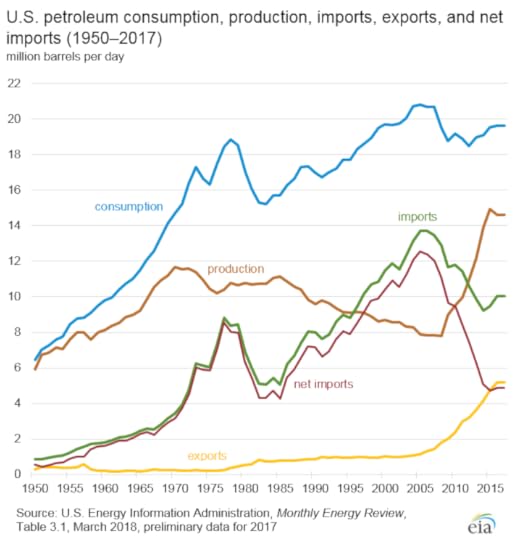 (source)


