Jump to ratings and reviews
Rate this book

The Smile

Rate this book
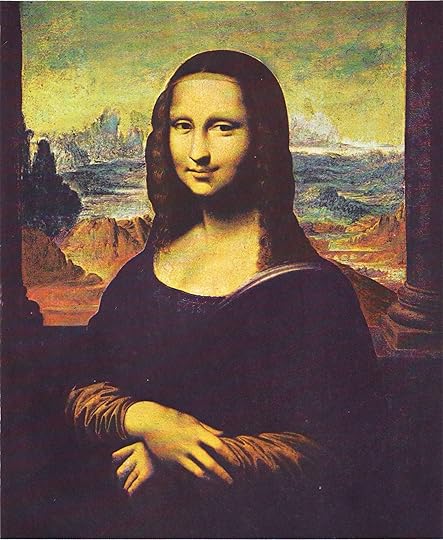
In 2061, in a world ravaged by war and filled with hatred for the past, a young boy is present at the destruction of the Mona Lisa.

32 pages, Hardcover

First published June 1, 1952

8 people are currently reading
232 people want to read

About the author

Ray Bradbury

2,556 books25.3k followers
Ray Douglas Bradbury was an American author and screenwriter. One of the most celebrated 20th-century American writers, he worked in a variety of genres, including fantasy, science fiction, horror, mystery, and realistic fiction.

Bradbury is best known for his novel Fahrenheit 451 (1953) and his short-story collections The Martian Chronicles (1950), The Illustrated Man (1951), and The October Country (1955). Other notable works include the coming of age novel Dandelion Wine (1957), the dark fantasy Something Wicked This Way Comes (1962) and the fictionalized memoir Green Shadows, White Whale (1992). He also wrote and consulted on screenplays and television scripts, including Moby Dick and It Came from Outer Space. Many of his works were adapted into television and film productions as well as comic books. Bradbury also wrote poetry which has been published in several collections, such as They Have Not Seen the Stars (2001).

The New York Times called Bradbury "An author whose fanciful imagination, poetic prose, and mature understanding of human character have won him an international reputation" and "the writer most responsible for bringing modern science fiction into the literary mainstream".

Ratings & Reviews

What do you think?
Rate this book

Friends & Following

Create a free account to discover what your friends think of this book!

Community Reviews

5 stars
98 (33%)
4 stars
106 (35%)
3 stars
70 (23%)
2 stars
18 (6%)
1 star
4 (1%)
Displaying 1 - 20 of 20 reviews
Profile Image for Diane S ☔.
4,901 reviews14.6k followers
April 28, 2015
The world has horribly declined, things of beauty are no longer appreciated but blamed form the world's downfall. But leave it up to a young boy, just loved the last image.
Profile Image for Bettie.
9,976 reviews5 followers
April 23, 2015


http://www.bbc.co.uk/programmes/b05r7...
Description: 4 Extra Debut. In a post-apocalyptic city, any semblance of past beauty is viewed with derision. Read by Peter Whitman.


I found a better synopsis: The main character of this story is Tom, a little boy who joins a group of people who are quering in front of a museum to spit on an oil painting belonging to the past, called the "Mona Lisa" by Leonardo da Vinci. People live a hard, difficult life and hate every aspect of the past of the past civilization which caused the nuclear war to break out destroyed their lawful haritage of progress and welfare. Tom is curious and he is quering up to see the portrait because they say it smiles. Tom likes going to festivals where remnants of the past are destroyed, concerning art, science, culture, and technology, but he is not so enraged with hate as the others are. When Tom sees the painting he finds the woman beautiful and he cannot take his eyes away from her smile. Suddenly, the people start destroying the painting and rip it into small pieces of canvas, behaving in a beastly, violent and wild manner. Tom gets a piece of canvas: the Mona Lisa's smile to preserve it from destruction. It was beautiful, warm and gentle and it produced in Tom feelings of affection, beauty and quietness. The smile is personified because it's the only expression of humanity in Tom's life. Source

Almost prophetic in nature - isn't the destruction of the past exactly what those terrorists are doing today?



Profile Image for Laura.
7,137 reviews606 followers
April 23, 2015
From BBC Radio 4 Extra - 4 Extra Debut.
In a post-apocalyptic city, any semblance of past beauty is viewed with derision. Read by Peter Whitman.
Profile Image for sonysakura.
3 reviews
December 18, 2016
This is more an analysis than a review, lots of spoilers, but why not. I rather like it.

The Smile is a short story written in 1952, a year before Fahrenheit 451, which it shares a few ideas with. This story is set in the post-apocalyptic future (year 2061), where the last “bits and pieces” of civilization are destroyed by humanity itself: books are burned, plants are blown up, cars are smashed and art works are spit on and torn. Like in Fahrenheit 451 there is though a person who feels the wrongness of all this destruction. His name is Tom and he’s a child standing in a queue to see a picture. The queue is a long one, and there are four policemen and a rope not to let people get too close…

It is significant that the picture is Leonardo da Vinci’s Mona Lisa (or, at least, a reproduction of it) to see which in our time you have to force your way through the crowd and face the same rope and the bulletproof glass. The only difference is in the way of appreciating Mona Lisa. In Bradbury’s future everyone in the queue is waiting their chance at spitting at it. And this is how the story opens. Early morning, the vision of ruined town, the long queue and a barefoot boy waiting in it. The exposition lets the reader see that the world went through something awful, creates an atmosphere of despair and also introduces us to two characters. The first one and the main one is the boy, Tom, the second one is a man ahead of him in the queue who’s named Grigsby. The story unfolds gradually through their conversation. We’re told in what state the world is, though not what exactly happened to it, we only know that humanity itself led it to this state (we can guess that it was a nuclear war) and now people shifted the hate for the people who ruined the world (“the people in Past” they call them) to the remains of civilization they had. Present people call the destroying of these remains “festivals” and mostly don’t find anything wrong with it. And so the climax of the story is Tom seeing Mona Lisa, awed and unable to spit, frightened when it’s getting torn to pieces by the mob. Tom tears off a piece of canvas himself in a desperate attempt to save something. And it is the famous smile, lovely and beautiful, warm and gentle. The resolution of the story gives hope to a reader that if there is one person like Tom, there could be more, the world is not lost yet. And the last line “…and the moon sailed up and then down the cold sky towards morning” makes it look like a beginning of something, a morning of a new world.

The Smile is quite rich stylistically. A few graphical stylistic devices used such as italic type to emphasize the intonation (“she smiles”, “do I remember?”, “she’s beautiful”). Closer to the end of the story this device is used in combination with capitalization (“the Smile, the lovely Smile”) to further emphasize how important this smile is to Tom. And it also adds to personification expressed by such words as “warm” and “gentle”. Personification in this story is also expressed through calling a picture “she”. Mona Lisa is always “she”, which makes her smile more real and her “death” more frightening. As for other lexical stylistic devices the ones present are: metaphor (“Grigsby spat and the missile flew”), simile (“roads like jigsaws from bombs”, “their hands like hungry birds pecking away at the portrait”), metonymy (“the line fell silent”), hyperbole (“with our guts plastered to our spines”)… All of these are either used to add expressivity to characters’ speech or to achieve fresher style. On the phonetic level there is direct onomatopoeia (“Crash!”, “Wham!”). As for syntactical stylistic devices there is for example the sentence “Got my place in line, I have”, which is probably a mix of inversion (“I have got my place”) and ellipsis (“Got my place in line”).

The story is rather interesting and makes us think. First of all, it creates the same thoughts Fahrenheit 451 does. This idea, that humans are ready to hate what they don’t understand, and destroy what they hate, makes The Smile sad and evokes fear for the future. But it also creates hopeful thoughts, as it was mentioned above. To me, personally, it is also a story about forgiveness. People hate their past, the past they don’t understand anymore… Tom forgives. He may not know about it, but that’s what he does. He forgives the past for the Smile.
Profile Image for Shaim❥.
41 reviews6 followers
May 12, 2023

"The Smile" is a thought-provoking and powerful short story by Ray Bradbury. Set in a post-apocalyptic world, the story follows a young boy named Tom as he waits in line to view the Mona Lisa, which is the only remaining piece of beauty in a world filled with destruction and hatred. As each person before him spits on the painting, Tom finds himself unable to do the same. Instead, he is struck by the painting's beauty and utters the simple phrase, "She's beautiful!"

Bradbury's message is clear - even in a world filled with ugliness and despair, beauty and hope can still be found. Tom represents the youth and innocence of a world that has been robbed of its beauty and innocence. His appreciation for the painting is a reminder that even the smallest amount of beauty and goodness can make a difference in a world consumed by hatred.

The story is beautifully written and poignant, and it leaves a lasting impact on the reader. The theme of hope in the face of despair is a powerful message that resonates with readers long after the story ends. Overall, "The Smile" is a wonderful read that is sure to leave readers with a newfound appreciation for the power of beauty and hope.
Profile Image for Anna.
42 reviews5 followers
January 24, 2021
Leaving aside my personal scepticism for authors that write in the genre of fantasy and science fiction. Leaving aside my personal discontent with Fahrenheit 451 — and giving all the kudos to Bradbury for this short work, yet as piercing and poignant as many novels fail to be. I remember reading it firstly in the age of 12 and just weeping uncontrollably with the image of spits on Mona Lisa in my mind. Highly recommendable for everyone who notices the aesthetic side of life.
Profile Image for Rob Thompson.
757 reviews44 followers
January 18, 2026
⭐️⭐️⭐️⭐️⭐️ (4 / 5)
A Small Story with a Lingering Echo

Some stories take only a few pages to leave a permanent mark.

The Smile is one of those rare pieces of fiction that lodges quietly in your mind and refuses to leave.

If you’re drawn to short speculative fiction that feels like a reflection rather than a spectacle, this will hit the right note. Bradbury’s writing is restrained but emotionally precise, and the story’s themes of memory, beauty, and cultural loss are hauntingly timeless.

The prose is deceptively simple, yet loaded with meaning. It doesn’t explain everything, but it doesn’t need to—Bradbury trusts the reader to sit with the imagery and implications.

It’s short but powerful, and the emotional impact lingers long after the final line.

A smart, engaging read that lingers longer than expected—well worth your time.

5 reviews
July 25, 2022
The only modern and sci-fi work that we covered in foreign literature class. A story that covers a lot of serious subject in a way appropriate for young children.
Since it also short and fun (who doesn't find a green glowing field to be cool at nine) it's a good book to use in schools.
Profile Image for Phil Giunta.
Author 24 books33 followers
February 19, 2023
In a post-apocalyptic world where remnants of the past are viewed with disdain, Leonardo Da Vinci’s most famous painting is turned over to the masses to be destroyed—but one boy finds comfort in Mona Lisa’s smile and does what he can to preserve her.
Profile Image for Forked Radish.
3,875 reviews83 followers
May 8, 2024
Bradbury anticipated the idiotic, woke, future very well… Luckily, it was only a copy.
Profile Image for Claire.
817 reviews368 followers
June 10, 2012
Picked this up on a tribute display shelf at the library today, I haven't read him before, so this hardback short story seems a fitting introduction.

An appropriate introduction and a pleasurable philosophical work of the seeds of optimism that remain even when it appears that things could not be worse in a post apocolyptic society.

Will be looking out for Farenheit 451 now.

You can read my review at 'Word by Word'
Profile Image for Kate.
4 reviews8 followers
January 23, 2014
This book was so bad it doesn't even deserve one star.
Profile Image for Sigal.
272 reviews
December 31, 2014
(3.5) Gracias a la profe Mabel por mostrarnos este lindo cuento ;_; (? <3
Profile Image for Sara.
467 reviews
Read
May 3, 2015
BBC radio adaptation.
Profile Image for Emma.
591 reviews12 followers
August 28, 2017
A short story that encapsulates the decline of art and civilisation in a near future where technology, reading and beauty are destroyed and the populace kept low.

A chink of hope, the smile endures in a child's heart and mind.
Displaying 1 - 20 of 20 reviews

Can't find what you're looking for?

Get help and learn more about the design.