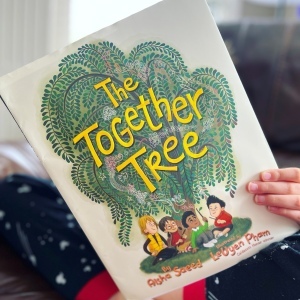
All Are Welcome meets Be Kind in this poignant and accessible picture book about the power every bystander—no matter how small—has to extend kindness and stand up in the face of intolerance.
At his new school, quiet Rumi feels small and unwelcome, and a few kids bully him for being different and wearing bright shoes. He finds refuge beneath the old willow tree by the playground and builds his own world of hope and dreams of belonging.
One day, when Rumi is made a target again, one of his classmates bravely steps in to defend him. It’s in that moment of solidarity Rumi’s class finally realizes that under the shade of the willow tree, all are welcome, and they create a space they can all play in—together.
Read this book for my toddler's bedtime. Rumi is a new kid in the new school. Just moved from the other side of the US. At recess he sat by himself under the willow tree with a twig in his hand. His classmates play together at recess while he reminisces about his friends from back home. It took time for Rumi to make friends with the students in his new class. What sparked their attention was the thing Rumi did with his twig under the willow tree. Good illustrations and good story. I hope when kids read this book, they will learn to see how bad bullying can be. The bully gets punished.
Thank you Salaam Reads and Simon Kids for the opportunity to read and review!
Wow, what an incredible book! The more I read it, the more I reflect on it and appreciate it and my heart is just melting by the end!
Genre: Picture Book Ages: 4-8 Author: Aisha Saeed Illustrator: LeUyen Pham Publisher: Salaam Reads/ Simon Kids
Rumi has moved to a new school from San Francisco. He misses his friends and life, and it doesn’t help when one of the kids, Asher starts making fun of him. But when an incident goes too far, other kids step up to see how Rumi is feeling and Asher feels horrible for what he did. But under the together tree, Rumi takes a leaf of forgiveness to give to Asher, And they all build a beautiful world out of sand together❤️
Ahhhh can you tell I am in love!
The sweet beautiful sparse text just goes hand in hand with the soft gentle colors of the art to deliver a gorgeous soft message about kindness and inclusivity, a message of acting against bullying, of making friends, and of forgiveness and unity.
The art was truly absolutely mesmerizing! The colors disappeared when the bad incident happened- and Asher became washed out when he was feeling guilty-showing that true color is when kindness and friendship is infused in the world. The drawings and tree art everywhere also made me smile and appreciate every little intricate detail.
Truly a gorgeous book and one that I predict will win awards!❤️
Sandra says: Being the new person, it can be difficult to know how to fit in. Rumi, a new student from San Francisco, started a new school and had a hard time making friends. When his classmate, Han, notices Rumi is getting bullied and isolates himself under a large tree, Han steps in to be his friend and play with him. Han realizes Rumi has created a world of art under the tree and invites all his classmates to join under the tree and play together. Han's bravery shows that kindness is one of the most powerful things you can show someone.
This review was originally written for The Baby Bookworm. Visit us for new picture books reviews daily!
Hello, friends! Our book today is The Together Tree, written by Aisha Saeed and illustrated by LeUyen Pham, a heartfelt story on bullying, understanding, and forgiveness.
When Rumi starts at his new school, he feels nervous and isolated; he misses his friends and former home of San Francisco, and is having trouble finding his place in this new class. This is worsened when two of the other students begin to bully him, and a third watches without intervening. Every recess, Rumi retreats to a sheltering willow tree to avoid interaction – and harassment – until the day that the bullying goes much too far. At last, classmate Han stands up for Rumi, and the newcomer begins to make friends. Yet when Rumi is given the opportunity to exclude his former bully, will he?
Compelling. Saeed’s narrative is measured and emotional, delving into each character’s motivations in just a few words, or one of Pham’s expressive illustrations. I like especially that the bullies are not portrayed as irredeemable villains, but as fellow children who are just as capable of empathy as they are of cruelty; the moment that one of Rumi’s bullies, Asher, realizes that throwing a rock at the other boy and causing physical damage has caused pain and shame for both of them, is subtle yet striking. Pham uses color and grayscale to enhance the already wonderful visual storytelling, the length is fine for all ages, and JJ greatly enjoyed the moral of the story. Overall, a lovely and touching book that reminds us of the power of empathy, and it’s Baby Bookworm approved!
(Note: A copy of this book was provided to the Baby Bookworm by the publisher in exchange for an honest review.)
This is a book about bullying. Some treat the student poorly just because he doesn't join the group. But then one child takes a chance and says hey, let's play together. And what happens in this book, though I can tell you it doesn't necessarily happen in the real world, is that the other kids want to join in, too. I like this as a different solution than just telling an adult. You can solve it yourself as a child, sometimes.
Easy to understand story about bullying and friendship, and especially standing up for kids who may be picked on. The illustrations are beautiful. A great classroom book.
This book is a great conversation started for young kids. It addresses bullying, bystanders, and reconciliation in an age appropriate way. Adults can learn from it too.
Read this with my son and was grateful for how it gave us a chance to talk together about so many things. What do you do when you see someone being bullied? How can you help? What if you are scared? What do you do if you are the one being bullied? What do you do if someone new comes to your classroom? What if someone looks different than you or acts differently than you? What does it mean to be a friend? He really loved the pictures and we took a long time looking through the book and pulling different details out. So thankful for books like this.
More than a book about bullying, this story also shows the ease with which forgiveness can take place. Pham's special illustrations make this book a winner.
Being the new kid, not having friends, and being teased are not new themes in literature (or life), so if you are going to write a book about them, take a lesson from Muslim author Aisha Saeed and make sure the story is heartfelt, emotional, and well-told. There is no Islam in the book, no foreign culture, or teasing because of skin color, it is a boy named Rumi who has moved from San Francisco to the other side of America and his shoes, with their drawings and colorings, that cause the kids to stare and start bullying. Rumi seeks solace under a willow tree and fellow classmate Han has to be brave to put a stop to the mistreatment by finding his voice and not simply staying silent. The text and illustrations provide a lot of opportunities for children to see themselves in the story, in the various characters, and ruminate over the actions and feelings from different points of view. The book is lyrical, it is not heavy handed or preachy, and the Author's Note at the end is equally touching and hopeful.
Rumi is quiet, and on his first day in Ms. Garza's class the kids stare at him as he stares out the window. At recess he wanders off to sit beneath the willow tree when Asher, Ella and Han leave the swings to see what he is up to. Asher and Ella start to make fun of Rumi, Han is uncomfortable, but stays quiet.
Rumi recalls coloring his shoes with his friends, and how different it was to where he is now, he picks up a twig to twirl as the hurt grows. In music class when the giggling starts, he tries not to cry. At recess he retreats to his refuge under the tree.
When the bullying escalates, and tears fall, Han speaks up and breaks the cycle. Others follow and see the world Rumi has created with his twig and are drawn to it and to Rumi. Forgiveness is asked for, and granted and the tree becomes a place of friendship and togetherness.
The Author's Note shares the real life observations of the author about her son in kindergarten and how while heartbreaking, there was also hope in the concern shown by other kids that simply weren't sure what to do. I love that even though Rumi is being teased for his shoes and being different, he doesn't stop wearing his shoes or try and clean the drawings off.
I think this book is a must read in classrooms and homes were kids can slowly peel back the pieces and see where they can relate, how they can plan to act, and what parts they identify with. The book is deliberate and slow, and while a child could read it on their own and enjoy the story and illustrations at hand, the real power it has, is being a catalyst for discussion and empathy and speaking up.
The Together Tree is a beautiful story that portrays how kids can extend kindness to others through presence.
In the Author’s Note, Aisha (the author) shares how her son was bullied because of his reserved nature and the color of his skin. The day after her son finally told her what was happening, Aisha visited his school during recess. She observed the bullying, but also how the other children looked on. Despite their concern they didn’t know what to do. Unfortunately, this isn’t an isolated incident. Acts of intolerance happy frequently from coast to coast, with adults and children alike succumbing to the bystander effect and waiting for someone else to take action. In The Together Tree, Aisha shares what children can do when they see acts of intolerance (in addition to telling a trusted adult): reach out to the person who is hurting and offer presence.
Han represents the concerned bystander who can see that something is wrong: Asher is saying mean things to Rumi, and Rumi doesn’t look happy about it. But Han lacks the tools to know how to respond, so he simply observes. I think that many readers, no matter their age, will relate to Han. We observe social injustices and unkind acts, we know that something is wrong, but we don’t know what steps to take to correct it. We may even wish that someone else would act for us. Only after Asher takes things too far—and no one else intervenes—does Han snap out of his state of paralysis.
Here, Aisha offers a solution: Han (and we the reader) can reach out to the one who is hurting and offer our presence. That simple act makes a huge difference. By offering presence, Han begins the healing process—for Rumi, for Asher, for the entire class.
I love the symbolic imagery of the willow tree with its outstretched branches providing a safe space: first, for Rumi in his loneliness and hurt, and later for the children as they come together. The joyful doodles—hearts, butterflies, rainbows—add a lovely touch that communicates the children’s joy and peace when they play together. LeUyen Pham is a talented artist. She has beautifully rendered the children’s emotions and the ambiance of the story. It is always a pleasure to watch her art bring a story to life.
I will be sharing this book with young readers and adult friends alike!
When Rumi moves to a new school, he is sad about the move and keeps to himself. He is somehow different from the other children, who seem willing to befriend him, but spends his time during recess apart from the group. When a Asher makes fun of him, Ella laughs, but Han looks on in unease. Because the children don't really know Rumi, they aren't quite sure how to stick up for him when Asher continues his bullying. When Asher throws a pebble at Rumi and hurts him, the children see the injustice and are finally pushed out of their complacent acceptance of Asher's actions. Han checks on the new boy and invites him to play with him. The other children see that Rumi was drawing beautiful pictures, similar to the ones on his shoes that were an object of ridicule, and the children start to draw with Rumi. The class is getting along better, but Rumi sees that Asher is now setting himself apart. Knowing how this feels, Rumi suggests to his classmates that they go play inside so that Asher doesn't feel excluded.
There is an author's note stating that the author's son had a somewhat similar experience, and that she thought a book modeling positive behavior might help children learn how to treat each other better. This is a great idea; I think as adults we frequently forget that this sort of behavior needs to be taught; not all children pick it up naturally.
The real draw here are Pham's illustrations; even though Rumi is shown looking very dejected, with a cloud of drawings lingering around him, there is something about Pham's illustrations that always look joyous, even with dark backgrounds and sad topics. She is also great at drawing characters from a variety of cultural backgrounds, and the chalk-like drawings surrounding Rumi add an extra layer of interest to the pages.
Books about being kind to each other should be included in frequent rotation in every child's list of books, and this one is a great one to add to Barton's The Invisible Boy, McAnulty's A Small Kindness, and Amy Wu and Zhang's Amy Wu and the Warm Welcome.
Book provided by publisher in exchange for an honest review
Rumi is the new student in class who seems to be different from his classmates. Rumi is quiet and enjoys spending time near a tree on campus imagining himself fitting in with everyone else. The other children begin to bully Runi simply because he has brown skin and colorful shoes. What they don't know is that Rumi is imaginative and talented, creating pictures in the sand beneath the tree.
Despite facing bullying from his classmates, Rumi perseveres and eventually earns their respect and friendship through his kindness and creativity. It also helps that one student finally speaks out against the bullying of Rumi, making it easier for the other kids to back off and realize their behavior was making Rumi very miserable.
The illustrations bring The Together Tree to life, creating a rich and colorful world for readers to get lost in. This book is an excellent reminder that it's never too late to make new friends and that kindness and understanding can go a long way. A must-read for young readers and anyone who has ever faced adversity or bullying.
I like that the author not only included the bystanders of the bully, but also treated their behavior as equally important in the storyline.
This was a library book that I have returned, so my review is based on the impression it left with me. There is a moment when Asher goes too far. He realizes it, and so do his classmates. And Rumi's classmates may have gathered around him in support simply for that reason. Or to admire his shoes and ask about his previous school. Instead, the author wants to "surprise" us with the fact that Rumi wasn't just twiddling a stick under the tree, he was creating a masterpiece! Why so much emphasis on Rumi's drawing skills? If he didn't have that talent would his classmates still have befriended him en masse under the tree? Are you a lesser person for simply sitting under a tree: reflecting, twirling a stick, because you are in a strange, new, and occasionally antagonisctic environment?
Full disclosure: I despise the song "Rudolph the Red Nosed Reindeer" because he was ostracized until he saved the day. Only then did all of the other reindeer love him.
“The Together Tree” is a picture book written by Aisha Saeed and illustrated by LeUyen Pham that captures two of the hardships that some young children (and even teens) may face. In this relatable tale, Rumi is the new kid in class. While the other students stare at Rumi, he decides to focus his thoughts to outside the classroom. When it comes time for recess, Rumi sits by himself under a tree while the other kids play. But instead of being left alone, some of his classmates decide to make fun of him and his shoes! What the other kids don’t know is that Rumi had painted and drawn on them with his old friends. “The Together Tree” depicts what being bullied feels like and what to do when you see another kid going through it. Not only does the book explain in depth, but it also makes it easy for younger kids to understand with easy sentences illustrated by vibrant drawings. Children who see this book with will likely want to read it more than once.
Rumi moves from San Francisco to a new school on the East Coast. He feels small, unwelcome at his new school and is bullied for being different and wearing bright shoes. He finds solace beneath an old willow tree in the schoolyard until one child approaches Rumi to play.
The Together Tree explores inclusivity, empathy, bullying, and forgiveness themes. It encourages children to think about feeling different or unwelcome and how acts of kindness can change these emotions.
Discussion Questions: 1. How does Rumi's experience at the new school make him feel? 2. Why do you think the other kids bully Rumi? How would you react if you were in his situation? 3. What role does the old willow tree play in Rumi's experience at the new school? 4. Can you think of a time when you felt different or unwelcome? How did you cope with those feelings? 5. What small acts of kindness could you practice at school? 6. How does the story illustrate the impact of these small acts of kindness?
Yes, my first book of the year is a children's picture book, but it was a great perspective that I'm glad to start 2024 with. The Together Tree portrays the anxiety of being the new kid and describes a situation of bullying in which Rumi, the new student, is teased for his shoes and being different. When the students, who once looked on during the mean actions of Asher, step in and decide to play with Rumi under the big willow tree, they find friendship and acceptance with one another. As the other kids in class all started playing with Rumi and Asher is left out, Rumi decides to go to Asher to invite him to play with the other kids. It is an important lesson to have empathy for others and Rumi displays that beautifully in this well-illustrated book. Empathy and treating others the way you want to be treated in return are the exact ideas that should be embodied by everyone, no matter their age.
This entire review has been hidden because of spoilers.
This was a good picture book that can help teach kids about empathy, loneliness, and bullying. Rumi is a new transfer student who struggles to fit in. He's quiet, and missing his friends, and very lonely. The other children mostly ignore him, but there are three in particular that are pointed out. One bullies him, the other laughs, and the third does nothing. When the bullying goes too far, things start to change.
I get that this book is for young children, and I did like the message that the bullying child was not ignored/bullied by Rumi in turn, but I kind of wish more had been done about the child that laughed about the bullying. Although she didn't bully Rumi herself, her laughing about it was part of the reason why the most antagonistic child kept escalating.
Even so, I do think it was a good book as an intro to the topic. The art was beautiful, and used well to depict the mood of various characters. I also liked the themes of acceptance and forgiveness.
I received an electronic ARC from Simon & Schuster Books for Young Readers through SLJ Picture Book Palooza. Tender and powerful message about inclusion and making someone feel welcome. When Rumi joins Ms. Garza's class, he feels alone. None of his classmates reach out to make him feel welcome. Sadly, a couple of them make fun of him on the playground and continue during classes. It' only when a classmate throws a rock and hits Rumi, that others stop being silent and reach out. The one young man then realizes what an amazing artist Rumi is. He is blended in to play with everyone and be part of the group. However, he notices that the one who bullied him is sitting alone in the classroom. Rumi reaches out and includes him too. Wonderful book to read at the beginning of the year when bonds are forming. A terrific reminder when needed throughout the year too.
First sentence: Rumi joined Ms. Garza's class on the first warm day of spring.
Premise/plot: Rumi, the new student, is bullied by his classmates. He spends his time during recess drawing underneath a tree. Soon he's not alone. It doesn't happen over night, nor quickly enough for Rumi, perhaps, but unlikely friends can become good friends.
My thoughts: This is a picture book that addresses bullying AND reaction to bullying. The focus isn't so much on the person bullying and the person being bullied as it is the bystanders who witness bullying situations.
This is a message-driven book. Unfortunately, bullying continues to exist in this world despite all the calls for kindness and compassion. Still every book that promotes kindness and compassion is welcome.
I liked this one. The illustrator has long been one of my favorites.