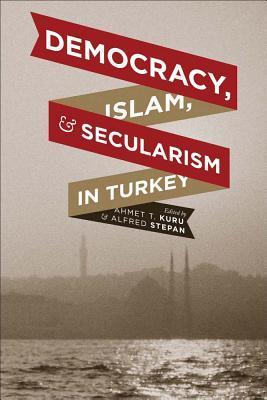
Written by experts in a range of disciplines, the chapters explore the toleration of diversity during the Ottoman Empire's classical period; the erosion of ethno-religious heterogeneity in modern, pre-democratic times; Kemalism and its role in modernization and nation building; the changing political strategies of the military; and the effect of possible EU membership on domestic reforms. The essays also offer a cross-Continental comparison of "multiple secularisms," as well as political parties, considering especially Turkey's Justice and Development Party in relation to Europe's Christian Democratic parties. Contributors tackle critical research questions, such as the legacy of the Ottoman Empire's ethno-religious plurality and the way in which Turkey's assertive secularism can be softened to allow greater space for religious actors. They address the military's "guardian" role in Turkey's secularism, the implications of recent constitutional amendments for democratization, and the consequences and benefits of Islamic activism's presence within a democratic system.
Table of Contents
Introduction, by Ahmet T. Kuru and Alfred Stepan
1. Rethinking Ottoman Management of Diversity: What Can We Learn for Modern Turkey, by Karen Barkey
2. The Historical Roots of Kemalism, by M. Şükrü Hanioğlu
3. Turkey—Plural Society and Monolithic State, by Ergun Özbudun
4. Laïcité as an “Ideal Type” and a Continuum: Comparing Turkey, France, and Senegal, by Ahmet T. Kuru and Alfred Stepan
5. A New Politics of Engagement: The Turkish Military, Society, and the AKP, by Ümit Cizre
6. The Turkish Constitutional Court and Political Crisis, by Ergun Özbudun
7. Turkey’s Accession to the European Union and the Role of the Justice and Development Party, by Joost Lagendijk
8. The “Turkish Model” in the Matrix of Political Catholicism, by Stathis N. Kalyvas
Ahmet T. Kuru (Ph.D., University of Washington) is the director of Center for Islamic and Arabic Studies and Professor of Political Science at San Diego State University. He was a postdoctoral scholar at Columbia University. Kuru is the author of Secularism and State Policies toward Religion: The United States, France, and Turkey (Cambridge University Press, 2009), which received Society for the Scientific Study of Religion (SSSR)'s Book Award. He is also the co-editor (with Alfred Stepan) of Democracy, Islam, and Secularism in Turkey (Columbia University Press, 2012). Kuru's articles appeared in various journals including World Politics, Comparative Politics, and Political Science Quarterly. His recent book, Islam, Authoritarianism, and Underdevelopment: A Global and Historical Comparison (Cambridge University Press, 2019) received the American Political Science Association's International History and Politics Section Award, France's Académie des sciences d’outre-mer Louis Marin Award, and honorable mention of SSSR's Book Award. It was also selected as a Times Literary Supplement Book of the Year and has been translated into Indonesian, Arabic, Persian, Bosnian, Dutch, French, German, Malay, Urdu, Bangla, and Hindi.
laïcité in French is usually translated as secularism in English but there seems to be significant difference in practice. In this extended academic article(s), Kuru and Stepan examine them in two categories, “assertive secularism” as implemented in France and “passive secularism” as practiced in the US. The difference is not just in separation of church and state, but also in freedom of religious acts and symbols in the public space. In the case of Turkey that is a bit more complicated considering various Islamic sects stance against democracy and also government religious council still controlling all the mosques and their staff for the majority sunni sect. Kuru finds the Turkish case closer to the French assertive secularism and points out conservatives and some liberals want a more passive secularism. He also considers the impact or lack of an “ancien regime” resulted in the US with a passive secularism as opposed to France. After the last two decades the author probably would want to revisit some of his findings for all three countries. I would appreciate a more readable revised edition maybe with a wider comparative analysis including other countries. Considering the rise of populist authoritarianism, I think all democratic societies need better understanding and practice of secularism now more than ever.
Good info, I appreciate its discussion into the background of Kemalism.BUT there’s just so many gaps between the chapters and lack of mention of humanitarian issues that have been/are prevalent is a no from me.
This book gave me great insight into politics and religion in the Republic of Turkey. I really enjoyed reading from a variety of authors, and the wide range of ideas they brought to the topic. That being said, the book was very political and should not be considered a light read. If you want to know about the political situation in Turkey and how it has been for the past 100 years, this is a very good read