When Travis McGee discovers a face from his past lying in a pool of blood on a cheap motel room floor, he wants answers. But so far, all he has are questions--plus the dubious inheritance of his friend's vengeance-driven girlfriend, and a valuable ancient Aztec golden idol. Part rebel, part philosopher, and every inch his own man, Travis McGee plunges into a wild and perilous trek for a killer that takes him from the Lauderdale beaches to the seething corruption of American expatriates in a distant Mexican town, to the lush high life of the California jet set.
John D. MacDonald was born in Sharon, Pennsylvania, and educated at the Universities of Pennsylvania, Syracuse and Harvard, where he took an MBA in 1939. During WW2, he rose to the rank of Colonel, and while serving in the Army and in the Far East, sent a short story to his wife for sale, successfully. He served in the Office of Strategic Services (O.S.S.) in the China-Burma-India Theater of Operations. After the war, he decided to try writing for a year, to see if he could make a living. Over 500 short stories and 70 novels resulted, including 21 Travis McGee novels.
Following complications of an earlier heart bypass operation, MacDonald slipped into a coma on December 10 and died at age 70, on December 28, 1986, in St. Mary's Hospital in Milwaukee, Wisconsin. He was survived by his wife Dorothy (1911-1989) and a son, Maynard.
In the years since his death MacDonald has been praised by authors as diverse as Stephen King, Spider Robinson, Jimmy Buffett, Kingsley Amis and Kurt Vonnegut, Jr.. Thirty-three years after his passing the Travis McGee novels are still in print.
“I hoped she was taken dead so quickly she was given no micro-second of the terrible reality of knowing she was ended.”
If ever there existed a book within a series which makes you realize as a reader that the series is something really special, this is it. You realize as you read A Deadly Shade of Gold that the Travis McGee series is more than the sum of its parts, and better than almost any other series in the genre ever written. This is the entry where you can visibly see on paper, and almost tangibly feel in your bones the series transforming from something very good, into something for the ages, worthy of being placed in a time capsule for generations hundreds of years from now to discover.
“She loved her tropic sea and it had killed her dead, in the hot blazing days of August.”
All John D. MacDonald had promised in the very good Deep Blue Good-bye was delivered on in this fifth book in the famous Travis McGee series. The lengthiest entry of the entire series is involving, insightful, violent, and yet resonating. It preceded Bright Orange For the Shroud and Darker Than Amber, making it the finest three-book stretch of the series until decades later, when we got Free Fall in Crimson, Cinnamon Skin, and the final Travis McGee, The Lonely Silver Rain.
I’m going to use a lot of quotes this time around, but I’m not really spoiling anything for anyone, because frankly, you can pretty much find something quote-worthy every two or three pages. And the story is so complex, so full of characters and motivations, there really isn’t a spoiler attached. As I mentioned, this is MacDonald taking the series to new heights, and it’s a stunningly good read. The body count is incredibly high here, yet the narrative is so rich and resonating, so filled with insight, it masks just how much life is lost in this one. McGee does actually take a body count as he lays wounded near the end of the book, and reaches ten. But the dying isn’t over yet.
A Deadly Shade of Gold is one of the Mexico stories, which seemed an extension of Florida, and McGee. Nothing was lost by taking McGee out of his Ft. Lauderdale environment in the Mexico entries. He’s in New York for a spell, and Los Angeles, but you can feel rural Mexico in this one:
“At sea level the heat was moist, full of a smell of garbage and flowers, and a faint salty flavor of the sea.”
“Unpaved streets of mud and dust, some clumsy churches, a public square with a small sagging bandstand, naked children, somnolent dogs, snatches of loud music from small cantinas, scores of small weathered stalls, squatting street vendors, ancient rickety trucks, a massive, pervasive almost overpowering stench composed of a rare mixture of mud flats, dead fish, greasy cooking and outdoor plumbing.”
Author Carl Hiaasen, in praising the series — as do a slew of writers which, were I to list them all, male and female, would read like a who’s who of great writers — talks about MacDonald’s ability to capture Florida perfectly, in all it’s racy sense of promise, breath-grabbing beauty, and languid sleaze. MacDonald does the same with Mexico. That may in fact be why the books where part of the narrative is set in Mexico, seem so natural. Mexico seems in fact, in this series, to be an extension of Florida, with much of the same atmosphere, including MacDonald’s disdain for its spoilage by greed and corruption.
There is also a lot about Cuba in this book, which like Mexico, has a strong connection with McGee’s Florida. McGee’s friend Raoul tries to explain just how it was in Cuba under Batista, and how it didn’t get better with Castro:
“You are not such a great fool as to try to fight such power, neither do you get too close to a power which has a silent and secret side, sudden disappearances, quiet confiscations. What you do, you give him and the ones close to him no opening. How do businessmen survive under Salazar, Franco, any of them? I am not being an apologist for my class. Perhaps we should have done something sooner, before the communistas came in with their perversions of freedom.”
Later, when Raoul puts McGee into contact with Dominguez, McGee inquires whether Dominguez knows some of the wealthy Cubans who made it out, and gets this response:
"I used to know them well. Just as Raoul used to know them well. Upper class Havana was a small community, McGee. But now there is...a considerable financial difference between us. Raoul and I came out later. It is the Castro equation, my friend. The later you left, the cleaner you were plucked. So we no longer travel in the same circles."
To know Florida, as MacDonald did, was to know both Mexico and Cuba, and there is a deep, rich resonance to all that happens in this narrative centered on those two countries. Mexico and Cuba loom large over McGee’s quest for justice for his friend Sam Taggart’s murder. McGee is doing it mostly for Nora, but also for some gold artifacts which led to Sam’s ugly death in a lonely hotel room:
“When a man with a hundred dollar car gets killed in a four dollar cabin, the pros are not going to get particularly agitated.”
But love dies hard, and the chance of reconciliation between Sam and Nora has McGee heading to New York, with Nora in tow, because this isn’t just his quest to unravel what happened, but hers as well:
“I cannot describe the look on her face then, a hunting look, a merciless look, a look of dreadful anticipation. It reminded me that the worst thing the Indians could do to their enemy prisoners was turn them over to the women.”
But there is danger, and deception, which bothers Nora. And there is a very dangerous man from the old Cuban regime living high on the hog in Mexico. McGee and Nora get close, and in a marvelously tense and exciting portion of the narrative, McGee sneaks into the compound at night, is attacked by a dog, and moves stealthily in the darkness to discover what’s been happening. There he meets the beautiful little Almah, with whom Sam was in love. McGee’s plan is to fool her into spilling the beans, and toward that end, he needs to frighten her:
"I wanted her to feel death so close she could smell the shroud and the dank earth."
But even when he’s accomplished what he needed to, there is a sickening feeling that the cost was too great:
"Her glance moved swiftly away again, reminding me of the way a spiritless dog cringes when inviting a caress."
"As I started up I told myself that something would have broken her sooner or later. She would have come up against something that couldn't be cajoled or seduced. The ones with no give, the ones with the clear little porcelain hearts shatter. And in shattering, some splinters are lost, so that when, with great care, they are mended, the little fracture lines show. But when you break a pretty thing, even if it is a cheap pretty thing, something does go out of the world. Something died in that clearing. And she would never fit together as well again."
All the while McGee moves closer to discovering what happened, he moves closer to Nora as well. He soon realizes that through actions aboard a boat, goaded into killing under false pretenses, Sam, at least the Sam both he and Nora knew, died long before he returned to Florida with the stolen artifact. And then, something beyond McGee’s control, and beyond the acceptable risk they were taking occurs, changing everything for McGee. As good as the story has been up to that point — and it’s stellar — it then gets better. Yes, it appears to meander a bit as McGee tries to drown his sorrows, but once Raoul puts McGee in touch with Dominguez, the story gets grittier, weirder, and more violent, with McGee desperately attempting to keep at bay his depression about all that’s happened, and all that’s been lost:
“There can be a sort of emotional exhaustion compounding of finding no good answers to anything. Too much had faded away, and the only target left was a grotesque pornographer with a voice like a trapped bee, and he seemed peripheral to the whole thing.”
But he may not be as peripheral as McGee first thought, and there is some unexpected violence to this one, which echoes all the way back to Cuba. The ending is not violent at all, but kind and resonating, as McGee plays guardian angel so at least one good thing can come out of Sam Taggart’s death.
Rich, colorful, incredibly involving and satisfying, A Deadly Shade of Gold is the kind of read that is marvelous on its own, and foreshadows the even deeper and more mature resonance of the last few books in the series. Meyer is only at the beginning of the narrative in this one, but will soon become an integral part of the series, taking on a larger role as McGee’s confidant, and sometimes conscience. At over 400 pages, there is a lot here for a McGee novel, but the ride, and the ending, make it all worth the reader’s time. A marvelous achievement within the series, and a book which set the bar higher for not only this series, but this genre. Highly recommended.
“For Superman it’s easy. For Mike Hammer it’s easy. But real people wander around in the foggy foggy dew, and never get to understand anything completely, themselves included.”
As research for a novel I'm writing, I'm reading detective fiction and ripping off everything of value. My story takes place in L.A. of the early '90s, but I'm traveling to all eras and hiring all manner of sleuth to serve as tour guide. Published in 1965, A Deadly Shade of Gold is the fifth Travis McGee mystery by John D. MacDonald. Most of the book takes place far from Bahia Mar in Fort Lauderdale as McGee is pulled in to investigating the murder of an old friend named Sam Taggart which takes him to Manhttan, to a backwater Mexican resort town on the Sea of Cortez and then Los Angeles.
-- I'm not thrilled by the way women are portrayed. MacDonald deserves credit for making the major characters as complex and exciting as he can and in the L.A. segment introduces one--a Venezuelan heiress named Connie Melgar--who in some ways would be McGee's equal if instead of solving mysteries he was purely a hedonist. McGee puts up with these women but he doesn't really like them and MacDonald doesn't plead their case. This is a man's man's man's world and if women are often frivolous or materialistic, it seems like man would assume some of the responsibility for that.
-- MacDonald allows himself one too many editorial asides about mankind for my taste, but does them with such flourish, I really couldn't fault him for it.
It was a cheap and dirty little death, a dingy way to die. When dawn came, there would be a hundred thousand more souls alive in the world than on the previous day, three quarters of a million more every week. This is the virus theory of mankind. The pretentious virus, never knowing that it is a disease. Imagine the great ship from a far galaxy which inspects a thousand green planets and then comes to ours and, from on high, looks down at all the scabs, the buzzings, the electronic jabberings, the poisoned air and water, the fetid night glow. A little cave-dwelling virus mutated, slew the things which balanced the ecology, and turned the fair planet sick. An overnight disease, racing and explosive compared with geological time. I think they would be concerned. They would be glad to have caught it in time. By the time of their next inspection, a hundred thousand years hence, this scabrous growth might have infected this whole region of an unimportant galaxy. They would push the button. Too bad. This happens every once in a while. Make a note to re-seed it the next time around, after it has cooled down.
-- McGee doesn't have much interaction with the antagonists of the story. Danger is lurking around, but it's not personal. One hallmark of the James Bond stories is that the bad guy is introduced very early on and 007 usually gets up close and personal, typically at a casino or perhaps on a tour of his evil facility. Bond wants to figure out what the villain is up to. The villain wants to have Bond killed, maybe after he finds out how much his majesty's secret service has learned about what he's up to. It's a routine development certainly in the 007 movies but very dramatic and effective. Here, I was confused who the antagonists really were until near the 75% mark of the book.
-- MacDonald is great at addressing what it's really like, whether we're talking about Mexico or boating or police interrogations or knife wounds or this business of being an amateur sleuth. Instead of writing detectives as seen on TV, he has a marvelous facility for addressing how this would work or not work out in "reality."
She wanted immediate confrontations. She had no patience with research. She wanted us to go at once to Puerto Altamura and start slamming around. She threatened to go by herself. I explained to her that it worked on television dramas and in muscular movies, but in the far drearier vistas of life itself, a man could pry nothing open unless he had a pry bar. And knowledge is that pry bar. Strangers do not suddenly open up because you confuse them. Confusion leads to a cautious silence. Strangers talk when they know that you have facts. They talk when it is in their interest to try to convince you your facts are wrong.
-- I learned how an amateur sleuth writes.
I printed her name and address on the outside of the envelope in square block letter. It is an old caution, and the only way any person can completely disguise their own handwriting. Merely hold the pencil as straight up and down as possible, use all capitals, and base them all on a square format, so that the O for example, becomes a square, and an A is a square with with the base line missing and a line bisecting it horizontally. No handwriting expert can ever make a positive identification of printing done in that manner, because it bears no relation to your normal handwriting.
-- I learned how an amateur sleuth can get ahead of themselves.
Sometimes, when things are coming together, when fragments start to fit, you can get the dangerous feeling of confidence that you are hovering over the whole thing, like a hawk, unseen, riding the lift of the wind. Like all other stimulants, it is a perilous thing to rely on. It makes you reckless. It can kill you.
-- Finally, I learned that murder is something most people can't take move on from. MacDonald evokes pity or sadness in a way that feels honest and earned.
She had explained something I had felt about Sam Taggart. There had been a strangeness about him. During the short time I'd been with him, I'd felt that we could never be as close as we had once been. He'd traveled too far. The little boat ride had taken him a long way. At the time he died, he was trying to come back, but he probably knew he could never make it all the way back. He could pretend for a time. But the act of murder was still with him. Nora would have immediately sensed that strangeness, that apartness. And she would not have rested until she learned the cause of it.
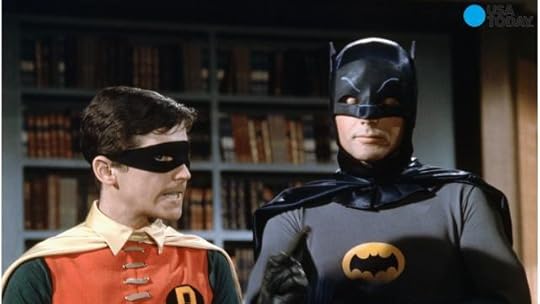
Batman and Robin sit in the Bat Cave and discuss John D. MacDonald’s 1965 Travis McGee novel A Deadly Shade of Gold.
POW!
Robin: Holy Aztec gold, Batman! This book was the bees knees.
Batman: That’s right Boy Wonder, Mac has a way – of putting words – together. And the 60s is such a great – time – to tell such a tale.
Robin: He gets a call from an old friend and then WHAM! They find him in a seedy Fort Lauderdale motel room – DEAD!
Batman: We've come a long way from the Prime Minister's exploding cake. Or have we?
Robin: Um, not sure what that has to do with the book, you did read it right Batman? We’re talking about where Travis goes to Mexico to solve the mystery of who killed his friend and to find ancient gold.
Batman: Of course, but there’s also a lot of drinking, where McGee feels remorse for his shooting and violence. But you wouldn’t know about that. Not you, Robin. They have strict licensing laws in this country. A boy of your age is not allowed in a drinking tavern.
Robin: Right … But the book also features lots of great quotes from MacDonald, though this was an action series BAM! POW! He interjected some astute observations about western civilization. McGee was a very worldly guy. An especially good protagonist for the 60s.
Batman: The true crimefighter always carries everything he needs in his utility belt, Robin.
Robin: OK, Adam, CUT!, I think we need to start over, you seem to be lost in a loop of some of your most campy quotes and we’re supposed to be talking about a Travis McGee book!
Batman: That's one trouble with dual identities, Robin. Dual responsibilities.
5 stars, Excellent. Another of my favourite McGees. Superb.
This is the most complex and satisfying of the Travis McGee series so far. But be warned, the body count is very high.
As usual with my reviews, please first read the publisher’s blurb/summary of the book. Thank you.
Again, McGee shows us many strong, unique women, and his respect for them, even the villains, is terrific. I love that McGee's love and appreciation and respect for women derives from that inner part of himself that seeks completion. One of the scenes with Connie, later in the book, is quite marvellous in this respect.
The plot initially looks as if it will center on McGee's and Nora's revenge and the recovery of very old, obscene, sex fetish statues made of gold, but the various settings and characters shifts the revenge portion into an almost secondary role. Full size image here
McGee's relationship with Nora is sweet and warm and interesting. She and McGee set out from Bahia Mar for revenge for her old boyfriend's brutal death, but their time in "old" Mexico of the early 1960s brings them much closer together for a while.
The time in Mexico shows McGee invade a fortress-like hacienda at great peril. The scenes with the dog attack are spectacular, and the escape is wonderful. Full size image here
McGee's later relationship with Connie is fabulous. Truly MacDonald's most powerful female character to date, fascinating, and the dialogue and reparteé is wonderful.
There is plenty of action, and plenty of philosopher-detective questions and observations of himself and the world. Sometimes, MacDonald's dislike and fear of the coming "new America" is laid on a bit thick, but essentially he is right in most aspects.
The ending is roller-coaster of action, character and dialogue. Very satisfying, and our Travis proves to be a sterling Robin Hood champion. Awesome!
48% Fabulous dog attack and defense. I’ve never seen McGee's technique before. Thrilling. Full size image here
70% It's interesting. This book feels both very modern, and simultaneously "early 1960s quaint". Very pleasant. Even in this brutal book, the world at large seems a gentler place.
78% The dialogue and reparteé with Connie is fabulous. Superb. It continues to the party at Cal's house.
Quotes:
The physical act, when undertaken for any motive other than love and need, is a fragmenting experience. The spirit wanders. There is a mild feeling of distaste for one's self. She was certainly sufficiently attractive, mature, totally eager, but we were still strangers. She wanted to use me as a weapon against her own lonely demons. I wanted information from her. We were more adversaries than lovers. The comments of old Samuel Johnson about the pursuit of women kept drifting into my mind. The expense is damnable, the position ridiculous, the pleasure fleeting. - It was a cheap and dirty little death, a dingy way to die. When dawn came, there would be a hundred thousand more souls alive in the world than on the previous day, three quarters of a million more every week. This is the virus theory of mankind. The pretentious virus, never knowing that it is a disease. - I stalled her on the other until after the small ceremony. Six of us there, under the beards of Spanish moss blowing wildly in a crisp wind on a day of cloudless blue. Shaj, Nora and me, a pastor and two shovelers. The wind tore the old words out of his mouth and flung them away, inaudible. - From way back in the 1960s, so much of McGee's "rants" seem prescient today Imagine the great ship from a far galaxy which inspects a thousand green planets and then comes to ours and, from on high, looks down at all the scabs, the buzzings, the electronic j abberings, the poisoned air and water, the fetid night glow. A little cave-dwelling virus mutated, slew the things which balanced the ecology, and turned the fair planet sick. An overnight disease, racing and explosive compared with geological time. I think they would be concerned. They would be glad to have caught it in time. By the time of their next inspection, a hundred thousand years hence, this scabrous growth might have infected this whole region of an unimportant galaxy. They would push the button. Too bad. This happens every once in a while. Make a note to re-seed it the next time around, after it has cooled down. - The ifs can kill you, and the never agains can gut you. Never again to feel the smooth and eager musculature of that smooth narrow back. Never again to hear the smug and murmurous little pleasure sound. Never again to watch the lilt and swing of those marvelous legs as she walked with the guile of the trained model. Never again to make her laugh. So what you do, if you have been down that road other times, is unhook the little hook and let the metal shutters bang down. When things have quieted down back there, you can lift them again. Time, divided by life, equals death every time. It is the deadly equation, with time as the unknown. - Calvin Tomberlin was in a small group. He was a grotesque. He was of middle size, fairly plump, and stood very erect. He was completely hairless, without brows or lashes. He wore a toupee so obviously fraudulent it was like a sardonic comment on all such devices. It was dusty black, carefully waved, and he wore it like a hairy beret. His eyes were blue and bulged. His face was pale pink, like roast beef. His lips were very heavy and pale, and they did not move very much when he spoke. His voice was a resonant buzz, like a bee in a tin can. He wore a pewter grey silk suit, with a boxy jacket, cut like a Norfolk jacket but without lapels. He wore a yellow ascot with it.
Bonus. From the 1970 "Darker Than Amber" movie starring Rod Taylor, pictures of the producers' ideas of McGee's "The Busted Flush":
The only thing in the world worth a damn is the strange, touching, pathetic, awesome nobility of the individual human spirit. - John D. MacDonald, A Deadly Shade of Gold
John D MacDonald presents a combination of James Dickey's prose with Ian Fleming's narrative flourish. With John D. MacDonald, however, you are also likely to find weird paragraphs sprinkled into the novel that deal with economics, politics, love, lust, the John Birch Society, and the ethics of hunting.
Reading MacDonald is like having a surprisingly lucid conversation with a drunk economics professor who you recently discovered just killed a man with his golf club. You can't pull away from the conversation and aren't quite sure if the story is going to continue, or if he is going to explore a tangent more appropriate for an economics class or his therapist. His brain is amazing and his stories definitely titillate on several levels at once.
Read again on 7/8/09. I've started going back through the Travis McGee books off and on in-order since last winter. I still enjoyed the first few, and was amazed at how McGee's cynical '60s worldview was still applicable to 2009. Since it's been so long, I've forgotten a lot of the plots and supporting characters so the books are new to me again in some ways, but it's weird how some lines or scenes were still very clear to me. A Deadly Shade of Gold has actually been the one that impressed me the most so far with it's plot of McGee running a scam to avenge a friend, but of course, ending up with a lot of physical injuries and emotional regrets.
MacDonald's portrayals of women seem very dated and even hysterical at times. Kind of like Mad Men without the irony. And McGee takes himself far too seriously. But these are still first rate crime stories, and MacDonald was way ahead of his time in some ways. McGee brooded about things like consumerism, privacy concerns (in an era where computer databases were just starting), and the ecological damage being done to Florida in the name of 'progress'. I think a lot crime fans may not realize how influential MacDonald and McGee were on the modern mystery novel, and it's been interesting reading them from the perspective of 40 years after they were written.
From time to time, I read a fun JDM novel. For this rugged outing, Travis McGee travels down to old Mexico in the pursuit of stolen gold statues. Things turn hairy with the explosions, murder, and mayhem found in an old-fashioned hardboiled private eye novel. Sometimes I wonder just why Travis does the things he does, but then I'm not a private eye, hardboiled or otherwise. I like his cynical, clear-eyed worldview which is on full display here.
In this, my third read of ~~~Cathy’s swooning over~~~Travis McGee~~~Cathy’s sighing over Travis McGee~~~ok, I admit it, there is no other like Travis McGee in my little black book.
I’m reading much more carefully than ever before in part because of the ongoing discussion of Travis on D. R. Martin’s blog, Travis McGee & Me when specific questions and discussion come about.
Travis McGee, Salvage Consultant
In my opinion, Travis though JDM, of course, is more philosophical in this book than any other book thus far on my third reading. I happen to enjoy, relish probably more accurate, Travis' musings on life.
There were a number of thoughtful observations that Travis made in Gold but this one was, I think, my favorite which I could have shortened but wanted the reader to get the entire reasoning behind Travis' remarks:
She took me into a study which was also a trophy room. African game. Some very good heads. Leopard, lion, buffalo. There was a case of fine weapons behind glass. There were framed photographs of her, younger, slimmer, just as vital, standing by the dead elephant, rhino, great ape. “My guns,” she said. “My dear dead animals. I took my sainted husband on safari five years running, thinking it would turn him into enough man for me. He killed like an accountant signing a ledger. He bent over a bush to pick a flower for me and a snake struck him in the throat. He was dead before he could fall to the ground. If it was permitted, I would have his head in here, mounted like the others.“ Then later, “You might be enough man for me.”
Travis speaking in the first person, “I do not like the killers, and the killing bravely and well crap. I do not like the bully boys, the Teddy Roosevelts, the Hemingways, the Ruarks. They are merely slightly more sophisticated version of the New Jersey file clerks who swarm into the Adirondacks in the fall, in red cap, beard stubble and taut hero’s grin, talking out of the side of their mouths, exuding fumes of bourbon, come to slay the ferocious white tail deer. It is the search for balls. A man should have his shot at something, a shining running something, and see it come a-tumbled down, all mucus and steaming blood stench and gouted excrement, the eyes going dull the final muscle spasms. And if he is, in all parts and purposes, a man, he will file that away as a part of his process of growth and life and eventual death. And if he is perpetually, hopelessly a boy, he will just to go do it again, with a bigger beast.”
And later “There is one thing which strikes me as passing strange. Never have I met a man who had the infantry memories, who had knocked down human meat and seen it fall, who ever had any stomach for shooting living things.” Then later…speaking of another character in the book…”He would need no romantic fantasies about himself. His manhood would need no artificial reinforcing.”
If a reader does not like JDM's writing, doesn't like Travis McGee, that’s fine with me. However, the following authors have made many extraordinary comments about John D. MacDonald’s writing and looking over the list, I would be hard pressed to say they don’t know what they're talking about or they have terrible taste in the written word:
Ian Fleming Mary Higgins Clark Sue Grafton Pete Hamill Carl Hiaasen Stephen King Dean Koontz Rex Stout Kurt Vonnegut, Jr. Joseph Wambaugh.
The stars, McGee, look down on a world where thousands of 4-H kids are raising prize cattle and sheep. The Green Bay Packers, of their own volition, join in the Lord's Prayer before a game. Many good and gentle people have fallen in love this night. At this moment, thousands of women are in labor with the fruit of good marriage. Thousands of kids sleep the deep sleep that comes from the long practice hours of competitive swimming and tennis. Good men have died today, leaving hearts sick with loss. In quiet rooms young girls are writing poems. People are laughing together, in safe places.
You have been on the underside of the world, McGee, but there is a top side too, where there is wonder, innocence, trust, love and gentleness. You made the decision, boy. you live down here, where the animals are, so stay with it.
My least favorite so far in the series. Probably the most amount of rantings against 20th Century Consumerist Culture so far though.
1. This spoiler is about any of the previous novels in the series
2. Possibly the most condensed ending of any of the books in the series so far. Which is kind of weird since it's about twice as long.
3. Confused about why this book was almost twice as long. I'm not sure if MacDonald just really liked the Nora character, or couldn't get himself to pull the trigger and start getting down to the meat of the story.
4. Still quite good. The lower rating is just to put this in perspective for me in the future so I know which ones I liked better than others. Because I forget things. A lot.
I motioned him back and had him get himself a shot glass. I filled it from my bottle. I held my glass up and said, "Drink to me, my friend. Drink to this poisonous bag of meat named McGee. And drink to little broken blondes, and a dead black dog, and a knife in the back of a woman, and a knife in the throat of a friend. Drink to a burned foot, and death at sea, and stinking prisons and obscene gold idols. Drink to loveless love, stolen money and a power of attorney, mi amigo. Drink to lust and crime and terror, the three unholy ultimates, and drik to all the problems which have no solution in this world, and at best a dubious one in the next."
He beamed without comprehension, and said, "Salud!". We drank and bowed and I filled the glasses again.
Far better than The Quick Red Fox. The mystery worked. Still I got a bit bored. I've read a bit much of Travis McGee in too short a time. I don't, for the record, think he's sexist. Yes, it's a male fantasy of having women willingly want you. But this book is from 1965, and it is what it is and doesn't bother me. That said, I'm bored of him sleeping with different women in every book. I just need a little space.
Time, divided by life, equals death every time. It is the deadly equation, with time as the unknown.
A rather reluctant five stars here, and the first from me so far in the series, but damn!, John D. MacDonald proves here he has both style and substance. I was even able to come to terms with his hero’s undeniable sexism, the way Travis introduces each and every woman character as a potential bed partner and then proceeds to demonstrate how he will manage to bag her for his trophy room. The actual plot in this particular episode puts the previous four to shame in its twisted web of Mesoamerican gold relics contraband, anti-Castro conspiracies, Californian cult leaders, hate mongers and good old-fashioned greed and blackmail. The original cover calls it a ‘double-length adventure’ but it doesn’t feel any longer or slower than the previous books. Probably the best part of the series is the fact that there is no need to read them in order: you can start anywhere you like, and this fifth book might be a better choice than the first one.
“You’re still doing the same kind of hustling, McGee?” “I am still the last resort, Sam, for victims of perfectly legal theft, or theft so clever the law can’t do a thing. Try everything else and then come to me. If I can get it back, I keep half. Half is a lot better than nothing at all. But I am temporarily retired. Sorry.”
As usual, we get reminded who Travis McGee is and what he does for a living. He is an unusual sort of private investigator, a repo-man who prefers to do a big job and then take it easy and relax on his house boat in Florida with a strong drink in his hand as he watches the beach bunnies strolling by. He is in one of his lazy bum periods when an old friend call on the telephone: “Right now I’m taking a nice long piece of my retirement, Sam. Hurry on down. The little broads are beautiful this year.”
When Sam gets brutally murdered right before Travis tries to reunite him with his ex Nora, something primal and relentless is awakened in our cynical and self-serving hustler. Some assholes thought they could get away with spilling the blood of one of his friends! And for what? Some mysterious ancient gold statues this Sam had apparently stolen from the wrong guy? Travis decides he must get to the bottom of this affair and punish those who believed they could get away from murder, not for the gold prize and not for his sympathy for Nora, but out of some probably misguided belief in our humanity.
The Only Thing in the World Worth a Damn is the Strange, Touching, Pathetic, Awesome Nobility of the Individual Human Spirit.
“I’d be better off without a little taint of idealism, Nora. Then I could accept the fact that man is usually a pretty wretched piece of work.”
McGee’s experience in the criminal underworld and his usually reliable dim view of how these guys operate [it takes a thief to catch a thief is I think the guiding principle here] will quickly follow the gold first to some New York art brokers who cater to black market collectors and from there to a luxury resort in Mexico. He takes Nora along, not as a playmate [at least not initially] but as a decoy for his investigations. They plan to check in as a romantic couple on vacation in Puerto Altamura.
She wanted immediate confrontations. She had no patience with research. She wanted us to go at once to Puerto Altamura and start slamming around. She threatened to go by herself. I explained to her that it worked on television dramas and in muscular movies, but in the far drearier vistas of life itself, a man could pry nothing open unless he had a pry bar. And knowledge is that pry bar. Strangers do not suddenly open up because you confuse them. Confusion leads to a cautious silence. Strangers talk when they know that you have facts. They talk when it is in their interest to try to convince you your facts are wrong.
This procedural aspect of the investigation is one of the ‘hooks’ that worked very well in the gold episode for me: the slow, patient untangling of the nest of vipers that centers on the well guarded villa of a reclusive Cuban expatriate that Sam used to work for. Investigator McGee trumps lecherous Travis every time. I don’t want to get into the nuts and bolts of what goes on in the villa of the former secret service Colonel of the Batista regime, but the aftermath of the Bay of Pigs debacle features prominently among the players of this deadly game, such as a reference to ... the little wolf pack of crypto-fascist exiles in Mexico City who think they can rebuild a Batista-regime in Cuba when a power vacuum occurs after a successful invasion. Travis McGee opinion on Cuba starts sort of balanced, only to side later on with the wealthy industrialists in their plans to force regime change through economic sabotage: It was his idea that if they could hasten the economic collapse of Cuba, they would be hastening the fall of the Castro government. . There is also an attempt to whitewash the Batista torturers by claiming that Communists are worse, which sadly makes MacDonald appear as tone deaf regarding the island as most of the American writers: “What made us think that was the most savage and dangerous of all worlds? Now it seems almost pure, something on a stage, with comedy uniforms.”
Luckily, these foreign policy notes are not really the focus of the story. They are only helpful in fleshing out the character of the players. The true talent of Travis McGee is his understanding of human nature, I would even say his empathy, the way he tries to understand not only the motivations of the bad guys but also that of the numerous women that crash land into his bed. Which brings me inevitably to my major complaint in the previous episodes: the way Travis thinks of himself as the Love Guru, ready to heal any vulnerable or vaguely interested female he crosses path with by first rejecting her and then allowing himself to be seduced.
She was a reasonable ripe and lusty-looking little woman, but in my adult years I have lost my taste for soap opera intrigue and high school solutions.
I thundered hot water into the big tub, setting up McGee’s Handy Home Treatment for Melancholy. A deep hot bath, and a strong cold drink, and a book on the tub rack. Who needs the Megrims? Surely not McGee, not that big brown loose-jointed, wire-haired beach rambler, that lazy fish-catching, girl-watching, grey-eyed iconoclastic hustler.
A more tolerant reading of these ‘spicy’ bits in the novel will note the discrepancy between our hero’s actions or his sexual tinted portraits and the way he actually feels love and sympathy for his partners, the way he always stresses the importance of free will. The woman must have the option to reject his advances and her choice must be respected. Context is also important: the book was published in 1965, and the ideas about sexual expression mentioned by Travis were revolutionary in their rejection of traditional roles in a couple. Maybe there is a grain of truth in McGee’s claims to be an expert in loving and in appreciating beauty at the start of the sexual revolution, at least in retrospect. By this fifth book, I am also convinced that there is more than a little dose of irony and subversive criticism of gender roles in these not so casual affairs of Travis McGee. The ability to laugh at his own antics is what finally reconciled me with Travis McGee’s often doomed love record.
This was the genus playmate, californius, a sun bunny.
“This is the last thing I expected to happen,” she said, with a luxurious stretching. “You’re very sweet.”
I have not kept notes of how many ‘trophies’ were added to the gallery aboard the ‘Busted Flush’ for Travis in this episode, but I believe very few of the female characters in the book escaped his attentions . I think it is better to laugh than to cry foul at McGee’s antics. He even tries to justify himself by claiming he extracts information from a suspect through pillow talk. All the dialogues and the editorial interventions in the book feel natural and well chosen, but one in particular caught my fancy and made me laugh out loud. How long do you think it takes for our hero to score?
As I got into the cab, she called, “I’m a good kid, tenth floor, Yates Brothers, name of Betty Rassmussen, anytime for thirty-second dates, you’re welcome.”
>>><<<>>><<<
Speaking of editorial interventions, these are actually responsible for bumping my review from four to five stars. The social commentary is particularly strong in this episode. I must thank Lee Child for his introduction. I am usually skipping these teasers in order to jump right into the action and to avoid spoilers, but the opening paragraph caught my attention:
Why? Why did a middle-class Harvard MBA with extensive corporate connections and a gold-plated recommendation from the army turn his back on everything apparently predestined, to sit at a battered table and type, with an anxious wife at his side?
The answer to Lee Child’s rhetorical question is right here in the story, and has been from the start of the series. I don’t like to search for the personality of the writer in the characters they create, but in the case of John MacDonald, his biographical details are too much of a reveal for the sensibilities and the diamond hard moral core behind the fictional hard-fisted slacker with the roving eye. Both of them have rejected mediocrity and the safety of popular trends, pulled themselves out of the rat race in order to enjoy life and focus on what is truly important.
In this toboggan ride into total, perfectly adjusted mediocrity, the great conundrum is what is worth living for and what is worth dying for. I choose not to live for the insurance program, for creative selling, for suburban adjustments, for the little warm cage of kiddy-kisses, serial television, silky wife-nights, zoning squabbles.
What both the author and his creation reject is pretty easy to spot: liars, cheaters, indoctrination, routine, the destruction of the planet and of cultural diversity. Both New York and Los Angeles are seen as places of corruption, poster children of a sick system. As shown in my earlier quote, Travis believes in our decency as individuals, in our humanity, despite all signs to the contrary. This is the other side of the coin toss he made when he rejected the option of conformity, how he goes from saying No to saying Yes:
This is the virus theory of mankind. The pretentious virus, never knowing that it is a disease. Imagine the great ship from a far galaxy which inspects a thousand green planets and then comes to ours and, from on high, looks down at all the scabs, the buzzings, the electronic jabberings, the poisoned air and water, the fetid night glow. A little cave-dwelling virus mutated, slew the things which balanced the ecology and turned the fair planet sick.
But that other vitality is still there, that rancorous, sardonic, wonderful insistence on the right to dissent, to question, to object, to raise holy hell and, in direst extremity, to laugh the self-appointed squad leaders off the face of the earth with great whoops of dirty disdainful glee. Suppress friction and a machine runs fine. Suppress friction, and a society runs down.
Echoing the classic Don Quijote tilting at windmills and the more recent man walking down the mean streets evoked by Raymond Chandler, McGee consciously made himself a rebel fighting for lost causes. Because somebody has to.
All that remains for the McGee is an ironic Knighthood, a spavined steed, second class armor, a dubious lance, a bent broadsword, and the chance, now and again, to lift into a galumphing charge against capital E Evil, his brave battle oaths marred by an occasional hysterical giggle.
>>><<<>>><<<
The rest of my notes are repeats of the themes I already touched on, like this example of Travis rejecting an offer to work for the government as a secret agent and troubleshooter:
“No temptation at all?” “Not very much I guess. I get into things, Colonel, because I get personally and emotionally involved.”
Yet there is a later subplot about white supremacists that I think is worth a mention in this year 2024, a demonstration that the rise of Trumpism was already evident to the eyes of the author who wrote in 1964 about a doctor Girdon Face, and his American Crusade:
“But Doctor Face, isn’t it part of our heritage for anyone to be entitled to say what they think, right or wrong?” “My dear woman, that is one of the luxuries of liberty, not one of the definitions thereof. And it is traditional and necessary in war that we forego the luxuries and concentrate on the necessities. My posture is that we are at war, with a vile, godless, international conspiracy which grows in strength every day while we weaken ourselves by giving every pinko jackass the right to confuse our good people.”
The comments elicited by Travis upon meeting with this self-appointed guardian of American values seem today almost prescient. Sadly, the warnings, like the ones about cultural appropriations and the destruction of the planet, were largely ignored by a public who preferred to focus on the spicy and bloody bits of the story, on panem et circenses.
There are a lot of them running loose these days, I thought , fattening themselves on the sick business of whipping up such fear and confusion that they turn decent men against their decent neighbors in this sad game of think-alike.
“The president is selling the country down the river with the help of the Supreme Court. Agree with us or you are a marked traitor. You know the sort of thing, all that tiresome pea-brained nonsense that attracts those people who are so dim-witted that the only way they can understand the world is to believe that it is all some kind of conspiracy.”
I wish this was only some sort of dystopian science-fiction novel from 1965, but my laughter at these conspiracy theories sound kind of hollow today.
"A Deadly Shade of Gold" is the fifth installment of this amazing series and it is a terrific thriller of a novel from cover to cover. At over four hundred pages, it is one of the longer McGee novels, but well worth the time it takes to read. It is filled with adventure, intrigue, romance, social commentary, and some of the best and most in-depth characterizations you will read anywhere. One of the things that really stands out about Macdonald's McGee series is that somehow he captures the substance of people and is able to convey it in his lengthy detailed descriptions. This novel takes McGee on some journeys, mainly away from his beloved sea. He starts in Florida,heads to deep Mexico, and ends up in Tinsel Town. There is almost never any let up in the tension though.
Here, McGee is after revenge and after some treasure that has been misappropriated and he goes through an entire range of emotions from shock and anger and so on and actually does things that are quite shocking and cruel in his quest to get the bottom of the mystery. This is not merely a novel about McGee working on commission to get someone's money back from bad folks, but McGee trying to avenge a friend -Sam Taggart- and he is emotionally attached to this quest and to Sam's long-lost love Nora, who tags along with McGee to adventures and dangers she could barely have imagined when she set out on this quest. One of the more striking things about the McGee novels is that it is about a man who muses about society and his place in it. He lives on a houseboat, doesn't exactly work a regular job, and is quite cynical about the institutions and people he encounters and about what their motives are. The social commentary he engages in does not feel dated or past its time even now.
Superb Travis McGee revenge and heist tale, with quite a bit of plot depth and complexity, including quite a bit of action, violence and international intrigue. McGee is jaded, the reluctant hero, and fiercely independent. And he can read people like a book, instinctively knowing what makes them tick. His insights and rantings on the failings of human nature and the ills of society make these novels great in my opinion. Railing against consumerism and conformity in particular, his trademark nuggets of hardboiled wisdom are in rare form here.
"All that remains for the McGee is an ironic Knighthood, a spavined steed, second class armor, a dubious lance, a bent broadsword, and the chance, now and again, to lift into a galumphing charge against capital E Evil, his brave battle oaths marred by an occasional hysterical giggle. He has to carry a very long banner because on it has been embroidered, by maidens galore, The Only Thing in the World Worth a Damn is the Strange, Touching, Pathetic, Awesome Nobility of the Individual Human Spirit."
By far the longest and most ambitious of the Travis McGee novels, A Deadly Shade of Gold packs in more adventure, mystery and sex than any of the other previous installments. Like the previous novels, this starts with someone seeking some help from Trav, this time, an old friend named Sam Taggart who vanished 3 years previously. Sam, somewhat akin to Trav, led the life of a beach bum, working charter fishing ships and such in Florida. He came close to settling down with his lover Nora, but, escaping commitment, conducted an unseemly affair and left the scene; basically he vanished.
Well, Sam and Trav have a chat. Turns out Sam found his way down to Mexico and worked there for three years. Along the way, he 'acquired' some ancient gold figurines, got swindled of them, and only has one left. Looking forward to getting back together with Nora, he tells Trav he just needs to sell the figurine and then he will not come back empty handed. Sam made some calls, and when Trav finds him next, with Nora in tow, he is dead. Murdered. Trav, intrigued, and Nora, pissed off, decide to do some digging and find out what is what. Thus starts another sordid mystery!
MacDonald does rely upon some standard formulas in these novels. Travis always seems to know someone who can help him with information across the social strata. Here, his prior association with Cuban refugees comes to the fore. Seems Travis befriended several Cubans and almost participated in the Bay of Pigs! Lots of nostalgia (perhaps that is not the right word) about Cuba here, given that this first came out in 1964 and the revolution was still pretty fresh. MacDonald gives, via Travis' thoughts, some interesting insights into revolutionary politics/actions and society in general. Lots of arm-chair philosophy, coupled with adventure and mystery, really is the key to these books being so successful. Travis does, however, manage to sleep with a wide array of characters here, much more so than in previous installments. Jeez. 3.5 stars, rounding up!
Number five in the Travis McGee series but only the second one I have read. This is a darker, more violent book than The Deep Blue Good-by, with plenty of explosions and surprises for everyone from the Cuban bad guys to the Cuban good guys.
An old friend shows up needing help, but gets killed before he can really explain to Travis what has gone wrong. In his quest to get answers, McGee travels to Mexico and California, meeting beautiful women and ugly men along the way.
I checked this out at the library while I was in Arizona, and there was only one title more available (review coming right up!) so I guess I am done with Travis McGee for awhile unless I treat myself to an online shopping spree one of these days or see him in the used book sale shelves the next time I go to Arizona.
First published in 1965, A Deadly Shade of Gold contains themes that might still apply in today's world, which speaks very poorly of how little social progress we've made in so many areas. Nevertheless, it is full of sexist themes and misogyny which, although apropos of that era, would appear anachronistic today.
While there are some interesting plot elements here, I found the book to be too preachy and Travis, away from his Florida digs, too serious and dark to suit my taste. I prefer other entries in the series that contain much more humor and witty sarcasm.
If you're a Travis McGee fan, definitely read this; if not, I'd steer you toward the more lighthearted stories within the series, typically centered around Florida, his boat, and oddball friends that inhabit his world.
The longest and densest of the Travis McGee books I’ve read, and despite getting in the weeds with too many characters, MacDonald keeps it all rolling tightly and smoothly. Several great scenes of thrills and suspense and death, along with MacDonald’s trenchant and still scarily relevant screeds against corrupt culture and politics. Loved the various locales of Florida, NYC, Mexico, and more. Highly recommended, but definitely a novel that requires your full attention! Really kept me entertained on a leisurely European trip.
So what's the deal with Travis McGee? I don't even know how to begin without sounding like an asshole or revealing some serious masculinity issues. . .
But shall we? Shall I dare say that Travis McGee is a kind of "man's man"? The best of these were written in the early to late 60s when the literal and popular landscape of this country was going through some radical changes (as if that isn't always happening but whatevs). How does a dude on the fringes of a culture ruled by cynicism, cheap sex and self-destruction manage to survive? Why by living on a BOAT in the Florida Keys OF COURSE. As a bachelor. With a compromised yet enlightened view about ecology, sex, work and righteousness and a penchant for getting into some crazy ass scrapes with some really bad dudes (and babes). He is NOT a detective. Can we get that STRAIGHT? Brother is a SALVAGE CONSULTANT. He will get your shit for you that you lost by being a total asshole for half the value of whatever it is. Maybe you socked away like 50K by being a prostitute and now your pimp wants you dead? Trav will probably hook you up. But in the meantime he's gotta rant articulately about the state of corporate America or the real estate nightmare that is southern Florida. Brother also has this genius friend named Meyer who also lives on a boat and is an accountant. He knows a ton about numbers. He keeps his emo's in check. He's the yin to Trav's yang. It's all good with the dudes. They play chess and just hang the f' out drinking GIN.
One thing that's tough for Trav but maybe convenient in the grand landscape of this series? All the ladies he falls in love with end up dead. So then he needs to get some revenge and he also is unattached so the series continued until John D. MacDonald croaked.
Yes - this may seem like some clubhouse, "No Gurlz Alloud" style nonsense but I have a number of woman pals who also swear by Trav and read all of these things and get bummed when they run out. There's only about 20 of them so pace yourself. Life is too short though. . .this one is my favorite. It's a tour de force in the Travis McGee mode.
I am a huge fan of the Travis McGee series, and this is one of my favorites. Trav is everything a detective hero should be: cunning, rakish, good with his hands, prone to deep thought and susceptible to love with the wrong kind of ladies. These books were mostly written in the 1960s so some of the plot lines are pretty retro, but the plots and action stand up today!
MID-20TH CENTURY NORTH AMERICAN CRIME/MYSTERY 1965 I've read the first 12 in this series, and am going back and starting again before reading the rest. Why? Some are very good-to-great but some are just one-star reads to me. Like #4, "The Quick Red Fox", which I rated a generous 1 star. Do we have a ghost writer around? This time, I'm using my rating system developed for my "Mid-20th Century North American Readathon". How does this read compare to my first, 3-star rated read? HOOK - 5 stars: This one simply explodes on the first page: "A smear of fresh blood has a metallic smell...when it is the blood of a stranger...of your own...of a friend..." No cliche of a weather report but a totally original opening that is so human and rather painful. Then an old acquaintance appears...a man who had disappeared (not a dame in trouble, like in so many crime novels of the period). And this opening leads to a sensational first half... PACE - 1 star:...then about halfway through this book - 200 pages in - I was sorta bored. Problem is that we wind up at a terrace in California and it reads like most of "Quick Red Fox" which was mostly about an orgy on a terrace in California. It felt like MacDonald had no idea where he was going here and just revised "Quick Red Fox" for the last half of the novel, another 200 pages. Wildly uneven. Unforgivably so: 9 days to get through this. I'm pretty sure I read Tolstoy's "Anna K" in fewer days. And just today I finished Saul Bellow's sensational "Henderson and the Rain King" in which a man is in Africa on a hunt of sorts, gets into as much trouble as McGee. The thing is I started "Rain King" yesterday, it's 310 pages, and was a 2 day read for me. If you want to read a brilliant novel that's a true-page turner, "Rain King" is the one. Published in 1959, I'd say MacDonald could have learned a thing or two about pace in this "Gold" novel, a 1965 publication. PLOT/CRIME - 2: A set of ancient, small, sexual figurines in gold are missing. Were they stolen? From where? Who owned them and when? Interesting, but a little too convoluted: I'm not sure MacDonald knew where he was going. And get this: when McGee returns from Mexico and winds up in California, he must hide out. He walks into a bar, meets a pretty young thing called Junebug, and she offers him the house of a friend! MacDonald is a better writer than that: in fact I think most readers of crime and mystery could do a better job hiding out that MacDonald/McGee. Another plot problem: there is an old joke that if you write to a point where you're in a corner and don't know where to go, have everyone run over by a truck. There is no truck here, but the dead body count is massive and just not necessary to the plot. CHARACTERS - 4: Sam Taggart is a mess, and he'll break your heart, along with that of his lost love Nora. Sam "was a random guy, a big restless, reckless lantern-jawed ex-marine, a brawler, a wencher, a two-fisted drinker". (We have a country song here!) Sam is one of McGee's own. Sam tries so hard to do the right thing, but things fall apart. About Nora, the author writes, "A real live complete entire woman can be a scary thing", referring to McGee's complete respect for the ladies, their smarts, their toughness, their absolute power. Then the author writes of McGee, "...that big brown loose-jointed, wire-haired beach rambler...girl-watching, grey-eyed iconoclastic hustler." (Country song #2!) Many characters are beautifully rendered until new characters are introduced late in the story and aren't very interesting. Still, McGee, Taggart, Nora, Meyer (McGee's neighbor in the Fort Lauderdale marina), Senor Garcia, the beautiful big prostitute named Felicia, and Miss Almah Hichin, all introduced in the first 200 pages, are fantastic. And once they are all in play, McGee needed only 50 pages to tell the rest of the story. ATMOSPHERE - 3: I've read that the Cuban community here in Southern Florida, today, are so close to each other, so defensive of their friends and family, that this particular community has the lowest crime rate of all social communities/levels in this area. MacDonald points out that's also the case in Mexico in 1965. The contrast between the Cuban community and McGee's underworld community of criminals and a a sub-community of global art dealers is indeed interesting. I also enjoyed the chase for the small statues of antiquity. The entire collection is made up of tw0 thousand, two hundred and forty-one point six ounces of gold, valued at $300K to $400K...in 1965. That's about $5,043,600,000 today, gold has been around $1,500 an ounce lately. So, yea, if that collection was privately owned today, it wouldn't be on view in anyone's home-as it is here in this book. Still, it's very unfortunate the author chooses to return to "Quick Red Fox" for the last 200 pages: the story goes off the rails. SUMMARY -An average of 3.0, matching my original rating. Probably no ghost writer, but definitely a missing editor. I've said something like this before, but there is a very good 250 page novel buried in the 400 pages. Read this one for the characters and the underworld of art dealers: it's worth it. There are some huge set pieces, true, but the biggest ones are on that terrace from "Quick Red Fox". So, unless you're into porn photography, read "Gold" and you've pretty much read "Red."
ORIGINAL REVIEW/2017 - 3 stars "Reasonable conservatism is a healthy thing...but poisonous divisionist hatemongering is the heart of contemporary propaganda, amigo, to strengthen ignorant terrible men who believe themselves to be perfect patriots...any way that they can make Americans hate Americans helps..." writes MacDonald. In 1965, no less! What's great? At 400+ pages, this is epic MacDonald/McGee with epic stage sets on which epic, stupendous action sequences occur. I'm reading this McGee series in order, and as far as plot, thrills, and sex go, this one is the best of the five. Four stars for this very good thriller, with a number of plot twists I didn't see coming at all. What's not so great? I believe I have already answered this question. I don't read this author, or this series, for politics. True, the above quote is fitting within the context in which it occurs, but still, I think it's out of place within this novel. Why, if I want good, solid, reliable, balanced news reporting, I'll watch Fox News of course! So, one star for an out-of-place soapbox political speech (which, though I must add, is oddly relevant today anyway, so let's make it two stars for relevancy.) In summary, four stars for an epic McGee thriller, two stars for much-too-long political speeches that stop all plot movement for a 3-star average rating. McGee has gotta be one of the best characters in all of American fiction with which one would want to have a beer, and a guy no doubt you would want on your side should you find yourself embroiled in that ever-popular 1960s debate; Stones vs Beatles, who was the best? (But it's like comparing rocks and apples, really.) On to more McGee for me! A new favorite comfort read, along with Dame Agatha and M.C. Beaton, who has a new, third series! (But don't worry, Hamish, there is only one place in my heart for a small-town Scottish detective....but I digress, as usual.)
Denser than I like for this kind of palate-cleansing fluff, but also notably stronger than the last couple of Travis McGees. I had this one sitting around for over 10 years because I thought I had the measure of McGee. He's a big lunk and women are objects and er... that's it. I came back to this one after lending it to my brother. He had a good experience with it so I thought it was time to tick it off. McGee's still a lunk and women are still objects, but some of the other work on display here seemed more evolved and even beautifully crafted at times. It's still unrelentingly misogynist, but there were moments of brilliance and a surprisingly coherent plot.
I had given up on this series, but now I think I'll keep an eye out for cheap old paperbacks of the rest of the series.
ok, I really did find this book sexist... I give it a bit of a break because it was written in the '60s, but every single woman was either manipulative and petty, or headed for McGee's bed. He 'slept' with so many women in this book, it was like a James Bond novel.
I would have loved this book otherwise. McGee is a little off kilter due to his personal stake in this mystery, and the fact that it shows adds to the emotional punch of the piece. It is almost depressing in its stark portrayal of human greed and cruelty, which makes the nice moments shine so much better.
At a point in this text, I happened to wonder if I knew what would happen, and I got it right. Still, just as in genres said to be more literary, the pleasures to be found were in characterization and thought, rather than in plot. The pleasures and the psychological perceptions were not mine, but they were great.
I've known about John D. MacDonald for a long time. I saw the massive shelf of his books when I worked at Barnes & Noble 25 years ago. And I've heard him mentioned by TONS of big-name authors as one of their favorites. Stephen King has sung his praises for years, and Dean Koontz claims MacDonald is his favorite novelist of all time. But my to-read list is long, and there's not much room for mystery writers--even well-praised ones.
But then I heard a recent interview with Tim Powers--my favorite author who's not Gene Wolfe--and he practically insisted the interviewer read John D. MacDonald's books, and that he ought to start with A Deadly Shade of Gold. Well, that was enough for me.
This is part of a series of 21 books featuring Travis McGee, a tough, smart, likable character who lives on a houseboat in Florida and helps people out when they need it--generally for a cut of the proceeds. That cut usually lasts just long enough to get him to the next person who needs his help. The books appear to be mostly stand-alone, with some recurring characters and overarching plot pieces that might pop up, but won't hinder you reading out of order. Of course, if Tim Powers hadn't said to start with this one, I would have started at the beginning, but whatever.
An old friend of Travis' comes back from years spent in Mexico, and is promptly killed--violently. Travis teams up with his friend's ex-girlfriend to head to Mexico and track down what happened. It's a mystery, so it would take something special to make me give a crap. And indeed, this is a typical mystery, but one that's well done, with twists and turns and clever happenings. I'm damning this with faint praise, but for a mystery novel, it's pretty good!
But beyond the plot, it soon becomes apparent that MacDonald is just a heckuva writer. His sense of place is excellent. His characterization is stellar. I think this is one of the strengths of McGee: He's actually likable! So many mystery leads are jerks, or criminals, or anti-heroes, or deeply flawed. McGee isn't perfect, and has his issues, but he seems like a genuinely nice guy--I'd hang out with him! Finally, MacDonald was constantly surprising me with turns of phrase that just made me stop and reread sentences and paragraphs. And while that might happen once in a great while with some authors, this happened multiple times in this innocuous 400-page book.
So I get it. The praise isn't overblown, or simple nostalgia. MacDonald is the real deal, and now I have a ridiculous number of books to make my way through. I can't wait.
Of the five MacDonald mystery thrillers I've read this month, this isn't my favourite. Maybe a bit too grim for me. Having said that, I still enjoyed it very much. MacDonald writes readable, interesting stories. Travis McGee is an excellent protagonist, as he describes himself, a white knight in a rusty suit of armour. This story takes him to Mexico and California, trying to find out who killed an old friend. An inevitable romance, more violence than I recall from the other stories and a twist to McGee's heart all add up to an excellent story. Travis McGee has quickly become a favourite of mine, cynical in his way, a throwback in a modern world, he's excellent.
This is one of the best paced and plotted crime novels I've ever read. I found it even more satisfying than the first in the series. Many fans have expressed disappointment at the length -- almost double that of its predecessors -- but I enjoyed the further development of McGee's background and his lengthier-than-usual observations of society. It's amazing how relevant most of this is today, although it was penned 45 years ago.
A beautifully structured mystery. Easily the longest McGee to date, no pun intended. Had the McGee rantings I've grown to love. It gave me what I wanted, Scotch and a Mexican hooker.
"The ifs can kill you, and the never-agains can gut you."
Estas historias son cada vez más cautivadoras. Nunca puedes esperar por donde va a venir el disparo que te llena de tensión y voracidad, que te obliga a devorar páginas con tal de descubrir los trapos más sucios de cada uno de los personajes. De descubrir el mundo que existe por debajo de la bondad de la vida cotidiana, el suburbio por el que Travis McGee fondea con su barco.
Esta vez, el brillo dorado era aún más negro que la oscuridad que habita entre las estrellas.