Jump to ratings and reviews
Rate this book

Matthew Scudder #6

When the Sacred Ginmill Closes

Rate this book
In the dark days, in a sad and lonely place, ex-cop Matt Scudder is drinking his life away -- and doing "favors" for pay for his ginmill cronies. But when three such assignments flow together in dangerous and disturbing ways, he'll need to change his priorities from boozing to surviving.

261 pages, Mass Market Paperback

First published January 1, 1986

307 people are currently reading
1985 people want to read

About the author

Lawrence Block

768 books2,995 followers
Lawrence Block has been writing crime, mystery, and suspense fiction for more than half a century. He has published in excess (oh, wretched excess!) of 100 books, and no end of short stories.

Born in Buffalo, N.Y., LB attended Antioch College, but left before completing his studies; school authorities advised him that they felt he’d be happier elsewhere, and he thought this was remarkably perceptive of them.

His earliest work, published pseudonymously in the late 1950s, was mostly in the field of midcentury erotica, an apprenticeship he shared with Donald E. Westlake and Robert Silverberg. The first time Lawrence Block’s name appeared in print was when his short story “You Can’t Lose” was published in the February 1958 issue of Manhunt. The first book published under his own name was Mona (1961); it was reissued several times over the years, once as Sweet Slow Death. In 2005 it became the first offering from Hard Case Crime, and bore for the first time LB’s original title, Grifter’s Game.

LB is best known for his series characters, including cop-turned-private investigator Matthew Scudder, gentleman burglar Bernie Rhodenbarr, globe-trotting insomniac Evan Tanner, and introspective assassin Keller.

Because one name is never enough, LB has also published under pseudonyms including Jill Emerson, John Warren Wells, Lesley Evans, and Anne Campbell Clarke.

LB’s magazine appearances include American Heritage, Redbook, Playboy, Linn’s Stamp News, Cosmopolitan, GQ, and The New York Times. His monthly instructional column ran in Writer’s Digest for 14 years, and led to a string of books for writers, including the classics Telling Lies for Fun & Profit and The Liar’s Bible. He has also written episodic television (Tilt!) and the Wong Kar-wai film, My Blueberry Nights.

Several of LB’s books have been filmed. The latest, A Walk Among the Tombstones, stars Liam Neeson as Matthew Scudder and is scheduled for release in September, 2014.

LB is a Grand Master of Mystery Writers of America, and a past president of MWA and the Private Eye Writers of America. He has won the Edgar and Shamus awards four times each, and the Japanese Maltese Falcon award twice, as well as the Nero Wolfe and Philip Marlowe awards, a Lifetime Achievement Award from the Private Eye Writers of America, and the Diamond Dagger for Life Achievement from the Crime Writers Association (UK). He’s also been honored with the Gumshoe Lifetime Achievement Award from Mystery Ink magazine and the Edward D. Hoch Memorial Golden Derringer for Lifetime Achievement in the short story. In France, he has been proclaimed a Grand Maitre du Roman Noir and has twice been awarded the Societe 813 trophy. He has been a guest of honor at Bouchercon and at book fairs and mystery festivals in France, Germany, Australia, Italy, New Zealand, Spain and Taiwan. As if that were not enough, he was also presented with the key to the city of Muncie, Indiana. (But as soon as he left, they changed the locks.)

LB and his wife Lynne are enthusiastic New Yorkers and relentless world travelers; the two are members of the Travelers Century Club, and have visited around 160 countries.

He is a modest and humble fellow, although you would never guess as much from this biographical note.

Ratings & Reviews

What do you think?
Rate this book

Friends & Following

Create a free account to discover what your friends think of this book!

Community Reviews

5 stars
2,404 (40%)
4 stars
2,326 (39%)
3 stars
955 (16%)
2 stars
160 (2%)
1 star
49 (<1%)
Displaying 1 - 30 of 405 reviews
Profile Image for carol. .
1,760 reviews10k followers
April 20, 2025
Oh Scudder novels, how do I love thee? Let me count the ways:


1) Period New York. This time it's a walk down memory lane to 1975. While Scudder remembers more about the sports scene than national politics, he also recalls that it was a big year for Black Russians and tequila sunrises. It's also a time of Irish dominance in Hell's Kitchen (anecdotal origin quote: "Hell's a mild climate. This is Hell's Kitchen"), a small rough, industrial down-and-out section of New York. Irish toughs with connections to the IRA have a strong influence in the area, not the least of which are the owners of Morrissey's after-hours club. Then there are the timeless city people: "I generally bought the paper there, unless I bought it from the shopping-bag lady who hawked them on the sidewalk in from of the 400 Deli. She bought them for a quarter each from the newsstand--and she sold them for the same price, which is a tough way to make a living."

2) Characterization that makes me feel like I was there. These are Scudder's bar-crawling days, and he has some good-time relationships with his bar tenders and fellow drinkers. There's Buddy, the actor; Skip, bartender and co-owner of Miss Kitty's; Billie Keegan, who tends bar at Armstrong's; Telephone Tommy, the salesman with the small, calculating eyes; Caroline,"with a soft you-all accent that, like certain culinary herbs, became stronger when you steeped it in alcohol." Dialogue is spot-on, that clever good-time mix of stories, social commentary, and good-natured mocking that a group of congenials have.

3) The emotional punch of a likeable lead struggling with alcohol and past demons. Scudder's a little edgier in this one, walking a thin line between anger and depression. Alcohol threads through all the scenes, the backdrop and motivation to most of his routine, the siren that draws him from bar to bar. There is one very ironic scene where Skip tells Scudder that "But even so [alcohol's] a choice for us. That's the difference between you and me and a guy like Billie Keegan." Though Scudder of the past sounds skeptical, the discussion impacts even more strongly knowing the Scudder ten years forward and the extent to which he was deluding himself.

4) Oh-so-subtle foreshadowing and the resolution of three clever little mysteries: a hold-up at Morrissey's, Tommy's marital troubles and Skip's financial troubles. There are hints of trouble from the start, but it isn't until the end that you realize how nicely they all blended in. Nothing is wasted here. The book comes full circle, making the ending even more poignant.

5) The bitter flavor of justice. I read the book again just so I could re-read the ending. Stunning.

I had to request this one from my library's 'lower stacks.' I wonder if they would notice if I never returned it?


*******************
In the old days, I'd add the audio edition separately. Nothing easy about doing that, however, so I'll add it in here.

It remains true that I am just not good with audio books. Mark Hammer does a very good job as a reader, mostly able to keep the recurring players distinct. He even does a great job with a Southern belle. But somehow, listening on the way home just doesn't move me the way the book did. Perhaps it's flow, and I just can't immerse myself the same way. Well, regardless, this is a marvelously crafted tale that ends up feeling a little thinner on audio.
Profile Image for Bill Kerwin.
Author 2 books84.4k followers
April 13, 2020

This is a fine entry in the Matt Scudder series, but fans of conventional mystery novels may be somewhat disappointed, for it involves not one particular case, but three: the armed robbery of an after-hours joint, the extortion of a tavern for the return of its cooked books, and the murder of the wife of a patron of one of Matt's usual haunts. Scudder does eventually connect two cases and solve them, and he sort of solves the other case too, but there is a lot of conversation not germane to the detective work, and their connection and solution are almost beside the point.

Well, just what then is the point? These three cases are a decade in the past, narrated by what is a now sober Matt in a meditative farewell to drink: to its taste, to its effects on the drinker, to the world where it is served and the colorful people found there, but, most of all, to the bond between drinker and world, a bond which the determinedly sober man may never experience again.

As Scudder tells us, during the summing up:

...when I look ten years into the past I can say that I would very likely have handled things differently now. Everything. All changed, changed utterly. I live in the same hotel, I walk the same streets, I go to a fight or a ball game the same as ever, but ten years ago I was always drinking and now I don't drink at all. I don't regret a single one of the drinks I took, and I hope to God I never take another.
Profile Image for James Thane.
Author 10 books7,071 followers
November 11, 2024
This is among the best of Lawrence Block's Matthew Scudder series, which is saying quite a lot. Set in the mid-1970s, it finds Scudder divorced, working as an unlicensed P.I. in New York City and essentially living in the bars that dot the neighborhood around his small hotel room.

The book opens with the brazen robbery of an after-hours saloon that happens to be owned by some scary Irish brothers that no smart person would ever think to screw around with. Matt is present at the time of the robbery and the owners ask him to look into it, offering a $10,000.00 reward for info leading to the robbers. At virtually the same time, the wife of a casual barroom acquaintance, Tommy Tillary, is murdered. Tillary becomes a suspect and asks Matt to help clear him. If all that weren't bad enough, another of Scudder's friends is being blackmailed and wants Matt to help arrange the payoff.

As the book progresses, Scudder works on each of the three problems with varying degrees of commitment and interest. Each of the three cases is interesting in and of itself, but as always in these books, it's the setting and the characters, especially Scudder himself, that keep you coming back and that make you regret it every time you come to the last page. Lawrence Block has created in these novels a world and a cast unlike any other--for my money easily the best, the most vivid and most interesting of any in crime fiction. I've read this book at least three or four times by now, and I'll be anxiously waiting for it again the next time I make my way through this series.

James L. Thane
www.jameslthane.com
Profile Image for Kemper.
1,389 reviews7,652 followers
March 20, 2011
I wish you could add sound effects to books because it would have been cool if the flashback noise from Lost would have played when I started reading this.

According to Lawrence Block lore, he originally planned to end the Scudder series with the last book, Eight Million Ways to Die, and it certainly would have made a good stopping point. But Block owed a Scudder story so he wrote a short version of this that he liked it so much he expanded it to a book. Then he liked the book so much he decided to write more Scudder novels, and I am very glad he changed his mind about continuing Matt‘s story.

The book opens with Matt having cocktails with some drinking buddies at an after hours club. Two men come in and rob the place at gunpoint. No one is hurt and Matt and his pals shrug it off as just another night in New York. But those who read the last book will find the beginning a bit jarring because Matt was struggling mightily to get sober so it’s shocking to read about him casually boozing it up again.

What we learn in the second chapter is that Matt is telling us this story as something that happened years before during a summer in the mid-1970s long before he tried to quit drinking. This chapter is some of my favorite writing by Block because it consists of Matt reminiscing about what was going on in New York and what he was doing at the time. It’s an elegant bit of stage setting that makes you feel like you’re there in Manhattan circa 1975.

The robbery of the after hours joint seems to kick off a series of random crimes involving the people who were drinking with Matt. The owners of the club are two IRA connected brothers who want to find the gunmen with no cops and they offer a ten thousand dollar reward for anyone who can tell them who did it. Matt thinks he has no chance of finding them, he does put some feelers out. Then the wife of Matt’s drinking buddy Tommy is murdered in what looks like a burglary gone bad, but the cops think he was involved. Tommy asks Matt to try and dig up definite proof that two men accused of the burglary also killed his wife. Another friend, Skip, calls on Matt for advice and assistance when someone steals his financial ledgers that would prove he’s been cheating on his taxes and now he’s being blackmailed for their return.

Matt roams around New York working on all these problems as tries to drink up all the bourbon in the city. By telling this as an episode that happened years ago, there’s a sense of nostalgia to this one that reads as Matt saying goodbye to a phase of his life. I also loved the ending and how it shows Matt’s unorthodox methods of helping justice along.

This is one of the best books of the Scudder series.
Profile Image for Dave Schaafsma.
Author 6 books32.2k followers
November 13, 2023
And so we’ve had another night
Of poetry and poses
And each man knows he’ll be alone
When the sacred ginmill closes—Dave VanRonk

I’ve exclusively been listening to all the (free) available audio versions of Block’s Matt Scudder mysteries, and am up to #14, but am a completist, and this one is not available through my app on audio, so I had to get the hardcover of this in part because it is by reputation one of the top three of the series, and then it has the best title, referring to the closing of a bar, but also the closing of drinking for the alcoholic detective Matt Scudder, who has just stopped drinking in book #5, the best of the books, Eight Million Ways to Die. In short, I think this is one of the best of the series, which is to say one of the best mysteries I have ever read, which is still only a fraction of good mysteries, I know. I’m still pretty new to this genre, really.

Another thing about this reading. Since I am on vacation, I happen to have completed TWO Block Scudder novels with in the same hour, one, Ginmill, read on paper, the other Hope to Die, #14, listened to. This gives me a chance to compare early Scudder to late Scudder. Ginmill takes place with a bunch of sketchy, witty, well-oiled, mostly Irish, Hell’s Kitchen characters, as Scudder looks back ten years to a time when he was still drinking hard, and almost every single scene involves drinking to excess; Hope to Die, a later book, takes place many years after Scudder has been going to AA, opening with he and Elaine having gone to a concert at Alice Tully Hall at Lincoln Center. I know, this is an easy choice; we prefer the early gritty gutter, edge-of- chaos Scudder to the later, more stable and happier Scudder. Sorry, Matt; I’m happy you survived, but tea ain’t bourbon. And I know, what do we have against you that we shoudl want your life in peril. Maybe it's the attraction of seeing life being lived on the edge, when things really matter.

Ginmill is terrific, seventies period Manhattan spot on, delicious. The story, booze-soaked, involves three cases that all happen around the same time to a group of bar friends: The armed robbery of Morrissey’s, an after-hours drinking establishment; the theft and ransom of another pub tavern for the theft of a false account of the pub’s bookkeeping, and the murder of the wife of a guy who often hangs out at one of these establishments. I know what you’re thinking, smartie, that all three are somehow connected. Well, at least a couple are, in a way.

Matt is hired to investigate two of the cases, and the resolution is both exciting and interesting, with lots of twists and turns, not what you expect at all, really, but it is lean and mean and entertaining, I highly recommend it. It features Scudder getting all the people who had been involved in the ransom exchange in something like a Hercules Poirot showdown. And then, since it is told ten years later, we get a kind of coda that reveals all the people who are dead or have moved away in those years, pretty powerful.

Here’s Dave Van Ronk, singing the song Block and Scudder obviously love that was played several times for Matt in the book, and became part of Scudder’s recovery:

https://www.youtube.com/watch?v=AaRTv...

I broke my heart the other day
it’ll mend again tomorrow
If I’d been drunk when I was born
I’d be ignorant of sorrow
Profile Image for Jason Koivu.
Author 7 books1,408 followers
December 31, 2017
I absolutely LOVED this! I thought the last book I read in the series was excellent and yet some how this one feels like it surpassed it!

When the Sacred Ginmill Closes is a line from a song by Dave Van Ronk, an old folkie from the 60s Village era. It's a slice of desperation and so is this awesome book!

Our sort-of hero ex-cop turned kinda detective Matt Scudder has his plate full in this one, running around New York City for his friends and acquaintances trying to solve robberies and murders for them.

When he's not busy doing that, he's busy getting his drunk on. Scudder has demons and on his downtime he tries to drown them. Much of the first half of this book is just descriptions of his favorite bars. It's sad as fuck, but also honest to the drunkard's point of view. It's also a great look at NYC back in the days before it was sanitized.

Drinking may be his demanding hobby, but when it's game time, Matt gets his shit together for his friends/clients to "do them a favor" for a few bucks in an effort to solve a crime for them. In When the Sacred Ginmill Closes he's trying to solve three of them at once. That's a lot to ask of a character and a writer, but Lawrence Block proves once again why -if you like detective fiction or mysteries or hell even just reading about NYC in the 70s- you ought to be reading Block's very well written Scudder series! Get on it!
Profile Image for Greg.
1,128 reviews2,147 followers
February 25, 2013
A few years ago it became somewhat fashionable for like a month or two to talk about how Stephen King deserved to win literary awards. Because I'm lazy I'm not going to look it up, but I think he was even given some kind of lifetime achievement award from the folks who provide us with the National Book Award. It was around the same time that McSweeney's and Michael Chabon were flaunting their genre fiction cred and releasing the pretty much unreadble anthology of adventure stories.

It's been longer than some of the people I'm 'friends' with here on goodreads have been alive since I've read a Stephen King novel (that wasn't the fairly unimpressive Colorado Kid), so I don't really know what the literary merits of his novels are (and I don't trust my teenage self to have any opinion worth having, since this same person thought that Motley Crue was the height of musical excellence), but I don't have the feeling that his novels were that good, I could be wrong though.

If I were going to lead a campaign for a popular genre writer deserving of mainstream literary accolades I don't think I'd use the mega-best-selling Stephen King as the person to rally around. Personally, I'd go for someone like Lawrence Block or James Ellroy.

Lawrence Block is surprisingly pretty amazing.

This is the sixth novel in his Matthew Scudder series of novels.

Who likes the sixth of anything in a series? By that point the author should just be phoning in stories, working the tried and true formulas and selling his books to the ever dimininsing group of readers who are still along for the ride. Generally no one is going to pick up a sixth book in a series and start reading from there. Right?

Who would think that the sixth book in a series would rival the first one for being up there with the series best? The first one the is like a first date with someone that you are trying to impress, you know where you do whatever it is that people who date do to impress someone. By the sixth you're in a routine, maybe falling asleep in front of the TV at some point.

This one doesn't start off all that strong. It kind of feels like other Scudder novels. There's a problem or two, some people need some help so they get a favor out of Scudder in exchange for some money that he gives a tenth of to some church that he passes by. He works on the problems, eventually figures out to some degree a solution and the book wraps up.

This one starts like that, but slowly turns into a bitter melancholy love story of the past.

Scudder doesn't really give a shit about the cases he's working. He drinks a lot and spends days wandering through parts of New York that no longer existed in the late Mayor Koch era that the novel was written in, and are now like ancient history to the present cartography of New York City.

The novel takes place in the mid-70's, when New York was a much shittier place than it is now (or better depending on your outlook, but shittier in terms of seedier, poorer, more dangerous). You can't really walk the streets that Scudder moves about in and feel like you are walking in the same world. Hell's Kitchen today is not exactly a place where dive bars and drunks make up the dominant landscape.

The novel comes in between (what I'm guessing, I haven't read the next book in the series yet) the moment when Scudder decides that he has to quit drinking and the first present day novel where he makes his way through his day to day activities without many coups of coffee with a liberal shots of bourbon in it. It's a flashback to ten years earlier, a time when he was drinking too much, not caring about much at all, and most likely on the verge of drinking even more after the events that take place in this book.

Like the first novel in the series, the book doesn't start to shine until the last third or so, and as it moves towards the last pages it just gets darker and better with each chapter.

Most of the city portrayed in this novel no longer exists. The neighborhoods are cleaner. Certain big buildings have collapsed, even smaller insignificant scenes, like the place in Sunnyside where Scudder and some friends go to see a few fights on a Thursday night is only remembered by a small plaque in front of a Wendy's fast food restaurant now. Like other Scudder novels, Woodside is home to a seedier element than I can imagine being here when I walk around doing my day to day chores.

The book is partly a melancholy send off of the good old days, which maybe weren't so good, or good at all, and which maybe it's for all the best that they are gone, but which still sometimes hurt to to see gone.

I'm not sure why I did, but I jotted this passage down while I was reading the book, so I'll share it:

She extended a painted nail, touched my chin. "You don't want a man that's too cute, you know?"

It was an overture, and one I somehow knew I didn't want to follow up on. The realization brought a wave of sadness rolling in on me out of nowhere. I had nothing for this woman and she had nothing for me. I didn't even know her name; if we'd introduced ourselves I couldn't remember it. And I didn't think we had. The only names mentioned had been Miguelito Cruz and Mickey Mouse.

I mentioned another, Angel Herrera's. She didn't want to talk about Herrera. He was nice, she said. He was not so cute and maybe not so smart, but maybe that was better. But she didn't want to talk about Herrera.

I told her I had to go. I put a bill on the bar and instructed the bartender to keep her glass full. She laughed, either mocking me or enjoying the humor of the situation, I don't know which. Her laughter sounded like someone pouring a sack of broken glass down a staircase. It followed me to the door and out.
Profile Image for Dan.
3,214 reviews10.8k followers
April 4, 2010
An after hours bar is robbed by two masked men. A bar buddy's wife is murdered and he's the prime suspect. The clean set of books from another friend's bar is stolen. What, if anything, do Matthew Scudder's three cases have to do with one another?

After Eight Million Ways to Die, I wasn't that impressed with this one in the first few chapters but it really picked up. It takes place while Scudder is still drinking, back in 1975. Once again, Block had me guessing right up until the end. It never ceases to amaze me how old Lawrence manages to tie everything together at the end in a believable fashion. It took me forever to catch on to which of the cases were related and I loved how Scudder didn't let the bad guy get away at the end after it was clear the law couldn't touch him. While it wasn't my favorite Scudder book, it was still really good.
Profile Image for Paul Ataua.
2,210 reviews293 followers
May 1, 2022
Ex detective and heavy drinker Matt Scudder sets about solving three seemingly unrelated cases in a less than conventional way. I don’t remember what got me to start reading this. I spent the first forty of fifty pages trying to work out what was happening, the next hundred trying to work out where it was all going, and just as I was at the point of wondering whether or not to give up, it came together. A powerful and unforgettable novel that transcends the detective genre. Try it and you will probably end up joining the rest of us who went to YouTube to listen to Dave Van Ronk’s ‘Last Call’ which plays a part in the novel and contains the line that gave the book its title.
Profile Image for Trudi.
615 reviews1,704 followers
December 13, 2012

First of all, Carol knows what she's talking about. This is another great installment in the Scudder series and I really wavered over whether to give it five stars or not. It's a flashback novel, back to Scudder's hard drinking, bar crawling days of wee morning hours and head splitting hangovers. This is Scudder in all his glorious dysfunction, surrounded by the other barflies that make up his small cadre of "friends". It's 1970's New York, where Irish bars have Republican Army connections.

Because this is the most intricately plotted of the series thus far, I feel like I didn't get as much Scudder this time around. There's so much going on in this book that Scudder is nearly lost in the details and dialogue required to drive the action forward. Don't get me wrong; he's there, just not as there when it comes to his private ruminations and general observations about life. Turns out that's what I really love even more than a richly constructed plot. My favorite thing about this one is that ending. Holy moses. Betrayal and backstabbing, revenge and a couple of suicides.


The last few pages of the novel are the best. Scudder's voice is so strong, the bittersweet nostalgia acute as he recounts all the landmarks that have crumbled and disappeared, all the lost souls lost for good to the hereafter: "So many changes, eating away at the world like water dripping on a rock." It's a strong man looking back from a better place in his life, yet it's a man who still finds himself longing, just a little bit, for "the good old days" of bourbon and coffee, and nights spent drinking til the sacred ginmill closes.

And so we'll drink the final drink
That cuts the brain in sections
Where answers do not signify
And there aren't any questions.

I broke my heart the other day.
It will mend again tomorrow.
If I'd been drunk when I was born
I'd be ignorant of sorrow.

And so we've had another night
Of poetry and poses,
And each man knows he'll be alone
When the sacred ginmill closes.

(Last Call, Dave Van Ronk)

Profile Image for Dave.
3,675 reviews451 followers
September 9, 2018
The sixth Matthew Scudder novel, “When The Sacred Ginmill Closes,” is a tightly written journey into the gritty realism of bars and after hours clubs of New York City. Scudder, here, is practically drowning in booze and even notes at one point that, when he sets out for home, he ends up in a bar. Most days, he doesn’t even know how he got home. Much of the action in this book takes place in a couple of nearby bars and, if it is not taking place in the bars, it is taking place with the guys

Scudder is hanging out with in the bars. In one bar, a pair of masked men with guns enter, holding up the place. In another, the books are stolen, meaning the real books, not the one that the IRS sees, the one that shows the take before the skim. Pretty much all the action takes place at night as Scudder deals with blackmailers and others. Even when he is checking out a client’s home to see where the burglars went and what they did, he can’t keep his hands off the client’s booze.

This may be one of the darkest and gloomiest of the Scudder novels. It is also one of the tightest, focusing on a few days in Scudder’s life as he deals with a few odd cases that are thrown his way from murder to blackmail to masked robbers. What sets this book apart from many other books out there is how realistic the dialogue and action is. Nothing in it is over the top. Nothing in it is purely something that only happens in books or movies. When the guys gather to figure out how to deal with the blackmailers, their reactions are authentic. They are truly a bunch of amateurs.

All in all, it is, without any question, a five-star read, but all of the Scudder series is fine work. It is detective fiction, but involving a most unusual detective. One without an office, without a secretary, without a license. One who doesn’t really know what fee to set when doing favors for friends or friends of friends. Scudder was once a cop, but lost the taste for it after an innocent girl got shot in a shoot-out with the bad guys. One could say he’s drowning in guilt. After he was cleared of wrongdoing in the shooting, he left the force, left his wife, left his suburban home, and makes it one day at a time, one drink at a time. There are probably few, if any, detectives in literary history who are as carefully and as deeply developed as Block’s Scudder is. He is as real as they come, warts and all.
A terrific read.
Profile Image for Ayz.
151 reviews57 followers
April 22, 2023
no such thing as a bad scudder book, but after ‘8 million ways to die’ this one was a bit too loose of a story for me. i stuck with it because lawrence block knows how to write; guaranteeing that all the characters and dialogue are especially good here, yet i couldn’t quite hook into the story part of the book. nor the mystery, which didn’t interest me as much as the previous scudder outings.

i must be one of the very few fans of this series who actually really prefer the earlier, slimmer, scudder books (1-4 or so) compared to the later and longer novels that start with 8 million ways to die. they seem to get less focused and more casually conversational in an almost literary way. i can see why it was well reviewed with critics.

granted, i’m not even halfway through the scudder series, so it’s just as likely i’ll end up appreciating the rest of the longer novels. as a rule of thumb however; almost all of my favorite books tend to be slim and tightly told stories at around 200 to 250 pages — give or take. no fat. every word counts.

naturally i enjoy tons of longer books too, and yet still i’d rather have a more focused and whittled down story, and not one that makes the same point too many times, for too many pages on end. exceptions aside, that is.

but that’s just me, as they say.

the ending as with most of block’s writing is quite good, so it’s still a recommend for me, just not my favorite in the series so far.
Profile Image for Mara.
413 reviews306 followers
April 6, 2014
Skip Devoe and Tommy Tillary. Theirs are the faces I see when I think of the summer of '75. Between them, they were the season. Were they friends of mine? They were, but with a qualification. They were saloon friends. I rarely saw them- or anyone else, in those days- other than in a room where strangers gathered to drink liquor.

I don't know why I underestimate Lawrence Block. After the joyride that was reading Eight Million Ways to Die, I thought that surely Matthew Scudder's next adventure would fall into the shadow of its predecessor. I certainly never would have expected Block to take my love of Scudder forward by flashback, and yet he does.

Wayne's World Flashback

There's a whole cadre of characters we meet amid Matt's barroom crowd. We've got a phone sales Wall Street type, Irish pub owners who leave a NORAD jar out for collections, a guy tending bar as he tries to break into acting, and a few fellows who just happen to share Scudder's affinity for Wild Turkey and the like.

With a pub stick 'em up, a murdered wife (not Scudder's- Anita's fine), missing books that the IRS would be all too happy to find, and Matt's self-effacing reticence to take problems on in any official capacity, it's not immediately clear what the "case" will be this time around. Not that anyone should mind, because the writing is just so damn good with an ineffable quality that just left me feeling the characters in all the right ways.

The cases and pieces close in ways that are elegant without feeling contrived. Block has an ability to give his readers satisfying ambiguity that I never even knew I craved.

You'll get no glib comments from me on this one, but I can never resist confessing to at least one of my moments of pop culture infusion and, being born in '84, my understanding of the criminal mind was largely shaped by my well-worn VHS copy of Home Alone .

Wet Bandits Home Alone
Profile Image for Metodi Markov.
1,730 reviews440 followers
August 29, 2025
Сладкодумен разказ за един различен, останал назад във времето Ню Йорк и за нюйоркчаните му.

В "Когато святата кръчма затвори", Блок умело обединява няколко криминални интриги, а четивото е интересно и напрегнато до самия си край.

Убийство на домакиня в Бруклин, въоръжен обир на незаконен ирландски бар в Манхатън и изнудване на познати подлагат Мат Скъдър на изпитания, които той преминава малко или повече успешно.

Цитат:

"You never know when you're gonna need mortar in this town."
Profile Image for Richard.
1,062 reviews474 followers
August 2, 2017
This is the latest installment in my journey into Lawrence Block's stunning Matthew Scudder crime series. This one comes on the heels of the showstopping Eight Million Ways to Die, and I was wondering if it was possible for this book to be as good. I was pleased to see that it comes pretty damn close! Block keeps it fresh by showing us a different side of Scudder, flashing back to events from Matt's past that occurred even before the first novel. Here, Matt tells the story of when he and his hard-drinking saloon homies got in and out of trouble during a hot, eventful New York summer in '75.

This book felt totally different from the previous Scudder novels. Matt seems less of a loner here and more connected with his buddies. I felt like he was a lot less interested in his cases, more aloof, which is understandable as I was reading about a slightly younger Scudder than I was used to. Even the writing itself fits into this tone. This one is very nostalgic as well; it's a love letter to a throwback New York City that doesn't exist anymore, and to a simpler, more innocent time for Matt (who at this point hasn't even begun to consider himself an alcoholic). This book also has a first-rate, bittersweet ending where, like most of the great crime novels, the mystery is solved not in the way you expected or even wanted, but in a way that is undeniably satisfying. This ending took my expected four star rating and turned it into a solid five.
Profile Image for Benoit Lelièvre.
Author 6 books189 followers
November 17, 2015
This is such an odd volume in the Matthew Scudder series, yet it is why it's so great. WHEN THE SACRED GINMILL CLOSES happens before the events of the first Scudder book (at least to my understanding), so Matt is not only giving in to his alcoholism, but he hadn't started living in monastic retreat on the world, yet. Scudder is hanging with the wrong crowd and has no innocent soul to save this time.

Not only this novel is so different, it's also pretty amibtious as it's not featuring one investigation, but three interrelated ones. Scudder just happens to be a man of great skill lost into a crowd of pretty criminals looking to get the bestout of one another. By far the most unique and least contemplative Matthew Scudder novel out there. I didn't understand the buzz around EIGHT MILLION WAYS TO DIE, but I get it for WHEN THE SACRED GINMILL CLOSES. One of the best detective novels out there period.
Profile Image for Jamie.
1,439 reviews222 followers
April 13, 2020
This was a great read, but not so much for the plot threads involving Scudder's three cases. Though certainly interesting, as they touch on his personal life in one way or another, none generate much suspense. Rather, what's compelling is the deep look at Scudder's social life. A testimony to how utterly it was dominated by his heavy drinking. The story is narrated as if in retrospect, many years after the events occurred, giving Scudder an opportunity to reflect on his old life, which he seemingly does without regrets, yet with a heavy heart.

"but ten years ago I was always drinking and now I don’t drink at all. I don’t regret a single one of the drinks I took, and I hope to God I never take another. Because that, you see, is the less-traveled road on which I find myself these days, and it has made all the difference. Oh, yes. All the difference."
Profile Image for Alan (the Lone Librarian rides again) Teder.
2,719 reviews258 followers
September 1, 2024
Scudder Looks Back
Review of the LB Productions eBook (September 26, 2020) of the original Arbor House hardcover (1986).
And so we’ve had another night
Of poetry and poses
And each man knows he’ll be alone
When the sacred ginmill closes.
- Excerpt from the song Last Call by Dave Van Ronk (1936-2002), used as the epigraph for this book.

Anecdotally, this novel is the top favourite Matthew Scudder book by Lawrence Block fans. That is slightly confirmed by its current GR rating of 4.17 which is a fraction of .01 or .02 greater than its closest contenders. I'm certainly not going to dispute that, and a 5-rating is the way to reinforce it.

The book is written as if it were a memoir by a now sober Scudder looking back at a case from his drinking days. Dating the events back to 1975 makes it a prequel to the first Scudder The Sins of the Fathers (1976). Unlike many series characters, Scudder ages in real time and current events are often noted in the plot.

The mournful tone of the book is reinforced by the constant referencing to the Dave Van Ronk song of the title (*Protip* Don't miss the backstory to the song at the link above). It is a Scudder looking back, perhaps with some nostalgia, to a time when he could still function despite his then two-fisted drinking. During the course of the novel he tackles three separate cases and they often have very noirish conclusions. There is a heist at an all-night speakeasy, a ransom demand and the murder of an associate's wife.


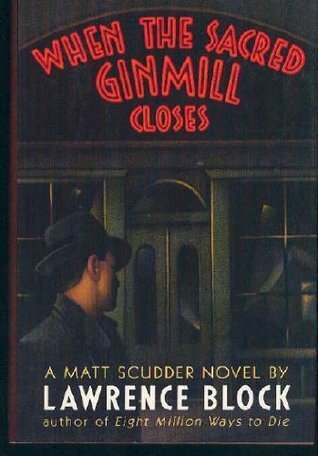
Front cover of the original 1986 Arbor House hardcover edition. Image sourced from Goodreads.

The cases come to a surprising conclusion with some unexpected crossovers. And justice is served, but not the kind that is obtained in a court of law. This was a strong return for Scudder after being retired by Block 4 years earlier. The series would now continue until 2023's The Autobiography of Matthew Scudder

Soundtrack
Used as the book's epigraph, the entire lyrics of Dave Van Ronk's Last Call are quoted in the book when Scudder's friend Keegan plays the record for him. You can hear the song on YouTube here or on Spotify here.

There is one other song mentioned (but not named) in the book:
On the jukebox, a girl sang about having a brand-new pair of roller skates. Her voice seemed to slip in between the notes and find sounds that weren’t on the scale.

From the description, this can only be Melanie Safka's Brand New Key which you can hear on YouTube here or on Spotify here.

Trivia and Links
I read a considerable number of Lawrence Block books in my pre-GR and pre-reviewing days. Probably 40 or so out of the 100+ that are available. That included all of the Matt Scudder books, several of the Bernie Rhodenbarrs, several of the Evan Tanners, several of the John Kellers, a dozen or so standalones and some of the memoirs. There were even a few of the earlier pulp novels which were originally published under pseudonyms. This re-read is a look back at some of those.

Lawrence Block (June 24, 1938 - ) considers himself retired these days, but still maintains an occasional newsletter with the latest issued in August 2024. He self-publishes some of his earlier works that have otherwise gone out of print, using his own LB Productions imprint such as this current eBook edition for When the Sacred Ginmill Closes.
Profile Image for Lynn.
1,608 reviews55 followers
July 18, 2016
Matthew Scudder is working to help friends with problems involving blackmail, robbery and murder. The events in this story took place back when Scudder was a heavy drinker. It seems pretty grim to spend all day maintaining an alcohol numb, but he and his friends do just that. Scudder gave up being a policeman, but figuring out whodunnit was the only bright spot for him in this whole book. Block writes these books from Scudder's point-of-view. He is a very sad guy with no self-pity....so I cried for him.
Profile Image for Toby.
861 reviews373 followers
August 8, 2013
Whilst reading about Jack Taylor fighting the good fight to stay on the wagon in Ken Bruen's Priest recently I figured it was probably inspired by Lawrence Block and Matt Scudder; the last time we met Matt was ready to turn his life around one meeting at a time, so in I jumped to this sixth in the series of books about alcoholic former cop turned professional favours for friends provider Matt Scudder.

Turns out this wasn't the moment I was looking for, When The Sacred Ginmill throws everything you expect from a sequel on its head and instead is Matt's memoirs from a time when he was still trying to drink New York dry. Looking back at the summer of 1975 and how he came to investigate a blackmail, a murder and an armed robbery, all involving his drinking pals, in quick succession.

It has been remarked by almost everybody that has read this series that this book starts off slowly, they're right, it is widely accepted that the completely different approach to the telling of the stories is responsible for this. Block adopts not only a Wonder Years style "it wasn't the same after that summer" reminiscing tone complete with a fantastically well incorporated nostalgia but introduces you to all the players much earlier than usual too. He allows himself the luxury of establishing personal relationships within the narrative, the world that Scudder inhabits and that most difficult thing for a series writer - repeating all the basic facts about your protagonist in a new and interesting way so that your existing fans gain something from the process too. There are few crime writers in any sub-genre who feel comfortable enough with their craft and the attention span of their readers to attempt this kind of reinvention and even fewer who achieve such impressive results. I've said it so many times about Lawrence Block but it deserves repetition, he IS THE crime writer all pretenders should aspire to.

With this one he gets everything right once more, wonderful characterisation, evoking a real sense of place and time, emotional insight in to his protagonist without resorting to lazy techniques, an interesting crime to investigate, a manner of investigation that is true to his character, a powerful and quite unexpected denouement and most importantly for what is still despite it's many qualities genre fiction, a thoroughly entertaining read.

It must be the seventh book in which he battles his demons. Bring it on.
Profile Image for Brandon.
1,010 reviews250 followers
September 20, 2011
I'm very happy for this novel's existence. Apparently, Block had originally planned on ending Scudder's adventures after finishing up Eight Million Ways to Die. However, after writing what was originally intended to be a short story, Block expanded it to what we now know as When the Sacred Ginmill Closes.

Taking place sometime between novels 1 and 5; Scudder is still heavily boozing it up. If I didn't know that this was a "flashback" novel, I would have been completely shocked that Scudder fell off the wagon that quickly and that severely. It's amazing the man can even function with the sheer amount of alcohol he intakes.

While not as deep as Eight Million Ways to Die in terms of Scudder's personal life, it's certainly not an inferior novel. I mean, the book is so thick with plot; I'm surprised I could lift it. You've got Scudder trying to work out 3 separate crimes, all of which never seem to overwhelm him at any point. Granted, they're all interconnected in some way.

His personal problems take a backseat in this novel and the cases are in the fore front. Rarely does he talk about his ex-wife and children, nor his past police work and what caused him to leave the force. I will say this; in the end, after the cases are closed, we return to Scudder as he finishes telling us this story. Without spoiling anything, he does reveal some events that have come and gone since this chapter in his life. I found that pretty interesting as I have no idea where he is in regards to timeline when Book 7 picks up. Looking forward to that.
Profile Image for Richard.
453 reviews126 followers
July 12, 2017
8/10

Scudder oozes class. Yeah he might like to overindulge in a drink or ten and some of his actions may be morally corrupt to the untrained eye but he's one smooth customer. This tale is a flashback of sorts looking back at a time before Scudder tried to give up the booze and was hanging around in many a watering hole.

Scudder gets caught up in a robbery and is asked to investigate so off he goes. He detects and even with the hindrance of booze he detects with class. Nothing fancy other than working the case. There are multiple story lines here weaving around one main one and they all tie together at the end and they're all tied off nicely too.

This was the first Scudder I've read rather than listened to due to some weird lack of this being on audible. The narrators have been chopped and changed and this read really well so I'd be tempted to leave the audio on this series and pick up actual copies going forward.

This is smoother than the whiskey Scudder and his cohorts drink and I'm glad of many more to come.
Profile Image for Peter Swanson.
Author 21 books13k followers
January 14, 2019
The best Scudder. How can a book be so heartbreaking and so much fun at the same time?
Profile Image for Phil.
2,445 reviews236 followers
April 28, 2025
I always have found Matthew Scudder novels a treat, but was left wondering what would happen after the 5th installment of this series Eight Million Ways to Die. It seems there that Matthew finally reached the bottom of his alcoholism and hopped on the wagon. What would that do to his detective work, which largely seems to involved cruising bars? Well, Block changes the script for the series here and presents a 'flashback' in Matthew's life-- some events from the summer of '75.

One of the things I like best about Scudder novels concerns the setting: pre-gentrified NYC, with all its grit. '75 was a bit of a low point for the big apple, with the government just about going broke. Another thing I enjoy concerns the reflections on the human condition and this aspect really shined here, perhaps more so than previous installments. While the mystery and detective work is good, I never really found them the highlight of the books; they seem to exist to move the plot along, but the focus resides on detailed navel gazing about life in general.

When... starts with Matthew in an afterhours bar with various locals and bar buddies with a pair of guys robs the place, taking the money in the till and the cash box, but leaving the patrons alone. The owners of the speakeasy talk to Matt and make know that they are offering 10K for news on the robbers. Matt pokes around a bit on this one, but no joy. Meanwhile, a bar buddy of his wants to hire him. It seems his house was robbed and his wife killed; they find the robbers, but the guys say they did not kill anyone. Tommy, the bar bud, wants Matt to get the dirt on these robbers. Finally, another bar buddy gets blackmailed; someone stole his accounting books (the real and the fake) and wants 50K to get them back or they will go to the IRS...

The emotion unleashed here is slow, but burns really hot. Good stuff! 4 burning stars!
Profile Image for Cathy DuPont.
456 reviews175 followers
October 7, 2013
WOW, WOW, and WOW

 photo aaa909a6-4eb1-4aba-87ed-c9905771161f_zpse09d2fa8.jpg
Lawrence Block circa 1986

WOW, WOW, and WOW AGAIN!

Scudder is not a social drinker but a confirmed alcoholic. In Eight Million Ways to Die, the novel published previous to When the Sacred Ginmill Closes he's attending AA after being told numerous times in the hospital that if he doesn't quit he will die. So what does a normal person do, he/she quits. Which is what Scudder did although he did have a few relapses along the way.

In this book, published in 1986, Scudder is drinking but When ...Ginmill Closes is a reflection (nostalgic, doubtful for Scudder) to 1975 when he was frequenting the 'ginmills' of New York City.

There are multiple storylines which thread throughout the book with his friends who own bars and taverns needing his help. He's not sure how much help he can give but they're insistent.

Sometimes I include updates during my reading of a book especially when there is something to say which I think is interesting.

I included those in the update status, so check there for some spicy lines.

Matthew Scudder is one of the best characters I've come across in many a year and so glad one (or more) of my Goodreads friends suggested that I begin reading the ex-cop who does favors for friends and receives gifts (money) in return.

Lawrence Block, just keep'em coming and at 75, he's still going strong. I receive his blog and his fans can tell that he sincerely enjoys interacting with them. It's obvious with his comments, so if you're a fan, be sure to check out his blog. If you're not a fan, time's awastin'.

Winner of:
Four Anthonys
Eight Edgars
Ten Shamus and the Lifetime Achievement Shamus Award.


Lawrence Block's Blog

Profile Image for Nate.
481 reviews20 followers
June 4, 2017
More solid gold from Block here. Dude really seems to just get noticeably better and better with every book, which is saying something because even the first Scudder novel was remarkable stuff. It’s really something when you get ahold of a work like Eight Million Ways to Die which seems to be as good as things get and powerfully weighted with its own sense of accomplishment and finality, then a followup comes along and is just as good or even arguably better. The Godfather Part II is a good example of this. So’s this book!

This story is entirely a recollection of Scudder’s set during 1975. He’s still drinking and is in the middle of another of his countless boozy nights, hanging out at an after hours bar with fellow night lifers. All of a sudden two dudes bust in and rob the joint and kick off another classic Scudder mystery, with the added bonus that the robbery is just one part of a trifecta of crimes that Scudder will solve in his own woozy, understated way. That’s right folks, not only do we have armed robbery in this one but we also have murder and blackmail! This is easily one of the more complex of Block’s novels I’ve read so far but he never makes it feel byzantine or forcedly complex for complexity’s sake, which is a huge testament to his mastery in the crime genre.

An even bigger indication of how good of a novelist Block is the fact that a lot of the time the cases aren’t even the most potent and rich parts of the story. The really great stuff here is the dialogue, how Block shows us the complexity of Scudder’s character without ever resorting to telegraphing emotions or deploying melodramatic ham-handed freakouts or brooding and the varied real-feeling people speaking real-sounding dialogue Scudder meets and hangs out with (and inevitably, drinks with) in bars and apartments all over super-scummy feeling 70s New York. It all just goes down so easy but can end up haunting you for days afterward, kind of like Scudder’s ever-present bourbon.
Profile Image for William.
676 reviews412 followers
November 3, 2017
Wow, what a sad and confused little book. Only 2.5 Stars.

A trip 10 years into the past, a trip to the cemetery, a road trip to nowhere, a goodbye to who we were. Living like they did, it's not surprising that their greed, arrogance and stupidity carried them all away.

I enjoyed parts of this book, as if an overloaded plane were bouncing down the runway, struggling to get into the air, only to bounce back down again and crash into the barriers.

I suppose the then-48 year old Block wanted it this way, perhaps thinking this was the end of the Scudder line. If so, it was certainly more poorly handled than Lehane's "Midnight Mile" farewell to Kenzie and Genarro.

Some of the dialogue is completely brilliant, but only some. The plotting is confused, and Matt's heart is never in it, not once. Too many innocents suffer, and with Matt's complicity, then acceptance. Blame the alcohol for a broken soul? Even his sense of justice is rushed out at the end, as he looks back on his shattered past.

But he's not drinking, and he feels hope. A nice note to end. I still miss Jan.


Notes:
NOTE! This book is a prequel, happening before "The Sins of the Fathers (book #1)" in time. I was shocked by Matt drinking "again" before I realised the time setting. I was never fond of this hard-core drinking, but I suppose I'll make it through this book.

Matt and Billie are drinking heavily, and Billie insists on Matt hearing this song -
Last Call
When the Sacred Ginmill Closes by Dave Van Ronk

1.0% ... Wow, quite a scare here, until you realise this book is a prequel to the Scudder series.

11.0% ..... dull. Dull, dull, dull. A stupid laundry list of bars and shops in his area. What's the fecking point?

18.0% ... picking up steam, finally.

21.0% ...
“BOURBON is low-down,” she said. “You know what I mean? ... It’s for a gentleman likes to get down in the dirt. Scotch is vests and ties and prep school. Bourbon is an old boy ready to let the animal out, ready to let the nasty show. Bourbon is sitting up on a hot night and not minding if you sweat.” Nobody was sweating.

23.0% ...
And my own thoughts turned suddenly to Anita, out there ... with the boys. I had a moment of fear for her, seeing her menaced, drawing back in terror from some unseen danger. I recognized the fear as irrational, and I was able after a moment to know it for what it was, something I’d brought home with me, something that clung to me now along with Carolyn Cheatham’s scent. I was carrying around Tommy Tillary’s guilt by proxy.

26.0% .... this is such great stuff, great rhythm, great imagery.

28.0% .... Block has used this at least once before ... He does tend to reuse paragraphs between books, now and then ...
I wasn’t sure I liked him, but I was just as happy not to like the men I worked for. It bothered me less that way if I felt I was giving them less than full value.

55.0% ... dragging slowly along here. *facepalm*

55.0% ... Have we seen this LJK license plate before?
e took a scrap of paper from his breast pocket, unfolded it. “LJK-914,” he read.

61.0% ...
... tells you when the services are and what the sermon’s going to be about.
“It’s always about the same thing. Figure out all the things you like to do and don’t do ’em.”


69.0% ... wow, two pages of laugh-out-loud humour! Block can be funny, a bit.

.
Profile Image for The Girl with the Sagittarius Tattoo.
2,946 reviews396 followers
July 20, 2023
I think this is my favorite Matthew Scudder so far. It has more substance to it frankly, partly because it involves two mysteries.

First, one of Matt's drinking buddies is accused of murdering his wife, so he hires Scudder to help him clear his name. The other one involves a bar owner whose financial records are stolen. It seems like a weird thing to steal until we learn the owner's been falsifying the documents, and the thieves want a ransom for their return. Nothing that a cool $50,000 can't resolve.

Throughout the book we see Matthew drinking for breakfast, lunch, dinner and as a late-night snack, just like the events in Eight Million Ways to Die never happened. I was super disappointed (from exasperation rather than sympathy) until I got to the end, when we find out that , but it wasn't as shocking as I was really surprised by that!

Onward to Out on the Cutting Edge.
Profile Image for Annery.
516 reviews156 followers
January 24, 2025
In the last book we were heavily invested in Scudder's "efforts" to get off the sauce. This is a memory book, the events of which take place about ten years in the past, and our Matt is still an active participant in the drinking life.

As expected the two cases in which Scudder becomes involved are intertwined but are almost incidental. Interesting only as they allow us view into the life and people Scudder knew, spent time with, and called friends.

On the technical side I wasn't too thrilled by the narrator. He's fine but ... just not for me. There is an issue with the file where the chapter breaks don't align with the "chapters" in the audiobook. It doesn't affect the enjoyment of the book.
Profile Image for Mohammed  Abdikhader  Firdhiye .
423 reviews7 followers
February 6, 2011
In the end i liked how different this book was from the 5th book that is so highly rated,award winning. I liked the flasback story mostly because of the gang of friends that hanged around with Matt in 1975. I liked Skip and co, the first Scudder book that hade lines that made me laugh. They tend to be more bleak,complex character study.

I liked how beliavable Block ended the different cases, how Matt worked without being some super detective. I liked the different things that the title was a symbol for in the story. Before i read the series i thought it was a simple title that catched your eye because a real ginmill was closing in the actual story. Hehe talk about not knowing Scudder books are not that straightforward
Displaying 1 - 30 of 405 reviews

Can't find what you're looking for?

Get help and learn more about the design.