

What do you think?
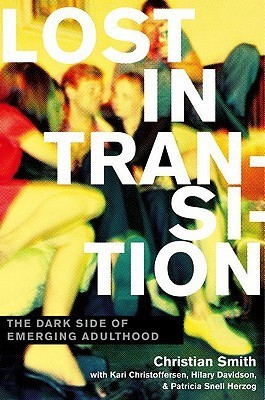
Lost in Transition: The Dark Side of Emerging Adulthood
Life for emerging adults is vastly different today than it was for their counterparts even a generation ago. Young people are waiting longer to marry, to have children, and to choose a career direction. As a result, they enjoy more freedom, opportunities, and personal growth than ever before. But the transition to adulthood is also more complex, disjointed, and confusing.
In Lost in Transition , Christian Smith and his collaborators draw on 230 in-depth interviews with a broad cross-section of emerging adults (ages 18-23) to investigate the difficulties young people face today, the underlying causes of those difficulties, and the consequences both for individuals and for American society as a whole. Rampant consumer capitalism, ongoing failures in education, hyper-individualism, postmodernist moral relativism, and other aspects of American culture are all contributing to the chaotic terrain that emerging adults must cross. Smith identifies five major problems facing very many young people confused moral reasoning, routine intoxication, materialistic life goals, regrettable sexual experiences, and disengagement from civic and political life. The trouble does not lie only with the emerging adults or their poor individual decisions but has much deeper roots in mainstream American culture--a culture which emerging adults have largely inherited rather
than created. Older adults, Smith argues, must recognize that much of the responsibility for the pain and confusion young people face lies with them. Rejecting both sky-is-falling alarmism on the one hand and complacent disregard on the other, Smith suggests the need for what he calls "realistic concern"--and a reconsideration of our cultural priorities and practices--that will help emerging adults more skillfully engage unique challenges they face.
Even-handed, engagingly written, and based on comprehensive research, Lost in Transition brings much needed attention to the darker side of the transition to adulthood.
In Lost in Transition , Christian Smith and his collaborators draw on 230 in-depth interviews with a broad cross-section of emerging adults (ages 18-23) to investigate the difficulties young people face today, the underlying causes of those difficulties, and the consequences both for individuals and for American society as a whole. Rampant consumer capitalism, ongoing failures in education, hyper-individualism, postmodernist moral relativism, and other aspects of American culture are all contributing to the chaotic terrain that emerging adults must cross. Smith identifies five major problems facing very many young people confused moral reasoning, routine intoxication, materialistic life goals, regrettable sexual experiences, and disengagement from civic and political life. The trouble does not lie only with the emerging adults or their poor individual decisions but has much deeper roots in mainstream American culture--a culture which emerging adults have largely inherited rather
than created. Older adults, Smith argues, must recognize that much of the responsibility for the pain and confusion young people face lies with them. Rejecting both sky-is-falling alarmism on the one hand and complacent disregard on the other, Smith suggests the need for what he calls "realistic concern"--and a reconsideration of our cultural priorities and practices--that will help emerging adults more skillfully engage unique challenges they face.
Even-handed, engagingly written, and based on comprehensive research, Lost in Transition brings much needed attention to the darker side of the transition to adulthood.
292 pages, Hardcover
First published July 7, 2011
About the author
Christian Smith
110 books74 followersChristian Smith is the William R. Kenan, Jr. Professor of Sociology and Director of the Center for the Study of Religion and Society at the University of Notre Dame. Smith's research focuses primarily on religion in modernity, adolescents, American evangelicalism, and culture.
Ratings & Reviews
Friends & Following
Create a free account to discover what your friends think of this book!
Community Reviews
Displaying 1 - 30 of 39 reviews

October 10, 2014
Christian Smith and his team of researchers have done an outstanding job in their published work by communicating their findings from the National Study of Youth and Religion (NSYR) in a series of books released for the general public. Anyone interested in the true state of American religion should be familiar with this work, which now has shifted from a study of teens aged 13-19 to a longitudinal study that notes how these beliefs and practices shift over time.
You may already be familiar with Smith's not-so-pithy but strikingly insightful summary of the de facto religious beliefs of American youth as "moralistic therapeutic deism", a term he coined when doing his original study published in Soul Searching: The Religious Lives of American Teenagers along with Melinda Denton. In Lost in Transition, his attention has shifted to a later cohort of 19-24 year-olds first interviewed in the earlier study. Now, they are what are known as "emerging adults", a life stage that has come into being on account of postponement of marriage and childbearing, less stable career paths in a global economy, and a greater willingness of parents to continue to support their children after they leave the home (among other things).
There are the typical challenges most people may already recognize in the lives of emerging adults, particularly college students, including the hook-up culture, binge drinking, and drug use. These are all too familiar, unfortunately. But what was surprising about these findings were the attitudes that also showed up among emerging adults: uncritical embrace of mass consumerism, almost total disengagement from civic and political life, and an inability to aspire to much beyond the limited horizon of a secure job and good relationships. Some of these things are not terribly important in the short term, but do not bode well for the future of our republic, and so should be of concern to all, not just those who are actively engaged in education or ministry. The importance of Smith's published work is not in any proposed solutions to these developments; none, in fact, are offered. Rather, his more modest goal is simply to communicate that what is happening in the lives of emerging adults in 21st century America does not serve them well and does not contribute to their flourishing or to the common good.
The more we can be persuaded that this is the case, the better. Without agreement that something must change in the short term, youth and emerging adults will continue to suffer the dire consequences of inaction.
You may already be familiar with Smith's not-so-pithy but strikingly insightful summary of the de facto religious beliefs of American youth as "moralistic therapeutic deism", a term he coined when doing his original study published in Soul Searching: The Religious Lives of American Teenagers along with Melinda Denton. In Lost in Transition, his attention has shifted to a later cohort of 19-24 year-olds first interviewed in the earlier study. Now, they are what are known as "emerging adults", a life stage that has come into being on account of postponement of marriage and childbearing, less stable career paths in a global economy, and a greater willingness of parents to continue to support their children after they leave the home (among other things).
There are the typical challenges most people may already recognize in the lives of emerging adults, particularly college students, including the hook-up culture, binge drinking, and drug use. These are all too familiar, unfortunately. But what was surprising about these findings were the attitudes that also showed up among emerging adults: uncritical embrace of mass consumerism, almost total disengagement from civic and political life, and an inability to aspire to much beyond the limited horizon of a secure job and good relationships. Some of these things are not terribly important in the short term, but do not bode well for the future of our republic, and so should be of concern to all, not just those who are actively engaged in education or ministry. The importance of Smith's published work is not in any proposed solutions to these developments; none, in fact, are offered. Rather, his more modest goal is simply to communicate that what is happening in the lives of emerging adults in 21st century America does not serve them well and does not contribute to their flourishing or to the common good.
The more we can be persuaded that this is the case, the better. Without agreement that something must change in the short term, youth and emerging adults will continue to suffer the dire consequences of inaction.

December 21, 2016
Millennials are probably the most researched generation ever and they are probably the most criticized generation ever. It seems like every week there is a new story about millennials not working hard enough, taking on too much debt, expecting too much from their bosses, etc.
Lost in Transition is a substantial qualitative study of 18-23 years old or emerging adults and how they interact with their environment. The study covers the areas of morality, consumerism, intoxication, sexuality, and civic and political engagement.
The results of the research were not surprising. Emerging adults are morally confused, advocates for capitalism and consumerism, frequent users of alcohol and drugs, sexually promiscuous, and civically detached. It was interesting to read the stories of the emerging adults and how hear their perspectives.
I would really enjoy seeing comparative studies that compare 18-23 adults today to 18-23 adults from twenty or so years ago. Obviously there would be some changes like media and technology, but would the heart of the matter change? Are emerging adults today significantly different from emerging adults of the past? Additionally, a comparative study that shows how 18-23 adults measure up to other older and younger generations would be interesting.
One example, emerging adults are morally confused. They are gaining their independence from the parents and have very little responsibilities, meaning their attachments to others are minimal and their moral code has little impact on their life. However, are adults over the age of 23 better at morality and are they able to communicate morality any better? Most philosophers and theologians have a difficult time defining a universal morality.
I enjoyed this book, but I felt like it was a little too critical of emerging adults. Emerging adults are in a time of transition. They do not comprehend the complexities of life and it should not be expected.
Anyone interested working with emerging adults would benefit from reading this book, but I think they should understand that this is only a tiny snapshot of college aged students.
Lost in Transition is a substantial qualitative study of 18-23 years old or emerging adults and how they interact with their environment. The study covers the areas of morality, consumerism, intoxication, sexuality, and civic and political engagement.
The results of the research were not surprising. Emerging adults are morally confused, advocates for capitalism and consumerism, frequent users of alcohol and drugs, sexually promiscuous, and civically detached. It was interesting to read the stories of the emerging adults and how hear their perspectives.
I would really enjoy seeing comparative studies that compare 18-23 adults today to 18-23 adults from twenty or so years ago. Obviously there would be some changes like media and technology, but would the heart of the matter change? Are emerging adults today significantly different from emerging adults of the past? Additionally, a comparative study that shows how 18-23 adults measure up to other older and younger generations would be interesting.
One example, emerging adults are morally confused. They are gaining their independence from the parents and have very little responsibilities, meaning their attachments to others are minimal and their moral code has little impact on their life. However, are adults over the age of 23 better at morality and are they able to communicate morality any better? Most philosophers and theologians have a difficult time defining a universal morality.
I enjoyed this book, but I felt like it was a little too critical of emerging adults. Emerging adults are in a time of transition. They do not comprehend the complexities of life and it should not be expected.
Anyone interested working with emerging adults would benefit from reading this book, but I think they should understand that this is only a tiny snapshot of college aged students.

April 16, 2012
This book reveals in detail what is going on in the minds and lives of “emerging adults” those between the ages of 18-23. The first chapter is, in my opinion, the most important. It serves as the lynchpin to the rest. Chapter one reveals what this group thinks about morality. What is moral, how they determine right from wrong, and what is the source or basis for morality? What is revealed is disturbing, disappointing but not socking. What comes out is their basic philosophy of living which is, most things are simply a matter of personal choice. That there is no real objective reality, so there is no obligation to help others in need other than if you want to then go ahead. One way to sum up their view of society is that it is a national mega-supermarket of endless products & services where shoppers seek human fulfillment through mass consumption.
The authors are very careful to point out along the way that there are several reasons for this. They do not jump to conclusions and try to put all the blame on any one group or institution. In the end the book is very sobering, abundantly informative, and richly beneficial. If you have read The Culture of Narcissism: American Life in an Age of Diminishing Expectations by Robert Lasch, then this is the appropriate follow-up and outflow of that work.
The authors are very careful to point out along the way that there are several reasons for this. They do not jump to conclusions and try to put all the blame on any one group or institution. In the end the book is very sobering, abundantly informative, and richly beneficial. If you have read The Culture of Narcissism: American Life in an Age of Diminishing Expectations by Robert Lasch, then this is the appropriate follow-up and outflow of that work.

June 9, 2017
If you want to know what emerging adults (18-25 year olds) are dealing with, then read this book. There are positives of emerging adulthood as well but this book exposes the negatives, so that we can better understand and help.

July 15, 2020
2/3 of my punishment books
Yeah, no. Like okay, but also no.
Yeah, no. Like okay, but also no.

Read
February 3, 2026A profound analysis of the millennial generation. But what about family and children?
This is a sociological study that began with a telephone survey in 2001 of a few thousand men and women who were born 1986 to 1991. This initial survey was followed up with personal interviews of 267 of them in 2005 and of 122 again in 2008 when they were 18 to 23 years old.
The book draws on the interviews rather than on data collected statistically. It is rich with quotes, presumably taken from tapes of the interviews. Sen Ben Sass draws on Smith's findings in The Vanishing American Adult: Our Coming-of-Age Crisis--and How to Rebuild a Culture of Self-Reliance.
The authors note all of the problems in conducting such a survey. They cannot be representative because some of the initial respondents die wind up incarcerated or institutionalized or simply cannot be located. In other words, the interviews would've self-selected for respondents was somewhat more successful lives. Nonetheless, the authors were troubled by what they found. The chapter titles for their findings are:
1) Morality Adrift
2) Captive to Consumerism
3) Intoxication's "Fake Feeling of Happiness"
4) The Shadow Side of Sexual Liberation
5) Civic and Political Disengagement
This review includes significant quotes from each of the chapters.
1) Morality Adrift
These young people were not getting much moral instruction. Their Boomer parents did not receive much themselves, and they are such moral relativists that they are reluctant to give their children moral instruction. They leave it to the schools, but the schools absolutely wash their hands of the matter.
Smith writes "In short, it appears that most schools, especially public schools, are not teaching students how to constructively engage moral issues about which people disagree. Quite the contrary, schools are teaching students that the best way to deal with difficult moral problems and questions is to ignore them. The moral pedagogy of most middle and high schools clearly seems to be: avoid, ignore, and pretend the issues will go away. Needless to say, that is naive and impossible. It actually resembles highly dysfunctional families that have sets of issues that nobody is allowed to bring up or discuss and that are instead carefully tiptoed around.
"To be clear, we do not think that American public schools should be in the business of promoting one particular substantive moral position on specific moral issues. Private schools may do that, but not public schools. But all schools certainly should be promoting the particular position that it is good to learn how to think clearly and coherently about important issues, including moral issues. That is what education is all about. Schools do not need to teach what in particular students should believe on every moral matter. But they certainly could, and, we think, should, teach how to reason well when it comes to moral problems."
"… emerging adults have observed how purportedly universal, absolutist moral claims have led to horrific destruction and violence. The attacks of September 11, 2001—which took place when this cohort of youth was 11 to 16 years old—is an archetypical case in point. These emerging adults have also heard about the Crusades, Jim Crow America, the Holocaust, Communism’s destruction of more than 100 million people, the Rwandan genocide, and so on. At the same time, these emerging adults have not been taught well how to differentiate between strong moral and religious claims that should be tolerated, if not respected, and those that deserve to be refuted, rejected, and opposed. Very few have been given the reasoning tools and skills to discern such important differences. As a result, many emerging adults simply end up trying to completely avoid making any strong moral claims themselves, as well as avoiding criticizing the moral views of others…"
In this chapter Smith does not address the basis of morality, a sense of purpose in life. He mentions it only in the conclusion. But without the kind of purpose in life that is given by Charles Murray's four fundamental personal characteristics undergirding a happy life --- honesty and industry, meaningful relationships, and a satisfying marriage --- they are like marionettes with cut strings. Nothing to hold them up. In this reviewer's words, the fact that they are not committed to family, community, church or nation leaves them adrift. This book describes what it is to be adrift.
A factor that Smith does not address is the schools' active disparagement of Western values. The quote above says that they do not accept absolutist moral claims. This is absolutely true, and their teachers beat it into them. They are repeatedly told of the evils of slavery, colonialism, the treatment of Japanese at Manzinar, our display element of the environment, the mistreatment of women under the patriarchy and so on. While what they are taught has a basis in historical fact, no credit is given to the fact that it was Western man, very often Americans, who recognized the existence of problems like slavery and did something about it. Quite the contrary, the private schools in Washington DC that my grown children (born 1982, 1983 and 1988) attended taught them that straight white males were uniquely evil. Mine are typical of the children that Smith is describing.
Smith writes "That the social order that emerging adults enjoy works as well as it does can simply be taken for granted. That schools, banks, corporations, and the rest function as well as they seem to is simply assumed to be normal. Functional order and social prosperity are taken to be the natural default, not valuable accomplishments that take real collective human effort. The idea that a democracy or a republic or any humane society requires that its citizens continually invest in the common good, or even actively contribute to institutional functionality, by sustaining and practicing moral virtues, such as acts of care and goodness, that go beyond simple procedural justice, is either inconceivable or else sounds laughably old-fashioned."
I agree with Smith. Yes, our children assume these institutions are infinitely resilient. They can absorb ANTIFA, BLM and other assaults, infinite talk about assassinating the president, fake news, leaks etc. with no damage. They do not appreciate how irreparable the damage being done today in 2017 will turn out to be.
2) Captive to Consumerism
The emerging adults whom Smith interviewed talked endlessly about the things that they wanted in life. They wanted not only the big things – a house and a car -- but the ability to shop extensively and almost aimlessly. The ability to consume. The freedom to while their lives away in Starbucks and Applebee's.
Smith writes: "Material comfort, security, family, and happiness. When asked about what makes a good life in terms of an 'ideal kind of lifestyle' and about goals when it comes to 'buying, owning, and consuming,' most emerging adults expressed some variant of this answer: 'A family, a nice car, nice house, my own practice, be happy, stuff like that.'"
Surprising to me, and certainly worth more mention than Smith gives it, is the lack of talk about children. Some of the respondents talked about "having kids." That's it. There is not a single mention of providing for the kids. Planning their education, passing on the culture and moral values, paying for vacations with the kids, paying pediatricians and the other specialists that they require. "Having kids" seems to be a distant and abstract thought to all of these respondents.
On education, Smith writes: "Most, though not all, emerging adults believe in the importance of finishing high school and getting a college education. Large numbers want to do well in school, go to college, get a degree, and put it to good use. But for most, the reasons they value college seem to have little to do with the broadly humanistic vision of higher education described above. Rather, their motivations have almost entirely to do with the instrumental advantages it produces for them as competitive individuals—as well as the fun they want to have while in college. What really matters to emerging adults is getting the credits, earning the diploma, and becoming certified as a college-educated person so that they can get a better job, earn more money, and become a good salary earner and supporter of a materially comfortable and secure life."
"In any case, seldom did anyone we interviewed mention family alone as defining their vision of what they ultimately want to get out of or accomplish in life. Usually, marriage and family were combined with a few other goals, values, and interests."
"The systemic imperative of economic growth in early 20th-century America launched not only new methods of mass production on the assembly line, which brought the price of most goods down to popularly affordable levels, but also three other key economic institutions. The first was a new marketing and advertising industry, which learned to sell products based not on the actual features of products themselves but on the identities, emotions, aspirations they as advertisers could construct for consumers to (often arbitrarily) associate with the products. Advertising thus became fundamentally irrational in the character of its appeal, making products desirable in ways often having nothing to do with their actual product characteristics. The second key institution generated by America’s burgeoning mass consumer economy was 'planned obsolescence,' first experimented with in the 1920s and 1930s. In some cases, this meant intentionally designing products to have limited useful lives, so they would break or wear out and have to be replaced. In other cases, this meant purposefully changing products’ visual styles and fashions, in order to make still-functioning products unwanted by consumers seeking to stay fashionable and 'with the style.' Thus, the former CEO of General Motors, Alfred P. Sloan, who helped invent the automobile’s annual model change, said in 1941, 'Today the appearance of a motorcar is a most important factor in the selling end of the business—perhaps the most important factor—because everyone knows the car will run.' The third institution invented to meet the systemic requisites of the rapidly expanding mass consumer economy was consumer credit. Until the early twentieth century, when the economy shifted from being production-oriented to consumption-oriented, most Americans called borrowing money to pay for consumer items 'debt' and considered it moral vice and practical foolishness. Good, smart people only bought what they could afford and saved up the money before purchasing new goods. In order to create a new consumer mentality that would encourage people to buy all they could afford and more, therefore, financial leaders replaced the old term 'debt' with the new term 'credit' and promoted credit-buying as a consumer right and moral good."
3) Intoxication's "Fake Feeling of Happiness"
Partying is on campus. Smith describes the social pressure to drink. It is not merely on campus. Half a century ago I felt it strongly both in fraternity life and the military. He attributes a commercial motive to much of it. The alcoholic beverage industry floods us with advertising. The same is starting to happen with legalized pot.
4) The Shadow Side of Sexual Liberation
Smith's whole discussion about sex does not talk about building relationships. Not romance, not marriage, not family.
Smith writes: "Emerging adults can jump into intimate relationships assuming that sex is just another consumer item, recreational thrill, or lifestyle commodity. But many of them soon discover the hard way that sex is much more profound and precious than that."
I would point out that the world's oldest profession, prostitution, certainly treats sex as a commercial item. Nothing new here. What is new is that men (and women) are no longer interested in forming families to reproduce themselves, so sex becomes little more than the act. Making love can be commercialized; making and raising children not so much.
Smith writes: Historically, human societies and cultures have known that sex is both powerful and potentially destructive. So everyone has devised ways to regulate sex. Typically, the social regulation of sex throughout human history has involved the exercise of patriarchy, repression, domination, coercion, and exploitation. The social control of sexuality has not always or even often benefitted the individuals involved. The sexual revolution of the 1960s and ‘70s was in part an attempt to remedy some of those problems, to lift former restrictions on sexual expression and leave more up to individual choice and happiness."
A factor Smith does not consider is the evolution of the family described by Carle Zimmerman in [[ASIN:B00JOW1WUC Family and Civilization]], from trustee to patriarchal to nuclear. Monogamy and fidelity are concepts associated with a patriarchal family. Since the Industrial Revolution liberated women, hypergamy has become the norm. Women do not want to settle for mere average men. Media expose them to the most attractive models, and as consumers that's what they want. There are not enough alpha males to go around. Women aspire for the best, giving themselves wantonly, only to suffer disappointment. It is consumerism gone amok, destroying our civilization's ability to reproduce itself.
5) Civic and Political Disengagement
Smith writes: "But whatever any popular cultural or political observers have had to say about the political interests of emerging adults, we—without joy—can set the record straight here: almost all emerging adults today are either apathetic, uninformed, distrustful, disempowered, or, at most only marginally interested when it comes to politics."
"Most emerging adults also have positive relationships with their parents, relationships that most value and spend time and effort to maintain. But most of those family relationships have also been renegotiated to selectively keep parents in the dark or at a distance about many of the important things going on in emerging adults’ lives. Parental relationships may remain important in many ways, but they usually do not form the fabric of the daily interactions or consume the hours of time spent together that other emerging adult relationships do. This means that, structurally, most emerging adults live this crucial decade of life surrounded mostly by their peers—people of the same age and in the same boat—who have no more experience, insight, wisdom, perspective, or balance than they do. It is sociologically a very odd way to help young people come of age, to learn how to be responsible, capable, mature adults."
"Yet there are ironies in American individualism. Having freed people from the formative influences and obligations of town, church, extended family, and conventional morality, American individualism has exposed those people to the more powerful influences and manipulations of mass consumer capitalism. Stripped down to a mere autonomous individuality, people stand naked before the onslaught of commercial media, all-pervasive advertising, shopping malls, big-box stores, credit-card buying, and the dominant narrative of a materially defined vision of the good life. In this, one form of external authority has been displaced by another, much more insidious and controlling external authority—all done in the name of individual self-determination."
6) Conclusion
Only in the conclusion does Smith, the agnostic social scientist, note that a structured system of values, such as a religious faith, may be required to give meaning to life and resolve the issues that he so extensively chronicles. Yes! People must believe in family, society and nation. However, the message they receive from all quarters is the opposite: celebrate diversity, and devalue your own historical antecedents.
My personal solution, after having raised a family in the United States that is dysfunctional in all the ways Smith describes, has been to move to a more traditional society in Eastern Europe to raise a second family. It is under assault by cultural influences from Western Europe and America. However, as I write this those forces seem to be imploding from overwhelming debt, abysmal birthrates, and a profound lack of belief in themselves.
This is a sociological study that began with a telephone survey in 2001 of a few thousand men and women who were born 1986 to 1991. This initial survey was followed up with personal interviews of 267 of them in 2005 and of 122 again in 2008 when they were 18 to 23 years old.
The book draws on the interviews rather than on data collected statistically. It is rich with quotes, presumably taken from tapes of the interviews. Sen Ben Sass draws on Smith's findings in The Vanishing American Adult: Our Coming-of-Age Crisis--and How to Rebuild a Culture of Self-Reliance.
The authors note all of the problems in conducting such a survey. They cannot be representative because some of the initial respondents die wind up incarcerated or institutionalized or simply cannot be located. In other words, the interviews would've self-selected for respondents was somewhat more successful lives. Nonetheless, the authors were troubled by what they found. The chapter titles for their findings are:
1) Morality Adrift
2) Captive to Consumerism
3) Intoxication's "Fake Feeling of Happiness"
4) The Shadow Side of Sexual Liberation
5) Civic and Political Disengagement
This review includes significant quotes from each of the chapters.
1) Morality Adrift
These young people were not getting much moral instruction. Their Boomer parents did not receive much themselves, and they are such moral relativists that they are reluctant to give their children moral instruction. They leave it to the schools, but the schools absolutely wash their hands of the matter.
Smith writes "In short, it appears that most schools, especially public schools, are not teaching students how to constructively engage moral issues about which people disagree. Quite the contrary, schools are teaching students that the best way to deal with difficult moral problems and questions is to ignore them. The moral pedagogy of most middle and high schools clearly seems to be: avoid, ignore, and pretend the issues will go away. Needless to say, that is naive and impossible. It actually resembles highly dysfunctional families that have sets of issues that nobody is allowed to bring up or discuss and that are instead carefully tiptoed around.
"To be clear, we do not think that American public schools should be in the business of promoting one particular substantive moral position on specific moral issues. Private schools may do that, but not public schools. But all schools certainly should be promoting the particular position that it is good to learn how to think clearly and coherently about important issues, including moral issues. That is what education is all about. Schools do not need to teach what in particular students should believe on every moral matter. But they certainly could, and, we think, should, teach how to reason well when it comes to moral problems."
"… emerging adults have observed how purportedly universal, absolutist moral claims have led to horrific destruction and violence. The attacks of September 11, 2001—which took place when this cohort of youth was 11 to 16 years old—is an archetypical case in point. These emerging adults have also heard about the Crusades, Jim Crow America, the Holocaust, Communism’s destruction of more than 100 million people, the Rwandan genocide, and so on. At the same time, these emerging adults have not been taught well how to differentiate between strong moral and religious claims that should be tolerated, if not respected, and those that deserve to be refuted, rejected, and opposed. Very few have been given the reasoning tools and skills to discern such important differences. As a result, many emerging adults simply end up trying to completely avoid making any strong moral claims themselves, as well as avoiding criticizing the moral views of others…"
In this chapter Smith does not address the basis of morality, a sense of purpose in life. He mentions it only in the conclusion. But without the kind of purpose in life that is given by Charles Murray's four fundamental personal characteristics undergirding a happy life --- honesty and industry, meaningful relationships, and a satisfying marriage --- they are like marionettes with cut strings. Nothing to hold them up. In this reviewer's words, the fact that they are not committed to family, community, church or nation leaves them adrift. This book describes what it is to be adrift.
A factor that Smith does not address is the schools' active disparagement of Western values. The quote above says that they do not accept absolutist moral claims. This is absolutely true, and their teachers beat it into them. They are repeatedly told of the evils of slavery, colonialism, the treatment of Japanese at Manzinar, our display element of the environment, the mistreatment of women under the patriarchy and so on. While what they are taught has a basis in historical fact, no credit is given to the fact that it was Western man, very often Americans, who recognized the existence of problems like slavery and did something about it. Quite the contrary, the private schools in Washington DC that my grown children (born 1982, 1983 and 1988) attended taught them that straight white males were uniquely evil. Mine are typical of the children that Smith is describing.
Smith writes "That the social order that emerging adults enjoy works as well as it does can simply be taken for granted. That schools, banks, corporations, and the rest function as well as they seem to is simply assumed to be normal. Functional order and social prosperity are taken to be the natural default, not valuable accomplishments that take real collective human effort. The idea that a democracy or a republic or any humane society requires that its citizens continually invest in the common good, or even actively contribute to institutional functionality, by sustaining and practicing moral virtues, such as acts of care and goodness, that go beyond simple procedural justice, is either inconceivable or else sounds laughably old-fashioned."
I agree with Smith. Yes, our children assume these institutions are infinitely resilient. They can absorb ANTIFA, BLM and other assaults, infinite talk about assassinating the president, fake news, leaks etc. with no damage. They do not appreciate how irreparable the damage being done today in 2017 will turn out to be.
2) Captive to Consumerism
The emerging adults whom Smith interviewed talked endlessly about the things that they wanted in life. They wanted not only the big things – a house and a car -- but the ability to shop extensively and almost aimlessly. The ability to consume. The freedom to while their lives away in Starbucks and Applebee's.
Smith writes: "Material comfort, security, family, and happiness. When asked about what makes a good life in terms of an 'ideal kind of lifestyle' and about goals when it comes to 'buying, owning, and consuming,' most emerging adults expressed some variant of this answer: 'A family, a nice car, nice house, my own practice, be happy, stuff like that.'"
Surprising to me, and certainly worth more mention than Smith gives it, is the lack of talk about children. Some of the respondents talked about "having kids." That's it. There is not a single mention of providing for the kids. Planning their education, passing on the culture and moral values, paying for vacations with the kids, paying pediatricians and the other specialists that they require. "Having kids" seems to be a distant and abstract thought to all of these respondents.
On education, Smith writes: "Most, though not all, emerging adults believe in the importance of finishing high school and getting a college education. Large numbers want to do well in school, go to college, get a degree, and put it to good use. But for most, the reasons they value college seem to have little to do with the broadly humanistic vision of higher education described above. Rather, their motivations have almost entirely to do with the instrumental advantages it produces for them as competitive individuals—as well as the fun they want to have while in college. What really matters to emerging adults is getting the credits, earning the diploma, and becoming certified as a college-educated person so that they can get a better job, earn more money, and become a good salary earner and supporter of a materially comfortable and secure life."
"In any case, seldom did anyone we interviewed mention family alone as defining their vision of what they ultimately want to get out of or accomplish in life. Usually, marriage and family were combined with a few other goals, values, and interests."
"The systemic imperative of economic growth in early 20th-century America launched not only new methods of mass production on the assembly line, which brought the price of most goods down to popularly affordable levels, but also three other key economic institutions. The first was a new marketing and advertising industry, which learned to sell products based not on the actual features of products themselves but on the identities, emotions, aspirations they as advertisers could construct for consumers to (often arbitrarily) associate with the products. Advertising thus became fundamentally irrational in the character of its appeal, making products desirable in ways often having nothing to do with their actual product characteristics. The second key institution generated by America’s burgeoning mass consumer economy was 'planned obsolescence,' first experimented with in the 1920s and 1930s. In some cases, this meant intentionally designing products to have limited useful lives, so they would break or wear out and have to be replaced. In other cases, this meant purposefully changing products’ visual styles and fashions, in order to make still-functioning products unwanted by consumers seeking to stay fashionable and 'with the style.' Thus, the former CEO of General Motors, Alfred P. Sloan, who helped invent the automobile’s annual model change, said in 1941, 'Today the appearance of a motorcar is a most important factor in the selling end of the business—perhaps the most important factor—because everyone knows the car will run.' The third institution invented to meet the systemic requisites of the rapidly expanding mass consumer economy was consumer credit. Until the early twentieth century, when the economy shifted from being production-oriented to consumption-oriented, most Americans called borrowing money to pay for consumer items 'debt' and considered it moral vice and practical foolishness. Good, smart people only bought what they could afford and saved up the money before purchasing new goods. In order to create a new consumer mentality that would encourage people to buy all they could afford and more, therefore, financial leaders replaced the old term 'debt' with the new term 'credit' and promoted credit-buying as a consumer right and moral good."
3) Intoxication's "Fake Feeling of Happiness"
Partying is on campus. Smith describes the social pressure to drink. It is not merely on campus. Half a century ago I felt it strongly both in fraternity life and the military. He attributes a commercial motive to much of it. The alcoholic beverage industry floods us with advertising. The same is starting to happen with legalized pot.
4) The Shadow Side of Sexual Liberation
Smith's whole discussion about sex does not talk about building relationships. Not romance, not marriage, not family.
Smith writes: "Emerging adults can jump into intimate relationships assuming that sex is just another consumer item, recreational thrill, or lifestyle commodity. But many of them soon discover the hard way that sex is much more profound and precious than that."
I would point out that the world's oldest profession, prostitution, certainly treats sex as a commercial item. Nothing new here. What is new is that men (and women) are no longer interested in forming families to reproduce themselves, so sex becomes little more than the act. Making love can be commercialized; making and raising children not so much.
Smith writes: Historically, human societies and cultures have known that sex is both powerful and potentially destructive. So everyone has devised ways to regulate sex. Typically, the social regulation of sex throughout human history has involved the exercise of patriarchy, repression, domination, coercion, and exploitation. The social control of sexuality has not always or even often benefitted the individuals involved. The sexual revolution of the 1960s and ‘70s was in part an attempt to remedy some of those problems, to lift former restrictions on sexual expression and leave more up to individual choice and happiness."
A factor Smith does not consider is the evolution of the family described by Carle Zimmerman in [[ASIN:B00JOW1WUC Family and Civilization]], from trustee to patriarchal to nuclear. Monogamy and fidelity are concepts associated with a patriarchal family. Since the Industrial Revolution liberated women, hypergamy has become the norm. Women do not want to settle for mere average men. Media expose them to the most attractive models, and as consumers that's what they want. There are not enough alpha males to go around. Women aspire for the best, giving themselves wantonly, only to suffer disappointment. It is consumerism gone amok, destroying our civilization's ability to reproduce itself.
5) Civic and Political Disengagement
Smith writes: "But whatever any popular cultural or political observers have had to say about the political interests of emerging adults, we—without joy—can set the record straight here: almost all emerging adults today are either apathetic, uninformed, distrustful, disempowered, or, at most only marginally interested when it comes to politics."
"Most emerging adults also have positive relationships with their parents, relationships that most value and spend time and effort to maintain. But most of those family relationships have also been renegotiated to selectively keep parents in the dark or at a distance about many of the important things going on in emerging adults’ lives. Parental relationships may remain important in many ways, but they usually do not form the fabric of the daily interactions or consume the hours of time spent together that other emerging adult relationships do. This means that, structurally, most emerging adults live this crucial decade of life surrounded mostly by their peers—people of the same age and in the same boat—who have no more experience, insight, wisdom, perspective, or balance than they do. It is sociologically a very odd way to help young people come of age, to learn how to be responsible, capable, mature adults."
"Yet there are ironies in American individualism. Having freed people from the formative influences and obligations of town, church, extended family, and conventional morality, American individualism has exposed those people to the more powerful influences and manipulations of mass consumer capitalism. Stripped down to a mere autonomous individuality, people stand naked before the onslaught of commercial media, all-pervasive advertising, shopping malls, big-box stores, credit-card buying, and the dominant narrative of a materially defined vision of the good life. In this, one form of external authority has been displaced by another, much more insidious and controlling external authority—all done in the name of individual self-determination."
6) Conclusion
Only in the conclusion does Smith, the agnostic social scientist, note that a structured system of values, such as a religious faith, may be required to give meaning to life and resolve the issues that he so extensively chronicles. Yes! People must believe in family, society and nation. However, the message they receive from all quarters is the opposite: celebrate diversity, and devalue your own historical antecedents.
My personal solution, after having raised a family in the United States that is dysfunctional in all the ways Smith describes, has been to move to a more traditional society in Eastern Europe to raise a second family. It is under assault by cultural influences from Western Europe and America. However, as I write this those forces seem to be imploding from overwhelming debt, abysmal birthrates, and a profound lack of belief in themselves.

January 14, 2018
I find these books by Smith and his colleagues interesting to read to get a sense of how and what young people think. At times, some of the data may seem discouraging, however, the authors do give some suggestions for making differences in the future and encourage neither fear nor complacency, but realistic care, mentoring and relationships by adults in their lives.
The interviews focussed on early emergent adults between the ages of 18-23, a group characterised by the following social changes: a growth in higher education; a delay in marriage; an undermining of stable careers (replaced by lower security and more frequent job changes with new education and training); a continuation of parental support into one's 20's and 30's; a disconnect b/n sexual intercourse and procreation (due to the wide use of birth control); and a rise in postmodern mindset which manifests in uncertainty, absolute moral relativism, and individual subjectivism (to name a few).
Each chapter covers a different issue and includes transcripts of interviews, some insight on the answers and some ways to interact with these young adults if we hope to speak meaningfully into their lives. Chapter 1 on "Morality Adrift" was the most interesting to me. Moral thinking is not particularly coherent, consistent, or articulate. Views are very individualistic--"I may not do it, but it doesn't mean it is wrong for everyone; I don't want to judge others". The authors also note that current adult society has done a poor job of moral education and formation and that young adults haven't been taught to distinguish between what should and should not be tolerated.
Chapter 2 "Captive to Consumerism" continues with the theme of individualism and how many are pursuing a middle class or higher financial lifestyle for themselves and their families and don't seem to have concern for the broader global economy or the environment.
Chapter 3 "Intoxicants 'Fake Feeling of Happiness'" deals with the use of intoxicants such as drugs and alcohol being quite high in this group. It starts in the teens and increases into early adulthood. For some it is a phase they outgrow, and for others it becomes a lifestyle they don't.
Chapter 4 "Shadow Side of Sexual Liberations" explains how there is a disconnect between what emerging adults say and how they may truly feel. Casual sex is routine and the "hook-up" is common for this group. The average age for the first experience of oral sex or physical intercourse is 16. 71% had experienced oral sex and 73% physical intercourse. The disconnect comes when the interviewees claim they have no regrets over this activity, but then ironically express regret and hurts over "misunderstandings", over different views from those of their partners, over sexual activity, over emotional pain, abortions, std's etc. Clearly sex is powerful and often beyond individual control.
Chapter 5 covers "Civil and Emotional Disengagement" and explains how most feel disempowered, apathetic, and even despairing about the social, civic, and political world. They are uninformed and distrustful of politicians and don't really believe an individual can make a positive impact on the world. This fact leads to the outcome that most volunteer little if at all and won't give of their time and money. The authors claim that they are disengaged b/c of a lack of moral education and b/c of society's investment in mass consumerism and the focus on individual friends and family rather than a broader view of the world.
The book concludes that this group is made up of real complicated people who claim to be happy and hopeful, yet seem to have a darker side of disappointment, grief, confusion and sometimes addiction. They note we are currently failing our teens and need to set our sights higher and give better supports to our young adults when they leave home for college and university. We could also offer classes in moral reasoning and be more intentional about doing activities, including recreation activities, together in a way that encourages conversation and community rather than individuality.
The interviews focussed on early emergent adults between the ages of 18-23, a group characterised by the following social changes: a growth in higher education; a delay in marriage; an undermining of stable careers (replaced by lower security and more frequent job changes with new education and training); a continuation of parental support into one's 20's and 30's; a disconnect b/n sexual intercourse and procreation (due to the wide use of birth control); and a rise in postmodern mindset which manifests in uncertainty, absolute moral relativism, and individual subjectivism (to name a few).
Each chapter covers a different issue and includes transcripts of interviews, some insight on the answers and some ways to interact with these young adults if we hope to speak meaningfully into their lives. Chapter 1 on "Morality Adrift" was the most interesting to me. Moral thinking is not particularly coherent, consistent, or articulate. Views are very individualistic--"I may not do it, but it doesn't mean it is wrong for everyone; I don't want to judge others". The authors also note that current adult society has done a poor job of moral education and formation and that young adults haven't been taught to distinguish between what should and should not be tolerated.
Chapter 2 "Captive to Consumerism" continues with the theme of individualism and how many are pursuing a middle class or higher financial lifestyle for themselves and their families and don't seem to have concern for the broader global economy or the environment.
Chapter 3 "Intoxicants 'Fake Feeling of Happiness'" deals with the use of intoxicants such as drugs and alcohol being quite high in this group. It starts in the teens and increases into early adulthood. For some it is a phase they outgrow, and for others it becomes a lifestyle they don't.
Chapter 4 "Shadow Side of Sexual Liberations" explains how there is a disconnect between what emerging adults say and how they may truly feel. Casual sex is routine and the "hook-up" is common for this group. The average age for the first experience of oral sex or physical intercourse is 16. 71% had experienced oral sex and 73% physical intercourse. The disconnect comes when the interviewees claim they have no regrets over this activity, but then ironically express regret and hurts over "misunderstandings", over different views from those of their partners, over sexual activity, over emotional pain, abortions, std's etc. Clearly sex is powerful and often beyond individual control.
Chapter 5 covers "Civil and Emotional Disengagement" and explains how most feel disempowered, apathetic, and even despairing about the social, civic, and political world. They are uninformed and distrustful of politicians and don't really believe an individual can make a positive impact on the world. This fact leads to the outcome that most volunteer little if at all and won't give of their time and money. The authors claim that they are disengaged b/c of a lack of moral education and b/c of society's investment in mass consumerism and the focus on individual friends and family rather than a broader view of the world.
The book concludes that this group is made up of real complicated people who claim to be happy and hopeful, yet seem to have a darker side of disappointment, grief, confusion and sometimes addiction. They note we are currently failing our teens and need to set our sights higher and give better supports to our young adults when they leave home for college and university. We could also offer classes in moral reasoning and be more intentional about doing activities, including recreation activities, together in a way that encourages conversation and community rather than individuality.
October 4, 2011
The authors, four sociologists, conducted in-depth personal interviews spaced over time with a nationally representative (U.S.) group of 230 emerging adults, aged 18-23. They organize their findings into five chapters - Moral thinking, Consumerism, Intoxication, Sexual behavior, and Political engagement.
The authors offer some interesting insights, but by and large the book disappointed me.
The section on morality was pretty well done - probably the best chapter. The authors show that emerging adults lack the intellectual tools to think clearly about moral issues. An overwhelming majority of those interviewed fail to identify moral dilemmas in their own lives, although it is clear from their other responses that they do face them. Morality for emerging adults in America seems to equate to individual choices - what's best for the individual, and does not lend itself to judgment or criticism by others. The authors point a finger at the educational system, which fosters a "culture of respect" to the point that teachers avoid difficult, controversial issues or tiptoe around them.
This has resulted in a cohort of emerging adults that lack the capacity to engage in constructive dialogue, or have any real opinions about moral issues. A good example is drug use. Emerging adults think only about the costs and benefits to them personally, but not about the moral issues of taking drugs, which include such considerations as the lives lost by foreigners who produce and distribute drugs at great personal cost, domestic gang warfare, incarceration of those who are dealing, and the tax dollars used to fight the 'War on Drugs' that could be deployed to other purposes.
However, the authors reveal their own lack of philosophical grounding in their simplistic handling of Moral Relativism, which they do not take seriously and in fact say that it is "intellectually impossible and socially unsustainable". I would suggest that most professional philosophers on both sides of the Realist/Relativist divide would disagree with the authors' quick dismissal of what is a pretty substantial area of literature within moral philosophy.
In terms of the methodology, the authors fall short. Importantly, we have no control group in their study which can be used to support the finding, which the authors take for granted, that the beliefs and behaviors on which they 'zero in' are salient or distinctive among emerging adults. In other words, how can we be sure that interviews of mature adults would not turn up with the same broad themes? I suspect in the area of morality, at least, that general views across society may turn out not to differ that much from those that the authors attach to emerging adulthood.
If this were true, the authors' work would be undermined considerably, since the story they tell is largely one where emerging adults choices, beliefs, and behaviors are shaped and influenced by broader social changes in recent decades, such as liberal democratic ideals, mass consumerism, the alcohol industry, mass media, etc.
As for accessibility, this book is very readable. The authors write pretty well and do not fall into impenetrable jargon from their field. However, I found it tiresome to read so many quotes from their subjects, which largely fill up the book. There is analysis interspersed between the quotes, but it tends to be repetitive and not always insightful.
Perhaps my biggest criticism is just that the authors' findings, even if empirically true, are not particularly revealing or surprising. Emerging adults do make bad choices, which results from social factors as well as personal ones, and often live to regret what they have done. This is indeed unfortunate, but in the end not that surprising.
The authors offer some interesting insights, but by and large the book disappointed me.
The section on morality was pretty well done - probably the best chapter. The authors show that emerging adults lack the intellectual tools to think clearly about moral issues. An overwhelming majority of those interviewed fail to identify moral dilemmas in their own lives, although it is clear from their other responses that they do face them. Morality for emerging adults in America seems to equate to individual choices - what's best for the individual, and does not lend itself to judgment or criticism by others. The authors point a finger at the educational system, which fosters a "culture of respect" to the point that teachers avoid difficult, controversial issues or tiptoe around them.
This has resulted in a cohort of emerging adults that lack the capacity to engage in constructive dialogue, or have any real opinions about moral issues. A good example is drug use. Emerging adults think only about the costs and benefits to them personally, but not about the moral issues of taking drugs, which include such considerations as the lives lost by foreigners who produce and distribute drugs at great personal cost, domestic gang warfare, incarceration of those who are dealing, and the tax dollars used to fight the 'War on Drugs' that could be deployed to other purposes.
However, the authors reveal their own lack of philosophical grounding in their simplistic handling of Moral Relativism, which they do not take seriously and in fact say that it is "intellectually impossible and socially unsustainable". I would suggest that most professional philosophers on both sides of the Realist/Relativist divide would disagree with the authors' quick dismissal of what is a pretty substantial area of literature within moral philosophy.
In terms of the methodology, the authors fall short. Importantly, we have no control group in their study which can be used to support the finding, which the authors take for granted, that the beliefs and behaviors on which they 'zero in' are salient or distinctive among emerging adults. In other words, how can we be sure that interviews of mature adults would not turn up with the same broad themes? I suspect in the area of morality, at least, that general views across society may turn out not to differ that much from those that the authors attach to emerging adulthood.
If this were true, the authors' work would be undermined considerably, since the story they tell is largely one where emerging adults choices, beliefs, and behaviors are shaped and influenced by broader social changes in recent decades, such as liberal democratic ideals, mass consumerism, the alcohol industry, mass media, etc.
As for accessibility, this book is very readable. The authors write pretty well and do not fall into impenetrable jargon from their field. However, I found it tiresome to read so many quotes from their subjects, which largely fill up the book. There is analysis interspersed between the quotes, but it tends to be repetitive and not always insightful.
Perhaps my biggest criticism is just that the authors' findings, even if empirically true, are not particularly revealing or surprising. Emerging adults do make bad choices, which results from social factors as well as personal ones, and often live to regret what they have done. This is indeed unfortunate, but in the end not that surprising.

April 24, 2013
==A thorough sociological analysis of America's youth==
Here we have a new fascinating perspective of the lifestyles, thinking and attitudes of a cross section of America's emerging adults (aged 18 to 23). Superficially--especially before reading the final chapter--it may seem to be a damning indictment of the majority of American youth and the adults who raised and influenced them.
The question which can never be answered (but should be kept in the back of one's mind) is: in the five categories chosen to dissect the data, how would the youth of thirty, fifty, eighty or a hundred years ago have fared? Many questions would have had to be phrased or posed differently and some could not even have been asked. Were youth in the past more motivated, level-headed, sober, moral, responsible and exemplary than today's youth? How would the normative standards of past time periods in regard to such diverse subjects as racial relations, same-gender sexuality, cultural pluralism, abortion, divorce, religious intolerance, assisted suicide, widespread starvation, global economic oppression, Jihadist terrorism, environmentalism, tyrannies of fascism or communism, etc. have influenced the lifestyles, thinking and attitudes of emerging adults of former generations?
Although today's youth may seem narcissistic, materialistic and spiritually detached, most of them are succeeding in manoeuvring through environments which are just as chaotic, or more so, than was the case decades before. We should acknowledge that American society has progressed in so many ways since the time when societal rules were rigid and attitudes tended to be black or white with no allowance for grey nuance. A study like the one presented can't avoid some judgmental bias in comparing the present circumstances to be less desirable than those of the past, which perhaps can be referenced as more established, stable and statistically safe. But, to be fair, the authors do try hard to be non-judgmental although total objectivity would be too much to expect.
Reading this book can be a depressing exercise. If we didn't suspect it at the outset we are quickly faced with the majority of emerging adults as being self-centred, self-indulgent, self-stimulated, sexually irresponsible, substance-addicted, politically illiterate, altruistically absent, morally ignorant, consumer zealots, fanatic individualists and financially incompetent. A lot of them have trouble expressing themselves intelligently. The details are self-incriminatingly disparaging. Fortunately, if you endure the agony, the final chapter, titled Conclusion, provides some illumination on the whole situation and puts the blame where it belongs: on our messed up post-modernistic hedonism (although those are not the words the authors use). The chapter's content is worthy of serious consideration to comprehend the how's and why's of emergent adults and of our contemporary society in general. Smith relates where and how we (the adults responsible) have failed our children. The authors assert that sociologists only have an academic directive to study social situations and their underlying causes but not to provide advice or solutions about how to alter situations. But despite that they can't resist giving some innocuous suggestions which are credibly resourceful and will ring true for most tolerant readers. This book should be read by anyone with a social conscience who hopes to better understand youth culture (or the lack thereof) and the challenges of growing up in today's America/North America.
Here we have a new fascinating perspective of the lifestyles, thinking and attitudes of a cross section of America's emerging adults (aged 18 to 23). Superficially--especially before reading the final chapter--it may seem to be a damning indictment of the majority of American youth and the adults who raised and influenced them.
The question which can never be answered (but should be kept in the back of one's mind) is: in the five categories chosen to dissect the data, how would the youth of thirty, fifty, eighty or a hundred years ago have fared? Many questions would have had to be phrased or posed differently and some could not even have been asked. Were youth in the past more motivated, level-headed, sober, moral, responsible and exemplary than today's youth? How would the normative standards of past time periods in regard to such diverse subjects as racial relations, same-gender sexuality, cultural pluralism, abortion, divorce, religious intolerance, assisted suicide, widespread starvation, global economic oppression, Jihadist terrorism, environmentalism, tyrannies of fascism or communism, etc. have influenced the lifestyles, thinking and attitudes of emerging adults of former generations?
Although today's youth may seem narcissistic, materialistic and spiritually detached, most of them are succeeding in manoeuvring through environments which are just as chaotic, or more so, than was the case decades before. We should acknowledge that American society has progressed in so many ways since the time when societal rules were rigid and attitudes tended to be black or white with no allowance for grey nuance. A study like the one presented can't avoid some judgmental bias in comparing the present circumstances to be less desirable than those of the past, which perhaps can be referenced as more established, stable and statistically safe. But, to be fair, the authors do try hard to be non-judgmental although total objectivity would be too much to expect.
Reading this book can be a depressing exercise. If we didn't suspect it at the outset we are quickly faced with the majority of emerging adults as being self-centred, self-indulgent, self-stimulated, sexually irresponsible, substance-addicted, politically illiterate, altruistically absent, morally ignorant, consumer zealots, fanatic individualists and financially incompetent. A lot of them have trouble expressing themselves intelligently. The details are self-incriminatingly disparaging. Fortunately, if you endure the agony, the final chapter, titled Conclusion, provides some illumination on the whole situation and puts the blame where it belongs: on our messed up post-modernistic hedonism (although those are not the words the authors use). The chapter's content is worthy of serious consideration to comprehend the how's and why's of emergent adults and of our contemporary society in general. Smith relates where and how we (the adults responsible) have failed our children. The authors assert that sociologists only have an academic directive to study social situations and their underlying causes but not to provide advice or solutions about how to alter situations. But despite that they can't resist giving some innocuous suggestions which are credibly resourceful and will ring true for most tolerant readers. This book should be read by anyone with a social conscience who hopes to better understand youth culture (or the lack thereof) and the challenges of growing up in today's America/North America.
February 1, 2012
A refreshingly well-researched take on the current culture of young adults, using real interviews to expose rather than sloppy conjecture to complain.
Smith, a sociology professor at Notre Dame, and his co-authors interviewed hundreds of people between the ages of eighteen and twenty-three and recorded many of their answers to questions on five topics: morality, consumerism, intoxication, sexuality, and civic and political involvement.
For the person who works with young adults or who has one that they care about this book is an excellent way to better understand their world. It deftly sifts through cultural assumptions about "kids these days" and exposes the cultural realities that we thought we new about. For anyone who likes to attach hard statistics to what are usually foggy general notions this is the right book.
In terms of the angle of the writing the book pushes toward the thesis that there is a set of alarming trends amongst what it dubs "emerging adults". In each category of interview questions it reveals a lack of direction in thought and standards and penetrates into the often self-centered motives behind the lives of emerging adults.
From philosophical perspective the first chapter alone is worth buying the book for. This is the only academic book I have found that pushes the conversation of morality back to the cliff of what the basis for morality is in the first place. The answers and questions illustrate with no uncertainty the lack of any coherent response by young adults and the objective need for an objective answer. The researchers have my gratitude for forcing such an important question.
Smith, a sociology professor at Notre Dame, and his co-authors interviewed hundreds of people between the ages of eighteen and twenty-three and recorded many of their answers to questions on five topics: morality, consumerism, intoxication, sexuality, and civic and political involvement.
For the person who works with young adults or who has one that they care about this book is an excellent way to better understand their world. It deftly sifts through cultural assumptions about "kids these days" and exposes the cultural realities that we thought we new about. For anyone who likes to attach hard statistics to what are usually foggy general notions this is the right book.
In terms of the angle of the writing the book pushes toward the thesis that there is a set of alarming trends amongst what it dubs "emerging adults". In each category of interview questions it reveals a lack of direction in thought and standards and penetrates into the often self-centered motives behind the lives of emerging adults.
From philosophical perspective the first chapter alone is worth buying the book for. This is the only academic book I have found that pushes the conversation of morality back to the cliff of what the basis for morality is in the first place. The answers and questions illustrate with no uncertainty the lack of any coherent response by young adults and the objective need for an objective answer. The researchers have my gratitude for forcing such an important question.

November 22, 2011
This book has been really difficult for me to read. As someone who grew up on the edges of mainstream culture, I have often found myself puzzled and confused by the attitudes and ideas of my peers, especially in their perspective on education, success, and morality. The researchers of this book not only interview emerging adults to get their own words about what they believe, the choices they make, and why, but also examine the sociological implications of their findings; they look at the impact of the community, of teachers, of family and parents, of the media and the surrounding culture to find the foundations of the seemingly adrift emerging adult. They are quick to point out what is researched data, and what is anecdotal from their interviews; however, the interviews make up the bulk of the book, and are fascinating to read. I found much of it to be disturbing, as did the researchers, especially when it came to attitudes towards materialism, consumption, and the cursory mention of conservation by most of the interviewees.
The authors provide plenty of references for the research they cite alongside the interviews, so there is a good body of work available for those who wish to continue their studies in this field.
The authors provide plenty of references for the research they cite alongside the interviews, so there is a good body of work available for those who wish to continue their studies in this field.
March 25, 2013
This is a troubling account by a group of sociologists of those between 18 and 23 years old. Unfortunately, it is not surprising in its details of this group's attitudes toward consumerism, alcohol, sex, and civic engagement.
The attitudes toward the first three seem to be dominated by a short-cut approach (buy to satisfy, easy sex, dulled experience through alcohol) to achieving a satisfactory existence. As there is no short-cut pill or credit card to improve our common civic engagement, the response among this group seems to be ignorance, apathy, or despair.
The book itself is very coherent, though the examples are often too lengthy to be taken in their entirety. The commentary comes from a generally conservative perspective. The observations that young adults cannot make decisions with moral skill (regardless of their moral moorings) is particularly frustrating.
This would be a great group discussion book.
The attitudes toward the first three seem to be dominated by a short-cut approach (buy to satisfy, easy sex, dulled experience through alcohol) to achieving a satisfactory existence. As there is no short-cut pill or credit card to improve our common civic engagement, the response among this group seems to be ignorance, apathy, or despair.
The book itself is very coherent, though the examples are often too lengthy to be taken in their entirety. The commentary comes from a generally conservative perspective. The observations that young adults cannot make decisions with moral skill (regardless of their moral moorings) is particularly frustrating.
This would be a great group discussion book.

December 13, 2011
This is both an insightful and disturbing book. Based on the follow-up study with participants in the National Study of Youth and Religion, this book on young adults raises some significant questions about the health of our culture and the damage we may be doing to young adults. While Smith poses some suggestions for change, he seems to believe that change will be long in coming and the best we can do is focus on helping individuals to avoid the dangerous cultural scripts that will engage most of their peers.
As a teacher of youth ministry, I am concerned about how we help the church to address young people in ways that will provide them with the best chance for success. I'm bothered by many of the assumptions of this generation and hope we will be able to see movement toward a healthier perspective on life.
As a teacher of youth ministry, I am concerned about how we help the church to address young people in ways that will provide them with the best chance for success. I'm bothered by many of the assumptions of this generation and hope we will be able to see movement toward a healthier perspective on life.
July 31, 2018
This sociological book looks at emerging adults, those ages 18-23, and talks about the problems that they are having. The authors are particularly interested in the loss of moral and religious authority in this generation, the moral confusion, and the cynicism about public life. The difficulty is that the authors never really explain what is unique about this generation, and in fact often compare it to earlier generations. So, it seems like the authors wanted to write a book about young adults, but didn't really find that much different from older generations, but tried to publish their conclusions to sound more striking than they actually are.

December 4, 2012
This book is as quaking as it is informative; Christian Smith and his team of sociologists explore the lives of emerging adults in America to better understand this unique generation of Americans. What the sociologists find are emerging adults far from understanding morality, let alone their own morals, many of whom subscribe willfully to the mantras of worldly scripts: buy all you want, climb to the top by yourself, casual sex and drunkenness are without consequence or casualty. Using quotes from real interviews, Smith records his findings in this enlightening, harrowing nonfiction.

December 22, 2011
Again, Smith and his co-contributors shine light on emerging adults. As with the other books in this collection stemming from their work with the National Survey of Youth and Religion as well as face to face interviews over a period of almost 10 years, this work helps us understand how larger cultural forces of the "adult" world of the older generations have helped to shape the values of today's emerging adults.

February 9, 2013
I have read two other books by this author that were about the religious lives of teenagers in the US. This book was interesting but quite academic. I found myself reading some parts in detail and skimming over other parts. The authors use a lot of direct quotes from the lives of "emerging adults" 18-23 year-olds. It is an interesting window into the lives of this age group that talks frankly about many of the challenges they are facing.

September 22, 2014
Read this for my Sociology 151 class. Just a sort of intro to Sociology/a core class. Don't really plan on taking any other Sociology courses, but this was an interesting read. I did skim some, but I read the majority of the text. Don't particularly agree with all of Smith's views and ideas, but he definitely raises a great number of good points and issues that must be addressed, or at least considered.

November 7, 2015
Although the writing style can be somewhat dry and academic, the issues that the researchers have study are fascinating and worth reading about. The book addresses the attitudes of emerging adults, ages 18-22, on a variety of topics from morality to consumerism to substance use, sexuality, and political involvement. The conclusion raises some concerns about ability of this group to make informed, positive choices in these areas.
February 25, 2018
Basic premise is that the next generation are moral relativists, who are pathologically individualistic, over-abuse substances, and have separated sex from emotion. While I agree with many of the points, and do think our culture is poorly equipped to face coming challenges, sometimes the book came across as 'hating on Millenials'...as though our current anomie is concentrated just within the very young.

November 18, 2015
This surprisingly engaging (secular) report, using survey and interview research on emerging adults, examines the data in five areas: moral reasoning, mass consumerism, intoxication as a lifestyle, sexual behavior and civil and political engagement. The results are sobering. Well written and I doubt you'll forget what they find.

May 4, 2016
Enlightening of the dark
This book is good as another view of emerging adulthood and its issues. It is informative but sadly only constructive at the end in the conclusion. Only then do we get to see the author's imagination and some potential solutions. However, the book is still well worth the read.
This book is good as another view of emerging adulthood and its issues. It is informative but sadly only constructive at the end in the conclusion. Only then do we get to see the author's imagination and some potential solutions. However, the book is still well worth the read.

September 22, 2011
Very comprehensive analysis of the darker side of emerging adulthood. Could probably be the basis for some serious cultural and political movements if we took the connection between some of the challenges and shortcomings of emerging adulthood and larger cultural trends seriously.

December 17, 2012
hard to read because it was mostly depressing. brought up feelings of hopelessness due to complexity of problems. stark contrast to more hopeful books about this generation like The Millennials and The Next Christians.

April 30, 2015
A really helpful sociological look at "emerging adults" ages 18-23 and their opinions about civic engagement, addictions, morality, and sexual liberation. Intriguing and doesn't offer a lot of hope, but good to know when working with this age group.

October 5, 2011
I recommend this book to parents, teachers, uncles, aunts, and grandparents of young adults who are members of the millennial generation.

February 1, 2012
Reviewed for the Jan/Feb 2013 edition of Books and Culture: "The Kids Aren't All Right."

March 20, 2012
Troubling.

April 7, 2012
great read... very true and enlightening about people in my age group. makes me see a lot of them in different ways.
Want to Read
July 17, 2012looks interesting
Displaying 1 - 30 of 39 reviews