

What do you think?

Intel Wars: The Secret History of the Fight Against Terror
The shock of the 9/11 attacks sent the American intelligence community into hyperactive growth. Five hundred billion dollars of spending in the Bush-Cheney years turned the U.S. spy network into a 200,000-plus employees, stations in 170 countries, and an annual budget of more than $75 billion. Armed with cutting-edge surveillance gear, high-tech weapons, and fleets of armed and unarmed drone aircraft, America deploys the most advanced intel force in history.
But even after the celebrated strike against Osama Bin Laden, America's spies are still struggling to beat a host of ragtag enemies around the world.
In Intel Wars , preeminent secrecy and intelligence historian Matthew Aid ("our reigning expert on the NSA"-Seymour M. Hersh) delivers the inside stories of how and why our shadow war against extremism has floundered. Spendthrift, schizophrenic policies leave next-generation spy networks drowning in raw data, resource-starved, and choked on paperwork. Overlapping jurisdictions stall CIA operatives, who wait seventy-two hours for clearance to attack fast-moving Taliban IE D teams. U.S. military computers-their classified hard drives still in place-turn up for sale at Afghan bazaars. Swift, tightly focused operations like the Bin Laden strike are the exception rather than the rule.
Intel Wars -based on extensive, on-the-ground interviews, and revelations from Wikileaks cables and other newly declassified documents-shows how our soldier-spies are still fighting to catch up with the enemy. Matthew Aid captures the lumbering behemoth that is the U.S. military-intelligence complex in one comprehensive narrative, and distills the unprecedented challenges to our security into a compelling- and sobering-read.
But even after the celebrated strike against Osama Bin Laden, America's spies are still struggling to beat a host of ragtag enemies around the world.
In Intel Wars , preeminent secrecy and intelligence historian Matthew Aid ("our reigning expert on the NSA"-Seymour M. Hersh) delivers the inside stories of how and why our shadow war against extremism has floundered. Spendthrift, schizophrenic policies leave next-generation spy networks drowning in raw data, resource-starved, and choked on paperwork. Overlapping jurisdictions stall CIA operatives, who wait seventy-two hours for clearance to attack fast-moving Taliban IE D teams. U.S. military computers-their classified hard drives still in place-turn up for sale at Afghan bazaars. Swift, tightly focused operations like the Bin Laden strike are the exception rather than the rule.
Intel Wars -based on extensive, on-the-ground interviews, and revelations from Wikileaks cables and other newly declassified documents-shows how our soldier-spies are still fighting to catch up with the enemy. Matthew Aid captures the lumbering behemoth that is the U.S. military-intelligence complex in one comprehensive narrative, and distills the unprecedented challenges to our security into a compelling- and sobering-read.
272 pages, Hardcover
First published January 3, 2012
Ratings & Reviews
Friends & Following
Create a free account to discover what your friends think of this book!
Community Reviews
Displaying 1 - 16 of 16 reviews
February 12, 2012
I wanted to like this book and it seemed extraordinarily well researched, but the final product just didn't come together particularly well. Time sensitive material like this tends to have its greatest impact if it can be published fairly quickly and it seemed like this book could have used a few more cycles of editing. There was a lot of information there and a lot of that information was interesting, but I don't feel like I have that much more of a firm grasp on the "intel wars" that took place over the last ten years.
Perhaps the book was a bit too "inside baseball" for my tastes as well. Aid seemed more concerned with dropping names to prove that he had access to classified sources than creating, or attempting to create, a cohesive narrative of what occurred.
I'm not disappointed to have read the book, but I certainly won't be recommending it to anyone but the biggest intel geeks.
Perhaps the book was a bit too "inside baseball" for my tastes as well. Aid seemed more concerned with dropping names to prove that he had access to classified sources than creating, or attempting to create, a cohesive narrative of what occurred.
I'm not disappointed to have read the book, but I certainly won't be recommending it to anyone but the biggest intel geeks.

July 6, 2012
Well researched, but you get booged down in the groups. Needed? A broader sweeping pen.

May 26, 2013
while reading this, I bounced between the 3 and 4. it'd be 3 stars at $20, hardcover, a mere 272 page book that would leave you wondering where your andrew jackson went. at the 2.99 price point, for 272 pages, hell's bells, a professional work, a very small area of weakness about 40% in but otherwise statistical data and non-fiction writeups that are otherwise unavailable. author switches between talking about individual sizes, history, personalities so there's something for everyone. i learned the clandestine service is like 500 people. well there are like 500 cia movies. so in other words, one movie per actual cia spy. never underestimate the power of secrecy.
I used to read a lot more Tom Clancy and Larry Bond and watched more war movies/novels until I turned 25. at that point, I guess, having watched a boss's son enter a company at a senior level, observed as regulations / business laws were used word for word by various people in the now that I began to realize that Nobel Glory and God King and Country were not quite as interesting as all the little shadowy things going on. so I began reading more spy books / novels.
yet even in this genre weirdness exists. as written, there are probably 500 movies about CIA officers or spies. but according to this book, there are only currently 500 CIA NOC officers abroad. one movie per spy. is this a diagnosis of human nature, our fascination with something that barely exists? or is the more telling statistic the fact that this book is barely selling even though Aid is the historian for the National Security Agency. (in other words, are we actually bored to tears by the truth, such as Aid writes; and only fascinated by good drama as a writer/screenwriter can create)
there's nothing on goodreads that prohibits semi bloggishness on these book reviews. it may very well come at the cost of popularity, but aside from lots of freebies (which I'm skeptical exists anyway), there's not necessarily any getting anything from a top reviewer. possibly this will change once amazon.com starts vertically-integrating the publishing industry more and more, but for now, we are merely where we are.
I was thinking in the shower just now, a tech univ graduate makes $50,000 a year, a lit major grad makes $35,000 a year (say). but of the 15,000 diff., half might be made up in the 2-3 weeks of vacation time: the tech is part of the middle class, is "socially obligated" or at least limited by his imagination into going to Paris, staying at the Intercontinental, going to the Montmartre theatre show, eating boulabaisse and coceau san jacques, and then returning in two weeks time back to his house and acura with miniature eiffel towers and 200 photos for facebook. on the contrary, the left-leaning lit major spends his two to three weeks in colombia or peru, meets the drug lords and squatter movements, eats really authentic incan food, possibly actually integrates a bit into the community, and not only spends less but actually gets more value. so "$7k of value" made right there. the remainder of the difference is made up in the other 41 weeks of the year, with the overall more culturally enriched, complicated life of the arts major versus the science/IT.
possibly? and possibly this is all babble? and I'm diverting from my usual pattern by blogging on a relatively untrafficked book entry? (thereby possibly increasing my profile's prominence? no matter... this is goodreads.... all bibliophiles i suppose) not much on the news: the killing in woolwich; edl responds; a few weeks since Boston, new laser weapon on navy ships, economic turbulence etc etc etc.... the flow of history never ends. (amazon dot com releases $1.99 classics' hemingway YES!) somebody "liked" one of my nonsense entries ha
ok ok trying to return back to linear thought or whatever. congrats on finding the babblers of goodreads. like when in Prague, I once spent a week waiting a visa, similarly? but lived in a hostel, walked around the castle, looked up various obscure locations EXCEPT Kafka's grave. lots of j-tourists around; the yen was strong.
it's 27 May 2013, towards the beginning of the 2013 summer. last summer (2012) was a watery, blue summer. this one... still wet... but more orangey in colour? I begin language study? the life of the perpetual learner/student? climbing mountains versus language acquistion, a life trial?

so can I be very deep? as in like the very old PC game 'sword of the samurai' was brilliant because of limited player control? just depending on fate or timing, you either did or did not have a chance to take your character very far. (link: http://www.youtube.com/watch?v=J8kZPs... can check it out on youtube. i recommend it as a good example of "good game design." as in, any one 5 minutes was fun; and then the whole thing was fun. however, the graphics appear primitive by modern standards. Sid Meier is generally high regarded in game design: every little battle or unit design is fun, and then the totality is also fun.
there is a limited number of good books to find and read! wahhhhh if only there were a great japanese novel appearing every 3 days.

so actually this rambling, disjointed, unorganized "book review" or "good reads book entry" is actually making a subtle point. because Sword of the Samurai was designed in 1989. it used primitive 16-color graphics with the pixels 1 mm by 1mm, and MIDI one-tone sound. (just to listen to the soundtrack today is painful). but despite all these limitations, SS has become legendary in the game-design field because of its ability to inspire replay. there was a lot of skill, but there was also a lot of chance: you had to learn the little sword-fighting game; the bandit and small map fighting game; and then finally the large unit fighting game. but even assuming everything went right, there was also the possibility that you would ascend to lord of your province just in time to learn that the next door provinces were quite strong and powerful, a sure recipe for losing the game at that stage. whether you languished as a medium rank samurai, ascended to the lord rank, or actually became shogun, the game felt real and playable.
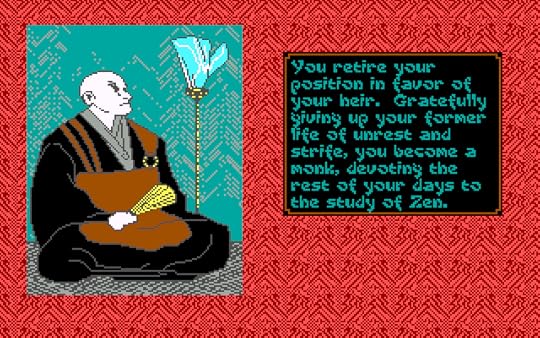
the first time you played it, naturally your character/avatar pretty much fell to the first or third battle or duel. after you mastered these 'minigames,' there was intrigue, and war-scale battles that had to be fought, and even after you had mastered all the controls, there was still only a 40% chance you could 'win' the game. the game influenced computer game design for years to come--the idea of 'unstable' situations-- there was no 'dominant strategy' that would win every time, and the possibility of total skill in warfare being undone by weakness in dueling or an honor clash affecting you even when you were relatively weak.
graphics have became far more better by today (2013):
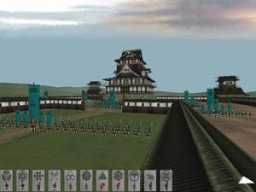
yet of course it's not clear that Total War is immensely better than SS.
so how does this tie back?
well James bond is the Sword of the Samurai. you read a james bond book or a jason bourne book even though it's camp, even though it's flaws are obvious, because it's presenting the myth very well; sword of the samurai presents the myth of medieval japan-- no disease, no smelliness, no poverty; just pureplay strategic engagements, war, personal combat, ninja missions, the struggle to unify the country. in the same way, james bond drinks martinis, flies helicopters, and so on, ...
this book is the Total War: Shogun of CIA books. you get far more for the money, actual facts, modern (2013) skepticism and analysis. but, in a sense, it will never have the impact that the earlier work did.
so I guess I made the gigantic point, at the cost of only two thousand words hahaha
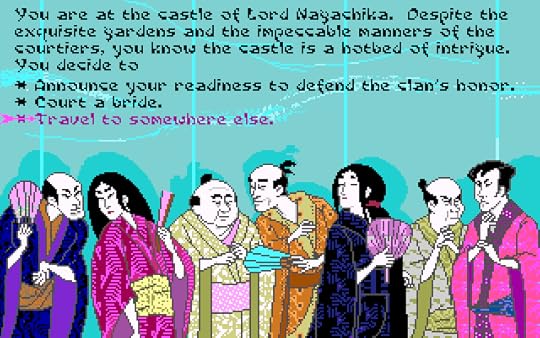
in short, a single, dynamic personality can have a huge influence on a project, such that a primitive 1989 project can stand up to a 2013 project made by many more people. it's not an absolute dominance by the 2013 software project-- people would pay $15 for total war: samurai; but a good number of people would lay down $7 for a copy of SS. what was powerful about SS was its ability to keep things non-linear: it wasn't like, 'pump up your samurai skill in swords 3 turns', and then 'hit up the peasants for more taxes 5 turns,' game won-- each turn you spent doing something came at the subtle cost of something else. death/defeat could come at any moment, and chance, ruthlessness, skill, and good strategy could result in an outcome anywhere from a minor lord to shogun of all japan. it presaged 'sims' tendency to not have a direct goal--although to be sure, you didn't really get anything special if you just produced lots of kids.
second, part of the appeal of japan is actually similar to interest in spy books. we are fascinated by a culture which has resulted from great internal-back and forth for 280 years as a closed, island society (1600 unification to 1880 opening by admiral perry of the united states). aspects of japanese culture creep into all places around the world-- shining path guerillas read japanese comic books as do rich swedish kids in stockholm. nobody ignores the japanese, except in the sense that they totally ignore the japanese.

if you're still with, and reading this long long long blog entry / book review, there is one mildly modish sort of twist that will finally close it out. what is tastes change? this happens to. if we introduced SS to the modern preteen /tween, they would just sneer and ask, what is this crap? can I play it on my cell phone? otherwise, it looks like something from the freakin' stone age. so in that sense, our tastes, as a consumer body change, and more and more is required for the same emotional impact. to that degree, really, very few people watch b&w films anymore, and "attention spans are getting shorter." ok, this intersects with the topic insofar as it's not simply a matter of values / receptions changing, nor is it purely a matter of "a 1989 work can beat a 2013 work," but the two phenomena in concert.

the final topic of discussion is; why is jpn-style universal? other than like heavy use of neutral / natural colors; it draws from some universal aspect of human taste. ~~anomie within the golden prison so like gwen stefani http://www.youtube.com/watch?v=O0lf_f... the immersive experience of a japan-centred "meta-ish" game; from a 2am wander through bar-stall streets to the 'baptist logistics specialist from dirty florida USAAF E-2' I was pondering all this decline only from a latinate and cypriotic perspective. they said language itself could uncover fundamental truths: if so, it was done here. i twas done

well I guess that is making less sense than usual. if I need to just cogently summarize what elusive allusive point I'm getting, aside from bubble babble prosody, what I'm saying is that I had a drink late at night with an E-2 logistics specialist from the US Air Force and his buddies, but as pleasantly as the conversation could go, I'm not necessarily going to pursue a friendship because I can hold his entire viewpoint in just one corner of the head. I realize that he enjoys buildings things; that he likes contributing to society, but my situation is < < it's harder to live in a hotel than it looks, high thread-count or not.
golden prison
golden handcuffs
somebody else paying all the bills; enrolling you in endless language study. polyglotism to the nth degree **7 languages? by 37--a possibility however unthought out from the beginning. all the advice from elders: live life without a plan
I used to read a lot more Tom Clancy and Larry Bond and watched more war movies/novels until I turned 25. at that point, I guess, having watched a boss's son enter a company at a senior level, observed as regulations / business laws were used word for word by various people in the now that I began to realize that Nobel Glory and God King and Country were not quite as interesting as all the little shadowy things going on. so I began reading more spy books / novels.
yet even in this genre weirdness exists. as written, there are probably 500 movies about CIA officers or spies. but according to this book, there are only currently 500 CIA NOC officers abroad. one movie per spy. is this a diagnosis of human nature, our fascination with something that barely exists? or is the more telling statistic the fact that this book is barely selling even though Aid is the historian for the National Security Agency. (in other words, are we actually bored to tears by the truth, such as Aid writes; and only fascinated by good drama as a writer/screenwriter can create)
there's nothing on goodreads that prohibits semi bloggishness on these book reviews. it may very well come at the cost of popularity, but aside from lots of freebies (which I'm skeptical exists anyway), there's not necessarily any getting anything from a top reviewer. possibly this will change once amazon.com starts vertically-integrating the publishing industry more and more, but for now, we are merely where we are.
I was thinking in the shower just now, a tech univ graduate makes $50,000 a year, a lit major grad makes $35,000 a year (say). but of the 15,000 diff., half might be made up in the 2-3 weeks of vacation time: the tech is part of the middle class, is "socially obligated" or at least limited by his imagination into going to Paris, staying at the Intercontinental, going to the Montmartre theatre show, eating boulabaisse and coceau san jacques, and then returning in two weeks time back to his house and acura with miniature eiffel towers and 200 photos for facebook. on the contrary, the left-leaning lit major spends his two to three weeks in colombia or peru, meets the drug lords and squatter movements, eats really authentic incan food, possibly actually integrates a bit into the community, and not only spends less but actually gets more value. so "$7k of value" made right there. the remainder of the difference is made up in the other 41 weeks of the year, with the overall more culturally enriched, complicated life of the arts major versus the science/IT.
possibly? and possibly this is all babble? and I'm diverting from my usual pattern by blogging on a relatively untrafficked book entry? (thereby possibly increasing my profile's prominence? no matter... this is goodreads.... all bibliophiles i suppose) not much on the news: the killing in woolwich; edl responds; a few weeks since Boston, new laser weapon on navy ships, economic turbulence etc etc etc.... the flow of history never ends. (amazon dot com releases $1.99 classics' hemingway YES!) somebody "liked" one of my nonsense entries ha
ok ok trying to return back to linear thought or whatever. congrats on finding the babblers of goodreads. like when in Prague, I once spent a week waiting a visa, similarly? but lived in a hostel, walked around the castle, looked up various obscure locations EXCEPT Kafka's grave. lots of j-tourists around; the yen was strong.
it's 27 May 2013, towards the beginning of the 2013 summer. last summer (2012) was a watery, blue summer. this one... still wet... but more orangey in colour? I begin language study? the life of the perpetual learner/student? climbing mountains versus language acquistion, a life trial?
so can I be very deep? as in like the very old PC game 'sword of the samurai' was brilliant because of limited player control? just depending on fate or timing, you either did or did not have a chance to take your character very far. (link: http://www.youtube.com/watch?v=J8kZPs... can check it out on youtube. i recommend it as a good example of "good game design." as in, any one 5 minutes was fun; and then the whole thing was fun. however, the graphics appear primitive by modern standards. Sid Meier is generally high regarded in game design: every little battle or unit design is fun, and then the totality is also fun.
there is a limited number of good books to find and read! wahhhhh if only there were a great japanese novel appearing every 3 days.
so actually this rambling, disjointed, unorganized "book review" or "good reads book entry" is actually making a subtle point. because Sword of the Samurai was designed in 1989. it used primitive 16-color graphics with the pixels 1 mm by 1mm, and MIDI one-tone sound. (just to listen to the soundtrack today is painful). but despite all these limitations, SS has become legendary in the game-design field because of its ability to inspire replay. there was a lot of skill, but there was also a lot of chance: you had to learn the little sword-fighting game; the bandit and small map fighting game; and then finally the large unit fighting game. but even assuming everything went right, there was also the possibility that you would ascend to lord of your province just in time to learn that the next door provinces were quite strong and powerful, a sure recipe for losing the game at that stage. whether you languished as a medium rank samurai, ascended to the lord rank, or actually became shogun, the game felt real and playable.
the first time you played it, naturally your character/avatar pretty much fell to the first or third battle or duel. after you mastered these 'minigames,' there was intrigue, and war-scale battles that had to be fought, and even after you had mastered all the controls, there was still only a 40% chance you could 'win' the game. the game influenced computer game design for years to come--the idea of 'unstable' situations-- there was no 'dominant strategy' that would win every time, and the possibility of total skill in warfare being undone by weakness in dueling or an honor clash affecting you even when you were relatively weak.
graphics have became far more better by today (2013):
yet of course it's not clear that Total War is immensely better than SS.
so how does this tie back?
well James bond is the Sword of the Samurai. you read a james bond book or a jason bourne book even though it's camp, even though it's flaws are obvious, because it's presenting the myth very well; sword of the samurai presents the myth of medieval japan-- no disease, no smelliness, no poverty; just pureplay strategic engagements, war, personal combat, ninja missions, the struggle to unify the country. in the same way, james bond drinks martinis, flies helicopters, and so on, ...
this book is the Total War: Shogun of CIA books. you get far more for the money, actual facts, modern (2013) skepticism and analysis. but, in a sense, it will never have the impact that the earlier work did.
so I guess I made the gigantic point, at the cost of only two thousand words hahaha
in short, a single, dynamic personality can have a huge influence on a project, such that a primitive 1989 project can stand up to a 2013 project made by many more people. it's not an absolute dominance by the 2013 software project-- people would pay $15 for total war: samurai; but a good number of people would lay down $7 for a copy of SS. what was powerful about SS was its ability to keep things non-linear: it wasn't like, 'pump up your samurai skill in swords 3 turns', and then 'hit up the peasants for more taxes 5 turns,' game won-- each turn you spent doing something came at the subtle cost of something else. death/defeat could come at any moment, and chance, ruthlessness, skill, and good strategy could result in an outcome anywhere from a minor lord to shogun of all japan. it presaged 'sims' tendency to not have a direct goal--although to be sure, you didn't really get anything special if you just produced lots of kids.
second, part of the appeal of japan is actually similar to interest in spy books. we are fascinated by a culture which has resulted from great internal-back and forth for 280 years as a closed, island society (1600 unification to 1880 opening by admiral perry of the united states). aspects of japanese culture creep into all places around the world-- shining path guerillas read japanese comic books as do rich swedish kids in stockholm. nobody ignores the japanese, except in the sense that they totally ignore the japanese.
if you're still with, and reading this long long long blog entry / book review, there is one mildly modish sort of twist that will finally close it out. what is tastes change? this happens to. if we introduced SS to the modern preteen /tween, they would just sneer and ask, what is this crap? can I play it on my cell phone? otherwise, it looks like something from the freakin' stone age. so in that sense, our tastes, as a consumer body change, and more and more is required for the same emotional impact. to that degree, really, very few people watch b&w films anymore, and "attention spans are getting shorter." ok, this intersects with the topic insofar as it's not simply a matter of values / receptions changing, nor is it purely a matter of "a 1989 work can beat a 2013 work," but the two phenomena in concert.
the final topic of discussion is; why is jpn-style universal? other than like heavy use of neutral / natural colors; it draws from some universal aspect of human taste. ~~anomie within the golden prison so like gwen stefani http://www.youtube.com/watch?v=O0lf_f... the immersive experience of a japan-centred "meta-ish" game; from a 2am wander through bar-stall streets to the 'baptist logistics specialist from dirty florida USAAF E-2' I was pondering all this decline only from a latinate and cypriotic perspective. they said language itself could uncover fundamental truths: if so, it was done here. i twas done
well I guess that is making less sense than usual. if I need to just cogently summarize what elusive allusive point I'm getting, aside from bubble babble prosody, what I'm saying is that I had a drink late at night with an E-2 logistics specialist from the US Air Force and his buddies, but as pleasantly as the conversation could go, I'm not necessarily going to pursue a friendship because I can hold his entire viewpoint in just one corner of the head. I realize that he enjoys buildings things; that he likes contributing to society, but my situation is < < it's harder to live in a hotel than it looks, high thread-count or not.
golden prison
golden handcuffs
somebody else paying all the bills; enrolling you in endless language study. polyglotism to the nth degree **7 languages? by 37--a possibility however unthought out from the beginning. all the advice from elders: live life without a plan

December 21, 2020
An incredibly in-depth, difficult read. But very thorough
September 20, 2024
By 2010 the way the conflict will shape in future was quite evident, although by shifting blames or closing eyes, one can't hide the truth on ground.
September 28, 2021
By 2010 the way the conflict will shape in future was quiet evident, although by shifting blames or closing eyes, one can't hide the truth on ground.

July 24, 2023
Today in books that don't overstay their welcome. Intel Wars is a great look at US intelligence post-9/11, and it covers a lot of ground while keeping discussions concise. A good book all around.

February 22, 2012
so far, this is horrible. all i'm seeing is selected sound bytes to justify that the war in Afghanistan is unwinnable. We should have never gone after bin laden, everything is Bush's fault. Acts of treason are ok if you don't like the rules, and apparently the military was all for increasing troop strength in AF. Umm WTF? this guys an idiot. It seems that this is a lets blame everyone else, go back to pre-9/11 dogma of technology will do everything (Drones) and make the current administration out to be the second coming of christ. The author does identify some issues with the AF campaign but not the underlying reason of why they happened or how to fix it, just point fingers. I almost wish i had the patience to sit and go through his book page by page, to dispute alot of BS. Granted I won't waste my time on something like this. but the one thing that i hope the casual or everyday reader takes away from this, is if your going to write about Intel, it needs to be un-biased. Pushing a political POV makes you out to be a mouthpiece that has zero credibility with people that actually understand and have knowledge of the things your writing about. Also, I hope the casual reader decides to verify the allegations made in the book, not blindly hold it up as the truth. If your gonna do that i'm sure there's some infomercials on late night that need people to shill the latest weight loss/cure for everything magic potion.

September 3, 2012
Good book about the national intelligence architecture of the United States of America, with specific focus on its growth and development since September 11, 2001 and expansion of counter-terrorism operations. Mr. Aid chronicled the size, make up, technology enablers, policies, processes, capabilities and limitations of the Intelligence Community (IC) over the last decade.
This book highlighted this challenge by analyzing the attempt to improve intelligence capabilities since 2001 via complex digital and sensor technology and data intensive systems. However, as the technical collection capability grew, the analytical processing and exploitation capability and quality declined. Analysts were flooded with data and often times unable to find or link key data together to provide policy makers and military commanders with increased clarity of national or regional security threats, their operations or intentions. However, technology did contribute to multiple impactful (and controversial) intelligence operations.
Increasingly, intelligence and covert operations featured unmanned aerial vehicles (UAVs). These systems offered additional collection capabilities to integrate with other sources of intelligence, but they also offered a new ability to eliminate time sensitive or fleeting targets. The book discussed how the Bush and Obama Administrations frequently relied on systems such as drones to perform targeted killings of terrorist threats.
This book highlighted this challenge by analyzing the attempt to improve intelligence capabilities since 2001 via complex digital and sensor technology and data intensive systems. However, as the technical collection capability grew, the analytical processing and exploitation capability and quality declined. Analysts were flooded with data and often times unable to find or link key data together to provide policy makers and military commanders with increased clarity of national or regional security threats, their operations or intentions. However, technology did contribute to multiple impactful (and controversial) intelligence operations.
Increasingly, intelligence and covert operations featured unmanned aerial vehicles (UAVs). These systems offered additional collection capabilities to integrate with other sources of intelligence, but they also offered a new ability to eliminate time sensitive or fleeting targets. The book discussed how the Bush and Obama Administrations frequently relied on systems such as drones to perform targeted killings of terrorist threats.

March 8, 2022
Extremely in-depth view of the United States' foray into the Middle East from an intelligence perspective. Found my eyes glossing over the text as Aid drops an insane amount of names, places, dates, and events. This book reminds me of a doctoral thesis with 223 citations, not a book to read casually.
This book does present some great findings such as America's use of data collection and the shortcomings of connecting a few needles from a million different haystacks. However, it is dated and ends around 2010 as it comes to references. With the shifting of focus from the Middle East to peer-to-peer escalation, this book reminds me of the purgatory state that the U.S. military and intelligence community was/is operating in as it comes to terrorism.
This book does present some great findings such as America's use of data collection and the shortcomings of connecting a few needles from a million different haystacks. However, it is dated and ends around 2010 as it comes to references. With the shifting of focus from the Middle East to peer-to-peer escalation, this book reminds me of the purgatory state that the U.S. military and intelligence community was/is operating in as it comes to terrorism.

September 11, 2013
I somehow was able to motivate myself to finish 30% of this book and I couldn't go beyond that. It's like a militRy historian took a giant dump on the pages and smothered it with his bare hands. All you get here is a lot of statistics and mathematical data that is absolutely useless. Would not recommend. Now I know what I am burning this winter for some heat outdoors.

September 30, 2014
More descriptive than anything, Aid droned on about the worrisome state of the intelligence community at present before really making any analytical points or arguments until he Conclusion/Epilogue. The tone and sheer encyclopedic nature of the book failed to engage me. The title promises a more stimulating and enjoyable reading experience than Aid delivers in the book.
March 17, 2014
Some interesting insights and an overall interesting description of intel challenges. In between there is a lot of story telling that contains information that I do not find useful. This book could have been less than half the size...

June 30, 2016
Interesting examination of Intelligence assists and activities. I found the analysis and conclusions to be kinda shallow, seemed like a lot of gossip and whining dug up from all kinds of sources from social media to personal interviews. Written in 2011, many of the assertions are outdated.

April 1, 2012
Realy good work. Very iinformmative. Lots of information and very thoroughly researched. Loots of perspective into the worl we face today

October 31, 2013
Nothing new. A rehash of wikileaks.
Displaying 1 - 16 of 16 reviews