

What do you think?

Bill Veeck: Baseball's Greatest Maverick
A masterful biography of one of most influential, sharp-witted, and often zany figures in baseball history, whose drive and imagination helped transform the game and the country. As owner of the minor league Milwaukee Brewers, and then the Cleveland Indians, the St. Louis Browns, and the Chicago White Sox-twice-Veeck truly changed the face of baseball.
Praise for Bill Veeck:
"Bill Veeck incorporates the picaresque anecdotes and populist charm of Veeck's memoirs into a narrative marked by Mr. Dickson's broad knowledge and fluid authority. The result is a biography that newcomers to the Veeck legend are likely to find immensely appealing, but one that also makes him new again for those who have already savored the baseball showman's own episodic volumes."- The Wall Street Journal
Praise for Bill Veeck:
"Bill Veeck incorporates the picaresque anecdotes and populist charm of Veeck's memoirs into a narrative marked by Mr. Dickson's broad knowledge and fluid authority. The result is a biography that newcomers to the Veeck legend are likely to find immensely appealing, but one that also makes him new again for those who have already savored the baseball showman's own episodic volumes."- The Wall Street Journal
448 pages, Hardcover
First published March 27, 2012
About the author
Paul Dickson
141 books42 followersPaul Dickson is the author of more than 45 nonfiction books and hundreds of magazine articles. Although he has written on a variety of subjects from ice cream to kite flying to electronic warfare, he now concentrates on writing about the American language, baseball and 20th century history.
Dickson, born in Yonkers, NY, graduated from Wesleyan University in 1961 and was honored as a Distinguished Alumnae of that institution in 2001. After graduation, he served in the U.S. Navy and later worked as a reporter for McGraw-Hill Publications.
Since 1968, he has been a full-time freelance writer contributing articles to various magazines and newspapers, including Smithsonian, Esquire, The Nation, Town & Country, The New York Times, The Los Angeles Times, and The Washington Post and writing numerous books on a wide range of subjects.
He received a University Fellowship for reporters from the American Political Science Association to do his first book, Think Tanks (1971). For his book, The Electronic Battlefield (1976), about the impact automatic weapons systems have had on modern warfare, he received a grant from the Fund for Investigative Journalism to support his efforts to get certain Pentagon files declassified.
His book The Bonus Army: An American Epic, written with Thomas B. Allen, was published by Walker and Co. on February 1, 2005. It tells the dramatic but largely forgotten story of the approximately 45,000 World War I veterans who marched on Washington in the summer of 1932, at the height of the Great Depression, to demand early payment of a bonus promised them for their wartime service and of how that march eventually changed the course of American history and led to passage of the GI Bill—the lasting legacy of the Bonus Army. A documentary based on the book aired on PBS stations in May 2006 and an option for a feature film based on the book has been sold.
Dickson's most recent baseball book, The Hidden Language of Baseball: How Signs and Sign Stealing Have Influenced the Course of our National Pastime, also by Walker and Co, was first published in May, 2003 and came out in paperback in June, 2005. It follows other works of baseball reference including The Joy of Keeping Score, Baseballs Greatest Quotations, Baseball the Presidents Game and The New Dickson Baseball Dictionary, now in it's second edition. A third edition is currently in the works. The original Dickson Baseball Dictionary was awarded the 1989 Macmillan-SABR Award for Baseball Research.
Sputnik: The Shock of the Century, another Walker book, came out in October, 2001 and was subsequently issued in paperback by Berkeley Books. Like his first book, Think Tanks (1971), and his latest, Sputnik, was born of his first love: investigative journalism. Dickson is working on a feature documentary about Sputnik with acclaimed documentarians David Hoffmanand Kirk Wolfinger.
Two of his older language books, Slang and Label For Locals came out in the fall of 2006 in new and expanded versions.
Dickson is a founding member and former president of Washington Independent Writers and a member of the National Press Club. He is a contributing editor at Washingtonian magazine and a consulting editor at Merriam-Webster, Inc. and is represented by Premier Speakers Bureau, Inc. and the Jonathan Dolger Literary agency.
He currently lives in Garrett Park, Maryland with his wife Nancy who works with him as his first line editor, and financial manager.
Dickson, born in Yonkers, NY, graduated from Wesleyan University in 1961 and was honored as a Distinguished Alumnae of that institution in 2001. After graduation, he served in the U.S. Navy and later worked as a reporter for McGraw-Hill Publications.
Since 1968, he has been a full-time freelance writer contributing articles to various magazines and newspapers, including Smithsonian, Esquire, The Nation, Town & Country, The New York Times, The Los Angeles Times, and The Washington Post and writing numerous books on a wide range of subjects.
He received a University Fellowship for reporters from the American Political Science Association to do his first book, Think Tanks (1971). For his book, The Electronic Battlefield (1976), about the impact automatic weapons systems have had on modern warfare, he received a grant from the Fund for Investigative Journalism to support his efforts to get certain Pentagon files declassified.
His book The Bonus Army: An American Epic, written with Thomas B. Allen, was published by Walker and Co. on February 1, 2005. It tells the dramatic but largely forgotten story of the approximately 45,000 World War I veterans who marched on Washington in the summer of 1932, at the height of the Great Depression, to demand early payment of a bonus promised them for their wartime service and of how that march eventually changed the course of American history and led to passage of the GI Bill—the lasting legacy of the Bonus Army. A documentary based on the book aired on PBS stations in May 2006 and an option for a feature film based on the book has been sold.
Dickson's most recent baseball book, The Hidden Language of Baseball: How Signs and Sign Stealing Have Influenced the Course of our National Pastime, also by Walker and Co, was first published in May, 2003 and came out in paperback in June, 2005. It follows other works of baseball reference including The Joy of Keeping Score, Baseballs Greatest Quotations, Baseball the Presidents Game and The New Dickson Baseball Dictionary, now in it's second edition. A third edition is currently in the works. The original Dickson Baseball Dictionary was awarded the 1989 Macmillan-SABR Award for Baseball Research.
Sputnik: The Shock of the Century, another Walker book, came out in October, 2001 and was subsequently issued in paperback by Berkeley Books. Like his first book, Think Tanks (1971), and his latest, Sputnik, was born of his first love: investigative journalism. Dickson is working on a feature documentary about Sputnik with acclaimed documentarians David Hoffmanand Kirk Wolfinger.
Two of his older language books, Slang and Label For Locals came out in the fall of 2006 in new and expanded versions.
Dickson is a founding member and former president of Washington Independent Writers and a member of the National Press Club. He is a contributing editor at Washingtonian magazine and a consulting editor at Merriam-Webster, Inc. and is represented by Premier Speakers Bureau, Inc. and the Jonathan Dolger Literary agency.
He currently lives in Garrett Park, Maryland with his wife Nancy who works with him as his first line editor, and financial manager.
Ratings & Reviews
Friends & Following
Create a free account to discover what your friends think of this book!
Community Reviews
Displaying 1 - 30 of 60 reviews

June 19, 2021
To be sure, this review of a very compelling baseball book, Bill Veeck: Baseball's Greatest Maverick by Paul Dickson includes my own personal memories of Bill Veeck as well as commentary on the book. Bill Veeck may have been the most approachable owner of a major league team in history, always seeing himself as just a fan who was lucky enough to own a baseball team, several of them in fact.
And when Bill died, it was most appropriate that Aaron Copeland's Fanfare for a Common Man was played at his funeral at a church in Hyde Park, not far from the Comiskey Park he'd inhabited for so long, always more as a fan than as owner of the Chicago White Sox & the old ballpark.
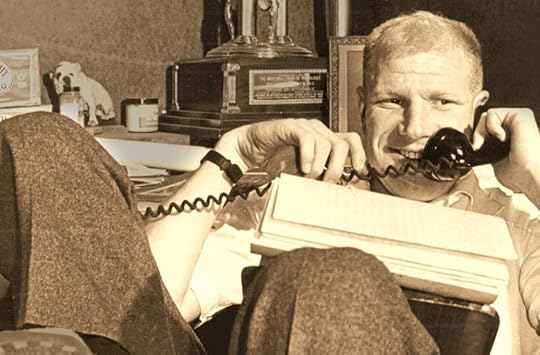
One Sunday in 1979, I wanted to take our young son to his first baseball game, hopefully teaching him how to keep score as well. Alas, Justin was 6 months old & still being nursed, causing my wife to resist my desire to introduce our son to the game of baseball at an early age. I called the old stadium to ask if there might be a private space where Justin could be nursed in seclusion and the woman who answered my call told me to call Bill Veeck at his home, suggesting that he had a listed number in the Chicago phone directory & loved hearing directly from fans.
Sensing a rather unusual opportunity, I called the Veecks' residence not far from Comiskey Park in the Hyde Park neighborhood of Chicago. One of Bill's daughters answered the phone & then called out, "Mom!", at which point Mary Frances Veeck came to the phone & advised me to have my wife & infant son go to the First Aid room, located near the 3rd base dugout & ask for Millie, telling her that Bill Veeck had approved the intersection.
All these years later, I continue to be amazed at the familiarity that Bill Veeck & his family enjoyed with everyday people, far more than was the case with any of his fellow owners. Having been born to relative wealth & as the son of the president of the Chicago Cubs, Bill Veeck at an early age perfected the role of being "Peck's bad boy" to those in authority over him & especially to the elite class of wealthy men who just happened to own baseball teams. He served as a constant fly in their proverbial ointment, i.e. an obstruction to their sense of power & privilege.
Bill Veeck is often called a maverick but more than that, he was an impresario, an innovator who had little respect for tradition, unless it empowered everyone, poor as well as rich, black & white alike, not just wealthy owners. Sent to the elite boarding school, Phillips Exeter Academy in Massachusetts, Bill felt out of place & retreated to his home base in suburban Chicago. In fact, later & without a high school diploma, he had to get a GED in order to enter Kenyon College in Ohio, a place where he felt comfortable enough to graduate, while first injuring a leg playing football, the same leg that would later be amputated after further injury in WWII.
A college graduate & with young children that might have gained him a deferment, Bill volunteered to serve in the war effort, requesting to be sent to a combat zone, after refusing the offer of a commission & being guaranteed that he'd enter the Marine Corps as a private. He was eventually invalided out of the military after spending time & suffering a wound at Guadalcanal in the Pacific.
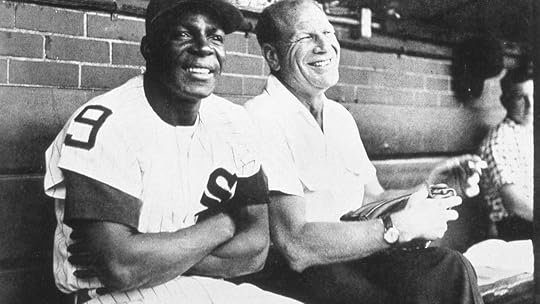
Veeck argued for integration even before Branch Rickey decided to sign Jackie Robinson to a professional contract with the National League Brooklyn Dodgers in 1947. He did introduce the first African-American, Larry Doby to the American League, as a member of the Cleveland Indians, then owned by a young Bill Veeck. Later, in Veeck's 2nd stint as White Sox owner, he hired Doby to be the first black manager in the league. When he helped to integrate the sport, he also insisted that the administrative offices, concession stands & ushers be duly integrated as well, causing Veeck to be viewed by some as the Abraham Lincoln of baseball.
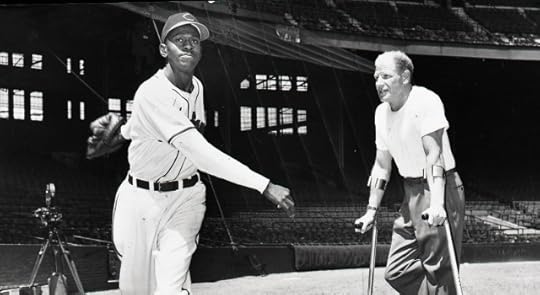
Early on, Veeck also believed in inter-league play, the possibility of free agency for players, in attracting more women to baseball parks & as almost every fan of baseball is aware, he personally helped to plant the ivy on the outfield walls at Wrigley Field and worked to get the iconic hand-operated centerfield scoreboard installed. With his father as president of the Cubs, he could have had any role he wanted but often worked in the concession stands, thus gaining a better sense of just what might enhance the lives of ordinary fans attending a baseball game.
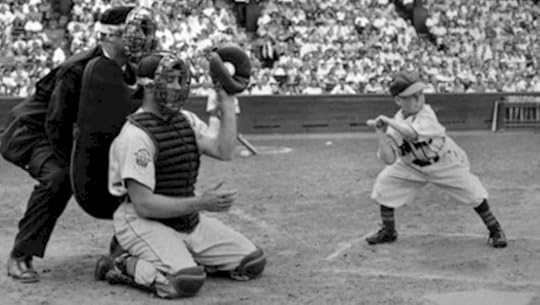 http://d279m997dpfwgl.cloudfront.net/...
Mention Bill Veeck's name & most immediately think of him as the P.T. Barnum of professional sports, his constant fascination with quirky & even exotic promotions to market baseball: signing a midget named Eddie Gaedel to a contract, officially uniform #1/8, while owner of the hapless St. Louis Browns; allowing fans to signal the manager on needed strategy while owning the Browns; the disastrous Disco Demolition Night (actually orchestrated by his son Mike) that caused a White Sox game to be forfeited; Greek & Mexican nights; pioneering giveaway days for baseballs, bats, caps, plastic batting helmets, bobbleheads of various players + scores of other promotions. He'd first been attracted to such promotions when he owned a minor league franchise in Milwaukee.
On one occasion Bill Veeck stated that anyone entering with a musical instrument would get into Comiskey Park free, causing a huge brigade of fans with tubas, bugles, a variety of horns, drums & even one who somehow offloaded a piano from a truck & gained entry to a corner of the park. Veeck delighted in labeling the old baseball field on Chicago's south-side, "the largest saloon in America."
The legendary exploding scoreboard was Mr. Veeck's idea when he owned the Chicago White Sox the first time, with the idea, implemented in 1960, apparently having occurred to him during a performance of the 1939 William Saroyan play, The Time of your Life.
And yet, Veeck, often operating from a suite at the Plaza Hotel, also loved the bright lights & grandeur New York City, its many newspapers (attracting their attention with each publicity stunt), hanging out at the Stork Club and even being feted with a black-tie dinner at the illustrious French restaurant, Le Pavilion, where only Bill Veeck was allowed to enter without the compulsory necktie. When one of those present, artist Salvador Dali, said to Veeck that he knew absolutely nothing about baseball, Bill Veeck responded: "Then, we're even!"
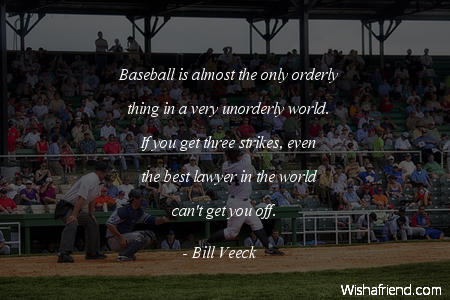
Throughout a series of painful amputations, Bill Veeck not only endured the pain but even seemed to ignore it, dancing vigorously with 2nd wife, Mary Frances, the love of his life, while occasionally leaving a trail of blood on the dance floor. And yes, as a heavy smoker, it was his fancy to frequently use his prosthetic device as an ashtray. Veeck was an avid reader, somehow devouring 5-7 books a week while running a major league baseball team & allowing "average Joes" to phone him at home or at the ballpark or to share a drink with him at his favorite watering holes.
Veeck's sense of humor was occasionally ill-placed but was an ever-present part of his aura. One time, late in life after Bill fell, he feared being unable to follow the White Sox east for a playoff game in Baltimore, being rolled onto an aircraft in a wheel chair.
Bill Veeck was as friendly & as open as a beloved next door neighbor or a member of one's own family. Having grown up in St. Louis, I asked him about his time living with his young family in an apartment above old Sportsman's Park on the north side of that city while owning the Browns and he shared some favorite memories. As always, both a fan and a most uncommon man.
One of the last things Bill did before his death was to write a column for an issue of the North Shore magazine in which he stated:
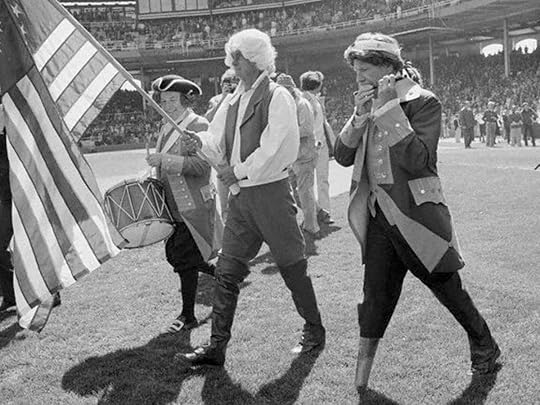
*Among the images within my review: an early photo of Bill Veeck; Chicago White Sox star, "Minnie" Saturnino Orestes Armas Minoso, the "Cuban Comet" & a Veeck favorite; Satchel Paige, rescued by Bill Veeck from the Negro Leagues; #1/8 Eddie Gaedel in his only major league appearance, with the St. Louis Browns; Opening Day 1976 with Bill Veeck & his peg-leg (at left) among the trio representing the Spirit of Liberty at Comiskey Park, Chicago.
**Thanks again to my son Doug for his gift of Bill Veeck: Baseball's Greatest Maverick by Paul Dickson + a copy of Veeck's own book, Veeck As In Wreck, Xmas 2020.
And when Bill died, it was most appropriate that Aaron Copeland's Fanfare for a Common Man was played at his funeral at a church in Hyde Park, not far from the Comiskey Park he'd inhabited for so long, always more as a fan than as owner of the Chicago White Sox & the old ballpark.
One Sunday in 1979, I wanted to take our young son to his first baseball game, hopefully teaching him how to keep score as well. Alas, Justin was 6 months old & still being nursed, causing my wife to resist my desire to introduce our son to the game of baseball at an early age. I called the old stadium to ask if there might be a private space where Justin could be nursed in seclusion and the woman who answered my call told me to call Bill Veeck at his home, suggesting that he had a listed number in the Chicago phone directory & loved hearing directly from fans.
Sensing a rather unusual opportunity, I called the Veecks' residence not far from Comiskey Park in the Hyde Park neighborhood of Chicago. One of Bill's daughters answered the phone & then called out, "Mom!", at which point Mary Frances Veeck came to the phone & advised me to have my wife & infant son go to the First Aid room, located near the 3rd base dugout & ask for Millie, telling her that Bill Veeck had approved the intersection.
All these years later, I continue to be amazed at the familiarity that Bill Veeck & his family enjoyed with everyday people, far more than was the case with any of his fellow owners. Having been born to relative wealth & as the son of the president of the Chicago Cubs, Bill Veeck at an early age perfected the role of being "Peck's bad boy" to those in authority over him & especially to the elite class of wealthy men who just happened to own baseball teams. He served as a constant fly in their proverbial ointment, i.e. an obstruction to their sense of power & privilege.
Bill Veeck is often called a maverick but more than that, he was an impresario, an innovator who had little respect for tradition, unless it empowered everyone, poor as well as rich, black & white alike, not just wealthy owners. Sent to the elite boarding school, Phillips Exeter Academy in Massachusetts, Bill felt out of place & retreated to his home base in suburban Chicago. In fact, later & without a high school diploma, he had to get a GED in order to enter Kenyon College in Ohio, a place where he felt comfortable enough to graduate, while first injuring a leg playing football, the same leg that would later be amputated after further injury in WWII.
A college graduate & with young children that might have gained him a deferment, Bill volunteered to serve in the war effort, requesting to be sent to a combat zone, after refusing the offer of a commission & being guaranteed that he'd enter the Marine Corps as a private. He was eventually invalided out of the military after spending time & suffering a wound at Guadalcanal in the Pacific.
Veeck argued for integration even before Branch Rickey decided to sign Jackie Robinson to a professional contract with the National League Brooklyn Dodgers in 1947. He did introduce the first African-American, Larry Doby to the American League, as a member of the Cleveland Indians, then owned by a young Bill Veeck. Later, in Veeck's 2nd stint as White Sox owner, he hired Doby to be the first black manager in the league. When he helped to integrate the sport, he also insisted that the administrative offices, concession stands & ushers be duly integrated as well, causing Veeck to be viewed by some as the Abraham Lincoln of baseball.
Early on, Veeck also believed in inter-league play, the possibility of free agency for players, in attracting more women to baseball parks & as almost every fan of baseball is aware, he personally helped to plant the ivy on the outfield walls at Wrigley Field and worked to get the iconic hand-operated centerfield scoreboard installed. With his father as president of the Cubs, he could have had any role he wanted but often worked in the concession stands, thus gaining a better sense of just what might enhance the lives of ordinary fans attending a baseball game.
http://d279m997dpfwgl.cloudfront.net/...Mention Bill Veeck's name & most immediately think of him as the P.T. Barnum of professional sports, his constant fascination with quirky & even exotic promotions to market baseball: signing a midget named Eddie Gaedel to a contract, officially uniform #1/8, while owner of the hapless St. Louis Browns; allowing fans to signal the manager on needed strategy while owning the Browns; the disastrous Disco Demolition Night (actually orchestrated by his son Mike) that caused a White Sox game to be forfeited; Greek & Mexican nights; pioneering giveaway days for baseballs, bats, caps, plastic batting helmets, bobbleheads of various players + scores of other promotions. He'd first been attracted to such promotions when he owned a minor league franchise in Milwaukee.
On one occasion Bill Veeck stated that anyone entering with a musical instrument would get into Comiskey Park free, causing a huge brigade of fans with tubas, bugles, a variety of horns, drums & even one who somehow offloaded a piano from a truck & gained entry to a corner of the park. Veeck delighted in labeling the old baseball field on Chicago's south-side, "the largest saloon in America."
The legendary exploding scoreboard was Mr. Veeck's idea when he owned the Chicago White Sox the first time, with the idea, implemented in 1960, apparently having occurred to him during a performance of the 1939 William Saroyan play, The Time of your Life.
Over a steak dinner & more than a few beers, Bill recounted how in the Saroyan play, an actor in a key role in the production had been playing a pinball machine throughout most of the play and just before the final curtain, the guy hit the jackpot & the machine exploded with all types of visual effects & loud music. It hit Bill right then and he transposed the idea to the scoreboard & wrapped it around home runs.And, it was Bill Veeck who had the idea of having a famous announcer named Harry Caray sing "Take Me Out to the Ballgame" during the 7th inning stretch, backed by organist Nancy Faust, reckoning that if anyone with an off-key voice like Caray's sang, the fans would join in, rather than being intimidated by someone with a more professional singing voice. Most if not all ballparks have since adopted this Veeck-initiated tradition, while many others presently include fireworks as well. And, how many owners would sit amidst the fans in the centerfield bleachers with their shirt off, as Bill Veeck did?
And yet, Veeck, often operating from a suite at the Plaza Hotel, also loved the bright lights & grandeur New York City, its many newspapers (attracting their attention with each publicity stunt), hanging out at the Stork Club and even being feted with a black-tie dinner at the illustrious French restaurant, Le Pavilion, where only Bill Veeck was allowed to enter without the compulsory necktie. When one of those present, artist Salvador Dali, said to Veeck that he knew absolutely nothing about baseball, Bill Veeck responded: "Then, we're even!"
Throughout a series of painful amputations, Bill Veeck not only endured the pain but even seemed to ignore it, dancing vigorously with 2nd wife, Mary Frances, the love of his life, while occasionally leaving a trail of blood on the dance floor. And yes, as a heavy smoker, it was his fancy to frequently use his prosthetic device as an ashtray. Veeck was an avid reader, somehow devouring 5-7 books a week while running a major league baseball team & allowing "average Joes" to phone him at home or at the ballpark or to share a drink with him at his favorite watering holes.
Veeck's sense of humor was occasionally ill-placed but was an ever-present part of his aura. One time, late in life after Bill fell, he feared being unable to follow the White Sox east for a playoff game in Baltimore, being rolled onto an aircraft in a wheel chair.
Writers knew there was something amiss, because Bill never used his infirmity to gain an advantage. It seemed that while walking down the long corridor toward the plane, Veeck's artificial limb became undone, causing him to sprawl on the floor. While he was unhurt, airline personnel insisted he be placed in a wheelchair with his faulty limb on his lap. "Do you need a doctor?", inquired one of the airline staff, "No, right now all I need is a carpenter", Veeck replied, flashing his famous smile.One day in the early to mid 1980s, while Veeck was no longer an owner but still dreaming of one last hurrah, I went to sit in the Wrigley Field bleachers when you could still walk up & buy a ticket just before game time at $3 for a bench seat. There was Bill sitting with a beer amidst just a few other older fans, with the Cubs long since eliminated from pennant contention. I went down to chat with him, as he sat using his prosthetic leg as an ashtray in those long-ago days when smoking was still permitted.
Bill Veeck was as friendly & as open as a beloved next door neighbor or a member of one's own family. Having grown up in St. Louis, I asked him about his time living with his young family in an apartment above old Sportsman's Park on the north side of that city while owning the Browns and he shared some favorite memories. As always, both a fan and a most uncommon man.
One of the last things Bill did before his death was to write a column for an issue of the North Shore magazine in which he stated:
Where did it go? I looked away & suddenly it seemed that there wasn't any time at all to do the things I'd dreamed. So now I sit & ponder long, who, when & where I'll be. But when it all is said & done, I'd rather just be me.Perhaps the best tribute to Bill Veeck may have come from writer Tom Boswell: "He lived a lifelong pursuit of a dream. It should be read that he died of life." Amen to that!
*Among the images within my review: an early photo of Bill Veeck; Chicago White Sox star, "Minnie" Saturnino Orestes Armas Minoso, the "Cuban Comet" & a Veeck favorite; Satchel Paige, rescued by Bill Veeck from the Negro Leagues; #1/8 Eddie Gaedel in his only major league appearance, with the St. Louis Browns; Opening Day 1976 with Bill Veeck & his peg-leg (at left) among the trio representing the Spirit of Liberty at Comiskey Park, Chicago.
**Thanks again to my son Doug for his gift of Bill Veeck: Baseball's Greatest Maverick by Paul Dickson + a copy of Veeck's own book, Veeck As In Wreck, Xmas 2020.

January 3, 2022
Bill Veeck's autobiographical works are such classics it would be easy to skip Paul Dickson’s biography as either redundant or lackluster by comparison. That would be a huge mistake. This is one of the great baseball biographies. It’s a thorough look at his life and it covers those parts that Veeck never got to. Even the appendix has a refutation of SABR’s 1998 article trying to debunk Veeck’s purchase of the Phillies in 1942. I have my doubts that another writer could do better with the same material. I plan to put Dickson’s Durocher biography on my list despite Durocher having written one of the other great baseball autobiographies.
Bill Veeck owned the Cleveland Indians, the St. Louis Browns (now Baltimore Orioles), and the Chicago White Sox (Twice). He spent his life getting into baseball and then watching circumstances push him out again. He had boundless energy despite a lifetime of illness, a World War II injury resulted in amputation of half of his right leg. He was never a rich man because he didn’t seek money. His gadfly nonconformity would have kept him from being an industry CEO, but his brain could have made him a great entrepreneur. In baseball, a sport that prides itself on consistency, his innovation was unappreciated and fought until it was eventually adopted. There is a quote later in the book suggesting if Veeck had been as charming to owners as cabdrivers and reporters he would have had none of the trouble that he gave himself. Veeck was too smart not to know this and yet he persisted because I think he didn’t have time for diplomacy for people he didn’t respect.
Veeck was lucky to grow up in the game of baseball. His father, Bill Veeck Sr., ran the Chicago Cubs until his death in the early 1930s, and junior worked for the Cubs up until he bought the minor league Milwaukee Brewers on the eve of World War II. He started at the bottom doing things like concessions and building scoreboards. It was a much better education in the game than most baseball executives get. He could see the ballpark experience as holistic. A good hot dog is as important as a good ballclub for the fan’s experience. Money invested well in the right amenities or players will pay for itself.
Dickson gave me an entirely different view of baseball’s integration. Bill Veeck had a plan to buy the Philadelphia Phillies in 1942 and field an entire team of Negro League players. The plan was ingenious, but Veeck’s inability to keep quiet, doomed the sale. Paul Dickson then explains a major economic factor that prevented integration earlier in the 1940s. Several of the major league teams were the landlords of the Negro League franchises, making up to $100,000 a year in rent and concessions for those games. Integration would mean the dissolution of those franchises and an end of that revenue stream. As tight as Branch Rickey was with money, I’m guessing Ebbet's Field wasn’t a Negro League venue and his economic incentive was in the other direction. Moreover, Branch Rickey paid nothing to the Negro League franchises when he vultured their players. Bill Veeck at least offered Larry Doby’s club $15,000 to integrate the American League. Time and again the example of Veeck’s life is that he was a fair man.
Veeck paid his players better and gave his fans more value. Bill Veeck understood the golden rule principle that we are all taught in youth, but that is forgotten in business where ROI or quarterly earnings are treated as a phenomenon outside of people. A counter-intuitive approach to business is sometimes the best way to differentiate yourself from the competition. Veeck’s Chicago and St. Louis teams had intercity competition and less operating revenue. He had to do something. Bill Veeck may have seemed extravagant, but he always made money for his partners and to the surprise of his critics. The major miscalculation of Veeck’s baseball life was thinking that the game should codify his behavior by strengthening the players union and bringing about the end of the reserve clause. While that has helped the players and the owners get rich, it has not been a great outcome for the fans nor owners like Veeck. A middle class person can’t afford season tickets anymore. A blue collar sport has evolved into an entitled class of millionaire players and corporate ticket buyers. Even Bill Veeck stopped going to Cubs games when the Tribune company started selling bleacher seats in advance.
Although Bill was ahead in his thinking on how to market the game, his love for baseball was only matched by the owners that were around a generation before him. That combination makes him a singular person in the history of America’s pastime. Paul Dickson does a marvelous job bringing his life to the page.
Bill Veeck owned the Cleveland Indians, the St. Louis Browns (now Baltimore Orioles), and the Chicago White Sox (Twice). He spent his life getting into baseball and then watching circumstances push him out again. He had boundless energy despite a lifetime of illness, a World War II injury resulted in amputation of half of his right leg. He was never a rich man because he didn’t seek money. His gadfly nonconformity would have kept him from being an industry CEO, but his brain could have made him a great entrepreneur. In baseball, a sport that prides itself on consistency, his innovation was unappreciated and fought until it was eventually adopted. There is a quote later in the book suggesting if Veeck had been as charming to owners as cabdrivers and reporters he would have had none of the trouble that he gave himself. Veeck was too smart not to know this and yet he persisted because I think he didn’t have time for diplomacy for people he didn’t respect.
Veeck was lucky to grow up in the game of baseball. His father, Bill Veeck Sr., ran the Chicago Cubs until his death in the early 1930s, and junior worked for the Cubs up until he bought the minor league Milwaukee Brewers on the eve of World War II. He started at the bottom doing things like concessions and building scoreboards. It was a much better education in the game than most baseball executives get. He could see the ballpark experience as holistic. A good hot dog is as important as a good ballclub for the fan’s experience. Money invested well in the right amenities or players will pay for itself.
Dickson gave me an entirely different view of baseball’s integration. Bill Veeck had a plan to buy the Philadelphia Phillies in 1942 and field an entire team of Negro League players. The plan was ingenious, but Veeck’s inability to keep quiet, doomed the sale. Paul Dickson then explains a major economic factor that prevented integration earlier in the 1940s. Several of the major league teams were the landlords of the Negro League franchises, making up to $100,000 a year in rent and concessions for those games. Integration would mean the dissolution of those franchises and an end of that revenue stream. As tight as Branch Rickey was with money, I’m guessing Ebbet's Field wasn’t a Negro League venue and his economic incentive was in the other direction. Moreover, Branch Rickey paid nothing to the Negro League franchises when he vultured their players. Bill Veeck at least offered Larry Doby’s club $15,000 to integrate the American League. Time and again the example of Veeck’s life is that he was a fair man.
Veeck paid his players better and gave his fans more value. Bill Veeck understood the golden rule principle that we are all taught in youth, but that is forgotten in business where ROI or quarterly earnings are treated as a phenomenon outside of people. A counter-intuitive approach to business is sometimes the best way to differentiate yourself from the competition. Veeck’s Chicago and St. Louis teams had intercity competition and less operating revenue. He had to do something. Bill Veeck may have seemed extravagant, but he always made money for his partners and to the surprise of his critics. The major miscalculation of Veeck’s baseball life was thinking that the game should codify his behavior by strengthening the players union and bringing about the end of the reserve clause. While that has helped the players and the owners get rich, it has not been a great outcome for the fans nor owners like Veeck. A middle class person can’t afford season tickets anymore. A blue collar sport has evolved into an entitled class of millionaire players and corporate ticket buyers. Even Bill Veeck stopped going to Cubs games when the Tribune company started selling bleacher seats in advance.
Although Bill was ahead in his thinking on how to market the game, his love for baseball was only matched by the owners that were around a generation before him. That combination makes him a singular person in the history of America’s pastime. Paul Dickson does a marvelous job bringing his life to the page.

December 4, 2017
Paul Dickson has written a thorough and amazing book on one of the more quirky baseball owners of all time. I had read his biography of Leo Durocher a few months ago and had this book in my bookshelf for a few years. I'm glad I pulled it out and dove into it.
Baseball fans all know of Veeck's "stunts" such as pinch hitting 3-foot 7-inch Eddie Goedel in 1951 against Detroit, his exploding scoreboard at Comiskey and his odd giveaways that included livestock. But there was so much more depth to the owner. Dickson shows the heart and brilliance of a man whom many thought was merely a showman. He was instrumental in the integration of baseball more so, some argue, than Branch Rickey who takes claim for signing Jackie Robinson. At least Veeck paid Larry Doby's team for signing him; Rickey merely "took" Robinson.
Veeck was also extremely loyal to his friends and Dickson shows that throughout the book. He helped his players during tough times, holding charity games for players who were injured and ill. He also stuck with Satchel Paige and Doby throughout their careers.
We always hear of the tough owners like Steinbrenner and Charley O. Finley. But Dickson's book portrays Veeck as a kind, caring, generous person who really did love baseball and the fans who came out to support his teams. This is an excellent book of someone who never really got the attention and the accolades he deserved while alive. He was one of the major game-changers in the sport.
Baseball fans all know of Veeck's "stunts" such as pinch hitting 3-foot 7-inch Eddie Goedel in 1951 against Detroit, his exploding scoreboard at Comiskey and his odd giveaways that included livestock. But there was so much more depth to the owner. Dickson shows the heart and brilliance of a man whom many thought was merely a showman. He was instrumental in the integration of baseball more so, some argue, than Branch Rickey who takes claim for signing Jackie Robinson. At least Veeck paid Larry Doby's team for signing him; Rickey merely "took" Robinson.
Veeck was also extremely loyal to his friends and Dickson shows that throughout the book. He helped his players during tough times, holding charity games for players who were injured and ill. He also stuck with Satchel Paige and Doby throughout their careers.
We always hear of the tough owners like Steinbrenner and Charley O. Finley. But Dickson's book portrays Veeck as a kind, caring, generous person who really did love baseball and the fans who came out to support his teams. This is an excellent book of someone who never really got the attention and the accolades he deserved while alive. He was one of the major game-changers in the sport.

May 10, 2012
In opening his 1962 autobiography, Veeck—as in Wreck, with a chapter on midget Eddie Gaedel, longtime baseball owner and showman Bill Veeck concedes straight off that sending the pint-size actor to the plate as a St. Louis Brown would go down as his legacy.
"I have done a few other things in baseball, you know," Veeck writes. "I've won pennants and finished dead last; I've set attendance records and been close to bankruptcy . . . But no one has to tell me that if I returned to baseball tomorrow, won ten straight pennants and left all the old attendance records moldering in the dust, I would still be remembered, in the end, as the man who sent a midget up to bat."
Veeck, of course, did return to baseball, purchasing the Chicago White Sox a second time in 1975. He wound up giving both fans and critics something new to talk about besides Gaedel, when Disco Demolition Night erupted into the most disastrous promotion ever undertaken by a professional baseball club.
Paul Dickson proceeds to rescue Veeck from the ranks of ringmaster, establishing him over the course of this insightful biography as one of the game's leading executives. Certainly many of the stories in Bill Veeck will be familiar to readers of Veeck's memoirs. But Veeck's writings are necessarily less objective than Dickson's. Dickson also provides a structure and the full cradle-to-grave perspective that was unavailable at the time Veeck and Linn unloosed the baseball pariah on the literary world five decades ago.
There's so much more to this colorful visionary to celebrate than midgets and Disco Demolition. Veeck was a one of a kind whose impact reached beyond the ballpark, into the very fiber of 20th-century America. Dickson has captured it all in entertaining fashion in one of the best baseball releases I've read so far this year.
"I have done a few other things in baseball, you know," Veeck writes. "I've won pennants and finished dead last; I've set attendance records and been close to bankruptcy . . . But no one has to tell me that if I returned to baseball tomorrow, won ten straight pennants and left all the old attendance records moldering in the dust, I would still be remembered, in the end, as the man who sent a midget up to bat."
Veeck, of course, did return to baseball, purchasing the Chicago White Sox a second time in 1975. He wound up giving both fans and critics something new to talk about besides Gaedel, when Disco Demolition Night erupted into the most disastrous promotion ever undertaken by a professional baseball club.
Paul Dickson proceeds to rescue Veeck from the ranks of ringmaster, establishing him over the course of this insightful biography as one of the game's leading executives. Certainly many of the stories in Bill Veeck will be familiar to readers of Veeck's memoirs. But Veeck's writings are necessarily less objective than Dickson's. Dickson also provides a structure and the full cradle-to-grave perspective that was unavailable at the time Veeck and Linn unloosed the baseball pariah on the literary world five decades ago.
There's so much more to this colorful visionary to celebrate than midgets and Disco Demolition. Veeck was a one of a kind whose impact reached beyond the ballpark, into the very fiber of 20th-century America. Dickson has captured it all in entertaining fashion in one of the best baseball releases I've read so far this year.

October 6, 2022
If you have heard of Bill Veeck, you likely think of two things. One, was the use of a little man Eddie Gaedel who had a plate appearance against the Tigers Bob Cain. Second was the disastrous Disco Demolition at Comiskey Park that almost burned down the stadium. Yet, he owned three major league clubs-the Cleveland Indians, the St. Louis Browns, and the Chicago White Sox. And from 1948 through 1960, he was the only owner to beat the Yankees twice. But Paul Dickson does a remarkable job of bringing the real Bill Veeck to life. I honestly feel like I know the man after reading this terrific biography. Veeck, it was said, was the vitamin pill of baseball. He was indeed a maverick and a menace to the establishment-the owners and commissioners-the stodgy class. But he was an incredible presence in baseball from the late thirties until his death in 1986. His father was a sportswriter who became President of the Cubs, and Bill worked from the bottom up to learn the game for which he had such a passion. As team treasurer, Veeck put in the iconic ivory over the brick wall at Wrigley. He advocated for lights, but to no avail. As owner of the Milwaukee Brewers in the American Association, his marketing techniques were so novel that the team attendance soared. There were free orchids to women-whom Veeck appreciated could be a sound fan base. Veeck would literally sit in the stands and talk to fans, to get their input. He did that in the majors as well. He would greet fans at the entrance and as they exited. He staged promotions like Joe Earley Day-to recognize the common fan. He gave away dozens of prizes, including pigs-anything to entertain. Veeck's life was full, and he wanted fans to be entertained, because baseball was really just a game for him. The man was so generous that he would devote an entire game's proceeds to the community. On one occasion, a pitcher Don Black of the Indians had a stroke while batting. Soon thereafter Veeck held a promotion for Black-all of the proceeds went to Black's recovery. As a man, he was as courageous and stoic as one can imagine, given his leg amputation, and the constant pain and bleeding he underwent throughout his adulthood. he was a passionate advocate in word and deed for civil rights and integration. Dickson does a great job in discussing the question of whether Veeck seriously tried to buy the Phillies in 1942 with the idea of integrating that team. I enjoyed reading the appendix where the issue is debated. Dickson concludes that it was a good faith attempt to break the racial barrier. Veeck signed the first black player in the AL- Larry Doby, who became like a son. he signed Satchel Paige at age 41 to become an important part of the World Series champion Indians. And he did the same with Minnie Minoso and the White Sox of 1959. I found it interesting that in 1969 Veeck interviewed Elston Howard to be the manager of the Washington senators, but the owners boxed him out of the league. If not, Elston Howard would have out done Frank Robinson as the first black manager. Veeck also supported a modified form of free agency well before any other manager would dream of it. I can't say enough about this biography. Dickson doesn't get bogged down in details. he tells stories that will make you laugh and cry. Next to Ted Williams The Kid by Ben Bradlee Jr., this is my favorite baseball biography.

June 24, 2024
I really enjoyed this book. I loved the insight that tells you so much more of what Veeck accomplished and saw as possibilities. This book tells you everything from his beginnings, development, the good and the challenges. He truly was a maverick and was the brain behind so much more than having a little person go up to bat. After all he not only had the forethought to send him up to bat but to be sure there was a contract and paperwork to keep it within the rules.
August 5, 2012
Baseball lovers should have this book as part of their reference library. Paul Dickson shows how Bill Veeck's life touched so many others, including some of the biggest luminaries who played, managed, and ran the game over nearly five decades. If a maverick is a principled person who is unafraid to stand by their principles even when it means standing well outside conventional or even accepted thought, then Bill Veeck was certainly one of baseball's greatest mavericks over the years. Dickson treats the "Veeckian legacy" from a largely sympathetic point of view, sometimes lapsing into a voice of near-worship. To his credit, though, he's not afraid to show how Veeck's failure to change with the times helped contribute to somewhat tarnish his contribution to the game he so loved in his later years.
Though I read the book from cover-to-cover, I suspect many will want to skim and focus on the highlights and lowlights of Veeck's sporting career: Eddie Gaedel, number 1/8 of the St. Louis Browns; Larry Doby and Satchel Paige; the penant-winning White Sox of '59; and the ill-fated Disco Demolition night 20 years later. Fueds with owners and commissioners; love affairs with players and fans. It's rather slow reading at times, but those who plow thorugh all of this will emerge with a comprehensive perspective on the life and times of one of the most controversial - and important - men in the history of American sports.
Though I read the book from cover-to-cover, I suspect many will want to skim and focus on the highlights and lowlights of Veeck's sporting career: Eddie Gaedel, number 1/8 of the St. Louis Browns; Larry Doby and Satchel Paige; the penant-winning White Sox of '59; and the ill-fated Disco Demolition night 20 years later. Fueds with owners and commissioners; love affairs with players and fans. It's rather slow reading at times, but those who plow thorugh all of this will emerge with a comprehensive perspective on the life and times of one of the most controversial - and important - men in the history of American sports.

March 17, 2016
Paul Dickson's biography of Bill Veeck was moving in two ways. It "moved" along swiftly, a testament to Dickson's ability to expertly sift through thousands of stories, interview nuggets, and anecdotes, and weave them into the perfect biographical tapestry. Bill Veeck himself, was a moving subject. Without trying to sound self-serving, Veeck reminded me very much of Boots Poffenberger, the former Tiger pitcher who was the subject of my biography. Both were so comfortable being themselves that others felt comfortable being themselves when in the presence of these gentlemen. That is a rare quality and spending time with Bill Veeck--even through the pages of a book--was a delight. I highly recommend this, not only to baseball fans, but to anyone who enjoys the story of a unique person.

May 28, 2019
Great Read ⚾️⚾️
Baseball's most creative mind. Fast moving book that is full of funny stories Lots of hard hitting facts as well. A winner!
Baseball's most creative mind. Fast moving book that is full of funny stories Lots of hard hitting facts as well. A winner!
April 29, 2018
I'm not a big Bill Veeck fan, though I remember him as the White Sox owner in the mid-1970s. I've read two of his memoir/autobiographies, and he came across as a jerk in them. Basically, he complained that everyone in a position of power is an arrogant fool, and every "regular" guy is smart and honorable. It's a conceit that feels good for a little while and then gets old.
So, I was skeptical when my dad told me to read this book. But I can say that I was pleasantly surprised. This book does tell those same anecdotes about Veeck fighting with the baseball establishment over and over again -- his hatred of commissioners such as Bowie Kuhn and the various owners of the Yankees (Del Webb, Dan Topping, and so on). And Veeck's efforts to show up the establishment are retailed again this book, and they're still as adolescent as they seemed when he wrote about them.
But... this book gives a lot more depth about Veeck's life, his motivations and his genuine achievements in baseball and society. The biggest revelation to me was how deeply he was committed to racial equality. I knew that he hired Larry Doby as the first Black player in the American league a season after Jackie Robinson debuted, and I knew that he brought in Satchel Paige, who had some remarkable seasons for Veeck's teams while in his mid-40s or older. But I didn't know that Veeck integrated the ushers, concessionaires and others at his ballparks in Chicago and Cleveland way in advance of others. I didn't know that he maintained lifelong friendships with Black players, I didn't know he hired the 2nd Black manager ever and the first Black assistant coaches. In short, he did a ton, and he forged alliances with the Black leaders of every era from post-WWII onward. He even marched at Martin Luther King's funeral (though not at the Selma March, a myth that this book exposes).
He also was a huge gun control advocate in the 1970s, most likely because his little brother was killed by a friend in a gun accident. And this came from a guy who volunteered for military service in WWII and lost a leg shooting artillery in combat.
I also gained respect for Veeck as an actual baseball wheeler-dealer, as he built championship-caliber teams in Cleveland and Chicago during a time when the Yankees were almost unassailable. It seems that Veeck could either inspire players to perform better than they did elsewhere (perhaps because he was so generous with salaries, gifts, parties, etc.), or he was able to see abilities in players that other general managers didn't see. He definitely liked reclamation projects and high-risk trades, and they often worked for him.
Ultimately, I came away with a lot more respect for Veeck than I had previously. I understood how quickly he moved to fix ballpark basics that we now take for granted, such as clean bathrooms, sanitary concession stands, and rapid ways to purchase tickets. I also understand how he saw -- decades ahead of most people -- that baseball was competing for the entertainment dollar, and that it needed to appeal to different types of fans in different ways, and to do it all year. And because this book presents Veeck with his warts, too, I really respect the good and great things that he did, and his understanding that sometimes his enthusiasm could backfire.
Good book, and possibly a great book if you're already inclined to like Bill Veeck.
So, I was skeptical when my dad told me to read this book. But I can say that I was pleasantly surprised. This book does tell those same anecdotes about Veeck fighting with the baseball establishment over and over again -- his hatred of commissioners such as Bowie Kuhn and the various owners of the Yankees (Del Webb, Dan Topping, and so on). And Veeck's efforts to show up the establishment are retailed again this book, and they're still as adolescent as they seemed when he wrote about them.
But... this book gives a lot more depth about Veeck's life, his motivations and his genuine achievements in baseball and society. The biggest revelation to me was how deeply he was committed to racial equality. I knew that he hired Larry Doby as the first Black player in the American league a season after Jackie Robinson debuted, and I knew that he brought in Satchel Paige, who had some remarkable seasons for Veeck's teams while in his mid-40s or older. But I didn't know that Veeck integrated the ushers, concessionaires and others at his ballparks in Chicago and Cleveland way in advance of others. I didn't know that he maintained lifelong friendships with Black players, I didn't know he hired the 2nd Black manager ever and the first Black assistant coaches. In short, he did a ton, and he forged alliances with the Black leaders of every era from post-WWII onward. He even marched at Martin Luther King's funeral (though not at the Selma March, a myth that this book exposes).
He also was a huge gun control advocate in the 1970s, most likely because his little brother was killed by a friend in a gun accident. And this came from a guy who volunteered for military service in WWII and lost a leg shooting artillery in combat.
I also gained respect for Veeck as an actual baseball wheeler-dealer, as he built championship-caliber teams in Cleveland and Chicago during a time when the Yankees were almost unassailable. It seems that Veeck could either inspire players to perform better than they did elsewhere (perhaps because he was so generous with salaries, gifts, parties, etc.), or he was able to see abilities in players that other general managers didn't see. He definitely liked reclamation projects and high-risk trades, and they often worked for him.
Ultimately, I came away with a lot more respect for Veeck than I had previously. I understood how quickly he moved to fix ballpark basics that we now take for granted, such as clean bathrooms, sanitary concession stands, and rapid ways to purchase tickets. I also understand how he saw -- decades ahead of most people -- that baseball was competing for the entertainment dollar, and that it needed to appeal to different types of fans in different ways, and to do it all year. And because this book presents Veeck with his warts, too, I really respect the good and great things that he did, and his understanding that sometimes his enthusiasm could backfire.
Good book, and possibly a great book if you're already inclined to like Bill Veeck.

August 23, 2020
Bill Veeck has had an incredible influence on American sports, especially baseball. He is considered a maverick because he was not the typical owner. Baseball has a tendency to take itself too seriously. Bill Veeck reminded everyone it is a game. A game to be enjoyed by all and a trip to the ballpark needs to be fun.
Bill Veeck grew up around ballparks. His father helped run the Chicago Cubs in the 1920s until his death. Veeck's first jobs was with the Cubs and his fingerprints are all over Wrigley Field. From the scoreboard in centerfield to the ivy covering the outfield walls. Every stop on Veeck's odyssey his marketing genius would increase attendance. He was a fan who would be in charge of the team. His most famous promotions are sending the little person, Eddie Gaedel, to pinch hit in a game to his approval of disco demolition night. The latter violated his rule of never interfering in the game.
Veeck's was truly a baseball man. He could spot talent and would help build teams to winners. It was Veeck who built the Cleveland Indians of the late 1940s to the mid 1950s. A team that won over 90 games every season from 1948-1955 with one exception. (1949 - 89 wins) He did this through trades and the signing of the first African American players in the American League.
Veeck's ideas, and perhaps his delivery of them, bothered the other owners. He became an outcast because of his publicity seeking and signing of black ballplayers. The owners when they could would not allow him to do what he wanted. He failed to get approval to move the Browns to Baltimore but as soon as they were sold they were allowed to move. Some of his ideas would disrupt the balance of the league but it was aimed at creating more parity. The idea of revenue sharing, a player draft, and his arguments against the reserve clause were all reasons for the hatred against Veeck. The revenue sharing is an idea that could balance out the game and is still not used by MLB. His idea of names on the backs of jerseys has become universal in nearly all sports.
Dickson's account of Bill Veeck is well done, well written and highly recommended.
Bill Veeck grew up around ballparks. His father helped run the Chicago Cubs in the 1920s until his death. Veeck's first jobs was with the Cubs and his fingerprints are all over Wrigley Field. From the scoreboard in centerfield to the ivy covering the outfield walls. Every stop on Veeck's odyssey his marketing genius would increase attendance. He was a fan who would be in charge of the team. His most famous promotions are sending the little person, Eddie Gaedel, to pinch hit in a game to his approval of disco demolition night. The latter violated his rule of never interfering in the game.
Veeck's was truly a baseball man. He could spot talent and would help build teams to winners. It was Veeck who built the Cleveland Indians of the late 1940s to the mid 1950s. A team that won over 90 games every season from 1948-1955 with one exception. (1949 - 89 wins) He did this through trades and the signing of the first African American players in the American League.
Veeck's ideas, and perhaps his delivery of them, bothered the other owners. He became an outcast because of his publicity seeking and signing of black ballplayers. The owners when they could would not allow him to do what he wanted. He failed to get approval to move the Browns to Baltimore but as soon as they were sold they were allowed to move. Some of his ideas would disrupt the balance of the league but it was aimed at creating more parity. The idea of revenue sharing, a player draft, and his arguments against the reserve clause were all reasons for the hatred against Veeck. The revenue sharing is an idea that could balance out the game and is still not used by MLB. His idea of names on the backs of jerseys has become universal in nearly all sports.
Dickson's account of Bill Veeck is well done, well written and highly recommended.

February 3, 2020
Wonderful book that gives readers a full view of Veeck beyond the "carnival huckster" vision that is the first-told tale of his time in baseball. It's wonderful to read about Veeck's friendship with and loyalty to Lawrence Doby and Leroy Paige, and it's heartbreaking to when the removal of the reserve clause (that he so rightly reviled) destroys his ability to afford competitive players. Through it all, we get to see how deeply Veeck loved baseball and worked tirelessly to promote it and support it. Dickson paints a picture of a caring, compassionate man who suffered indescribable physical setbacks in his life. And as a lifelong Phillies fan, I've wanted for decades to peek into the alternate universe where Veeck was able to execute his plan to purchase the Phillies in the early 40s and radically overhaul their roster (and, in the process, totally obliterate MLB's despicable color barrier).

February 16, 2022
Bill Veeck is certainly one of the most interesting figures in professional sports, but I had no idea about other remarkable aspects of his life until I read this book. Although definitely on the pro-Veeck side (aren't most biographies pro their subjects though), the author seems to make every day of Veeck's life exciting...and it was. The "common man's" owner - Veeck owned three different major league baseball clubs and was among the last sport's team owner who wasn't independently wealthy. If you like a character who constantly pokes at the establishment, then you'll love Bill Veeck. Highly recommend this quick read to both baseball and non-baseball fans alike.

April 14, 2017
A great history of the middle of the last century in Major League Baseball through the eyes and actions of one of the central players. This biography does not shy away from the personal foibles and challenges (physical and otherwise) and includes significant family history as well as the inner workings of the business of baseball that Bill Veeck changed. Though remembered as a character, Bill Veeck was more than that and a real innovator and agent of change.

September 2, 2019
Very engaging and thought-provoking. It is a biography of a human being, who seems likely to have been a character and a success in any field, not necessarily baseball or even sports. Veeck's personality came through clearly and convincingly. The writing was so clear as to be mostly transparent, so it felt as though I were hearing a story told to me, rather than noticing any particular style or intention of the author. Well done, and a wonderful book for vacation!
January 3, 2024
I thoroughly enjoyed this book about Bill Veeck, who was quite a character. His influence on the game of baseball throughout the 1900's was amazing, and so many of the ideas he introduced have become integrated in current baseball as well as other sports. The book filled in the details of many of the historical events that I heard reference to as I was growing up. To hear the background and context of the events made great reading.
March 6, 2023
Thoroughly enjoyable read about a man I had heard of but whose best days were before I was old enough to know what was up. I had no idea his influence was so embedded in today’s world of baseball, much to the imagined horror of the stodgy old guard that ruled baseball long ago. I hope they are rolling over in their graves, mostly from embarrassment at being so wrong.
Read
February 2, 2026An inside look at the business side of the game. Veeck tried to buy the Phillies, planning on filling the roster with Negro League stars. It worked for 24 hours. Veeck planted the ivy at Wrigley Field. The fan experience was his main concern. A definite contrast to today's more business-like baseball execs.

October 26, 2016
Informative book. gets a bit bogged down in the first third or so with too many names and details that are hard to keep straight, and seem not to contribute to the story. The personal anecdotes and stories of the stunts he pulled had me laughing out loud at times.

February 17, 2018
A truly fascinating read. So much more to the man that I ever realized. I never knew how instrumental he was when it came to integrating the major leagues. Makes me wish I had gone to a game and met him out in center field.
August 28, 2018
Great book on a great and fascinating man. People like this are needed in baseball today. People that can make going to the park fun again. Also a fascinating look at his involvement in integration. Nicely spaced and well written.
September 7, 2022
I think any baseball fan but especially any older than 50 would enjoy reading about my favorite sports executive. It provides many additional insights to "Veeck........as in wreck" which was written decades earlier by the man and his co-author Linn.

March 14, 2018
The definitive biography of a baseball pioneer.

June 2, 2018
Fascinating subject. Acceptable writing.
June 22, 2021
Bill Veeck did more for baseball than anyone.

May 18, 2022
Nice look at baseball history

September 4, 2023
Paul Dickson really gets into Veeck's life and uses Veeck's autobiography when needed. Also a fascinating life.

August 4, 2024
I could read, and re-read this fantastic book because it is full of amazing stories. Especially the bonus chapter on Veeck and his plans to buy and reshape the 1943 Phillies.

September 8, 2022
Two weeks! I have been with the late, great Bill Veeck for two weeks in this, his most definitive biography. I began with all three (3) of his autobiographical books, then moved on to a biography, but I still felt incomplete.
This book gives us the full, unabashed picture of the man, described on p. 353 as an "iconoclast and an individualist". Was he ever! He brought a sense of fun and humor to baseball at a time that it was staid and humorless, at best. He was an inclusionist at a time of racial division as well as a Jew who converted to Catholicism for his second marriage.
He was definitely virulent, leaving behind a large family, but it becomes obvious that his married life suffered by virtue of his immersion in (especially) baseball. He conducted himself as a single man, but somehow reconciled his smoking/drinking/nightclubbing lifestyle with his marriage.
They say that a person dies three times: 1) when their physical body succumbs to death; 2) when their corporeal body is interred or scattered; 3) when the last remaining person to have any knowledge of them passes away.
Bill's legacy should prevent #3 from happening for a while, but I am proud to take up his banner for my remaining time. He was a decorated, disabled war veteran, as am I. He as closely affiliated with the CHISox and I am becoming more and more enamored of them. He was someone with whom I enjoyed spending this time with and I encourage others to read this book.
This book gives us the full, unabashed picture of the man, described on p. 353 as an "iconoclast and an individualist". Was he ever! He brought a sense of fun and humor to baseball at a time that it was staid and humorless, at best. He was an inclusionist at a time of racial division as well as a Jew who converted to Catholicism for his second marriage.
He was definitely virulent, leaving behind a large family, but it becomes obvious that his married life suffered by virtue of his immersion in (especially) baseball. He conducted himself as a single man, but somehow reconciled his smoking/drinking/nightclubbing lifestyle with his marriage.
They say that a person dies three times: 1) when their physical body succumbs to death; 2) when their corporeal body is interred or scattered; 3) when the last remaining person to have any knowledge of them passes away.
Bill's legacy should prevent #3 from happening for a while, but I am proud to take up his banner for my remaining time. He was a decorated, disabled war veteran, as am I. He as closely affiliated with the CHISox and I am becoming more and more enamored of them. He was someone with whom I enjoyed spending this time with and I encourage others to read this book.

April 11, 2012
ARC provided by NetGalley
Bill Veeck. For baseball fans the name draws to mind instantly the ill fated Disco Night and Eddie Gaedel, the shortest player to ever bat in a MLB game. But there is so much more to the story and a debt that baseball fans the world over owe to Bill Veeck. He was so much more than baseball. He was an innovator, a free spirit, and an advocate for racial equality in a time when many baseball owners wanted nothing to do with it.
Relying on primary documents and more than a 100 interviews Paul Dickson builds a well crafted story that takes us on a journey through Bill’s life. Paul begins with Bill Senior, Bill’s father, to give us a sense of where the passion for baseball came from. Bill Senior was a self made man, with little education, but worked his way up to being president of the Chicago Cubs and Bill Jr. learned at his feet.
Working with his father Bill helped make Wrigley field the premier place to be, even introducing the famed ivy wall to the stadium. And that was just the start of his baseball career and a life well lived. He owned multiple teams, served in World War II--not as honorary member or stateside serving soldier, but in combat zones constantly asking to be sent to the front lines to help fight the war. He endured a leg injury that later led to amputation and multiple surgeries throughout his life that he endured without complaint. He signed the first black baseball player for the American League and pushed for racial equality throughout baseball. He walked with Martin Luther King Jr., he invented the exploding scoreboard, reached out to female fans and made them feel welcome, and even sat in the bleacher seats with the rest of the fans.
Paul does an excellent job of creating a readable story, one that is not overburdened with facts and figures, but brings Bill Veeck--the human being--to life. He touches upon the good and the bad in Bill’s life--his regrets about his failed first marriage and his loneliness. More importantly he shows us that Bill was more than just a fan of baseball, but a fan of making people feel welcome. From inviting them to his home, taking players and people under his wing to help follow their dreams, to trying to challenge the world and helping it change.
The greatest compliment I can give this book is that I don’t own many (if any) biographies, but I can’t wait to buy this one. 5 out 5 stars.
Bill Veeck. For baseball fans the name draws to mind instantly the ill fated Disco Night and Eddie Gaedel, the shortest player to ever bat in a MLB game. But there is so much more to the story and a debt that baseball fans the world over owe to Bill Veeck. He was so much more than baseball. He was an innovator, a free spirit, and an advocate for racial equality in a time when many baseball owners wanted nothing to do with it.
Relying on primary documents and more than a 100 interviews Paul Dickson builds a well crafted story that takes us on a journey through Bill’s life. Paul begins with Bill Senior, Bill’s father, to give us a sense of where the passion for baseball came from. Bill Senior was a self made man, with little education, but worked his way up to being president of the Chicago Cubs and Bill Jr. learned at his feet.
Working with his father Bill helped make Wrigley field the premier place to be, even introducing the famed ivy wall to the stadium. And that was just the start of his baseball career and a life well lived. He owned multiple teams, served in World War II--not as honorary member or stateside serving soldier, but in combat zones constantly asking to be sent to the front lines to help fight the war. He endured a leg injury that later led to amputation and multiple surgeries throughout his life that he endured without complaint. He signed the first black baseball player for the American League and pushed for racial equality throughout baseball. He walked with Martin Luther King Jr., he invented the exploding scoreboard, reached out to female fans and made them feel welcome, and even sat in the bleacher seats with the rest of the fans.
Paul does an excellent job of creating a readable story, one that is not overburdened with facts and figures, but brings Bill Veeck--the human being--to life. He touches upon the good and the bad in Bill’s life--his regrets about his failed first marriage and his loneliness. More importantly he shows us that Bill was more than just a fan of baseball, but a fan of making people feel welcome. From inviting them to his home, taking players and people under his wing to help follow their dreams, to trying to challenge the world and helping it change.
The greatest compliment I can give this book is that I don’t own many (if any) biographies, but I can’t wait to buy this one. 5 out 5 stars.
Displaying 1 - 30 of 60 reviews