Jump to ratings and reviews
Rate this book

The Dodecahedron: Or A Frame for Frames

Rate this book
Twelve narratives, twelve narrators, twelve genres and twelve fictional worlds collide to spectacular effect in Paul Glennon's The Dodecahedron, or a Frame for Frames . The second book from the author of How Did You Sleep? takes his adventures in short fiction to strange new regions, where professional polygamists, heretical alcoholics and hallucinating arctic explorers find themselves sharing plot points, character traits and dialogue. At turns philosophical and farcical, The Dodecahedron makes for intriguing, compelling reading. Each of the book's twelve chapters has its own style and apparent fictional autonomy, but every narrative finds itself corroborated or undermined by the next. Messages found in bottles, computer-generated dialogues and the lamentations of the world's last genie shouldn't have much in common, but their paths constantly intersect in The Dodecahedron , creating networks of allusions and contradictions. The Dodecahedron revels in the art of story making and proves once and for all that the geometry of the dodecahedron is a rich source of comic fiction.

224 pages, Paperback

First published September 30, 2005

84 people want to read

About the author

Paul Glennon

8 books2 followers

Ratings & Reviews

What do you think?
Rate this book

Friends & Following

Create a free account to discover what your friends think of this book!

Community Reviews

5 stars
25 (37%)
4 stars
26 (39%)
3 stars
12 (18%)
2 stars
3 (4%)
1 star
0 (0%)
Displaying 1 - 9 of 9 reviews
Profile Image for Emily.
172 reviews269 followers
Read
April 29, 2011


I kind of feel I should just leave it there. But no, I won't.

I had good fun with Paul Glennon's The Dodecahedron. This series of twelve interlinked stories, structured like a dodecahedron in which each shares five referential "sides" with its contiguous stories, and thrice-repeated phrases create "vertices" among story-triads, functions like a giant Sudoku puzzle and kept me reaching for my pen and subsequently for my computer to track the appearances and reappearances of various motifs. While Glennon's stories are more clever and stylized than affective or deep, more of an ingenious game than Kafka's "axe for the frozen sea within," I still found The Dodecahedron to be a thoroughly enjoyable little excursion into literary geometry. The overarching interest and suspense, for me, came not from the individual stories themselves but from watching their interrelationships tug and rearrange themselves, seeming to fall into place in one story only to be brought into question in the next.

Indeed, one of the most interesting things about Glennon's highly structured book is the number of places that structure seems in danger of collapsing in on itself. Sometimes, as in "The Parlor Game" and "Some Clippings on My Article on Machine Literature," this happened in a way that almost felt like "cheating": it is easier, after all, to incorporate references to five other stories into the story you're writing if you use a kind of clip show format. In general, I found the stories stronger toward the beginning because of just this phenomenon. In many cases, though, I liked the ambiguity created by the way Glennon's ostensibly geometric formations don't quite fit together, like a door sticking in its jamb. The stories often echo each other without mapping precisely one onto the next; the ones that come later in the book don't necessarily "explain" the ones that come earlier.

Throughout the collection, for example, there is a recurring theme of a young boy whose father is missing, and the three shadowy strangers who are searching for him. Variations on this basic plot resurface again and again. One expects them to resolve at some point, but they never truly do: is the narrator of "My Father's Library" merely the protagonist of the adventure novel written by Jensen in "Why Are There No Penguins?" Is the Arctic explorer in that story merely hallucinating Jensen's novel, or did he hallucinate his entire previous life based on something Jensen once told him? Is the "Why Are There No Penguins" narrator the Ulrich Gjedson mentioned in "The Collector"? If so, the details don't exactly fit: a seemingly analogous character is at one point named "Jenkins," elsewhere "Jensen"—and in one case he dies by fever, in another by poison. Similarly, another character is "Katerina" in one story, "Catherine" elsewhere. Even the repeated phrases at the vertices occasionally refuse to match up exactly, so that we get "self-expression is a feeble excuse" ("The American Shahrazad"); "wish-fulfillment, like self-expression, is a feeble excuse" ("The Tenebrian Chronicles"); and "Self-expression and self-exploration are feeble excuses" ("The Last Story"). In this last example, the addition of "and self-exploration" is not required by the story; it would have been easy enough for all of the phrases to match exactly, but Glennon appears to insist on a strong, yet inexact, correlation.

The strength of the narrative echoes sometimes build up to a point where they compromise or disguise Glennon's laboriously-built scaffolding. The plots of young boys protecting their imperiled fathers, for example, and the theme of pre-Columbian contact between American and Europe, crop up in so many of these stories that their appearance can no longer be taken to signal anything about the collection's geometry: they spread among non-adjacent stories throughout the book. It can therefore sometimes be difficult to find the key "connection" between two stories, even if they have MANY obvious connections, if those same connections crop up too often elsewhere. The journalist narrator of "The Plot to Hide America" writes that


Connecting the four stories was a small miracle, but nothing about it is reassuring. The sheer luck of it makes me doubt my own profession. I'm reminded of how many stories are out there undiscovered. Even when the characters and events are known to everyone, luck has to intervene to assemble the story. It convinces me that for every story we chance to put together, thousands of others remain disassembled and lost. For every person like myself with an interest in reintegrating distant facts into a coherent story, there are many others who would prefer to keep those facts scattered and confused. It reminds me that there are people working to assure that the thing we imagine is out there cannot be captured on paper.


But Glennon's work also suggests the opposite problem: that when the human mind is looking for connections, looking to "reintegrate distant facts into a coherent story," it's apt to find those connections even when they don't exist. Or, when the mind starts finding legitimate connections between two things, it will then find more and more until it can't distinguish which connections are the important ones, and which irrelevant. So too, connections in Glennon's book are just as likely to call into question their earlier incarnations, as they are to reinforce them. Little, as the journalist says, that is "reassuring," except the fun of assembling and disassembling narratives as connections come and go.
Profile Image for Maxie.
Author 4 books344 followers
January 23, 2013
I was assigned The Dodecahedron in a university English lit course I despised, the professor of which had a way of ruining any piece of literature she taught. Naturally, I was dreading the point in our syllabus where we reached this book. Said professor introduced the book to us by saying that when she had contacted the publisher for copies for the class, she was scoffed at and told that a first year university class would not be a suitable demographic for the book at hand. I was preparing myself for certain doom.
To my pleasant surprise, I not only survived my reading of The Dodecahedron, but I thoroughly enjoyed it as well. Glennon has crafted something truly beautiful and unique in this interconnected compilation of frame tales. Each story, while short, offers well defined and developed characters and intriguing plot lines that often spill, sometimes subtly and other times more overtly, into their neighbouring tales. Spanning every genre imaginable, Paul Glennon manages to incorporate history, romance, humour, and adventure into the various stories within The Dodecahedron, and along with his impressive range of characters and perspectives, I can't help but marvel at this writer's versatility.
Though it's been a few years since this class and my reading of this book, The Dodecahedron has stayed with me and remains my one positive memory of an otherwise unpleasant class. I highly recommend everyone give this brilliantly original book a read, and I won't stop recommending it until they all do!
Profile Image for lenny.
102 reviews23 followers
October 24, 2024
A puzzle of a book. Delightful, intriguing and just an overall great read!
Profile Image for Jenna (Falling Letters).
771 reviews80 followers
July 5, 2016
Brief thoughts originally published 20 April 2012 at Falling Letters.

Sometime in late 2010, probably in December, I discovered book blogging. I went browsing through a lot of blogs, trying to find the ones that appealed to me. One of the blogs I looked at reviewed Canadian fiction, something I feel obliged to read more of since I am a Canadian (unfortunately that doesn't mean I actually do read more Canadian fiction...my real rule is read whatever the heck I want). Anyhow. I can't remember the blog and I can't remember what the review said, but it made me take note of this book. I finally got around to reading it over the last couple of weeks!

I believe this is the first conceptual novel I have ever read. Most conceptual fiction I've encountered has been through university courses, where we looked at a text that was a list of alphabetical answers to a Rorschach test. For me, conceptual fiction was something totally abstract and out there, so I was impressed by the readability of The Dodecahedron. I mean, I didn't even remember it was a conceptual book at heart until I signed it out from the library and took a closer look at it. The novel is made up of twelve short stories, all told in distinctive styles from distinctive perspectives. A variety of themes/motifs carry throughout the book - the title of the novel refers to number of stories and the points at which each connects - each story shares five points with another, some extremely subtle (I don't think I noticed all five connections in any story) and others more obvious (the early exploration of America). I absolutely love things like this. That feeling you get when you realize you've read about that before, when you realize how the stories are connected. I think it was a really neat concept that was executed well.

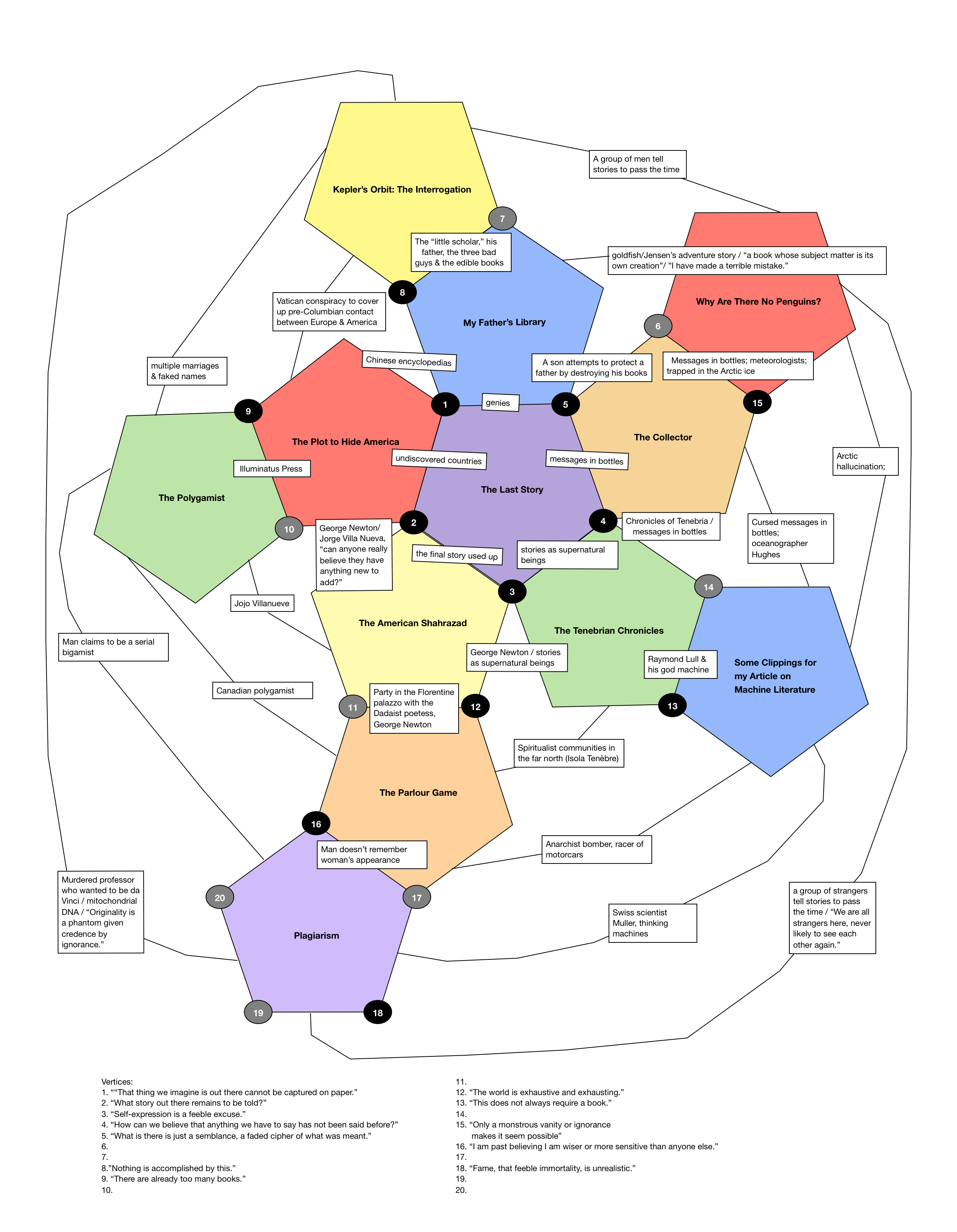
Another reviewer shared this fantastic chart which might perhaps defeat the whole purpose of the novel - after all, I think the reader should piece these things together on their own, see how things work, through multiple readings if necessary. But honestly, it would be pretty impressive for anyone to map out all connections on their own and, what the heck, I'm a sucker for reading 'supplement's like this. Pretty neat!

It took a little bit for me to get into this book, but once I understood how it 'works' and what to expect, I settled in no problem.

Most of the stories were intriguing and well-written, despite the variety of genres and styles. One of my favourites was 'The Polygamist'. I forgot I was reading a collection of short stories and I was getting pulled into this character's story so much so that I was disappointed when it ended. I wanted to read his whole story! (Er, 'whole' is not the appropriate term here. I wanted to read more of his tale.) The following couple of stories fell flat for me, but I can't say whether that was in comparison to the story I adored so much or because of their own nature.

Another favourite was 'The Last Story' which was, coincidentally, the last story - Glennon notes that the collection-cum-novel could have started with any tale. The end of the story had me laughing out loud at the post-modernity of it all - could Glennon actually have asked for those stories in an airport and gotten such an answers/

Other favourites: 'In My Father's Library', 'Why Are There No Penguins?' and 'Kepler's Orbit - Chapter 1: The Interrogation'.

A final closing note: I wanted to purchase this book so I when I was near the bookstore, I popped in to check if it was on the shelf but no luck. When I was at a used bookstore a few days later, looking for something else, I walked past the Canadian Literature section and thought 'What the heck, I might as well check if they have it' and surprisingly they did! :) I was able to purchase it for $10; I walked out of the store very happy (I never find the books I need at used bookstores XP).
Profile Image for Lori.
1,384 reviews60 followers
June 12, 2016
According to the author's Afterward, the idea for The Dodecahedron, or A Frame for Frames grew from his thoughts about the "geometry of short story collections." In most cases, he observed, the stories follow a continuity similar to that of the novel, progressing through a series of developments until a resolution in the final story. Instead of this "cyclical" geometry, Glennon wanted to produce a unified collection where each story could nevertheless stand on its own and linear order was irrelevant. He also looked to the Oulipo principles that also guide Georges Perec's novel Life: A User's Manual, and set A Frame for Frames within certain constraints based on the geometry of the twelve-sided dodecahedron. Each of the twelve stories represents one of the dodecahedron's faces, which are pentagonal. These five sides in turn stand for the relationships between the stories: each one must refer to or be referred to by each of the five stories adjacent to it. And so the book's shifting perspectives and all-out Mind Screw were born.

A Frame for Frames is difficult to describe without spoilers. Common themes include an ancient Vatican conspiracy to hide the New World, messages in bottles, the Arctic, the production of fiction by machines or artificial intelligence, the philosophical notion of transcendent paragons (or "types"), and variations on the tale of Scheherazade. Several genres are present in addition to the standard short story, including fantasy, memoir, the children's story, the magazine article, academic paper, adventure fiction, and what seems to be the opening chapter to a novel. Regardless of the order in which you read, the collection as a whole unfolds like endlessly deconstructing origami. The stories both contradict and reinforce one another in a disorienting flux that leaves reality itself in doubt with the faint image of the underlying dodecahedron as the only point of stability. In the self-contained universe of the The Dodecahedron, it is the symbol of ultimate reality - that spiritual truth glimpsed at by monks in the prolonged Arctic night or a casual conversation about said monks at a modern cocktail party. But wait - are the Tenebrian manuscripts just a hoax???

The Dodecahedron, or A Frame for Frames is a constant surprise. The stories themselves are individually gripping in their own ways and the concepts they introduce are delicious food for thought.

Original Review
Profile Image for Douglas Summers-Stay.
Author 1 book52 followers
March 9, 2013
Writing fiction is a little like making a necklace from found objects. You find a few interesting ideas lying around, you string them together in a pleasing pattern, and you have a short story. In this book, the author has carefully formalized and extended that process, reusing particular ideas in each story so that, if you were to trace out which ideas were in each story, they would weave the net of a dodecahedron. That is, there are twenty reused tropes, each of which shows up in exactly three stories; each story contains five.
The ideas themselves are the sort of thing you would find in stories by Jorge Borges, Umberto Eco, Steven Millhauser or Italo Calvino. There are volumes of encyclopedias that describe themselves, messages in bottles that may or may not be forgeries (and may or may not be Djinn), conspiracies of catographers, monks laboring in the arctic darkness to write their increasingly bizarre visions, and so forth. One story is a half dozen explorations of machine-generated literature, including mentions of Ramon Llull and Jonathan Swift.
Most of the stories are related by a narrator, rather than immediately related in action and dialogue form. This provides an additional frame, but also adds a little distance from the reader.

You can get a used paperback edition from Amazon for the price of shipping.
Profile Image for Jessica.
31 reviews
February 20, 2016
I read this book for the first time a number of years ago, lent my copy to a friend and never saw it again. I stumbled upon it recently in a fated visit to my favourite used bookstore, and I am so happy that I did. Reading the first paragraphs was like shaking hands with a long lost friend. I slipped effortlessly into the circuitous narrative and longed, as I had on my first read, to build my own 3D version of this brilliant collection of interwoven short stories fashioned on a dodecahedron. Paul Glennon is masterful I pulling of this literary trick. I would recommend this book to any lover of fiction, but especially anyone, who like me, is less than enthusiastic about the short story form. If all collections of short stories were this intriguing, I would definitely read more of them.
22 reviews1 follower
July 10, 2008
Great book. Each short is strong enough as a stand alone, but when put together, it's amazing what he's done. Each story changes the perspective of some before it, and, in some cases, some after it. Fantastic read.
Profile Image for isaacq.
124 reviews25 followers
October 3, 2012
my favourite fictional book, and has been through several rereads. just so much here for every taste, and levels within levels to unravel.
Displaying 1 - 9 of 9 reviews

Can't find what you're looking for?

Get help and learn more about the design.