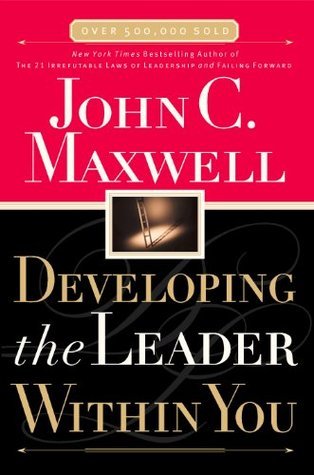
I feel great ambivalence towards this book. I was swept up by the first third of it. By the middle I was harboring some nagging doubts. By the end I was seriously irked.
Let me start out by saying that there is, in fact, a great deal of valuable content within these pages, and I don't want to throw out the baby with the bath water. But it's a small baby in a big bath. The problem is not that Maxwell doesn't offer useful, pragmatic insights into leadership; he does. It's not that he doesn't support his assertions with relevant, frequently pithy quotations; he does. Where Maxwell stumbles is on numerous fundamental assumptions which underlie the initial desire to write a book such as this.
The central flaw which runs throughout this work is the implication that Maxwell's approach to leadership represents the singular correct approach. This assumption, in turn, gives birth to several others. Written, ostensibly, from a Christian perspective, I would suggest that Maxwell has lost sight of what is, arguably, one of the central and most fundamental passages in the New Testament, the Sermon on the Mount. What emerges from Maxwell's pen is a guidebook on how to most successfully conform to the things of this world, not how to love one another. In other words, he takes it as a given that the world view under which we all labor is without flaw, whereas the essence of the Christian ethic is that we live in a broken world which we are commissioned to improve upon selflessly, to the fullest extent possible.
Maxwell comes from a long line of similar thinkers who insist that anything other than "the power of positive thinking" is an affront to all that is good and noble in this world. This general philosophical bent describes a bee-line to such dubious schools of thought as the "prosperity gospel" and the "law of attraction," both of which certainly seem true to those who both believe in them and experience good luck. Maxwell would have us believe that luck is a fiction, which is a cruel requirement to foist upon one's fellow beings.
To take a few examples, Maxwell asserts that great leaders should hire only "the best" people. But who is to say who those best are? By what measure are we to judge? Well, apparently he would exclude anyone with so-called "personal problems." Yet I myself have yet to meet any human being who does not suffer from such problems. So, seemingly, Maxwell advocates the hiring of people who exist in a state of delusional denial. Or, perhaps, who are simply clever and convincing liars. It certainly makes the reader wonder what Maxwell's own closet contains.
Elsewhere he makes the point that, "Continued success is a result of continued improvement." This, of course, raises the question of how we define "success." Is it to be measured in terms of worldliness and material gain or in terms of how much good we bring to the meek, the weak, and the downtrodden, whether tangible or otherwise? But aside from that question, Maxwell posits something which is, in point of fact, an impossibility. Improvement is a form of growth and, as such, cannot be continual. No system can grow forever and at all times. When we exercise to build strength, we do not -- we cannot -- flex our muscles unremittingly. We must flex and then relax, flex and relax, flex and relax. Germination precedes growth and, more to the point, is absolutely, strictly necessary.
As to the strong implication, reiterated throughout this book, that a "positive attitude" is a prerequisite for living a successful, and, what's more, a morally acceptable, life, I would counter that this is not compatible with Christian teaching as found in the Bible. I know there are many, many Christians -- pastors and theologians among them -- who insist that the Bible supports this point of view, but I stand by my conviction. I would refer readers, particularly, to Ecclesiastes 3:1-8, as well as countless passages throughout the book of Job. Jesus was plagued by doubts and sorrow at various points throughout the New Testament. And the Old Testament prophets, generally acknowledged as the harbingers of the coming Messiah, express so-called "negativity" and discontent over and over and over again. Let me be clear: I do not advocate a gloom-and-doom view of the world, but, rather, a balanced and realistic view which, I believe, is entirely in line with Christian teaching.
I could raise many more objections to Maxwell's work. It is poorly organized and vague in the extreme. For example, consider the titles of three of the ten chapters: "The Key to Leadership: Priorities," "The Most Important Ingredient of Leadership: Integrity," and "The Indispensable Quality of Leadership: Vision." It seems that the key, the most important ingredient, and the indispensable quality are all distinct, although I fail to understand how. Maxwell's text is frequently repetitive, too. In several instances passages are repeated, verbatim, in their entirety. His reliance on snarky quotations and anecdotes is at first amusing and sometimes insightful, but wears thin quickly. The result is a feeling that Maxwell has simply stirred together a huge collection of platitudes in more or less random sequence without adding much by way of his own original thought or giving us the benefit of his unique experiences in life. Finally, the veracity of the author himself is drawn into question when he asserts that, in addition to functioning as lead pastor to a large church and heading an organization devoted to educating leaders, he also, purportedly, makes 400 public appearances per year. The end pages list no less that 38 books he's written, which may provide more than a little insight into why this particular volume seems half-baked and perfunctory.
My best advice if you want to develop leadership skills? Put down the books, stop shelling out for seminars and summits, stop listening to the "experts," and do, do, do.