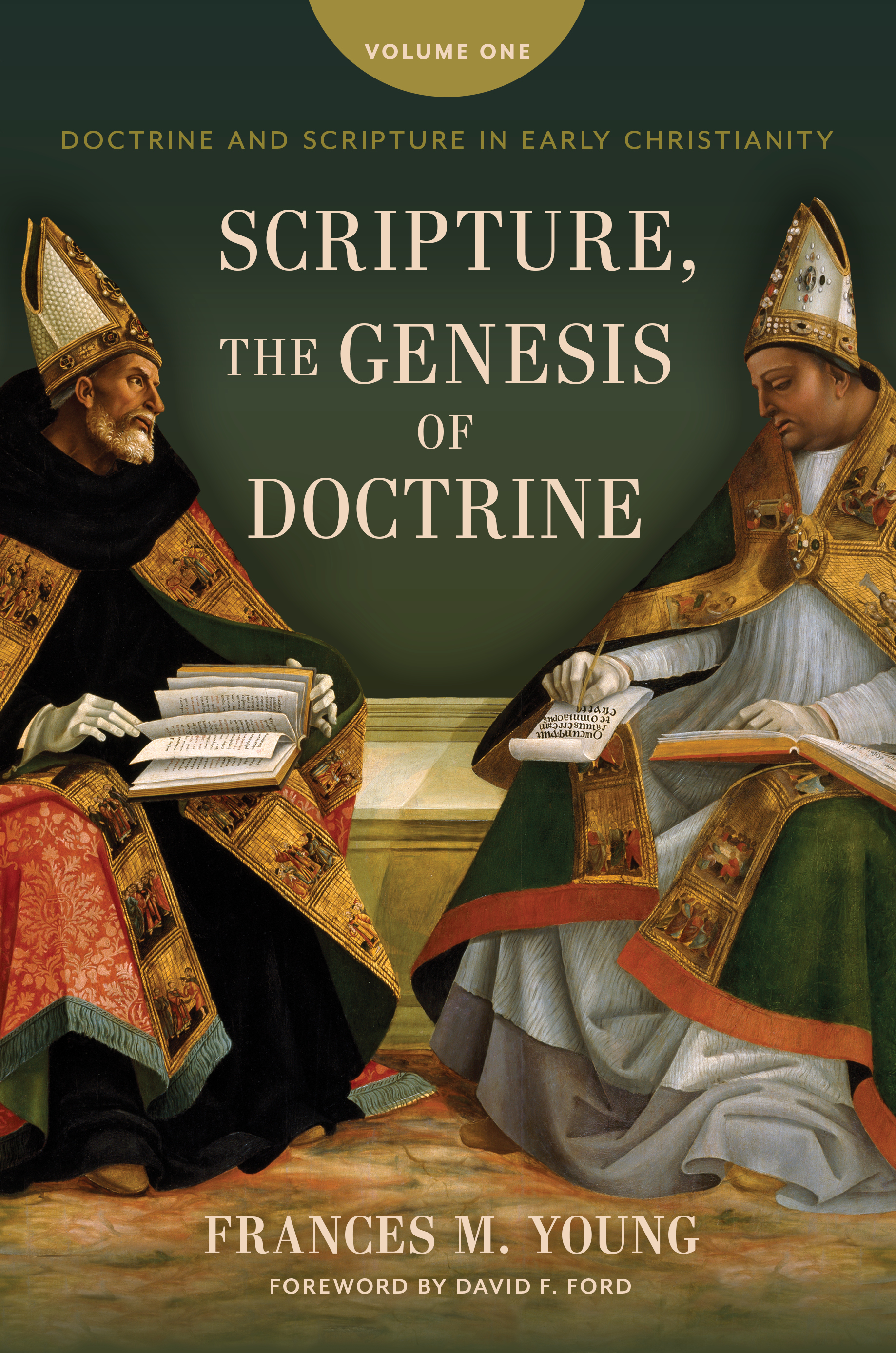
Historical criticism has revealed a gap between Scripture and the mainstream doctrines that define Christianity today. Not the least of these are the Trinity and two natures of Christ—widely accepted since the fifth century, but unfounded in historical readings of Scripture. How did these dogmas become so integral to the faith in the first place?
Frances M. Young tackles this monumental question in a culmination of decades of biblical and patristic research. The first of two volumes exploring the emergence of doctrine in the early church, Scripture, the Genesis of Doctrine reframes the relationship between Scripture and doctrine according to the intellectual context of the first few centuries CE. Young situates the early Christians’ biblical hermeneutic within the context of Greco-Roman learning without espousing historical relativism. Ultimately, Young argues that the scriptural canon and the rule of faith emerged concurrently in the early Church, and both were received as apostolic. The perceived gap between the two may in fact be the product of our modern assumptions rather than an ancient reality.
Nuanced and ecumenical, Scripture, the Genesis of Doctrine explores early Christians’ biblical hermeneutic, with an eye toward how we interpret the Bible today. Young’s magisterial study holds widespread implications for not only patristics but also exegesis and systematic theology.
Scripture is the foundation of Christian theology. It has to be interpreted, which led to doctrinal formulations, including the creeds. In early Christianity several areas of concern emerged, beginning with God's role as Creator, from there, Christian leaders dealt with Christology, which in turn led to the development of the doctrine of the Trinity, as defined in the creeds of Nicea and Constantinople. The question that emerges regularly concerns the relationship between Greek philosophy and Scripture. There are those, often Restorationists, who see the developments after the second century as corruptions of the original pristine doctrines in the New Testament. But, while there was development, did the early Christians seek to be true to Scripture even as they dealt with important issues, such as whether the God of Jesus was the Creator (Marcionism).
Frances Young has written a major two-volume tome, "Doctrine and Scripture in Early Christianity." In this volume, the first of the two, she focuses on "Scripture, The Genesis of Doctrine." The Second volume is titled Scripture in Doctrinal Dispute: Doctrine and Scripture in Early Christianity, vol. 2. While volume 1 focuses on the developments leading up to the development of the Trinity in the fourth century and the fifth-century debates over the two natures of Christ, this volume sets the stage, focusing largely on setting the stage for what is to come, including modern debates over the development of doctrine, such as Newman's ideas, or whether we see the Hellenization of the Gospel. One of the key elements of this volume, which serves as a foundation for the second is the idea that early Christianity was "school-like." We think of Christianity as a religion, but in its early stages, like synagogues, the focus was on teaching, such that bishops took on the role of teachers. The doctrinal developments of these early years emerged out of these schools.
The earliest debates focused on responses to Marcionism and Gnosticism (Valentinian), out of which the earliest summations of scriptural thought were summarized in various rules of faith. Irenaeus and others focused these developments on God's role as creator, thus the idea of Monarchianism.
Young draws on several theologians of this early period, including Irenaeus, Origen, Cyril of Jerusalem, and in the summary at the end of the volume on Augustine's text Teaching Christianity (Vol. I/11). As she works through these early theological works, Young seeks to show how early Christian leaders/theologians sought to ground their doctrinal developments in Scripture, even as they drew on the philosophical resources of their time. As such, she sets up what is to come in volume 2, where she focuses on the disputes of the fourth and fifth centuries that resulted in the Nicene-Constantinopolitan Creed and the Chalcedonian Definition of 451.
These two volumes are dense but rich in theological resources. While it is true that early Christian theologians didn't use the historical-critical method. They were quite aware of the human elements that help form Scripture.
Essential subject matter to engage with if you want to understand the nature of the faith. Young gives us a helpful doorway to step through into the dysfunctional 2nd century household where to gnostics and patristics duke it out for the best view out the window.
Frances Young explores through extensive primary source literature the emergence of Christian beliefs and the Christian canon. She demonstrates how the Church of the first two centuries functioned as much as a school as a worshiping community, for that community was embracing beliefs and modes of living that were truly countercultural, requiring thoughtful reflection and the founding of these beliefs in an authoritative source. As she notes, the canon itself that we take for granted today “owes its very existence to the network of schools that used these books in their instruction (doctrina), which they believed enunciated the truth” (233). As "the rule of faith” grew side-by-side with the acceptance of received scripture, “there never was a gap between scripture and basic Christian teaching” (244). So it was that “a Christian reading of scripture required the doctrinal framework that scripture itself generated as interpreters sought to articulate what scripture was all about” (233).
This intriguing interplay of emerging doctrine and the canon of Scripture is played out through the voices of multiple church fathers including Irenaeus, Cyril and Augustine (among others). Through careful engagement with these voices, Young shows how “the historical process was not so much a ‘development’—certainly not an alien importation but rather the articulation within that particular intellectual context of what had been received from the apostles, and the identification of scripture’s overarching unitive narrative, from the beginning to the end, as an account of fall and redemption under the providential oversight of the one true Creator God, to whom all human creatures are accountable” (244).
Young argues that the articulations of doctrine (especially through apophatic articulations) are not so much evidence of a Hellenization of Christian thought as a natural reflection of the Jewish and early Christian writings in Greek categories as the Church faced consequential issues related to its core identity. Notwithstanding the early apophaticism arose from the Jewish concept of not pronouncing the name of God and an affirmation of creatio ex nihilo, I do wonder, how much the alienation of the Church and Jewish community in which it was birthed allowed for an increasingly westernized form of the faith that is now being reassessed by fresh engagement with Hebrew scripture and the New Testament authors’ usage thereof.
Finally, I particularly appreciated Young’s brief engagement with Augustine’s triangle of ethos, pathos and logos as being equally necessary in the work of doctrine and formation of Christians and the church. Young’s work opens pathways for an intellectually humble theological reading of scripture within a doctrinal and devotional framework that sustains a biblical witness in the ever changing contexts of the community of faith across the centuries. I look forward to reading volume two of this monumental opus in which this approach is explored in further detail with an eye on the Trinitarian and Christological controversies of the fourth century.