

What do you think?

Ichiro
ICHIRO IS A BOY ADRIFT IN THIS WORLD.
Raised by his Japanese mother in New York City, his American father taken by war before Ichiro ever knew him, Ichiro finds it difficult to figure out where he fits in.
A trip to Japan leaves Ichiro with his grandfather, a stranger to him in a country he does not know.
And then one night Ichi gets dragged down a hole by a monster. When he wakes up, he isn't in Japan anymore. In fact, he isn't in the mortal world. Ichi has entered the domain of the gods.
With words and pictures, Ryan Inzana seamlessly interweaves myth and reality, life and death, gods and mortals, creating a wholly original fantasy adventure about one boy's search for peace, acceptance, and a place to call home.
Raised by his Japanese mother in New York City, his American father taken by war before Ichiro ever knew him, Ichiro finds it difficult to figure out where he fits in.
A trip to Japan leaves Ichiro with his grandfather, a stranger to him in a country he does not know.
And then one night Ichi gets dragged down a hole by a monster. When he wakes up, he isn't in Japan anymore. In fact, he isn't in the mortal world. Ichi has entered the domain of the gods.
With words and pictures, Ryan Inzana seamlessly interweaves myth and reality, life and death, gods and mortals, creating a wholly original fantasy adventure about one boy's search for peace, acceptance, and a place to call home.
288 pages, Hardcover
First published March 20, 2012
About the author
Ryan Inzana
8 books4 followersRyan Inzana is an illustrator and comic artist whose work has appeared in numerous magazines, ad campaigns, books and various other media all over the world. His illustration work has been recognized by The Society of Illustrators and Communication Arts. Ryan's comics have been inducted into the Library of Congress's permanent collection of art and have earned an Eisner nomination as well as an Asian American/Pacific Islander Honor Award for YA literature.
Ratings & Reviews
Friends & Following
Create a free account to discover what your friends think of this book!
Community Reviews
Displaying 1 - 30 of 243 reviews

September 24, 2012

One of the more recurrent themes of young adult literature is disorientation. A young protagonist one day wakes in an unfamiliar place and—through a variety of struggles and trials—eventually overcomes the cultural hindrances that hold him back. Or a young protagonist's home is destroyed and she, alone and unprepared, must discover and come to control the wildness of the greater, wider world around her. Or a young protagonist arrives at a new school (perhaps even mid-term) and must learn to swim in the new, strange waters of his new social ecology. These are common stories—common enough that we probably don't need names or titles to prompt us to fill in some of the details about how these things will work out.
But what if that sense of disorientation, that alienation, didn't give way to heroic success and comfortability? What if the story was less about success in a strange place than it was about acquiescence in the face of an inescapable foreignness, an otherness that cannot be overcome because its alien nature was too great. In a way, that's the kind of story Ryan Inzana explores in Ichiro. It's a book where success is measured not in fighting against disorientation but more in simply coming to apprehend that feeling and taking what ambiguous lessons one can from it. For this, despite the book's certain indebtedness to fantasy and folklore, it may actually be a more realistic story—and hence more valuable to the young reader.1
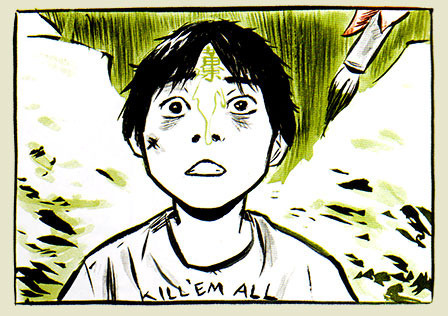
[This kanji apparently means "yellow" for whatever reason. Or something. Don't ask me, I can't read kanji.]
Ichiro and Ichiro survey through several layers of disorienting strata, investigating and coming to terms with vertiginous environmental, historical, and political paradigms. Inzana's protagonist is introduced immediately at the mercy of two common circumstantial troubles, as well as a third—this one less common but unfortunately by no means rare. In the first place, Ichiro is a young teen, which naturally places him at odds with every other living being (for even the best of us, traveling through puberty is an awkward journey—with our ungovernable bodies controlling us rather than being controlled by us). On top of that: Ichiro, the son of an American father (of indeterminate heritage2) and a Japanese mother, is hapa. Because he has Asian physical characteristics, even in a city so cosmopolitan as New York, Ichiro has to endure the stereotypical racist reactions that in America still haunt those of Asian descent. Even in his home country, Ichiro is made to feel a foreigner. He hides his eyes behind thick, dark aviators and his personality behind loud, angry music. He projects the ethos standardized across the disenfranchised American youth. Both of these are environmental and ontological struggles that must be endured rather than overcome. And while we all grow out of teenagerness into whole new insecurities, ethnic identity is as much the response of others as it is a projection of our own.
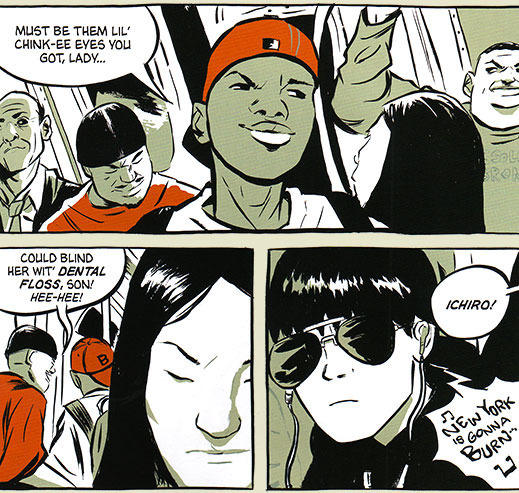
[I mean, it will of course.]
The third threat to Ichiro's comfortability in this world may be built of melodrama, but it fits the story well enough. Ichiro, by military accident, is fatherless. He wasn't abandoned so much as he was de-fathered. Remembering his father nearly only in dreams—a silent, almost ominous figure for much of the narrative—Ichiro is set at a heavy disadvantage so far as male influences go. While his dad (obviously enough) was world-friendly and adept enough at adapting to other cultures, Ichiro's grandfather Benny is characterized by the worst American ignorances. He's loud, boastful, and builds his interactions with the world off bias and presupposition. And so, Ichiro threatens to follow suit.
Ichiro, at story's beginning, is a lost boy—and the storm into which he will soon be drawn doesn't promise to make finding his way any more likely. At best, Ichiro may discover himself better able to orient along his life's current, but he will only ever be carried where the rivers of fate will move him.

While Inzana sets Ichiro in the midst of a shaken, uncertain world, the author quickly moves him into much more disorienting worlds. If New York didn't understand him, at least he somewhat understood it. Or at least his place in it. Japan is quite another animal and beyond a presentable-though-obviously-foreign use of the language, Ichiro is a fish out of water. A fish out of water out of water. He vastly prefers America and holds onto the national arrogance that his Grandpa Benny built into the lens of Ichiro's foreign policy. Still, living with his Japanese grandfather will only serve to cause further disorientation, further disillusionment—though with his Asian grandfather's help, Ichiro may come to recognize that this kind of alienation from expectation is actually the common human experience throughout life. Perhaps his mother and both grandfathers are continually experiencing this at-odds-with-the-world experience as well. And maybe it's the way you deal with the fear that these experiences create—maybe it's your reaction that will prove what kind of a person you have been raised to be.
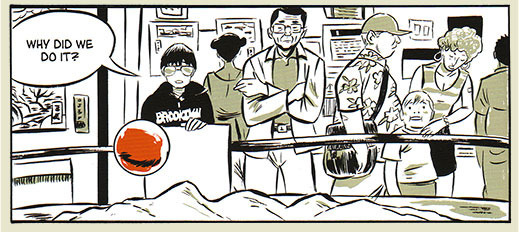
[Mostly because we didn't see them as human. We were not great people.
Ichiro's grandfather is way more charitable than me.]
Ichiro can be a powerful, thoughtful work—an evaluation of what it means to be a human trapped by the arbitrary structures inherited by the capriciousness of birth. Male or female? Rich or poor? Red or yellow, black or white? American? Japanese? Ugandan? How are we responsible for the state into which we are born? Ichiro, among its other conceits (for instance, a decent story with well-crafted art), can give us a framework by which to better evaluate the existence we have been pushed into. It's not the path of victors, but it proposes something better than living as one of the conquered.
____________________
Note
I hadn't mentioned it, but a good portion of Ichiro—perhaps a full third of the book—takes place in a world of myth and magic reflecting traditional Japanese creation legends. Ichiro is drawn into this mythic world as much by his own volition as he was when when born into our own. It was not by his choice and he is as much at the mercy of that foreign environment as we each are of our own worlds. Ichiro's time in that fantasy realm seems to function primarily as a filter through which to understand his real-world struggles. It's a parable of sorts, and more or less works. As with Miyabe's Brave Story, I preferred the real-world side of the story to the myth-world side, but I do appreciate Inzana's purpose.
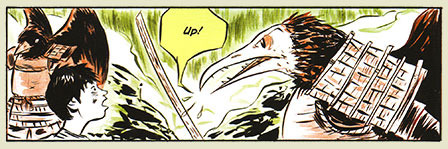 NOte: Word balloons in pale yellow-green are in Japanese. In white are English.
____________________
Other Note
I'd seen several reviewers describe Ichiro as manga. The appellation is baffling to me, no matter what sense you choose to honour for the term manga.
• If manga means "Japanese comics," it is unsuitable here, for Inzana is American.
• If manga is meant to refer to a certain genre of comics, then it also seems an inane description as it follows none of the stylistic tics commonly associated by Americans as being hallmarks of "manga"—big eyes, speedlines, chibi versions of characters, sweatdrops on the backs of heads, and interminable fights punctuated more often by inner monologue than by actual action. Visually, Ichiro is composed in a manner very consistent with Western comics culture—save for when Inzana homages traditional Japanese arts. In fact, his work looks reminiscent of that of GB Tran.3
• If manga simply means "comics," as it does in Japan, then the appellation is worthless in an English context because our word for comics is comics.
It's possible (i.e. likely) that reviewers' use of manga to describe Inzana's book is a serendipitous intersection between 1) the narrative state of alienation that Ichiro experiences and 2) a similar state which Inzana himself almost certainly experiences to greater or lesser degree (cf. Gene Luen Yang's American Born Chinese ). So I guess, in some sense, we can cheer the awkwardness created as an object lesson in support of Inzana's work.
____________________
Footnotes
1) It may be slightly presumptuous to describe this book in terms of YA lit, as I haven't seen that taxonomy prescribed elsewhere. The jacket and indicia give no clue to how it should be catalogued. I only lean toward YA because the protagonist is a young teen and is fraught with young teen concerns. Ichiro, like all good YA lit, can be enjoyed by adults as well as young adults.
2) Ichiro's father is at least a portion Westerner as Ichiro's grandfather, Benny, appears to be the typically ethnocentric Caucasian American. Although... the art is unclear as to whether Benny is Anglo, Italian, Jewish or of any other nationality. It's even possible that Benny could be a Japanese man whose hair had lightened with age and whose attitudes may have been shaped by the same media projections that too often capture the hearts and minds of the average American.
3) And yes, I realize how ironic that might sound, but Tran (while of Vietnamese heritage) was born and raised in America (cf. his wonderful recountment of his recent family history, Vietnamerica ).
____________________
[review provided courtesy of Good Ok Bad]

July 28, 2016
Even before researching a bit about the author, Ichiro clearly has political undertones about war and the lies behind it. Ichiro, in its front is a Spirited Away-esque story of the eponymous character, who somehow "fell" in a hole Alice in Wonderland style. He met some of Japan's Shinto gods and the creatures of the spiritual world.
During the time he spent there he have learned this war between the realms Ama and Yomi from the god of war himself, Hachiman. This war is obviously an allusion to the recent war the world have experienced, how it started, the lies fed to the people and its lasting effects. Although it passes as a good shinto story, and one may not relate it to the ones happening in the real world yet can still appreciate the material.
The book has some racist remarks at the beginning which may raise some eyebrows. But it was also briefly seen that Ichiro and his mom, being Asians were also victims of it.
The almost "sumi" art style is a great plus in the graphic novel.
I understand why many dislike Ichiro though. The narrative is a bit clunky and disjointed at the start and one has to be invested in appreciating Shinto culture in order to get the most out of the book.
During the time he spent there he have learned this war between the realms Ama and Yomi from the god of war himself, Hachiman. This war is obviously an allusion to the recent war the world have experienced, how it started, the lies fed to the people and its lasting effects. Although it passes as a good shinto story, and one may not relate it to the ones happening in the real world yet can still appreciate the material.
The book has some racist remarks at the beginning which may raise some eyebrows. But it was also briefly seen that Ichiro and his mom, being Asians were also victims of it.
The almost "sumi" art style is a great plus in the graphic novel.
I understand why many dislike Ichiro though. The narrative is a bit clunky and disjointed at the start and one has to be invested in appreciating Shinto culture in order to get the most out of the book.

September 8, 2012
This one is hard to rate. Do I rate it for the illustrations and style, which would easily get 5 stars, or do I rate for the story, which sits at about a mediocre 3? I'll go halfsies and give it 4.
I picked this up at the library, and was about 10 pages in before I could put it down. It starts with an old story of a monk and a mystical tea pot. I'm all for old magical Japanese myths, so I was really excited about this one. Besides, the graphics and colors are gorgeous.
Then I got to the meat of the story, which is mostly a Japanese-American boy hearing old war stories from his grandpa in Japan. It was interesting, but not very... engaging. I pressed on, and through to the boy meeting the magical tea pot and being carried off to another world. Hurray! More magical action! Alas, despite reading the entire thing in one sitting, I felt the story was rather lacking. Or perhaps the message was too bare for me, and not buried deep enough in action and characters. The main character sat and listened and learned, but did not really interact with his world. Perhaps it would be more moving for the younger audience for which it is intended.
Regardless of what I thought of the story, I'll definitely be looking for more of Ryan Inzana's work in the future. I loved the style of the illustrations, and just wish the dialogue and story matched my fascination with the drawn characters.
I picked this up at the library, and was about 10 pages in before I could put it down. It starts with an old story of a monk and a mystical tea pot. I'm all for old magical Japanese myths, so I was really excited about this one. Besides, the graphics and colors are gorgeous.
Then I got to the meat of the story, which is mostly a Japanese-American boy hearing old war stories from his grandpa in Japan. It was interesting, but not very... engaging. I pressed on, and through to the boy meeting the magical tea pot and being carried off to another world. Hurray! More magical action! Alas, despite reading the entire thing in one sitting, I felt the story was rather lacking. Or perhaps the message was too bare for me, and not buried deep enough in action and characters. The main character sat and listened and learned, but did not really interact with his world. Perhaps it would be more moving for the younger audience for which it is intended.
Regardless of what I thought of the story, I'll definitely be looking for more of Ryan Inzana's work in the future. I loved the style of the illustrations, and just wish the dialogue and story matched my fascination with the drawn characters.

April 20, 2026
Ichiro pairs messy, unrefined artwork that feels cool and intentional without being over-stylized with a folklore-saturated story of identity and belonging rooted in history. Not sure I caught every layer, but I admired it even when it kept me at arm’s length. Hitting the ceiling of 3 stars, rounded up.
August 11, 2022
3.5 rounded down
the art of this was so beautiful, especially the use of reds and greens and blues. the story was good but the art really made an impact
the art of this was so beautiful, especially the use of reds and greens and blues. the story was good but the art really made an impact

April 21, 2023
If you are interested in Japanese mythology this is a nice introduction. Ichiro has been raised in Brooklyn and after the death of his father he and his mother return to Japan and Ichiro goes to stay with his grandfather. The mythology is nicely woven into the stories his grandfather tells him and then when he is dragged into the underworld by a tanuki (racoon) who is trying to pinch the persimmons from his grandfather's garden

April 13, 2012
Woo!!! Japanese monsters!!!
So yeah, I thought this book would be a cheesy war fantasy for boys when in fact it was about a half Japanese kid who gets stuck in the Shinto spirit world and learns all about the rift between heaven and earth from the war god! I have recently been lucky enough to have conversations with my fellow bookstore employees about the monsters of Japanese folklore. And they are really one of my favorite things to find in manga -- they are so weird and spooky and sideways and imperfect and beautiful.
Inzana did a great, if slightly uneven (ah! his perspective was weird sometimes, but who am I to judge!), job of capturing that style and making it his own -- with some stylistic Japanese-American things in common with Jillian Tamaki. His use of color was perhaps a bit over the top, but perhaps that's a matter of the printing/publication choices.
I really really liked this, it was a solid story, exciting art, and made me want to learn a lot more! Thanks, dude!
So yeah, I thought this book would be a cheesy war fantasy for boys when in fact it was about a half Japanese kid who gets stuck in the Shinto spirit world and learns all about the rift between heaven and earth from the war god! I have recently been lucky enough to have conversations with my fellow bookstore employees about the monsters of Japanese folklore. And they are really one of my favorite things to find in manga -- they are so weird and spooky and sideways and imperfect and beautiful.
Inzana did a great, if slightly uneven (ah! his perspective was weird sometimes, but who am I to judge!), job of capturing that style and making it his own -- with some stylistic Japanese-American things in common with Jillian Tamaki. His use of color was perhaps a bit over the top, but perhaps that's a matter of the printing/publication choices.
I really really liked this, it was a solid story, exciting art, and made me want to learn a lot more! Thanks, dude!

May 18, 2019
Some good moments in the first half, but it's hard to know the sincerity of the author when I don't know his personal connection to the story. Being nikkei, I'm wary of non-nikkei telling stories with Japanese settings for the ~aesthetic, and especially when the book explores diaspora issues which are very complicated and nuanced. There were times when he handled that nuance well, but other times I wasn't as impressed. I wish he'd spoken more about himself in the book so I knew he was writing from a place of genuine caring and not cultural tourism.
October 11, 2019
Ichiro is a graphic novel written and illustrated by Ryan Inzana, it centers on a young American teen, son of a Japanese immigrant and an American soldier killed in combat, goes to Japan with his mother for an extended visit and begins to grapple with sophisticated cultural complexities.
Ichiro, raised in America by his Japanese mother, is left with his grandfather in Japan during his mother's business trip. Though they've rarely been together, the visit is treated as an opportunity to bond and a way for grandfather to introduce Ichiro to the history and culture of his homeland through a series of day trips.
Ichiro is written and constructed rather well. Inzana fashions his literary hybrid by moving between grandfather's lectures about the sites and Ichiro's personal drama, bringing the wider strokes of history and religion into a personal realm. Framed by a mythological backdrop, Ichiro's story collides with fantastic tales of Shinto gods and goddesses that begin to engulf his own and offer a reason to fight his way back to a life of day trips and lectures with grandpa. Inzana mixes the mystery with the matter-of-fact in his lively artwork, creating a mood of enlightenment throughout and offering an insight into Japanese culture with a maximum of imagination.
All in all, Ichiro is a beautiful and thought-provoking tale of a boy's journey in trying to find his culture.
Ichiro, raised in America by his Japanese mother, is left with his grandfather in Japan during his mother's business trip. Though they've rarely been together, the visit is treated as an opportunity to bond and a way for grandfather to introduce Ichiro to the history and culture of his homeland through a series of day trips.
Ichiro is written and constructed rather well. Inzana fashions his literary hybrid by moving between grandfather's lectures about the sites and Ichiro's personal drama, bringing the wider strokes of history and religion into a personal realm. Framed by a mythological backdrop, Ichiro's story collides with fantastic tales of Shinto gods and goddesses that begin to engulf his own and offer a reason to fight his way back to a life of day trips and lectures with grandpa. Inzana mixes the mystery with the matter-of-fact in his lively artwork, creating a mood of enlightenment throughout and offering an insight into Japanese culture with a maximum of imagination.
All in all, Ichiro is a beautiful and thought-provoking tale of a boy's journey in trying to find his culture.

October 17, 2017
Great art, great tale. A gift for anyone who has ever felt like they were caught between cutlures, between worlds - between anything.
It's a specific tale - about a half-Japanese, half-American boy who doesn't feel like he belongs to either culture and -
Well I'll leave the rest up to you to find out. Let's just say there is some real life, some fantasy - and a lot of heart from Ryan Inzana. I highly recommend it - and though the Japanese creatures can be a little foreign to anyone born outside of the islands, Mr. Inzana does shows them well, and the reader is pulled along with the tale.
5 stars - I recommend it!
It's a specific tale - about a half-Japanese, half-American boy who doesn't feel like he belongs to either culture and -
Well I'll leave the rest up to you to find out. Let's just say there is some real life, some fantasy - and a lot of heart from Ryan Inzana. I highly recommend it - and though the Japanese creatures can be a little foreign to anyone born outside of the islands, Mr. Inzana does shows them well, and the reader is pulled along with the tale.
5 stars - I recommend it!

July 5, 2021
Ichiro lives in New York City with his Japanese mother. His father, an American soldier, was killed in Iraq. Now, Ichi’s mom has taken a job in Japan, so they move to Japan and Ichi goes to live with his maternal grandfather.
Grandfather becomes Ichi’s tour guide, taking him to temples as well as the Hiroshima Peace Park, where Ichi starts to question the nature of war. This was quite the contrast to the time Ichi spent with his paternal grandfather, who was, quite frankly, a racist asshole.
After a supernatural encounter with the gods and creatures of Japanese mythology, Ichi must face his fears and find his way back home.
I really liked where the story was going before we got to the supernatural element, and I was really looking forward to Ichi bonding with his grandfather. I wanted Ichi to question the inherent racism he learned from his other grandfather, but it was kind of just left on the page. The story took a completely different direction, and I honestly wasn’t a huge fan. There was a lot of mythology, and it didn’t ease you into it at all. I think I was just overwhelmed, honestly, so maybe I missed the moral of the story.
Grandfather becomes Ichi’s tour guide, taking him to temples as well as the Hiroshima Peace Park, where Ichi starts to question the nature of war. This was quite the contrast to the time Ichi spent with his paternal grandfather, who was, quite frankly, a racist asshole.
After a supernatural encounter with the gods and creatures of Japanese mythology, Ichi must face his fears and find his way back home.
I really liked where the story was going before we got to the supernatural element, and I was really looking forward to Ichi bonding with his grandfather. I wanted Ichi to question the inherent racism he learned from his other grandfather, but it was kind of just left on the page. The story took a completely different direction, and I honestly wasn’t a huge fan. There was a lot of mythology, and it didn’t ease you into it at all. I think I was just overwhelmed, honestly, so maybe I missed the moral of the story.

April 19, 2022
This was brilliant. A beautiful story, told within a story. Ichiro travels to Japan to visit with his grandfather that he's never met. Through stories, Ichiro learn the mythology surround the island, from its creation to the various births of its gods. Wonderful and informative. Really enjoyed both the story and the artwork.


June 26, 2023
I already knew about the shape shifter tanuki and the Kappa but it would have been good to have a glossary with a list of mythological creatures and gods.

March 2, 2024
Love the Japanese mythology in this story.
September 19, 2017
It was a really good book but the ending was weird I didn't understand what was going on but overall I really enjoyed it!

February 23, 2022
Beautifully illustrated and a very complex and interesting narrative. The story has so many elements that I wish could’ve been explored deeper. I would’ve loved to see this story develop over multiple volumes.

January 10, 2023
anti-war, pro-humanity <3

May 2, 2019
I enjoyed the combination of Shinto background and the god stories. The 2nd/3rd culture protagonist is interesting and the words of his grandfather about patriotism and not really knowing the true past of a nation and what it stood for and stands for is very relevant in today's landscape.

July 28, 2026
Solid!

April 6, 2012
3.5 stars -- An intriguing storyline and fantastic creatures straight out of Spirited Away are highlights of this nicely presented comic book. Themes such as pacifism and warfare, life after death, Japanese spirituality, and cultural identity are woven throughout. I was especially intrigued by the shapeshifting raccoon dog, or tanuki, who appeared throughout the pages--even if the sight of the crafty canine always sadly reminded me of the real life ways in which these animals are so widely abused and exploited.
I appreciated the character development in this one, as well. Ichiro begins the story idealizing warfare and a macho attitude; his favorite shirt reads "Kill 'em all; let God sort 'em out." However, a visit to the Hiroshima museum shakes up his worldview. Ichiro no longer idealizes killing. I will say that I do wish Ichiro would have extended his pacifist ways to the animal kingdom, however; he is shown fishing toward the end of the book, which was a bit of a disappointment to me personally.
I appreciated the character development in this one, as well. Ichiro begins the story idealizing warfare and a macho attitude; his favorite shirt reads "Kill 'em all; let God sort 'em out." However, a visit to the Hiroshima museum shakes up his worldview. Ichiro no longer idealizes killing. I will say that I do wish Ichiro would have extended his pacifist ways to the animal kingdom, however; he is shown fishing toward the end of the book, which was a bit of a disappointment to me personally.
This entire review has been hidden because of spoilers.

December 12, 2012
2021:
Rereading the paperback edition. Went from a 2* to 3*, but I still feel that the plot and themes weren't as tightly planned as they could have been, especially in regard to the end, which hinted that the gods (or just one) is among us. Parallels were rather in your face and blunt. I did still like the drawing style but it felt klunky during action sequences where it was difficult to tell what was happening. And tanuki and kitsune are really overpowered in this world, it seems...
Really found his dialogue cringey and dated and I'm surprised it wasn't updated with the paperback. It felt like a bad buddy action movie where they shout "Wooo!!" and "That's what I'm talkin' 'bout!" amidst explosions rather than displaying the intriguing cultural differences between Japanese American and Japanese language.
2012:
Nice drawing style but I had no idea what was happening half of the time.
Rereading the paperback edition. Went from a 2* to 3*, but I still feel that the plot and themes weren't as tightly planned as they could have been, especially in regard to the end, which hinted that the gods (or just one) is among us. Parallels were rather in your face and blunt. I did still like the drawing style but it felt klunky during action sequences where it was difficult to tell what was happening. And tanuki and kitsune are really overpowered in this world, it seems...
Really found his dialogue cringey and dated and I'm surprised it wasn't updated with the paperback. It felt like a bad buddy action movie where they shout "Wooo!!" and "That's what I'm talkin' 'bout!" amidst explosions rather than displaying the intriguing cultural differences between Japanese American and Japanese language.
2012:
Nice drawing style but I had no idea what was happening half of the time.
This entire review has been hidden because of spoilers.

February 13, 2017
I enjoyed this book so much because I identified with the protagonist at his age. Hyper-militaristic and hyper-nationalist definitely described me in middle school. But like Ichiro I was exposed at age to what happened at Hiroshima and the horrors of war. Ichiro, from the guiding words of his grandfather, me from reading Barefoot Gen.
Ichiro's subsequent tumble through the spirit worlds of Yomi and Ama are something I never experienced, but they set up his feeling of uncertainty and lack of a clear compass that accompany the loss of one's prior identity. Inzana's artwork and dialogue are beautifully mastered and I highly recommend this, for both stories of childhood growth but also anyone interested in a look at conflict and the philosophy behind it.
Hachiman's quote "Rather than use our whole hand to build we used only a finger to accuse" speaks wonders to the power of the us versus them mentality.
Ichiro's subsequent tumble through the spirit worlds of Yomi and Ama are something I never experienced, but they set up his feeling of uncertainty and lack of a clear compass that accompany the loss of one's prior identity. Inzana's artwork and dialogue are beautifully mastered and I highly recommend this, for both stories of childhood growth but also anyone interested in a look at conflict and the philosophy behind it.
Hachiman's quote "Rather than use our whole hand to build we used only a finger to accuse" speaks wonders to the power of the us versus them mentality.
This entire review has been hidden because of spoilers.

June 4, 2013
A Teen used to spending time with his conservative American grandfather travels with his Japanese mother to her homeland, to spend time with his hitherto unknown Japanese grandfather. After experiencing Japanese culture and recent history through the gentle guidance of his grandfather, he comes to realize that life is more complicated than Fox news had led him to believe. Ultimately he stumbles through a series of encounters with Japanese gods and demons, before gratefully being reunited with his family. This is a really heartfelt graphic novel (not manga) that reminids me in ways of Blankets by Craig Thompson (due both to the autobiographical feel of the work, and the painterly brush style of the art).

December 14, 2014
Ichiro, our main character, grew up in the U.S. with his Japanese mom. His white American father died when he was just a baby. When his mother scores a temporary job opportunity in Japan, she takes teenage Ichiro with her so he can spend time with his grandfather. Ichiro didn't feel like he fit in back in the U.S., and he certainly doesn't feel like he fits in now, in an unknown country. Plus, all his grandfather does is tell weird old stories. It's going to be a boring few weeks, he thinks... until one night when things get really, really strange. He finds gods, monsters, and magic in an alternate world that he may be trapped in forever. Deep thoughts about war and forgiveness in this one.

April 19, 2013
This Eisner Award-nominated graphic novel has gorgeous artwork and coloring that takes the reader along. Although the story was interesting enough, and I liked learning about Japanese mythology and Shinto tales, the story had a somewhat simple, didactic message about war, and the characters, though likeable, weren't complex. I think that Ichiro is definitely worth the read, especially since it's a quick one, for the gorgeous artwork and adept graphic storytelling, but I wish that there were more story for the gifted Inzana to tell.

April 24, 2022
Read it but don’t remember much about it except that the main character, Ichiro, and his mom move back to Tokyo to be with her dad. Ichiro’s dad died when he was young and all he knows about him is that he was an American soldier -ethnicity unknown but implied white. Ichiro idolizes his memory to the point that he ends up in the land of the Shinto gods and learns war is not the answer. TBH I’d rather have had more character development of Ichiro and his mom and grandfather that be taken on a ride to fantasyland.

September 25, 2012
At heart, Ichiro is really about the power of stories. In this case, stories (both mythological and historical) change the perspective of our title character, teenage Ichiro. And indeed, the stories are the best part of the book. Ichiro's personal storyline is a little thin, though his character progression does make sense under the circumstances. But the art is brilliant, and I loved the way that Inzana dealt with the mythology.

April 29, 2015
Either there is a cultural gap that I was unable to cross, or this story was largely incoherent. Or something in-between? The art was enjoyable. I was willing to follow the protagonist and his family on their increasingly fantastical journey, but I really didn't know what was going on! Also, the character growth was nil? Maybe?
As you can see, I had a lot of questions ...
As you can see, I had a lot of questions ...

April 2, 2012
Wow, this book was a total mess. So many missed opportunities! I could see sort of what Inzana wanted to do with the story, but he just did not pull it off at all. Which is too bad because I really liked his art style and how it flowed on the page...but the story was a flop.
Displaying 1 - 30 of 243 reviews