Jump to ratings and reviews
Rate this book

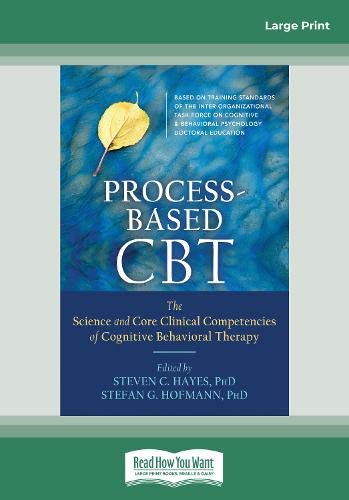
Process-Based CBT: The Science and Core Clinical Competencies of Cognitive Behavioral Therapy

Rate this book

Edited by Steven C. Hayes and Stefan G. Hofmann, and based on the new training standards developed by the Inter-Organizational Task Force on Cognitive and Behavioral Psychology Doctoral Education, this groundbreaking textbook presents the core competencies of cognitive behavioral therapy (CBT) in an innovative, practically applicable way, with contributions from some of the luminaries in the field of behavioral science.

CBT is one of the most proven-effective and widely used forms of psychotherapy today. But while there are plenty of books that provide an overview of CBT, this is the first to present the newest recommendations set forth by a special task force of the Association for Behavioral and Cognitive Therapies—and that focuses on the application of these interventions based on a variety of approaches for doctoral-level education and training. Starting with an exploration of the science and theoretical foundations of CBT, then moving into a thorough presentation of the clinical processes, this book constitutes an accessible, comprehensive guide to grasping and using even the most difficult competencies.

Each chapter of Process-Based CBT is written by a leading authority in that field, and their combined expertise presents the best of behavior therapy and analysis, cognitive therapy, and the acceptance and mindfulness therapies. Most importantly, in addition to gaining an up-to-date understanding of the core processes, with this premiere text you’ll learn exactly how to put them into practice for maximum efficacy.

For practitioners, researchers, students, instructors, and other professionals working with CBT, this breakthrough textbook—poised to set the standard in coursework and training—provides the guidance you need to fully comprehend and utilize the core competencies of CBT in a way that honors the behavioral, cognitive, and acceptance and mindfulness wings of the tradition.


Paperback

First published January 2, 2018

65 people are currently reading
558 people want to read

About the author

Steven C. Hayes

113 books398 followers
Steven C. Hayes, PhD, is Nevada Foundation Professor in the department of psychology at the University of Nevada. An author of thirty-four books and more than 470 scientific articles, he has shown in his research how language and thought leads to human suffering, and cofounded ACT, a powerful therapy method that is useful in a wide variety of areas. Hayes has been president of several scientific societies and has received several national awards, including the Lifetime Achievement Award from the Association for Behavioral and Cognitive Therapy.
He runs the leading Ph.D program in Behavior Analysis, and coined the term Clinical Behavior Analysis. He is known for devising a behavior analysis of human language and cognition called Relational Frame Theory, and its clinical application to various psychological difficulties, such as anxiety.
Hayes has been President of Division 25 of the American Psychological Association, of the American Association of Applied and Preventive Psychology, the Association for Advancement of Behavior Therapy (now known as the Association for Behavioral and Cognitive Therapies), and the Association for Contextual Behavioral Science. He was the first Secretary-Treasurer of the American Psychological Society (now known as the Association for Psychological Science), which he helped form.
Hayes' work is somewhat controversial, particularly with his coined term "Relational Frame Theory" to describe stimulus equivalent research in relation to an elaborate form of B.F. Skinner's Verbal Behavior (also referred to as verbal operants).
An author of 38 books and 550 articles, in 1992 he was listed by the Institute for Scientific Information as the 30th "highest impact" psychologist in the world during 1986-1990 based on the citation impact of his writings during that period.
According to Time columnist John Cloud, "Steven Hayes is at the top of his field. A past president of the distinguished Association for Behavioral and Cognitive Therapies, he has written or co-written some 300 peer-reviewed articles and 27 books. Few psychologists are so well published".

Ratings & Reviews

What do you think?
Rate this book

Friends & Following

Create a free account to discover what your friends think of this book!

Community Reviews

5 stars
44 (48%)
4 stars
30 (32%)
3 stars
13 (14%)
2 stars
4 (4%)
1 star
0 (0%)
Displaying 1 - 8 of 8 reviews
Profile Image for Morgan Blackledge.
823 reviews2,694 followers
December 5, 2021
Process Based CBT (PB-CBT) seeks to identify and integrate the varieties of effective interventions (processes) from the wide span of proprietary models and schools of psychotherapy, and integrate them in a meta-model.

Most psychotherapist already work an “eclectic” way.

Picking in choosing elements of CBT, ACT, DBT, EFT, EMDR, and the humanistic and psychodynamic traditions.

PB-CBT aims to give structure and direction to this practice by weaving them together in a meta framework for pairing therapeutic processes with the processes of suffering underlying what we currently referred to as mental health disorders as defined by DSM5.

I can’t do PB-CBT justice in this review.

Suffice it to say this is nothing short of revolutionary.

A must read.

5/5 stars.
Profile Image for Elyse.
127 reviews
April 10, 2020
This was a nice capstone text to help organize everything I've learned about psychological treatment over the last two decades. It did a good job of organizing trans-therapeutic approaches that have demonstrated therapeutic change within the context of a field that is in the midst of big changes in terms of how we view diagnoses and treatment in general.
Profile Image for Nicole.
118 reviews
Read
April 10, 2023
Assigned for class. Good reference for therapy.
Profile Image for Samuel Kinch.
71 reviews
November 26, 2025
In this cutting edge textbook, visionary editors Stefan Hofmann and Steven Hayes have brought together a convocation of authors to cover two dozen of the most important psychological processes and topics in behavioral science relevant to the practice of modern cognitive behavioral therapy. Inspired by the new training standards put forward by the Inter-Organizational Task Force on Cognitive and Behavioral Psychology Doctoral Education, Hofmann and Hayes lay out their future of clinical practice and research: not a question of which therapy for which syndrome, but asking which biopsychosocial processes should be targeted with this client, for this goal, in this situation, and how can they most effectively be changed? Integrating across theoretical silos and named therapies, yet aware of the philosophical assumptions contained in each, I, among many others, feel this movement is clearly the ethos our field needs to progress toward a more impactful clinical science.

Chapters that stood out:
Chapter 10, Evolutionary Principles in Applied Psychology
Chapter 16, Coping and Emotion Regulation
Chapter 21, Cognitive Reappraisal
Chapter 23, Cognitive Defusion
Chapter 24, Cultivating Psychological Acceptance

It was a brilliant and moving textbook, with twenty-nine chapters (10-20 pages) summarizing multiple decades of research on each topic, finishing it for me took almost my entire semester, but the result has been a massive expansion of my knowledge on each of these vital processes. For those interested in completing advanced training in the cognitive and behavioral approach, it is a must.

Chapter 3: Science in Practice
“From a cognitive behavioral perspective, general means-ends problem-solving strategies offer guidance about how to select component elements for treatment targets. First, assess whether the absence of effective behavior is due to a capability deficit (i.e., the client doesn’t know how to do the needed behavior) and, if so, then use skills training procedures. If the client does have the skills but emotions, contingencies, or cognitive processes and content interfere with the ability to behave skillfully, then use the procedures and principles from exposure, contingency management, and cognitive modification to remove the hindrances to skillful behavior. Pull disorder-specific procedures and principles from relevant protocols as needed.” pg 60

Chapter 8: Emotions and Emotion Regulation
“Emotions can also influence the content of cognition by directing attention and by affecting memory. Bower’s network theory of affect (1981) suggests that distributed, associational information processing [...] facilitates the recall of affectively similar information, which explains phenomena such as mood-state-dependent recall (e.g., when you are sad, you’re only able to recall ever being sad) and mood-congruent learning (recall is maximized when there is affective congruency between a learner’s mood state and the type of material being presented). [...] When effort is low and sources of information are open and constructive, individuals use an affect-as-information heuristic in which their emotional state is a source of information about a situation, regardless of whether the situation elicited the emotion (Clore & Storbeck, 2006). This is consequential, as once emotion-related associations are activated, there is a tendency for people to appraise subsequent, temporally related and/or affectively related events similarly, regardless of the functionality of the appraisal (e.g., Lerner & Keltner, 2001; Small, Lerner, & Fischhoff, 2006). This could be problematic when anxiety from one source leads to attributions of high risk and uncontrollability across situations, independent of the risk inherent in a particular context.” pg 143

Chapter 21, Cognitive Reappraisal
“There are many ways to identify underlying beliefs. Clients can identify themes inherent in the automatic thoughts that they have shaped over the course of treatment. Therapists can use the downward arrow technique, in which they repeatedly probe a client about the meaning associated with an automatic thought until the client gets to a meaning that is so fundamental that there is no additional meaning underneath it (Burns, 1980). Recall the earlier example of Lisa, who identified the automatic thought ‘My friend doesn’t like me’ when she realized that she was not invited to her friend’s baby shower. Using the downward arrow technique, her therapist asked her, ‘What does it mean that you weren’t invited?’ Lisa responded, ‘It means that we were never friends in the first place.’ The therapist continued, ‘What does it mean about you if you were never friends in the first place?’ Lisa responded, ‘It means that I’m more invested in my friends than they are in me.’ The therapist continued, ‘What does that say if you are more invested in your friends than they are in you?’ Lisa became tearful, began shaking, and responded with a core belief: ‘It means that I’m totally undesirable.’” pg 328

Chapter 23, Cognitive Defusion
“Embedded in the construct of defusion and related processes is an assumption that thoughts, or words, are likely incapable of capturing the full richness and depth of direct experience. It is common for clients to view thoughts (particularly compelling ones) as the ultimate arbiters of truth, even when they fail to capture the complexities of human experience. When we are ‘fused’ with our thoughts (i.e., when we take them literally), ‘thinking regulates behavior without any additional input’ from our direct experiences, ‘overwhelm[ing] contact with the direct antecedents and consequences of behavior’ (Hayes, Strosahl, & Wilson, 2012, p. 244).” pg 352

Chapter 24, Cultivating Psychological Acceptance
“Many clients are incredibly hard on themselves and relate to their history and difficult psychological and emotional content with resistance, anger, and self-blame, adding more suffering to their pain. Acceptance work is not about asking clients to like what they think and feel. Instead, we are inviting clients to change the quality of their relationship with the experiences they are having anyway. Instead of turning away, acceptance asks the client to soften, to open up, and to meet difficult content with kindness, friendliness, gentleness, and, dare we say, love. Self-compassion and self-kindness are not feelings—they are actions to be practiced, both in and out of session. They involve expanded awareness that (a) pain in life is inevitable, and (b) all human beings confront obstacles, problems, and pain (Neff, 2003).” pg 367

Chapter 29, Future Directions in CBT and Evidence-Based Therapy
“In the main, we believe that these trends are positive, and a more process-focused approach will help today’s students push out the boundaries of tomorrow’s consensus. The goal is not upheaval; the goal is progress. People are in need and are seeking answers from our field. It is up to us to provide for them. We hope this volume offers not just a snapshot of where we are today but also shines a beacon toward a place where we can go.” pg 437
Profile Image for Jasmin .
138 reviews
January 13, 2024
Was recommended this by a speaker at a conference and was a decent refresher on all things new wave CBT including ACT. Read a bunch of chapters in the second half and reported on them in supervision for a period of time before it fell off our radar. Currently props up my laptop to eye height. Not the most thrilling or exactly step by step instructional but at the time it served its place.
Profile Image for Hallie Foster.
3 reviews
August 12, 2024
Had to read for fundamentals of behavioral therapy so not a “fun” read, but completely changed my perspective on life/ the world/ people and I am SO glad I got to read this. I docked a star bc it was a forced read and could be boring at times but a GREAT book especially for practitioners
42 reviews
May 7, 2023
Foundational in understanding my therapeutic approach. Hayes is able to be a guiding hand in providing a clear cut way to integrate approaches.
Displaying 1 - 8 of 8 reviews

Can't find what you're looking for?

Get help and learn more about the design.