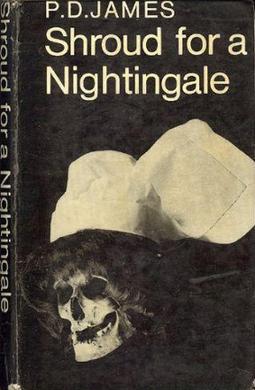
1971, #4 Supt. Adam Dalgleish, Scotland Yard, Nightingale House, just outside London. Nursing students living in a creepy old hospital building find murder and lots of intrigue; erudite, old-fashioned closed-community/manor house style mystery but with interesting modern (~1970) twists and a bit of then-relevant British history; classic cosy police procedural.
Nursing "sisters" are an alien breed to most US folks, but if you've read or watched a lot of British-set mysteries you'll have a bit of understanding how their ranking system for nurses and doctors works; the plot of this intricate mystery is closely woven around this, with the information presented slowly and interestingly. The systems of training in British hospitals of the period is the center for this murder mystery, and James shows not only her familiarity with the Health Service and many of its ramifications (she worked for them for many years and was, I think, still working for them when she wrote this). But don't be put off by this - the plot is a very good (if convoluted) one, the characters remarkably fine, and the overall writing while a mite florid in spots is beautifully done.
James is one of my favorite writers, and I've reread most of her books several times; this time I listened to SHROUD in audio, read by Michael Jayston, courtesy of my library. He's a smooth, excellent reader, and this was very enjoyable. And now to the plot...
An almost-graduated nursing student is killed while playing the patient in a demonstration/instruction lecture before a visiting VIP. It might have been suicide - the girl was extremely religious, temperamental, moody, and prone to extremes of behavior - much of it rather unforgiving, and some of it perhaps illegal. As the local police work their way through the suspect list and information they've gathered, no real conclusion is reached and the case goes cold. But before too long another student is dead under suspicious circumstances, and the "coincidence" is too much for one high-powered doctor connected with the training facility to endure. He calls Scotland Yard himself, and Adam Dalgleish is assigned to the case, along with Sargent Masterson, a young, not exactly raw (but not far removed from it either) policeman with a slight tendency for bullying witnesses. He's got a lot to learn.
This is an intricately woven story of power and the power of forgiveness - or not, as the case may be. Involving medical - and personal - politics in the late 1960s and a bit of recent British history, the main focus is upon five increasingly interesting young women and their teachers, the nursing Sisters. Each Sister is very clearly presented and followed through the story, along with most of the students as well. James has a facility for showing us the workings of people's minds and their interactions with others. Here she uses that approach in a lot of detail but it never becomes quite slow - the information given is always pertinent, always at least "curious..." if not always immediately easy to understand where it falls within the plot.
Written in a completely classic style this may seem a bit slow-moving for modern tastes, but is downright explosive when compared with earlier, similar, stories. I've recently been reading Mignon Eberhart's nursing mysteries from the 1930s, and if you want "slow-moving thriller" (not *exactly* an oxymoron...), then her earliest work is for you! But while Eberhart was entertaining, James is an overall much better writer, and it is fascinating to see here how little of the attitudes towards nurses and their craft had changed in the intervening forty years. And while outside of the small-hospital environment (the nurses live-in, and don't spend much time in The Real World) things are changing rapidly in the social sense, here the ethos is of an older Britain even in 1970 - the values are traditional, the plotting traditional, the writing style traditional. But not stuffy, not at all boring.
There are chase scenes, murders-in-progress, a couple of nasty assaults, one or two very funny set-pieces (particularly Sargent Masterson's involvement with a ballroom dancing contestant...) and a lot of suspense and gloomy forboding along with really superb characterizations. And the ending exposition while a bit slow in spots is fascinating, and absolutely beautifully done, weaving in every little thread and bit of earlier-presented information we'd been given, while still making us/allowing us to "feel for" the people involved. Really fine writing.
If all you've read of James' writing is her post-1990 books, then give yourself a nice treat and read some of her earlier works - she was first published in 1962. Her earliest novels are smoothly written, very well-plotted, and within a couple of books her characterizations move from "decent" to "very good", and become brilliant by her middle period (~1980s). This 1970 story is an excellent mystery in and of itself, and although IMO it's not her very best, it's still head and shoulders above that of most mystery writers from the period, and comparable to some of the best then (last 1960s, early 1970s) writing in that classic style in the UK (i.e., Catherine Aird, Ruth Rendell, Ellis Peters, Sara Woods, Charlotte Armstrong, Christianna Brand...) and the US (Margaret Millar, Amanda Cross, Elizabeth Peters, Sarah Caudwell, Emma Lathen...).
James obviously read and admired Christie, as did most women readers (and writers!) of her generation. Early on in her career you can easily see how Christie and Sayers et. al. have influenced her. But James then goes on to actually improve upon their writing style, at least IMO, becoming one of the best current practitioners of the "traditional style" mystery now living and still writing. As she's extremely elderly now, I suspect she won't be publishing much more in the future, alas. So savor her earlier works if and when you can - while quite old-fashioned they're still a treat!
SHROUD FOR A NIGHTINGALE may not be her very best novel, but it's an extremely good one, and I highly recommended it to your attention.