Jump to ratings and reviews
Rate this book

L'Amérique des sioux: Nouvelle histoire d'une puissance indigène

Rate this book
Red Cloud, Crazy Horse et Sitting Bull sont des figures emblématiques de l'imaginaire américain. Placés pour la première fois au centre de l'histoire, ils apparaissent comme les architectes de l'Amérique des Sioux, une puissance indigène considérable qui, pendant des générations, a dominé et façonné l'intérieur du continent.
Pekka Hämäläinen retrace l'histoire complète des Lakotas, riche et souvent surprenante, du début du XVIe à l'aube du XXIe siècle. Tout d'abord chasseurs-cueilleurs marginaux, les Lakotas se sont réinventés à deux reprises : d'abord en tant que peuple fluvial qui dominait la vallée du Missouri, la grande artère commerciale de l'Amérique, puis - dans ce qui a été la première expansion radicale de l'Amérique vers l'Ouest - en tant que peuple de cavaliers régnant en maître sur les vastes hautes plaines. ?
Comme dans son précédent livre, L'Empire comanche, Pekka Hämäläinen se révèle un historien de premier plan, soucieux de donner point de vue différent de celui des vainqueurs.   « Tous les peuples mériteraient que leurs histoires soient racontées avec ce degré d'attention. »
The ??New York Times?


599 pages, Kindle Edition

First published October 22, 2019

347 people are currently reading
5697 people want to read

About the author

Pekka Hämäläinen

27 books235 followers
Pekka Hämäläinen is the Rhodes Professor of American History and Fellow of St. Catherine’s College at Oxford University. He has served as the principal investigator of a five-year project on nomadic empires in world history, funded by the European Research Council. His previous book, The Comanche Empire, won the Bancroft Prize in 2009.

Ratings & Reviews

What do you think?
Rate this book

Friends & Following

Create a free account to discover what your friends think of this book!

Community Reviews

5 stars
528 (44%)
4 stars
456 (38%)
3 stars
162 (13%)
2 stars
25 (2%)
1 star
8 (<1%)
Displaying 1 - 30 of 210 reviews
Profile Image for ♑︎♑︎♑︎ ♑︎♑︎♑︎.
Author 1 book3,807 followers
May 24, 2020
Incredibly thorough, and yet riveting. This is classical history, in both tone and scholarship--if that means something to anyone but me. It exposes the biases of western/white-oriented narratives of this era and geographic region, but it does so while using the same tools of erudition, and scholarship, and measured-ness, and historical fact, as any history coming from an academic/scholarly tradition. It's a completely different tone from, say, a Zinn book, where I often feel like I'm being told how to feel about the facts, without being told the facts to begin with. It's not at all like Cheyenne Memories by John Stands In Timber, where the goal is to preserve a historical tradition that is/was an oral tradition. It's not a heart-wrencher like Bury My Heart at Wounded Knee: An Indian History of the American West, which is history written to be a call to action, or at least a call to atone for past wrongs.

Hämäläinen begins with a painstaking etymological discussion of the terms "Sioux" and "Lakota" and as he moves forward he continues to take the time to unthread these and other terms, exposing their hidden meanings and origins, so that we know what he's talking about every step of the way. It's a careful, deeply researched story, that at each stage continues to be thoughtful about language, where the 'facts' are presented, and 'historical truths' revealed, page after page, with an almost mathematical precision.
Profile Image for Moonkiszt.
3,041 reviews333 followers
September 6, 2019
Lakota America: A New History of Indigenous Power

This is a text that needs to get in front of students in these United States! History from a completely different point of view, where wasicu (white) politics are incidental for hundreds of years, until they become the problem. History told from the mainly Lakota perspective, with Lakota broadly comprising a number of groups known collectively as the Seven Council Fires (Lakotas, Yanktons, Yanktonais, Mdewakantons, Sissetons, Wahpetons, and Wahpekutes) doesn't start on the plains - it starts North and East - around the Great Lakes. It didn't take long to realize that the history books I’ve read throughout my not so diverse education was limited and lacked a fullsomeness that I had never even considered. The people my books referred to as the Sioux, had as many different names for their various groups within groups as my own people did. Thankfully the author generously provides readers like me with helpful notes, and reference information in the end materials.

Indigenous language, dialect and written Lakotan is used throughout the book, which I found fascinating. It sent me on a side tour to find Lakota speakers to listen to and feel its music.

Throughout my life I thought I’d studied these events, but looking through the other side of the window was eye-opening and interesting. The writing is scholarly and full of details ("the rest of the story") not found in my history books. All of the usual suspects are here: Custer, Sitting Bull, Crazy Horse, Sacagawea, Lewis & Clark, warriors known and unknown, on through the centuries to the current day struggles and victories.

This is a book to sit within, for studying and research and soaking. Drinking in the immensity of the two nations that were created in 1776, and the national efforts to co-exist, by hook or by crook - with blood spilt and sacrifice made. Not a light read, but a very satisfying one, 5 stars.

A Sincere Thanks to Pekka Hamalainen, Yale University Press and NetGalley for an ARC to read and review.
Profile Image for James Murphy.
982 reviews26 followers
September 22, 2021
My reception of Hamalainen's history was one of admiration but shifted into skepticism because I think he boxed himself into historical conclusions and positions which are unconvincing. I'd read his earlier history of the Comanche empire and was impressed with its treasure of historical perspectives new to me. I accepted his premise of empire in regard to the Comanche because I had no reason to quarrel with it and not enough understanding of the region and the groups competing for it to support a quarrel. However, I've read more widely about the Plains and was disappointed by Hamalainen's insistence on empire, on a sovereignty and even a nationalism for the Sioux. I thought the perspective of empire forced him into revisionism.

It's true the 6 large kinship groups we combine as Sioux have always been the dominant peoples wherever they established themselves. His story of the Lakota and the sister groups is an epic one, as you might expect. When the Europeans first contacted them in their home in the western Great Lakes they were already prominent. As they spread west out of the woodland lake region onto the Plains, the Missouri River basin, and west to the Black Hills, motivated by the mobility of the horse and its improvement of hunting and warfare, they continued to dominate every indigenous group they encountered. This is the best part of the story, the description of how Lakota society functioned, how leadership structures regulated it, how it related to the land and its resources, and much more. How a society more complex than we imagined lived.

Hamalainen writes that their supremacy over the river systems feeding the Missouri was possible through their sheer numbers and their increasing skill with horses. That supremacy also was possible because the U. S. didn't need the land. The 1st half of the 19th century saw the U. S. focusing on expansion into the Mexican southwest. After the Civil War, increasing migration into California and Oregon, the building of the railroads, and America's divine mission to expand across the continent changed that. He also makes the point the 2 cultures were incompatible. So, 2 antipathetic cultures competing for the same space meant one had to die. If the Indians didn't understand the treaties they signed, they understood the cultural death that came with the reservation system and with the end of the vast bison herds.

Hamalainen bases Sioux rights on sovereignty. His claim is their holdings along the Missouri and Powder Rivers made then a sovereign entity, but the U. S. perspective was never that they were 2 national states competing for the heart of the continent. To the U. S. the Indians were always wards of the state, even if the many treaties (a word discontinued in regard to Indians in 1870 because treaties exist only between nations) gave them a sense of independence the American government never intended.

The result of this dissonant point of view tended to divide the book into 2 halves: the 1st a history of the Sioux before the Civil War with which I engaged, the 2d their history after the Civil War which I came to disbelieve. It's all absorbing and informative reading, but I thought the 2d half flawed by Hamalainen's insistence on the land the Sioux occupied being considered a national entity. The record of U. S. treatment of the Indians is a sorry one. They were coerced into giving up a life providing sustenance for life on reservations dependent on government issue of food and other annuities. Their sacred places were taken because they contained resources the U. S. wanted. They were victims of deliberate infections and their way of life destroyed by the deliberate killing of the bison herds. And this happened because there was only one imperial organization on the Plains, not two. His history feeds on perspectives I've never encountered in other sources.
Profile Image for Carolyn McBride.
Author 5 books106 followers
August 29, 2019
What a book!
Wonderfully well-researched with a huge scope, it would make a great textbook. It pales a little for a casual reader, however. For the "regular" enthusiast, it could be a little overwhelming.
I found it fascinating
Profile Image for Scriptor Ignotus.
596 reviews272 followers
December 28, 2024
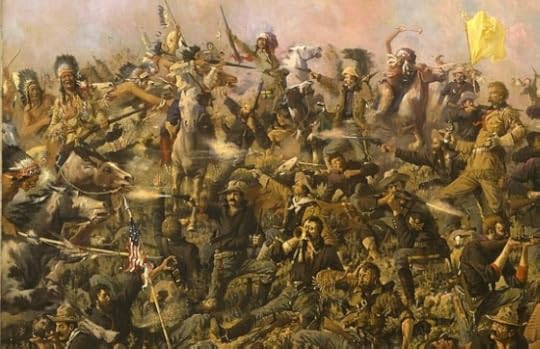
1776 was a definitive year for two great North American nations. A confederation of thirteen British colonies on the eastern seaboard, the western pole of the transatlantic British Empire, declared their independence from the mother country and turned their gaze toward the untapped bounties of the looming continental interior. The same year, the Lakota, the westernmost and preeminent people of the Očhéthi Šakówiŋ—the “Seven Council Fires” of the Sioux nation—took possession of the Pahá Sápa—the Black Hills of South Dakota—and made the sacred refuge into the heartland of one of the two dominant indigenous empires on the continent. A century later, a warband of Lakota and Cheyenne braves under Sitting Bull and Crazy Horse trapped and annihilated George Custer’s 7th Cavalry Regiment at the Battle of the Little Bighorn, a spectacular achievement that would be followed by swift and tragic reprisals. Much of that intervening century may be thought of as a history of two wests and two westering peoples, whose worlds often overlapped and transmuted one another.

The conquest of the Black Hills was the culmination of a long, fraught, and arduous journey of relocation and redefinition on the part of the Lakota. In the seventeenth century, the Sioux were a weak and marginalized people, huddled together off the western tip of Lake Superior, excluded from the flow of firearms and metal tools that trickled out to the Great Lakes basin from the French imperial city of Montreal. They weathered blistering wars of aggression waged by the Lakes Indians, who had access to firearms and were often united against them in an effort to prevent them from gaining access to French trade lines, and they survived the onslaught only due to the large population they sustained from the protein and carbohydrate-rich river valleys they inhabited. The westward exodus of the Lakota from the Mississippi River to the Missouri and its tributaries was a harrowing gamble; they were exposed on the open plains rather than sheltered in the riverine woodlands to which they were accustomed, and once they reached the Missouri they had to fight for a place along its banks against the Arikara, Mandan, and Hidatsa peoples who already lived there.

But in the eighteenth century, the gamble yielded incredible success and positioned the Lakota to be the dominant power of the interior west. Once settled on the Missouri, the Lakota became one of the first nations to inhabit the confluence of the gun frontier—the French and Spanish firearms trade that traversed the Mississippi and Missouri—and the horse frontier—the growing population of wild horses that were migrating northward after an original dispersal from New Mexico following the Pueblo Revolt of 1680. Like the Comanches to the south, the Lakota superseded their rivals by being quick to adopt a horse culture, which gave them a powerful military advantage over their pedestrian enemies, shortened the liminal spaces of the high plains, and turned the bison-heavy grasslands from a no-man’s-land that could be visited on hunting expeditions but not inhabited permanently into a heartland that could sustain a burgeoning nation.

The Americans derided the Lakota as the “pirates of the Missouri”, portraying them as highwaymen who used their numbers and equestrian mobility to extort both white traders and the indigenous tribes the Lakota had subjugated; but this is merely a testament to their shrewdness. They were careful to use their dominance of the region to extract concessions from American traders and prevent the formation of alliances between American frontiersmen and the native enemies of the Lakota, but without being so heavy-handed that the flow of trade stopped altogether. For most of the nineteenth century, the Lakota were the kingmakers of the west, leaving a substantial imprint on the shape taken by the peopling of the continent.

Little wonder, then, that the epochal final clash between the Lakota and American empires in the 1870s produced many of the most recognizable names of Native American history: Sitting Bull, Crazy Horse, Red Cloud, Black Elk, and American Horse among them.

description
Profile Image for Edward Gwynne.
577 reviews2,470 followers
June 17, 2022
A great ride through the history of the Lakota Sioux. The writing was pulling and smooth, the facts played out clearly and the sources magnanimous. Another good book from Hämäläinen.
Profile Image for David.
182 reviews9 followers
May 20, 2022
As a seconday History teacher who teaches Native Americans in Year 7, I liked to think that I knew a decent amount about the Indians of the Great Plains. However, this excellent book simply proves that I had barely scratched the surface!
An exhaustive study of the origins of the lakota in the eastern Woodlands, it traces their inexorable migration into the continental interior and their encounters with the French, the English and eventually- the newly-established United States. Even Lewis and Clark make an appearance!
There are in-depth investigations of key events, including the Fort Laramie Treaty and the Battle of the Little Bighorn and it's pleasing to note that the coverage of the latter is far from the usual Custer-centric reportage.
The book contains excellent and detailed summaries of key players including Red Cloud, Sitting Bull, Crazy Horse and Spotted Tail, and I particularly enjoyed the explanation of the significance to Lakota culture and beliefs of 'White Buffalo calf woman's
Though at times this was a tough and academic read, the sheer depth of coverage made the long slog worthwhile and absorbing. Thoroughly recommended!
Profile Image for Moses.
683 reviews
May 28, 2021
Lakota America has many shining qualities but is ultimately deeply disappointing. Hemalainen starts by asking the question, “What if we see the Lakota not as eternal victims, but as the confident builders of their own Great Plains empire?” Yes, all well and good. But by the end of the book, it is clear that he is not ready to interrogate Lakota sources, to ask the hard questions. If Lakota empire-building, which included massacring Pawnees, Crows, and Aniishinabe is a value-neutral display of “indigenous power,” then why is US imperialism, complete with its own massacres, such a problem? Does it have anything to do with their skin color?

Hemalainen makes it abundantly clear that he accepts the Lakota story of the 20th century events, like the American Indian Movement, uncritically. That means he is a cultural storyteller, or worse, a propagandist. He is not displaying the critical judgment of a historian. Peter Cozzens’s book on the Indian wars is a great place to see this done right.
Profile Image for cat.
1,223 reviews42 followers
Read
January 12, 2020
I don't know ya'll. I struggled with this one. Wanting to follow up my reading experience of Roxanne Dunbar Ortiz's fantastic 'An Indigenous Peoples' History of the United States', I picked up this book of clearly scholarly historical writing about the Lakota people and land. And it isn't written by a Native author. And much of it seems to rely on frontier accounts - so a retelling of history that comes somewhat through the eyes of the settler colonizers. I had to set it aside. The book claims to be "The first complete account of the Lakota Indians" which I find reprehensible as a claim, given the oral and other history and storytelling traditions held by the Lakota themselves. Maybe the first WHITE and scholarly written history? But to claim it as the first complete account? A continuation of the ways that we have, as a white culture, stolen not only Indigenous land but also Indigenous history.

My first DNF of the year - got far enough in to be able to make an educated decision about not continuing, so I am counting it. Not giving a rating at all.
Profile Image for Christopher.
Author 3 books133 followers
December 21, 2019
Hamalainen knocks it out of the park again. Though personally I still prefer his epic accounting of the indigenous power politics of the Comanche, this is every bit the work of important scholarship that that prior book was.

We see the Lakota story centered on native conceptions of power and change, from obscurity and rise to sudden and immediate fall. Seeing neither victims nor savages, we see instead the reality of indigenous empire, strategy, power and adaptation. A context lost not with the Lakotas but with tribes across this continent-and integral part of North (and South) American so commonly written out of our understanding today.
Profile Image for Jonna Higgins-Freese.
811 reviews79 followers
August 2, 2022
Okay this is a totally phenomenal book, the kind that makes you rethink everything you thought you knew. In particular, I feel renewed rage at my school history textbooks. I remember reading and rereading the slim (maybe 8 paragraphs)? opening to my third grade textbook about Iowa history, where there was a picture of a wickiup and text that read something like "Native American arrived in what would become Iowa by about 5,000 years ago. They lived in bands that planted corn along the rivers in summer and hunted buffalo on the prairies in winter. Then Europeans arrived in 1832 and Iowa was formed."

Well, not quite. First, there were the complex societies that preceded Europeans (Cahokia, anyone, with its official outposts stretching all the way to Wisconsin and its cultural influence permeating Iowa?). Then there were the French and Spanish arriving for the fur trade by the mid-1500s, and all the upheaval among the tribes that were here before the fur trade and Atlantic settlement, the Iroquois Empire, and others pushed folks further west into refugee shatter zones west of the Great Lakes.

[Only complaint: what is going on with the maps where north is not up, for no good reason? Make it stop.]

"The great paradox of Lakota history is that by helping prevent the realization of other Wests -- French, British, Spanish - Lakotas inadvertently paved the way for an _American_ West and, eventually, their own downfall." (5)

1695 - Sioux representative to Montreal asking for alliance with the French to attack the Mesquakies (12)

Sioux at that time were centered around Lake Mille Lacs and were relatively small. No idea where the Ojibway were supposed to be at this time, since he doesn't mention them, which seems a pretty big lacuna (27).

While the Iroquois drove refugees westward before 1670, the Sioux did so afterward, as they held a line on the west bank of the Mississippi (34). Sioux aggression west of Lake Michigan pushed the eastern Indians (Iroquois, other Anishnaabe, etc.) closer into the arms of the French alliance. "War between France and Sioux could deliver the interior to England, whereas peace between the two could secure it for France" (37).

In 1681 the informal system of coureurs de bois was formalized, permanent posts were established in Siouxland, and the traders came to the Sioux on their terms, which was their goal (38).

1701: Le Sueur established a trading post, "but a Mesquakie-Mascouten attack sent [them] into a panicked flight to the Gulf Coast. A new trader was dispatched from Montreal with a substantial load of merchandise, but all his wares were stolen by Mesquakies. No one was sent in his stead. Alone and exposed, Sioux were once again bastard children without a father" (though it's not clear why they were disfavored instead of the Mesquakies) (54).

By early 1700s Sioux territory had bulged west, Big Sioux river rather than Minnesota now marked their western boundary (58), and they often clashed and raided with the villages (perhaps 50,000 strong) along the Missouri valley. In 1715 they were first attacked by people from the west who had horses - they did not. However, they still didn't have good access to guns -- the contraction of French trade after 1700 left them without, and the flintlocks were delicate, difficult to repair, and prone to shatter in extreme cold (59). Indians to the east were being liberally armed by the British and French in an attempt to win allies in Queen Anne's war (60). By the early 1700s, "Sicangus may have been the only Native group in the continental grasslands to simultaneously possess guns and horses" - but their supply of both was unreliable.

By 1712, the French had packed their allies around Detroit to block British expansion, but this turned it into a seething mess of conflicting needs and demands. Then more than a thousand Mesquakies moved to Detroit, claiming it as their own ancestral territory (62). Everyone attacked the Mesquakies, who retreated to the pays d'en haut and were taken in by their old enemies, Sioux (62). As part of a plan to separate the Mesquakie from the Sioux, the French built a trading post on Lake Pepin -- what is extraordinary about this, to me, is that nearly two hundred years later, Laura Ingalls Wilder mythologizes Lake Pepin as a "virgin" wilderness - despite the fact that a French post had been there nearly 150 years before the events she describes!

In 1749, the new governor, Jacques-Pierre de Taffanel de La Jonquiere, authorized a trader named Paul Marin to make peace with the Sioux to drive the trade further to the west; he brokered a peace with the Green Bay tribes and built Fort La Jonquiere on the western shore of Lake Pepin (!) (76).

By 1750, the Sioux were "a colossal force in the deep interior" from the upper Mississippi to the Missouri Valley. They pushed others to the middle Missouri, creating "a refugee world of their own making. Omahas, Poncas, Otoes, and Iowas, all previously prairie people, had fled to the middle Misssouri Valley under pressure from the westering Lakota oyates" (85). There they found informal coureurs de bois (presumably coming up from St. Louis) who existed in the cracks of the formal fort structure due to everyone's desire for trade (85).

In 1794 Jean-Baptist Truteau was sent upriver by the Missouri Fur Company to trade above the Poncas, build a fort among the Mandans, and find a route to the Pacific. The Lakotas weren't having it, and stopped him before the Arikara villages (104-5). "Lakota had become a force filed that twisted and bent human endeavors around them. Their enemies avoided them, their allies gravitated toward them, and those still outside their sphere cajoled them. Louisiana's Spanish merchants wanted to trade with them, while high-level Spanish officials wanted to eliminate them. No one could ignore them." (110). "Dakotas were educating Lakotas, but they were also furnishing their relatives with the most precious commodity of all in late eighteenth-century North America: information. Pooling knowledge, the seven fires accumulated an exceptionally broad understanding of North America's imperial and indigenous landscapes. Together, they had dealings with the Spaniards, British, Scots, Louisiana French, Canadian French, Americans, and dozens of Native nations. Occupying the center, they had a 360-degree panorama of the continent and its peoples (114).

Lakotas were a significant force affecting the Lewis and Clark expedition; "Sicangus played a critical role in regulating the Missouri commerce and knew that a total block of upriver traffic risked killing the trade for good. But instead of savvy traders, Lewis and Clark saw rowdy and uncouth nomads and dismissed them as predators to be avoided (136).

Summer of 1815 US invited western Indians to council at Portage des Sioux just north of St. Louis; when they built an unauthorized fort at Prairie du Chien, Mdewakanton asked the British for help, but quickly realized that after the Treaty of Ghent, they'd have to face the US alone (155). In 1815 also, a trader named O'Fallon went up the rivers and "within a year the US Army started planning a military fort at the Mississippi-Minnesota junction on lands Pike had purchased 14 years earlier (156).

By the late 1820s Lakota were wintering in the Black Hills, where "when severe drought struck the grasslands, the bison tended to seek relief in the high-altitude microclimate around the Black HIlls where summers were cooler, rainfall higher, and pasture more lavish" (169).

"Horses, in a purely mechanical sense, served their masters as finely tuned organisms that converted inaccessible plant energy into tangible and instantly exploitable muscle power" (170). But horses and bison ate the same species (about 80% overlap) and both preferred lush river bottomlands. Horses needed a lot of care. Winter was the crux of the problem - Lakotas solved it by slowing down and dispersing, trying to do as little as possible (171).

While Lakotas sustained a commercial boom, villagers became increasingly marginalized as their fur creatures and bison diminished; they could purchase only a few cheap guns so instead often purchased alcohol (179).

1820s to 1840s were very wet; drought struck in the mid-1840s and led to ceaseless Lakota attacks on river villages, which used resources the Lakota needed (188-189). Beginning in the winter of 1830, Lakotas "killed some twenty Crows at Matho Paha," the beginning of a fifty-year war between them - the longest known war "in the history of North America" (192). This made me think how this was when things were heating up with the Sauk at Rock Island, and just preceding the Black Hawk war in 1832, and long before the 1862 Sioux Uprising -- someone should do some kind of GIS time-lapse layer of what was happening across North America through time, so you could see territories expand and contract, and events unfold, and pause at any moment for a time lapse. Maybe they already have.

"The Lakota takeover of the upper Missouri Valley in the early nineteenth century had been a major turning point in the history of the American interior, signaling the rise of the nomads. The Lakota expansion into the short -grass plains west of the Missouri marked another seismic shift of power in the great interior. Until then the northwestern Great Plains had been used by many but were home to few. They had largely been a meat-and-robe reserve for people who lived elsewhere - nomads in the Rockies and villagers along the Missouri. Now the vast region, one of the world's best hunting grounds, belonged to Lakotas. There were about thirteen thousand of them, and their largest oyates, the Oglalas and Sicangus, were among the most connected Native people o the continent, with several thriving trading posts within reach. With the rapid disintegration of the Comanche empire in the southern plains under a punishing drought and mounting pressure from a booming state of Texas, Lakotas emerged as the most powerful indigenous nation in North America" (199).

"In the course of the 1830s and 1840s Lakotas fought and defeated scores of people and absorbed uncounted numbers as captives. Seen from the vantage of their rivals, they often appeared ferocious conquerors bent on annihilation. But while they dispossessed entire societies, they also embraced former enemies. Their vision for the West was supple and capacious. They saw in most people, even in their rivals, potential allies who could be brought in their fold as kin through ritual adoption. Their quest to control game, pastures, water, and trade in the West coexisted with a spiritual mandate to balance the world by extending wolakhota to those capable of proper behavior and thoughts" (199).

Though had density of less than one person per square mile, their power rested "not on inviolate territorial control but on a horse-powered capacity to connect and exploit key strategic nodes - river valleys, prime hunting grounds, corn-yielding Native villages, trading posts, Paha Sapa - which allowed them to control resources without controlling people.. . theirs was a kinetic empire built on mobile power politics" (205).

With the cotton gin (and, as other reading emphasizes, the success of the slave revolt and creation of a republic in Haiti), there arose a new vision for cotton production in the South. By 1830, 400,000 slaves were forced to migrate from the old south to the new lands along the Mississippi (208). "The South now produced roughly half of the world's raw cotton, a staggering output that spawned a new finance-insurance-shipping nexus that welded southern slavery and northern capital together and embedded both in an emerging global economy . . . For the Cotton Kingdom to thrive, the Indigenous southerners would have to give way to a white-owned black multitude." (209).

Of the new Indian Office, it "served an administration that had no patience for Indigenous peoples in the East, whether poor farmer-hunters, nations with long-standing treaty relations with the United States, highly educated slave-owning Cherokee planters, or Indigenous intellectuals. Jackson harnessed the Office to implement a wholesale removal of Natives from the East and, by extension, the expansion of slave capitalism across the South" (209).

"Jackson, Polk, and their officials pored over maps and drew new lines on them, rearranging the world into a new shape . . . [these imperial dreams had long been present but] it was only in the 1840s that Americans possessed the means -- sufficient administrative capacity and an ability to borrow money on a vast scale - to start turning imperial abstractions into reality through state-sanctioned violence" (211).

Argues that in the 1850s, both the US and Lakotas could claim the northern plains as their own, because they imagined the world differently "the two regimes coexisted on separate mental planes" (222).

Cheyenne Dog Soldiers allied with Confederates in New Mexico, and the US put its scarce resources to work preventing them from raiding the Colorado gold fields. "It was not a coincidence that Lakotas were raiding all over the place and enjoying their best hunts for a long time during the early years of the Civil War" (240). While the US was looking away, Lakotas stretched their empire to Canadian border in the north, central plains in the south, Missouri Valley in the east, and Continental Divide in the west. "They were consolidating an empire, of a kind Americans could neither see nor understand. Built around a shifting tribal alliance rather than a state, it was a distinctly fluid organism that reflected Lakotas' vision of the world and their place in it. They desired power, prosperity, and respect, but they did not seek direct control over foreign people or territories to secure them. Their dominance rested on a capacity, underwritten by military power and mobility, to do certain things -- raid, extort, intimidate, and kill -- over and over again and across vast distances. Spectacular foreign political action, punctuated with ominous lulls, allowed them to achieve what traditional empires achieved through institutional control: harness resources, create dependencies, enforce boundaries, and inspire awe. Lakotas were a presence even when absent. (241). [Would be interesting to see him in conversation with James C. Scott, who I think would argue instead that the Lakotas were an anti-state, skilled in the art of not being governed.]

The section beginning on p. 273, about the battle for control of gold mining northwest of Yellowstone, makes SO much more sense than Empire of Shadows, which keeps talking about the delay in "exploration" of the Yellowstone country, despite the fact that it had been well explored and used for millenia. "Montana mines tantalized the post-Civil War United States, yielding millions worth of gold dust and nuggets year after year, a much-needed revenue stream for a nation desperate to rebuild itself" (273). One route to Fort Benton, another followed Oregon Trail into Rockies and curved northeast, "skirting the Lakota lands that lay east an north of the Bighorn Mountains." Lakotas drove back an 1865 incursion of 2500 troops and Indian scouts. For unclear reasons, Red Cloud then decided to talk, but Colonel Harrington approached Fort Laramie with 700 horses and said he was going up the river, angering the Lakota and causing them to disperse.

Sitting Bull, Red Cloud, High Backbone, and Crazy Horse mobilized Lakotas for war as an empire (284). "Red Cloud's Oglalas formed the empire's southern bulwark against wasicu expansionism along the Oregon Trail, the United States' imperial road across the West; Sitting Bull's Hunkpapas led the war effort against the army fortd on the upper Mnisose; and High Backbone's Minneconjous were a fulcrum between the two magnetic poles, joining forces with either as needed." (284). "Sitting Bull repeatedly urged the Assiniboines 'to join him, telling them not to stick so close to the whites, getting as poor as snakes, eating nothing but bacon and hard-tack.' Instead, he offered freedom, prosperity, and personal fulfillment among the Lakotas, whose hunting grounds were still rich and who could raid US forts at will." (285)

This section was harder for me to follow, and made me want to read some of the books on Red Cloud that might help explain the events that led to Wounded Knee a bit better.

By 1880, Red Cloud was still fighting, but half a million settlers were already in Nebraska, and the government began "surveying the unceded Lakota lands between the North Platte and the Nebraska state line" (320). Gives examples of the ways even Indian agencies were in locations chosen by Indians, and how they refused to be counted through various means and inflated their numbers to ensure adequate supplies (again, Scott's perspective on their practice of the Art of Not Being Governed would be super interesting) (321)

By 1871 the Lakotas were expanding, engaging in aggressive warfare against other tribes and preventing settlers from entering Montana; the Laramie treat of the 1860s underwrote their right to land where hunts were still possible and set no northern boundary, so they fought agsint Crows, Utes, Shoshones, and Flatheads while allying with Cheyennes, Arapahos, Yanktonais, and Yanktons. They also "distanced themselves from the American government [while] continuing to trade with AMerian merchants alon gteh upper Missouri. They also tightened their ties with the Metis who, threatened by the Canadian annexation of Rupert's Land in 1869, had mounted a failed rebellion under Louis Riel. Disaffected Metis moved farther west, specialized in bison-robe trade, and made 'overtures to the Sioux for an alliance.' Commercial gravity, together with a shared abhorrence of modern states, pulled Metis and Lakotas together" (325).

Custer took command of Seventh Cavalry in Yankton. Dakotas had 10000 settlers to 30000 Lakotas. Previous summer they had stopped the survey for the Northern Pacific. Yellowstone expedition was tied to railroads, designed to crush indigenous power (339).

348 - role of Black Hills expedition in 1874

"Three weeks alter Grant authorized the Allison Commission - named for its chairman, Iowa senator William B. Allison - to visit the Lakotas and negotiate the relinquishment of the Black Hills" (350)

Fall 1875 Indian Office staff wrote that Northern Lakotas "roam over Western Dakota and Eastern Montana, inlcuding the rich valleys of the Yellowstone and Powder Rivers, and make war on the Arickarees, Mandans, Gros Ventres, Assinaboines, Blackfeet, Piegans, Crows . . . they are rich in horse sand robes, and are thoroughly armed." (353)

1940s dams took huge swaths of land due to Pick-Sloan dam project
Profile Image for Shoshi.
261 reviews4 followers
September 6, 2021
2.5 stars...ever so much wrong with this book. Severe editing fails included using European names for tribes though the author leads with note claiming Native American terms will be used, repeatedly claiming either the Sioux/Lakota or the USA were emerging as an empire, and over doing some Noble Savage motifs while then seeming to not understand the Noble Savage doctrine and its problems. Someone really needed to tell this guy to rewrite whole sections.
I don't know much about the scholarship in the field, but considering Oxford University hosts the author and his study of nomadic peoples, Yake University published the text and individuals identified as professors in the field gave this laudatory reviews it seems the best and brightest may be studying other bits of history. A shame.
Profile Image for Tom.
253 reviews6 followers
December 18, 2019
This was quite interesting; it functions as both a history of the Lakota, and a history of the American West from a Lakota perspective.

Much of the early book deals with the Indian-French-Spanish-British-American power struggles in the west. Lots of interesting dynamics there, with authorized and unauthorized trade going various directions, with different native groups fighting over access to it and the technology it brought. There was some pretty mercenary behavior by the great powers, which couldn't really afford to keep all the natives happy all the time and so ended up cultivating specific client states, which were readily exchanged for others when circumstances so dictated.

Discusses the Lakota shift from a pre-contact-style hunter-gatherer lifestyle to being a nomadic horse-and-gunpowder civilization driven by external trade. Makes the interesting point that they sat at a convergence where two technological frontiers met: horses were spreading up the plains from the Spanish in the south, and guns were spreading west from the British and Americans, and the Lakota were sort of at the nexus where natives ended up with lots of both relatively early.

I learned the extent of Lakota control over the Missouri river basin in the early 1800s; they exploited their strategic position on the river by levying tribute (or extorting protection money, if you like) from traders trying to get to natives further upstream. Lewis and Clark make an interesting cameo and close escape in this regard.

Lakota interactions with other native groups are covered through their history; there was a fair amount of Lakota pushing other groups off of land, tyrannizing village-living natives, doing their own empire-building on the far margins of their land even while facing US pressure on the near side, and so forth. Author is obviously pretty enthusiastic about the Lakota, but still covers some less-than-flattering aspects of their history.

Of course the later part of the book covers Lakota interactions with the US government, at that point the other major power contesting the interior (although gunrunners from Canada were still a factor in the second half of the 19th century). Discusses the treaties, which were pretty messy--the sides were negotiating across too many cultural and linguistic barriers for good mutual understanding; the Lakota didn't really have a centralized political administration, despite U. S. efforts to wish one into being; and the U. S. didn't do a good job of honoring its commitments as administrations and public opinion changed through the years (how things change, how things stay the same).

The U. S. military interaction with them was a travesty, with intentional attacks on Lakota civilians. (The Lakota attacked civilians too, but you have to wish the U. S. could have better lived up to its ideals.) The book frames it as a conflict between empires, but the U. S. action also feels sort of like a counter-insurgency; it was hard to know who to fight, and even when the president had a policy of peace and accommodation, that couldn't really be pushed down the chain and made effective on the ground.

It's interesting to wonder how things could have gone differently. American numbers (millions vs. tens of thousands), economic incentives (gold, western settlement) and industrial power (railroads) were pretty overwhelming. On the other hand, the Lakota economic model seems to have consisted largely of hunting (it seems at unsustainable levels) for the fur trade to purchase guns, tools, and other manufactured goods; autarky wasn't really even an option in the 18th century, never mind the late 19th when conflict with the U.S. really came to a head. Even if everyone on each side had been practically angelic it is hard to see how this sort of an economic collision could have gone well. Interestingly, the book notes some history of the U. S. government at times discouraging miners from going on Lakota land (although that policy swung back and forth), but it seems neither the U. S. nor the Lakota were capable of effective border control; another framing for the conflict would be as a case of massive illegal immigration gone horribly wrong.

Yet another framing is as a transition from traditional property rights (this land is ours, collectively, because we have used it for a long time, or at least since kicking off the previous occupants) to a common law system (this land is divided up into sections, owned by individuals). The Lakota lacked clearly defined individual property rights in land, and indeed their buffalo-centric economic model couldn't really accommodate such. The U. S. tried to square the circle by exchanging treaty annuities for land, which could then be brought into the American economy on a common law basis. The Lakota could draw their treaty annuities at "agencies," and those who did so tended to become very dependent on the government.

I hadn't realized annuities had been policy, but obviously this was doomed to generate all kinds of corruption and have horrible moral effects on both the distributors and receivers of such payment, and it did. There was a dynamic where some Lakota drew payments while others stayed aloof or actively hostile, with lots of overlap and interplay between these groups. Inevitably there were confiscations of guns, forced re-education, and all sorts of paternalism in the endgame. Seems like the net result may have been worse than straightforward land theft, which might have at least allowed a greater measure of human dignity for the victims.

Again, hard to imagine how this sort of a property rights transition could have gone well, and it seems like most places in the world it has gone/is going poorly. One can argue the transition never should have happened, but then you're back to a border delineation & control issue, and that inevitably prompts irredentist questions about who the most original owners are. In any case it's a really messy set of issues, and the results for the Lakota were tragic.

Overall, very thought-provoking stuff, and the book is an impressive piece of writing and research.
Profile Image for Suz.
67 reviews2 followers
May 13, 2020
A fascinating view into the world of the Lakota, and the other tribes of the Očhéthi Šakówiŋ. I've always been interested in the history, language, and culture of the Lakota people so this was a must read for me. Finished it in a few days and wow, was it an exhilarating ride.

Although this book could be read casually, I would recommend it for people who at least have a vague understanding of Native American/early American history. For the uninitiated, the endless names of the various tribes, bands, lands, treaties, forts, traders and people may seem a bit overwhelming.

Lakota America chronicles the journey of its titular nation through the 16th century all the way to the events of the present day. It is a hugely ambitious project in that sense. Pekka Hamalainen traces their origins as an insignificant group of hunter gatherers sitting on the fringes of the fur trade, to their ascendancy as the most powerful people in the northern plains after the adaptation of the horse, to their eventual downfall at the hands of the US army. It even goes as far as to touch on AIM and the situation with the DAPL in the 20th-21st centuries.

Maybe I'm biased because I already did my fair share of studying the Lakota before I read this book, but they remain in my opinion, one of the most fascinating groups of people that were vying for power in the Americas. Supremely flexible, diplomatically minded (unlike some of their neighbors), and financially shrewd, the Lakotas continuously demonstrate again and again, their abilities to not only survive but thrive.

One of the eye openers that I got was learning about the role the Lakotas had in blocking French westward expansion, severely dampening their imperial agendas in North America. This is one of the pivotal factors that actually ended up shaping the face of the continent, and the role the Lakotas play is significant.

In addition to the European settlers, much of the book is dedicated to their relationships with some of their neighbors like the Mandan or Arikara, whom they (more or less) forced to become their vassals. The nomadic, pastoral Lakota turned these agricultural people into what were essentially indentured farmers who paid them tributes of highly valuable carbohydrate crops. Backhanded political maneuvering, backed with violence and aided by disease turned these tribes so desperate and poor that they had no choice but to give their Lakota masters what they wanted, when they wanted. They actually ended up fighting on the side of Custer (!) during Little Bighorn as a result, although also, to tragic ends.

Lakota dominance in the northern plains also lead to the decline of several of the less powerful tribes around them (ie. the Omahas), who had no choice but to fight for remains as their hunting grounds were increasingly incurred upon. Smallpox inoculations provided for the Lakota by the US government gave the Lakota a much higher tolerance to the disease than other Native Americans, and once groups like the Pawnee were decimated by pestilence, they swooped in and grabbed all their territory.

Kudos to Hamalainen for using modern Lakota syntax when referring to their language. That alone gets a gold star in my books. The only issue I have to point out is that there are some proofreading errors (in English), something that is baffling as this was published by the Yale University Press.

Overall, I would say this is a solid solid book. Hopefully this will create new fans of Native American history! If anybody is interested in learning more about the Lakota language, Lakota Learning Consortium has a great range of dictionaries and grammar books available for purchase.
Profile Image for bibliotekker Holman.
355 reviews
April 19, 2020
I met the author in the fall of 2016 when he visited Sitting Bull College Library on Standing Rock where I was the librarian at the time. I knew this would be a good book in part because of the author's effort to visit the people he was writing about and seek out local sources. On that note, I wished he had incorporated more of those local sources and informants. History is as much about what is recorded in documents as what people hold in oral memory and how that history is viewed and felt in the present. I am not an expert in the minutiae of Lakota history, nor well versed enough to argue what is correct or incorrect, but his use of Lakota primary sources (winter counts) and copious Lakota words in the new orthography gave the text a fresh feel. I especially like the copious maps that illustrate the geography at various points. It is an enjoyable read and a solid one volume update to some of the older works that are out there. It brings the broad scope of Lakota history into one place. Mostly.

For me, the book's major flaw is that the 130 years of Lakota history since the Wounded Knee Massacre and Frederick Jackson Turner are absent except for a short few (13) pages in the epilogue. It feels like a U.S. History class that ends with World War Two because the semester is over. It feels incomplete, especially since several important events within recent historical memory could have drawn on living informants and relatively fresh documentation. There is a cornucopia of books on Lakota history, especially for the storied 19th century. By comparison, the number of books covering the same amount of years in the 20th can be carted around in a few boxes.
Profile Image for Emily.
109 reviews17 followers
August 17, 2020
There are some titles that stretch on for miles after the scholarly colon, and yet fail to capture the heart of a book. Lakota America: A New History of Indigenous Power does just the opposite, for this book is a tracing not of a broken, victimized people, but of a powerful, if ultimately (temporarily) defeated American nation.

This book is, at its heart, a re-telling of the inevitable narrative. All history is revisionist; or at least, most good history is, and in this book, Hämäläinen takes on the inevitability of history as it's been told, and most crucially it tells the story of Lakota power, which was adaptable, flexible, and a force to be reckoned with. The Lakota - one of the Sioux tribes - were, in essence, the other great American empire.

The structure of this is done beautifully. Hämäläinen is a talented writer. He opens with a pithy but spot-on introduction: the challenge, he explains, is to make history foreign to the mainstream reader. This was a great and pointed introduction to frame the narrative that follows.

I found the first 200-ish pages a little slow-going, but that could be me. Power amongst the Native American tribes waxed and waned; different tribes took the lead, held more power, and shifted to accommodate and maximize different political scenarios in relation to the Great Powers.

This is the history of the other great American empire: you know the story at its touchpoint - the Minnesota massacres, the Civil war generals, Lewis & Clark, but it's a side you (likely) have never seen.

The climax of the book comes to a head with the juxtaposition of the Battle of the Little Bighorn and the massacre at Wounded Knee. Battle of the Little Bighorn is fantastically, masterfully told. Hämäläinen tells it with all the relish and drama it deserves. The Lakota handled it brilliantly, strategically, and smashed Customer's division. And then comes the massacre at Wounded Knee.

There is a brief summary of time since Wounded Knee: it touches on the reservations, on Standing Rock, on the Ghost Dancers, and on Alcatraz, and it ends on what, to me, felt like something that could have been falsely hopeful, but I don't know enough to say.

I'm a fairly informed history reader - and a good 90% of this book was new to me, which is deeply embarrassing, personally, and also a pretty embarrassing reflection on how we traditionally tell "American" history. This book may feature a number of terms and tribe names, but I found it pretty easy to remember everything, so casual readers, no need to fear - you don't need to bring much context to the table. If anything, this is a perfect place to start - but I imagine the more advanced readers would love this book, too. If you find yourself getting confused on terms, there's a glossary in the back!

Overall, this was an excellent book that I'd highly recommend, both in terms of content and writing style. There are striking, magnetic historical figures here: Sitting Bull, Crazy Horse, Red Cloud, who deserve to be seen, as they are here, as powerful, brilliant American leaders who maneuvered their empire through rough waters and for a long time, succeeded. Lakota America tells the history that doesn't get told, and it tells a history that still needs to be resolved now.
590 reviews90 followers
September 8, 2021
Trends in the historiography of Native Americans go around and around, like any history, but a little more fraught considering just how much of the modern world has been built on indigenous peoples’ death and dispossession. The first histories, or anyway the first produced by the American historical profession, depicted the Native Americans as savages who needed to be cleared away for the good of civilization (Theodore Roosevelt contributed to this historiography). Some of these writings allowed that there was tragedy and atrocity involved. But it took a later era to write histories that brought those elements to the fore, coinciding both with the coming of social history, “from below” stuff, and the rise of militant indigenous movements in the sixties and after.

Now the thing is to “give indigenous people back their agency,” though the fact that the leader in this historiography is a white dude from Finland does make it a bit funny, like, “thanks, product of Nordic social democracy, for our agency back!” I’m sure Pekka Hämäläinen is sensitive about this dynamic, he seems a smart and sensible guy. He wrote “The Comanche Empire” a few years back, and now casts his gaze north across the American plains to the domain of the Lakota Sioux. I’m still not sure why he chose the Lakota, specifically — he gets across the idea they were the dominant strain of the alliance that made up the Sioux over the Dakota (even if the latter get the states named after them), and also that Sioux was originally a slur — but either way, he makes an argument about them similar to that he made for the Comanche. The Lakota were not savages but they were also no mere victims. They adapted and remade the world around them. They were ambitious, flexible, human. Hämäläinen claimed that the Comanche played empires off each other, and he claims the Lakota did the same, and more- they offered a competitive version of American empire.

In general, this makes for an improvement on the previous historiography, at least from the cheap seats in which I reside. And it also basically allows good old-fashioned political history — leaders, empires, wars — in through the back door, as it were. Of course, Hämäläinen includes social and ecological context, which is key in thinking about Lakota politics and the politics of the West in general, but he reads the Lakota long counts — illustrated buffalo hides that tell much of the people’s history — like so many war department memoranda.

One niggle- in making the Lakota “human,” what do we mean by “human?” The cultural historians would make great hay of this question, but Hämäläinen throws up the emergency flare of “adaptability” and really, that’s good enough for our purposes. We tend to think of Native Americans as always doing, always having done, whatever it is white people encountered them doing. Even cursory thought shows this couldn’t be true, for anyone and certainly not for the Lakota- horses, the iconic Lakota animal companion, didn’t come to America until the arrival of Europeans (there were some ancient horses but they died off thousands of years before). But the Lakota didn’t take to the horse initially, either. The historical record, and Hämäläinen, first find them in the forests around the Great Lakes, hunting, gathering, and trading. They played the game of trade and war with the French, the Dutch, the British, the Iroquois, and numerous other Native players. They did ok, but ran into trouble and started moving west towards the plains in the mid-eighteenth century.

By and by, the Lakota adopted a lifestyle built around horses and chasing the buffalo herds. Mobile, unified, and capable of both great ruthlessness and clever diplomacy, they created what Hämäläinen claims can only be called an empire. They gathered tribute from other tribes, especially those along the river, who could grow carbohydrate-rich plants that the nomadic lifestyle otherwise lacked. They monopolized control of lucrative trades in furs and buffalo hides, and used these commodities to secure guns, which in turn cemented their military capabilities. Becoming a masterful nomadic military/political machine in a matter of a few generations is, to me, considerably more impressive than some gauzy “we’ve always done this” mythology.

It’s also worth noting the numbers involved. The Lakota didn’t really do censuses, but it seems unlikely they ever numbered above the mid-six figures. Only a minority of those would be fighting-age men. Even at the best of times, the Lakota were afflicted by plagues, internecine fighting, alcohol dependency, the harshness of nomadic life. But not only could they form an empire that subjugated other indigenous people, but one that could, for at least a few years, check the power of the United States, a nation of tens of millions. The Lakota ran the northern plains until the 1870s. They had to adapt to the presence of the Americans, but the Americans weren’t in charge. The Lakota seldom had numerical advantage against the Americans, even tactically (Little Big Horn being a notable exception). What they had was superb tactical and strategic sense paired with unrivaled mobility, leadership structures that valued talent over politics, a solid appreciation for firepower and surprise, and incredible — but sane, calculating — courage. There’s a reason American troops still call uncontrolled areas of countries they occupy “Indian country.” Racism, yes, but also terror- these are still the things insurgents bring to bear to bring down more heavily-equipped enemies.

Of course, it didn’t last. Who knows what a world would look like where it did, or could. Eventually, the Americans decided they wanted the Dakotas and the sacred Black Hills, with their gold. Custer, despite being a self-promoting egomaniac, became a martyr to Americans who went out to avenge him with massacre after massacre. This also entailed ecological warfare, like Phil Sheridan’s orders to destroy the buffalo herds that the Lakota lived off of (it’s hard to admire a lot of Union Civil War heroes — Sheridan, Sherman, Lincoln, Grant comes off a little better but not much — when you read them against their record in terms of indigenous people). Courage and strategy can only do so much in the face of demographics and geography. Once there was enough money in their land — and the Dakotas were a classic boom, a huge rush for gold and land, very soon after which the area became pretty much as depressed and thinly populated as it is today — that was all she wrote.

After the generals and troops came the missionaries and the teachers, unapologetically, gleefully, trying to destroy Lakota culture. They didn’t; as Hämäläinen reminds us in the conclusion, the Lakota are adapters, and have continued to adapt into the present. I know many who’d argue we need that adaptivity, and assorted other “indigenous values,” to survive climate change. There’s probably a lot of truth to that, along with some questionable historical assumptions about indigenous homogeneity. Hämäläinen does a lot of commendable work to undo our assumptions about indigenous communities being homogenous, or homogeneity’s ahistorical partner, timeless.

He doesn’t quite go all the way, though. For example- the Black Hills are sacred to the Lakota. I’m completely fine with the Americans returning it to them. But then… the Lakota took it from the Cheyenne! Not that long ago, as far as these things go (Hämäläinen is pretty good about how Lakota spirituality adapted along with the rest of their lives to changing circumstances). I’m sure the Cheyenne and Lakota could come to a deal without our involvement, and I’m sure pretty much anyone would be better stewards of the lands than white Americans at this point, but the point is, if the indigenous are historical actors, it doesn’t make sense to say “they’re historical, up and until we decide to make them ahistorical again.” Among other things, a more consistent, rigorous historicizing attitude could have done more to illuminate the internal economy of the Lakota, the emerging class structure involving captives and the roles of women that the American offensives of the late nineteenth century interrupted. Or, indeed, have used cultural history resources to interrogate how the Lakota themselves understood what they were doing as they adapted. As it stands, it risks falling into a third stereotype, along with “the savage” and “the victim:” the rational actor of economics. In any event, historiographically, Hämäläinen prefers the more political/ecological approach, and I’m sure we’ll see more like this in the near future. It’s pretty good, but could use to be more complete. ****’
Profile Image for Rhys.
904 reviews139 followers
April 4, 2024
A brilliantly written history of the Lakota.

"They were consolidating an empire, of a kind Americans could neither see nor understand. Built around a shifting tribal alliance rather than a state, it was a distinctly fluid organism that reflected Lakotas’ vision of the world and their place in it. They desired power, prosperity, and respect, but they did not seek direct control over foreign people or territories to secure them. Their dominance rested on a capacity, underwritten by military power and mobility, to do certain things—raid, extort, intimidate, and kill—over and over again and across vast distances. Spectacular foreign political action, punctuated with ominous lulls, allowed them to achieve what traditional empires achieved through institutional control: harness resources, create dependencies, enforce boundaries, and inspire awe. Lakotas were a presence even when absent" (p.240)
Profile Image for Chris.
2,091 reviews29 followers
May 21, 2023
Another epic retelling of history. As he did for the Comanche Pekka Hamalainen does for the Lakota or Ochethi Sakiwirj. Instead of thinking of these Native American peoples as tribes think of them as empires. That word is used readily with the Aztecs and Incas. Not so with the Sioux or Comanche. Amazing how it takes a Finnish historian to provide such a fresh perspective.

The Sioux were extraordinary shapeshifters, constantly adapting to circumstances and their environment. They were possessed with dynamic political skills. Just a fascinating reading of their taking on the American colossus and other tribes. Their size and remoteness could only shield them for so long from railroads and the never ending American demand to acquire and control the land.

Looking forward to his next book, Indigenous Continent.
Profile Image for Jesper.
178 reviews13 followers
January 16, 2022
Hämäläinen counters the culturally dominant narrative of indigenous people as static, weak, and most of all, Not Here Anymore, by describing the Lakota as a people that has been dynamic, powerful, politically canny, and adaptable throughout its history. His favorite description of them is shape-shifters, successfully molding themselves to changing conditions throughout 250 years of history up till today and into the future.

A very good book and a necessary counterpoint to the common elegiac mode of the historiography on indigenous people.
Profile Image for Katherine.
98 reviews
January 5, 2025
Lakota America fills in many gaps in my understanding of American history. It recovers history I thought was lost as far back as the 17th century across present-day MN to MT. I spent many summers in historic Sioux territory and didn’t know anything about it. I learned a lot about bison, horses, politics, and battles as the book follows the Sioux’s shift west too.

I was resigned to never having a fuller story, but Hämäläinen has produced one here. He seems to know that his readers will likely to begin with very little background, but doesn’t dumb down the vocabulary. In the 1870s, he writes, the US government “began a systematic erasing of the Lakotas and their remarkable history—the creation of Lakota America—from memory.”

It’s a dense and sometimes slow read, but I may read it again someday!
Profile Image for Martin Riexinger.
300 reviews29 followers
September 2, 2025
A very interesting and well written book on the native American nation that like no other formed the image of the "Indian" among Euro-Americans and Europeans, but with some conceptual weaknesses and some annoying formal issues (therefore 4 not 5).

Hämäläinen presents the history of the Lakota (commonly known as Sioux) as deeply entangled with that of the United States. The account starts however in the late 17th century when the Lakota, at that time fur hunters and small scale agriculturalists, were pressed to the West in conflicts with neighboring nations. Thus they arrived in an area to where the horse based hunting culture invented by the Comanche had spread. They adapted to horse riding and were the first to combine this technique with the use of fire arms. In 1776, the same year when the US was founded, they chose the the Black Hills as their new spiritual center, while bison hunting had become their economic bases. In the course of their westward expansion which preceded that of the US they subdued the more sedentary nations along the rivers, but seemingly without the violence that characterized the Comanche treatment of their competitors.
In the first decades of the 19th century they were mostly on friendly terms with the US and their bison products were in high demand and well paid for. Yes, like the Comanche they were no noble savage eco heroes, but hunted for gain, and sometimes the bison hunt became no longer economically viable in certain places. With the growing influx of settlers interested in agricultural land and gold, the press on the Lakota increased, and the relations with the US became conflictual in the 1860s. In the start they were able to inflict humiliating defeats on the US Army, like the Fetterman massacre and above all the Battle at Little Big Horn ("Custer's Last Stand"). Thereafter, however, the resistance was broken, culminating in the infamous massacre at Wounded Knee. In a kind of coda Hämäläinen sketches the efforts of the Lakota to regain recognition as a nation throughout the 20th and 21st century, but the chapter is rather cursory.
Hämäläinen diligently describes social change among the Lakota, and splits among those who were willing to adopt a sedentary lifestyle and those trying those who opposed adaption. Whereas his preceding book on the Comanche is primarily based on sources in European languages, Hämäläinen could make use of a native form of historiography, the so called winter counts drawings on Bison hides depicting the decisive events of certain years.


And now for the weak spots: Two of them resemble those of his book on the Comanche. Unlike in that work he does not use the term "empire" in the title, nonetheless he uses it several times throughout the book. But the term is usually associated with statehood and formal administration, hence its application to an entity that lacks these characteristics leads to an overstretch. In particular as the Lakota were even more loosely organized than the Comanche. In his intention to ascribe agency to the Lakota he rightly emphasizes that they for almost two decades effectively impeded the US advance in the West, but he does understates the role of the unwillingness of the government to dedicate large resources to the fight against the Lakota and their allies played in this context. When the government changed its attitude after Little Big Horn, their resistance collapsed rather swiftly. Finally, he mythologizes on several occasions their history by describing them as 2shapeshifters2, a concept common in their religious beliefs.
Hämäläinen deserves praise for his decision to use many Lakota terms but while the book contains a list of official abbreviations it contains neither a glossary of Lakota words and nor a list guidelines on the pronunciation of the letters of the Lakota alphabet. The maps provide too few reference points for those without a detaild knowledge of the American West.
Profile Image for Lillian Elliott.
204 reviews50 followers
September 15, 2019

I received a digital ARC of Lakota America from the publisher via NetGalley, with the expectation of an honest review.


Lakota America is a comprehensive history of the Lakota from pre-colonial times to the present day. Pekka Hämäläinen begins by telling about the Lakota and Sioux interactions with other indigenous nations, describing their westward migrations over the centuries, then continues by detailing Lakota interactions with the various imperial powers in North America, with the climax being the well-known histories of the Battle of Little Bighorn and the massacre at Wounded Knee. The book ends with a discussion of the continued Lakota struggle for sovereignty, touching on current events such as the Dakota Access Pipeline. Hämäläinen presents the events from an indigenous perspective, showing how the Lakotas viewed their interactions with other indigenous nations and European powers.


I enjoyed reading Lakota America and learned a lot while reading. It is a very well-researched account which does a good job of focusing on the factors that Lakotas viewed as influencing their decisions, rather than relying on European accounts of Lakota behavior. I think it is incredibly important to learn about indigenous history, which is unfortunately not focused on enough in the American school system, and the best accounts to consult are ones that focus on Indigenous stories and influences, rather than portraying an American or Eurocentric view of natives. I was impressed with the detail in the book, especially since it covered such a long period of time. I also appreciated that it focused on Lakota society prior to interaction with Americans, showing how that evolved into the society that went to war with the US. Since the Battle of the Little Bighorn and the massacre at Wounded Knee are the only parts of Lakota history that are relatively well-known, it is good to know about the details of the historical context for those events.


I would definitely recommend Lakota America. Native American history is a good subject to learn about and this book is a good resource on the topic. It provides a complete account of Lakota history, including all of the basic information so that someone without basic knowledge will have a full understanding, while still including all the complex details for a comprehensive understanding of the Lakota Nation. It is a very well-researched account which focuses on the often overlooked perspective of the actual Lakota people. I would recommend it to everyone, particularly Americans or those interested in history.

Profile Image for Chris Allan.
148 reviews1 follower
August 14, 2022
A fascinating portrayal of a history I had only had bits and pieces of before this. It was terrific to see the changes in Lakota history from the 17th to the 20th centuries, in stark contrast to "traditional people who have lived unchanged for centuries," which is the usual narrative of Indigenous peoples. In some ways the author argues his case a bit too strongly, repeating it over and over in case you didn't get the idea that the Lakota people have used the resources available and adapted to historical changes that came at them: invading Iroquois, British and French Empires, American expansion, and changes in technology and economy. A minor quibble, but a worthy corrective to previous versions of this history. And the devotion to using whatever Indigenous sources there were was refreshing, especially the winter counts over decades that were written by the Lakota themselves, presumably the men, though if he mentioned a gender dimension to who wrote the history then I missed it.

The narrative was a bit odd, in that it seemed that every chapter started off with a grave challenge to Lakota people, and then through diplomacy, warfare, technological adaptation, and political shifts they managed to come out on top. Nearly every chapter ends with the Lakota people re-establishing their empire in a new way. Yet the next chapter would start with impending disaster, when on the previous page they were masters of their universe. A narrative strategy that worked a few times, but become tedious after a while.

Given my ignorance of this history, I wished that there were a wider lens -- what were other neighboring Indigenous groups doing at the time, how did they manage the incursions of the French, British, and Americans, how did they view the Lakota. Why, for example, were the Cheyenne and Arapaho eternal allies, while the Crow were continual enemies, especially when relationships with other groups shifted frequently? It would have given a clearer picture of what was going on.

Overall well worth a read, clear and easy to follow, and a terrific corrective for centuries of the Western perspective on this fascinating tale.
Profile Image for Eric Grunder.
135 reviews2 followers
March 26, 2020
In Stephen Ambrose’s 1975 duel biography, Crazy Horse and Custer, there’s a line in which the late historian describes the great Sioux warrior as “in a state of being” and the ever-ambitious Custer as in “a state of becoming.” The line, of course, was Ambrose’s shorthand description of the nation’s indigenous people and the white tsunami that would eventually swamp them.
After reading Pekka Hamalainen’s Lokota America I came to think Ambrose’s analogy is too static. Lokota America describes a people who again and again and again were able to shift and feign and adapt and fight, all in an effort to maintain as much of their cultural identity as possible. That behavior continues today.
Lakota America is a detailed book, ripe with supporting footnotes. At times it can be a slow read, but well worth the effort. Given that the Lokota story sweeps across so much territory, Hamalaine’s book could have used more maps. Those included tend to refer to locations based on the names of valleys and rivers, which is fine to a point. Giving locations in terms of, say, distances to present day cities would make the maps easier to understand.
I once heard a historian say that we know more about the Egyptians 5,000 years ago than we do about American Indians 500 years ago. Lokota America helps fill that knowledge gap.
Profile Image for Rex Babiera.
75 reviews1 follower
January 18, 2022
Vital history of the Lakota people: it was fascinating to read a history of North America (mainly from the 17th to 19th century) where an indigenous society is the protagonist. Yes, colonialism and imperialism are part of the story, but I gained a new understanding of the different world views that clashed on this continent during this time period. I didn't rate this higher because it was often a slow read, and I found myself getting lost in some of the details from time to time while other times not getting a strong enough view of the big picture. The language wasn't overly scholarly, but as a more general reader, I would have liked a little more scaffolding--more maps, visuals, timelines, etc.
332 reviews3 followers
July 20, 2019
An interesting read. As someone who grew up in the Dakotas, I was curious to know more about the history of the Lakota peoples. This book definitely does that, although at times it almost gives too much, and reads more like a textbook. On that note, this would be an excellent book to use in that context. Would recommend as the book is well written and researched. Really enjoyed the images throughout as well. Highly recommend this book.
Profile Image for Elan Garfias.
142 reviews12 followers
December 15, 2023
As with nearly every native group, the Lakota story has way more dimensionality than we've been led to believe. Lakota America presents a riveting account of what I can only describe the the ethnogenesis of the quintessential plains people. Yet far from dominating the prairie from time immemorial, the Lakota were relative newcomers on the scene, moving west in search of greater opportunities and consciously forcing their evolution into an equestrian nomadic civilization in the span of a few hundred years. I'm reminded quite of bit of the Goths of late antiquity, who responded to Hunnic migrations by migrating themselves, shaped indelibly by Roman trade as they made their way west. One thing that really comes across especially in the opening chapters is just the scale on which native population numbers hinged. For example, the Iroquois are described as launching a game-changing army of 800 warriors in an all-out offensive effort. 800? That's smaller than most colonial towns, and this is the best the mightiest Indian nation can muster? It really puts into perspective how impossible it was to win with numbers that lopsided, and I suppose even more impressive it was when chiefs like Pontiac and Tecumseh mustered thousands of men at a time. While it's hard not to sympathize with the Lakota as protagonists, and they no doubt come across as more pleasant than American imperialists, the author definitely doesn't go so far as to make it a caricature. They're perfectly willing to trade with whites for guns and then turn those same guns against their neighbors to raid their villages and chase them out of hunting grounds, and inequality brought about by their newfound prosperity does indeed have important ripple effects on Sioux power dynamics and gender relations. In an interesting contrast to the Iroquois, who were an predominant power fighting a rearguard action against colonization, the Lakota were in many ways a product of colonization, made by their interactions with the British and French and Americans. Though a numerous people in the Great Lakes region, they were far from the dominant power. Pushed around by their neighbors, they made the decisive move to seek out trade with the French, acquiring over a painfully long period the horses and guns needed to completely uproot their society and seek their own manifest destiny in the West. This tale goes through exhilarating fits and starts as they start to make gains against their enemies, only to find themselves surrounded, reinventing themselves again and again as the situation changes, absorbing this tribe here, destroying that one there. Though charting a treacherous course through events, their fate emerges in stark contrast to their Dakota cousins, who stuck it out where they were and found themselves penned in reservations much sooner. Though they eschewed the full westernization reminiscent of a group like the Cherokee (perhaps this could have upped their numbers before the final showdown?), the judicious use of firearms, cavalry, and it seems smallpox vaccines to a certain extent, allowed them to give as good as they got an emerge as the predominant Western Indian group, occupying the dominant position in the American imagination. Far from the death by a thousand cuts suffered by other tribal groups, their led to their full efflorescence as a power even in the days leading up to their ultimate downfall. (Case in point their most spectacular triumph against the US Army happened just a year before they collapsed.) As the nascent US pushed west, so did the Lakota, growing in strength, wealth, and numbers at the expense of their neighbors. Yet despite their growing power and prestige, they remained dispersed and decentralized, repeatedly resisting American requests that they appoint a supreme chief with which to negotiate. (Would this have helped them coordinate their defense? Delayed their conquest?) It was a radical departure from their traditional ways when men like Sitting Bull and Crazy Horse finally assumed something of a united command to keep the Americans out, and they were aided in two respects. When war erupted in the 1860s, a busy US military could only concentrate so much firepower in the frontier, distracted as it was by the Confederacy. It is perhaps all too indicative of America's unique moral-historal exceptionalism to be able to fight a protracted war of abolition against slavers while continuing a policy of genocide and keep a straight face. Even in the aftermath of the war, massive troop commitments were still a challenge for a an exhausted Army and treasury. This allowed the Lakota to score a few impressive victories such as Fetterman and Little Bighorn, yet with their paltry numbers it proved impossible to stem the tide of invasion and illegal forts. The two countries proved so irrevocably intertwined, for while the Lakota ended in the death embrace of the United States, Lakota power was impossible without American trade. The Lakota invited and sought out American trading posts and merchants, only to be drowned out when settlers and soldiers inevitably followed and those posts turned into forts. As in the east, Indians lining up to procure beaver pelts to trade for guns to use against their native rivals only made themselves weaker by those conflicts. In the end both the beavers and the Indians were largely wiped from the map, with the remaining Europeans left wearing some very stylish hats.
30 reviews
Read
December 15, 2022
Drawing on Jesuit relations, trader letters, native oral histories, and the records of the winter counts etched onto bison hides—an excellent history. The imperatives of survival and the promises of wealth drive Lakota movement and expansion west from the woods of Lake Superior, first into the river valleys between the Mississippi and the Missouri, and then out onto the high plains as equestrian nomads. Hämäläinen's story is environmental, social, economic, and political, the latter in a way that the stories of American natives rarely are, exploring the decisions of different actors in the Lakota polity, who were quite capable of formulating complex and cohesive grand strategies. At their peak, the Lakota hold sway for 500 miles in any direction from Paha Sapa, the Black Hills, raiding Salishan and Crow enemies, trading with Metis and rogue Americans, fighting guerilla campaigns against the US Cavalry, extracting a crucial caloric tribute of carbohydrates from the sedentary tribes that live along the rivers; at the same time, they negotiate with the Indian Agencies, with eastern humanitarian societies, and with President Grant himself, in the White House.
The book ends rather abruptly and somewhat anticlimactically after Little Bighorn. Hämäläinen tries very hard to make this a story of contingencies, fighting against a teleological narrative of inevitable native defeat. But the Lakota are forced into submission quite quickly once the Army turns its full attention to them. Even in the skeleton state between Reconstruction and the imperial wars of the 1890s, the sheer numbers of the whites, and the military and caloric resources at their disposal, seem to sweep over a people that number [merely] in the tens of thousands. Half a million settlers live in Nebraska by 1880. Were it not for Grant's Peace Policy (with its aim of assimilationist cultural genocide, rather than the real article), with the Seneca Ely Parker at the head of BIA, it might have happened a decade earlier.
Other thorny questions are skirted by Hämäläinen, but implicitly raised. The Paha Sapa, today central to Lakota cosmology, are not reached until the mid 18th century at the earliest. Two and a half centuries is a long time—as old as the USian civic religion, at least—but can only be "immemorial" if older cultural memories of another homeland in the east, lost to brutal beaver wars, were consciously forgotten.
Hämäläinen repeatedly references Iktomi, the trickster god, and his capacity for shapeshifting. Above all, this is most striking feature of the book. The Lakota reinvent themselves whole cloth, repeatedly adapting to new political and ecological imperatives, in just a few generations. It gives me pause, and prompts some reconsideration in Inner Asian history. The shifting networks of equestrian nomads, which permit political coalitions that cut across linguistic lines, see the Lakota absorb Cheyenne and Arapaho into their camps and war parties as the Mongols did the Turkic tribes. But it is the atonishing speed of transformation from reliance on grown & foraged carbohydrates to protein on the hoof—a conscious decision of a people that could have clung to older fashions—that merits reflection on murky stories of ethnogenesis from the Don to the Liao.

Edit: Forgot one more important note. I find it passing strange that, despite his repeated invocation of the term, Hämäläinen never really explores or defines an “empire”. Cross-reference w Burbank & Cooper on Eurasian steppe-pastoralist empire vs agrarian bureaucratic empires seems in order.
Profile Image for James Henderson.
2,225 reviews159 followers
September 24, 2020
What is civilization? According to Felipe Fernandez-Armesto in his book, Civilizations, it is "a relationship between man and nature". (p 14) In his estimation it is contingent upon the environment in which a people exist. Ludwig von Mises, in his book Theory and History, claims that "Civilization is like a biological being; it is born, grows, matures, decays, and dies." (p 223) Just one of the questions raised as one reads Lakota America is whether the Lakota nation was a civilization. The author claims in the introduction to his book that it is the "solution to a puzzle". (p 3) Whether he succeeds in finding that solution or not, he has produced a voluminous record of the Lakota and other indigenous Indian tribes in America from the 17th century to the end of the 19th.

The author presents the relations between the Lakota (a group of several tribes) and other groups, including other tribes of native Americans, the French, the British, and finally the Americans who, following the Louisiana Purchase of 1803 and the War of 1812, were their primary source of commerce, their benefactor, and as time went on often their opponent.

As the Seventeenth century ended the natives appeared to be in a fairly constant war with each other, with some groups gaining in prominence from time to time. "A new technological frontier centered on the horse had been launched." (p 51) The Lakotas were notable in using this technology to enhance their mobility in this era, as they would continue to throughout the next two centuries gradually migrating from the area known as the Northwest Territory toward the Northern plains and the Black Hills. The indigenous groups first contact with Europeans were the French traders in this era. The author highlights the advance of technology introduced by the Europeans. This became important to the Lakotas as they were viewed as "pragmatic" and "adaptable". Along with technology the Europeans also brought diseases such as Smallpox, spread by the increase in commerce and this took a severe toll on the native Americans.

Along with the narrative of the Lakota's migratory activities the author highlighted the continued encroachment of not only the French and then the British, but the Americans. This was escalated following the Louisiana Purchase with the expedition of Lewis and Clark up the Missouri River and through the northwest to the Pacific. All the while the Lakotas continued to migrate and adapt. "The U.S. empire was built on institutional prowess and visibility, whereas the Lakota empire was an action-based regime, which gave it a fickle on-and-off-again character." (p 241) The history also includes the complexities of native culture including polygamy and the training of young warriors. The only constant was the continued encroachment of the Americans accelerated by the discovery of gold in California and the building of the railroads through routes in the south, center, and ultimately the north.

The story concludes with the era of armed engagements following the Civil War in the 1870's culminating with the famous battle of Little Big Horn. While Sitting Bull came out of that as the victor over General George Armstrong Custer, the reprisals over the subsequent decade would result in the effective demise of Lakota power with the massacre at Wounded Knee in 1890.

I found the book to be most effective and informative through the early history of the indigenous peoples; a history with which I had no familiarity. The century following the American Revolution was one in which technology and commerce overwhelmed the Lakotas and other tribes, who for the most part were unable to adapt to changes in their environment. The nature that the indigenous peoples knew as the environment that formed their culture changed so tremendously that their civilization gradually decayed and became a mere shadow of what it once was. The author notes that "The Indians remained a subordinate people, subject to the whims of a foreign empire." (p 382) The complexity of the new environment left them dependent on the government of the United States for support. This is a situation, with few exceptions, that continues to this day.
Displaying 1 - 30 of 210 reviews

Can't find what you're looking for?

Get help and learn more about the design.