

What do you think?
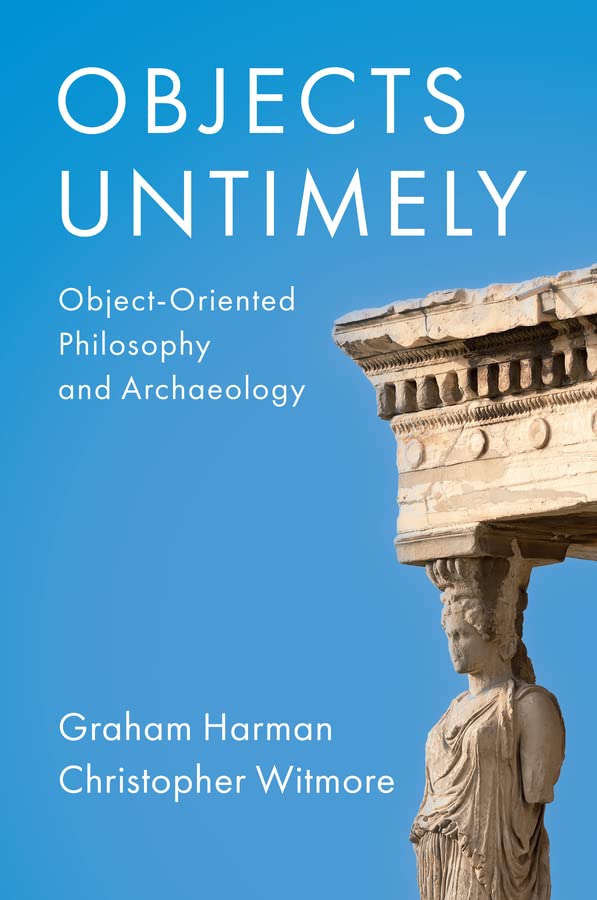
Objects Untimely: Object-Oriented Philosophy and Archaeology
Objects generate time; time does not generate or change objects. That is the central thesis of this book by the philosopher Graham Harman and the archaeologist Christopher Witmore, who defend radical positions in their respective fields. Against a current and pervasive conviction that reality consists of an unceasing flux – a view associated in philosophy with New Materialism – object-oriented ontology asserts that objects of all varieties are the bedrock of reality from which time emerges. And against the narrative convictions of time as the course of historical events, the objects and encounters associated with archaeology push back against the very temporal delimitations which defined the field and its objects ever since its professionalization in the nineteenth century. In a study ranging from the ruins of ancient Corinth, Mycenae, and Troy to debates over time from Aristotle and al-Ash‘ari through Henri Bergson and Alfred North Whitehead, the authors draw on alternative conceptions of time as retroactive, percolating, topological, cyclical, and generational, as consisting of countercurrents or of a surface tension between objects and their own qualities. Objects Untimely invites us to reconsider the modern notion of objects as inert matter serving as a receptacle for human categories.
- GenresPhilosophy
240 pages, Hardcover
Published June 6, 2023
About the author
Graham Harman
62 books214 followersGraham Harman (born May 9, 1968) is a professor at the American University in Cairo, Egypt. He is a contemporary philosopher of metaphysics, who attempts to reverse the linguistic turn of Western philosophy. He terms his ideas object-oriented ontology. A larger grouping of philosophers, Speculative Realism, includes Harman and the philosophers Iain Hamilton Grant, Quentin Meillassoux and Ray Brassier.
Ratings & Reviews
Friends & Following
Create a free account to discover what your friends think of this book!
Community Reviews
Displaying 1 - 2 of 2 reviews
June 27, 2026
This is a highly productive and rare kind of discussion between two trailblazing academicians in their respective fields, Graham Harman in philosophy and Chirstopher Witmore in archaeology. The project is built around the central goal of expanding the understanding of time from its generic linear conception, towards a more synthetic alternative approach where time is regarded as an outcome of object-relations, wherein it could be manifest in various non-linear types such as topological, retroactive, cyclical, or generational to name a few.
The format of the book is very interesting, and does well to bring the reader into the room with Harman and Witmore. Book consists of five chapters, which include two introductory texts in a more academic style by either thinkers, one relatively more speculative text by Harman diving further into his philosophy, and two sections covering conversations between the authors responding to the texts, interspersed in between.
The overlap between Harman's object-oriented-ontology and Witmore's vision of archaeological praxis as an affair that traverses past-present-future as opposed to mere historiography, proves extremely fruitful of a discussion, that exceeds disciplinary boundaries and advocates a mode of thinking that could be employed by anyone in any discipline. Breaking free of linear conceptions of time potentially unleashes a new form of liberation rooted in irreducibility of any given relation (societal, individual, political, environmental, technological) to its components and effects, advocating for a worldview that is ever creative and ripe with potential of unprecedented modes of solidarity and cooperation.
Only criticism I have is that some of the conversations between the authors become quite one-sided, as in it may sound like at times they're not responding clearly to one another but rather simply reinstating their own positions (which are complimentary anyway). Perhaps this is something due to the edited nature of the original recorded conversations.
The format of the book is very interesting, and does well to bring the reader into the room with Harman and Witmore. Book consists of five chapters, which include two introductory texts in a more academic style by either thinkers, one relatively more speculative text by Harman diving further into his philosophy, and two sections covering conversations between the authors responding to the texts, interspersed in between.
The overlap between Harman's object-oriented-ontology and Witmore's vision of archaeological praxis as an affair that traverses past-present-future as opposed to mere historiography, proves extremely fruitful of a discussion, that exceeds disciplinary boundaries and advocates a mode of thinking that could be employed by anyone in any discipline. Breaking free of linear conceptions of time potentially unleashes a new form of liberation rooted in irreducibility of any given relation (societal, individual, political, environmental, technological) to its components and effects, advocating for a worldview that is ever creative and ripe with potential of unprecedented modes of solidarity and cooperation.
Only criticism I have is that some of the conversations between the authors become quite one-sided, as in it may sound like at times they're not responding clearly to one another but rather simply reinstating their own positions (which are complimentary anyway). Perhaps this is something due to the edited nature of the original recorded conversations.
August 12, 2023
An interesting and insightful approach to archeology. It forces us to ask questions concerning the nature of time and change.
Displaying 1 - 2 of 2 reviews