Jump to ratings and reviews
Rate this book

Nachts In Der Stadt

Rate this book
Nachts in der Stadt erzählt die Geschichte des Hochstaplers Harry Fabian und spielt in einer kleinen Welt von Gaunern, Ganoven und Huren im London der 1930er-Jahre. Fabian lebt von dem Geld, dass seine Geliebte Zoë im Rotlichtviertel Soho auf dem Strich verdient. Als gewissenloser Spieler und Hasardeur beutet er sie gnadenlos aus, betrügt sie nach Strich und Faden und würde sie zur Not auch an den Teufel verkaufen. Fabian will groß herauskommen und hat hochfliegende Pläne als Ringkampf-Promoter. Doch das ist in den mageren Zeiten der Depression nicht ganz einfach: Er muss innerhalb kürzester Zeit 100 Pfund auftreiben, um mit Figler, einem windigen Hehler, ins Geschäft zu kommen. Aber erst als er sich durch eine hinterlistige Erpressung das nötige Geld erschleicht, nehmen seine Pläne eine konkrete Form an.
Darüber hinaus ist Nachts in der Stadt auch die Geschichte von Adam und Helen, die versuchen, inmitten von moralischem Schutt und Dreck ein würdevolles Leben zu führen. Beide arbeiten im Nachtklub von Phil Nosseross und verlieben sich ineinander. Dort treffen sie auch auf Harry Fabian, der sich bereits als erfolgreicher Mann präsentiert und sein Geld verschleudert. Unter dem Einfluss Fabians ergreifen Eitelkeit und Habgier auch von Helen Besitz. Sie will mit Adams Hilfe einen eigenen Nachtklub aufbauen. Adam sträubt sich dagegen, weil er ein ehrliches Leben führen möchte. In dieser Situation erscheint Fabian Helen als letzte Chance. Dem machen aber Polizeirazzien vor den Krönungsfeierlichkeiten zu Ehren George VI. einen Strich durch die Rechnung. Bis dahin haben seine Betrügereien bereits Menschenleben gefordert.

Der Roman erzählt die tragische Geschichte falscher Träume und waghalsiger Hoffnungen. Kershs Figuren leben in einem Netz von Lügen und Selbstbetrug, so dass sie immer eher vor einem Abgrund stehen als vor dem erhofften Absprung aus der Gosse. Seine beeindruckende Erzählung aus den Sümpfen menschlicher Psychologie zeigt das in gnadenloser Konsequenz auf.

Mit Nachts in der Stadt wurde nach mehr als 60 Jahren endlich einer der ganz großen Krimiklassiker ins Deutsche übersetzt. Zwar wurde das Buch schon 1950 von Jules Dassin und 1992 von Irwin Winkler (mit Robert de Niro in der Hauptrolle) verfilmt. Doch im Gegensatz zu den Verfilmungen sind die Bücher Gerald Kershs (1911-1968) hier zu Lande eher unbekannt und bis auf wenige Ausnahmen nicht übersetzt. Es wurde Zeit: Ein Stern der Noir- und Kriminalliteratur leuchtet endlich auch in Deutschland. --Christian Koch

Paperback

First published January 1, 1938

4 people are currently reading
979 people want to read

About the author

Gerald Kersh

109 books62 followers
Gerald Kersh was born in Teddington-on-Thames, near London, and, like so many writers, quit school to take on a series of jobs -- salesman, baker, fish-and-chips cook, nightclub bouncer, freelance newspaper reporter and at the same time was writing his first two novels.

In 1937, his third published novel, Night and the City, hurled him into the front ranks of young British writers. Twenty novels later Kersh created his personal masterpiece, Fowler's End, regarded by many as one of the outstanding novels of the century. He also, throughout his long career, wrote more than 400 short stories and over 1,000 articles.

Once a professional wrestler, Kersh also fought with the Coldstream Guards in World War II. His account of infantry training They Die With Their Boots Clean (1941), became an instant best-seller during that war.

After traveling over much of the world, he became an American citizen, living quietly in Cragsmoor, in a remote section of the Shawangunk Mountains in New York State. He died in Kingston, NY, in 1968.

(Biography compiled from "Nightmares & Damnations" and Fantastic Fiction.)

Ratings & Reviews

What do you think?
Rate this book

Friends & Following

Create a free account to discover what your friends think of this book!

Community Reviews

5 stars
102 (33%)
4 stars
137 (44%)
3 stars
52 (16%)
2 stars
14 (4%)
1 star
3 (<1%)
Displaying 1 - 30 of 47 reviews
Profile Image for Jeffrey Keeten.
Author 5 books252k followers
September 13, 2020
”Every film he had ever seen, and every book he had ever read, rushed together in his brain to form one blazing and magnificent composite, in which he, Fabian, fantastically enlarged, fantastically dressed, leaned backwards in a wild photomontage of champagne bubbles, limousines, diamonds, galloping horses, baize tables, and beautiful women; all whirling and weaving in a deluge of white and yellow chips, and large bank notes; an eternal reduplication of breasts and legs and every conceivable shape, size, and color.

That, he said to himself, is what I’m going to do….Plunger Fabian, the playboy who broke the bank at Monte Carlo. Afterwards, I can buy plenty dames.”


 photo Night_and_the_City_Widmark_zpsedxdqtmz.jpg
Richard Widmark plays Harry Fabian in the 1950 movie.

Harry Fabian is a small man, but in his mind, he is a colossus. Lies flow from his lips in machine gun fashion. He says he is an American songwriter, but he is really an English ponce. He says he is rolling in money, but he is usually broke. If not for the money his girlfriend Zoe is making on her back, the illusions he spins about himself would collapse like a scarecrow without a pole to hang on.

Despite the ludicrous inconsistencies with most of the assertions he makes about his capabilities, most people, even those who know him reasonably well (there is no knowing the real Harry Fabian because whoever that is... is someone he doesn’t want to meet), ride along with his fantasies. He decides he is a wrestling promoter and comes up with just enough money, through blackmail, to float the idea into reality. When he talks about the illusions inherent with professional wrestling, he might just as well have been talking about the self-deceptions and delusions of his own life. ”These mugs go to wrestling the same as they go to the pictures. They know it ain’t genuine. They know the Black Strangler doesn’t really draw with Legs Mahogany, just the same as they know Walter Pidgeon doesn’t really marry Greer Garson in the films. Well, they like to be fooled.” How could people possibly believe he is an American songwriter? Because they want to believe it. They want to believe they have touched fame.

Gerald Kersh writes in an aggressive, relentless style. I knew I had a tiger by the tail on page five when I read this paragraph. ”There was a quality of savagery about his clothes--hatred in the relentless grip of his collar, malice in the vicious little knot of his tie, defiant acquisitiveness in the skin-tight fit of his coat--his whole body snarled with vindictive triumph over the memory of many dead years of shabbiness.” Harlan Ellison has stated that Kersh is his favorite writer. When I read that years ago, I can remember thinking, I need to read a Kersh, but then his books were out of print and difficult to find. Fortunately, Valancourt Books, like they have for other lost writers, is bringing many of his books back into print. As I was reading this book, I brought Kersh up with my author friends, and most of them didn’t know who he was, but one who did wrote back to me gleefully that he was glad I was finally joining the Kersh cult. I could tell from his response that, as he wrote to me, he had a glint in his eye and a smile on his lips.

Isn't it wonderful to encounter people truly excited about an author/book and who share that excitement with you? And by doing so they increase your excitement and enjoyment of the reading experience as well?

Kersh published his first “novel,” Jews Without Jehovah, in 1934. It was promptly pulled from the shelves when members of his family sued him. I put the word novel in parentheses on purpose because it seems Kersh did a poor job disguising the true identities of his characters. “In the late 1930s, Kersh said that his novels published to that date ‘haven't really been fiction at all’ and ‘contained an irreducible minimum of made-up-stuff’.” He worked a variety of unusual jobs over his lifetime to keep bread on his table, but also with the intent of having intriguing, spellbinding experiences and meeting the irascible, fascinating people who would become the characters who populated his novels. The reason why Kersh’s novels resonate, with the right kinds of readers, is the authenticity of the dialogue and the genuineness of the plots. I feel like I stepped into the pages of the book and didn’t even try to leave until I discovered whether Harry Fabian’s accumulation of lies was finally going to rise higher than his head and drown him.

The other characters in the book are also as fascinating as Fabian. Joe Figler is another guy who maintains a fictitious financial view of himself. To raise money to go in with Fabian on his wrestling promotion opportunity, he buys products such as eggs or chairs or any number of things on extended credit, and then he sells these products for less than what he owes for cash. He has to take a loss to churn the quick turnover. The hope is that he can keep enough money flowing that he can pay off enough of his debts to keep the whole scheme afloat. Meanwhile, he hopes the cash will return more dividends than what he owes to all his creditors. He has good credit with people around London, and as long as he can keep juggling the balls, he can keep the illusion of solvency alive. He looks down his nose at Fabian, but maybe that is because they are more alike than he would ever want to admit.

There is also the substory of Helen and Adam, who work in a nightclub designed to milk as much money out of the inebriated clientele as possible. Adam is a sculptor and only intends to stay until he has enough money saved to take a year off to work on his art. Helen is only going to work at the club until she finds a normal, respectable job, but they both become sucked into the easy money, and their long-term dreams are sidetracked by the short-term gains. Kersh explores a lot of dark aspects of human nature as we watch their relationship get torn apart by their avidity for money. Can they remember their original dreams in time to escape the clutches of greed? The retired wrestler Ali gives Adam some advice that rings in his ears. ”Young man, mark my words. You listen to me: if you’re looking for money first, then by the time you get it you won’t be good for nothing else no more. Live! Work! Money? Money is lousy! Money is rotten! Money is an illusion!” Easy money is the destroyer of dreams, unless money is all you dream of.

There were two movies made of Night and the City. The first was in 1950 with Richard Widmark, and the second was in 1992 with Robert DeNiro. I hope to watch the 1950 version very soon. From everything I’ve read, it is a fantastic depiction of the characters that populate this novel as well as the streets of Kersh’s London. Kersh died in 1968 at the tender age of 56. He’d been in poor health for a while before his death and he would probably be the first to tell people, your health is worth more to you than all the money in the world.

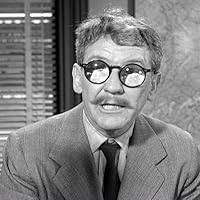
 photo Gerald Kersh_zpsc91eieyj.jpg
In this picture, Gerald Kersh reminds me of a brooding vampire.

I do hope to see a resurgence of interest in Gerald Kersh’s novels. His hardboiled, impossible to ignore writing style is invigorating and unique, and I, for one, certainly need more. These old, forgotten novels have a lot of life left in them. They just need readers to brush the dust off them, crack their pages, and let them live in a new generation of minds. Harry Fabian is a villain of the highest order and completely untrustworthy, but I won’t ever forget him either. Kersh has created a character who has lived on beyond him.

If you wish to see more of my most recent book and movie reviews, visit http://www.jeffreykeeten.com
I also have a Facebook blogger page at:https://www.facebook.com/JeffreyKeeten and an Instagram account https://www.instagram.com/jeffreykeeten/
Profile Image for Ian.
990 reviews60 followers
August 15, 2023
As suggested by its title, Gerald Kersh’s 1938 novel is one that features the nighttime people - club owners, the people who work in or frequent clubs, streetwalkers, professional gamblers, and the duckers-and-divers of life. The setting is London’s Soho district, once known as “The Square Mile of Sin”, though now (I believe) gentrified.

There are few novels that I’ve read, if any, where the central character is as much of a lowlife as Harry Fabian, the protagonist here. He is, in the British slang of the period, a “ponce”. Today we would call him a pimp. Blackmail and fraud are other specialities. Most of all though, he’s a show-off. He’s a small-time operator but likes to play the big man. He affects an American accent, pretending that he used to live in the States, and as one of his acquaintances describes him “He’d go without food to buy you a cigar for three shillings.” His surface generosity doesn’t arise out of any kindness but out of a desperate desire for status and respect. In reality Harry is held in contempt by almost everyone. Harry “fools nobody as completely as he fools himself” and moves around “unimpaired in his self-esteem”.

Other characters are Harry’s girlfriend Zoe; Adam, an aspiring artist who takes a job as a waiter in a club to put food on the table; Figler, who is Fabian’s occasional business partner; Ali, a Turk and former wrestler, and two women called Vi and Helen, of whom I won’t say more for fear of spoilers. There’s also Bert, a costermonger who is not part of the nighttime economy, but who has known Harry since they were children. Bert represents the antithesis of Harry. He’s not averse to some minor lawbreaking but is essentially an honest man. As he says to Harry in one conversation, “’Arry, we’ve all done some funny strokes in our time, but may I be paralysed, I draws the line at poncing.”

As can be seen above, some of the dialogue is in Cockney dialect. At one point, Bert tells Harry to “take a ball-and-chalk” (a walk). I imagine some of that could be tricky for those who have English as a second language. Perhaps predictably for its era, the novel also has dated racial attitudes and language.

The desire for money, and what it can provide access to, is a theme of the book. Several of the characters can’t control their desire to spend, and to possess things. (I can relate as I’m a little like that with books, though in our modern society I have enough disposable income to sustain my “habit”). I suppose if the novel has a message it’s that we are better off not being like that.

You get a sense of authenticity from this novel, because Kersh himself operated in this milieu. Part of the plot of the novel involves Harry setting himself up as a promoter of All-In Wrestling contests. In real life Kersh made a living as a wrestler, as well as a nightclub bouncer. He apparently said in another context that his novels contain “an irreducible minimum of made-up stuff”, implying that his characters were based on people he knew. He has an occasional tendency to philosophise through his characters, which made the novel a little patchy for me, but the last 100 pages were compelling.

There have been two film adaptations, neither of which I’ve seen, but which are said to be very different from this novel.
Profile Image for Franky.
619 reviews63 followers
October 31, 2015
“Many commercial gentlemen are called ‘businessmen’ until they are found out; then they are described as ‘crooks.’”

Look up chump—or for that matter, mug-- in the dictionary and you might see Harry Fabian’s face. A man with a plan, you might call him. Always has something up his sleeve. Wrestling racket? A means to get ahead, staying in front of the other mugs…A hustler on the move…

Within this novel, even the title takes on a bit of symbolism and significance. Night is the time when deals are made, when the big shots make money, when the seediness of London’s underground comes into full view….The innocent need to beware: the city itself is unforgiving, moving on without remorse…

Gerald Kersh has apt and spot on prose, delving into who these characters are under the surface, especially aforementioned Harry, an unsympathetic weasel-like con man of sorts: “…he was like a sinister figure in a somber morality play: a creature of the gutters…” There is one scene where Harry relentlessly follows an older man, only to eventually blackmail him with false bravado and conniving methods. Harry may remind you of the used car salesman who invents a false story to get you to buy that lemon of a car.

I can see why Night and the City is listed on many noir reads. It seems to be dripping in depravity: characters, setting, plot all add to an element of this vibe. Kersh is spot on with many poetic descriptions of time and place, creating an atmosphere typical of noir. There is a level of bleakness that personifies and typifies much of the plot, as scams and deals and rackets are done for profit. Harry himself perhaps personifies this philosophy the best, remarking “If you’re not trying to make a buck, any way possible, you’re a mug.” In many ways The Silver Fox, the club where many of the locals go, is a microcosm of this seediness.

Night and the City would not have felt complete if at least some characters attempted to break from the bleakness and depravity, and we do see this in the novel’s second half. Without conflict, what can we hope for against all this? One minor character, Adam, attempts to break from this vicious cycle, tries to save another soul from the grasp of the “Night.”

In all fairness, Kersh’s novel did take awhile to become fully invested in, with much of the first part being exposition of defining who Harry Fabian is and who those around him are. There is something a bit circular about some point in the plot, but the second half comes around nicely.

A really fine and effective noir read is Night and the City. There is also a film with Night and the City, starring Richard Widmark as Harry. While the film is great in many aspects, as usual with book vs. film, they are really two different animals (although Widmark does personify Fabian effectively). Check out the novel, then the film, and see what you think.


Profile Image for Algernon.
1,857 reviews1,171 followers
December 5, 2023

Why hunt mice? Only fools work. There is always food.

Harry Fabian resembles this feral cat from the novel, as he roams the streets of the city at night, searching for some opportunity to get rich in a quick and easy manner. ... born in a slum, bred in the gutters, versed in the tortuous geography of the night world and familiar with every rathole in West One and West Central Harry dresses well, speaks fast and bends truth whichever way he thinks it will suit his purposes best. While waiting for his golden egg to be laid, Harry pimps out his gullible girlfriend Eve on the streets of Soho. He is cocky and self-confident and even relentless, once he spots a ‘mark’ to be fleeced. Yet few of the true sharks of the underworld are deceived: Harry is living in dreamland, and his trajectory in the novel is not only predictable to fans of the noir genre, but it reaches almost classical tragedy values:

He saw London as a kind of Inferno – a series of concentric areas with Picadilly Circus as the ultimate center.

Against this background, my initial comical impression about Harry Fabian, inspired by the popular sitcom Only Fools and Horses , was soon in need of re-evaluation into ... a sinister figure in a somber morality play: a creature of the gutters, sniffing after a trail along the dank and shadowy roads of the night, hunting somebody down.

This is my first novel by Gerald Kersh, and I am also unfamiliar with the movie version of Jules Dassin, so it was easier for me to picture Fabian in my mind as a clone of Derek ‘Del Boy’ Trotter, although the introduction of old man Bert came even closer to the mark:

He had an air of absolute poverty; but he carried his disintegrating clothes with a curious impudent jauntiness – the swagger of the Cockney costermonger, the indomitable fruit vendor, tougher than leather, more indestructible than the stones of the City; wiry; sleepless; sharpened like a needle by perpetual vigilance; devoid of criminal instinct, but accustomed to regarding the policeman as his hereditary enemy; humorous, touchy, uproarious, and quick with his hands – the only permanent type of the Londoner, speaking an individual jargon and upholding an old and characteristic tradition.

Gerald Kersh knew the city of night intimately, from his own youthful experiences working in nightclubs and fight clubs. Even more relevant I think is his experience writing for newspapers, because I believe his novel is just as much an expose of the seedy night life of the city as a character study of the corrupting influence of this night life.
The secondary characters in the story feel as important to the plot as the efforts of Harry Fabian who, in the same noir tradition I already mentioned, is moving on predetermined, inflexible tracks decided by Fate.

The habitual liar always imagines that his lies ring true. No miracle of belief can equal his childlike faith in the credulity of the people who listen to him; and so it comes to pass that he fools nobody as completely as he fools himself.

Very few characters in the book are worthy of redemption: Eve is a willing victim for Fabian abuses, Vi is another habitual liar who deceives herself with cheap shoes, perfumes and men, Helen starts out well, trying to make an honest buck in an office job, but soon falls under the spell of easy money to be fleeced from silly customers in a dance hall run by a venal Greek [Nosseross]. You’ll make more down here than you would in an office, anyway. whispers the serpent.

If a man has spent over ten pounds, we sometimes give him a twopenny carnation: you know the idea – give a mug twopence back out of a tenner, and he’ll be so pleased that he’ll probably spend another fiver ...

As Harry Fabian runs around the night spots in search of 200 pounds to invest in his latest idea, to become a wrestling promoter, we are introduced to a more ambiguous character, one that the writer seems more lenient towards. Figler is still a member of the underworld , a shark between sharks, but at least he has the right instincts for a man of business and a passing acquaintance with morality:

Such was Figler. His activities were manifold and diverse. He was the perfect type of the agent or go-between. He lived almost entirely on percentages, commissions, corners, rake-offs, fivers from buyers, fivers from sellers – he was the kind of man that goes into the world with nothing but an eye and a tongue, and makes money without laying out a penny.

[...]

If you approached Figler with a consignment of spoiled birdseed, perished elastic garters, rusty umbrella ribs, warped butter patters, out-of-date calendars, or shaving papers left over from the nineties, he would run a finger up and down the pages, smoke a cigarette, look up, choke, recover, and say: “Uh ... I can dispose of this stuff on a fifty-fifty basis ... .”

This was another reference to “Only Fools and Horses” for me, despite the five decades that separate the two settings. Kersh puts Figler to good use in the novel as a pragmatic, realistic counterpoint to the crazier schemes of Harry Fabian.

The other sympathetic character that is introduced to balance somehow the venality of Nosseros, Fabian and of the other West End sharks is Adam, a young and penniless sculptor who works for a time in the dance and fight clubs and tries to make both Helen and Harry see the wrongness of the path they have taken.

“To hell with money, to hell with the whole stinking racket, I say. You vultures! You parasites and imbeciles. You crooks and you fools! You greedy little degraded idiots! I’m going to quit this and go to work.”

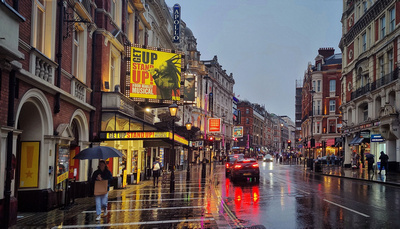
What else can I say here without spoilers? I loved the colorful language Kersh uses here, with its numerous Cockney slang insertions that made the glossary at the start of the novel a welcome addition. I liked his journalistic style that allows for some excellent poetic images of the interplay between light and darkness on the streets of the city, the same streets that fascinated me with their rain washed glitter on my latest visit to London

soho


Vaudeville theaters, like gigantic vacuum cleaners, suddenly sucked in waiting queues. Behind upper windows lights clicked on and blinds snapped down. Gas, wire, wax, oil – everything burned that would give out light. The darkness of the April night got thicker. It seeped down between the street lamps, poured into basements, and lay deep and stagnant under the porches and the arches of the back streets.
The last of the shop doors slammed. The places where one could eat, drink, and amuse oneself alone remained open, and burned with a lurid and smoky brightness. Night closed down upon the city.


I also liked the grittiness and the realism of the long anticipated wrestling match that is the culmination of Harry Fabian’s machinations, with its terrible yet equally long anticipated aftermath.

There was no moon, and the night was bitterly cold. One tiny blue star twinkled, light-years away.
There is always the icy light of some distant star to guide us, lost and bewildered wayfarers in the wilderness of this world.


Now I can watch the movie with a clean conscience. I also plan to read more from Kersh, probably ‘Fowler’s End’ next because it has the same West End setting.
Profile Image for K.J. Charles.
Author 65 books12.3k followers
Read
May 13, 2019
A spectacularly bleak and misanthropic novel of London low life just before WW2 (pimps, prostitutes, wheeler dealers, scammers, blackmailers) set among nightclubs and the wrestling world, both of which the author knew personally. Compellingly horrible---grubs writhing in an immense night, as Rupert Brooke said of Webster, with very little offered in the way of hope for the species, just human selfishness, self-delusion, self-harm and self-indulgence on full sordid display in all their grime. A good book, but not a beach book.
178 reviews35 followers
May 8, 2018
Blimey, this was good!

My acquaintance with Gerald Kersh's writing began a few years ago, when I read a few short stories in some 1960s fantasy anthologies. I also got a recommendation for Fowler's End, but wasn't really in the mood to read it at the time. Finally, I got a short story anthology as well as the novel Prelude to a Certain Midnight, both of which I thought were absolutely great, and the novel in particular I devoured and reviewed rather enthusiastically last year. Then I went and got the Night and the City film from 1950 starring Richard Widmark, knowing that it was based on a kersh novel. I loved the film, and just now finally got round to reading the book, and I can definitely say that kersh was right when he said of the film that they took "everything that was me" out of the story.

Indeed, this is not really the same story as that which we see in the film. The movie pretty much invented whole new characters, or made up relationships between people that don't even exist in the novel. I still think the film is great, but now have to acknowledge that this is because of elements separate from the screen-play: a superb cast, excellent direction and, of course, that wicked wrestling scene.

You might not prefer the novel, though. I mean, although it generally has better drawn characters than the film does, it's also, I think, a good deal more cynical. Mind you, it's not true that the book is crammed full of utterly hateful people. I think Kersh's favourite people (as in the characters he genuinely likes best) in the book are Adam the artist, who seems much like how I imagine Kersh himself to have been, and Ali the "Terrible Turk", whom I think is the sort of sheer obstinate physical force that Kersh probably admired in real life. Everyone else though? Let's just say, prepare for seediness and squallor.

This book is really candid and up-front about certain things, which is something I also noticed about Prelude. Reading this, one gets the impression that Gerald Kersh had been "round the block" a lot, seen a lot of things and done a lot of things. He pulls no punches about the things he doesn't like, and don't suppose for a moment that because this is a book from the 1930s, he's going to shy away from showing you the dirty, depraved underbelly of things. Indeed, while there weren't as many drugs around back then, I kind of got the idea from reading this that nightlife in late '30s London was a rather sordid and dangerous thing. All ill-lit underground clubs, stuff being done under the table, prostitution hiding barely beneath the surface, and club owners doing their best to make all customers as "tight" as possible so they will part with their cash. And that's not even getting into the grotesque physical descriptions of these places and their denizens that Kersh seems to delight in giving us. The man is a master of the debilitating pharse and brutal verbal take-down.

Now, all this is interesting to me, because I can see that Kersh is down on nightlife in general and that he, through the voice of his mouthpiece character (I think) Adam, tries to get to the bottom of what exactly is wrong and how it twists, and even infects, the people who navigate the dark corridors of the urban landscape in those tawdry hours before dawn. Speaking from my 21st century, thirty-something perspective, I've always thought of myself as a rather nocturnal person; one who doesn't necessarily get enough sunlight and who thrives in the atmosphere of the late-night rock 'n' roll gig, if not the illicit after-hours club. I can see where Kersh is coming from, but can't help but think that it's really not that bad and that there's no need for such blanket condemnation. But then, this was 1938; times were different then, and I'm not going to doubt his experience: a lot of what he described here probably was just as crooked as he described it. And I don't have to agree with him wholeheartedly to be disappointed (along with Kersh himself, no doubt) in how the character of Helen, who started out sympathetic and identifiable, allowed herself to become "infected", and let the greed of the nightclub pusher take over. It was sad seeing her mind go down these pathways and leading her astray, even if Adam wasn't really the man for her. I like that Kersh doesn't sugar-coat, and doesn't offer any beds of roses for his characters. This is another big difference between the book and the film.

The film, by the way, on reflection, was probably too interested in its stars; namely Richard Widmark, and, laughably, Joan Tierney, who is only actually in the damn thing for a couple of scenes but still somehow manages to come off as something of a saintly martyr. The book makes no bones about her being a prostitute, and Harry Fabian (Widmark's character in the film) is her pimp. This is usually said to be Harry Fabian's story, and that's definitely true of the film, but I think the book encompasses a lot more, and so there's a lot more to ponder on in Kersh's text than Fabian alone. Fabian himself, by the way, is total scum. I'm trying to ease off on these book/film comparisons here, but again, i think the film stopped short of making Fabian a truly despicable piece of shit, whereas kersh sees the reality of Harry and has no qualms. This guy, Fabian, is utterly ridiculous. He's a poseur, a fake, a schemer, cheater, thief -- his whole persona is based on a dozen different lies, and he doesn't even think twice about using and stepping all over everyone to make it appear that he's a "man in the money". Oddly though, it's still sort of possible to feel a bit sorry for harry, because he manages to sabotage his own ambition at every turn. Seriously, just get a load of this guy! Every time he gets his hands on some money, he squanders it away through drinking, gambling or simply showing off. As Bert says in the last scene, he could have made something of himself, even if his footholds would have been gained illicitly. But no, some hungry, needy, lazy, instant-gratification-wish-fulfilment part of him always stops him from getting ahead, because he needs the immediate attention, the praise, the babes, the lavish excess, right-here-right-now-all-the-time! Just look at that scene where he's imagining all the glory that will come to him once he "breaks the bank at Monte Carlo". Just a huge onslaught of champagne and money and sports cars and stallions and titties. It's like the mad dreams of a dimented twelve-year-old. And the funniest thing is that despite his sick and useless nature being known, he has a couple of guys around him that will look out for him, guys like Bert and Figler who will warn him when he's getting in too deep or about to make a terrible mistake. Unbelievable! But of course, he always tells them to "go to hell!"

Can i just say right now that the writing here is superb? There are passages that plumb the depths of depravity, but also some startlingly beautiful prose moments. Someone on here likened bits of this book to "street poetry", and I can definitely hear it. There's a whole interlude in the book dedicated to cats mating! I'm not kidding. Kersh manages to make this poignant, funny as hell but also relevant to the "big picture" in some startling, eye-opening ways. Theres' a bit where a roaring drunk Harry starts raving rhythmically about boys with guns waiting in the street to answer his call and bump off anyone he chooses, and I swear he's "free-styling". There's perspective and sympathy and harshness, and it's all thrown together into this huge, rambling but totally coherent picture. I don't know how he does it, but I hail the man Kersh for managing to pull this off with such style and confidence.

There's loads of humour to be milked here, too, even if it's usually at someone's expense (often Harry's, and he often doesn't realise it). The scene in the Turkish bathhouse where Harry tries to get information out of a guy he intends to blackmail had me in stitches, as did Harry's entire drunken escapade at Phil Nosseros's nightclub. There's a bit of sexism (but not, I hasten to add, any trace of misogyny that I could see), and some casual racism (out of the mouths of his highly questionable characters, mind you), and hey, it was 1938, and yes, times were different, and I want to hand it to Kersh for being rather forward and unrestrained for his times, talking openly and candidly about sex and sexuality, and even subtly bringing race and class issues to the fore. By the way, I think the class thing here is quite interesting. Everyone of a certain social stratum seems to know exactly what Harry's about, and why he's no good. But people like Helen, whom despite her new-found openness to nightlife and such, comes from an educated background and a "good" family, are ripe, so to speak, and can easily be taken in by him and all his ruses and false promises. Kersh could have gone a lot further with all this, but he chose to stop the train before Harry could really drag helen or anyone else down with him. An interesting choice, for sure, and one which perhaps belies his cynicism. I'd say that maybe The Strangler should have done Harry in with that razor in the end, but it's ok. Maybe this was for the best: harry carted off by the police, his "poncery" found out and exposed for all, his brother shaking his head sadly, and all the while screaming "It's a frame-up!" This is the journey; the story of how we got to this point. Strap in, and let this wise writer, who always manages to temper his occasional cantankerousness with thoughtfulness and a kind of ecstatic music, take you down to the underground. You might want a shower when you're done. You might not be sure if you want to grin and laugh or be terminally sad. I think that's the beauty of it.
Profile Image for David.
252 reviews28 followers
December 24, 2008
This terrific noir of 1930’s London was a revelation, even though I had seen the fine 1950 movie w/ Richard Widmark, I knew that things would be more vicious and degenerate than the movie. But the real splendor of the novel is the prose, or should I say the dialogue – this would make a fabulous audiobook for a skilled actor or troupe. The prose is a clamor of London voices, high and low, and at the middle of this Dickensian hubbub is one of the most magnificent scoundrels ever written, the grandiloquent low-life pimp and would-be wrestling promoter Harry Fabian, who boasts, brags, scams, dreams and lies his way through the pages of this book with awesome gusto. A great trickster figure, Fabian is not entirely without scruple; he’s no sociopath. For instance, he does think twice about selling his girl into white slavery to raise capital. Yet his dreams are so grand and vertiginous that he is driven to the darkest depths to reach them, and there are hulking men w/ straight razors waiting for him down there. Aside from the banter and bluster, there’s are some delicious sequences of street poetry here, such as an interlude with a yowling cat, and a terribly physical wrestling sequence (there’s a good one of those in the movie, too), all tending to expose the human animal and his irrepressible and ultimately insane urges, the hungers that burn in us even in the midst of plenty. In fine, this is a gorgeous testament to longing and folly, something like Graham Greene’s Brighton Rock after a magnum of champagne (or a line of cocaine?)

Here's a small taste: "Every film he had ever seen, and every book he had ever read, rushed together in his brain to form one blazing and magnificent composite, in which he, Fabian, fantastically enlarged, fantastically dressed, leaned backwards in a wild photomontage of champagne bubbles, limousines, diamonds, galloping horses, baize tables, and beautiful women; all whirling and weaving in a deluge of white and yellow chips, and large bank notes; an eternal reduplication of breasts and legs of every conceivable shape, size, and color. That, he said to himself, is what I'm going to do.... Plunger Fabian, the playboy who broke the bank at Monte Carlo. Afterwards, I can buy plenty dames."
Profile Image for Peter.
363 reviews34 followers
May 16, 2017
The darkness...seeped down between the street lamps, poured into basements, and lay deep and stagnant under the porches and the arches of the back streets...Night closed down upon the city.

And here’s Harry Fabian, a ponce on the prowl in “the shifting frontier between the slough of small business and the quagmire of the underworld.” Harry is a no-hoper, a fantasist who makes out that he’s a wide boy but isn’t. Things are going to end badly for Harry...but that’s par for the course in Kersh’s shabby pre-war London. The book is full of nocturnal characters trying to make ends meet on the borderlines – club-hostessing, wrestling, doing doubtful deals – each with their dreams, but all of them losers.

If you like seedy, then Kersh’s locales and their inhabitants are just the ticket. There’s a wonderful description of the International Political Club which is a respectable backstreet establishment whose “staid atmosphere was spoiled only by the face of the proprietress. This woman had something about her that was indescribably terrifying. Imagine the death-mask of Julius Caesar, plastered with rouge, and stuck with a pair of eyes as small, as flat, and as bright as newly-cut cross-sections of .38 calibre bullets...She painted her lips bright carmine, but had a habit of pressing them together so firmly that lipstick was smeared over the surrounding skin. This made her look like a newly-fed ghoul that had forgotten to wipe its mouth. She never had much to say. She was supposed to be a Russian. Her name? Scarcely credible: Anna Siberia.

And as the night wears on, there’s worse. Bagrag’s Club is well within the outer circles of hell. “It used to be a coal-cellar. Daylight has never penetrated to this place since it was built, three hundred years ago. Picture it now, at two o’clock in the morning...Half-exhausted people throw up spasms of febrile energy: they rise in groups without purpose, move round, then sink back again, like stirred-up filth on the bottom of a pond...gulping the wine of madness from questionable glasses, against a damp-raddled background of gangrenous yellow distemper.

Good stuff - and when Kersh is on form, he's very good indeed. Night and the City has been called "the epitome of London noir" - but it's not so easily pigeon-holed. It has a distinct voice and a distinct atmosphere that transcend any genre and are happily unclassifiable.
Profile Image for Tosh.
Author 15 books778 followers
August 14, 2010
"Night and the City" is pretty amazing on different levels. On one end I don't think its a great novel, but as a portrait of a time, place, and a certain type of character its totally ace. Written in 1938 and mostly taking place in Soho London it is a snapshot of a group of hustlers trying to stay above the water-line of sorts.

The main character is Harry Fabian, who for god knows, should be a major iconic fiction figure. But alas, what we have here is a pimp who lives his life in a certain amount of fantasy. No self-control, not that bright, but at least he has the talent of a hustler, but hustles in small steps instead of a larger plan. And yes, he does have a large plan of opening up a wrestling ring/club, but he also a man of very little talent.

The fun of the book is knowing that he will hit downward, but how? The big character in the book is West London and its citizens. Along with Fabian we get Helen's road to ruin as well Phil Nosseross, the British Pound counting nightclub boss. Remarkable book and a remarkable new press : London Books Classic.
Profile Image for Lee Foust.
Author 11 books218 followers
December 25, 2022
Finally got around to this British noir classic. It's quite interesting, both a fun read and a pretty bad book at the same time. On the plus side, it's super readable, the characters are amazingly vivid and the primary ones quite well drawn and, it seems to me, psychologically accurate as types. That is to say they both felt real and acted also convincingly as victims of one psychopathy or another. There are some over the top editorial digressions on the part of the omniscient narrator, though, and a few pyrotechnical verbal displays on his/her part, that, I imagine, most readers will either love or hate. Or, like me, both love and hate at the same time, depending upon how they strike you. Many of them will at least make you laugh for their out there bravado at least.

On the down side, however, mostly this super-involved Dickensian narrator sounds pretty phony and uptight when you compare him to the best first person narrators of the Modernist classics, or even their hard-boiled American noir offspring. From Hemingway to Chandler we have much more convincing narrators. Even in the works of lesser, more popular authors like Mickey Spillane, we've learned that less can be more, that male frailty can come through stronger when a male narrator fights back the tears and emotion in a text, rather than having some know-it-all God-like overly moralistic, bombastic narrative voice pontificating endlessly about human foibles as if he/or she had none of their own.

Also souring me a bit here was how close this narrative is to those of my favorite American author Hubert Selby Jr. In Selby's hands, the plight of such flawed, unenlightened marginal and marginalized losers becomes a beautiful hymn to humanity, opening our empathy for our fellow human beings, particularly those we would shun in the streets for the moral and physical depths to which they've sunk. Here, however, our omniscient voice remains one of those smug, hypocritical conservative Christian TV pundits blathering on about "Personal responsibility," when it should be obvious to a child that life in a class-based capitalist system breeds monsters right and left because it offers us next to no options other than chasing after material goods, endlessly hyping ourselves as our only capital, and stabbing every one else's back in order to make the rent at the end of the month.

So, good story, wrong moral.
Profile Image for Rob.
22 reviews1 follower
February 22, 2009
This is a novel well worth reading, for its strengths are immense, as Kersh delves not so much into the underworld, as the book cover would have had me believe, as the depths of the minds and souls of hustlers, specifically Harry Fabian, who is the fully realized and totally repugnant star of this story. Harry is a delusional fool who abuses the trust of others, including that of the woman he purportedly loves, and his ambition drives the story. But he's obviously a loser from the start, and it's only a question of how he will lose and who he will take down with him. What's of greater interest than Harry's fate is that of the peripheral characters who often seem no better than Harry, just less ambitious or more efficient.

Kersh doesn't have much in the hope for any of the characters but one, whose story gets abandoned toward the end, and he seems to like only one other, who he kills off late in the book. I don't have a problem with that, but there isn't enough impact to any of this. For the most part the book is about losers, and there isn't much doubt that they're going to lose. The worst scenes in the book are when the young couple he sets as lovers engage in dialogue - it's horrific set crap written at a beginner's level well beneath anything else in the book. Whatever the cause, lovers talking is presented as something that Kersh simply can't write; maybe if they were conducting some sleazy amoral activity instead of talking about love he'd handle it better.

The thing is, for all my criticism, Harry Fabian is a damned interesting character, and the other characterizations in the book are also well done, so that nearly every scene is interesting. The ending is a disappointment, and I think it's because Kersh doesn't go far enough. Obviously Harry isn't going to succeed, but with all his ambition he might take more people down with him. Some of this, intentionally or otherwise, comes across as a critique of the British police system, arresting those who project a poor image of the kingdom rather than arresting those who are dangerous, but to the author's credit that's a position taken by his characters.

Kersh's politics are not imposed here. He presents his characters as they are without giving his opinion, and that's where the book succeeds. An underground segment of London society is given to us, and it's given to us to decide what we think of these people. We see those in bad situations who are unlikely to get out, those who have found a way to succeed within this underground, and of course the interesting ones are those who see the situation and are choosing whether to succeed within it or to somehow escape it. And that's where this book really works. Kersh knows his characters and writes exceedingly well about them. I wish he'd gone farther; perhaps he saw nothing beyond what he presents here, but it's in that beyond that greatness lies.
Profile Image for Joshua.
110 reviews13 followers
January 13, 2018
An absolutely astonishing foray into the seedy underbelly of pre-war London. Elevated miles beyond the average pulp noir fair by the elegant prose stylings of Gerald Kersh that somehow manage to come off as far more poetic than purple.

It is to my detriment that I'd never picked up this novel before. I wish I'd been reading it for years. The film version of the book, excellent in its own right, distills much of the gritty feel into a cogent, brisk plot. The novel itself is quite a different experience, content as it is instead to meander lazily through the musty ale-cellars, musky brothels, murky alleys, and muffled fleshy thuds of unlicensed wrestling rings.

The characters are universally despicable, but all eventually take a back seat to the true protagonist of the sinister narrative...the City herself. And she is dire depravity writ large, make no mistake. Much of the book could function as a grease-smeared travelogue through the sleazy underways of low crime in the twilight hours of 1938's London.

There is little to nothing about this rogue's gallery of deplorables to make you feel good about even one single page of this novel. They're all base, vile, and depraved...save perhaps for one masochistic tortured artist who has the dubious moral distinction of valuing his art over relationships with his fellow scurrying creatures of the night.

A smashing good read, and one of the most elegant portrayals of slime-riddled corruption and filth that I have ever enjoyed reading.
Profile Image for Andy Weston.
3,226 reviews229 followers
February 4, 2022
It seems we've all met someone like Harry Fabian, a smart dresser who talks a good game, dreams big, but in reality is flying by the seat of his pants, going nowhere except down. But the character that Kersh portrays is not very good at even holding this image. Within only a few pages we know what a conniving and deceiving person he is. He models himself on Bogart and passes himself off as a successful US songwriter. He is someone who will stop at nothing to achieve his dream of breaking the bank at Monte Carlo, and getting to the top in the wrestling business, initially by pimping his girl-friend to work the streets. He is basically a small time crook, and in the language of the day, a wide-boy, a ponce, a spiv - but there's an irony to him, he is intelligent, and capable of being charming.
The habitual liar always imagines that his lies ring true. No miracle of belief can equal his childlike faith in the credulity of the people who listen to him, and so it comes to pass that he fools nobody as completely as he fools himself.
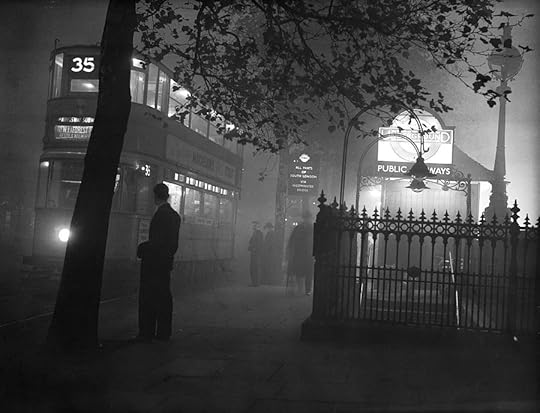
The backdrop is 1930s London, just before the coronation of George VI, and Kersh captures the Soho slang of the vernacular well. His writing is unyielding and electric, with liberal doses of humour, but an abundance of viciousness also. The novel is populated by other vivid figures, aged nightclub owners and their young wives, an assortment of wrestlers, as well as thugs, ex-cons, gamblers and lowlife. It is Soho, in all its seedy 1930s glory, that is the real, larger than life, character here.
530 reviews30 followers
January 12, 2021
Gerald Kersh is someone I'd wanted to read for a while. Harlan Ellison and Michael Moorcock were and are both fans, and the author seems to be one of those, like Poe or Dickens, who managed a hack's volume, but also kept a remarkable quality.


He also looked natty as fuck, let's face it.

Night and the City is a 1938 novel that spawned a classic noir film, which is now likely better known than its source material. Broadly, it concerns a spiv, Harry Fabian who dreams big and is in eternal pursuit of the big payday - or heavy sugar as he would have it.

He's not very good at it. Instead, he's a self-mythologising ponce - a pimp who forces his girlfriend to work the streets while he fantasises about breaking the bank at Monte Carlo, or about becoming a big wheel in the wrestling biz.

The habitual liar always imagines that his lies ring true. No miracle of belief can equal his childlike faith in the credulity of the people who listen to him, and so it comes to pass that he fools nobody as completely as he fools himself.


The novel is set in 1930s London, in the aftermath of the Great Depression. There's a coronation on the way, and money to be had. Whether Fabian has the nous to keep any of the cash he gets (via blackmail, pimping and assorted other schemes) remains to be seen.

Fabian isn't the only dweller on the threshold we're introduced to. Kersh populates the novel with vivid figures: aged nightclub owners and their young wives, looking for the next rung on the ladder of gentrification; hardened dance hall partners; bellicose fruiterers; marks and sheep; and wrestling heavyweights, both past their prime and hitting their straps.

There's a lot made of the extremes to which people will go in order to get by in the big city, and the effect this has on ambition, noble and ignoble. A sculptor becomes enmeshed in the club scene at the cost of his artistic ambition. A sophisticate is drawn to the level of her flatmate. And an old man is geed up by his charges to the point of possible death. The spectre of prosecution looms, yet there's a sense that people are whirling around a world where consequences are something unconsidered.

Until, of course, they occur.

London is the biggest character of this novel, however: particularly Soho. If you've ever walked those streets, avoiding drunks and touts, you'll find something in here you recognise. There's a real love for the city, despite its frequent ugliness, and Kersh finds poetry in homeless fires and the sun rising over spew-decked streets.

He saw London as a kind of Inferno - a series of concentric areas with Piccadilly Circus as the ultimate center.


The writing is taut and electric. There's plenty of humour, but plenty of viciousness, too. I'm not a wrestling fan, really, but the novel's description of a high-stakes match is peerless, a real dose of adrenaline. The book has the booze sweats and the tub-skipping funk of the perpetually hustling, and it's great.

The book also contains a fairly detailed overview of Kersh's life and worked, penned by the editor of the current edition. It's a useful way into the author's world, though the increase in ebook editions of his works do address some of the rarity mentioned in this section. In it, though, one learns that the characters in Night and the City are so keenly observed because they are taken from Kersh's life experiences.

(You also learn that he was once run over by a relative, in a car bought by that relative with funds awarded them after suing Kersh for defamation in an earlier novel. Guy had stories, for sure.)

I'm unsure how this novel will compare to the rest of Kersh's work. He's known for his prodigious output, especially of short stories, and I also know he's got a rep in the SFF world. I know that there's a couple of other books set in this milieu (Fowler's End, for example) so my desire for more low-life jerk-arsery will undoubtedly be sated once more.

But part of me is worried. Night and the City is so terrible and wonderful - how can one top it? I'm almost tempted to investigate no further and keep this as a gritty solitaire.
Profile Image for Paul Brazill.
85 reviews37 followers
July 14, 2016
Gerald Kersh’s brilliant 1938 novel Night and the City is ‘a book I wish I’d written’, Rich and darkly beautiful. Cruel and funny. There’s a tidy introduction from John King in this edition, too.

The blurb: Harry Fabian is a ponce, a Flash Harry in an expensive suit, a cockney wide boy who adopts American tones and talks big, yet will never make it to the top. He operates in the Soho of the 1930s, a metropolitan tangle of dodgy geezers, prostitutes, spivs and strong-arm men. Twice filmed, Night and the City is a seminal low-life novel, which presents a vivid glimpse of a lost London. It also marks the return of a lost London author, Gerald Kersh, a maverick character whose life was as colourful as those of his most flamboyant creations. This new edition includes an introduction by John King.
Profile Image for Andrea.
64 reviews19 followers
September 7, 2024
If ever I were to be described by someone, I would wish it to be by someone with the exquisite talent of Kersch. What he captures in a few sentences is beyond that of any actual image, portrait or sculpture: the good, the bad, the ugly, et al.
Profile Image for Shawn.
753 reviews19 followers
May 23, 2025
"What does this guy have X-ray vision? He looks up her skirts and sees brains."

There are a few gems like that that made me laugh out loud scattered across this novel about lower class people trying to make it in the big city. Most pulp novels you can tell a lot about the characters by how they go about getting what they want. Here however in a more noble form, we see how the characters try to get what they want but occasionally get blasted with a morality sermon by the narrator. It's not a total drag and it's kind of novel in its weathered (bitter?) cynicism towards man and his lesser impulses but it's entirely unsympathetic. It's definitely a chin-up, bucko (stiff upper lip) type book.

Fabian, who is the first character introduced is wonderfully loathsome, a gutter rat putting on airs trying to act like a big shot American (forcing him to hide his natural cockney accent). He's even an ungrateful ponce (that's pimp to us Americans) who at one time considers selling, that's right sex trafficking the woman who has been supporting him in his frivolous schemes. Watching his walking train wreck act is worth the few hours spent reading this.

It's a little detail heavy and slow to start and , but it's a different kind of take on the pulp genre.
Profile Image for Brian Fagan.
419 reviews132 followers
May 13, 2025
"Man spends the first half of his life trying to find himself, and the other half trying to lose himself". So says (probably not uniquely) nightclub owner Phil Nosseross as he tells his naive young wife about the losers that spend their hard-earned money drinking at clubs. I think Kersh, who wrote Night and the City in 1946, had an essential theme of his novel expressed here.

The story takes place in SoHo, a bad area of London, in 1936. We follow several men who are eking out their day-to-day money in different but similarly difficult and imaginative ways.

When I read noir novels, they are usually dark and violent, but also engaging, fascinating, riveting, compelling. Night and the City I found just depressing. In the aggregate, Kersh's characters display an encyclopedic variety of vices and human shortcomings and downright evil. I think Kersh may have come up with a potentially blockbuster ending, but shied away from it when writing the final scene. When a writer spends all of his effort on telling us how rotten everyone is, I worry about him.
Profile Image for Williwaw.
484 reviews30 followers
August 18, 2018
Quite some time ago, I saw a movie with the same title, starring Richard Widmark, and it's considered a "noir" classic. Some quick and dirty internet searches divulge that the movie didn't follow the book very closely, and that the director never read the book.

My memory of the film is dim now. But I can say that both the book and the film feature a low-life weasel named Harry Fabian, who is desperate for money so that he can become a wrestling promoter in 1930's London. In the book, Fabian is living off his girlfriend, who is a prostitute. Fabian is repeatedly described by his neighbors and acquaintances (I don't think he has any friends) as a "ponce," which is Cockney for a pimp.

The climactic scene of the book is a bloody wrestling match between a fat, 70-year-old champion named Ali the Turk and a much younger and more fit Cypriot wrestler. It's very well-written and I won't say who "wins" (but if you've seen the movie, you already know what happens).

There are many well-depicted characters and occasionally some very lush interludes (where the author seems to be waxing philosophical and stepping outside the characters' thoughts and actions -- clearly a "no-no" by today's standards. Nevertheless, I liked these passages.)

Most of the characters are desperate and hopeless. The exceptions are: Adam, a young man who temporarily stoops to be a waiter at a night club so he can earn enough money to coast for a year and try his hand at the art of sculpture; and Helen, his girlfriend, who has more practical ambitions. She'd like to open her own nightclub, but Adam is completely uninterested. And that causes some tension between them, to say the least. The names Kersh chose for the positive characters (Adam and Helen) strike me as very suggestive. Fodder for some literary analysis, no doubt.

I sent a copy of the book to a friend of mine, who said that he couldn't read it because it was too "ugly." That intrigued me, so I decided to try it out for myself. I found it beautifully ugly, and got through it within a week. Despite the ugliness of the characters, the story sustained my interest. Furthermore, the book ends on a hopeful note, so it isn't unredeemably ugly.

This book is regarded by many as an underground classic. I'd say that it's not up there with the greatest books of all time, but it's still a very good book. Kersh was quite popular for a time, but from what I've read he ultimately sank into obscurity and died in poverty in upstate New York. One final, interesting note is that Harlan Ellison always said that Kersh was his favorite writer. If you are an Ellison fan, that's a pretty significant statement.
Profile Image for Moloch.
507 reviews782 followers
February 17, 2015
Più di dieci anni: tanto ha dovuto aspettare questo libro dal momento in cui ne lessi una recensione sul Corriere della Sera (maggio 2003) a quello in cui finalmente l'ho preso dallo scaffale e letto (ottobre 2013). Al punto che ormai questa edizione che ho è fuori commercio.

Londra, 1938. Harry Fabian è un delinquentello di mezza tacca, sempre alla ricerca di modi per far soldi che poi puntualmente scialacqua subito in alcol, scommesse, bei vestiti e spesucce varie, vive sfruttando i guadagni della fidanzata-prostituta Zoë, si atteggia a "duro" sul modello dei gangster americani, ma in realtà chi lo conosce bene ride di queste pose alle sue spalle. Sembra che il suo moto perpetuo, le sue chiacchiere incessanti e la sua ostentata spavalderia servano più che altro a lui stesso per impedirsi di contemplare la disperazione della sua esistenza. L'ultima sua trovata è aprire una sala per combattimenti di lotta libera, per cui serve trovare un socio, mettere insieme un capitale, rimediare un campione sul viale del tramonto che si occupi di allenare i lottatori... Accanto a questa vicenda principale si collocano anche altre figure che entrano in contatto col nostro protagonista.

Non è stata però una lettura che mi ha coinvolto molto (un altro libro che mi aveva attirato anni e anni fa e che poi delude: come, ma meno clamorosamente, Gli Schwartz ): interessanti il protagonista, Harry Fabian, e gli squarci sui tanti espedienti che i vari personaggi, dal trafficone Joe Figler dalle mille risorse alle entraîneuse che spillano soldi ai clienti ubriachi nei pub, mettono in atto per tirare a campare, suggestivo anche il capitolo sul combattimento sul ring, ma molti dei personaggi secondari (Adam, Helen, Vi) non avevano altrettanta capacità di tenere desta l'attenzione, a tratti le loro vicende suonavano quasi come un riempitivo o una distrazione dalla trama principale, o apparivano troppo scopertamente moraleggianti (specie le "tirate" dell'aspirante scultore Adam). L'epopea dei "perdenti" e di coloro che popolano la Londra più buia, sporca e meno "rispettabile" è senz'altro interessante, e questa ambientazione non è usuale, ma lo svolgimento mi è sembrato privo di mordente e un po' dispersivo.

Oltre tutto, ho l'impressione che questo romanzo nella traduzione abbia perso parecchio: se una delle caratteristiche del protagonista era atteggiarsi a gangster americano, probabilmente ciò si sarà riflesso anche in un suo uso esagerato e parodistico di slang ed espressioni diverse rispetto agli altri personaggi londinesi, cosa impossibile da rendere in modo adeguato in italiano (me lo fa pensare il fatto che spesso Fabian dica "O-kappa" al posto di OK). Purtroppo temo che questo libro, che ha atteso per tanti anni "il suo momento", sarà invece dimenticato in fretta.

2,5/5

http://moloch981.wordpress.com/2013/1...
Profile Image for David.
252 reviews28 followers
December 24, 2008
This terrific noir of 1930’s London was a revelation, even though I had seen the fine 1950 movie w/ Richard Widmark, I knew that things would be more vicious and degenerate than the movie. But the real splendor of the novel is the prose, or should I say the dialogue – this would make a fabulous audiobook for a skilled actor or troupe. The prose is a clamor of London voices, high and low, and at the middle of this Dickensian hubbub is one of the most magnificent scoundrels ever written, the grandiloquent, megalomaniacal low-life pimp and would-be wrestling promoter Harry Fabian, who boasts, brags, scams, dreams and lies his way through the pages of this book with awesome gusto. A great trickster figure, Fabian is not entirely without scruple; he’s no sociopath. For instance, he does think twice about selling his girl into white slavery to raise capital. Yet his dreams are so grand and vertiginous that he is driven to the darkest depths to reach them, and there are hulking men w/ straight razors waiting for him down there. Aside from the banter and bluster, there’s are some delicious sequences of street poetry here, such as an interlude with a yowling cat, and a terribly physical wrestling sequence (there’s a good one of those in the movie, too), all tending to expose the human animal and his irrepressible and ultimately insane urges, the hungers that burn in us even in the midst of plenty. In fine, this is a gorgeous testament to longing and folly, something like Graham Greene’s Brighton Rock after a magnum of champagne (or a line of cocaine?)

Here's a small taste: "Every film he had ever seen, and every book he had ever read, rushed together in his brain to form one blazing and magnificent composite, in which he, Fabian, fantastically enlarged, fantastically dressed, leaned backwards in a wild photomontage of champagne bubbles, limousines, diamonds, galloping horses, baize tables, and beautiful women; all whirling and weaving in a deluge of white and yellow chips, and large bank notes; an eternal reduplication of breasts and legs of every conceivable shape, size, and color. That, he said to himself, is what I'm going to do.... Plunger Fabian, the playboy who broke the bank at Monte Carlo. Afterwards, I can buy plenty dames."
2,490 reviews46 followers
August 22, 2013
A most interesting novel highlighting the underbelly of London. Set in the months before George VI's coronation(1936), we see a different sort of life> The characters here are what would be considered lower class, in the mores of the time and their actions. But some were just hard working folks trying to survive the best way they could.

Harry Fabian is the unquestioned star of the book, a little man with delusions of grandeur that had the intelligence and drive to make something of himself. If he'd worked as hard at honesty as he did trying to make the big score, he likely would have succeeded.

But his aim to be a big fish in the pond is fueled by the American films he devoured, the tough guys in the films that thumbed their noses at the straight world. he never seemed to get that they all fell in the end.

He's a pretty loathsome character that sells his girl friend to men and keeps most of the money, all the while pretending he's a big shot, drinking and gambling most of it away.

His current aim is to be a wrestling promoter, seeing the big dollars he thinks will come his way, all the while hustling around for start-up money, then flashes it all away being the big man he claims.

Others get caught up in his schemes as well, though some try to pull away. There's Helen the secretary that wants more out of life. Her bou friend Adam wants to be a sculptor. Zoe is the woman keeping him up and doesn't know he has his eyes on another woman and plans to sell her to white slavers.

London is cleaning up the town for the Coronation ceremonies and that proves the end for all concerned.

Liked this novel by the British author
18 reviews
January 26, 2021
Night And The City is a crime novel masterpiece by the unsung genius of 20th century literature, Gerald Kersh. As always, his words shine. Nobody describes the look or personality of characters, the emotion and the atmosphere of the times, or the troubles and ailments of humanity and the hearts that are crushed or broken like Kersh, and this book is no exception. It is his most 'known' novel in a series of works that have mostly been forgotten by many. Is it his best? Not necessarily, but by God it is up there near the top of the list.

Harry Fabian is the weasley chancer that the world of the book revolves around, and he is a fascinating creation. The supporting cast are equally as important and are so fleshed out and believable. And what a world they inhabit! The gritty late-1930's London setting is so powerfully drawn that you can practically smell the surroundings. The schemes, the old-style cockney turns of phrase, the fragile relationships, the chapter that randomly follows a stray cat as dawn breaks...it is all so brilliantly done. But is that so surprising? It's Gerald Kersh. And those who know, know. He is one of the very best.
Profile Image for Guy Salvidge.
Author 15 books43 followers
November 1, 2017
This would be five stars except that Kersh doesn't actually seem to be able to construct a plot. Great characters and dialogue, but a bit interminable. The film is just about my favourite noir of them all and it manages to streamline this unruly subject matter most effectively.
Profile Image for Pirate.
Author 8 books43 followers
February 13, 2022
The author Gerald Kersh is a stern looking chap, called to mind a character out of the Prisoner of Zenda. Indeed his back story would make a fine book in itself...buried under rubble three times during the Blitz -- as the French says jamais deux sans trois -- made it to Paris for the Liberation and had at one point at least three of the top 10 bestsellers during WWII. Apparently 'best known for his vigorous, Rabelaisian approach to life.'....well chapeau to the old fox for that. Right perhaps best to address the book itself ahem...some may know it through a black and white film starring the inestimable Richard Widmark as the principal character Harry Fabian. Our 'hero' -- anti-hero more like -- is not a la Fabian of the Yard nor founder of the Fabian Society...but a pimp/ponce based in Soho pre WWII. A fantasist who speaks with an American accent at times to try and impress and who has big plans for himself but ultimately well you will see for yourselves if you take a plunge on the book. The atmosphere of Soho in that era is beautifully created by Kersh, the different dives etc and the characters around Fabian all ring true..their dreams often broken or hopeless in their scope...and in Phil Nosseross a wonderful portrait of a club owner of the time. Classy book and well worth a read...by the way Kersh did not appreciate the film version. I enjoyed the film, Widmark is oustanding, but the book is a terrific read and delighted to have made the acquaintance of Mr Kersh and Fabian.
Profile Image for RJ - Slayer of Trolls.
991 reviews191 followers
October 25, 2025
All life is a cycle of ripening and decay. The seed which you plant in the soil goes back to the dirt in dung; the seed which you plant in the womb goes back to the earth in abominable putrefaction—yet life stirs in the rottenness; life struggles upwards, from change to change; and death and decay beget higher life.

Plunge into the underbelly of post-Depression London, where dreams rot in the gutter and survival is the only virtue; a city in moral freefall, a place where ambition curdles into desperation and every human connection is transactional. Harry Fabian—hustler, promoter, artist of self-delusion—scrambles for a slice of respectability as the city devours him whole, each encounter steeped in betrayal and pity. Brutal, beautiful, and written with hypnotic precision, its brilliance lies in the recognition that for some men, the dream of greatness is indistinguishable from their downfall.

The greatest consolation of the degraded human being is the fact that there are others in the same mire. The lower you descend, the intenser grows your yearning for standardisation. The drunkard loves to see others get drunk; the prostitute would like to see all the women in the world on the streets. There is no satisfaction quite so deep and evil as that of the man who can say: ‘Aha, now we’re all in the same stew!’

Profile Image for Ian.
1,021 reviews
March 2, 2023
Harry Fabian is a pimp, a blackmailer, a hustler, a bully, a dreamer, a compulsive liar, a sharp dressed, smart-mouthed coward: a "spiv" almost before the word was coined. This is London of the mid-thirties, or at least its unpleasant underbelly, the night time economy of clubs, cinemas, dancing girls, prostitutes and beer-soaked wrestling halls. Harry wants to be king of this world, and he is going to be king without soiling his hands in any regular daily grind. Can he do it before his lies catch up with him? Fascinating and seedy noir, stirringly written.
148 reviews
March 23, 2021
Picked up a copy of this book in a second hand book store and was super excited to read this based on the description. The first two thirds of the book were outstanding and hard to put down. The last portion felt to me like it lost it's way and didn't really end strongly. I was left wondering exactly where everyone ended up. I can see why may people call this book a classic and I'm really glad I read it. Just not sure I'd rate it as top-notch.
Profile Image for Thomas Barrett.
100 reviews12 followers
November 9, 2022
Definitely an example where the film was better than the source material. Harry Fabian is slightly more fleshed out than Richard Widmark's hammy on-screen turn but the book lacks the sharp menace of Jules Dassin's fierce adaptation. Apparently he never read the book, and it does show.

Thankfully, the film binned off a dreary subplot between a dancer and waiter at the nightclub and the 'off its time' racist descriptions of black people.
Displaying 1 - 30 of 47 reviews

Can't find what you're looking for?

Get help and learn more about the design.