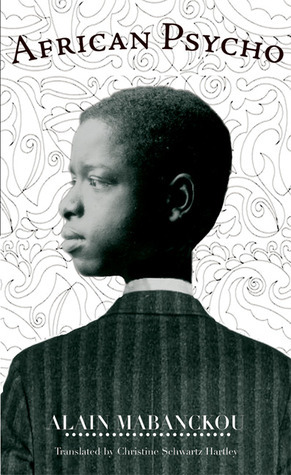
African Psycho concerns a would-be serial killer, Gregoire Nakobomayo, and the spiritual relationship he has developed with his phantom mentor, a far more accomplished serial killer, Angoualima.
The title recalls Bret Easton Ellis' infamous book but while Ellis' narrator was blank, and the book eschewed any kind of psychological exposition, accepting pure psychosis as the bottomline, Mabanckou's protagonist is all psychology and relentless internal chatter and prevarication. The act of deciding to kill, immediately exposed in the novel's first line, "I have decided to kill Germaine on December 29,� puts the psychological front and center. Whatever one may say about it, killing someone requires both psychological and logistical preparedness. This aspect is iterated within the first few paragraphs, when Gregoire introduces his deceased idol, Angoualima, the phantom to whom he continually speaks about his criminal intentions. Little by little, Gregoire interweaves Angoualima's life and criminal exploits with his own. Despite his string of previously botched criminal attempts, Gregoire's final decision and failure to kill Germaine, his live-in girlfriend and a professional prostitute, leads to an abrupt unraveling.
Although the gruesome descriptions that characterize crime fiction are many, it is Mabanckou's inventive use of language that surprises and relieves the reader by injecting humor into this disturbing subject. What had been thinly veiled geographical references to the Congo region in his past fiction have taken on comedic twists in the present narrative. Two such examples of Mabanckou's playful onomastics are the name of Gregoire's shantytown, "Celui-qui-boit-de-l'eau-est-un-idot," [He-Who-Drinks-the-Water-Is-An-Idiot] and the local road in the red-light district, "Rue-Cent-francs-seulement" [Ten-Francs-Only Road]. Such attention to the comedic appears throughout the narrative as well. This occurs, in one instance, during the report of an eyewitness to Angoualima's crime in which the reporter poses a comedic repetition of enthusiastic "Et alors?" that are followed by the witness' exclamatory repetitions, "Croyez-moi!" The narrator adds to the reader'�s amusement by recounting that journalism students throughout the country "dissect" this interview for its use of the technique that has been referred to as "Et alors? Croyez-moi!"
In sum, African Psycho most surprisingly engages readers through style, not gore, a remarkable feat for a narrative that takes murder as its subject and that references probably the most gruesome novel in recent American literature. Moreover, it does so with intimacy rater than the standoff-ish dispassion that characterizes novels that seek to contend with the volence engendered by the amorality and ennui of contemporary society.
Lauded in France for its fresh and witty style, African Psycho is a testament to this novelist's exceptional ability to carry over to prose a poet's talent for the crafting of words.