

What do you think?
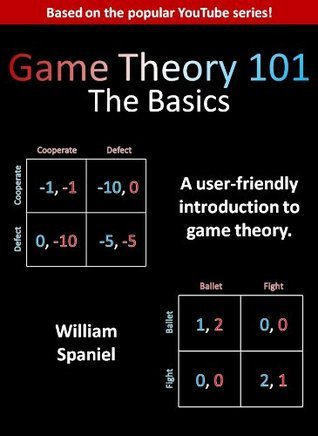
Game Theory 101: The Basics
New edition for the 2012-2013 school year!Game Theory 101: The Basics is a no-nonsense, games-centered introduction to strategic form (matrix) games. From the first lesson to the last, each chapter introduces games of increasing complexity and then teaches the game theoretical tools necessary to solve them. Inside, you will the basics fully explained, including pure strategy Nash equilibrium, mixed strategy Nash equilibrium, the mixed strategy algorithm, how to calculate payoffs, strict dominance, weak dominance, iterated elimination of strictly dominated strategies, iterated elimination of weakly dominated strategies, and more!Dozens of games solved, including the prisoner's dilemma, stag hunt, matching pennies, zero sum games, battle of the sexes/Bach or Stravinsky, chicken/snowdrift, pure coordination, deadlock, and safety in numbers!Crystal clear, line-by-line calculations of every step, with more than 200 images so you don't miss a thing!Tons of war, trade, game shows, and duopolistic competition.Quick, efficient, and to the point, Game Theory 101: The Basics is perfect for introductory game theory, intermediate microeconomics, and political science.
139 pages, Kindle Edition
First published July 18, 2011
Ratings & Reviews
Friends & Following
Create a free account to discover what your friends think of this book!
Community Reviews
Displaying 1 - 13 of 13 reviews

July 3, 2016
Great book. Very well explained. I didn't know anything about game theroy before, I feel that at least I have grabbed the core concepts now.

February 10, 2019
This book managed to take an interesting topic and make it boring. It kept repeating itself, and didn't worry about making sense. I gave up on it when it said, about 40% through the book, it said "but wait, this technique we've shown you isn't really how it's done!" and basically restarted from the beginning of the book with an entirely new technique. Also, while it talked a lot about what people would like to do, it never indicated how they would get there and for the most part I think the answer is "it's pure dumbshit luck"

February 18, 2020
Lots of detailed examples
Reading this book means going through a long list of examples in great detail. And this is a good thing. Usually that’s what is lacking. But a little more by way of theoretical explanation and ideas would also have been nice. Not enough by itself to really get it. But still worth well worth a quick read
Reading this book means going through a long list of examples in great detail. And this is a good thing. Usually that’s what is lacking. But a little more by way of theoretical explanation and ideas would also have been nice. Not enough by itself to really get it. But still worth well worth a quick read
Want to Read
June 5, 2019I want to read this book.

May 20, 2020
I think i might go over this book again, kudos t0 the writer for the easy to understand style of writing.

March 23, 2012
Game Theory 101 is, as reflected in the title, a basic introduction to Game Theory which addresses its core concepts. This book, however, becomes more computationally heavy about halfway through when it begins to address Mixed Strategies. Still, the math is fairly basic and the book does a great job of explaining Strict and Weak Dominance and how different Pure and Mixed Strategies should be selected and how to "solve" games. Spaniel also does a great job of addressing critics of Game Theory, explaining how games should be tailored to their participants preferences to create the game that most accurately reproduces reality.

March 11, 2012
Started off well with the Prisoners Dilemma and then slowly progressed towards creating a table based on the outcomes and how to determine the best possible outcome/move based on the data provided.
Touches upon the Stag hunt, penny game, battle of sexes, chicken game, Nash equilibrium and other strategies to use to solve the issue. Started getting repetitive or rather bland towards the end..
Overall, not bad though.
Touches upon the Stag hunt, penny game, battle of sexes, chicken game, Nash equilibrium and other strategies to use to solve the issue. Started getting repetitive or rather bland towards the end..
Overall, not bad though.

May 26, 2012
UPDATE MARCH 2013: after doing my best to make it through, I feel like I acquitted myself well. I have a better understanding of the theory and was interested in the explanations. There were still way too many sigmas for me to fully grasp it................Always want to learn more about high-profile econ, and then when I get into it, there are just too many Greek letters in parenthesis for me to get past. I suppose I'll leave this stuff to the John Nash's of the world.
January 2, 2017
Good book to gain basic understanding of Game Theory
Was looking for a book to refresh my understanding of Game Theory. Had taken a course in game theory almost 12 year's ago in college. The book helped me understand the basics of game theory and appreciate the subject for how it can be used in everyday life. I think game theory as a subject should be understood and applied by anybody who takes important decisions on a regular basis.
Was looking for a book to refresh my understanding of Game Theory. Had taken a course in game theory almost 12 year's ago in college. The book helped me understand the basics of game theory and appreciate the subject for how it can be used in everyday life. I think game theory as a subject should be understood and applied by anybody who takes important decisions on a regular basis.
March 10, 2014
The book explains you the basics of Game Theory. It has given me a pretty good base for understandibg this science. Sometimes it becomes too repetitive, and sometimes lacks small explanations, but if you understand the basics of statistics, they will be obvious for you. But beware, there are some typos thst you will realize as you read.

January 29, 2012
Very dull.

January 30, 2015
It started off well, then got repetitive.
August 13, 2015
Super clear.
Displaying 1 - 13 of 13 reviews