From superstar creators TOM KING and ELSA CHARRETIER comes the first volume of a thrilling epic in the tradition of Sandman and SAGA.
Joan Peterson discovers that she is trapped in an endless, terrifying cycle of "romance"—a problem to be solved, a man to marry—and every time she falls in love she's torn from her world and thrust into another tear-soaked tale. Her bloody journey to freedom and revelation starts in this breathtaking, groundbreaking collected edition.
I'm side-eyeing whomever wrote the blurb for this. This is nothing like Sandman or Saga. It's pulp fiction about a woman trapped in alternate universes of romance, groundhog day style. Yet it's written by a man and comes across very patriarchal. I like the villain but I had to force myself to read the 'romances'. Every issue reads pretty much the same, not enough villain and story and too much doomed 'romance'. DNF'd at issue 3. eARC received from the publisher via Edelweiss+ in exchange for an honest review.
A woman gets trapped in a series of short stories straight out of 1950s romance comics, and when she tries to push back she finds herself punished by outside forces. It's simultaneously a wonderful homage, a witty metafictional satire. and a brutal horror fantasy with an intriguing mythology.
I would give this 3.5-4 stars based on Elsa’s art alone which is perfect for the callback to the vintage romance comics from long ago. I love the premise, enjoying the plot, but I do wish we got more of the mystery. I’m starting to feel as frustrated as the main character.
Só fiquei sabendo que Tom King e Elsa Charretier tinham investido em uma criação que faz homenagem aos quadrinhos de romance dos anos 1950 quando a Taverna do Rei anunciou a publicação deste quadrinho, Love Everlasting, Amor Eterno, aqui no Brasil. A trama conta a história de Joan Peterson, condenada a migrar de história em história a cada vez que um homem se declara para ela. Um mote sensacional e que desafia as convenções do gênero quadrinhos de romance e algumas convenções das expectativas de gênero na relação feminina e masculina. Mas sinceramente eu esperava mais. Espera que mais discussões sobre a representação das mulheres na narraiva fossem utilizadas e também esperava que existisse uma pequena pista de quem ou o que é o mecanismo que faz Joan andar de história em história repetindo sempre o mesmo clichê. Ainda assim, darei uma chance para o próximo volume, para que as coisas se esclareçam um pouco mais, para me dar vontade de ler o último dos três volumes.
An interesting start to...something. Trust Tom King to offer an engaging, text-heavy read that kind of goes nowhere.
In Love Everlasting, we find Joan Peterson in one love story after the next - the book is basically a series of romance novels with the same main character. Towards the end of each scenario, Joan identifies that something is off... until the next issue arrives and the pieces have been reset.
That continues to the last issue, where we finally get a glimpse of some higher level in which Joan isn't just a pawn, but an actual person. Why is she being forced into romance? Who is forcing her? Who is Joan really? No answers to be found here. Love Everlasting is missing any sort of resolution, but it's a decent enough time that I'll stick around for the next volume, hoping for more depth and more of Elsa Charretier's gorgeous artwork.
I don't know what to make of this title. Five issues to get to... not much to write home about at this stage. I don't think it was necessary to develop the loop aspect for so long to get to this fifth issue, which is extremely frustrating, promising so much and delivering so little.
It's true that the corny side of the pseudo-parodies of 1950s romance is very appealing, especially highlighted by Charretier and Hollingsworth, but it's too long! But the subtext that runs through the last episode is promising. That's what will keep me reading the series. I usually like King, and I think he can develop something interesting with an excellent artistic team but I can't blame anyone for giving up after this first volume, where King indulges too much in stretching out his plot, thinking he's being clever.
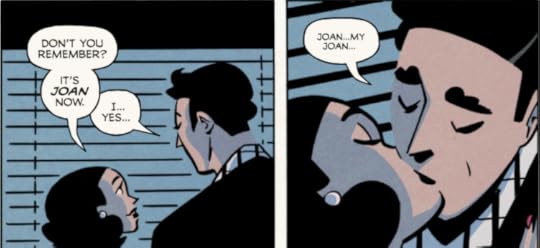
Joan Peterson, love-smitten secretary, is overcome with joy when her boss proposes. "Joan, I have something very important to tell you. You can no longer be my secretary." "Oh NO!" "Because now you'll be MY WIFE." "Oh George...my George..." [swoon]
Joan Peterson, lovelorn society girl smitten with a poor singer from the Village, is overcome with joy when he turns out to be society himself. "Joan, I was a coward. I was afraid you wouldn't agree to be my wife!" "Oh Kit, don't you know with me...your luck will never run out!"
Joan Peterson, lovestruck rancher's daughter, is torn between beau Chad and the handsome new ranchhand Bill...but when Bill proposes she flees across the desert. Bill tracks her down, says "SHE would like you to know that love is everlasting" and shoots her--
Joan Peterson, lovesick servant, is besotted with the young lord but when he proposes she says no, to her own confusion. And ranchhand Bill appears and shoots her again.
Joan Peterson pops up in one overwrought romance after another like Scott Bakula in Cloying Quantum Leap. Every time she refuses the marriage proposal, ranchhand Bill appears, tells her that love is everlasting, and murders her. ----------------------------------- Five issues in I still don't know what's going on, but I am enthralled. Is it an oblique examination of real world violence against women by exes and spurned suitors, a peek inside the heads of men who can't handle the word No? If so, the approach is brilliant.
I'm giving it a probationary 5-star rating but it could go south fast.
I picked up Tom King’s new Image title because well, it was there, but “Love Everlasting” is different.
I have heard it explained as Quantum Leap except written as 50s pulp romance novels. So, that’s…something.
I am not really sure if this will flesh out over time and give us some deep insight, or if it is just a series of writing prompts for King
I hope it’s the former, though I really don’t know if I expect to be right.
On the positive side, King is a better-than-most writer, so it is interesting to read. Also, artist Elsa Chartetier, colorist Matt Hollingsworth et al are pretty fantastic here. The art really matches the mood.
On the flip, it feels like an anthology, and given the style, we don’t get a lot of chances for “ah ha moments” before we are on to the next storyline.
Like so many King first issues, it’s really hard to grade. I have seen some very laudatory reviews of this comic. I don’t expect the book to be considered a classic. But there’s always that realm of possibility with King. It’s always nice to see someone ambitious and talented, so it might be worthwhile to stick around and see.
If there is one word that can sum up the work of Tom King, it would be “deconstruction”. Taking cues from Alan Moore, though not as cynical, King is always interested in pulling apart his fictional heroes, usually through a flawed, psychological lens. The Moore comparison definitely looms large with his DC titles, such as Mister Miracle and Strange Adventures, both of which domesticate the titular characters and tell stories that blur the line between what’s real and what isn’t. King applies his usual bag of tricks to his Image Comics debut, Love Everlasting.
When she said “Shut the f*ck up” to that one dude. I felt that. LMAOOOO
Idk. Art is beautiful and the premise is sooo interesting, but honestly the romantic vignettes were a little tedious to read for me because you, as the reader, are experiencing the same groundhogs day-esque life of her repeatedly entering into different romantic tropes and being killed in them. So you just wait for it to happen and for it to shift to the next story.
But thats the entire volume. Just waiting for the story to be over so it can shift to the next one.
I think if the pacing was much faster and the vignettes were shorter (because we get the point after a few in), it’d be more exciting and intriguing but reading through each long romance was a lot for me and there was no payoff in this volume.
You can read my full No Flying No Tights review here, but this was inventive, intriguing, and overall really enjoyable. Elsa Charretier's art really adds to the story as she handles the time jumps well and the color palette shifts just enough to make era's distinct.
Curious to see where this story goes next, looking forward to the next volume.
La resa grafica, che richiama i fumetti anni ‘80, è accattivante e lo spaesamento della parte mistery della trama si sposa bene (badabum-tsssss) con le varie storie d’amore che scorrono in parallelo. L’enorme problema di questo volume è la totale mancanza di un senso. Si arriva all’ultima pagina ed ancora non si ha una delucidazione su quanto stia accadendo nella vicenda; questa scelta è apprezzabile all’inizio - l’idea di non indugiare in “spiegoni” e far scoprire al lettore la dinamica di questa anomalia (?) insieme alla protagonista, dal mio punto di vista, funziona -, ma non si può concludere un intero libro senza che almeno qualcosa sia motivato. Ok, è il primo di una serie, ma almeno un chiarimento, un indizio per far capire la direzione in cui sta andando la vicenda… spero che almeno l’autore sappia come venire a capo della situazione. Detto questo, Joan è, forse, la protagonista nella quale più mi sono immedesimata in vita mia: circondata da una schiera di uomini bidimensionali e privi di fascino, non capisce un cazzo di quello che le stia accadendo, e, in un momento di dubbio, prende un fucile e spara all’impazzata.
Perché ti preoccupi? Sei come tutti gli altri. Sei una ragazza con problemi di appuntamenti.
This was weird. But interesting. It’s a post modern slow-burn, in which a woman finds herself awakening as a metatextual heroine that must succumb to the particular trope of falling in love. Or something like it. In a kind of Groundhog Day type situation, every time she attempts to seemingly any choice, something happens to reset her into another romance plot.
There’s not a lot of answers but I did find what was happening intriguing. But I also do just tend to like post modern stuff like this. There’s a few things teased as to what may be happening, and catharsis is denied every time. It probably bugged some people, but I’ll pick up the next volume and see what’s going on; I haven’t read anything like this before.
The Publisher's Weekly review calls this "romance comics meet Quantum Leap" and that's as good a description as any. We first meet Joan Peterson in the 1950s, falling for her boss, and just when you think she's going to get her happy ending - off she's bouncing into another era to fall in love with someone new. After this happens a couple of times our heroine becomes increasingly confused and desperate for answers, especially as these stories start ending with not only tears, but blood as well.
This graphic novels collects issues #1-5 and while I wouldn't call the end of #5 a cliffhanger per se, it definitely has an open ending which means I'll be picking up Volume 2 as soon as I can get my grubby little hands on it.
como é bom ler algo que te prende do início ao fim!!! uma narrativa sobre destinos finais predestinados e a fuga disso em meio a perspicácia de uma história sobre looping tempo-espaço. mistura humor, protagonista cativante, ação e desamor.
Probably my favourite new graphic novel of the year. Dark, complicated and with pitch-perfect art. I can’t wait to see where this goes. The comps to SANDMAN are perhaps a touch premature but this kind of reads like someone took WESTWORLD and put it in a blender with Gaiman. It’s fresh and original and well worth your time.
Joan Peterson is the protagonist of a classic romance comic. And then another, and another, and another. The guy may be a cowboy, a businessman, a rebel, but every time she gets him, she finds herself in another, equally melodramatic scenario. And if she tries to dodge the happy ending...well, that doesn't go brilliantly. It's the perfect vehicle for Elsa Charretier's gorgeous retro art style, a sort of slightly punkier Darwyn Cooke, and it turns out that even Tom King's writing doesn't annoy me as much when he's not being all desperately 'Notice me, Daddy' at Alan Moore – though I did spot that some of the publicity for this described it as doing for romance comics what Watchmen did for superheroes, as if classic romance comics were still a genre that were going strong along its traditional lines, rather than one which now survives almost exclusively in queered and deconstructed form. Plus, when the last issue here finally gives some hints at what's afoot, I wasn't convinced they quite clicked with what had come before*. But I'm definitely along for the ride, if only for the visuals.
This is also the first complete volume I've seen from the whole Substack comics experiment, wherein the mailing list company threw apparently huge sums of cash at creators to do comics by email, to which the creators would nevertheless retain rights and which, it became apparent fairly early on, were mostly going to get reprinted as conventional comics thereafter. Usually at Image, as here, which would have been most of their natural homes anyway, except Image only pays on the back-end, so suddenly books that might have seemed like a huge gamble before, weren't. Some of those mailing lists require you to pay to read the comics – generally about $80 per creator per year, and while there are people for whose new stuff I would drop that, none of them are the ones currently doing it. Others do the comics for free, with the paying tier unlocking perks and community stuff (obligatory plug for Brian K Vaughan and Niko Henrichon's Spectators, which I sense isn't reaching as many people as it ought given BKV's fanbase from Saga, Paper Girls et al, plus not costing a penny). And then there's Love Everlasting, which has gone for the compromise model where paying subscribers get it sooner. Meaning I was surprised to see Edelweiss putting this collection up as an ARC before said paying subscribers have had #5, the last issue in here, and despite the fact Image are not actually releasing said collection until February, something that seems liable to put a lot of noses out of joint to no obvious benefit.
*SPOILER: the suggestion is that Joan is meant to be accepting love, and gets bumped off for saying no - the metaphorical implications of which are obvious and timely. But this ignores, and surely she would mention with legitimate exasperation, that she only started saying no because every yes also threw her into a new story.
Really unique, striking art and an interesting premise take this decently far, but there’s not a lot of meat on the bones yet. The story doesn’t really evolve or develop in this first volume—it’s cyclical, essentially establishing and reiterating the premise four different times and then ending on something that seems like it’s going to take you a bit behind the curtain but doesn’t. It doesn’t leave me with a strong enough urge to keep going, sadly. I’ll stick around for at least the next volume, but I hope to see some traction or depth injected into the vibes King and Charretier have created because this is a mostly surface-level story so far.
I also hope King dials back the period-specific, old-timey dialogue—it was cute for a few pages yet quickly starts to grow tiresome. This is one of the first of King’s projects where he seems to be writing outside of his usual skill set, so while there’s some excitement in seeing him branch out, this first foray is a little clumsy. This gets a tepid 3 stars from me.
Everytime that Joan falls in love, she dies and gets carried to a complete different story and time. Why is love so cruel to her? And who is the masked man that keeps putting an end to her romances?
I loved the femme Fatale feels. The drawings soaked me into several ambiances from western to 1950s... I need to know more.
1.5 The homages to old romance comics, while cute, grows very tiring very fast, and you get the whole point of the book after like 1 story, the rest is pretty much useless. I don’t know how the story ends, but I’ll guess that the entire arc could’ve easily been 5 issues instead of 10 since we just waste time until you get the tiniest bit of information at the end.