

What do you think?
The Fantagraphics Atlas Comics Library #1
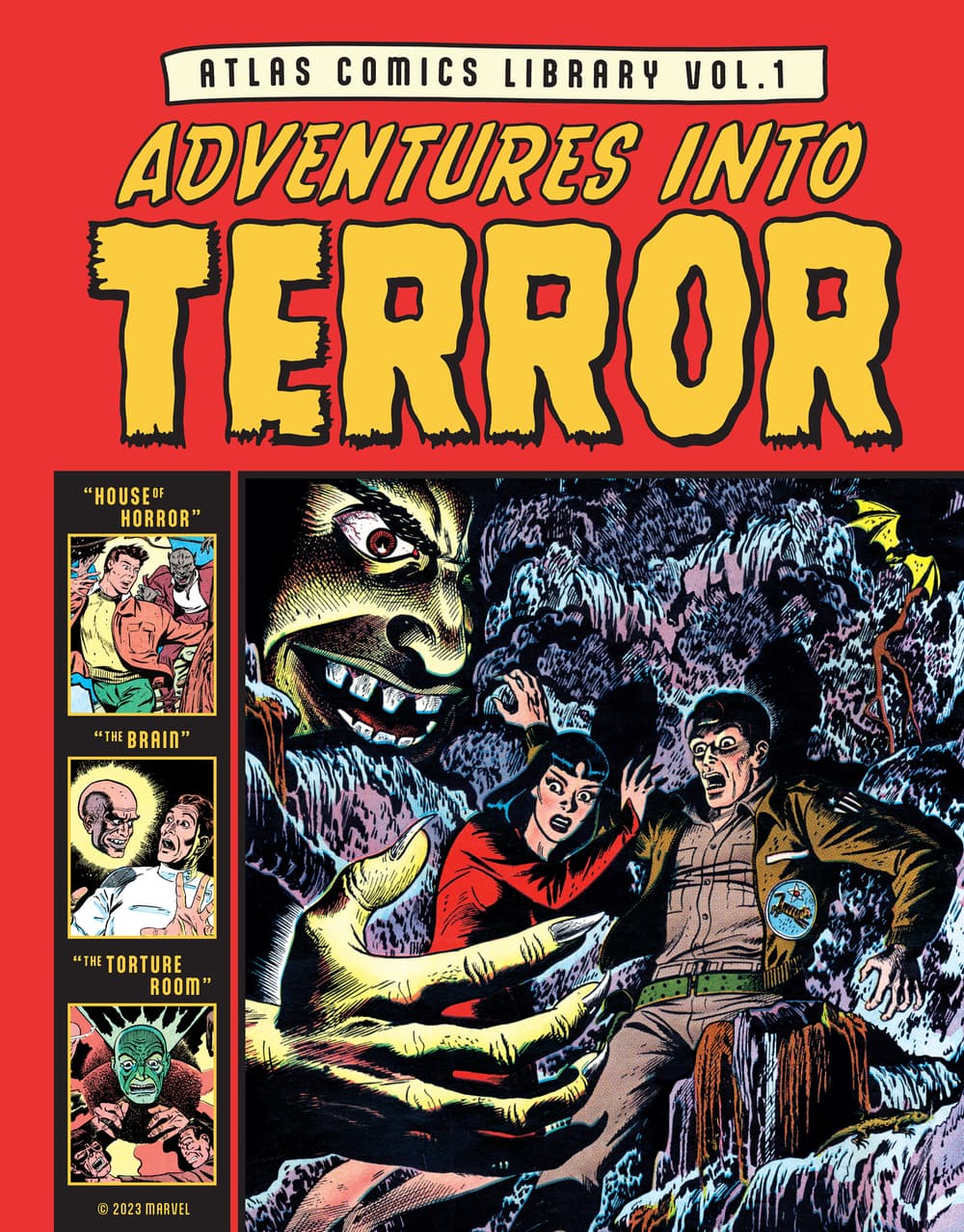
The Atlas Comics Library No. 1: Adventures Into Terror Vol. 1
Fantagraphics is embarking on a project to reprint Marvel Comics’ 1950s genre titles ― war, crime, supernatural, funny animal, Western ― under its new Atlas series with the first eight issues of the pre-Code horror series Adventures Into Terror . Atlas holds a special place among aficionados of the genre, producing more horror titles and issues by far, than anyone in the industry. While the quality of EC's six horror/sci-fi titles was unsurpassed with their elite cadre of talent, Atlas was the equivalent of the B-movies studio, churning out anywhere from 8 to 12 different horror titles a month, giving a wider array of artists, including some of the best craftsmen of the era, a chance to show off their in addition to those already mentioned, future volumes will include Bill Everett, John Romita, Bernie Krigstein, Jerry Robinson, Harry Anderson, and Matt Fox. Stories from Marvel’s Atlas line have barely been reprinted. The Fantagraphics Atlas Comics Library is the first attempt to publish a carefully curated line of Atlas titles. Our first volume, Adventures Into Terror, includes a treasure trove of stories drawn by many of the most stylistically accomplished artists of the Golden Age including George Tuska, Carl Burgos, Mike Sekowsky, Joe Maneely, and Joe Sinnott. Highlights include Russ Heath’s two-part story “The Brain” from issue #4 and “Return of the Brain” from issue #6; Basil Wolverton's classic “Where Monsters Dwell” from issue #7; Gene Colan's moody “House of Horror” in issue #3; and Don Rico’s wild layouts are on display from #4’s “The Torture Room." The stories are written firmly in the tradition of the pulpy, perverse, borderline deranged style that brought Fredric Wertham, the United States Senate Sub-Committee, and public opinion down like a sledgehammer on comics in the early ‘50s. Edited by Atlas scholar Dr. Michael J. Vassallo, scanned directly from the published comics, and meticulously restored by Allan Harvey, the first volume of the new Fantagraphics Atlas Library series is an event among comics lovers, collectors, and historians Full-color illustrations throughout
180 pages, Hardcover
First published January 1, 1950
Ratings & Reviews
Friends & Following
Create a free account to discover what your friends think of this book!
Community Reviews
Displaying 1 - 16 of 16 reviews

December 3, 2023
Adventures Into Terror Vol. 1 collects Adventures into Terror #1-8, published by Atlas Comics (aka Marvel) in the early 1950s.
First off, this is a larger book than I thought it would be. Unlike the EC library, the dimensions are a big larger than a standard comic. Secondly, the restorations were lovingly done and the pages are cleaned up scans from actual comics with some cleanup, meaning the colors are faithful to the newsprint editions.
The tone is similar to EC stories but the stories aren't as gore strewn and sometimes have a certain possibly unintentional goofiness to them. Russ Heath's The Brain and The Return of the Brain, for instance, when the severed head of a Nazi scientist runs amok. The other stories are more or less standard horror fare, apart from the Basil Wolverton story Where Monsters Dwell, and the surreal Find Me.
The artists are a mix of legends and guys I've never heard of. Russ Heath, Joe Sinnot, Chic Stone, Gene Colan, Carl Burgos, Basil Wolverton, and Joe Maneely grace the pages. Fun fact - the Les Daniels Marvel book has a couple pages of the Basil Wolverton story in it AND a profile of Joe Maneely in it.
I'm not completely sold on Fantagraphics' Atlas line just yet after one volume but I'd buy another Adventures Into Terror volume if they put one out. 4 out of 5 stars.
First off, this is a larger book than I thought it would be. Unlike the EC library, the dimensions are a big larger than a standard comic. Secondly, the restorations were lovingly done and the pages are cleaned up scans from actual comics with some cleanup, meaning the colors are faithful to the newsprint editions.
The tone is similar to EC stories but the stories aren't as gore strewn and sometimes have a certain possibly unintentional goofiness to them. Russ Heath's The Brain and The Return of the Brain, for instance, when the severed head of a Nazi scientist runs amok. The other stories are more or less standard horror fare, apart from the Basil Wolverton story Where Monsters Dwell, and the surreal Find Me.
The artists are a mix of legends and guys I've never heard of. Russ Heath, Joe Sinnot, Chic Stone, Gene Colan, Carl Burgos, Basil Wolverton, and Joe Maneely grace the pages. Fun fact - the Les Daniels Marvel book has a couple pages of the Basil Wolverton story in it AND a profile of Joe Maneely in it.
I'm not completely sold on Fantagraphics' Atlas line just yet after one volume but I'd buy another Adventures Into Terror volume if they put one out. 4 out of 5 stars.

August 1, 2026
Reprinting the old Atlas Comics from the 40s and 50s, this contains the first eight issues of Adventures Into Terror. As stated in the foreward, this tried to be like Tales from the Crypt and other horror titles from EC Comics but were decidedly more of the B-level. Most of the tales involve either a not-so-nice-to-evil person getting involved with something that leads to their downfall or purely innocent people who unfortunately stumble into something horrific. The artwork is typical of its time, but fairly decent. The stories themselves sometimes reached the Twilight Zone-ish ironic endings, but, probably from trying to come up with several short horror stories per book, the plots were sometimes repetitive, others just plain weak. I hoped I'd enjoy this more, but the stories contained way too much dialog and were pretty dated and not as good as some other horror comics. 2* for OK.
July 16, 2024
Rather give a long history on the birth of Atlas Comic's horror lime...let me recommend reading Vassallo's exce4llent introduction " Welcome to Adventures into Terror " at the beginning of the book.
"Adventures into Terror" sprang up in the heady days before the introduction of the Comics Code in 1954 which seemingly killed off many of the major horror comics of the 1950s, after the publication of "Seduction of the Innocent".
Atlas, under the Marvel imprint...published a wide array of comic books - true love/romance, crime, etc...but after the bottom or market fell out of these subjects, Atlas turned to horror in late 1949. And, with EC Comics ramping up their horror output.....
"Adventures" was the result. Often short, from 2-4 pages...the stories themselves are simplistic.....evil floating heads, Satan, giants meant to conquer the world, etc.
Like nothing on the market. Recommended.
Jeff McIntosh
"Adventures into Terror" sprang up in the heady days before the introduction of the Comics Code in 1954 which seemingly killed off many of the major horror comics of the 1950s, after the publication of "Seduction of the Innocent".
Atlas, under the Marvel imprint...published a wide array of comic books - true love/romance, crime, etc...but after the bottom or market fell out of these subjects, Atlas turned to horror in late 1949. And, with EC Comics ramping up their horror output.....
"Adventures" was the result. Often short, from 2-4 pages...the stories themselves are simplistic.....evil floating heads, Satan, giants meant to conquer the world, etc.
Like nothing on the market. Recommended.
Jeff McIntosh

January 3, 2024
While EC Comics were further elevating the literary quality of genre comics, other publishers like Atlas (later Marvel) were also attempting to find ways to innovate in the medium. Though EC is generally considered the gold standard of the pre-Code era comics, particularly from a more modern lens, there was some interesting stuff being put out by other publishers too. Here, Fantagraphics collects eight early issues of Adventures Into Terror, a horror anthology title published by Atlas Comics in the early '50s. Though the comics here don't quite stand up to the same standard set by its EC counterpart titles, there is still plenty to enjoy here.
The stories here aren't remarkably sophisticated or even all that chilling, but they do find ways to be creative in their own right. A lot of it does come down to art - the contributions of artists like Russ Heath, Gene Colan, Don Rico and Basil Wolverton really makes this a worthwhile time. Wolverton's single story, "Where Monsters Dwell", from Adventures Into Fear #7 is particularly noteworthy for being both bold with the story and artwork. More of a sci-fi affair than the usual horror tropes, this story is set in an alternate dimension filled with grotesquely designed creatures and people all gorgeously rendered in Wolverton's eclectic style.
Other strong highlights in here include "The Monster Awakes" by Russ Heath, a story about an explorer awakening a giant demonic being hellbent on global destruction, the multi-part "Brain" story also by Heath which features an absurd floating Nazi head, and "The Storm" by Chic Stone which features a haunted house frozen in time. Many of these fall in the "so bad that it's good" category whereby the stories feature bizarre storytelling devices but end up being entertaining because of how weird they actually are. It's relevant to note that these horror stories are fairly tame with respect to violence, something that stands out when compared to the EC counterparts. Also, these tales often lack proper plotting in that they tend to just randomly end, which might work a lot better in the modern context when viewed as more postmodernist works. Though, I'd push back against looking into each story with too much scrutiny since these stories are mostly built on razor-thin characterizations and overused horror clichés.
Still, this was a surprisingly entertaining time and I would definitely consider picking up more of these restorations of pre-Code comics. The stories themselves aren't revolutionary by any means, but there is a charming quality to them for the most part. While there are much better options for early horror comic collections, I'm glad Fantagraphics is putting effort into restoring this early Atlas Comics material.
The stories here aren't remarkably sophisticated or even all that chilling, but they do find ways to be creative in their own right. A lot of it does come down to art - the contributions of artists like Russ Heath, Gene Colan, Don Rico and Basil Wolverton really makes this a worthwhile time. Wolverton's single story, "Where Monsters Dwell", from Adventures Into Fear #7 is particularly noteworthy for being both bold with the story and artwork. More of a sci-fi affair than the usual horror tropes, this story is set in an alternate dimension filled with grotesquely designed creatures and people all gorgeously rendered in Wolverton's eclectic style.
Other strong highlights in here include "The Monster Awakes" by Russ Heath, a story about an explorer awakening a giant demonic being hellbent on global destruction, the multi-part "Brain" story also by Heath which features an absurd floating Nazi head, and "The Storm" by Chic Stone which features a haunted house frozen in time. Many of these fall in the "so bad that it's good" category whereby the stories feature bizarre storytelling devices but end up being entertaining because of how weird they actually are. It's relevant to note that these horror stories are fairly tame with respect to violence, something that stands out when compared to the EC counterparts. Also, these tales often lack proper plotting in that they tend to just randomly end, which might work a lot better in the modern context when viewed as more postmodernist works. Though, I'd push back against looking into each story with too much scrutiny since these stories are mostly built on razor-thin characterizations and overused horror clichés.
Still, this was a surprisingly entertaining time and I would definitely consider picking up more of these restorations of pre-Code comics. The stories themselves aren't revolutionary by any means, but there is a charming quality to them for the most part. While there are much better options for early horror comic collections, I'm glad Fantagraphics is putting effort into restoring this early Atlas Comics material.

August 21, 2026
Hoopla bonus borrow. It’s probably not fair to judge this since I only flipped through it without much reading so I’m just giving it a 3. There are just too many words and it’s late. I did like some artists a bit more than others though they’re all very similar. The old ads for random things were fun to see.

September 9, 2026
Really fun read of old horror comics.
For the rest of the review, visit my Vlog at:
https://youtube.com/shorts/TXjArlcj5K...
Enjoy!
For the rest of the review, visit my Vlog at:
https://youtube.com/shorts/TXjArlcj5K...
Enjoy!

November 25, 2023
The first volume of Fantagraphics' Atlas Comics Library demonstrates the strengths and weaknesses of a volume that collects a comprehensive run of a specific title. I'm always in favor of complete issue reprints but, with this approach, the reader gets the good, the bad, and the awful contents, where a more curated volume would focus on the high end. To be blunt, many of the stories here are not very good, lamely written and roughly executed, really what one would expect from disposable children's entertainment in any era. Historically interesting but probably a hard sell for modern readers or people looking for more comics like the more sophisticated ECs. As happy as I am that Marvel is allowing the material be be published by Fantagraphics, I'm doubtful about the size of the prospective readership. I think their later volumes, focusing on individual talented creators and more ambitious titles (really looking forward to VENUS!), will be more successful.
Negativity aside, the presentation here is wonderful -- crisp reproduction, enough ads and other peripheral content to give context to the comics, and a readable format for material largely lost to the ages all combine to provide the best possible way to experience B-list pre-Code horror comics. Atlas was a prolific producer of comics in the late 40s and early 50s and only a tiny fraction of this material has been available since its original production. I'm on board for anything the line includes and hope the venture lasts for many years and many volumes.
Negativity aside, the presentation here is wonderful -- crisp reproduction, enough ads and other peripheral content to give context to the comics, and a readable format for material largely lost to the ages all combine to provide the best possible way to experience B-list pre-Code horror comics. Atlas was a prolific producer of comics in the late 40s and early 50s and only a tiny fraction of this material has been available since its original production. I'm on board for anything the line includes and hope the venture lasts for many years and many volumes.

December 4, 2025
Springtime for Schmittsder and Germany
A mixed-bag describes these opening eight issues of Adventures into Terror. I enjoyed all of the stories but yeah, there were a few were groaners and eye-rollers. It made me appreciate more the editors of Marvel's 1970's-era reprint titles like Weird Wonder Tales, Crypt of Shadows and (apropos of this volume) Where Monsters Dwell, who sifted through the chaff to uncover the wheat which filled those issues.
I remember distinctly reading as a kid Harry Lazarus' "Enter--The Lizard" from issue 8, and a web search confirmed that story was reprinted in Weird Wonder Tales #9 (April 1975). Everything else in this volume was all-new to me. It seems those Marvel reprint editors rarely went back as far as the early 1950s, pulling primarily from the late-Atlas work of Kirby and Ditko with the odd Maneely.
My favorites in this volume include Russ Heath's "The Brain" and "The Return of the Brain," which were just bonkers and a ton of fun. Heath's "The Monster Awakes" was a strong start to the book and was a relatively complex story that drew me in. "The Storm" had a Twilight Zone vibe I liked. "The Stranger" and Don Rico's "Torture Room" could have been EC if they brought the horrors out of the shadows. "I Stalk the Night" was a compelling story made even better by Mike Sekowsky's art. "The Thing in the Water," "Going Down," and "The Girl Who Couldn't Die" were a few more of my standouts.
Paul Reinman illustrated that last story and it was so well done it struck me as a shame he (and Joe Sinnott and Chic Stone) were in the 1960s and beyond relegated primarily to inking chores. I took a strong liking to the good work of Harry Lazarus and Jay Scott Pike, two artists I wasn't familiar with by name (Lazarus was a sentimental favorite remembering from childhood his unsettling Lizard story).
As much as I found Mike Vassallo's introduction a wealth of information, I hit two hurdles hard to clear: His pompous boast in the second paragraph, "I've likely done more in the service of promoting Marvel's Atlas period than anyone alive" (p. ix) and (2) Vassallo's billing himself as "Dr." He's a dentist, not a Ph.D. in Comicology or Pop Culture Studies. That said, I can't deny this guy really knows his stuff.
But the highest hurdle in the intro and the book was Vassallo's blithely dismissing the text stories as features "no one reads" and implying their only value lay in the panels sprinkled in from other Atlas books. Thus he saw no problem snipping them all out minus one token example. Huh? Spluttering and apoplectic, I ranted on the subject for a few paragraphs and am appending them below --revised and wiped clean of spittle flecks--for my fellow outraged text-story fans.
Already awaiting on my shelf are Venus and In the Days of the Rocket, so I'm off to visit more worlds of wonder and amazement in this... the Atlas Age of Comics!
Report of the Fair Play for Text-Story Readers Committee
Let it be known these Adventures Into Terror comics are NOT complete! Vassallo writes, "Although my plan was originally to include all the two-page text stories in this book--stories no one reads but often have panels from other Atlas stories--pagination issues allowed us to only include them through the first four issues. Trust me, you're not missing anything" (p. xvii).
No, Mike, I don't trust you and I am missing something: the promised text stories from issues 1, 2, and 4 (not to mention the stories from issues 5-8). There is only ONE text story in the whole book: "The Isle of No Return" from issue #3 spanning pages 66-67. And what, "pagination issues" precluded reprinting them all? Make that make sense, especially when there were pages a'plenty for the dozen or so dull ads.
And contrary to Vassallo's vacuous claim, I am confident many of us in the ranks of comicdom assembled enjoy reading the text stories. I'm currently getting a kick out of the text stories faithfully reprinted in DC Finest: Justice Society of America, and I have always enjoyed 'em in old Atlas books through Silver Age DCs, which really packed the pages with science and history fun-fact text pieces.
And lest we forget... Stan Lee's very first comic book work was a text story in Captain America #3. 'Nuff said!
A mixed-bag describes these opening eight issues of Adventures into Terror. I enjoyed all of the stories but yeah, there were a few were groaners and eye-rollers. It made me appreciate more the editors of Marvel's 1970's-era reprint titles like Weird Wonder Tales, Crypt of Shadows and (apropos of this volume) Where Monsters Dwell, who sifted through the chaff to uncover the wheat which filled those issues.
I remember distinctly reading as a kid Harry Lazarus' "Enter--The Lizard" from issue 8, and a web search confirmed that story was reprinted in Weird Wonder Tales #9 (April 1975). Everything else in this volume was all-new to me. It seems those Marvel reprint editors rarely went back as far as the early 1950s, pulling primarily from the late-Atlas work of Kirby and Ditko with the odd Maneely.
My favorites in this volume include Russ Heath's "The Brain" and "The Return of the Brain," which were just bonkers and a ton of fun. Heath's "The Monster Awakes" was a strong start to the book and was a relatively complex story that drew me in. "The Storm" had a Twilight Zone vibe I liked. "The Stranger" and Don Rico's "Torture Room" could have been EC if they brought the horrors out of the shadows. "I Stalk the Night" was a compelling story made even better by Mike Sekowsky's art. "The Thing in the Water," "Going Down," and "The Girl Who Couldn't Die" were a few more of my standouts.
Paul Reinman illustrated that last story and it was so well done it struck me as a shame he (and Joe Sinnott and Chic Stone) were in the 1960s and beyond relegated primarily to inking chores. I took a strong liking to the good work of Harry Lazarus and Jay Scott Pike, two artists I wasn't familiar with by name (Lazarus was a sentimental favorite remembering from childhood his unsettling Lizard story).
As much as I found Mike Vassallo's introduction a wealth of information, I hit two hurdles hard to clear: His pompous boast in the second paragraph, "I've likely done more in the service of promoting Marvel's Atlas period than anyone alive" (p. ix) and (2) Vassallo's billing himself as "Dr." He's a dentist, not a Ph.D. in Comicology or Pop Culture Studies. That said, I can't deny this guy really knows his stuff.
But the highest hurdle in the intro and the book was Vassallo's blithely dismissing the text stories as features "no one reads" and implying their only value lay in the panels sprinkled in from other Atlas books. Thus he saw no problem snipping them all out minus one token example. Huh? Spluttering and apoplectic, I ranted on the subject for a few paragraphs and am appending them below --revised and wiped clean of spittle flecks--for my fellow outraged text-story fans.
Already awaiting on my shelf are Venus and In the Days of the Rocket, so I'm off to visit more worlds of wonder and amazement in this... the Atlas Age of Comics!
Report of the Fair Play for Text-Story Readers Committee
Let it be known these Adventures Into Terror comics are NOT complete! Vassallo writes, "Although my plan was originally to include all the two-page text stories in this book--stories no one reads but often have panels from other Atlas stories--pagination issues allowed us to only include them through the first four issues. Trust me, you're not missing anything" (p. xvii).
No, Mike, I don't trust you and I am missing something: the promised text stories from issues 1, 2, and 4 (not to mention the stories from issues 5-8). There is only ONE text story in the whole book: "The Isle of No Return" from issue #3 spanning pages 66-67. And what, "pagination issues" precluded reprinting them all? Make that make sense, especially when there were pages a'plenty for the dozen or so dull ads.
And contrary to Vassallo's vacuous claim, I am confident many of us in the ranks of comicdom assembled enjoy reading the text stories. I'm currently getting a kick out of the text stories faithfully reprinted in DC Finest: Justice Society of America, and I have always enjoyed 'em in old Atlas books through Silver Age DCs, which really packed the pages with science and history fun-fact text pieces.
And lest we forget... Stan Lee's very first comic book work was a text story in Captain America #3. 'Nuff said!

March 26, 2024
Fantagraphics has formed an unholy alliance with Marvel Comics to reproduce a series of hardcovers reprinting the Atlas comics of the 1950s. It’s an ambitious project: There’s already five announced books in the Library series (including science fiction, war, crime and a Venus, a fan-favorite character drawn primarily by Bill Everett), plus two Artist Editions, the first one on Joe Maneely and the second on Al Williamson. I find myself strangely fascinated by these books, even though I find the stories reprinted therein borderline unreadable. Ah, but the art! Atlas had an incredible roster of freelance artists on all their books, including Maneely and Williamson, plus John Buscema, Gene Colan, Russ Heath, John Romita, Mike Sekowsky, Basil Wolverton, and many, many more. The entire series is edited by Dr. Michael J. Vassallo, an Atlas Comics expert and his introductory essay is wonderful. I’m a little confused as to why they picked this particular series—Adventures Into Terror—but it’s evidently a favorite of much more seasoned Atlas fans. This is a pricey pick-up for me, to be honest—volumes range from $34.99 to $49.99, with the Artist Editions a $75.00 (deals can be found online), and I don’t know how deep a dive I’ll continue to take on the series, but some of the volumes really do fascinate me and Fantagraphics does it's usual great job on design, production, and printing.

January 22, 2024
3.5/5
Admittedly I went into this with low expectations, but it was a really nice surprise all the same. I'm a big EC Comics fan, and I knew this wouldn't be up to that quality of writing and art - and I was right. That said, it manages to be a lot of fun and some of the work in here could certainly sit on the shelf with the EC brethren. NO ESCAPE from Russ Heath is a delight, and YOU CAN ONLY DIE ONCE is wildly inappropriate regardless of era. It may be a little rough around the edges - scanned from the original books mean some of it is off-registration and what not - but it was fun enough I'll get Volume 2.
Admittedly I went into this with low expectations, but it was a really nice surprise all the same. I'm a big EC Comics fan, and I knew this wouldn't be up to that quality of writing and art - and I was right. That said, it manages to be a lot of fun and some of the work in here could certainly sit on the shelf with the EC brethren. NO ESCAPE from Russ Heath is a delight, and YOU CAN ONLY DIE ONCE is wildly inappropriate regardless of era. It may be a little rough around the edges - scanned from the original books mean some of it is off-registration and what not - but it was fun enough I'll get Volume 2.

August 10, 2026
I love the idea of Fantagraphics reprinting all of these comics from before when Marvel was Marvel since Marvel won't do it themselves. However, these just aren't very good. Some stories are your typical morality plays where the evil character gets their warranted end. Others are just bad things happening to otherwise good people. All of them are pretty poorly written.

August 28, 2026
If i grew up in this time frame, would have loved these books. Most are quick stories maybe 10 pages total. They are basic twilight zone plots. What if this bad person made a deal with the devil? What if the murderer met a ghost... what if alien just took over the world. Etc. Most are funny. The real fun is seeing the old adverts. Think the old X-Ray glasses ads.
September 15, 2024
So ridiculous, so of a time, so confusing at times. I LOVED it and had such a fun time reading this craziness. Come for “The Brain,” stay for “Vampire Brats.”

November 18, 2024
Not near as good as the EC Comics of the time.

April 16, 2026
Nice collection of these early Silver Age stories. A different read than today's comic stories. Recommended
January 9, 2024
This along with the various EC titles were extremely influential. Many of these ideas and stories are familiar because they were reused in other media, notably on shows like the Twilight Zone and Outer Limits. The major difference between these stories and the EC ones is that the EC ones had more blood in them.
Displaying 1 - 16 of 16 reviews