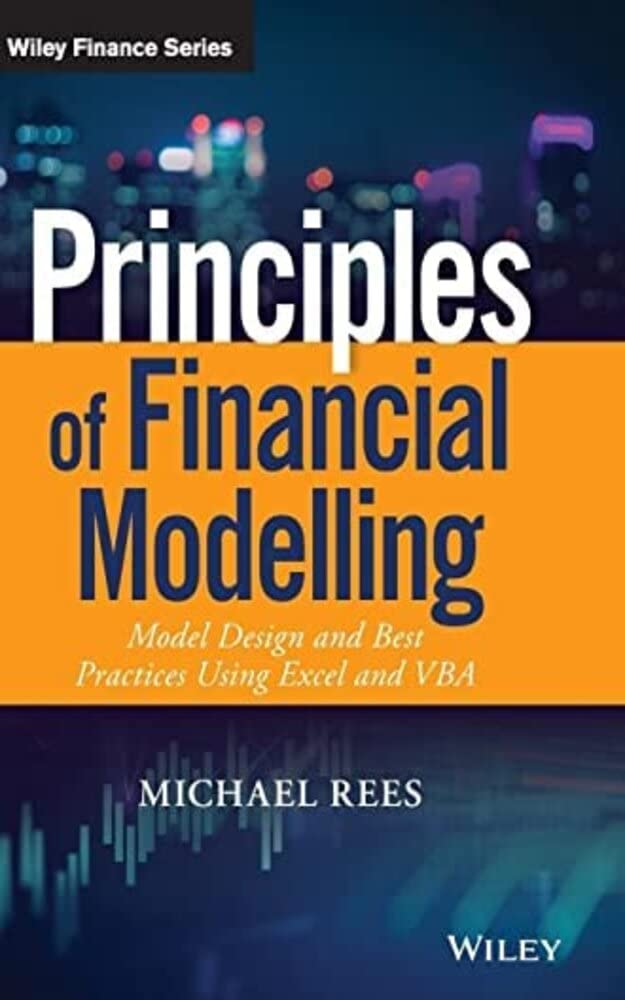
Principles of Financial Modelling covers the full spectrum of financial modelling tools and techniques, which are drawn from the author’s years of experience in dealing with a wide variety of real-world applications, both from consulting projects and from conducting training courses. The book demonstrates how to plan, design and build financial models that are flexible, robust, and transparent, and which are applicable to many decision-support contexts, including forecasting, business planning, project evaluation and selection, portfolio optimisation, and resource allocation.
Michael Rees' Principles of Financial Modelling: Model Design and Best Practices Using Excel and VBA is an essential guide for those delving into financial modelling. This book offers a thorough exploration of model design and the effective use of Excel and VBA, making it invaluable for students and professionals in finance. Rees covers fundamental principles, from constructing robust models to ensuring accuracy and efficiency, all while providing practical examples and best practices.
Suitable for Studying: Rees' book is highly recommended for finance students and practitioners. It demystifies complex concepts, breaking them down into actionable steps. The emphasis on practical skills, combined with a clear explanation of theoretical underpinnings, equips readers with the tools needed to create reliable financial models.
Inspiration for Fantasy Novel Writing: Beyond its academic value, this book can spark creativity for fantasy novelists. The structured approach to problem-solving and logical thinking outlined in Rees’ work can inspire the design of intricate, rule-based systems in fantasy worlds. For example, understanding model design principles can help in crafting detailed economic systems or magic rules within a fictional universe, adding depth and realism to the narrative.
In summary, Principles of Financial Modelling is not only a practical resource for financial professionals but also a source of creative inspiration for world-building in fantasy fiction.
The book is divided in three main parts: the first one is related to the best practices of financial modeling concerning planning and design; the second is related to Excel functions commonly used in financial analysis; the last one is introduction to coding in VBA. The book is really detailed and could have more potential, however the website that accompanied the book is broken, so it is really complicated to follow the exercises in Excel. I would leverage more the book if there was a drive in which you can download the Excel files used in each chapter and do it at the same time you're reading. Also I would like to see more empirical exercises, like actually build a financial model.