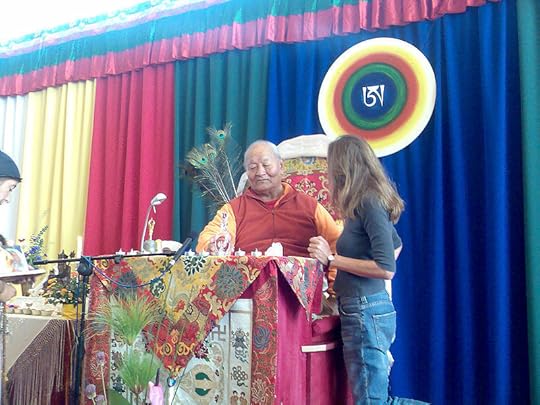
Chögyal Namkhai Norbu Rinpoche (Tib. ཆོས་རྒྱལ་ནམ་མཁའི་ནོར་བུ Chos-rGyal Nam-mkha'i Nor-bu) was one of the foremost 20th century masters of Dzogchen and lead Buddhist retreats through out the world. As a child he was recognized as the reincarnation of the great Dzogchen Master Adzom Drugpa (1842-1924) and later by the sixteenth Karmapa as a reincarnation of Shabdrung Ngawang Namgyal (1594-1651), the first Dharmaraja of Bhutan. (Dharmaraja in Sanskrit and Chögyal in Tibetan are both honorific titles meaning "King of the Teachings." Rinpoche is likewise an honorific meaning "Precious One.")
In 1960, following the deterioration of the social and political situation in Tibet, he moved to Italy on the invitation of the well-known orientalist Prof. Giuseppe Tucci. There, he contributed to giving a concrete stimulus to the spread of Tibetan culture in the West. After teaching Yantra Yoga in Naples for several years, in the mid-seventies he started giving Dzogchen teachings, encountering a growing interest throughout the West.
- series of thoughts, visions, or feelings that happen during sleep
- an idea or vision that is created in your imagination and that is not real
- something that you have wanted very much to do, be, or have for a long time
स्वप्नदर्शन
Dreams, most common folks would agree, are something that “just happens to you”; are something “out of control”.
However, from a clinical point of view, it would be interesting a perspective which would put the observer/passive-onlooker in a more active role. I mean, for those who undergo nightmares or any sort of unpleasant dreams, it’s quite obvious, that perspective would be useful.
This book is a lot about that perspective, truly issued from a Buddhist old tradition (DZOGCHEN), and fully explained by the Tibetan master Nakhai Norbu Rinpoche.
Before approaching N.N. Rinpoche’s teachings, the book offers an enlightening introduction by Michael Katz* (New York city, 1991). Katz refers in an anthropological sense how dreams are valued by some cultures, namely the Australian aborigines and the Senoi people, in Malaysia; the latter highlight the “creative dream work”.
Then the symbolism aspect of dreams is presented with recourse to Freud’s and Jung’s views. But most importantly is the actual experience of Katz who travelled to France to meet with N.N. Rinpoche and learn about his methods and get proof they really work. As a child Katz never forgot the dream he had: a snake he’d seen while dreaming; then waking up rushing to parents to tell them about the snake in the bedroom, and the attempt by his parents to convince him that nothing at all was really there.
Katz writes thereafter about one of the most important lessons of the Buddhist approach:
“…do not sleep like an animal, but transform illusion into luminosity” (so says the Buddhist prayer).
His study in France was meant to develop his “awareness of the Yogi sleep”. In a different venue Katz also mentions the Steven Laberge approach: on training of lucid dreaming and the use of cues (to tell the dreamer it’s a dream he/she’s experiencing). Laberge’s views build on REM analysis.
Stephen LaBerge:"The goal is to remain awake during deep sleep when the gross conceptual mind and the operation of the senses cease. Most Westerners do not even consider this depth of awareness a possibility, yet it is well-known in Tibetan Buddhist and Bon spiritual traditions.The result of these practices is greater happiness and freedom in both our waking and dreaming states."
Yet the Buddhist approach is unique.
"I bow to Padmasambhava..."
Now, N.N. Rinpoche’s. Historically it dives in the teaching of Mahamaya Tantra and the Dzogchen teachings. It aims at developing the Mayic body and uses the power of concentration in certain syllables and their visualization.
N.N. Rinpoche, in an interview (inserted in the book), recognizes he himself is not always “lucid” in his dreams, but the techniques allow for (control over) ending the dream or having a “positive dream”. He said a curious thing in the interview: true, a master can enter the dream of the disciple.
Dreams by the author abound in the book, especially in the part when he describes a pilgrimage he’d made to Maratika, “to retreat with his consort Mandarava”.
The role of intentionality is paramount: you may be dreaming about a forest, but you may “want to change the situation” and place yourself in a desert. That part made me wonder about the epistemological side of these issues; since this approach blends “sleep and reality”, I wonder: that which you experienced (once you have applied the methods at stake) can still be called a dream?
The book also provides a biography of the Tibetan master. Of special interest I retained his study under Ayu Khandro, a woman, then 113 years of age. More recently, Rinpoche had been a teacher of Tibetan (and other languages) in Naples, Italy.
This is a short and concise book about dream yoga.
Not to be confused with just lucid dream (as in the Western Laberge's sense), Dream of Clarity is lucid dream without karmic traces on waking life and is arisen from Clarity rather than impression.
I received oral transmission from ChNN last month and had Dream of Clarity just the night after the 3 day-retreat. I'm completely aware of the entire experience from falling asleep to vision (which I rather kept private) up to waking up shortly after (I have lucid dream a lot but I'm rarely conscious for the entire process). This happens before I finish reading this book but after the retreat.
After the retreat, I continue reading this book and still find value. Maybe the retreat was short and packed with other teachings as well, I find the book covers more depth on the subject of Dream Yoga than on the oral transmission (Although the experience of oral transmission is definitely felt more precious and more cherished)
IMHO It is better to have oral transmission if you have the capacity and merit to meet ChNN in person because some of the teachings cannot be understood intellectually by a book and need the presence of the teacher in order for you to "taste" the teachings.
This is not a book for beginners. As far as I can see, it is really more suitable for people who have some experience of dzogchen practice and I'm not one of those. Still, I found it to be an interesting account of various practices from to Tibetan Dzogchen tradition, to be performed while falling asleep or while in the dream state. Most interesting, however, are the accounts of dreams that the author himself experienced.
This started off very good. It provided a method of dreaming that I hadn’t encountered before. I was excited to read the rest, hoping for an expansion on this unique method of dreaming. I particularly liked the fact that this method wasn’t hung up on recalling the content of the dream. It focuses more on the light that is thrown upon the content of the dream instead. This was good for me because my goal was to not only become fully aware within my dream state, but also become fully aware in a state of dreamless sleep. This book seemed to give me what I was looking for in the first two chapters.
I gave the book three stars because it completely dropped off after the first few chapters. It became a glorification of a particular Dzogchen master who is the subject of most of the book. It went from instructional to biographical, and I didn’t care to read the rest.
Auspiciously, I fell asleep while listening to this text and had a very vivid dream. It included multiple versions of waking up and a few moments of intense clarity and non-duality. That's not something to make very much ado about, it was still highly experiential, but it was very useful to have a concrete experience to compare with this short book with its dzogchen view. I was skeptical about the instructions for sleeping one one side or the other, based on if you're male or female, because of lunar cycles, while plugging your nose; as well as the claims about Agar 35 and notes about the way tantra texts claim to be "hidden" for many years and were "discovered" when the world was ready for them. Nevertheless, I have some specific reasons why the non-duality between myth and everyday experience is compelling, so I continue to investigate the differences between sutrayana, from theravada and vipassana view, and mahayana, also with it's particular vajrayana/tantra view. This was an enjoyable dip into the implications of practice for our dreamstate while asleep.
If you are new to dream yoga, you should read other books first or this book will confuse you. Also, sometimes the writer wanders off and I had difficulty to continue reading. But here and there still a good read.
After a treatment of the various ways that western psychologists have viewed dreaming and the dream state (as well as indigenous cultures), this book approaches dreaming states from the perspective of Tibetan Buddhist practices of Dzogchen. Dzogchen has roots blending Buddhism with the ancient shamanic Bonpo tradition, which was practiced prior to the arrival of Buddhism. There are many personal stories of dreams from Norbu Namkhai Rinpoche, illustrating various types of dreams (divided into those arising from karmic seeds, and dreams of clarity, arising from the natural state of the mind). These are fascinating accounts (and include dreams of foresight, receiving messages from one's teachers, receiving terma or mantra practices/teachings that were hidden by deceased masters, and finding treasures in real life) and really expanded my mind around what is possible around dreaming. The book also includes an interview with Norbu Namkhai Rinpoche, and plenty of footnotes to explain the Buddhist terms in the book. It also outlines and gives instructions for one main practice to do to develop the capacity to lucid dream.
Although this is an accessible Tibetan Buddhism book and practice that is tailored for the lay practitioner in its messaging, I would not say this is overall an easy read by its content, and personally, I would like to read it a second time because there is a lot that I do not understand. Readers who have some degree of familiarity with Tibetan Buddhism will be poised to get more out of this book to begin with.
One main takeaway from this book: It is possible to lucid dream and to have dreams of clarity without having a daytime practice of contemplation and meditation to develop one's practice, but from the Dzogchen perspective, the purpose of dreaming is secondary to the waking hours practice, and arises out of that. However, if you already have a daytime practice of contemplation and meditation, you can also use nighttime to further develop your practice. The ultimate aim is to realize the nature of reality and the mind, not to use these practices for the purposes of gaining spiritual power, astrally project oneself, predict the future, or things like that. I just want to clarify that because I imagine that some people who may be drawn to the subject matter from the perspective of shamanism may lack this framework. Norbu Namkhai Rinpoche speaks about the importance of having a teacher and receiving transmission. This was the first time I had been able to read a question-and-answer format on the subject of transmission, and it was very clarifying for me to better understand this topic, which seems shrouded in mysticism and misunderstanding.
Overall, I recommend this book to serious practitioners of Buddhism, to those looking to develop a spiritual practice that includes dreaming and the dream state, and to those who want to understand dreaming in the context of the developed and ancient spiritual teachings of Dzogchen.
This was the first book I read on Dream Yoga and it left me feeling totally dis-empowered, unnecessarily putting me off a very worthwhile spiritual practice for a number of years, until I read Tenzin Wangyal's book on the subject. Namkhai is clearly a traditionalist and probably only revealed as much as he felt he was allowed to, but the result is so obscure it left me wondering why he had bothered to write the book. He was part of the first wave of Tibetans who left the country following the Chinese invasion in the 1950s and maybe he hadn't gotten his head around the fact that the cultural context had changed, or maybe he was just being stubborn, but seeing as I'm a "meet me half-way" kind of guy, I had to give this one a definite thumbs down.
This a beginning more than anything complete in and of itself, at least for me. It does offer instructions on how to begin practice Dzogchen before bed, in the hopes of using sleep as a time to continue meditation.
Dreaming as process of getting wiser, by experience light of <<"A">> mantra, feeling depth of real life. When with clear dreaming you can widen your perception to many sizes, and that allows you, to stay you after death.
Although a semi long and difficult read, I found this book very interesting. One needs to be in the right headspace to get the most out of it, but if one is in the right headspace, then the read is enlightening and fascinating.
Has a fair amount of specific practical advice for techniques, though probably reads more smoothly if you have more background in tibetan buddhism and know some of the vocabulary. Short.
Not particularly worth reading unless you’ve received some pretty extensive teachings in tantra and dzogchen. There are better ‘beginner’ books; this is for more advanced practitioners.
Informative short book on dream yoga and natural light practice, with the added bonus of pointing out instructions at the end. I'm not sure if I'll ever be able to master dream yoga, but it can only reinforce my practice.
Interesting! Offer specific insight into the practice of Natural Light. Definitely beneficial to those already practicing yoga and curious in the state of dreams. Helpful to have some prior knowledge of yoga or at least yogic philosophy/teachings. As mentioned before, if you are currently practicing or partaking in yoga it is much easier to actualize or understand what is being expressed.