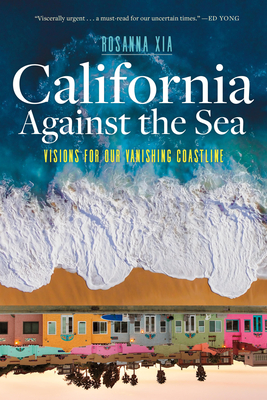
PEN/E.O. Wilson Literary Science Writing Award Winner * Golden Poppy Award Winner for Nonfiction * California Book Awards Gold Medal Winner * A Great Read from Great Places selected by the Library of Congress * A San Francisco Chronicle Best Book of the Year * American Book Award Winner *
"Viscerally urgent, thoroughly reported, and compellingly written—a must-read for our uncertain times." — Ed Yong, author of An Immense World
From a celebrated environmental journalist, the riveting exploration of sea level rise along the West Coast through human stories and ecological dramas.
Along California’s 1,200-mile coastline, the overheated Pacific Ocean is rising and pressing in, imperiling both wildlife and the maritime towns and cities that 27 million people call home. In California Against the Sea, Los Angeles Times coastal reporter Rosanna Xia As climate chaos threatens the places we love so fiercely, will we finally grasp our collective capacity for change?
Xia, a Pulitzer Prize finalist, investigates the impacts of engineered landscapes, the market pressures of development, and the ecological activism and political scrimmages that have carved our contemporary coastline—and foretell even greater changes to our shores. From the beaches of the Mexican border up to the sheer-cliffed North Coast, the voices of Indigenous leaders, community activists, small-town mayors, urban engineers, and tenacious environmental scientists commingle. Together, they chronicle the challenges and urgency of forging a climate-wise future. Xia’s investigation takes us to Imperial Beach, Los Angeles, Pacifica, Marin City, San Francisco, and beyond, weighing the rivaling arguments, agreements, compromises, and visions governing the State of California’s commitment to a coast for all. Through graceful reportage, she charts how the decisions we make today will determine where we go headlong into natural disaster, or toward an equitable refashioning of coastal stewardship.
Rosanna Xia is an environmental reporter for the Los Angeles Times, where she specializes in stories about the coast and ocean. Her breadth of work includes the highly anticipated feature documentary film, Out of Plain Sight, which she directed and produced, and her celebrated book, California Against the Sea, which received the PEN/E.O. Wilson Literary Science Writing Award and a gold medal from the California Book Awards, among other honors. She was named a Pulitzer Prize finalist in 2020 for explanatory reporting, and her journalism has been anthologized in the Best American Science and Nature Writing series.
I feel badly about my rating. This is a 5 star worthy book but for me the reading experience was maybe 3 star worthy. Even though I disagree with the author about one particular thing and even though for me it wasn’t a page-turner and it took me almost three months to read since reading one section at a time was enough for me, and I read many other books during that time instead of picking up this one, I think it is a worthy book. Because of that I can’t give it less than 4 stars. It’s an excellent book about a topic of the utmost importance. It’s well researched. It’s well written. It’s well reported. I highly recommend it to people who have interest in climate change. It’s a must read for anyone who lives near a coast and for all Californians.
There are lovely though not detailed pictorial maps. There is one of the California coast with some towns marked and at the start of each chapter there are mini round maps of the small area to be covered in that chapter. I did not mind there being no photos until a friend said she hoped there were a lot of beautiful photos. Yes, it would be even better with photos though perhaps they would make people want to visit the coast which would be counter to this book’s purpose. I know a few of the areas but not most of them. It is easy to find photos on the internet of all the coastal areas covered.
I’ve been telling my local friends for decades to move inland, and north too. Climate change will be affecting the coastline more and more.
This author is in favor of banning cars on the Great Highway and making it into a park which I think is going to happen. I’m sad about that. As long as the Great Highway is relatively stable as land and not as sea it should be a highway for cars (and pedestrians and bicyclists; there is already a multi-use path) and having it remain so is more equitable and it’s also better for the environment. Much better. Not to mention that it borders a beach and is across the street from a huge park and is close to a lot of parks/parkland/hiking trails/wild areas. Crazy selfish people and interest groups having their way with the city is driving me and many others crazy.
I read this book for the science and the scientific parts are interesting and I learned a lot but I think my favorite parts were the many people’s personal stories and the present & past Native American parts.
I wish I’d looked at the Notes and Further Reading section before I started the book. I would have read each section immediately after its corresponding chapter rather than all of them at once after I’d finished the rest of the book.
Quotes from the book:
"We talk about the Amazon being the lungs of our planet, but studies show that coastal wetlands, left to their own devices, can capture and store three to five times more carbon dioxide than tropical forests - and sometimes much, much more."
"The best shot at saving the tidal marsh in California might just be, after all, along the San Francisco Bay."
The San Francisco Bay Area and groundwater: "already identified 25 different landfills at risk of leaching toxic chemicals as the water levels rise."
"The coast of California is marked by massive inequality."
"Floating cities might sound like science fiction...(but) no new technology is required."
"Resilience includes knowing when an unwanted transformation is inevitable."
"Crammed onto the tip of a thumb-shaped peninsula, this celebrated metropolis...owes its existence to sheer force of will...Something needs to give. But even in a city as environmentally minded as San Francisco, acquiescing to nature has not been easy."
"At its most basic, coastal armoring could be as simple as dumping giant pieces of broken concrete along the beach or at the base of a cliff. Remnants of freeways, destroyed in past earthquakes, support much of the riprap protecting some areas along San Francisco Bay."
“Sand, although it might seem limitless…it’s the most exploited and consumed natural resource in the world after fresh water…”
“In San Francisco, most people would be surprised to learn that beyond the marshlands that have been filled in or altered, there also used to be miles of sandy beach fronting the Bayshore…”
“Most responses so far to sea level rise can be placed along a ‘green-to-gray scale’…”
“Right now, managed retreat is just a slogan.”
“Here’s the hard truth…We’re already locked into a certain amount of climate change, and we need to adapt to the effects that we know we’re going to be experiencing.”
“Coastal officials have been working actively against the tendency to reinforce existing environmental injustices, and more institutions are now paying attention to Indigenous knowledge.”
“What if we saw every decision to relocate as a brave advance?”
“The coast is never saved; it’s always being saved.”
“There’s no point fighting a force as powerful as the ocean.”
“…Old photos showed the house at least 20 feet from the edge…When (a family member) opened the sliding door, “there was nothing…You looked straight down into the ocean.”
“AS the planet continues to burn and the ocean submerges more of California as we know it…We have realized, unfortunately very late into the game, that we buried a lot of wisdom around how to care for land…”
“By early 2021, Biden was urging all Americans to join together to conserve at least 30 percent of the nation’s land and water by 2030.”
“These Seeds of change have already been planted. We already have the knowledge to forge a new vision of the coast.”
“The wisdom of this coast has been here all along, and California is finally listening.”
Contents:
Introduction: The Sea Has Music for Those Who Listen
Coast under Seige: 1. California Against the Sea 2. Our Vanishing Coastline 3. A Town on the Edge
Saving the Golden Shore 4. The People’s Law 5. Protect at What Cost? 6. Choosing Casualities
Missing Pieces 7. The People’s Coast 8. Overlooked and Forgotten 9. Rebirth Between the Tides 10. Relearning the Ways of the Shore
May We Open Our Eyes to Water 11. Grappling with Retreat 12. The Little Town That Would 13. Bridges to the Future
Acknowledgments Notes and Further Reading Index About the Author
An insightful, well-researched and well-written look at how California, as a microcosm for the world, is confronting (or not confronting) sea level rise in different communities. Don’t be intimidated by a non-fiction climate change book - most of the information is conveyed via storytelling. Xia describes to us the story of various places and the people affected by the sea in them, and most importantly the people looking for solutions.
I was struck by the author’s nuanced approach to what resilience means, both in terms of the land and in terms of people and individuals. I thought I might feel overwhelmed by a detailed description of the crisis ahead of us, but I also felt encouraged to read the stories and passion and creativity fueling so many frontline climate activists, from scientists and academics to local policymakers and just every day coastal residents trying to protect their families.
Lastly, the book did an amazing job acknowledging the fact that California is stolen land, and we maybe wouldn’t be in quite a crisis like this at all if the original stewards of the land still controlled it. I thought the initial chapter on the Chumash people might be the only “nod” to indigenous tribes, but in fact that narrative of different tribes and native approaches to conservation was woven throughout the book. I rarely see this extent of an environmental justice lens applied to journalistic non-fiction.
What a gem of a book I randomly purchased at the Monterey Bay Aquarium while there on a trip late last year.
"California Against the Sea..." is an amalgamation of many things. Local and state history, politics, climate science, sociology, anecdotal storytelling, strong writing, intriguing problems, creative solutions, and the voices of many, many Californians of a variety of backgrounds. It's a fascinating look at the state's history with its own coastline, and the mixed reactions of the folks who live on it.
The book is broken into chapters and sections that move up and down the entire coastline of California. Each section covers a lot of topics under the same related umbrellas. Certain sections focus on the industrial and engineering marvels (and failures) of different areas, such as San Francisco. Others focus on the history of Indigenous peoples such as the Kashia and Chumash who were victims of genocide and relocation, thus burying thousands of years of knowledge on land stewardship. And others focus on the local political climate of a variety of coastal areas; ones that are very resistant to change, and others that are more welcoming and understanding of its necessity. This summary only scratches the surface of the multitude of topics covered throughout this book's entirety.
My main takeaway from this book was this: We cannot do things that alter our environment (throw out the compounding elements of "general" climate change; I am referring to paving over wetlands, damming rivers, etc.) and then try to buy our way out of the consequences. Nature can -- and will -- push back. Examining our relationship with it, and learning to live in greater harmony is not only ideal, it is essential.
Rosanna Xia wrote this book with great empathy, curiosity, and fairness. I really enjoyed the education I received about a variety of issues. Even though I don't live in California, the lessons here are applicable to all of us. Now more than ever!
If you read this book (and you should!), you will never look at the California coast the same way again. Nor will you have a shred of envy for anyone who owns a charming coastal property that us mortals can't afford.
The book has a few minor shortcomings. At least once a chapter, Xia lapses into an editorial paragraph that took me out of the flow of the evidence and narratives that were far more persuasive. When reading a detailed discussion of policy debates in small towns like Pacifica or Imperial Beach, I wanted to see maps or graphics that illustrated the problems and solutions, even if in an appendix. And her most intriguing argument-- that 20th century Californians mostly developed the coast during a gentle phase of the "Pacific Decadal Oscillation", thus not realizing how precarious and evolving the coast typically is-- was dropped in a short sentence here or there as if it was a familiar, accepted argument to all readers. I wanted more explanations and discussion of this.
Overall, though, Rosanna Xia has written a compulsively readable book that somehow introduces us to multiple current and near-future disasters-- bluff erosion, racial and class inequities from industrialization, sea walls that kill beaches, flooding from increasingly strong king tides and stronger winter storms, and of course, rising sea levels from climate change-- while leaving me with a strange sense of hope that the beach can repair itself if we learn to get out of its way. And that there are ample wise leaders willing to engage in difficult conversations and negotiations that will help us learn to do so.
Do start out with the preview, which is the book's first three chapters, and has the heart of the author's arguments and observations. It's a short book, and definitely worth reading. Sea level has been MUCH higher in the past, and will be again in the future. As to the timing, who knows? But there is a lot of extra heat that's already been pumped into the earth system . . .
One of the most striking things is the visceral reaction of homeowners to the idea of "Managed Retreat." It's not a popular idea. Defending your turf is almost every home-owner's first reaction. Seawalls! Which are, at best, a temporary solution. Although, in the case of downtown San Francisco, likely the only one, even if they have to be rebuilt from time to time. And there are places like Marina/Fort Ord, just north of Monterey, that lucked out in that the coastal dunes have (so far) largely survived. The book ends well, on an inspirational note.
Sometimes her writing style gets a bit purple for my taste. But it's a real problem, and it's good to take a close look to see what might actually work, and what is hopeless. Recommended reading, especially for California coastal residents. For me, a 3.5+ star book.
Really excellent - great for anyone living near the California coast, even if you’re not in coastal/ marine things. I’ve been following Xia’s reporting in the LA Times for a while, only realizing after a bit that the great coastal/ sea level rise stories were all written by the same person. In this book pulls together this deep knowledge of the region through essentially mini interviews, with each chapter focusing on a new coastal city or set of cities and a new set of scientists or community leaders. From the science perspective, she talks to all the right people - names that I have heard before as the experts for the experts. She does a fantastic job of looking at the issue of sea level rise from many different angles, and from many different types of solutions. Her writing is easy to understand and very engaging while being packed with interesting information, and she leans into highlighting the relationships and histories of her interviewees with the coast. My only complaint would be the very beginning and the very end - it felt a little bit like, free from the limits of an LA Times article, she waxed a little too poetic (the word “oft” made many appearances.) But I loved her writing style for the rest of the book.
Highly recommend this engaging story of the California coast and what its future may be based on the difficult decisions we make today. This is not just a book about the science of sea level rise and ways of addressing it, it’s about communities grappling with what we value about the coast- what should be saved and what can be sacrificed and how these decisions should be made. In just under 300 pages the author covers a wide range of topics from indigenous coastal knowledge, to the commodification of the shore, the formation of the coastal commission, and strategies for preservation and community resilience. Case studies come from communities stretching from San Diego up to Humboldt County. If you love the beach, and especially if you live near the California coast, read this book.
Well reported and beautifully written, Rosanna Xia has given us an in-depth look at how sea level rise is impacting communities all along the California coast. Equally heartbreaking and hopeful, this book lays bare the problems with where we are while offering examples and opportunities for more fruitful solutions — for us and the planet.
This book made me more enamored by the ocean and furthered my passion to protect it. Xia’s writing is exquisite and offers a way of looking at climate change with hope rather than fear. I’m in awe of this piece of work.
I was fortunate to get an early read and blurb this book. I wrote:
“Xia’s prophetic and perceptive book reveals a California coastline denied by centuries of settlers more intent on dreaming than facing the unsteady reality of the living ocean’s edge. California Against the Sea is the invitation we need today to enter a future where we learn to work with nature instead of against it. Xia’s message should be heeded everywhere ocean meets land."
Masterfully crafted, yet a first book for Xia. Prizewinning, and so worthy. The climate crisis compels essential legal and regulatory changes in the next decade or two, so aspects of these essays will be in new laws, court battles, and expensive engineering adaptations imminently. Classical essay style that reminds me of Steinbeck, true literature. Yet with far better research, into history, law and climate science. Honestly covers early native cultures, and includes racial economic injustice in almost every chapter, and shockingly it still somewhat persists. The wide ranging impact of California's Coastal Act is shocking. It is only about 50 years old, so I can imagine the idealistic yet flawed society that supported it, after the coast oil spills and activism of the 1960s.
An eye-opening look at the specific challenges that lay ahead for Californians and an urgent call to action for people everywhere to live in harmony with nature, this book was as educational as it was moving and personal. An absolute must-read!
This book was absolutely incredible. Everyone in the state of California needs to read this!!
It was the perfect blend of facts and stories, history and present, problems and solutions, despair and hope. Xia did such a great job composing this and you can tell it took years of work and hundreds of conversations with people throughout California. As someone who lives in one of the cities referenced in this book, this book was extremely personal. I learned things about my home that I never knew and now I look at the coast with new eyes. Our coast is degrading, how will we fix it? No matter what we do, the ocean *will* rise and we can never beat it’s magnificent power. It was infuriating to read about people just wanting to reenforce sea walls — which destroy the beach, are only a temporary fix, and are extremely costly — just to protect their property value. It’s a huge privilege just to own a house! It’s devastating to hear about Marin City and Alviso — low income, predominately non-white communities — that are constantly neglected and suffer the worst consequences. But there are so many solutions already in the works! Sea walls are being banned, dunes and estuaries are being restored, “living” structures are being built, managed retreat is starting to be taken seriously. This book is the perfect balance of “something is wrong” and “this is how people are fixing it”.
Notes: * Every 1 foot of sea level rise pushes the coast back as much as the length of a football field (300 feet). * If businesses continue as usual and global temperatures continue to rise, more than $370 billion in property could be at risk of coastal flooding by the end of the century. * In a few more decades, 2/3 of the beaches in Santa Barbara, Los Angeles, Orange County, and San Diego will be lost to the sea. * Pacifica is the most eroded coastal town in California — they represent what much of California will look like soon. * It cost Pacifica $16 million to respond to the devastation caused by the latest El Niño in 2016 — out of their $36 million operating budget that relies mostly on property taxes. * Historical erosion rates of Pacifica indicate a long-term average of about two feet per year being eroded from the coast. With projected sea level rise of about a foot and a half by the year 2050, we could expect the erosion rates to approximately double. * In just the next 20 years, even if the sea rose only by modest amount, armoring the entire state of California could cost home owners and taxpayers more than $22 billion. * Choosing to protect homes, roads, and other critical infrastructure behind the seawall is a direct choice to sacrifice the beach in front. * The Embarcadero in San Francisco safeguards more than $100 billion in businesses and buildings. There would be no port of San Francisco without this waterfront, which moves billions of dollars in goods and services in and out of the bay. There would be no San Francisco without this enormous seawall. * The ferry building, were all transportation lines and the city come together, could flood every day if water rows three more feet — an extreme scenario that some study said could arrive before 2050. A report in 2016 also found that it wouldn’t take much more than a moderate sized earthquake to liquefy the soil holding up this fall. * Without reinforcement, the Embarcadero could also slum into the fill in an instant. Updating the seawall would cost at least $2 billion, likely many billions more. But the cost of doing nothing would be even greater: studies estimate that on the northern end of the waterfront alone damages from earthquakes and flooding could total as much as $30 billion. * “Never start a conversation with sea level rise as what we learned. Start the conversation with: ‘what do you care about? What do you want your community to look like?’ Uncovering the problem together and having time for the process to evolve is really important.” — Lindy Lowe, port of San Francisco’s resilience officer * Project designs for a bigger seawall are nearly completed and construction is expected to begin in 2024. * They are working on ways to make the sea wall more textured, reef-like habitat — a living seawall — with bumps and ridges that could support rock, weed, oysters, herring, and other rock-shore species. * “Resilience is often about making sure we are strong enough to not be changed, but what if we should change? We’ve seen increasing gentrification and disparities in wealth. We’ve seen the cost of housing in the coastal zone go through the roof, and we’ve seen exposed, impoverished political system that in many cases is driven by power and vested interest, as opposed to larger interests of society, and the community. So my mind, we need to figure out how to adapt — but it’s deeper than that. So as a first step, I think we need to acknowledge and recognize and remember that social institutions are human created artifacts. They’re not rooted in some natural order. All of these debates that we’re having along the property of the shoreline: that’s really rooted in the original colonialism, and the taking of land — by the sovereign, and then passing it from the Spanish government to the Mexican government to the US government —and establishing the property lines that we are now fighting about up and down the coast.” — Charles Lester, lawyer, and political scientist, who was on the Coastal Commission * Sea level rise means you also get salt water intrusion in the ground water from below, causing communities not immediate to the water like Marin City face flooding. * Lower income communities of color are five times more likely than California’s general population to live within half a mile of a toxic site that could flood from rising water. * It’s important to know that managed retreat is not a goal in itself. Ensuring that the community is safe is a goal. Providing social and environmental justice is a goal. Providing coastal, habitats and public open space is a goal. Managed retreat, many researchers have clarified, is simply one way to help a community achieve those goals. * Even if the entire world stopped emitting carbon dioxide tomorrow, the sea will continue to rise for decades. Due to all the planet-warming gases already released in the atmosphere, the best and worst case scenarios look roughly the same between now and 2050. (imagine putting the engine of a speeding ship in neutral) there is still time to stop these shocks in the climate system after 2050 — every inch makes a difference and our actions today will determine how livable our planet will be in the final decades of the century.
as i drove down PCH from SF to LA last week, waves of wonder flowed through me as i rounded bluff after bluff. the natural beauty of the coastline wouldn’t exist without the environmental regulations of the ‘70s and ‘80s. as mentioned multiple times in the book, nature is never saved, but in constant need of saving.
this book felt like the polar opposite of Abundance; it highlighted the magic of California and the benefits of tight environmental regulations. the book did tackle tricky political realities of eminent domain, managed retreat, historical redlining and racist zoning policies. it tried, at least, to consider the current political climate, past injustices, and economic factors that make present-day conservation so tricky.
the book didn’t discuss housing and the dark side of CA’s environmental regulations, but instead highlighted the continual fight needed to maintain the nature we have left. if this book and Abundance had a baby, maybe, just maybe, we’d have a more well-rounded understanding of the real-world implications of CA’s environmental laws. yes, CEQA has stifled much-needed housing and development which has caused the societal failure and moral crisis of homelessness. and yes, what’s left of CA’s natural beauty is intact because of the laws that allow us to fight profit-seeking developers that care not for our beautiful state and only want to profit off of its beauty. both are true, and we must not sacrifice one for the other.
Good research and examples of the many possible solutions. However, there was a repetition of some ideas over and over. While I realize that can be useful, it made me get frustrated, like the author didn't think it was clear.
Sign me up for every California environmental group, we need to save the coast :-D This book is incredibly informative, not to mention eye-opening. It’s also beautifully written - you can smell the sea, feel the sand, hear the waves in every word. I learned a lot about CA history and about efforts up and down the coast to save what makes California so very special. There are also great stories in here about what it means to do something for the greater good v. individual gain, and I wish people would read this book for those points alone. Some of these stories also gave me a glimmer of hope in humanity - not much, but a little :-)
Really well written book about the challenges of addressing sea level rise along the California coast. Well-researched with real people’s stories. I wish there had been pictures and diagrams to accompany the text.
as someone who grew up inland in the central valley, the california coast with its picturesque beaches was at once core to the way that i conceptualized the state that i love and also incredibly far from my own reality. it wasn't until i moved to los angeles and met my partner who is an avid surfer did i begin to develop a personal relationship to the california coastline. and i am so ashamed to say that at my big age: i did not realize that beaches are not supposed to be manicured, flat swaths of soft sand. this was the timeless image of the beach that supposedly made my homestate so desirable, but it wasn't until reading CALIFORNIA AGAINST THE SEA that i learned that this was unnatural. in fact, california's iconic beaches were constructed through settler colonialism, white supremacy, and capitalism. and this has been done at our own peril. i have never known a year in which highway 1 hasn't been flooded or closed down. i have never known beaches that weren't rapidly shrinking due to rising sea levels and sand loss. i have never known cliffs that aren't constantly collapsing from erosion. the signs have always been in front of me declaring that the california coast is not only changing but is meant to change despite the rigidity we impose on it. and instead of facing this reality with curiosity and seeing it as an opportunity to redesign the way that we live with nature in an equitable way, many californians have chosen to bury their hands in the sand and desperately cling to what they have always known.
i am so grateful for the way that rosanna xia highlights the different communities along the california coastline. every place has its specific challenges whether due to their geography, their politics, or their histories. this really demonstrates that there's no one size fits all solution to tackling climate change--it's going to require a lot of different tactics, but all of them have to be rooted in the understanding that in order to save the coast, and in order to save ourselves, we must adapt together and in step with nature or we will lose it all.
xia wrote this with a specific eye towards equity by not only spotlighting low income communities or color who have been historically divested from & designated as sacrifice zones, but by also continuously weaving in the knowledge & expertise of indigenous peoples in california. there's not just one "indigenous" chapter in this book. multiple indigenous peoples up and down the coast are represented here.
i now want to see a natural dune system & some wetlands!!!
This book came highly recommended by the sister of a coworker of this author (hey Bonnie.) Xia admirably combines incisive explainations of California development legislation, while vividly painting their histories and the unique personalities and social/environmental forces which combine to create such monumental works such as the California Coastal Act of 1976.
She lucidly explains the contradictory dynamics of sea wall which the wealthy and desperate put up to defend their land from the ocean, which in turn strip the coast of it’s beaches, which accelerate the coastal degradation which threatens the very same property, highways, and public spaces.
She begins the story and many more deep in the time and cosmology of the many California native communities, especially the story of coming to the land we now know as california told by the people known today as the Chumash. In aligning her story within that deep time and expansive and pluralistic worlding, she broadcasts a more complete view than I often see in such critical journalistic reporting.
Her prose is beautiful and evocative, and I wish she had been able to infuse it more throughout. I the moments where she leans into more emotional storytelling were when I was gripped the most (most notably in the opening and closing chapters,) so I hope future stories lean into this vibrant storytelling mode more.
“In Šmuwič, one of the Chumash languages still spoken today, there exists the prefix kiyis. When joined together with another word, it speaks to a shared sense of “our.” Kiyis’skamin, for example, means “our ocean.” The “our” conveys kinship, a mutual state of belonging. People belong to the coast; the coast belongs to the people. This belonging has little to do with posession, or control, in any Western sense of the word. At the heart of kiyis is a duty to heal, to care for, to love this one Earth that is ours.”
Such an educational, thorough, and holistic overview of California’s coastlines. I especially love the balance of scientific environmental discussions, with topics of social justice and environmental racism. Read this my CA surfer friends!
Rosanna Xia's reporting and storytelling here is incredible, as always, but she goes to a whole new level by piecing together stories of California's coast and its people in this book. As someone who follow's Xia's reporting at the LA Times, I thought it was really cool to recognize some of the same topics/stories from her articles as I was reading. I love the coast, I love California, and I love learning new things and reading new perspectives!!!
i believe this is the first book ive read written in a journalistic style. im accustomed to reading history, so i was always looking for concrete evidence and statistics backed up by time, of which there are many. but xia’s writing, as a journalist, was even more grounded in current stories of individuals living along and protecting the coast. each chapter centered around the journeys of specific projects and why they are so important, not just to a vague notion of “the ecosystem,” but also to the individuals living in these communities. i think that the balance of data and anecdote makes xia’s writing accessible, fresh, and urgent, without being fear-mongering.
i was concerned at the beginning that this book would fall too hard towards the “humans vs nature” narrative, advocating evacuation above all else, but it became increasingly clear that xia’s message pushes living with the ocean, not against it. by sharing stories of successful urban conservation projects, xia made me more hopeful about the futures of coastal communities. i also really appreciated that the final chapter emphasizes indigenous conservation as a live possibility, rather than portraying indigenous relationships with nature as “lost” to the past. i think that viewing conservation as less of a retreat and more of a return— including the literal return of the coast into indigenous leadership, and indigenous caretakers being able to come home to the coast— is deeply important.
all in all an insightful read! i think that after reading this, ill notice coastal infrastructure in a way that i hadnt before.
Xia takes us in a tour of the California coast to see how different communities are approaching sea level rise. Some approaches seem fruitless but others are encouraging and positive. There’s no judgement just a recognition that this is an emotional and challenging issue.
Well worth reading to get a more holistic perspective.
I would have finished this in one sitting if I didn’t constantly stop to look up places on my phone, follow organizations mentioned on Instagram, and prowl Zillow to see how feasible moving back to Humboldt county would be 😭 An engaging and smart book. The Prop 20 section gave me goosebumps.
I really love how so many different perspectives on environmentalism and conservation advocacy were tackled in this book. It is so well laid out, and to be learning so many new important moments from history even as a CA native myself was really refreshing. Serves as a really poignant reminder of how to recognize damage that has been done over the years, but also how to embrace optimism.
This entire review has been hidden because of spoilers.
I think this is "must read" for anyone living in California. As a native Californian, I found it interesting as to what's going on in my own state in saving the coastline. There are good things and not so good things. It's a struggle to do things "right" while also acknowledging that not every place can go "back to nature", like San Francisco. There are ways to do both but it isn't easy. Compromise seems to be a dirty word these days but that's what it will take.
I don’t typically write reviews but this book was so compelling, I felt remiss not to. It’s possible that being a child of the California coastline, having spent 75% of my life here and learning more of the past and present about some of the places most near and dear to my heart made it an inevitability that I would love this book. The way Xia captures the essence of the people and places of our beloved coast and paints a vision of its future is truly remarkable. She makes bureaucracy poetic. The lessons from the stories she tells are applicable to coastal communities beyond California. I’ve been recommending this book to anyone and everyone I know.
An excellent book about California and its relationship with the sea told through thirteen chapters about cities and towns that are rethinking their relationship with the coastline. Riveting, hopeful, and engaging, an inspiring vision for the future!