

What do you think?

Cave of Bones: A True Story of Discovery, Adventure, and Human Origins
A true-life scientific adventure story, this thrilling book takes the reader deep into South African caves to discover fossil remains that compel a monumental reframing of the human family tree.
In the summer of 2022, Lee Berger lost 50 pounds in order to wriggle though impossibly small openings in the Rising Star cave complex in South Africa—spaces where his team has been unearthing the remains of Homo naledi , a proto-human likely to have coexisted with Homo sapiens some 250,000 years ago. The lead researcher on the site, still Berger had never made his way into the dark, cramped, dangerous underground spaces where many of the naledi fossils had been found. Now he was ready to do so.
Once inside the cave, Berger made shocking new discoveries that expand our understanding of this early hominid—discoveries that stand to alter our fundamental understanding of what makes us human. So what does it all mean?
Join Berger on the adventure of a lifetime as he explores the Rising Star cave system and begins the complicated process of explaining these extraordinary finds—finds that force a rethinking of human evolution, and discoveries that Berger calls "the Rosetta stone of the human mind."
In the summer of 2022, Lee Berger lost 50 pounds in order to wriggle though impossibly small openings in the Rising Star cave complex in South Africa—spaces where his team has been unearthing the remains of Homo naledi , a proto-human likely to have coexisted with Homo sapiens some 250,000 years ago. The lead researcher on the site, still Berger had never made his way into the dark, cramped, dangerous underground spaces where many of the naledi fossils had been found. Now he was ready to do so.
Once inside the cave, Berger made shocking new discoveries that expand our understanding of this early hominid—discoveries that stand to alter our fundamental understanding of what makes us human. So what does it all mean?
Join Berger on the adventure of a lifetime as he explores the Rising Star cave system and begins the complicated process of explaining these extraordinary finds—finds that force a rethinking of human evolution, and discoveries that Berger calls "the Rosetta stone of the human mind."
240 pages, Hardcover
Published August 8, 2023
About the author
Lee Berger
4 books99 followersLee Berger is a palaeoanthropologist and explorer, he is is the author of Almost Human: The Astonishing Tale of Homo Naledi
Ratings & Reviews
Friends & Following
Create a free account to discover what your friends think of this book!
Community Reviews
Displaying 1 - 30 of 175 reviews

July 24, 2023
This is mind-blowing. The significant discoveries of a new species Homo naledi (which seems to have buried its dead, mastered fire, and made markings on cave walls) are reason enough to read this. But interspersed are riveting, page-turning chronicles of the rather dangerous caving required to make these discoveries. Date estimates have naledi likely co-existing with sapiens. It really becomes an enchanting archeological mystery-thriller that puts a twist to our understanding of human origins and the origins of intelligence and culture. It demands a sequel, which will only exist when more discoveries are made and when new technology is able to extract more clues from what's already been found.

September 11, 2023
Human evolution as a march of progress is completely false. It’s more like a bush than a tree. Up unto fairly recently, there were many species of homo and proto humans living at the same time. The Neanderthals disappeared around 40 000 years ago, and the Denisovans could have held on as late as 14500 years ago. We share some of their DNA.
Homo naledi, the subject of this book, were small-brained and lived approximately 335 000 - 236 000 years ago. Many remains have been found in the Rising Star cave in South Africa, a notoriously difficult site to reach. The author and science points to this species having the control of fire, burying their dead and having some primitive art.
The book can be read as a caving expedition adventure. The author had to lose a lot of weight to enter and it was an incredibly high risk expedition.
Homo naledi, the subject of this book, were small-brained and lived approximately 335 000 - 236 000 years ago. Many remains have been found in the Rising Star cave in South Africa, a notoriously difficult site to reach. The author and science points to this species having the control of fire, burying their dead and having some primitive art.
The book can be read as a caving expedition adventure. The author had to lose a lot of weight to enter and it was an incredibly high risk expedition.

February 27, 2025
Since 2013, Lee Berger has been leading a team of paleoanthropologists, including co-author John Hawks, to explore the Rising Star Cave system in South Africa. This book reports his team’s findings to date regarding a species called homo naledi. It is also a memoir. Lee Berger takes the reader on an archeological adventure as he squeezes through the tiny openings and descends deep into these caves. It is a fascinating account of the difficulties involved in gaining access to the deep chambers as well as what they discovered.
The book presents evidence of: 1) deliberate placement of bodies in the difficult-to-access Dinaledi chamber, suggesting intentional disposal of the dead - a behavior previously thought to require much larger brains, 2) geometric engravings found on the cave walls, suggesting “cave art” or at least symbolic behavior, 3) evidence of controlled fire use, such as deliberate blackening of cave walls and burn patterns on bones (possible signs of cooking). It also showcases the methods involved in archeological digs, and the scientific regimen they followed to ensure their findings were vetted by other scientists (and peer reviewed).
They are not suggesting these are early humans but would have been contemporaries of early homo sapiens. The team’s findings fundamentally challenge many long-held assumptions about the relationship between brain size and complex behaviors, since homo naledi had a brain only about one-third of the size of modern humans. It is well-written and engaging. Recommended to those interested in anthropology, archeology, geology, paleontology, or sociology.
The book presents evidence of: 1) deliberate placement of bodies in the difficult-to-access Dinaledi chamber, suggesting intentional disposal of the dead - a behavior previously thought to require much larger brains, 2) geometric engravings found on the cave walls, suggesting “cave art” or at least symbolic behavior, 3) evidence of controlled fire use, such as deliberate blackening of cave walls and burn patterns on bones (possible signs of cooking). It also showcases the methods involved in archeological digs, and the scientific regimen they followed to ensure their findings were vetted by other scientists (and peer reviewed).
They are not suggesting these are early humans but would have been contemporaries of early homo sapiens. The team’s findings fundamentally challenge many long-held assumptions about the relationship between brain size and complex behaviors, since homo naledi had a brain only about one-third of the size of modern humans. It is well-written and engaging. Recommended to those interested in anthropology, archeology, geology, paleontology, or sociology.

September 22, 2023
Rating: 4.5 stars
Lee Berger is a palaeoanthropologist and explorer. In other words, the guy does crazy and dangerous things like loose 23 kg (50 pounds) just to (hopefully) be thin enough to squirm and contort his way through the narrow passages of the Rising Star cave system in South Africa, just to look at a bunch of fossil bones. Bergers caving experience is downright claustrophobia-inducing for any armchair explorers tagging along.
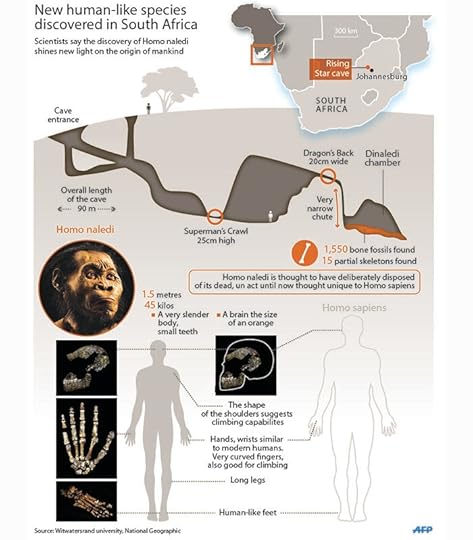
In addition to Bergers personal account of his caving experience, this book describes the fascinating discovery of Homo naledi: an almost (but not)-human likely to have co-existed with Homo sapiens some 250,000 years ago. Excavations have provided evidence that Homo naledi were only 1.5 metres (5 feet) tall; with small teeth; had brains much smaller than homo sapiens; probably used tools; used fire, made markings on cave walls; and buried their dead. This discovery suggests that Homo sapiens were one of several species experimenting with walking upright, using tools and fire, and had some sort of culture involving marking walls and burial rituals.
I would really have loved more information on the analyses of the fossils and environment. Maybe a forthcoming book will provide and update, especially with regards to any forthcoming DNA and proteonomic data.
I found the description of the physical aspect of excavating fossils in cave systems particularly informative. The naledi discovery and its wider implications for human evolution was also very interesting. The book includes a nice collection of photographs, sketches and maps, which were particularly useful. The audiobook narrator is the author himself and he does a pretty good job.
YOUTUBE VIDEO: https://www.youtube.com/watch?v=oxgnl...
Lee Berger is a palaeoanthropologist and explorer. In other words, the guy does crazy and dangerous things like loose 23 kg (50 pounds) just to (hopefully) be thin enough to squirm and contort his way through the narrow passages of the Rising Star cave system in South Africa, just to look at a bunch of fossil bones. Bergers caving experience is downright claustrophobia-inducing for any armchair explorers tagging along.
In addition to Bergers personal account of his caving experience, this book describes the fascinating discovery of Homo naledi: an almost (but not)-human likely to have co-existed with Homo sapiens some 250,000 years ago. Excavations have provided evidence that Homo naledi were only 1.5 metres (5 feet) tall; with small teeth; had brains much smaller than homo sapiens; probably used tools; used fire, made markings on cave walls; and buried their dead. This discovery suggests that Homo sapiens were one of several species experimenting with walking upright, using tools and fire, and had some sort of culture involving marking walls and burial rituals.
I would really have loved more information on the analyses of the fossils and environment. Maybe a forthcoming book will provide and update, especially with regards to any forthcoming DNA and proteonomic data.
I found the description of the physical aspect of excavating fossils in cave systems particularly informative. The naledi discovery and its wider implications for human evolution was also very interesting. The book includes a nice collection of photographs, sketches and maps, which were particularly useful. The audiobook narrator is the author himself and he does a pretty good job.
YOUTUBE VIDEO: https://www.youtube.com/watch?v=oxgnl...

August 17, 2023
This was an interesting story of adventure and discovery. It was light on the actual analyses, but I think that was by design. It provided a great discussion on the relevance and impacts of the team’s finds, and what their analyses concluded. The discussion highlights some pretty big questions about when “humanity“ first sparked, and if we were the first species to meet those requirements.
The only real complaint I have about this book is that I wish there was more discussion on what some of the other team members went through during their time in the cave. As it stands, the book reads more like a semi autobiography of Berger, which is fine, but I had hope for more on the two cavers that found the site and the team who had been excavating within it. Those are my only gripes, and they aren’t serious enough for me to lower my rating.
The only real complaint I have about this book is that I wish there was more discussion on what some of the other team members went through during their time in the cave. As it stands, the book reads more like a semi autobiography of Berger, which is fine, but I had hope for more on the two cavers that found the site and the team who had been excavating within it. Those are my only gripes, and they aren’t serious enough for me to lower my rating.

October 25, 2023
I originally gave this book 5 stars and it was one of my most favorite books I read this year, but after listening to the podcast “why fossil nerds are pissed right now” on Science Vs, I came back to rate it 2 stars. It turns out the Lee Berger did not got any of his work peer reviewed and he half-assed the scientific methods used. The information provided in this book and in the documentary on Netflix was presented as though it was properly researched and peer reviewed, which does a disservice to the public when it’s not. Lee Berger tried to defend himself saying that he was just putting out information as it came out and that science ever changing, but he never stated that disclaimer in the book or documentary or ever mentioned that these were just his theories. He made it sound like this was all proven facts.

December 12, 2025
Abandoned about 3/4 of the way through. There is a great book to be written about Homo naledi, but this isn't it. The discovery itself is remarkable, but the author comes across as a vain, self-absorbed twit. Perhaps a third of what I read was concerned with his incredible heroism in going (once) into a cave after he'd sent dozens of other people into the cave, and his brilliance in correcting the mistake those lesser mortals made.

December 30, 2023
Fascinating book on the discovery of human-esque ape-like creatures that buried their dead, used fire, tools, and etched marks into cave walls. Like a genuinely paradigm shifting discovery.
Writing that flows like molasses and seems to spend most of the time on Lee’s climb down into the cave.
It’s like if your little cousin told you “I discovered buried treasure!” and then responded to your question of “wow where and what’s in the buried treasure box?” With a rambling story about how they were chasing leaves, and the different types of leaves they were chasing, a bird they saw, some interesting sticks on the way, without ever really telling you much of what you actually want to know.
Watch a documentary or YouTube video on it. The book is incredibly mediocre despite being about one of the more interesting archaeological discoveries of the modern era.
Writing that flows like molasses and seems to spend most of the time on Lee’s climb down into the cave.
It’s like if your little cousin told you “I discovered buried treasure!” and then responded to your question of “wow where and what’s in the buried treasure box?” With a rambling story about how they were chasing leaves, and the different types of leaves they were chasing, a bird they saw, some interesting sticks on the way, without ever really telling you much of what you actually want to know.
Watch a documentary or YouTube video on it. The book is incredibly mediocre despite being about one of the more interesting archaeological discoveries of the modern era.

August 27, 2023
2023-08-27
Title: “cave of bones”
Authors: Lee berger, John Hawks (2023)
Category; nonfiction, origin of humans, paleo-anthropology, evolution
This is a phenomenal book written by Lee berger and John Hawks. A true story about us humans. It’s as if written for me and is about caves and a huge paleoanthropological find in South Africa, a species known as Homo naledi, in 2013. Now ten years later here is the story in book form.
It’s fair to say a few things that are remarkable about
Naledi - they:
• Had small brains
• They used fire and crawled narrow caves
• Had small teeth and hands with thumbs similar to us
• They probably used some tools
• They used markings on cave walls
• They buried their dead in the cave
• They were fairly small with small head and short, 1.3 m
• Lived about 200 000-300 000 years ago
One assumption that is challenged is that you must have a big brain to be smart. Naledi points in a different direction.
In the end, Naledi went the same way as the neaderthals - extinct. But did they breed with humans (incredible they were contemporary with humans)? How did they impact our species, if they did? We don’t know …
Title: “cave of bones”
Authors: Lee berger, John Hawks (2023)
Category; nonfiction, origin of humans, paleo-anthropology, evolution
This is a phenomenal book written by Lee berger and John Hawks. A true story about us humans. It’s as if written for me and is about caves and a huge paleoanthropological find in South Africa, a species known as Homo naledi, in 2013. Now ten years later here is the story in book form.
It’s fair to say a few things that are remarkable about
Naledi - they:
• Had small brains
• They used fire and crawled narrow caves
• Had small teeth and hands with thumbs similar to us
• They probably used some tools
• They used markings on cave walls
• They buried their dead in the cave
• They were fairly small with small head and short, 1.3 m
• Lived about 200 000-300 000 years ago
One assumption that is challenged is that you must have a big brain to be smart. Naledi points in a different direction.
In the end, Naledi went the same way as the neaderthals - extinct. But did they breed with humans (incredible they were contemporary with humans)? How did they impact our species, if they did? We don’t know …

August 18, 2023
The groundbreaking paleoanthropological finds that Berger and Hawkes report on here are fascinating, curious, almost unbelievable. Many of their colleagues contest some of the authors' initial hypotheses. And Berger comes off, in this book, as a bit of a grandstander. But my, what a great story, and regardless of what we find out about Homo Naledi over the next few years, the excitement of these finds is unlikely to be easily surpassed. The chapters on how Berger navigated the narrow cave entrances and exits is way overdone, and detracts from the scientific story. But what a story--ancient, non-humans with brains a third the size of ours seem to have buried their dead, 280,000 years ago, in an underworld deep beneath the veld. If you have any interest in evolution or archeology, you should get this book.

July 4, 2026
1.5 stars ⭐️
To Lee Berger and John Hawks I would say, “I may not be a caver and only an armchair archaeologist, but I’m not an idiot.”
This was a pretentious, self-serving, speculative, and boring way to tell an extremely interesting and exciting story. Shame.
As said in my last review, go watch Lindsay Nikole’s “Evolution of Us” series on YouTube (this story is also mentioned).
To Lee Berger and John Hawks I would say, “I may not be a caver and only an armchair archaeologist, but I’m not an idiot.”
This was a pretentious, self-serving, speculative, and boring way to tell an extremely interesting and exciting story. Shame.
As said in my last review, go watch Lindsay Nikole’s “Evolution of Us” series on YouTube (this story is also mentioned).

October 28, 2023
A first hand account into the finds of Homo naledi, focusing on the main researcher and his experiences at the site and how H. naledi fits into the hominin family tree. We are provided an overview of the finds, the anatomy on display, and the incredible finds within the cave that reveal a hominin that is capable of culture in a much more advanced degree than would have been expected; a realization that modern humans are not alone in the use of culture for survival. We are even left with a teaser that there may be more to come from these interesting and intriguing finds. Overall and engaging, interesting, popular science book on an incredible find in human evolution.

November 1, 2023
I read Lee Berger's previous book Almost Human: The Astonishing Tale of Homo naledi and the Discovery That Changed Our Human Story earlier this year and learned a ton about our homo ancestors (I never knew just how many other species there were on our family tree)! The highlight of that book was definitely the discovery of the Rising Star Cave system in South Africa, with its wealth of homo naledi fossils, seemingly obscure entrance deep underground, and lucky discovery. I picked up Cave of Bones because I wanted to know more about what had been deduced from the fossils that were excavated! In this update, Berger explores not only other chambers (!!) but also the exploration of homo naledi culture and behavior. I still feel invested in this research, but I think Cave of Bones suffers from similar issues to Almost Human - namely the writing is very simplistic, and too much of the focus is on Berger himself.
I was entertained, but I'll likely read a National Geographic article in lieu of another book by Berger for future information about homo naledi and the Rising Star system!
I was entertained, but I'll likely read a National Geographic article in lieu of another book by Berger for future information about homo naledi and the Rising Star system!

September 11, 2025
This is a deep dive into Homo naledi rather than an overview of paleoanthropology/hominins. The discovery alone of Homo naledi is incredible. If Berger and co's claims about their behaviour all turn out to be true, it radically alters the story of human evolution. It's nothing short of miraculous that their remains were preserved for so long. Berger does a great job presenting his theory by ruling out alternative explanations and always encouraging skepticism. However, the book could have been shorter. There are several parts where Berger describes his own spelunking and recalls experiences that lead him to his conclusions. These drag on and, while they make the narrative accessible and engaging, it feels like filler in between the naledi stuff. The audiobook version was narrated by Berger himself, and it was a treat hearing the enthusiasm and wonder in his voice as he brought his experiences (and naledi's) back to life. I look forward to seeing how Homo naledi research develops, and watching the documentary when I can.

January 3, 2025
Great first read of 2025. Engaging story, quick read, compelling science.
Lee Berger shares his experiences finally heading into Dinaledi Chamber in the Rising Star cave system where he uncovers fascinating (possible) practices of the ancient hominid species Homo naledi.
There’s some interesting stuff in this read for sure, and I was compelled. However, I also read some interesting blogs about the controversy around Berger’s choices with scientific publication (look into it!), which has made me question the scientific rigor to a degree.
Interested to read more about the science that’s come out since the books publishing date.
Lee Berger shares his experiences finally heading into Dinaledi Chamber in the Rising Star cave system where he uncovers fascinating (possible) practices of the ancient hominid species Homo naledi.
There’s some interesting stuff in this read for sure, and I was compelled. However, I also read some interesting blogs about the controversy around Berger’s choices with scientific publication (look into it!), which has made me question the scientific rigor to a degree.
Interested to read more about the science that’s come out since the books publishing date.

October 7, 2023
Berger has reached the ladder.
Not for the claustrophobic.
Not for the claustrophobic.
December 29, 2023
This book is part true adventure story and poplar science book. The adventure is the difficult and dangerous descent into and escape from a deep, small tunnel labyrinth of a cave system in South Africa where the remains of hominids (Homo naledi) were discovered. The adventurer, also known as the lead researcher by the name of Lee Berger, had to lose 50 pounds to even think about taking on the endeavor and finds himself caught in place where he is not sure he can get out of. That part is just as exciting as any adventure movie, all the more so because it is real.
The rest is about the findings of this extraordinary Homo species that existed at the same time and in the same place as Homo sapiens. It has been discovered they used fire, buried their dead and left cave markings. What does that mean for our understanding of human evolution?
Well, that depends on who you talk to. His findings are controversial and not accepted by everyone in the scientific community. That always seems to happen when someone presents a theory that challenges the present paradigm no matter how compelling the evidence. In this case, there is some reason for the hesitancy. Part of it is that the results from some tests are either still outstanding or need to be done and also there needs to be a larger data source, in other words, they say there needs to be more finds.
I think also part of it is because Lee has an ego that comes out at times in the book. And I wouldn't be surprised if some people are just resistant because he rubs them wrong (I may be supposing a lot there). But the most important reason, I think, is because it challenges the supremacy of Homo sapiens. It was thought that only we did things like cave markings, burials, etc. Even scientists have a hard time letting go of the thought of how unique and special Homo sapiens are.
What ever you think about his conclusions, it is a fascinating book. Well, worth the read, not just for the scientific information but the adventure of it.
The rest is about the findings of this extraordinary Homo species that existed at the same time and in the same place as Homo sapiens. It has been discovered they used fire, buried their dead and left cave markings. What does that mean for our understanding of human evolution?
Well, that depends on who you talk to. His findings are controversial and not accepted by everyone in the scientific community. That always seems to happen when someone presents a theory that challenges the present paradigm no matter how compelling the evidence. In this case, there is some reason for the hesitancy. Part of it is that the results from some tests are either still outstanding or need to be done and also there needs to be a larger data source, in other words, they say there needs to be more finds.
I think also part of it is because Lee has an ego that comes out at times in the book. And I wouldn't be surprised if some people are just resistant because he rubs them wrong (I may be supposing a lot there). But the most important reason, I think, is because it challenges the supremacy of Homo sapiens. It was thought that only we did things like cave markings, burials, etc. Even scientists have a hard time letting go of the thought of how unique and special Homo sapiens are.
What ever you think about his conclusions, it is a fascinating book. Well, worth the read, not just for the scientific information but the adventure of it.

January 27, 2025
Oddly exciting for a book on Hominidae evolution. To me the book felt first and foremost like a telling of how the team made their discoveries, with the information of those discoveries feeling like it often took a back-seat. That being said both of those components were enjoyable to read about so it doesn't hurt the work.

January 23, 2026
Great, fascinating description of an exciting discovery. Our history (human) is certainly not a simple one. I look forward to more discoveries and insights into our history. When you combine it with the new discoveries about the universe (via Webb and Hubble) it is an exciting time to be alive. Although I'm a bit sad I can't see into the future to know ... more. ;)

June 8, 2025
Really interesting. I feel like the parts where he describes going into the cave system is like an adventure story and the discoveries in the caves are equally as fascinating. But if you want the gist of the information, watch the Netflix documentary.

January 8, 2024
Fast-paced summary of a decade of incredible field-changing research about Homo naledi, an extinct hominin species. Worth every single star, very cool read.

March 9, 2024
Fun, short, easy to read adventure/discovery book.

October 28, 2024
Very interesting listen about possibly finding a species of bi-peds and the how things went on the journey.

January 2, 2026
Incredible. I wanted this book to be three times as long, and I wish there were more by these authors. Fabulous first read of 2026.

June 10, 2024
Pretty interesting look into our ancestry and it had some pretty significant impacts on how we view our own evolution and history
December 22, 2025
Got some new insights. Great read!

March 3, 2024
Well written and well read by the author. He does a good job at making the history and the exploration easier to understand for the lay person. I actually listened to this twice, and after the second listen, there are still a couple of things that were not clear to me.

November 30, 2024
Facinating discovery and shows we aren't the first for culture, fire and burials always more to learn of our origins. I wish it had the DNA analysis and compared with how much modern homo sapiens genetics are from naledi.

November 6, 2023
ARCHAEOLOGY AND THE FREEDOM OF HOMININS
Who is Homo Naledi and what does he/she – of course, he/she, not “it” as Lee Berger often says, since he is part of our genus, hence a close relative of ours – represent in the Homo genus?
Naledi was discovered in the Rising Star cave system in South Africa in 2013. This very complex cave system is the only place where a great number of fossils were found in various chambers of the complex. Naledi was never found outside, but was he/she looked for outside? We do not know what life he/she had outside the caves. When Lee Berger says that Naledi could have had some sexual contact with Homo Sapiens who was starting to evolve close by, he has no proof at all, and it will take some time to be able to get Naledi’s DNA to see if it can be traced in Homo Sapiens’ DNA. So far, we could even consider Naledi is a caveman only living in the complete darkness of the caves as a nocturnal Hominin that would have nocturnal vision. But it is not sure at all since we are going to see that they had fire, and one chamber was used as a cooking area with bones from various small mammal species that live more or less exclusively on the surface of the earth.
The time bracket of its existence is 335,000-235,000 BCE. Homo Sapiens started emerging around 300,000 BCE. The time bracket has been determined only from the dating Lee Berger’s team could get for the caves and the various minerals they could find. That explains that Naledi is seen in his (absolutely no mention of women) period of full development with no indication about where they came from, what phylogenic process governed their emergence, and which or what Hominin, who was present in this area of Southern Africa before the 335,000 BCE date, they descended from. We already have here three questions that will have to be solved later: the DNA of Homo Naledi, the geographical and phylogenic origin of Homo Naledi, and the life pattern they had, like cave living, surface activities, social order, the role of women, contact with other Hominins in the area and time. We can say the research is just starting. But Lee Berger and his team have proved quite a few things. I will accept his remarks and conclusions on the basis that it is endorsed by National Geographic which has a good scientific reputation. Some of these conclusions are highly controversial with standard academics and for standard scientific conformity. The conclusions have to be confirmed by further research. Note here the long section on the whole line of the emergence of Homo Sapiens from Ardipithecus Ramidus positioned before “4 million” years ago as opposed to Homo Sapiens identified pages 32-33 as “now.”
We have to note that this is very superficial since each one of these branches is the result of mutations on the branch from which it or they deviate. It is of course not complete. Many particular Hominin fossils are missing, like Homo Heidelbergensis for Neanderthals. But this gives an idea of the complexity of the Hominin family and of the Homo Genus. As for Naledi, we do not have any clue about who he/she is descending from by mutation. And speaking of descendants refers to sexualized reproduction. Naledi being so different from the simple physical average norms of other Hominins, is it a set of mutations and a new branch appeared on the trunk that generalized in two or three generations, (obviously, it did not, since it disappeared around 235,000 BCE, did he/she not disappear? Then where is he/she?), or is it a haphazard and whimsical mutation, or set of mutations that caused a consensual or segregational bringing together, but outside the main source-Hominin community, of these smaller Hominins in an environment, the caves, in which a normal size Hominin could not easily circulate, if at all, let alone live.
Just to help you visualize the cave system here are some Pictures. First one horizontal projection, then two vertical projections, neither 3D projections.
The physical (no real physiology since we only have bone fossils) summary is given on page 200:
1- “a small brain.”
2- “a frame built for climbing.”
3- “a pelvis and a trunk, as some earliest human relatives did.”
4- “long legs.”
5- “human-shaped feet.”
6- “hands that included thumbs suited for toolmaking.”
7- “small, human size teeth.”
Each characteristic (here numbered by me) deserves a comment.
The small cranial capacity of 465–610 cm3 (28.4–37.2 cu in), compared with 1,270–1,330 cm3 (78–81 cu in) has to be corrected with the EQ of the species. The Encephalization Quotient (EQ) is the volume of the brain compared to the mass of the body. And this element is never alluded to in the book. It brings in two other elements, the size, and the weight: Naledis are estimated to have averaged 143.6 cm (4 ft 9 in) in height and 39.7 kg (88 lb.) in weight, yielding a small Encephalization Quotient of 4.5. If compared to an EQ of 10, the difference in size is a lot less flagrant: minimum [(465 : 4.5) x 10 = 1,033], maximum [(610 : 4.5) x 10 = 1,355]. But this assumes that the brains of both Naledi and Sapiens are comparable, meaning have the same structure, the same architecture, and the same general functioning as the center of a central nervous system that is also similar. At times, when EQ is taken into account, we have surprises. Neanderthals have bigger brains than Sapiens, but due to their massive bodies compared to the slender bodies of Sapiens, Neanderthals have an 11% cerebral deficit. I am not sure the 610 cm3 is correct if compared to the 465 cm3 because the difference between the two is widely more important in proportion than the difference between the minimum and maximum of Sapiens. We need to straighten up these measurements. If we consider the size, 143.6 cm compared to the average size of a Caucasian man, 177.4 cm, the difference is 33.8 cm, hence Naledi is 23.53% shorter (in his own terms) than a Caucasian Sapiens. But the weight, which is the mass of the body is 39.7 kg as compared to the average weight of an American Caucasian male of 89.6 kg, hence 49.9 kg in difference, and in Naledi’s own terms a deficit of 125.7%. This means we should multiply the volume of the brain by (89.6 : 39.7 = 2.25). Hence the maximum brain volume is (610 x 2.25 = 1,372.50 cm3. This is no deficit at all. I am just surprised that Lee Berger did not take this EQ into account. The two calculations I made led to the same result. There is no cerebral deficit at all; even if we consider the average American Caucasian male weight of 89.6 kg is excessive within the comparison with Naledi’s. I started using this EQ quotient some 15 years ago to compare Sapiens and Neanderthals. Nothing new then, in archaeology.
The frame and the longer thumb are just perfect for climbing, in trees of course, but also in caves. You have to take into account that the thumb is longer than ours because it is adapted to climb trees and grasp branches. That, of course, makes Naledi very good in the caves where he has to grasp rocks in order to climb up and down.
The pelvis and the trunk seem to imply Naledi is advanced in his bipedalism and has maybe moved one step further on the road leading to running.
But here the foot is not described properly. Similar means nothing. Homo Sapiens is unique among Hominins because the structure of his foot has completely been changed by his becoming a bipedal long-distance fast runner. From the picture given by Lee Berger, it is not conclusive whether Naledi is a walker or a runner. There is a lot of recent research on the problem of Homo Sapiens’ foot and particularly its architecture and physiology for what is called endurance running, which I call bipedal long-distance fast running. Homo Sapiens does not run on the heel first but on the forefoot first with the midfoot arched ready to expand the forward movement of the whole body. The foot works like a sort of spring or diving board. See the figure below: Holowka, Nicholas B. & Lieberman, Daniel E., “Rethinking the evolution of the human foot: insights from experimental research,” published by The Company of Biologists Ltd | Journal of Experimental Biology (2018) 221, jeb174425, doi:10.1242/jeb.174425 © 2018
The point is to know if Naledi had the same arched midfoot as Homo Sapiens, and hence how far he was engaged in running, and if he had reached long-distance fast bipedal running, a stage in the evolution of Hominins that selected many mutations whose collateral side effect was oral articulated language. At the present level of research, it is impossible to say, though Naledi’s foot seems to be only slightly arched.
The long legs must be compared to the full height of the body. But they can imply he is already entering the running stage, bipedal running, that often when trained early, at times very early, produces longer legs and this might not be genetic because it is the result of training, like pianists and their long fingers. This might also apply to the thumbs. That’s one thing that has to be clarified in Naledi’s lifestyle. Is he a simple walker or is he a runner? This requires some genetic mutations, and at the same time depends on the training the child, and even the infant gets.
The teeth are not specified in real size, and it is going to be the same as the brain. Smaller yes, maybe but multiply them by 2.25, and then look at the thus-obtained EQ size and compare it with Sapiens’ teeth. It is standard to analyze dental tartar deposits on teeth to determine the diet of the person. Great advances were made in this field with Neanderthals and some even older Hominins. It is also used for animals. Such an approach might give better data on Naledi’s diet. […]
Dr; Jacques COULARDEAU
Who is Homo Naledi and what does he/she – of course, he/she, not “it” as Lee Berger often says, since he is part of our genus, hence a close relative of ours – represent in the Homo genus?
Naledi was discovered in the Rising Star cave system in South Africa in 2013. This very complex cave system is the only place where a great number of fossils were found in various chambers of the complex. Naledi was never found outside, but was he/she looked for outside? We do not know what life he/she had outside the caves. When Lee Berger says that Naledi could have had some sexual contact with Homo Sapiens who was starting to evolve close by, he has no proof at all, and it will take some time to be able to get Naledi’s DNA to see if it can be traced in Homo Sapiens’ DNA. So far, we could even consider Naledi is a caveman only living in the complete darkness of the caves as a nocturnal Hominin that would have nocturnal vision. But it is not sure at all since we are going to see that they had fire, and one chamber was used as a cooking area with bones from various small mammal species that live more or less exclusively on the surface of the earth.
The time bracket of its existence is 335,000-235,000 BCE. Homo Sapiens started emerging around 300,000 BCE. The time bracket has been determined only from the dating Lee Berger’s team could get for the caves and the various minerals they could find. That explains that Naledi is seen in his (absolutely no mention of women) period of full development with no indication about where they came from, what phylogenic process governed their emergence, and which or what Hominin, who was present in this area of Southern Africa before the 335,000 BCE date, they descended from. We already have here three questions that will have to be solved later: the DNA of Homo Naledi, the geographical and phylogenic origin of Homo Naledi, and the life pattern they had, like cave living, surface activities, social order, the role of women, contact with other Hominins in the area and time. We can say the research is just starting. But Lee Berger and his team have proved quite a few things. I will accept his remarks and conclusions on the basis that it is endorsed by National Geographic which has a good scientific reputation. Some of these conclusions are highly controversial with standard academics and for standard scientific conformity. The conclusions have to be confirmed by further research. Note here the long section on the whole line of the emergence of Homo Sapiens from Ardipithecus Ramidus positioned before “4 million” years ago as opposed to Homo Sapiens identified pages 32-33 as “now.”
We have to note that this is very superficial since each one of these branches is the result of mutations on the branch from which it or they deviate. It is of course not complete. Many particular Hominin fossils are missing, like Homo Heidelbergensis for Neanderthals. But this gives an idea of the complexity of the Hominin family and of the Homo Genus. As for Naledi, we do not have any clue about who he/she is descending from by mutation. And speaking of descendants refers to sexualized reproduction. Naledi being so different from the simple physical average norms of other Hominins, is it a set of mutations and a new branch appeared on the trunk that generalized in two or three generations, (obviously, it did not, since it disappeared around 235,000 BCE, did he/she not disappear? Then where is he/she?), or is it a haphazard and whimsical mutation, or set of mutations that caused a consensual or segregational bringing together, but outside the main source-Hominin community, of these smaller Hominins in an environment, the caves, in which a normal size Hominin could not easily circulate, if at all, let alone live.
Just to help you visualize the cave system here are some Pictures. First one horizontal projection, then two vertical projections, neither 3D projections.
The physical (no real physiology since we only have bone fossils) summary is given on page 200:
1- “a small brain.”
2- “a frame built for climbing.”
3- “a pelvis and a trunk, as some earliest human relatives did.”
4- “long legs.”
5- “human-shaped feet.”
6- “hands that included thumbs suited for toolmaking.”
7- “small, human size teeth.”
Each characteristic (here numbered by me) deserves a comment.
The small cranial capacity of 465–610 cm3 (28.4–37.2 cu in), compared with 1,270–1,330 cm3 (78–81 cu in) has to be corrected with the EQ of the species. The Encephalization Quotient (EQ) is the volume of the brain compared to the mass of the body. And this element is never alluded to in the book. It brings in two other elements, the size, and the weight: Naledis are estimated to have averaged 143.6 cm (4 ft 9 in) in height and 39.7 kg (88 lb.) in weight, yielding a small Encephalization Quotient of 4.5. If compared to an EQ of 10, the difference in size is a lot less flagrant: minimum [(465 : 4.5) x 10 = 1,033], maximum [(610 : 4.5) x 10 = 1,355]. But this assumes that the brains of both Naledi and Sapiens are comparable, meaning have the same structure, the same architecture, and the same general functioning as the center of a central nervous system that is also similar. At times, when EQ is taken into account, we have surprises. Neanderthals have bigger brains than Sapiens, but due to their massive bodies compared to the slender bodies of Sapiens, Neanderthals have an 11% cerebral deficit. I am not sure the 610 cm3 is correct if compared to the 465 cm3 because the difference between the two is widely more important in proportion than the difference between the minimum and maximum of Sapiens. We need to straighten up these measurements. If we consider the size, 143.6 cm compared to the average size of a Caucasian man, 177.4 cm, the difference is 33.8 cm, hence Naledi is 23.53% shorter (in his own terms) than a Caucasian Sapiens. But the weight, which is the mass of the body is 39.7 kg as compared to the average weight of an American Caucasian male of 89.6 kg, hence 49.9 kg in difference, and in Naledi’s own terms a deficit of 125.7%. This means we should multiply the volume of the brain by (89.6 : 39.7 = 2.25). Hence the maximum brain volume is (610 x 2.25 = 1,372.50 cm3. This is no deficit at all. I am just surprised that Lee Berger did not take this EQ into account. The two calculations I made led to the same result. There is no cerebral deficit at all; even if we consider the average American Caucasian male weight of 89.6 kg is excessive within the comparison with Naledi’s. I started using this EQ quotient some 15 years ago to compare Sapiens and Neanderthals. Nothing new then, in archaeology.
The frame and the longer thumb are just perfect for climbing, in trees of course, but also in caves. You have to take into account that the thumb is longer than ours because it is adapted to climb trees and grasp branches. That, of course, makes Naledi very good in the caves where he has to grasp rocks in order to climb up and down.
The pelvis and the trunk seem to imply Naledi is advanced in his bipedalism and has maybe moved one step further on the road leading to running.
But here the foot is not described properly. Similar means nothing. Homo Sapiens is unique among Hominins because the structure of his foot has completely been changed by his becoming a bipedal long-distance fast runner. From the picture given by Lee Berger, it is not conclusive whether Naledi is a walker or a runner. There is a lot of recent research on the problem of Homo Sapiens’ foot and particularly its architecture and physiology for what is called endurance running, which I call bipedal long-distance fast running. Homo Sapiens does not run on the heel first but on the forefoot first with the midfoot arched ready to expand the forward movement of the whole body. The foot works like a sort of spring or diving board. See the figure below: Holowka, Nicholas B. & Lieberman, Daniel E., “Rethinking the evolution of the human foot: insights from experimental research,” published by The Company of Biologists Ltd | Journal of Experimental Biology (2018) 221, jeb174425, doi:10.1242/jeb.174425 © 2018
The point is to know if Naledi had the same arched midfoot as Homo Sapiens, and hence how far he was engaged in running, and if he had reached long-distance fast bipedal running, a stage in the evolution of Hominins that selected many mutations whose collateral side effect was oral articulated language. At the present level of research, it is impossible to say, though Naledi’s foot seems to be only slightly arched.
The long legs must be compared to the full height of the body. But they can imply he is already entering the running stage, bipedal running, that often when trained early, at times very early, produces longer legs and this might not be genetic because it is the result of training, like pianists and their long fingers. This might also apply to the thumbs. That’s one thing that has to be clarified in Naledi’s lifestyle. Is he a simple walker or is he a runner? This requires some genetic mutations, and at the same time depends on the training the child, and even the infant gets.
The teeth are not specified in real size, and it is going to be the same as the brain. Smaller yes, maybe but multiply them by 2.25, and then look at the thus-obtained EQ size and compare it with Sapiens’ teeth. It is standard to analyze dental tartar deposits on teeth to determine the diet of the person. Great advances were made in this field with Neanderthals and some even older Hominins. It is also used for animals. Such an approach might give better data on Naledi’s diet. […]
Dr; Jacques COULARDEAU

March 17, 2024
Cave of bones? Absolutely not. It should be called the Cave of Anxiety. I’ve never felt more claustrophobic from a book in my life. some people would say this book is about anthropological digs however to me this book was about inducing, anxiety in small spaces.
Displaying 1 - 30 of 175 reviews