

What do you think?

Eclipse: The Horse That Changed Racing History Forever
His four rivals are so far behind him that, in racing terms, they are "nowhere." Watching Eclipse is the man who wants to buy him. An adventurer and rogue who has made his money through gambling, Dennis O'Kelly is also companion to the madam of a notorious London brothel. While O'Kelly is destined to remain an outcast to the racing establishment, his horse will go on to become the undisputed, undefeated champion of his sport. Eclipse's male-line descendants include Secretariat, Barbaro, and all but three of the Kentucky Derby winners of the past fifty years.
352 pages, Hardcover
First published January 1, 2009
Ratings & Reviews
Friends & Following
Create a free account to discover what your friends think of this book!
Community Reviews
Displaying 1 - 30 of 31 reviews

June 10, 2012
Finally finished it! I was distracted by other books, but finally finished this one. The title was a little bit misleading I thought. Eclipse was in it, but it mostly seemed to be about the people around Eclipse and the time period he raced in. I think the first three or four chapter were about his owner and his significant other who was a prostitute and a madam before they really even got to Eclipse in any major way. The author seemed to have more interest in cover their lives than in Eclipse the horse.

November 7, 2015
American readers might be familiar with the annual Eclipse Awards, but who was Eclipse and why is he famous? Look to Georgian England, a period Nicholas Clee explores in elaborate detail. Horseracing and gambling brought together the roughest commoners and the most elite blue-bloods of the period. Thus, the histories of William Augustus (1721-1765), Duke of Cumberland and 3rd son of George II; William Wildman (1718-1784) a prosperous Smithfield livestock broker; and Dennis O'Kelly (1725-1788), an Irishman described by Clee as “...Rogue, madam's companion and Jockey Club reject.” intertwine in the story of this remarkable horse.
Eclipse was bred by the Duke and born in 1764. On the Duke's death the following year, Eclipse was purchased at an estate auction by Wildman. In 1769 O'Kelly, who already owned a share of the horse, purchased the horse outright from Wildman.
Clee devotes the first 50 pages to setting the scene. He recaps the Duke's career which included a fateful battle that gained him the epithet the “Butcher of Culloden.” He relates O'Kelly's colorful exploits as a poor Irish emigree, gambler, debtor, and shameless womanizer. One of his amorous attachments was to Charlotte Hayes, a leading brothel proprietress whose clientele included both nobility and nouveau riche. Brothels, gambling venues and drinking establishments were patronized by intermingled clientele with outsized appetites. Yet, at the same time, “You did not presume that, because a gentleman or lady might condescend to socialize with you on certain occasions, he or she was your new best friend. Wildman shot game on the Duke of Portland's estate, but he did not join the Duke's shooting parties: he went at other times with a companion of his own circle.” (p.61)
Horseracing was one of the major gambling venues that brought these diverse classes together. However, horseracing was quite a different sport in Georgian England. Jockeys wore spurs and whipped their mounts without restraint (Eclipse was the notable exception. It was said his jockeys never wore spurs or applied the whip to him. He would not have stood for it). Typical courses might be 4 miles long and were laid out in a horseshoe shape that included uphill and downhill grades. Weights for handicapping were assigned by age with older horses carrying greater weight. The official birthday of all thoroughbreds was May 1, not January 1. Races were run in 3 heats and might require an additional run-off in case of a tie. Bets could be laid even while the race was in progress. Jockeys were allowed to place bets. Spectators were free to decamp on the course, which could make for some harrowing finishes. Typical racing dates might be scheduled a scant 2 weeks apart. The horses were trained wearing their rugs to sweat off excess weight, hence the greyhound-like conformations of the horses in paintings of the period. Horses were typically raced at a much later age. Once retired, stallions were made to cover a mare twice since there was no scientific way of gauging the success of a union. This was the backdrop to the extraordinary career of Eclipse.
He was the undisputed champion of his day. He never lost a race and often “walked over” to victory because no competition would race against him. He first raced as a 5-year-old on May 3, 1769. His success in breeding was even more spectacular. In 1771 his stud fee of 50 gainers was the highest in England. An overwhelming number of winners of the Epsom Derby have been descendants from his blood line. In addition, “It is estimated that 95 per cent of contemporary Thoroughbreds are Eclipse's male line descendants.” (p.138) (Given the amount of inbreeding, it's surprising to me that even 5% are not part of his male bloodline). Clee enumerates many of his significant descendants. They are undoubtedly names that would be familiar in Great Britain, even if unfamiliar here in the U.S.: Pot8os, Waxy, King Fergus, Hambletonian, St. Simon, Persimmon, Ribot and Alleged.
The obscurity of these names in the U.S. points to a parochial mindset toward what has become a global sport. In the U.S. the Derby is assumed to mean the Kentucky Derby. In the U.K. it is the Epsom Derby. In the U.S. the triple crown is comprised of the Kentucky Derby, the Preakness, and the Belmont Stakes. The English triple crown is the Two Thousand Guineas, the Epsom Derby and the St. Leger. The last English triple crown winner was Nijinsky (an Eclipse descendent) in 1970.
Clee also points out that the breeding farm business model was first realized by O'Kelly. Readers of WILD RIDE by Ann Auerbach will recall that the model was one of the factors in the decline of Calumet Farms in the late 20th century.
Clee's book is a colorful account of horseracing history. The social context is often overwhelming in its details, but may motivate many to explore Henry Fielding's TOM JONES with a fresh eye. The book includes numerous line drawings and color plates from the period, including a detail from artist George Stubbs' most admired work, “Hambletonian.” The painting captures a rare liveliness in both its equine and human subjects. Another interesting chapter describes the ongoing research efforts of the Royal Veterinary College. The 3 star rating applies to general readers. Those interested in historical details of the period will find this a comprehensive account with lively prose.
NOTES: Eclipse's blood line in thoroughbred pedigrees:
http://www.dailymail.co.uk/sciencetec...
Stubbs' painting of Hambletonian:
http://www.thecultureconcept.com/circ...
Eclipse was bred by the Duke and born in 1764. On the Duke's death the following year, Eclipse was purchased at an estate auction by Wildman. In 1769 O'Kelly, who already owned a share of the horse, purchased the horse outright from Wildman.
Clee devotes the first 50 pages to setting the scene. He recaps the Duke's career which included a fateful battle that gained him the epithet the “Butcher of Culloden.” He relates O'Kelly's colorful exploits as a poor Irish emigree, gambler, debtor, and shameless womanizer. One of his amorous attachments was to Charlotte Hayes, a leading brothel proprietress whose clientele included both nobility and nouveau riche. Brothels, gambling venues and drinking establishments were patronized by intermingled clientele with outsized appetites. Yet, at the same time, “You did not presume that, because a gentleman or lady might condescend to socialize with you on certain occasions, he or she was your new best friend. Wildman shot game on the Duke of Portland's estate, but he did not join the Duke's shooting parties: he went at other times with a companion of his own circle.” (p.61)
Horseracing was one of the major gambling venues that brought these diverse classes together. However, horseracing was quite a different sport in Georgian England. Jockeys wore spurs and whipped their mounts without restraint (Eclipse was the notable exception. It was said his jockeys never wore spurs or applied the whip to him. He would not have stood for it). Typical courses might be 4 miles long and were laid out in a horseshoe shape that included uphill and downhill grades. Weights for handicapping were assigned by age with older horses carrying greater weight. The official birthday of all thoroughbreds was May 1, not January 1. Races were run in 3 heats and might require an additional run-off in case of a tie. Bets could be laid even while the race was in progress. Jockeys were allowed to place bets. Spectators were free to decamp on the course, which could make for some harrowing finishes. Typical racing dates might be scheduled a scant 2 weeks apart. The horses were trained wearing their rugs to sweat off excess weight, hence the greyhound-like conformations of the horses in paintings of the period. Horses were typically raced at a much later age. Once retired, stallions were made to cover a mare twice since there was no scientific way of gauging the success of a union. This was the backdrop to the extraordinary career of Eclipse.
He was the undisputed champion of his day. He never lost a race and often “walked over” to victory because no competition would race against him. He first raced as a 5-year-old on May 3, 1769. His success in breeding was even more spectacular. In 1771 his stud fee of 50 gainers was the highest in England. An overwhelming number of winners of the Epsom Derby have been descendants from his blood line. In addition, “It is estimated that 95 per cent of contemporary Thoroughbreds are Eclipse's male line descendants.” (p.138) (Given the amount of inbreeding, it's surprising to me that even 5% are not part of his male bloodline). Clee enumerates many of his significant descendants. They are undoubtedly names that would be familiar in Great Britain, even if unfamiliar here in the U.S.: Pot8os, Waxy, King Fergus, Hambletonian, St. Simon, Persimmon, Ribot and Alleged.
The obscurity of these names in the U.S. points to a parochial mindset toward what has become a global sport. In the U.S. the Derby is assumed to mean the Kentucky Derby. In the U.K. it is the Epsom Derby. In the U.S. the triple crown is comprised of the Kentucky Derby, the Preakness, and the Belmont Stakes. The English triple crown is the Two Thousand Guineas, the Epsom Derby and the St. Leger. The last English triple crown winner was Nijinsky (an Eclipse descendent) in 1970.
Clee also points out that the breeding farm business model was first realized by O'Kelly. Readers of WILD RIDE by Ann Auerbach will recall that the model was one of the factors in the decline of Calumet Farms in the late 20th century.
Clee's book is a colorful account of horseracing history. The social context is often overwhelming in its details, but may motivate many to explore Henry Fielding's TOM JONES with a fresh eye. The book includes numerous line drawings and color plates from the period, including a detail from artist George Stubbs' most admired work, “Hambletonian.” The painting captures a rare liveliness in both its equine and human subjects. Another interesting chapter describes the ongoing research efforts of the Royal Veterinary College. The 3 star rating applies to general readers. Those interested in historical details of the period will find this a comprehensive account with lively prose.
NOTES: Eclipse's blood line in thoroughbred pedigrees:
http://www.dailymail.co.uk/sciencetec...
Stubbs' painting of Hambletonian:
http://www.thecultureconcept.com/circ...

May 7, 2015
This is more of a sport history book than a "horse book." Not much is known about Eclipse, the thoroughbred breed's most influential stud -- outside of race results, myth, a killer painting by George Stubbs and Eclipse's remarkable progeny. Eclipse could rightly be called one of the first "real" thoroughbreds. It's not for nothing that the major awards in the thoroughbred racing industry are called the Eclipse awards.
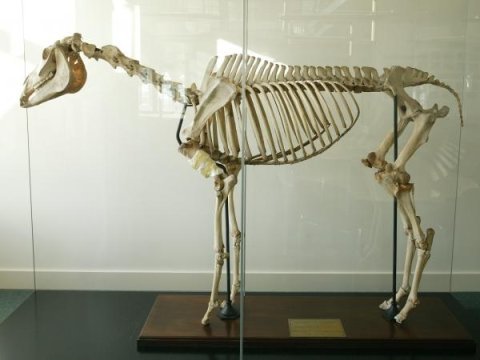
If a time-machine could somehow bring Eclipse to race against today's thoroughbreds (and if the myth of Eclipse's speed and staying power is true), he'd bury them. He shows how much the breed has degenerated through inbreeding and sheer greed of the racing industry. He was a horse of iron in comparison to the horses of Kleenex that run on tracks today. Even his skeleton could beat today's horses -- you know, if skeletons could run, that is. Here is Eclipse's skeleton:
Clee spends a good deal trying to describe what racing at the time was like -- and it was a good deal different than today's million-dollar events. I found this entertaining to read, but someone looking to read just about the horses may be disappointed.
In an interesting side note, DNA Tests have shown that most modern Thoroughbreds can directly trace back to Eclipse -- including the entire field of the 2006 English Derby.
If a time-machine could somehow bring Eclipse to race against today's thoroughbreds (and if the myth of Eclipse's speed and staying power is true), he'd bury them. He shows how much the breed has degenerated through inbreeding and sheer greed of the racing industry. He was a horse of iron in comparison to the horses of Kleenex that run on tracks today. Even his skeleton could beat today's horses -- you know, if skeletons could run, that is. Here is Eclipse's skeleton:
Clee spends a good deal trying to describe what racing at the time was like -- and it was a good deal different than today's million-dollar events. I found this entertaining to read, but someone looking to read just about the horses may be disappointed.
In an interesting side note, DNA Tests have shown that most modern Thoroughbreds can directly trace back to Eclipse -- including the entire field of the 2006 English Derby.

March 19, 2013
Advertised on the cover as "Seabiscuit without the schmaltz" didn't really endear me to this book, as I loved Laura Hillenbrand's tale. And schmaltz or not, she did a far better job bringing the humans associated with Seabiscuit to life than Clee did with the humans in Eclipse's life. I found this book to be pretty dry, especially when the horses were set aside for the humans. Eclipse's brilliant, undefeated racing career seemed barely touched upon, as he did his breeding career, in order to focus on Dennis O'Kelly and his contemporaries. I very much enjoyed the brief essays on some of the greatest horses of Eclipse's male line (St. Simon, Nijinsky, Secretariat, and Dubai Millennium among others) and the discussion of Eclipe's wandering skeleton, but by then I was in the last 100 pages or less of the book.

September 19, 2025
Eclipse was a British racehorse, foaled in 1764. He won 18 of his 18 starts and went on to be a highly successful sire. Many of the modern racehorses we know come from some of his descendants, including Northern Dancer and Sunday Silence. This book provided an interesting look at his career. I enjoyed learning more about this horse and the connections around him.

April 26, 2012
This was fun to read! I love horses and racing and this horse is the root and foundation of thoroughbred racing. He is the bomb, the ONE, the mostest; a prepotent sire who is the ancestor of more than 95% of thoroughbreds today. By itself that would be enough to interest me, but the story just gets better and better. In Eclipse's time(late 1700's, early 1800's) English racing was at its wildest and most wide open. Certainly, many owners were so-called gentlemen and members of noble families or even Royalty, like the Prince Regent. But a noble pedigree doesn't mean you won't swindle cheat and dope to win a race. When the striving talents of the lower classes were added to the mix, there was a whole lot of swindling going on. Eclipse's owner, an Irishman named Daniel O'Kelly, was probably the most colorful rapscallion to ever disgrace a racecourse. He arrived from Ireland with a bad attitude and the clothes on his back. He had the charming blarney common to scoundrels and the sexual appetites of a crazed chinchilla on crack. There was nothing he wouldn't do to get money except honest labor. His exploits with women were the stuff of scandal, but the love of his life was Charlotte O'Hare, one of the most famous "soiled doves" of the Regency period. After she "retired" from her life as a working girl, she became the "Abbess" of one of London's most notorious brothels. Together, she and O'Kelly had a lock on illicit entertainment. When O' Kelly came into ownership of Eclipse, it was the biggest deal of his life. The horse had speed and stamina and even when retired to stud, this horse proved to be prepotent; that is, his get had the finer qualities of both sire and dam. He was a champion who got more champions. Author Nicholas Clee not only tells us the tale of this remarkable horse, but he explains many fine points of racing and breeding in clear simple ways. This book made me want to put on my bonnet and pelisse and hop into the gig for a drive to Newmarket to drink champagne and watch the races with Prinny.

July 15, 2015
Eclipse: The Horse That Changed Racing History Forever by Nicholas Clee appealed to me because of its connection to the Kentucky Derby and especially to Secretariat. I've always had an affinity for horses because they are so graceful, beautiful, and strong. I studied the Kentucky Derby in school, but I never gave much thought to the history of horse racing. Eclipse reminded me that racing has a long and rather sordid history. Clee delves into the history of horse racing and doesn't shy away from presenting different oral histories that have been accepted even though they contradict one another. Eclipse in some ways reminded me of how easily stories are spread regardless of the truth and how those stories become folklore. The factual elements of Eclipse's story are fascinating and interesting even without the intrigue created by the stories surrounding him. Clee spends a tremendous amount of time focused on the people who surrounded Eclipse in an effort to not only explore Eclipse's descendants but also his ascendants. His examination pushes the reader to see Eclipse in context of both his time and in context of his contribution to the future of racing. The treatment of horses during the time period surrounding Eclipse made my heart ache. In today's world, we'd recognize the treatment as abuse yet I couldn't help but wonder if we haven't traded one set of abuses for another all in the name of entertainment. While Eclipse is definitely a history lesson, it's also an important examination of how the racing industry became what it is today as well as human attitudes toward the other beings with which we share the Earth.

May 7, 2012
The blurb on the front of the book says, "A ripping yarn expertly told...Seabiscuit without the schmaltz." Well, they got that half right. Where Seabiscuit was an incredibly readable, detailed history, this was a meandering, dry, dare I say boring book that dragged and dragged and dragged. I will read any kind of horse racing book out there, but this one felt at times only peripherally related to Eclipse. The writing also feels slightly more academic than storytelling (hence, the dryness).
I will say, once I started powering through this, the two chapters on Eclipse's descendents saved it for me. The very short bios of more modern racehorses were much more readable than the rest of the book.
I will say, once I started powering through this, the two chapters on Eclipse's descendents saved it for me. The very short bios of more modern racehorses were much more readable than the rest of the book.
February 23, 2010
The history of Eclipse, owned jointly by a gambler and a brothel keeper should have been one of the most fascinating histories of all time, but Mr. Clee's account was oh-so-very dry.
Too much of the book rambled off into commentary on other subjects and horses.
It was informative and well-researched but as much fun as a history book.
Too much of the book rambled off into commentary on other subjects and horses.
It was informative and well-researched but as much fun as a history book.

May 19, 2012
I really wanted to read about the racehorse. What I actually got was a detailed history of 18th Century prostitution and so many footnotes I couldn't keep track of the current subject.

May 23, 2015
It was an interesting read about racing during Eclipse's lifetime. Chockful of dangerous and shady characters with lots of rumor and innuendo about horses, their bloodlines, their owners, etc.

March 2, 2021
I think the book should not have been advertised as one about Eclipse himself as it definitely is more so a book about the time period as well as the history of horse racing. However, once you get over the fact the novel isn’t what you expect it to be, it is quite interesting. I found the exploration of England at the time to be quite exciting, and I liked the brief stories of some more recent celebrated horses of Eclipse’s lineage. My only criticism except for the somewhat false advertising is that it definitely reads quite slowly. I found myself not retaining what I read very well. It’s a very academic piece of writing and information dense.

February 23, 2018
Wow!! What a swashbuckling story of the horse and the man who owned him. Really interesting stuff about the pedigree of early thoroughbreds and the history of horseracing. I'd give it 20 stars if I could.
September 13, 2019
Interesting story but a little slow.
January 30, 2025
Didn't like this at all. Seemed more about the people then the horse. Hard to follow. long and boring.
June 16, 2013
I am sure that most readers who pick up "Eclipse" will either already have a keen interest in horseracing or will be equally keen students of 18th century social history. In both cases the book will not tell them much that they did not already know - the author explains, often with the use of extensive, academic-style footnotes, details about racing and Georgian London that often seem to just show how much research he's done. The trouble is that the subject of the book is elusive - racing in the days before mass media there are only the bare results and contemporary accounts to show what a dominating presence Eclipse was in his day, both as a racehorse and then as the most influential stallion in the history of bloodstock breeding. Racing in those days was not a pastime enjoyed by the great masses and so Eclipse was never a national hero in the way Red Rum and Arkle were to become.
Where the book works well is when it focuses on the horse, his owner, the Irish "wide-boy" O'Kelly and his brothel-owning mistress. I could see it working well as a piece of fact-based fiction, with the horse running up his amazing sequence of wins and the owner wheeling and dealing and running up against the establishment of racing, the landed gentry who ran the sport until the last quarter of the 20th century. But Eclipse has retired to stud (unbeaten) well before the halfway point of the book and O'Kelly is dead soon after. So then the book is padded out with an exposition on the anatomical studies done by George Stubbs for his paintings, the search for the relics of Eclipse (his skeleton is at the veterinary college, but at various times there were 9 of his "genuine" hoofs in existence!)and an overview of the last 200 years of racing history in 2 chapters, focusing on the exploits of the descendants of Eclipse: as this includes over 90% of all modern Thoroughbreds this lacks exclusivity.
Although the style of "Eclipse" is somewhat academic and dry it is a readable book and it comes to life when it is allowed to focus on the horse and the racing - maybe someone will one day use it as the research background for a novel or a film!
Where the book works well is when it focuses on the horse, his owner, the Irish "wide-boy" O'Kelly and his brothel-owning mistress. I could see it working well as a piece of fact-based fiction, with the horse running up his amazing sequence of wins and the owner wheeling and dealing and running up against the establishment of racing, the landed gentry who ran the sport until the last quarter of the 20th century. But Eclipse has retired to stud (unbeaten) well before the halfway point of the book and O'Kelly is dead soon after. So then the book is padded out with an exposition on the anatomical studies done by George Stubbs for his paintings, the search for the relics of Eclipse (his skeleton is at the veterinary college, but at various times there were 9 of his "genuine" hoofs in existence!)and an overview of the last 200 years of racing history in 2 chapters, focusing on the exploits of the descendants of Eclipse: as this includes over 90% of all modern Thoroughbreds this lacks exclusivity.
Although the style of "Eclipse" is somewhat academic and dry it is a readable book and it comes to life when it is allowed to focus on the horse and the racing - maybe someone will one day use it as the research background for a novel or a film!

January 8, 2015
For a book touting itself as biography of Eclipse, I still know very little about Eclipse now that I've finished it. In fact, we reach the end of Eclipse's racing career only one third of the way into the book. There's also a chapter about Eclipse as a sire, and then at the end of the book they talk about his skeleton a little. Otherwise, this could be looked at as a combined biography of Eclipse's owner and general history of English horse racing, with plenty of information on the history of prostitution in 18th century England, gambling in 18th century England, and boxing in 18th century England. Not really what I was hoping to get out of it.

July 29, 2012
I couldn't decide between 3 and 4 stars on this one. I thought the writing was great, and loved how the author went into detail on the historical record and used unexpected detours into the social history and biographical connections between players in the racing scene - both efforts really enriched the book for me. Nonetheless, I felt it was hard to make it through the second half of the book. Recommend for horse lovers, aficionados of the Turf, or newbies interested in learning about the basics and history of Thoroughbred racing in an easy, pleasant way.

March 31, 2012
I very much enjoyed this book. It's a good look at the times back then, particularly the racing practices. Eclipse's owner was...uh...something else? The beginning, which focused particularly on him, was kind of slow and boring, but I can see where someone else might find those parts more interesting.
All in all, a must have for any horse racing fan-cum-history buff, as this combines those two loves.
All in all, a must have for any horse racing fan-cum-history buff, as this combines those two loves.

March 5, 2013
What do you get when you take a gambler, a rogue and a madam? The world's most prepotent race horse, Eclipse. This social history of the Georgian era in Britain is rife with big money, bad behavior and incomparable horses. Clee paints an oftentimes rather hilarious picture of the times. This isn't just a horse biography, it's a well researched analysis of the mores and foibles of polite and not-so-polite society of the mid to late 18th century.
July 3, 2013
I really enjoyed this book. I love horse racing and like history and this book had both so it was very easy to enjoy. Mr. Clee has a very nice style that is easy to follow. I really enjoyed the backgound on the main characters - being neither the upper nor the lower eschelon, I feel that they were a group that is seldom written about. I feel he did very well in his horse racing history too!

May 5, 2012
Entertaining and informative - as much about the birth and evolution of Thoroughbred racing as the horse who has become the ancestor of a large percentage of the breed.
(Also - horse names in the 1700s were something else. Pot8os is perhaps my favorite among Eclipse's sons.)
(Also - horse names in the 1700s were something else. Pot8os is perhaps my favorite among Eclipse's sons.)

May 17, 2013
An interesting look at the birth of modern horse racing; yet the most compelling parts of the tale are the people and the times the great horse came from. The follies and foibles of the humans involved made me hungry for more information on the times.

July 26, 2013
The book was on the short side which was disappointing, and there was more about his owner/trainer then the actual horse. In general it was a great read for any race horse fanatic since you cannot typically find much information about Eclipse

January 5, 2015
A great reference book for those looking for information on this great animal as well as early British racing history. At the times, the writer goes off topic, but the tangents are interesting although not pertinent to the subject.
January 6, 2015
A very good history of the horse that started it all and the people that surrounded him. Clee does a masterful job of bringing you into the 18th century and building a very real world out of race records, ledgers and bills. Brilliant.

April 10, 2016
Not the best racing book you'll ever read but considering the legacy of Eclipse essential reading for turf fans.
The author does a commendable job of bringing the world of Eclipse to life despite the limited and unreliable source material available.
The author does a commendable job of bringing the world of Eclipse to life despite the limited and unreliable source material available.

August 10, 2012
Great look at 18th century horse racing and society in England. Fascinating study of Eclipse's influence on Thoroughbred development down to the present day.
October 29, 2012
Informative - lot's of Thoroughbred history.

November 24, 2014
This was a fun and interesting look at the history of horse racing as well as an eye-opening account of how much influence one horse had over the entire breed and sport.
Displaying 1 - 30 of 31 reviews