Jump to ratings and reviews
Rate this book

Vedanta and Christian Faith

Rate this book
"His life suggested that one could be spiritually grounded and thriving in more than one tradition at the same time.” —Marcus Braybrooke, for the  Interfaith Observer
This pioneering work harmonizes Hindu Vedanta philosophy with the Christian vision of the Word made flesh through the Spirit of God's love. An introduction to the Vedic scriptures and Christian mysticism that reveals how God lavished his riches on both Christians and non-Christians alike and the importance of our unity as a people if we are to become whole.  “Without Christianity I don't think the oriental religions, Hinduism and Buddhism, can answer the needs of the modern world. But without the enrichment of the mystical tradition of Asia I doubt whether the Western Churches can really discover the fullness of Christ which we are seeking.” (Bede Griffiths)

118 pages, Paperback

First published June 1, 1995

Loading...
Loading...

About the author

Bede Griffiths

67 books34 followers
Bede Griffiths (1906-1993), born Alan Richard Griffiths and also known as Swami Dayananda (Bliss of Compassion), was a British-born Benedictine monk who lived in ashrams in South India. He was born at Walton-on-Thames, England and studied literature at Magdalen College, Oxford under professor and Christian apologist C. S. Lewis, who became a lifelong friend. Griffiths recounts the story of his conversion in 1931 to Roman Catholicism while a student at Oxford in his autobiography The Golden String.

Although he remained a Catholic monk he adopted the trappings of Hindu monastic life and entered into dialogue with Hinduism.

Griffiths was a proponent of integral thought, which attempts to harmonize scientific and spiritual world views. In a 1983 interview he stated,

"We're now being challenged to create a theology which would use the findings of modern science and eastern mysticism which, as you know, coincide so much, and to evolve from that a new theology which would be much more adequate."

Ratings & Reviews

What do you think?
Rate this book

Friends & Following

Create a free account to discover what your friends think of this book!

Community Reviews

5 stars
9 (47%)
4 stars
6 (31%)
3 stars
4 (21%)
2 stars
0 (0%)
1 star
0 (0%)
Displaying 1 - 4 of 4 reviews
Profile Image for Scriptor Ignotus.
618 reviews309 followers
April 29, 2026
Bede Griffiths was an English Catholic priest and Benedictine monk who spent much of his life in ashrams in southern India, integrating Vedantic thought and spiritual practice with an orthodox Catholic theology and devotional orientation. Becoming well-versed in both worlds and finding them eminently compatible, his life and work represent a discovery that many spiritual seekers before and after him—whether Christian, Hindu, Muslim, Jewish, Sikh, Buddhist, or whatever else—have made: that Jesus, especially when considered as a religious subject, as one who prays, fasts, sacrifices, studies, teaches, undergoes a spiritual transfiguration that is visible to others, suffers martyrdom, and ascends to a state of unity with the Divine, establishing a Way and gaining a certain intercessory power to enlighten those who follow him, makes at least as much sense—if not more—within the conceptual frameworks of other religions as he does within the edifice built specifically around him; an edifice that, in honoring his divinity, enshrines him as an object of worship and veneration. While there is nothing inherently wrong with this objective approach, and Griffiths himself, as mentioned, was perfectly orthodox in his Nicene and Chalcedonian Christology, there is a danger that in excluding the subjectivity of Christ—his experiential oneness as a human being with the Father in the pure, unconditioned Mind, Awareness, or God-consciousness underlying all emergent phenomena which Christianity calls the Logos, realized in the consummate bliss of the Spirit of Life—one renders him remote and inaccessible; an exceptional case set apart from our shared human nature, rather than one in whom the truth of that nature, its inherent and ultimate nonduality with the essence of God, is revealed; the tip of the spear for the spiritualization—the awakening, enlivening, and transparence to consciousness—of all things from the inside out, for God’s becoming All-in-All.

For Griffiths, the supreme insight of Vedanta in its various forms—he examines the three classical schools: the Advaita of Sankara, the Vishishtadvaita of Ramanuja, and the Dvaita of Madhva, finding in each deep resonances with a Christian understanding of creation and deification, but nothing exactly equivalent to it—is the identification of Atman (the Self, the universal subject) with Brahman (absolute being and reality); the understanding that being and consciousness, the essential “thatness” of reality and the awareness of it, are ultimately coincident with reality itself; as is the infinite life, experienced as bliss, that is present when this oneness is realized. Reality is Being, Mind, and Life, unencumbered by the limitations and separateness that characterize the world as we typically perceive it. Where one of these attributes is lacking, as is always the case (or at least always seems to be the case) in the created or maya-bound order, the others are deficient as well. These are the three constituents of the composite term Satchidananda, the threefold character of the experience of union with God in Vedanta, when one has transcended all relative and contingent existence to reside in the inexpressible, inexhaustible, and incomprehensible One. They also correspond, of course, to the three divine hypostases of the Holy Trinity.

The Vedantic identification of God with the fire of personal consciousness or subjectivity—the “I AM that I AM” (to use perhaps the biblical equivalent of the Upanishadic “That Thou Art”) that shares itself with each individual soul or jiva and at once illuminates, creates, and becomes every object of perception without being reduced to it—provides a more intuitive basis than the categories of most Western theology for understanding Christ as the incarnate Logos of God. Christ had an individual body and soul/psyche like every other person; and underneath this limited, egoic self was the divine “I AM,” the same supreme, universal Self through which all things come into being and which imparts itself, like one flame igniting others without itself being diminished, to all spiritual natures. This supreme Self, the highest Self of all beings, is the Logos of God. In Christ, the individual ego-self is so transparent to the Logos as to be identical with it. His identity with the Logos was revealed in a life lived not for itself but given over to the Spirit of Life, ultimately laid down for the life of the world.

Hui-neng, the seventh-century Chan Buddhist master, reportedly said that “to an ordinary man, even a Buddha is an ordinary man; but to a Buddha, even an ordinary man is a Buddha.” Likewise, Christ’s identity with the Self of All was manifested in his ability to see the same Self in every person: to the Son of God, everyone is a child and heir of God; for the same Logos which is the Self of Christ—as which Christ is the Self of the cosmos and the one through whom the shattered image of God in creation is restored to its original purity; in whom Subject (hypostasis/Logos), Object (essence/Sophia), and eternal life are united in creation as they are in God; the Point at which matter, having through long ages of evolution become the vehicle of the living soul, is transformed into the life-giving Spirit, the vehicle of God-consciousness (this is the nature of resurrection)—is fully present to and as each of us; the difference between ourselves and Christ being only that in us the Logos is obscured by our egoic, fragmentary condition.

While union with God is often conceived in Vedantic thought as the total absorption of the individual person into the ocean of divine being, consciousness, and bliss, Christianity tends to use the rather different analogy of spiritual generation and birth. The Christian union with God is a union in relation; a bond of love that does not abolish the distinctness of personal, hypostatic being but in fact makes this personal existence fully real. This is why Christ can say "I am in the Father and the Father in me" (Jn. 14:11), and "the Father and I are one" (Jn. 10:30), but not "I am the Father." Love for God and man entails a unity in multiplicity; Christ's identity with the Logos is realized precisely in his love for the Father, whose Word he is. As Christos Yannaras puts it, love is what forms being into hypostasis, both in the “inner” life of God and within creation. The love by which two parents beget a new, distinct, and irreducibly unique human person is an image of the divine love that gives birth to children and heirs of God. Christ imparts the Spirit, which germinates the logos spermatikos, the seed of God-consciousness latent in every person, until Awareness blooms and one is born from above as a created god. Our personal uniqueness is not to be obliterated, but to grow into its archetype in the mind of God, and with it the whole creation; an infinite ascent into Satchidananda.

Beloved, we are God's children now, and what we will be has not yet appeared; but we know that when he appears we shall be like him, because we shall see him as he is. (2 John 3:2)
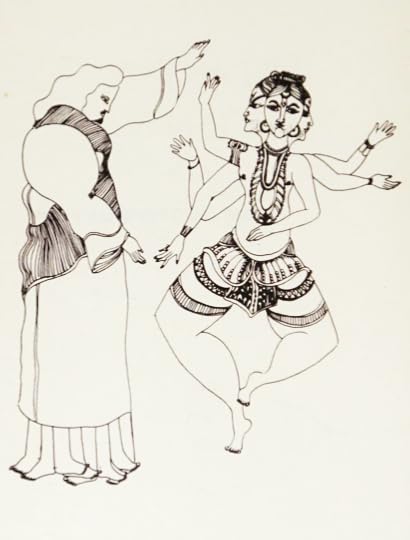
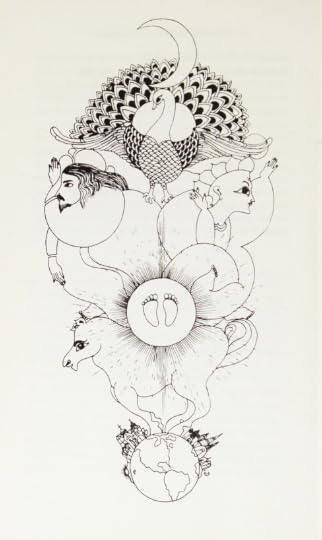
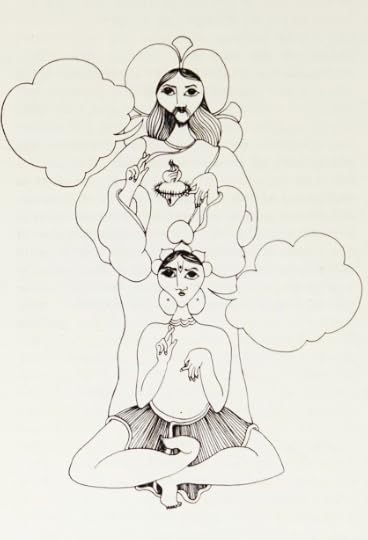
Anyway, here are some cool illustrations from the book.

description

description

description
Profile Image for Roger Carter.
61 reviews
March 1, 2024
Left me speechless

This book is astonishing. I think I have been looking for this exposition all my life. That’s all I can say.
Profile Image for Michael Michailidis.
63 reviews13 followers
April 3, 2026
Refreshing

If the Devil is in the details then the “one-ness” idea that sprang from the 1960s expected a literal invitation to the Devil himself by missing all of the details of those Hindu doctrines it professed to have understood so deeply. This book is in fact about those very details.
Profile Image for Gregory Klug.
50 reviews1 follower
February 28, 2026
Thoughtfully and honorably written, with several important insights about transcendence, but I personally get tired of needing to reconcile things with orthodox Christianity. The author feels forced to reject the ‘pantheistic’ systems of Vallabha and Ramanuja, but these are the most seamless and refined for me. I feel more confident, after reading this book, that mystical or spiritual experience is profound, beautiful, and unified; but that the theological systems used to conceptualize them are various, contradictory, and often tedious. I grow more and more convinced that the tedium is hardly worth it. Still, concepts are necessary, and they need to be coherent. I suppose it’s just orthodox concepts that are tedious for me. But the book is well-written, and the author’s orthodoxy will be a point in his favor for other readers; and he has much to teach about the Hindu views.
Displaying 1 - 4 of 4 reviews