Jump to ratings and reviews
Rate this book

American Empire Project

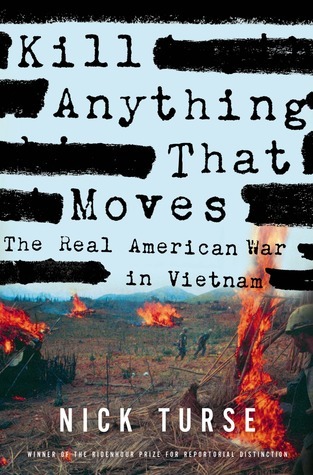
Kill Anything That Moves: The Real American War in Vietnam

Rate this book
Based on classified documents and first-person interviews, a startling history of the American war on Vietnamese civilians

Americans have long been taught that events such as the notorious My Lai massacre were isolated incidents in the Vietnam War, carried out by “a few bad apples.” But as award-winning journalist and historian Nick Turse demonstrates in this groundbreaking investigation, violence against Vietnamese noncombatants was not at all exceptional during the conflict. Rather, it was pervasive and systematic, the predictable consequence of orders to “kill anything that moves.”

Drawing on more than a decade of research in secret Pentagon files and extensive interviews with American veterans and Vietnamese survivors, Turse reveals for the first time how official policies resulted in millions of innocent civilians killed and wounded. In shocking detail, he lays out the workings of a military machine that made crimes in almost every major American unit all but inevitable. Kill Anything That Moves takes us from archives filled with Washington’s long-suppressed war crimes investigations to the rural Vietnamese hamlets that bore the brunt of the war; from boot camps where young American soldiers learned to hate all Vietnamese to bloodthirsty campaigns like Operation Speedy Express, in which a general obsessed with body counts led soldiers to commit what one participant called “a My Lai a month.”

Thousands of Vietnam books later, Kill Anything That Moves, devastating and definitive, finally brings us face-to-face with the truth of a war that haunts Americans to this day.

370 pages, Hardcover

First published January 15, 2013

801 people are currently reading
24075 people want to read

About the author

Nick Turse

15 books98 followers

Ratings & Reviews

What do you think?
Rate this book

Friends & Following

Create a free account to discover what your friends think of this book!

Community Reviews

5 stars
2,448 (46%)
4 stars
1,908 (36%)
3 stars
717 (13%)
2 stars
152 (2%)
1 star
60 (1%)
Displaying 1 - 30 of 811 reviews
Profile Image for BlackOxford.
1,095 reviews70.3k followers
September 16, 2021

America Is #1❗️

All power is untrustworthy, everywhere and about everything. There are no exceptions. Agents of power in a democracy lie more than similar agents in a dictatorship because democratic power is more vulnerable. This is the only epistemological principle to survive in a world of increasingly concentrated power. Nick Turse’s book demonstrates the validity of this principle, and with it the corollary that the greater the power the greater the lies that emanate from it. The United States has for some time been the most powerful democratic country on the planet. And its lies are the biggest and best in the world. Greatness is at hand.

During the American war in Vietnam, between 3 to 7 million were killed in a country of 19 million. No one knows the number with any greater precision because records of civilian deaths were purposely avoided, or as proportionately underestimated as military body counts for enemy troops were over-estimated. While many of these were ‘collateral damage’ in American military operations, most were intentional killing of unarmed and non-threatening civilians, mostly women and children, or the result of military policy decisions like ‘free fire zones,’ irresponsible aerial bombardment, and an almost complete absence of training in either the Geneva Conventions or local culture.

These deaths, therefore, were not exceptional and accidental but routine and systematic, the consequence of both military policy and a pervasive ground-level homicidal ethos created in training and passed down continuously through the chain of command. This ethos not only failed to understand the reality of the social and political situation in the country, it also successfully de-humanised the entire population in the minds of American soldiers. With an average age of 19, these soldiers were effectively children, armed with the latest military technology, frustrated by the system which kept them in physical misery, constantly fearful of violent death, and kept on the edge of psychic survival by the demands of their job.

The now infamous massacre at the village of My Lai in 1968 is exceptional only because it was discovered and reported in the American media. At My Lai a company of U.S. soldiers murdered an entire village of 500 women, old men, children, and infants over a period of four hours (with a break for lunch). The entire company participated with no significant hesitation or protest by anyone. The officer in charge had received a direct command to wipe out the village, which he carried out meticulously and without question. The incident, upon being ‘leaked’ by several observers, was denied up the entire chain of command. Eventually one man, the company officer, was subject to court martial, spent several months under house arrest, and received a presidential pardon.

Turse’s research revealed hundreds of similar incidents which, because they never reached visibility in the popular press, were simply buried by the military authorities. Some further, uncountably larger number of such incidents are common knowledge among the men involved as documented through hundreds of interviews carried out by Turse. All show the same pattern as that in My Lai: unopposed murderous brutality, perceived as not just necessary but normal by those participating, and protected by a code of omertà at the highest levels in the military and beyond.* Patriotic service, military commitment, loyal camaraderie, indeed heroism had become a matter of killing without restraint.

What underlay this total moral breakdown? In Vietnam everyone lied to everyone else. They had to in order to keep the system going, to make careers, and often merely to stay alive. Government officials lied to the military commanders, who lied to their subordinates, who lied to the soldiers on the ground - about everything from the rationale and progress of the war, to the real purpose of individual military operations, to the air and logistical support that could be expected. The troops responded in kind, lying about body counts, the details of operational encounters, and their attitudes towards their officers and comrades.

These ‘chain of command’ lies were augmented by administrative lies - failure to report or pass on reports of illegal military conduct; refusal by relevant officers to initiate courts martial or other disciplinary procedures; dismissal by courts martials themselves of obvious crimes; and the systematic destruction of documents and records of thousands of likely criminal incidents. Mendacity was not just a policy, it was also a culture within which atrocities were tolerated, indeed encouraged as long as evidence to the contrary could be suppressed, ignored, or denied.

Literally everything recorded and reported about the war was what we have come to call fake news. Upwards of 3 million American soldiers, advisers, agents, and officials lived in the midst of this fake news, were aware of its falsity, and experienced the social reprogramming necessary to establish and normalise an ethos in which this fake news was accepted. Even before Turse’s investigation of official archives, it was clear that the malaise was systematic throughout this substantial military population: And it is clear from the Army’s own investigations that the problem was pervasive:
“the War Crimes Working Group files alone demonstrated that atrocities were committed by members of every infantry, cavalry, and airborne division, and every separate brigade that deployed without the rest of its division—that is, every major army unit in Vietnam.”
The 3 million men returned home with the knowledge of both the acts and the refusal to acknowledge the acts and their consequences.

Given the frequent personal psychological dysfunctions that have been reported and analysed over decades since the end of the war in Vietnam, is it an exaggeration to suggest that these 3 million men formed a sort of leavening agent in American society, changing the social matrix of the country for generations to come? To what degree, one wonders, is the increasing rate of violent crime in the country; its persistent racism, and its populist mistrust of government (including its Trumpian expression, however paradoxical) a consequence of not just the training to kill and the suspension of basic moral structures, but also the normalisation of the lie as an American mode of being?

Subsequent experience in Iraq, Afghanistan, and Syria suggests that while the country may not be very successful on the battlefield, it is certainly an undisputed #1 when it comes to lying, particularly to itself. In this, among possibly many others, Trump is indeed the perfect representative of his country.

* See https://www.goodreads.com/review/show... for the consequences of mendacity within the highest government levels during the war.
Profile Image for Amanda.
282 reviews308 followers
March 24, 2013
In his famous chapter How to Tell a True War Story from the Vietnam classic The Things They Carried, Tim O'Brien says, "True war stories do not generalize. They do not indulge in abstraction or analysis. For example: War is hell. As a moral declaration the old truism seems perfectly true, and yet because it abstracts, because it generalizes, I can't believe it with my stomach. Nothing turns inside. It comes down to gut instinct. A true war story, if truly told, makes the stomach believe" (78).

Kill Anything That Moves is not a pleasure to read. It's not an entertainment. It's a rote account of atrocity after atrocity that gives names and faces to the abstraction created by numbers and statistics. And I felt it in my stomach with every turn of the page. This is war at its most foul, most hellish, most base and brutish. In other words, it's war without the veneer of romanticism; it's war that is not cloaked in nobility and honor and valor. It's about what men can and will do to a people they feel are inferior, labeled as "Other." It's an important book because it confronts us with the truth of what war is and the toll it takes on the land on which it's fought and its civilian populace. And it reminds us of the moral corrosion it sometimes inflicts upon the boys--little more than children--who fight it.

Countless novels and non-fictions have been written about the horror of the Vietnam War and the impact it had on a generation, and rightly so. It is important to acknowledge the service and sacrifice of those who fought, regardless of how one feels about the policies of the U.S. in Vietnam. However, those accounts have mostly focused on the American cost in the war. Turse's account is different in that its purpose is to explore the war atrocities committed by American forces as a result of military policies that reinforced a "kill anything that moves" mentality. The book also reveals that My Lai was not an aberration, but only seemed one after the military used intimidation and cover-ups to keep other atrocities quiet and out of the media. This was especially true of Operation Speedy Express in the Mekong Delta, which led to approximately 5,000 civilian deaths (250).

Because Vietnam was not traditional Western warfare where troops met on a battlefield, the notion of "body count" as a means of determining who was winning was instituted. The results were disastrous. War became a machine with a quantifiable output, leading to increasing pressure to produce high body counts as a sign of American victory. From this, the "Mere Gook Rule" mentality was born--if it's Vietnamese, it must be VC. Kill boards were sometimes erected, keeping tally of how many kills a unit had. Because troops were told that anyone who ran in the presence of U.S. military must be a VC and could therefore by justifiably killed as an enemy, civilians were often purposefully frightened so that they would run. Women, children, and old men who clearly were not enemies were tortured and killed with little or no effort given to ensuring they were, in fact, the enemy. Weapons were planted on some of the bodies so they could be called in as enemy kills. For example, Operation Speedy Express yielded results such as "During the week of April 19 . . . 699 guerillas had been added to the division's body count (at the cost of a single American life), but only nine weapons were captured" (250). Such discrepancies should have raised suspicions--and, in fact, often did--but the whistle blowers were often threatened into keeping quiet. Turse chronicles these harrowing events, both from the perspective of the Vietnamese survivors and from interviews conducted with American veterans.

Turse clearly points the finger of blame at a military establishment more concerned with sweeping everything under the rug than confronting the demons it created with its both spoken and unspoken policies. He's not without sympathy, however, on the part of the average soldier in Vietnam and he doesn't generalize. Not every American in Vietnam is portrayed as a ruthless killer. Many of the soldiers, fresh out of high school, were placed in a war where not knowing who the enemy was, seeing the gruesome and tragic deaths of their comrades, and spending endless days humping through the boonies while worrying about a seemingly phantom enemy created a sense of disorientation, fear, and anger. Combined with fear of retribution should they disobey orders, many would do as they were told without second guessing command. The book is also not without its heroes. Men like Jamie Henry, Ron Ridenhour, and the 100 Vietnam veterans who testified at the Winter Soldier Investigations refused to remain silent about what they had seen, and participated in (both willingly and unwillingly), in Vietnam. The Winter Soldier Investigations themselves "put the lie to any notion of bad apples and isolated incidents . . . the Winter Soldiers explicitly pointed to superior officers and command policies as the ultimate sources of the war crimes they had seen or committed" (239). It took tremendous courage to stand up to the military establishment and these men should be praised for their refusal to keep silent on behalf of a people who seemed a world away to the average American.

I'm not naive enough to think that war is completely unavoidable. However, books like Turse's remind us of what war really is and how it can warp the morality and finer points of human nature. It's also a reminder that when we send our men and women in uniform to fight on behalf of our country, we better make certain it is for a justifiable cause--because the costs are just too high and the sacrifice too great, for both sides, when it's not.

Cross posted at This Insignificant Cinder and at Shelf Inflicted
Profile Image for Dem.
1,259 reviews1,427 followers
August 13, 2018
3.5 Stars

A insightful and shocking expose of US armed forces during the Vietnam War. I had not read or listened to any books on this subject and this did make for grim but important reading and while I struggled through it, I feel I have gained a little insight to a war that I learned very little about in history class

This is a very well researched and written account and one I listened to on audio which I think might have been a tad easier had I sourced a hard copy of the book as I found the tone of the narrator was lifeless I struggled through this one. However the information is there and the author does an incredible job of painstakingly sourcing instances of war crimes though the government’s own records. I was appalled to read of the shocking accounts of the mounds of corpses, including women, children, and even babies, murdered by American troops in the Vietnamese hamlet of My Lai and this is something that will stay with me for a long time.

This is not an easy read, but I do think it is an important one in understanding what happened in Vietnam, if like me you have very little knowledge on this time in history.
Profile Image for Stefania Dzhanamova.
535 reviews575 followers
January 8, 2023
In his book, Nick Turse presents his meticulous research about American war crimes in Vietnam in the form of what is, for me, the most comprehensive, interesting, and thought-provoking account of those atrocities. Turse deserves praise for so many things that it is difficult to decide which ones to duscuss.  

What I noted and liked was that he did not approach the topic of war crimes during the Vietnam conflict as if the My Lai massacre was the only war crime that happened. I know that it is the most well-known atrocity, but too many authors have focused on it, fostering the idea that it was an exceptional case, while it actually was not. It was one of many equally bad, if not worse, war crimes. The author himself offers an interesting explanation why My Lai was the only atrocity of the Vietnam conflict to become so popular despite being neither the first nor the last. According to him, when the news of the massacre shook America and the world, and the pro-government media realized that they could not deny or disregard it anymore, they chose a different tactic: they stopped trying to convince people that American soldiers were not committing war crimes and instead began to treat war crimes as old news. They used the idea that atrocities were obviously an essential part of war to excuse not writing about any war crimes after My Lai. This is why most of the atrocities committed during the Vietnam conflict were either forgotten or never widely known.

I am happy that Turse did not go down this familiar road and instead introduced the readers to the countless other atrocities that prove that My Lai was not an individual case of brutality but one instance of a system of suffering that was made possible by the government's policy toward Vietnam, the body count approach to winning the war, and the widespread racism among American military men and government officials. He tells about the massacre at Trieu Ai, a war crime committed by Marines in 1967, about what Bravo Company did to the people of Ma Khe, a neighboring hamlet of My Lai, about Tiger Force's killing rampage, and about so many other acts of individual and collective cruelty – from rape to torture, to killing. His work is one of the few that manage to convey the scale of the damage that American soldiers inflicted on the people of Vietnam.

Furthermore, he underscores that for all the pain and suffering unit-level war crimes caused, they could not compare to the harm done by chemicals such as Agent Orange and the number of civilian casualties and destroyed lives resulting from the spraying of these toxic herbicides. It was not only defoliation that happened, The chemicals killed livestock and affected negatively the health of villagers. With the fruit trees and the animals dead, the people were driven to even greater poverty and hunger. The women and children got the worst of it. By the end of the war, 500,000 women had turned to prostitution out of hunger and desperation. Saying that many war crimes happened during the Vietnam conflict is not as suitable as saying that the Vietnam conflict was one huge war crime, which brought misery of all kinds to innocent people every day.

One fact that I is not usually mentioned, but was pointed out by the author, was that the South Korean soldiers who were American allies in the war also participated in massacres. They killed two hundred people in An Phuoc hamlet in 1966 and, according to some reports, committed more than fourteen massacres in that year only. Unlike the Australians, for instance, the author explains, the South Koreans functioned as American mercenaries because President Lyndon Johnson had poured funds into modernizing the Korean army and training, equipping, and transporting Korean soldiers to Vietnam, so their behavior there reflected that of the Americans. 

Turse also chronicled the case of Sergeant Roy Bumgarner, which I did not know about before. On February 25, 1969, he shot three men, all of them unarmed, defenseless civilians and then reported that his team had found weapons nearby. The case was investigated, and since a soldier from the team, James Rodarte, revealed what had actually happened, Bumgarner was court-martialed. It was also revealed that he had a history of similar crimes, having killed a girl and two boys who also had not had any weapons. Nevertheless, Bumgarner did not spend even one day in prison for what he had done. He was only stripped of his rank and fined ninety-seven dollars a month for two years. His case, one of many, showed how much the American military valued the lives of the people of Vietnam.

KILL ANYTHING THAT MOVES is impressively well-written. Turse has done a brilliant job both researching and writing. This book is definitely worth the read if one is interested in the subject. 
Profile Image for Kaora.
620 reviews6 followers
September 10, 2014
We shoot the sick, the young, the lame
We do our best to kill and maim
Because the kills all count the same,
Napalm sticks to kids.

Ox cart rolling down the road,
Peasants with a heavy load,
They're all VC when the bombs explode,
Napalm sticks to kids.


This book is a little bit different than what I normally read, but I feel it is an important topic. I knew very little of the Vietnam War. I grew up in Canada and our history lessons mainly focused on what the British did or Canada's role in important battles.

So after reading Of Bone and Thunder by Chris Evans, a book based on the Vietnam War and wanting to see the similarities I picked up this book in order to completely understand what I had just read.

I don't think I have ever been quite so angry at a 5 star book. But not at the writing, but at the content. Pages and pages of incidents showing that anyone saying the My Lai massacre being an isolated incident is a fucking liar.

The same massacre of which no one was ever jailed, disciplined or charged for.

Just look up Operation Speedy Express, where 5,000 people died, the majority of those civilians because the US would rather kill innocents than allow VCs access to a river.

I wanted to stop reading 10 pages in. The incidents kept coming, babies bludgeoned, children bombed, old men tortured, women raped. But I couldn't stop. I couldn't close the book. Because some people don't have that option. Because ignorance is what contributed to this. Because ignoring it doesn't mean it didn't/doesn't happen.

Because those who cannot remember the past are condemned to repeat it.

The author does a great job of outlining some of the things that went wrong. In addition to the obvious ones, that Viet Congs were visibly no different, the language barrier, cultural differences, etc there were a number of problem policies, such as using body count to identify the success of a battle. These were then use in promotions, resulting in the most bloodthirsty and ruthless of soldiers being put in charge, even becoming decorated. Training focused on stripping the Vietnamese people of their humanity by using terms such as VC or 'gooks' and convincing soldiers that everyone is a potential VC.

Reports of wrongdoing were quickly covered by planting evidence or resulted in slaps on the wrist, such as a written letter or a demotion. Whistle blowers were threatened and ignored.

This disturbing cycle is just one that revealed itself in this book.

He also outlines what happened after and the disturbing fact that the government continues to lie to us. To hide things from us. And nothing will be done about it until people start realizing.

This book scares me.

It scares me that despite public outcry about My Lai the investigations went nowhere. The army stalled until the public lost interest. They even did not allow the term massacre to be used in a press conference.

It scares me that even after all the horrors that happened here there was nothing learned. They still say they are "Winning hearts and minds."

It scares me that so many can die and be so easily forgotten.

I really hope more people read this book. And start to question what we are being told.

This is only part of the review. More posted at Kaora's Corner
Profile Image for Zach Carter.
265 reviews237 followers
April 1, 2023
I guarantee that however angry you think you are about U.S. aggression and crimes against humanity in Vietnam (and Cambodia and Laos), it's not enough. This is a grueling exposition on the sadistic violence and destruction that the U.S. military brought to Vietnam for years, not sparing a single detail. Turse is meticulous in his documentation of war crimes, but he also does a good job of humanizing the victims - telling the stories from their perspectives, using their names, describing their lives. Every single person responsible for what happened in Vietnam needs to be tried for crimes against humanity and pay reparations before they meet their eternal damnation.
Profile Image for Olethros.
2,724 reviews534 followers
July 31, 2020
-El tiempo revela todo, y más que revelará.-

Género. Ensayo.

Lo que nos cuenta. El libro Dispara a todo lo que se mueva (publicación original: Kill Anything That Moves. The Real American War in Vietnam, 2013) se aproxima a la Guerra de Vietnam desde la perspectiva de una estrategia militar concreta, más o menos explícita, como hecho responsable (o más bien explicativo) de los crímenes de guerra y la violencia contra no combatientes.

¿Quiere saber más de este libro, sin spoilers? Visite:

https://librosdeolethros.blogspot.com...
Profile Image for Michael Perkins.
Author 6 books469 followers
December 18, 2020
The thorough and well-researched Ken Burns documentary on Vietnam readily dispenses with challenges to the veracity of this kind of book. People are people. We are just as susceptible, under certain circumstances, to the heart of darkness as anyone else. Given that the conquest of territory was a meaningless metric of progress in Vietnam, one woeful attempt at a new measure was "body count."

This what happened to my late brother in law......

Right out of high school in the mid-60's, my brother in law joined the Marines and was destined to be in the midst of some of the worst fighting in Vietnam, including being trapped inside a supposed fortress on a hill in The Battle of Khe Sanh, one more bungled piece of strategy by General Westmoreland. The fortress was pinned down by opposing troops, with constant shelling, while the rest of their forces carried out the Tet Offensive, a total surprise to the Americans. The U.S. came very close to losing the war, which may have been a good thing. Secretary of Defense, Robert McNamara, had already decided by then that the war was a lost cause, although he felt it was important to continue so as to save face. War criminal, Henry Kissinger, would later agree and push to prolong even longer to help Nixon get re-elected.

Vietnam has been called "The War Without Heroes" including my brother in law. He came home with severe PTSD and a drinking problem. He also chain-smoked. He would engage in a kind of slow suicide through the heavy use of these substances until he died in a VA hospital in Reno, six years ago.

The author tells this story in his book to reveal something many may not know. Not matching the usual Hobbesian assumptions, troops on WW II were reluctant to shoot at the enemy. The military set out to correct that in future wars, first in Korea, then in Vietnam. The plan was to dehumanize the opposition by portraying them as vermin.

As the author reports, Vietnam recruits were immersed in boot camps that exalted not only a sense of brotherhood, but also the most brutal violence, forcing the men to scream ‘KILL! KILL! KILL!’ until they were hoarse. They were drilled to fire instinctively at realistic human figures. Shooting a firearm became an automated, Pavlovian reaction you could perform without thinking. Second World War veterans (most of whom had never learned to kill) were shocked when shown images of this brand of training.

The American military managed to boost its ‘firing ratio’, increasing it to 95 per cent in Vietnam. But this came at a price. Not only had Innumerable soldiers only killed other people–-something inside them had died, too.

This was my brother in law. Sullen, constantly drinking, always trying to fill the hole in his soul with material things, and the victim of horrific nightmares. Disposable.

------------

war crimes....

https://www.nytimes.com/2017/12/01/op...
Profile Image for Kist.
46 reviews4,297 followers
October 7, 2024
Accomplishes what it sets out to do, which is important, by drawing attention to the horrific actions carried out during Vietnam. Lacks the human psychology side of the story, the why (beyond policy), that other books of this nature and framework (Ordinary Men, Bloodlands, The R*** of Nanking etc) have explored. Solid but left some important meat on the bone.
Profile Image for Nathan Shuherk.
392 reviews4,394 followers
May 8, 2022
Not an easy book, but something you should read.
Profile Image for Wick Welker.
Author 9 books692 followers
September 20, 2021
America is the largest rogue terror state that has ever existed.

I remember when I was a young Boy Scout, my Scout leader was extoling us about the virtues of America. He explained that America is virtuous and moral because it is the only country that goes to war over principle. Well, he wasn't exactly wrong but I don't believe he was referring to the principles found in Kill Anything That Moves.

Beyond just a few bad apples, the American Army, Navy and Air Force engaged in murder, torture, rape, mutilation of not only enemy combatants (whoever they were anyway) but the elderly, women, children and babies. And we're not talking collateral damage. I'm referring to specifically going into a hamlet without men of combat age and directly shooting, raping and murdering every person, child and chicken that moved. The US did this repeatedly in Vietnam for years killing between 3 to 7 million people. They are called war crimes. Or if you prefer, crimes against humanity. The systematic dehumanizing of the Vietnamese was a top down approach to the war where troops were ordered to have as high as "body counts" as possible to justify a disconnected war bureaucracy to keep the cash flowing and feed lies to the American public. Every single aspect of the Vietnam war was vile, disgusting and beyond shameful.

The Geneva Convention and rules of engagement do not apply to the United States. It is the global authority that can make war, and execute that war, however it sees fit within its own self interest. The US destabilizes governments, murders millions of innocent civilians with impunity up to and including today. Nothing has changed since Vietnam.

This book was impossible to read. I had to skip often because it was so horrifying. I actually don't even recommend this book unless you're ready to hear the truth.

Relevant book which I high recommend is the Jakarta Method where the US did the same thing in Indonesia, but covertly.
https://www.goodreads.com/review/show...
Profile Image for Craig Werner.
Author 16 books217 followers
August 29, 2013
As I read this frustrating, unremitting book, I found myself thinking of a line from Alfredo Vea's great Vietnam novel, Gods Go Begging: "It's true, but it's not the truth." Turse is determined to correct what he sees--incorrectly I think--as a thorough whitewashing of the nature of the war in Vietnam by insisting over and over and over again that atrocity was the center of the story. On meaningful levels, that's true, and Turse provides copious documentation of both individual and systemic abuse of Vietnamese, emphasizing--again correctly--the human suffering visited by H&I policies, free fire zones, and operations such as the horrendous Speedy Express. I don't think there's any question about the truth behind the stories Turse tells.

So why the two stars? Part of it has to do with Turse as a historian; he's almost entirely uncritical of his sources, presenting all manner of information as if it's equally trustworthy. This is a problem because it will open him to the sort of criticism that dismisses the points he wants to make. Nothing new about that in discussions of Vietnam; the revisionists will savage anything that doesn't adhere to their "noble cause" hallucinations. No need to help them out. That's tied to the voice of the book, which irritated hell out of me. Without justifying or apologizing for US or South Vietnemese or South Korean actions, I disagree with his choice to call the NVA and the VC "revolutionary forces," especially since--a subordinate clause or two aside--he pretty much gives them a free pass they didn't earn. This is NOT to say that the situation was equally horrible on both sides; it wasn't. But Turse again and again ramps up the rhetoric--his use of adjectives and adverbs and scare verbs bugged the hell out of me--and it has the effect of diminishing, not increasing his impact.

Although Turse is reasonably clear that he doesn't want to blame the soldiers and holds command decisions accountable for what happened on the ground, the weight of the evidence focuses on the soldiers and a reader who doesn't already have the wider context will be likely to emerge with a demonized view of them.

Finally, I simply don't think there's much new here, with the exception of some useful delving into official military records. The Winter Soldier hearings made the basic points Turse claims credit for very clearly, as did the numerous contemporary books he cites. Maybe we've forgotten more than I think we have. If this book reminds us about some of that, well and good. But the truth is in the memoirs and earlier histories that recognized that My Lai wasn't an isolated case.
Profile Image for Randy Fertel.
6 reviews7 followers
January 6, 2013
Kill Anything That Moves is the total fulfillment and completion of Ron Ridenhour's belief, which he took to his early grave, that My Lai was not an aberration but an operation like many another. (Ridenhour was the man who blew the whistle on My Lai -- see ridenhour.org). Turse supports Ron's idea with evidence based on government documents and interviews with veterans and victims. The evidence is as incontrovertible and devastating as it is discomforting. Turse's tone is angry but restrained--just right. These things were done in our name and hidden from us even after the government did the investigations to confirm the allegations. He does not point fingers except up the chain of command, not at the men on the ground who were put in harm's way and asked to do these morally reprehensible things. Shit always flows downhill. Turse makes the case for reversing gravity. No doubt Turse should ready himself for the flame wars. They are coming.

These things matter because how America wages war today is largely based on the lessons -- the wrong lessons -- drawn from Vietnam. The generals learned "no more My Lais" but what that meant was, don't put men on the ground who can be prosecuted and implicate us up the chain of command. Hence our increasing reliance on push-button wars.

One reader he complains that Turse does not listen to the other side, that he should consider "how those same soldiers helped the people in that country." I suggest they read Jonathan Schell's masterpiece The Military Half on the devastation of Quang Ngai province in which he writes: "The Americans in Vietnam liked to speak of the 'military half' of what they were doing, but the 'half' was more like nine-tenths, and the other one-tenth--the contribution to 'nation building'--was often, in the context of the war, pure mockery. For example, it frequently happened that in driving the enemy out of a village the Americans would destroy it. That was the 'military half.' the 'civilian half' then might be to drop thousands of leaflets on teh ruins, explaining the evils of the N.L.F., or perhaps introducing the villagers to some hygenic measures that the Americans thought were a good idea." (quoted in Turse p69)
Profile Image for Josh.
396 reviews5 followers
September 22, 2015
Nick Turse has written a polemical work on the Vietnam War that basically offers nothing new or revolutionary about our understanding of the conflict. Anytime an author suggests that what they are writing is "new" or "revolutionary" or "eye-opening" or a "secret history," I immediately become suspicious. Sometimes that suspicion is unfounded. But, in this case, Turse fits the bill as someone packaging old wine in a new bottle.

His central claim is that "Murder, torture, rape, abuse, forced displacement, home burnings, specious arrests, imprisonment without due process—such occurrences were virtually a daily fact of life throughout the years of the American presence in Vietnam" (6). He echoes Ron Ridenhouer's feeling that the My Lai massacre was not an aberration but an operation.

Many Goodreads reviewers are praising this book effusively for its eye-opening accounts of the "Real American War" and the litany of atrocities allegedly perpetrated by American G.I.s. If they found this book truly mind-blowing then it was probably because they have read nothing about the war or have lived under a rock for the past fifty years. Seriously. The idea that Americans committed wide scale war crimes during the war has been prevalent in the literature and news media since the Winter Soldier Trials in the 1970s. Granted, various Republican and Democratic presidents, conservative pundits, and military innovators have been very effective in their efforts to rebrand the Vietnam War as an inherently noble cause, or alternatively (and much more palatable for the American public) an opportunity to thank the troops for their service. Regardless, Turse has just re-packaged fifty years of speculation and documented evidence about war crimes into a popular history that has Barnes & Noble appeal for readers interested in wanton violence, rape, torture, and sadistic behavior.

If I were to compare the narrative flow of this book to a movie, I would say that it is very similar to the horror series Saw. That is, there is very little explanation of why any of what you are reading/watching really matters other than it is disgusting and horrible. Turse meticulously details rapes, murders, executions, forced evacuations, systemic bombing of villages, massacres, and the effects of napalm on human bodies on page after page. What he doesn't do is situate any of these isolated events into a coherent understanding of the Vietnam War. Well, to be fair, Turse does say all of these isolated events represented the "American way of war": the American military (at all levels of command) intentionally prosecuted a war that "killed anything that moved" to forcibly instill fear in the South Vietnamese people so that they would relocate to refugee camps and, in turn, American soldiers could more easily root out the Vietcong. Turse commits the logical fallacy of reductio ad absurdum by taking much more sophisticated and nuanced arguments about the creation of American strategy and tactics (esp. "Search and Destroy) during this period and pushing them to the extreme of "nearly all military commanders and soldiers were probably murderers or complicit in atrocious violence." Those on the far Left and those who participated in radical segments of the anti-war movement of the 1960s and 1970s will probably find this argument comforting because it confirms what they already believed about the war and American imperialism. However, it doesn't resonate well with more responsible scholarship.

Turse's argument becomes more problematic when one begins looking at his source base. He mined the Vietnam War Crimes Working Group files in the National Archives which incompletely catalogued a number of atrocities and war crimes that were unevenly prosecuted in the post-war years. Mostly, interviewers solicited information from potential witnesses and documented alleged atrocities that occurred throughout the war, ranging from the murder of one prisoner to the slaughter of an entire village. Turse then did his own field work by trying to seek out those who contributed to the VWCWG and solicit interviews. He relies on roughly 300-400 interviews conducted with veterans who self-identified as witnesses to war crimes. Thus, his sample isn't representative of anything other than a small minority of individuals who self-reported war crimes and then consented to be interviewed by the author. It also appears that he used a convenience sampling method, or a snowball method, to compile his interviews by asking interviewees about friends who might also know something about an alleged crime. There's nothing inherently wrong about using a convenience sample when you are producing work that argues for the uniqueness of your source base. It doesn't quite fit with a universalizing argument.

Turse also never offers a firm definition of atrocity. Instead, the term is thrown around throughout the book as a catch-all that becomes so broad that it is essentially meaningless. He groups strategic bombing, the bulldozing of hamlets, forced evacuations, shootings, sexual assaults, and massacres on the scale of My Lai under the same term.

And that leads me to my final critique. Turse peppers the book with testimony from his small sampling of veterans and the VWCWG and then fills in the rest with long, eloquent diatribes against strategic bombing, refugee policies, the strategic hamlet program, and the use of defoliants. By the way, none of this material is new. There are literally hundreds of books that document and castigate American policies on all these fronts.

Turse makes no claims for the historiographical significance or historical significance of his work other than it exposes a "secret war." Well . . . War is hell, and some alleged atrocities definitely occurred (My Lai being one example), but the Vietnam War was also much more than body parts, guts, gore, and violent sexual assaults. Turse has chosen this as his lens for understanding the entire war effort and has convinced some that his interpretation WAS the Vietnam War and that we've all been essentially misled.

I do give Turse credit for trying to push the pendulum on American thinking about the Vietnam War. Was this war truly noble? Heroic? Necessary? Benign? In that effort, Turse largely succeeds during a time when commemorations of the war's approaching fiftieth anniversary were constructing a narrative that completely elided Vietnamese suffering. Then again, there are far many other works that more rightly deserve such commendation.


Profile Image for Beda Warrick.
157 reviews20 followers
October 21, 2024
3.5 Stars Kill Anything That Moves: The Real American War in Vietnam is, overall, a great book. It is a well researched and sobering look at our involvement in Vietnam and the many war crimes the United States committed there, largely as a result of military policy and a lack of value placed on the lives of the Vietnamese people.

For us, the war in Vietnam was fought for political reasons; to stem the Red Tide of communism. It was not fought for the Vietnamese people, and as a result, hundreds of thousands of innocent Vietnamese civilians died for no real reason. Some died as collateral damage, but many as a result of deliberate war crimes committed to satisfy the top levels of command, who were focused on body count as opposed to any real effort to ‘win hearts and minds’.

The book is filled with account after account of a variety of war crimes that included everything from burning entire villages and ‘killing anything that moves’ to the rapes and beatings committed by US soldiers against the Vietnamese people, to the torture that was routinely used during interrogations, to the nighttime helicopter raids that took out entire villages from the air.

The stories are shocking; the evidence compelling. But worst of all, the coverups of all of this, done for and by the very highest levels of command, disheartening.

But there is one problem I had with this book that prevented me from rating it higher, and that is this: it often read like a book of statistics. Meaning, it had no heart. The facts are all there, heavily researched and substantiated. And indeed, the author even interviewed both soldiers and Vietnamese survivors. But I never FELT their pain in this writing. Instead, I felt like I was drowning in a sea of ‘for example’ antidotes, all factually related without the seemingly necessary grief.

Maybe the author was too outraged to move on to grief. He certainly has more than ample cause for an ocean of outrage. But having been to Vietnam myself, and having read the books of people like Tim O’Brien (The Things They Carried), which I literally CRIED over, this book left me cold. Outraged, for sure. But still cold.

Maybe outrage was the objective for this author. But outrage alone is not going to heal the wounds still left from this conflict. We need to face what we did in Vietnam and grieve the unspeakable loss we caused there. Grieve with and for the Vietnamese people, and with and for the American soldiers who came home from this war filled with guilt, shame, disgust, and horror that can never be resolved until we all acknowledge what happened.
Profile Image for John.
21 reviews9 followers
April 4, 2013
I'm reading the book. Promotions of officers were tied to the "body counts," accrued in as short as six month's time. Combatants received perks ( extra beer and food, better R&R, permission to wear non-regulation clothing, etc. ) based on the numbers of dead gooks.

From the book:

According to Wayne Smith, a medic with the 9th Infantry Division, the body count system led to a "real incentivizing of death and it just fu@ked with our value system. In our unit, guys who got confirmed kills would get a three-day in-country R and R." Another veteran echoed the same sentiments: "They would set up a competition. The company that came in with the biggest body count would be given in-country R and R or an extra case of beer. Now if you're telling a nineteen year-old kid it's okay to waste people and he'll be rewarded for it, what do you think that does to his psyche?"

"Box scores" came to displayed all over Vietnam--on charts and chalkboards
( also known as "kill boards") at military bases, printed up in military publications, and painted in crosshatched "kills" on the sides of helicopters, to name just a few of the more conspicuous examples. "We had charts in the mess hall that told us what our body count was for the week," recalled one veteran. "So you were able to look up at a chart and see that we had killed so many."


All civilians were perceived as the enemy by many soldiers. Black pajamas were often worn by men and woman who were not Viet Cong. Grenades were thrown into bunkers when voices were detected, even if only women and children were in them. Most young men would flee villages, leaving women, children and the elderly behind, for fear of being shot or captured by the Americans, or conscripted by the South Vietnamese army. Those on the bunkers were most often civilians. The "search and destroy" missions led to what became to be known as "collateral damage."

Anyone interested in this period of history ( that has relevance to what has happened recently ) should read this book.
Profile Image for liv ❁.
456 reviews1,016 followers
October 31, 2024
I don't think anything could have prepared me for the horrors told in this book. Harrowing, heartbreaking, and necessary, Turse has done some incredibly thorough research in the decade leading up to this book and it shows.

It is a very hard read, but one that I would encourage any one (especially any American) to read because of how important it is. The audiobook, read by Don Lee, was excellently narrated and a great way to get through a quite nauseating history that is unfortunately not as rare as we would like to think.
Profile Image for Kristy.
1,426 reviews182 followers
December 1, 2025
Infuriating, heartbreaking, and another thing I wish we were taught.
1 review
January 9, 2013
Dr. Turse does not approach this gem of fastidious and copious research, as reporting on mistakes or acts of a few renegades but proves beyond the shadow of a doubt, that the policies of the political and military hierarchy dictated a kill anything that moves culture that subjected the people of Vietnam to horrors America for decades has refused to acknowledge, and thus we are doomed to repeat.
The voices that came before him Ridenhour, Buckley, Hirsh, were shouted down with an orchestrated government cover up. The documents of that cover up are reveled on nearly page.
Dr. Turse goes beyond soldiers tales, even beyond the supporting documents of the US Government that tell a story in themselves, He goes to the scene of the crimes, to the tortured, to the maimed, to the orphaned, to the widowed.
With 30,000 books written on the Vietnam War, few come close to telling the story of the American War on Vietnam that Dr. Turse tells beautifully in Kill Anything That Moves.
Profile Image for Mal Warwick.
Author 29 books487 followers
April 6, 2017
A Wrenching View of the U.S. Military at War in Vietnam

If you were following the news in 1971, chances are you were aware at least dimly of the Winter Soldier investigation, when American soldiers, sailors, and marines testified to the atrocities they had witnessed, or even participated in, during their service in Vietnam. You may also have come across reports in newspapers and magazines from time to time about other war crimes committed by the U.S. military there. However, like most of us who followed news of the war only sporadically, you probably thought only about the 1968 My Lai Massacre whenever the subject of U.S. war crimes in Vietnam saw the light of day.

The frenzy of reporting and commentary on that single event was so voluminous that you may remember some of the names of those involved: Seymour Hersh, whose fame as an investigative reporter began with his disclosure of the massacre; Ron Ridenhour, the soldier whose persistent efforts finally succeeded in gaining a hearing; and Lt. William Calley, the only person convicted of criminal acts in connection with the massacre of more than 500 Vietnamese villagers.

My Lai was characterized by the Pentagon and the Nixon Administration as an aberration, the result of “a few bad apples” such as Calley. But it was nothing of the sort, as Nick Turse reminds us in his shattering new book, Kill Anything That Moves.

The sheer scope of the Vietnam War was far greater than that of the U.S. military efforts in Iraq or Afghanistan. More than 10 times as many Americans died in Vietnam than in Iraq and Afghanistan combined. Even more significantly, some 3.8 million Vietnamese died in that conflict, according to the best available estimate, while Iraqi and Afghan casualties are measured in hundreds of thousands. In 1969, the peak of U.S. engagement in Vietnam, more than 540,000 troops were serving there. As Turse notes, “Over the entire course of the conflict, the United States would deploy more than 3 million soldiers, sailors, marines, airmen, and sailors to Southeast Asia.”

As Turse illustrates, the reality of the war they experienced was far worse than even the most lurid mainstream reporting disclosed. Far from being an outlier, the My Lai Massacre was typical of the daily experience in much of the country for years on end, although no instance came to light in Turse’s research with nearly as many dead as the 500 who perished at My Lai. As Turse notes, “I’d thought I was looking for a needle in a haystack; what I found was a veritable haystack of needles . . . [A]trocities were committed by members of every infantry, cavalry, and airborne division, and every separate brigade that deployed without the rest of its division — that is, every major army unit in Vietnam.”

Turse displays his findings in heart-wrenching and ultimately numbing detail. However, his major contribution in Kill Anything That Moves is to explain why so very many U.S. troops participated in the virtually indiscriminate murder of Vietnamese civilians. It was all a matter of policy set at the highest levels.

The war, and war planning, were grounded in the racist assumptions underlying the emphasis on the “body count.” Turse: “[E]verything came down to the ‘body count’ — the preeminent statistic that served in those years as both the military’s scorecard and its raison d’etre.” When senior officers rated junior officers on the numbers of “enemy” dead they reported, junior officers demanded that enlisted men “kill anything that moves” in the belief that it made no difference whether the dead Vietnamese were “Viet Cong”, supporters of the allied U.S. government in the South, or simply peasants who couldn’t care less — didn’t “they all look the same”, anyway? “While officers sought to please superiors and chased promotions, the ‘grunts’ in the field also had a plethora of incentives to produce dead bodies. These ranged from ‘R&R’ (rest and recreation) passes . . . to medals, badges, extra food, extra beer, permission to wear nonregulation gear, and light duty at base camp.”

Kill Anything That Moves is an indispensable contribution to the enormous body of writing about one of the most significant — and most tragic — episodes in the history of the United States.
Profile Image for Rob Prince.
103 reviews5 followers
April 14, 2013
Unfortunately an excellent book. I say unfortunately because it is an accurate picture of the slaughter of Vietnamese by the U.S. military during the war the U.S. launched against that country. It's like reading about the holocaust - 4 million Vietnamese killed, a figure itself lost in history. the book not only details hundreds of `My Lais' but it explains the warped rationale (McNamarra's body count psychosis)for the slaughter. The book is well researched, unsparingly painful, deadly accurate. The shadow of that war still hangs over the country, and always will. As certain propagandists try to re-write the history of that war, suggesting that the U.S. `won' (we didn't - we got the shit kicked out of us), that it was a noble cause, that our counter insurgency tactics worked (they didn't they were a complete failure) and should be the model of more recent wars, Nick Turse bursts all those bubbles. Every American should read it,,...the same way that Germans should read what the Nazis did at Auschwitz.
Profile Image for Nick Lloyd.
150 reviews9 followers
June 8, 2015
Reading this book will make it abundantly clear to you why the United States lost the war in Vietnam. If you were to read this after completing Iris Chang's The Rape of Nanking, which details the atrocities of the Japanese in their conquest of China during the early years of WWII, you would think the actions of Americans in Indochina were far more similar to those of Imperial Japanese soldiers than they are to their modern US counterparts. As someone who has been studying guerrilla warfare for several years now, I'll be the first to admit that it is a question of much debate as to whether or not this type of war can be won in any circumstance, but the broad consensus is that if victory is possible, it must be achieved through population protection and development of domestic institutions. The US military in Vietnam did the exact opposite. Indiscriminate killing, alienating the population, and focusing on arbitrary statistics like enemy bodycount, did nothing but drive the people of Vietnam closer to the Vietcong/NVA. Perhaps saddest of all, theories of successful counterinsurgency were not only known at the time, but had been tested successfully in places like Malaya. David Galula, the famed counterinsurgency theorist, published his work in 1961. The United States military rejected overtures by foreign advisors to assist in this effort, for reasons one can only attribute to hubris.

This book should be considered required reading for any scholar of the Vietnam War, as well as any student of counterinsurgency.
Profile Image for David Corleto-Bales.
1,070 reviews70 followers
February 16, 2013
Difficult to read, obviously because of the subject matter, Nick Turse was able to mine the National Archives for war crimes investigation reports that had been sitting unread for 40+ years from the Vietnam War which led to hundreds of hours of interviews with U.S. veterans and Vietnamese to come up with this monumental work on what he calls the "real war" in Vietnam. That is, a war that killed mostly civilians and where American firepower was directed against an often defenseless and innocent population. Of course, the information was there decades ago but had been buried, whitewashed or ignored. Turse again resurrects the tales of "free fire zones", "pacification" and "strategic hamlets" in a retelling of the monstrous and very unjust war, the more sordid parts of which are often forgotten--but as he shows, not by the Vietnamese who survived or the U.S. veterans. One of the great books on the Vietnam War.
Profile Image for John Brown.
559 reviews66 followers
May 9, 2025
A very horrific account of the atrocities our military did to the people of Vietnam, which obviously happens to anyone we face. The people in power of our military have almost always been truly evil behind the scenes. Not only were people getting raped and murdered for no reason than being Vietnamese, herbicides were sprayed all over their foliage, killing their trees and vegetables and also poisoning the people themselves. This book accounts all the atrocities but doesn’t go more in depth about why things were happening. The book became redundant so I took a star away.
Profile Image for Dave Moore.
139 reviews5 followers
September 11, 2013
I understand that the agenda Mr Turse puts forth is to enlighten the reader that the U.S. forces in Vietnam showed little regard for civilians, that the "body count" figures were absurd (and no real indicator of progress in the conflict), and that these facts were covered up, denied, and the responsibility of the upper echelons directing the military.
His approach could do with a dose of balance, however. The fact is, atrocities of various grotesque types were committed equally by NLF and Vietcong forces on an equally routine basis. Vietcong guerrillas mutilated the corpses of GI's killed in action in nightmarish ways that horrified, incensed, and hardened American troops to take revenge.
You have 18-20 year-old kids thrust into an alien culture in an alien environment fighting a guerrilla-style war they were never trained for and they're scared. Mind-boggling means of destruction were under the control of kids who had not yet experienced life. Their only concern was to get home alive.
The unfortunate, indeed tragic, result was that if it was a Vietnamese it may be lethal---kill first-get home.
Vietnam was a tragedy that didn't have to happen. It was a useless, pointless waste of lives on both sides.
Mr Turse needs to direct his blame at Truman and his alliance with France after WWII which resulted in American involvement in a situation that was none of our business, not at the poor conscripts who were forced to survive in a hostile jungle.
Profile Image for M.L. Rio.
Author 5 books9,815 followers
December 31, 2018
The best way I can think to describe this book is "unbalanced." Turse's project is obvious from the get-go, which isn't a bad thing, but his argument isn't particularly strong and sometimes fades into the background so it feels like he's just describing atrocity for the sake of the shock value. (Moreover, I don't think anyone who has a working knowledge of the Vietnam War is going to be all that shocked by any of what he's reporting.) The bigger problem is his failure to engage or even acknowledge counterarguments. On a slightly pettier note, his prose isn't doing him any favors. It verges on purple in a lot of places and he can't seem to resist the urge to add an ominous coda along the lines of "There were more horrors to come" at the end of every section, which does the opposite of what it's supposed to by undermining the impact of whatever went before it. It reads more like propaganda than good journalism, which is ironic considering his argument that that was how the establishment typically discredited veterans' accounts of atrocity throughout the war. He's clearly done a lot of research and tried to draw attention to some things which have been, yes, disgracefully disregarded, but that's not quite enough to make a persuasive book.
Profile Image for Jimmy.
Author 6 books280 followers
August 7, 2016
I found it difficult to read this book because I was in Vietnam and this catalogue of slaughter was troubling to handle. All I can do is tell the stories of my experiences when I write. Many soldiers look at killing in war as a survival technique. They defend what they are doing by claiming they want to live and have the other guy die. Some soldiers need to look at the "enemy" as less than human in order to kill them. It seems to me that part of the solution is good training, finding some way to get leaders who can do a better job, getting their ideas down to the grunt on the ground, and avoiding war in the first place.
Profile Image for Jayden gonzalez.
195 reviews59 followers
December 23, 2019
one of the best Call of Duty: Black Ops strategy guides you'll find, second only to BradyGames’s official Call of Duty®: Black Ops Signature Series Strategy Guide, which includes full-color maps that pinpoint critical locations in every SP and MP level.
Displaying 1 - 30 of 811 reviews

Join the discussion

Can't find what you're looking for?

Get help and learn more about the design.