What if the history of the transatlantic slave trade had been reversed and Africans had enslaved Europeans? How would that have changed the ways that people justified their inhuman behavior? How would it inform our cultural attitudes and the insidious racism that still lingers today? We see this tragicomic world turned upside down through the eyes of Doris, an Englishwoman enslaved and taken to the New World, movingly recounting experiences of tremendous hardship and the dreams of the people she has left behind, all while journeying toward an escape into freedom.
Bernardine Evaristo is the Anglo-Nigerian award-winning author of several books of fiction and verse fiction that explore aspects of the African diaspora: past, present, real, imagined. Her novel Girl, Woman, Other won the Booker Prize in 2019. Her writing also spans short fiction, reviews, essays, drama and writing for BBC radio. She is Professor of Creative Writing at Brunel University, London, and Vice Chair of the Royal Society of Literature. She was made an MBE in 2009. As a literary activist for inclusion Bernardine has founded a number of successful initiatives, including Spread the Word writer development agency (1995-ongoing); the Complete Works mentoring scheme for poets of colour (2007-2017) and the Brunel International African Poetry Prize (2012-ongoing).
Reading this was heartbreaking. Not because it’s the raw, brilliantly creative, and insightful tale of a woman’s experience of slavery I expected, but because I adored Girl, Woman, Other (see my review HERE), and I found nothing of merit in this - not even allowing for its being written 12 years ago (2008), as satire that borders YA.
The sit
The concept of reversal/recasting is fine, though hardly original (see Art Spiegelman’s Maus: A Survivor's Tale, serialised from 1980, Malorie Blackman’s Noughts & Crosses of 2001, and arguably Jonathan Swift’s Gulliver's Travels of 1726, plus the title being a nod to Alex Haley Roots: The Saga of an American Family of 1976). Here, the slave trade is reversed, with blak Aphrikans capturing, selling, and enslaving whyte Europanes to work on distant plantations. (Evaristo is a British woman with a Nigerian father.)
There are kidnaps, punishments, escapes, rapes, revenge, appalling living conditions, love, separations, reunions, sacrifice, and more. The types of brutality are many and varied, but nothing I’ve not heard of before. It’s described in enough detail to be revolting, but not so much to make it unsuitable for an older YA audience.
The race-swap is all it has to offer. It doesn’t shed any new light once you’ve got used to it, as you quickly do.
The main plot points were too predictable and I never believed in the world or characters enough to find it exciting or to really care.
Image: “The Slave Ship”, by JMW Turner in 1840. It looks beautiful at first, but actually shows slavers throwing the dead and dying overboard as a typhoon approaches. Does the glorious sunset diminish the horror, or does the disconnect with the drowning slaves make the horror more real? (Source.)
Three sections
In the first section, Doris Scagglethorpe tells of her childhood, which was broadly happy, though poor (a cabbage-farming family of serfs) and how, aged 10, she was captured, enslaved, transported, and renamed Omorenomwara.
The second section is Chief Kaga Konata Katamba’s tracts, describing how he became wealthy trading slaves, and justifying the trade. It’s an easy way to present the arguments white “Christians” used: saving sub-humans from serfdom by enslaving them to a superior race. His slaves are branded with his initials: KKK. This section includes how he came to be the Bwana (master) of Doris and also sets unsubtle expectations of “twists” to come.
Finally, we return to Doris, now on a sugar plantation.
Who, when, where?
There are caricatures rather than character development (especially Sir Percy Montague, a feudal lord, and Massa Nonso, the rather prodigal son of Bwana). There's also a predictable checklist of race-difference issues: natural hair, names, food and spice, clothes, personal habits, language, beauty standards, cultural assimilation/resistance.
There’s a fair bit of world-building - but the world doesn’t have much internal logic. The map at the front bears little relation to the real world, and the time period is impossible deliberately contradictory and anachronistic: soldiers wear armour, sailing ships have cannons, but teens wearing low-slung pants/trousers enjoy “electronic beats”, and disused Tube trains have been replaced with horses and carts. As it’s alternative history, I tried hard to overlook this, but I failed because I wasn’t enjoying it.
Missed opportunity
At one point, there are questions about how a whyte slave, who’s lost most of their family to slavery, can cosy up to the blak masters for an easier life. It was rushed, and never fully explored. Family ties being savagely broken and sometimes surreptitiously rearranged is an enduring tragedy of slavery, but in this book, I never really felt the pain of it.
The only serious points are the first and the last. The dedication: “Remembering the 10 to 12 million Africans taken to Europe and the Americas as slaves...and their descendants 1444-1888.” The epigraph, quoting Nietzsche: “All things are subject to interpretation. Whichever interpretation prevails at a given time is a function of power and not truth.” Finally: “In the twenty-first century, Bwana’s descendants still own the sugar estate and are among the grandest and wealthiest families in the United Kingdom of Great Ambossa, where they still reside. The cane workers, many of whom are descended from the original slaves, are paid.”
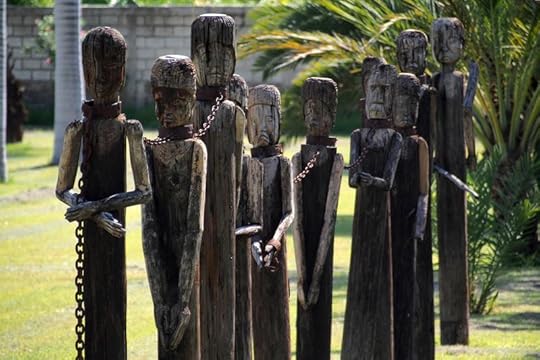
Image: The Slavery Memorial in Stone Town, Zanzibar, United Republic of Tanzania. Far more graphic than Turner’s painting (Source.)
Language
Evaristo’s books before this one were in verse, and “Girl, Woman, Other” has a free and lyrical style, but that wasn’t really evident here. Nevertheless, the language is notable in other ways.
Doris’ voice is… odd. She’s narrating in her 30s, but sounds more like a slightly snarky know-it-all teen, using contemporary colloquialisms - and the occasional insight: “I read these people so well. It’s very easy when you’re invisible.” Given what she’s endured, I’d expect her to be angrier and/or more broken. The slippery time period is also a factor, her sarcastically describing her slave “job” like a 21st century HR report, with “in-service training” and “performance targets” jars, but I guess that’s the joke. “I hadn’t worn a skirt since I’d begun my new career as a slave.”
Then there’s the wordplay: Shepherd's Bush becomes Goatsherd Bush, The Black and White Mistrel Show becomes The Whyte and Blak Minstrel Show, and the West Japanese Islands are misnamed for the same reason as the West Indies were. I know this is meant to be satire, but it’s all so heavy-handed, with gratuitous lists of such things (a Tube map, a list of plays, titles on a bookshelf), then none for several chapters. Places in Londolo are spelt to fit with a contemporary British Afro-Caribbean accent.
Most notably, there’s the patois, widely spoken and spelled phonetically, in the third section. “Don’t tri buk sistem becorze sistem bruk yu down furz… Hush-now. Furz few week bad-bad, den get betta… Sumbuddy wid-a lotta-lotta monee must-a give it her.” Not easy to read at first, but that’s not what bothered me: why is it so very close to Afro-Caribbean patois rather than anything derived from British English, given that’s where the slaves are from? Similarly, the slaves’ church is more like black gospel churches than a hybrid of the Church of England and the beliefs of the slavers in the story. The race-swap sit doesn’t quite fit.
Image: Slavery Memorial in Ogier-Fombrun Museum in Haiti (Source.)
Quotes
• “The palm trees… are tall, sleek, snooty with the deportment of those who grow up balancing the precious milk of coconuts on their heads.”
• “Frank’s dextrous carpenter’s hands roamed so expertly over the contours of my back and limbs that my deadened body was resensitised and reshaped into a work of art.”
• “That soft desert voice… that requires little reverberation to blow across miles of uninterrupted sands.”
• “I was offered a drink called tea which looked like dirty water and tasted like boiled straw.”
• “The humid air draped itself languorously over the surface of my lungs.”
4.5 stars rounded up A clever satire on race and slavery. Evaristo, who is of Nigerian and British descent, generally writes poetry, but this is a novel about the slave trade. It is the slave trade in reverse; in Evaristo’s language the whytes are the slaves and the blaks are the masters and slave-owners. A number of reviewers have complained about time lines, geography and historical accuracy. My advice would be suspend that sort of judgement. This is a satire. It’s not fantasy, but nor has the historical timeline been smoothly switched, Evaristo does play with technological development and settings. Don’t try and work the geography either; just go along with the poetry of the language and the clever and sometimes funny (yes funny) switches. The story revolves around Doris, an English slave captured at the age of ten; we pick up her tale about twenty years later and the timeline loves backwards and forwards. At the start she is an educated slave with some privileges in a wealthy household in Londolo, the capital of Great Ambossa. She makes an escape again, is recaptured, severely beaten and sent to do manual work in a sugar cane plantation. Evaristo works hard to switch all the terms and culture. Whytes are called “wiggers” as a term of abuse. Doris hates the tropical heat and misses the cold, mists and rain of her homeland. She also misses the food, disliking Ambossan food and missing cabbage. Evaristo also switches some patois, usually to good effect. There are also plenty of references to be picked up; “Naturally, having a whyte skin was all the evidence the sheriffs needed to accost a young man and strip-search him”. There is a minstrel show where performers “whtye up”, they “whyte up and do Morris Dancing (yes really!); film adverts for “To Sir with Hate” and “Guess who’s not coming to dinner”. Some very neat satire focusses on brain size; “Over millennia, the capacious skull of the Negroid has been able to accommodate the growth of a very large brain within its structure. This has enabled a highly sophisticated intelligence to evolve.” And of the Europanes (whytes) “The narrowness of the skull denotes a brain that is a bit, as we laymen would say, squashed up”. There are a lot of what ifs and Evaristo weaves in the Maroons, some free working class whytes, slave rebellions, the horrific conditions on slave ships, the sexual exploitation, the selling of slaves and splitting children from families, beatings, poor living conditions: everything would expect. The reversing of geography can be quite inventive; “Slavers had just arrived or were getting ready to set sail for the various coasts of Europa: the Coal Coast, the Cabbage Coast, the Tin Coast, the Corn Coast, the Olive Coast, the Tulip Coast, the Wheat Coast, the Grape Coast, the Influenza Coast and the Cape of Bad Luck.” Evaristo by writing in this way critically engages with the slave narrative and shows its limiting and limited nature. She is disrupting history in order to show the ways the Atlantic slave trade is relevant in a contemporary context. There are also, inevitably because of the title, comparisons that can be made with Alex Haley’s Roots. There are also references to Conrad and Heart of Darkness which are very telling. It was worth ploughing through Conrad for this phrase; “What can I say, Dear Reader, but the horror, the horror…” And it’s very clever placement within the text. The novel is brilliantly counterfactual; the first person narration in the first and third parts adds to the effect. It is fascinating and asks questions that still need to be posed. Evaristo does not quite get all the nuances right, but that is quibbling; it’s a novel that is well worth reading.
When I read this book’s description, I thought: Wow! What a genuinely interesting, creative, and fresh idea for a novel. And Elle Magazine, my barometer for books I’d probably enjoy, praised it. Yet I was disappointed.
The story is slow paced. It alternates between two points of view, the heroine (a white slave girl) and our antagonist (a black slave trader). But for some reason the heroine is dull at best, and the slave trader is witty making for a disturbing debate of whom to root for.
The author must be commended for creating an entirely new world. A world which is complete with made up words and places. Though the attempt is imaginative, the effect is irritating and confusing. I also couldn’t place a timeline for when these events take place…modern day or two hundred years ago? There are arguments for each both. Finally in order to turn slavery on its ear, the author throws every white and black stereotype I can think of at the reader. All of this treads to an abrupt and anticlimactic conclusion proclaiming a tried message; slavery is bad (well duh).
This is an interesting and ultimately quite moving mixture of history and satire. Evaristo's premise is to describe the history of a slave, her family and her owners, with the twist that the roles of Britain and West Africa reversed. This reversal provides the humour, but the details of what slaves suffered are played pretty straight, and without the satire would make for rather a bleak narrative. This was Evaristo's first prose novel - her earlier works were mostly written in verse.
Cosa succederebbe se gli schiavi fossero i bianchi e non i neri? Questo romanzo esilarante è una satira intelligente sulla razza e la schiavitù: una rivisitazione sulla tratta degli schiavi, a parti invertite. Infatti, gli schiavi questa volta sono i bianki (whytes nell'edizione originale), mentre i padroni e gli schiavisti sono i neghri (blaks, nell'edizione originale).
Contrariamente da quello che ho fatto con l'altro libro, con cui ha vinto il Booker Prize nel 2019, "Girl, woman, other" che ho letto in originale (l'ho comprato cartaceo, nell'edizione subito dopo la proclamazione del premio) prima della pubblicazione della traduzione in Italia, stavolta mi sono solo limitata a fare il confronto con alcune parti dell'originale.
“Deep down I knew that the slave traders were never going to give up their cash cow. It was, after all, one of the most lucrative international businesses ever, involving the large-scale transport of whytes, shipped in our millions from the continent of Europa to the West Japanese Islands, so called because when the “great” explorer and adventurer Chinua Chikwuemeka was trying to find a new route to Asia, he mistook those islands for the legendary isles of Japan, and the name stuck.”
“The story went that the Border Landers were involved and so were men called Aphrikans, who were colored blak.”
La potenza creativa della Evaristo deve solo essere assecondata e non analizzata né giudicata. La storia ruota attorno a Doris, una schiava inglese catturata all'età di dieci anni, il cui racconto si riprende circa vent'anni dopo, con la linea temporale che salta andando avanti e indietro. All'inizio è una schiava istruita con alcuni privilegi in una famiglia benestante a Londolo, la capitale della Grande Ambossa. Fugge di nuovo, viene catturata, picchiata duramente e mandata a fare lavori manuali in una piantagione di canna da zucchero.
Notevole è il lavoro della Evaristo che cambia e adatta tutti i termini e la cultura (ecco perché merita di essere letta in originale. Comunque bravissima anche la traduttrice Martina Testa!). Doris odia il caldo tropicale e sente la mancanza del freddo, delle nebbie e della pioggia della sua terra natale. Le manca anche il cibo, non le piace il cibo degli ambossani e il simil-cavolo.
“Vedevo come gli ambossani avevano indurito il cuore di fronte alla nostra umanità. Si erano convinti che noi non provavamo emozioni come loro, e quindi non si sentivano obbligati a provare emozioni per noi. Era un sistema molto conveniente e redditizio.”
Con uno stile scorrevole e una satira pungente, Bernrdine Evaristo porta alla luce tutta la sofferenza del popolo africano, che, nonostante siano passati più di trecento anni, è ancora vittima di pregiudizi e ahimé di fenomeni di razzismo.
“Naturalmente, agli sceriffi la pelle bianka bastava e avanzava come pretesto per fermare un ragazzo e fargli una perquisizione integrale. Quasi tutti i cocchieri venivano fermati e ispezionati dagli sceriffi se circolavano senza passeggeri a bordo, specie quelli di proprietà dei più ricchi, che si permettevano finiture personalizzate come i raggi delle ruote placcati d’oro.”
Affidandosi alla “scienza esatta dell’Antropometria Craniofeciale, disciplina di acclarato valore che misura le dimensioni dei crani, all’interno del rigoroso e stimatissimo campo dell’Antropologia Fisica.”, Bernardine Evaristo irride tutte le tesi pseudo scientifiche, in base alle quali si dichiara la superiorità di una razza rispetto ad un'altra: “È unanimemente riconosciuto che la testa negroide presenta una fronte ampia e prominente, con una regione posteriore voluminosa e rotonda, accompagnata da quello che è stato definito prognatismo della mascella (mascella sporgente). Nel corso dei millenni, il capace cranio del negroide ha potuto ospitare al suo interno la crescita di un cervello assai grande. E ciò ha consentito l’evolversi di un’intelligenza altamente sofisticata. Inoltre, il prognatismo stesso della mascella denota determinazione di carattere e un forte senso dell’obiettivo. La conformazione del cranio negroide ha dunque prodotto i seguenti tratti: ambizione, motivazione personale, ingegnosità, autodisciplina, coraggio, integrità morale, illuminazione spirituale e responsabilità collettiva. Va altresì notato che, per via della sua posizione nella scala evolutiva, il Negro è anche assai Sensibile e capace di Grande Profondità di Sentimento. Inutile dire che l’Antropometria Craniofeciale dimostra che il Negro è biologicamente superiore alle altre due tipologie. Anzi, mentre il Negro appartiene alla «Specie Umana», il Mongolo e il Caucaside rientrano in una definizione più ampia di «Genere Umano», che va dalla «Specie Umana» pienamente evoluta a specie meno evolute classificate come «Neo-Primati»."
Non solo. Se gli uomini di razza bianca fossero così intelligenti, come si dichiara nelle tesi della supremazia della razza bianca sulle altre, non si sarebbero mai sognati di inventare le razze: “Il cranio caucasidoide, viceversa, è purtroppo destinato ai gradini più bassi della scala del Genere Umano. È lungo, stretto e posteriormente piuttosto squadrato, e presenta ortognatismo della mascella (minore sporgenza). Questa tipologia di cranio contiene un cervello di dimensioni molto più limitate, che non ha potuto espandersi oltre i limiti della sua calotta. Inoltre, la scarsa ampiezza del cranio denota un cervello che è un po’, come diremmo noi profani, striminzito.”
Il romanzo è scritto in modo tale che costantemente interroga il lettore sui suoi modi di pensare e di agire, per stanare tutti i pregiudizi, anche quelli più sottaciuti, e lo fa sempre regalando un sorriso, anche se amaro.
“Yu iz we sunshine We onlee sunshine. Yu mek we happee When skies iz grey. You neva know, Bwana How much we loves yu. Please don’t tek we sunshine away.”
“Tu sei il nostro sole / Il nostro unico sole. / Ci fai felici / Quando il cielo è grigio. / Non saprai mai, Bwana / Quanto ti amiamo. / Per favore, non toglierci il nostro sole»: è il testo, riadattato, di «You Are My Sunshine», una canzone popolare statunitense. [n.d.t.]”
My only complaint about Bernardine Evaristo's alternate history of racial slavery is that it's 150 years late. Imagine the outrage this clever novel would have provoked alongside Harriet Beecher Stowe's incendiary story or Frederick Douglass's memoir! But now, amid the warm glow of 21st-century liberalism, with our brilliant black president, what could we possibly learn from a new satire of slavery?
Plenty.
Blonde Roots turns the whole world on its nappy head, and you'll be surprised how different it looks -- and how similar. In the reverse-image past that Evaristo imagines, civilized Africans have built a vibrant culture and economy by capturing primitive Europeans and using them as slaves. This ingenious bit of "what-if" speculation provides the backdrop for a thrilling adventure about a "whyte" woman named Doris Scagglethorpe who works as a "house wigger" for Chief Kaga Konata Katamba. (She's branded with his initials: KKK.)
The story dashes off the first page as Doris makes her escape during the annual celebration of Voodoomass. Recapture could mean death by torture for "the crimes of Ungratefulness and Dishonesty," but she's done waiting for freedom. "Deep down I knew that the slave traders were never going to give up their cash cow," Doris tells us. "It was, after all, one of the most lucrative international businesses ever, involving the large-scale transport of whytes, shipped in our millions from the continent of Europe to the West Japanese Islands, so called because when the 'great' explorer and adventurer Chinua Chikwuemeka was trying to find a new route to Asia, he mistook those islands for the legendary isles of Japan, and the name stuck."
Historical anachronisms along with a weirdly distorted geography contribute to the novel's through-the-looking-glass atmosphere. As a rare literate slave, Doris enjoys a privileged position in her master's house, but she snatches a chance to ride Londolo's Underground Railroad -- the city's abandoned subway system -- out of the glamorous "Chocolate City" and into the seedy "Vanilla Suburbs." As we follow her perilous escape, Doris tells us how she was abducted from a poor English cabbage farm where she lived with her parents. She describes the gruesome Middle Passage, during which half her fellow captives expire or are murdered; the vicissitudes of the slave market, where traumatized family members are sold off in different directions; and the rape and humiliation that keep whyte people laboring on the sugar cane plantations. This is, in other words, a story whose basic elements we already know from Douglass, Harriet Jacobs, Stowe, Alex Haley, Toni Morrison and others whom Evaristo alludes to throughout Blonde Roots, but even the most colorblind readers will be unsettled by seeing these horrors with the colors reversed.
As always, the values of the dominant culture reflect its power structure; the black master's body and attitudes are the desired norm, even the ideal. "Privacy was a foreign concept to all Aphrikans," Doris says. "They said that the Europane need for solitude was further proof of our inferior culture." An expert explains that "over millennia, the capacious skull of the Negroid has been able to accommodate the growth of a very large brain within its structure. This has enabled a highly sophisticated intelligence to evolve." Are you listening, James Watson?
Standards of attractiveness are similarly upended. Whyte people try to tan themselves into black beauties, and those who can afford it have surgery to flatten their noses. After giving Doris a proper name -- "Omorenomwara" -- her African owner expects her to look respectable, which means wearing her straight blonde hair in plaited hoops all over her head and going barefoot. And topless. As a "fully paid up member of the most loathed race in the history of the world," Doris admits that she has "image issues." Every morning she secretly repeats affirmations that some whyte Steve Biko must have preached: "I may be fair and flaxen. I may have slim nostrils and slender lips. I may have oil-rich hair and a non-rotund bottom. I may blush easily, go rubicund in the sun and have covert yet mentally alert blue eyes. Yes, I may be whyte. But I am whyte and I am beautiful!"
The daughter of an English mother and a Nigerian father, Evaristo is a poet whose previous three novels were written in verse. This time, although she's writing in the colloquial speech of her narrator, she's still extremely attentive to the function of language, the power of words to shape reality. Blonde Roots is spiked with witty cultural references that detail the pervasiveness of racism. As she flees, Doris passes advertisements for "Guess Who's Not Coming to Dinner" and "To Sir With Hate." She describes popular minstrel shows in which performers in whyte-face "sang out of tune in reedy voices, their upper lips stiff as they danced with idiotic, jerky movements . . . singing music hall songs about being lazy, lying, conniving, cowardly, ignorant, sexually repressed buffoons."
Evaristo has even reversed the dialects, forcing us to struggle with the plantation whytes' thick patois the way we have to wade through the Nigger Jim's speech in Huck Finn: "Sundays him carve tings fe folk in de quarter an don't charge nuttin but just aks to join famlees fer dinner." Trying to cheer themselves, the slaves sing the old spirituals of their homeland: "Shud ole akwaintaince be forget/An neva bring to mind/Should ole akwaintance be forget/An ole lang zine."
In the middle of Blonde Roots, Evaristo drops in a 50-page essay written by Doris's owner: a "modest & truthful" defense of "The True Nature of the Slave Trade." It's a masterful bit of satire, with a sarcastic nod to Conrad's Heart of Darkness. Breathtaking in its self-pity, self-justification and self-satisfaction, this faux memoir is full of the scientific rationales, cultural insights and moral gymnastics that buttressed 19th-century slavery and remain handy for justifying 21st-century liberations of less civilized nations.
In a moving final section that keeps the excitement pounding till the last page, Doris describes the devastating effects of racism on whyte families: fathers turning violent and oversexed; young men devolving into thugs and ignoring the noble models of their ancestors; women working to death, raising children they know they'll soon lose. The whole story is a riotous, bitter course in the arbitrary nature of our cultural values. Don't be fooled; slavery might have ended 150 years ago, but you've still got time to be enlightened by this bracing novel.
Critics would have you believe that Ms. Evaristo has written an "astonishing," "clever," and "beautiful" novel about an alternative history scenario to the slave trade.
Every morning I'd repeat an uplifting mantra to myself while looking in the mirror. I may be fair and flaxen. I may have slim nostrils and slender lips. I may have oil-rich hair and a non-rotund bottom. I may blush easily, go rubicund in the sun and have covert yet mentally alert blue eyes. Yes, I may be whyte. But I am whyte and I am beautiful.
Slaves are also referred to as wiggers. I just felt gross writing that.
I get satire but this just felt uncomfortable & wrong.
Finalmente terminei o *Raízes Brancas* e não foi uma leitura muito interessante. Sei que o livro tem valor ao inverter a escravatura e, por isso, chamar a atenção para o tema mas falta qualquer coisa. É uma distopia um pouco estranha e não se percebe bem quando ocorre mas parece ser na Idade Média e num mundo com uma configuração diferente do nosso.
I really love the concept of this book. Reality switched upside down.
Doris (a white woman) was minding her own business in her sleepy English cottage when she was kidnapped, shipped off, and sold into slavery to serve Black people.
What a premise!
This book takes all the justifications for slavery and racism and turns them onto white people along with a slice of satire, and silliness really shows how ridiculous (and arrogant) us whites are.
This is a real 'it's me not you' situation, as much as I like satire on screen, in books it rarely works for me.
I liked this, but I'd hoped to love it.
Three stars.
PS - I don't understand the strawberry blonde thing either.
There were parts of this that I really enjoyed and found both thought-provoking and unexpectedly funny at times (I sincerely hope certain aspects of this were meant to be read as humorous) but there were also extended periods where my focus drifted entirely and I had to rewind the audiobook and force myself to pay attention. For me there was a fairly equal balance between these two feelings, a three star rating for a book that felt at various times a two star read as well as a four.
I did enjoy many aspects of Bernardine Evaristo's writing, and will be reading more of her novels in the hope that I will click with one of them. If I do, I may reread this one in the future, as a physical book. I enjoyed the audio performance, but the trouble with having your mind wander with an audiobook is it harder to locate the point where you lost track.
I preferred Chief Kaga Konata Katamba's chapters as he was a more interesting character than Doris. Doris had my sympathy, but only held my interest fully in the final third of the book, especially the last chapters. The narrators of both characters were very good, and their voices felt well suited.
Doris Scagglethorpe, the daughter of a cabbage farmer, was ten years old when she's captured by slavers. Now twenty years later, she's trying to escape.[return][return]This is an interesting premise. Blacks (or blaks, as they are inexplicably called in the book (more on that later)) are the dominant race and whites (whytes) are the ones enslaved. It's not an alternate history, nor is it a fantasy set in another world. I'm not really sure what it is, or what it wants to be, and that was the problem for me.[return][return]To start with, from the very first page it seems like the author has just gone through and done a search and replace, like the blaks celebrating Voodoomas as their main holiday, or whytes being derogatively referred to as wiggers. Neither of these make sense! Wigger can only exist as a word if nigger exists, which of course it doesn't in this universe. And why would their celebration be Christmas with "voodoo" pasted on? (The suffix mas comes from mass!) The book is full of stuff like this and it made my head hurt at least once every page or so.[return][return]The other eye-twitchy, headache inducing thing was the world. It's sort of kind of our world, except geography is randomly different (and I don't mean place names, but actual continents and stuff are not the same shape). Stuff is randomly spelled oddly, like whytes and blaks. It makes no sense at all. There's also the technology and...culture, I guess. Like, it's historical mixed with modern. They have carriages and ships, but there's also the Tube under London (Londolo). They have plantations and yet the kids shop at Hot Topic-esque boutiques. The fashions of the Europeans are from hundreds of years ago, yet Doris says that her physique, stick skinny so her bones show, is the height of beauty. [return][return]I just...don't like it! It's all done like a joke and so haphazard. It reads like the kind of fanfic that people label crack because they just want to toss in whatever they think is funny without a care for whether it makes sense to the story. I don't like that sort of fanfic, and I don't like it any better in this book. It just makes my brain go crazy and I can't enjoy the story because I'm getting irked by all the ridiculous inconsistencies every other page.[return][return]As for the story itself...it offered nothing new except the idea of the white/black switch, which I didn't find to be done well. If you've read any accounts of slavery, you won't find anything new or different here. It was a real disappointment.
I didn't understand the point of this book. Ordinarily, I don't worry about the point of a book; most of them are written simply because the author had an idea for a story and they wrote it down. And, that is probably the case here, but the author took something that is known, well-known, and twisted it for her own purposes and I don't know what those purposes are/were.
This is a story about the slave trade. But, instead of Africans being captured and sold into slavery, Europeans were. The main African slave trader in the story gives the same reason for enslaving Europeans as was given for enslaving Africans in real life; less than human, no culture, doing them a favor, etc. In fact, in describing much of the European slave experience, the author borrowed from documented African slave experiences. But, why? What was the point?
I mean, who is the audience for this type of book? Are there still people who can't understand the horrors of slavery because it happened to Africans and not them? Is it a sort of "torture porn" for those who'd like to read about Europeans being whipped and raped for once? I honestly don't know why this book was written - it's not clever, it's just pointless.
Additionally, the author adds a bunch of anachronistic nonsense that makes the book even harder to read. There is a map at the front of the book that shows Aphrika as north of the equator and Europa to the south; essentially, the African and European continents are swapped for this story. Which is fine... except that the author still has Aphrika being hot, humid and jungle-filled. And equatorial Europa? Well, it's freezing. Also, she vacillates between being "historically" accurate with the two civilizations and just throwing in a bunch of modern stuff. The Europeans wear woolen stockings, hoop skirts and the like and the Aphrikans wear loincloths and draped fabric and headdresses, but there are also Barbee dolls, skateboards, and possibly malls. It's rather jarring and fairly irritating to have this sort of thing thrown into a book.
Η Evaristo φέρνει τα πάνω κάτω σε όσα ξέραμε για την κυριαρχία των λευκών, τη σκλαβιά και την κακομεταχείριση των έγχρωμων, αλλά και τον κόσμο τον ίδιο. Μέσα από μια εναλλακτική πραγματικότητα, τονίζει όλα τα λάθη που κάναμε σαν ανθρωπότητα, όλο το κακό που προκαλέσαμε σαν Καυκάσια φυλή με την απληστία, την αλαζονεία και την υπεροψία μας.
Σε μια ανεστραμμένη κοινωνία, οι ισχυροί του κόσμου είναι οι έγχρωμοι ή αλλιώς μάβροι της Αφφρικής, που χωροταξικά, βρίσκονται στο σημείο που υπάρχει η Ευρώπη στον κόσμο μας. Κάτω από την Αφφρική υπάρχει η Ευρώπα που κατοικείται από τους ασπρουλιάρηδες, τους Καυκασόι, μια κατώτερη μορφή του ανθρώπου. Οι Καυκασόι, ζουν σε μια γκρίζα ήπειρο, ντύνονται πολύ και πολεμούν πολύ. Πολεμούν μεταξύ τους. Για πιο λόγο; Κανείς δεν ξέρει! Όμως αυτό δεν είναι πρόβλημα για τους πολιτισμένους ανθρώπους της Αφφρικής. Το κάνει απλά πιο εύκολο για εκείνους να τους αιχμαλωτίσουν και να τους πουλήσουν για σκλάβους. Είτε στην Μεγάλη Αμπόσα, είτε στο Ηνωμένο Βασίλειο της Μεγάλης Αμπόσα. Φθηνά εργατικά χέρια είναι πάντα καλοδεχούμενα και οι σκλάβοι δεν κοστίζουν τίποτα, παρά μόνο τα χρήματα της αγοράς τους. Το εμπόριο σκλάβων ανθίζει και άνθρωποι σαν τον Μπουάνα το εκμεταλλεύονται και πλουτίζουν από αυτό.
Η Αγγλίδα Ντόρις είναι μόλις έντεκα χρονών όταν την απαγάγουν και την πουλούν σαν σκλάβα. Μέχρι τότε ζούσε μια ήσυχη ζωή με την οικογένειά της, μια ζωή αγροτών, όπως τόσες και τόσες άλλες. Μπορεί να μην ήταν πλούσιοι, είχαν όμως ο ένας τον άλλο και η Ντόρις είχε τις αδερφές της. Μέχρι τη μέρα που η ζωή της άλλαξε. Αρπάχθηκε από κάποιον και πουλήθηκε σε κάποιον άλλο. Μεταφέρθηκε στο αμπάρι ενός πλοίου και με εκατοντάδες άλλους σκλάβους ταξίδεψε μέχρι τη γη των αφεντάδων. Έμαθε τη γλώσσα τους, μιας και δεν είχε άλλη επιλογή, αλλά έμαθε και γραφή κι ανάγνωση μαζί με το κοριτσάκι για το οποίο την είχαν αγοράσει. Δουλειά της ήταν να κάνει παρέα στο κοριτσάκι με τον όνομα Μικρό Θαύμα. Όταν το κοριτσάκι πέθανε, την πούλησαν σε άλλη οικογένεια. Όμως ποτέ δε σταμάτησε να ονειρεύεται την ελευθερία. Το δρόμο για το σπίτι και τη ζεστή αγκαλιά της οικογένειάς της.
Ο Μπουάνα ήταν αυτός που αγόρασε την Ντόρις από την οικογένεια του κοριτσιού. Κι επειδή είχε γνώσεις σπάνιες για σκλάβα, της έδωσε μια θέση που κανένας σκλάβος δεν είχε μέχρι τότε. Η Ντόρις έγινε ένα είδος γραμματέως με γνώσεις λογιστικής, που ουσιαστικά κρατούσε το γραφείο και τις υποθέσεις του Μπουάνα, όσο αυτός της το επέτρεπε. Θεωρητικά, ήταν σε πολύ καλύτερη θέση από άλλους σκλάβους. Είχε πάντα στέγη και φαγητό και δεν πέρναγε τα βασανιστήρια που γονάτιζαν τους άλλους σκλάβους. Ακόμα κι έτσι όμως, όταν της δόθηκε η ευκαιρία, προσπάθησε να το σκάσει προς την ελευθερία.
Η Evaristo χρησιμοποιεί σημαντικά στοιχεία από τη ζωή και τα δεινά των σκλάβων, ώστε να τραβήξει την προσοχή του αναγνώστη και να του θυμίσει, αν τυχόν το ξέχασε, ότι σκοπός της δεν είναι να βγάλει το άχτι της στους λευκούς για όσα πέρασαν και συνεχίζουν να περνούν οι έγχρωμοι, αλλά ότι δεν πρέπει να ξεχνάμε τι έχουμε κάνει, μπας και καταλάβουμε ότι πρέπει όλο αυτό επιτέλους να τελειώσει. Γιατί ναι, μπορεί η απελευθέρωση των σκλάβων να έχει γίνει εδώ και πολλά χρόνια, μπορεί ο φυλετικός διαχωρισμός να μην υπάρχει πλέον στα χαρτιά, όμως ο φυλετικός ρατσισμός δεν έχει εξαλειφθεί. Ένα χαρακτηριστικό στοιχείων της ιστορίας που αναφέρει, είναι ο Υπόγειος Σιδηρόδρομος, που ενώ στην πραγματικότητα ήταν η ονομασία ενός κρυφού δικτύου διαφυγής των σκλάβων, στην ιστορία που διαβάζουμε εδώ, είναι ένας πραγματικός σιδηρόδρομος που εξυπηρετεί αυτόν ακριβώς τον σκοπό.
Ένα από τα περίεργα στοιχεία που ίσως διαπιστώσει κανείς είναι ότι, ενώ ο κόσμος είναι ανεστραμμένος, τουλάχιστον όσον αφορά την Ευρώπη και την Αφρική, το Ηνωμένο Βασίλειο και το Λονδίνο παραμένουν στη θέση τους, ή περίπου. Γιατί ουσιαστικά, η Ευρώπα είναι πιο κάτω από τον ισημερινό, η Αφφρική είναι εκεί που βρίσκεται η σημερινή Αφρική, οπότε το κλίμα των δύο ηπείρων δεν αλλάζει σε σχέση με όσα γνωρίζουμε. Όμως το Ηνωμένο Βασίλειο της Μεγάλης Αμπόσα παίρνει τη θέση της Βρετανίας και αντί να βρίσκεται πάνω από την ηπειρωτική Ευρώπα, βρίσκεται στα αριστερά της Αφφρικής, εκεί περίπου που βρίσκονται τα σημερινά Κανάρια Νησιά. Ομοίως, πρωτεύουσα του Ηνωμένου Βασιλείου είναι το Λόντολο, παράφραση του σημερινού Λονδίνου. Πιστεύω πως αυτή η τοποθέτηση της Βρετανίας, στο ρόλο δηλαδή των κυρίαρχων λαών, των δουλεμπόρων, έχει πιο πολύ να κάνει με την καταγωγή της Evaristo. Μην ξεχνάμε ότι η συγγραφέας έχει Βρετανική και Νιγηριανή καταγωγή, ζει και εργάζεται στη Βρετανία. Τα δύο μισά της καταγωγής της είναι πιστεύω που συγκρούονται και την ωθούν να τα εξερευνήσει περισσότερο.
Ένα βιβλίο εναλλακτικής ιστορίας, αν θέλετε, από την πολυαγαπημένη Bernardine Evaristo, όπου οι μαύροι είναι οι δουλέμποροι που καταδυναστεύουν τους λευκούς, τους κάνουν την ζωή αφόρητη, τους συμπεριφέρονται σαν να μην είναι άνθρωποι, τους πουλάνε και τους αγοράζουν όποτε τους συμφέρει. Μέχρι και την γεωγραφία φέρνει τούμπαλιν η συγγραφέας, κρατώνατς όμως τον ρόλο του Ηνωμένου Βασιλείου στο δουλεμπόριο το ίδιο βαρύ όσο ήταν στην πραγματική ζωή. Βρίσκω την ιδέα αυτή, όπως και την εκτέλεσή της, απολύτως πετυχημένη. Σε βάζει συνεχώς σε σκέψεις όσον αφορά το "white privilege" σου που πολλές φορές ξεχνάς ότι έχεις καν. Το πιο σοκαριστικό για μένα, μάλιστα, ήταν πως πολλές φορές ξεχνιόμουν και στο μυαλό μου είχα την εικόνα της πρωταγωνίστριας λανθασμένα ως μαύρης, τόσο εντυπωμένη είναι στην συνείδησή μου πως αυτοί οι άνθρωποι υπέστησαν δουλειά, τόσο παράξενο μου φαινόταν το κόνσεπτ ότι λευκοί μπορεί να βρίσκονταν σε αυτή την θέση. Γιατί όμως; Έλα ντε! Είναι αρκετά εμφανές, επίσης, πως το εν λόγω βιβλίο γράφτηκε πριν από το "Κορίτσι, Γυναίκα, Άλλο", μιας και η συγγραφέας μιλαέι μεν γλαφυρά, αλλά όχι ακόμα τόσο λυρικά όσο στο bestseller της και καλό είναι να μην τα συγκρίνουμε αυτά τα 2 βιβλίο, είναι κρίμα και άδικο για την ίδια την συγγραφέα. “We slaves don't end relationships. Other people do it for us. Often we don't start them either, other people do it for us. We're encouraged to breed merely to increase the workforce.”
Currently situation: it's too complicated... μ αρεσε κ δεν μ αρεσε. Υπηρχαν μερη που αγαπησα, μερη που με αφησαν αδιαφορη, μερη που σκεφτηκα παρα ειναι ευτυχες το γεγονός, μέρη που αναρωτιομουν πού κ πότε βρισκομαι... αλλα οκ. Οποτε κρατήστε οτι ειναι ενα ενδιαφερον βιβλιο κ διαβαστε το! Δεν θα ζημιωθείτε... μπορεί να εχετε την ιδια αισθηση με μενα αλλα κ παλι θα πειτε ωραιο ηταν!
2,5* A premissa do livro é muito boa (uma escravatura ao contrário, em que os brancos são os escravizados) e as primeiras páginas prometem... Só que a promessa não se cumpre. A partir de um determinado ponto, a história perde-se. A voz do "dono de escravos" é desnecessária, nada acrescentando. O final é uma acumular de coincidências abruptas. Tenho de pena, mas este não ficará na memória.
One of the poorest written books I've read in a while. For good writing and well thought out world building on this topic, read Steven Barnes's 'Lion's Blood' and 'Zulu Heart' instead.
Έχοντας διαβάσει την αυτοβιογραφία της κι ακούσει την ίδια να μιλάει για το έργο της, μελέτησα το μυθιστόρημα αυτό με μια διαφορετική ίσως ματιά.
Γεννημένη με ρίζες ξανθές και μαύρες, από Αγγλίδα μητέρα και Νιγηριανό πατέρα, βίωσε τον φυλετικό ρατσισμό ακόμα κ' στο οικογενειακό της περιβάλλον, με αποτέλεσμα να έχουμε σήμερα στα χέρια μας το πρωτότυπο αυτό έργο.
Η συγγραφέας επέλεξε ν' αντιστρέψει το νόμισμα που κατά τύχη έδειξε κάποτε κορώνα.
Η ιστορία αυτή τη φορά θα ειπωθεί αντίστροφα. Ίσως έτσι οι λευκοί κατανοήσουν τον πόνο που προκάλεσαν σε εκατομμύρια ανθρώπους, ίσως αντιληφθούν το βάρος που κουβαλούν από τις πράξεις των προγόνων τους κι ίσως αποδεχτούν το αδιανόητο, ότι δηλαδή ακόμη και σήμερα, τα περιστατικά βίας εις βάρος των "άλλων" δεν έχουν εξαλειφθεί.
Η ίδια καυτηριάζει, έξυπνα, χωρίς καμιά επιτήδευση, τη γυναικεία καταπίεση, τις απάνθρωπες συνθήκες διαβίωσης των σκλάβων, τη δύναμη της κουλτούρας να καθορίζει ακόμη και τα πρότυπα ομορφιάς, τη διαφορετική αντίληψη του κόσμου ανάλογα με τον τόπο που γεννιέται καθένα από εμάς. Υπογραμμίζει, μάλιστα, την ανάγκη των ανθρώπων να μοιάζουν σε αυτό που θεωρείται κοινωνικά αποδεκτό ανάλογα με τον τόπο και τον χρόνο.
Το βιβλίο χωρισμένο σε τρία μέρη, στρέφει το φακό ποτέ στους σκλαβωμένους λευκούς ποτέ στους μαύρους δυνάστες, ποτέ στους λευκούς που πρόδωσαν τους δικούς τους ανθρώπους.
Με πάμπολλες ιστορικές αναφορές, χλευάζει τις αυθαίρετες απόψεις σχετικά με την γενετήσια υπέροχη των λαών, ενώ ταυτόχρονα υπογραμμίζει, με έντονα ειρωνική διάθεση, τα εγκλήματα που διέπραξαν «πολιτισμένοι» Ευρωπαίοι.
Πρόκειται για το δικό της κοινωνικοπολιτικό σχόλιο σε έναν κόσμο άνισο, που οι ιμπεριαλιστικές τακτικές όρισαν -και δυστυχώς ορίζουν μέχρι και σήμερα- τις ζωές ανθρώπων ανάλογα με το χρώμα, το φύλο, το γένος, την τάξη.
Με την ιστορία της αυτή υπογραμμίζει το τυχαίο γεγονός της ύπαρξής μας, της γεννήσεώς μας στην πλευρά των ευνοημένων.
Όχι, δεν είναι το πιο δυνατό της "παιδί". Αξίζει, όμως, να διαβαστεί και να συζητηθεί.
Καθώς το διάβαζα στο μυαλό μου ερχόντουσαν εικόνες μαύρων σκλάβων..κι αυτό δεν το θεώρησα αποτυχία της Evaristo αλλά αποτυχία της ανθρωπότητας.
Πολλές φορές σκέφτομαι "Τι θα γινόταν αν είχα γεννηθεί στην τάδε χώρα;" "Πώς θα ήμουν αν δεν ήμουν μετανάστρια;" "Πώς θα με αντιμετώπιζαν αν το δέρμα μου είχε άλλο χρώμα;" Οποία απάντηση και αν έρθει, δεν θα μάθω ποτέ πραγματικά πως θα ήταν.
Η Evaristo, μας δίνει ένα ευφυέστατο βιβλίο, γεμάτο παραλληλισμούς και συμβολισμούς. Θίγει την δουλεία με έναν μοναδικό τρόπο.
Αντιστρέφει την ιστορία: οι Ευρωπαίοι είναι αυτοί που υποτάσσονται και αναγκάζονται να εργάζονται στις φυτείες. Ακολουθείτε τη μοίρα της Ντόρις και των ιδιοκτητών της. Ονειρεύοντας μια δική της ζωή, προσπαθεί να ξεφύγει, τόσο ψυχικά όσο και σωματικά. Οι χαρακτήρες και τα συναισθήματά τους είναι ανεπτυγμένα στον υπέρτατο βαθμό. Δίνει ζωντανές περιγραφές. Ενίοτε αποτρόπαιες. Ωστόσο, αναγκαίες!
Είναι από τα βιβλία που μόλις το ολοκληρώνεις, σκέφτεσαι ότι ίσως είναι ένα από τα πιο σημαντικά βιβλία που έχεις στην κατοχή σου. Ένα από εκείνα, που όσες φορές και αν τα διαβάσεις, θα σου δώσουν ένα νέο νόημα, έναν νέο παραλληλισμό, μια νέα πραγματικότητα! Είναι δύσκολο να σε ταρακουνήσει και να σε παρασύρει ένα μυθιστόρημα ταυτόχρονα.
Δεν ξέρω αν τα έγραφε με πικρία ή με σατιρικό ύφος. Θέλω να πιστεύω ότι ισχύουν έστω και λίγο και τα δύο. Είναι ένα πολύ καλό, συγκινητικό και πνευματώδες μυθιστόρημα για ένα θλιβερό, αλλά σημαντικό θέμα.
Romanzo ucronico nel quale l’autrice immagina “cosa sarebbe accaduto se…” lo schiavismo fosse stato perpetrato dagli Africani nei confronti degli Europei, o meglio, come scrive lei, dai Nehri verso i Bianki. Ma cosa sarebbe accaduto è facile da capire: invertendo l’ordine dei fattori il risultato non cambia.
Doris, la giovane diafana protagonista bionda subirà tutti gli affronti, le costrizioni e le violenze possibili (e oramai purtroppo tutte immaginabili) insieme ai rappresentanti della sua ‘razza’. Dunque: il potere è sempre subdolo, prevaricatore, cieco e ignorante. La sofferenza è sempre odiosa e terrificante. Il valore imprescindibile dell’essere al mondo è, oltre alla vita, la libertà senza quale non possiamo dirci degni di essere chiamati umani.
Il tono è satirico, e forse questo è il limite del romanzo: il rischio di scivolare nel macchiettistico, con l’intenzione forse di strappare qualche (amaro) sorriso.
A little bit of cleverness goes a long way. Too much -- jumbled anachronism, twisted geography, transplanted London place names, and a literal Underground Railway (hah!) -- makes a supposedly thought provoking novel more like a spin through a clever blog.
The central race flipping premise isn't thought out. It wobbles between crude stereotypes and simple re-hashing of other people's books about slavery. Reading it so soon after the Book of Night Women, an entirely passionate, serious, heartrending and hair raising book about Caribbean slavery, this too clever by half superficial retread especially grated.
ARGH, this book is seriously not okay. I felt so unbelievably uncomfortable reading it, there was no point or intelligence behind the decision to reverse the slave trade - all the message seemed to be was poor whites look how mean black people are?!?!? And if this is the only way for white people to feel bad about or understand the slave trade then that's repugnant and we need to wake the fuck up.
What if Africans had been the ones to enslave Europeans instead of the other way around? That’s the premise Evaristo uses to launch this harrowing alternate history, which in general does a fantastic job shedding fresh light not just on the horrors of slavery—which, even if we are all generally aware of them, it can never hurt to be reminded of in stark, brutal, specific detail: people did these things to other people—but also on slavery’s ongoing ripples and aftereffects, exposing the very white, Eurocentric way we may still consider the natural way to view the world.
When Evaristo sticks to these aspects of her story, I think it works amazingly well; however, she makes some odd auxiliary choices. There’s a map at the beginning of the book that physically alters the way Earth’s continents are arranged, putting Europe where Africa is, and part of Africa where Europe is, but leaving the British Isles alone, so Londinium is one of the great seats of power of the African Empire, but it still has its Roman name—why? Europe is described as cold and grey, and Africa balmy, as if they were still located in their usual hemispheres—huh? And to confuse things further, at times Evaristo seems to be setting her story in the 18th or 19th centuries, when comparable events took place in our history, but there exist aspects of technology that are utterly modern—her protagonist escapes at one point on an Underground Railroad that is literally the London Underground. I found all of this incredibly confusing and needlessly distracting. Why complicate things so? To me it seems completely unnecessary—just off-putting.
Anyway, if you can manage to handwave Evaristo’s seemingly bizarre world-building decisions—as I was eventually able to do—this is well-worth reading. And if you can explain to me the purpose behind said decisions, I would love to hear your theories!
Blonde Roots is set in a parallel universe, where African, not European, cultures use shipping and weapons technology to create colonies in the Americas and the Caribbean, and to kidnap millions of people and enslave them to work on sugar plantations. Residents of the Atlantic coastal fringes of Europa - the English, Irish, Spanish, Portuguese, and Scandinavians - are particularly at risk of being stolen away from their families, regardless of rank or priviledge, and crammed into slave ships bound for the New World. The reader knows from the outset that this is not alternate history of our own universe, because the author has included a map showing Aphrika in the North, Europa in the South, and the Caribbean islands unchanged, but renamed the West Japanese Islands.
The idea is interesting, and has been explored by other authors (such as Mallory Blackman, in whose Noughts and Crosses series it is taken for granted that the dominant culture is that of black people, and white people are treated as inferior). Unfortunately, in White Roots the execution of the idea is rather muddled and extremely illogical. For a start, why is there any need to have altered geography? The slave/sugar trade triangle could just have easily worked with geography unchanged, but Africa as the pivotal point of power. Linguistically, the novel is very puzzling; the slaves speak a kind of Patois, but the author seems to assume that in the White Roots universe there would be little difference from real life Caribbean Patois. We are repeatedly told that the slaves are from a mixture of European countries, and logically therefore the Patois would be an blend of Abrossan combined with elements of grammar and vocabulary from Germanic and Hispanic European languages, but there is no evidence of this at all, and we get a phonetic representation of what sounds to me like contemporary Jamaican patois. Even when two slaves discover that they are from the same country, they do not speak their native language together - even when this is English.
Most puzzling of all is the question of when the novel is supposed to be set. Various pointers (not least the "what happened next" postscript) suggest the early twentieth century at the latest; the slave ships appear to be sailing boats, and there is no electricity, although there is a disused Londolo Underground. The turns of phrase used by high status Aphrikans echo 18th or early 19th century real life discourse on slavery, and the Europeans clearly operate a system of workers on land-owners' estates. Yet characters use skateboards; they "airpunch"; and the young male Whyte slaves call themselves names such as "Bad Bwoy" or "Totallee Kross." Evaristo appears to be trying to cram current issues of identity and social exclusion among black youth in modern day Britain or America into a analysis of 18th/19th century attitudes to race and colonialism, and it simply doesn't work.
It's a pity, because there are sections of the novel which are much more thought-provoking, but these are lost in the overall lack of logic. Book Two, in which Chief Kaga Konata Katamba gives us his memoirs of his first trip to the Heart of Darkness which is the Cabbage Coast, and describes his first encounters with the backwards-seeming natives of England, is well done. It reminded me somewhat of Body Ritual Among the Nacirema in its ability to dismantle our own cultural assumptions with the eye of the outside, and I couldn't help feeling that had the novel as a whole been writted in this vein, it would have been much harder-hitting.
Overall, however, if you want to read about the real horrors of slavery from the point of view of a slave woman, I'm afraid you are much better off grabbing a copy of Andrea Levy's The Long Song.
I would actually give this book 4.5 stars if I could. The main reason I don't give it a full 5 stars is because I had a hard time with understanding some of the world building. There were some technologies of our modern world they seemed to have, but not others so I felt a bit lost trying to figure out where and when to place this in my mind.
I did like how she mixed in cultural things that people would be able to identify as from somewhere in Europe or somewhere in Africa, so that when she turned the tables and blaks where those in power and enslaving whytes, it makes many readers really think and become aware of prejudices they may not have consciously thought about before. I think this book could be a great way to start so many different conversations.
Content Warnings: rape, physical abuse (though maybe torture might be more appropriate feeling in certain scenes), slavery, racism
Ευρηματικός ο τρόπος που δείχνει τη δουλεία από την πλευρά των λευκών. Ωραία η γραφή της αλλά η πλοκή του δεν ήταν κάτι το ιδιαίτερο. Κοινώς βαρέθηκα! 2,5 τα αστεράκια
This was a heartbreaking read that was interesting and insightful. This book reverses the slave trade as in it white people are the slaves and black people are the masters. It mainly follows the POV of Doris who is a slave after being kidnapped as a young child. She has had three children but all of them were taken away from her after their births. Doris is trying to escape and make it back to her homeland but she gets caught and taken back into slavery. The POV we get is from one of Doris's masters who is trying to justify why he put Doris back into slavery and also a fact that he's a slave owner. This book is heartbreaking and sad because of its subject matter and I found parts of it hard to read because of this. Unfortunately so many people have experienced/are experiencing slavery and that makes this book even more heartbreaking because of the largely hidden realities that it shines a spotlight on. If you want to read a sad and powerful story I would recommend this book. The reason it's not above a 3 star read for me is because it's not what I would normally read and I didn't really connect to it for the most part.